10 Steps to Build a Long-Term Financial Plan That Can Grow With You

10 Steps to Build a Long-Term Financial Plan That Can Grow With You | MoneyOnliners
MoneyOnliners • Financial Planning → Long-Term Roadmap

10 Steps to Build a Long-Term Financial Plan That Can Grow With You

A strong financial plan should not assume your life will stay the same. Income changes. Families grow. Careers shift. Homes are bought and sold. Markets rise and fall. Retirement gets closer. A useful long-term financial plan gives you direction today while remaining flexible enough to change as your goals, responsibilities and financial capacity evolve.

BY MONEYONLINERS EDITORIAL TEAM Last Updated: August 27, 2026 Fact-Checked & Reviewed
Quick Answer

A practical long-term financial plan can be built around 10 connected areas:

Step Financial Planning Area Main Question
1 Define your goals What are you trying to build?
2 Understand your current finances Where are you starting?
3 Build a flexible spending plan Where should your income go?
4 Create an emergency fund What protects the plan from shocks?
5 Build a debt strategy Which liabilities are slowing progress?
6 Protect against major risks What could financially derail everything?
7 Save and invest for long-term goals How will assets grow?
8 Plan for retirement How will future income be funded?
9 Organize taxes, beneficiaries and estate basics How will the plan remain efficient and protected?
10 Review and update the plan How will it grow with your life?
The central idea:

A financial plan is not one perfect spreadsheet you create once. It is a system you revisit whenever your income, family, assets, debts, goals or stage of life changes.

What Is a Long-Term Financial Plan?

A long-term financial plan is a structured approach for deciding how today's income, assets and financial decisions can support future goals.

It can connect:

  • Income
  • Spending
  • Saving
  • Debt
  • Emergency reserves
  • Insurance
  • Investing
  • Retirement planning
  • Tax considerations
  • Estate and beneficiary decisions

A Financial Plan Is Broader Than a Budget

A budget mostly answers:

“Where is my money going this month?”

A long-term plan asks:

“Where do I want my financial life to go over the next 5, 10, 20 or 40 years—and what system can move me there?”

A budget manages today's cash flow. A long-term financial plan connects today's cash flow with tomorrow's goals.

Why Your Financial Plan Should Grow With You

Life does not move in a straight line.

Your Income May Change

You might receive:

  • A promotion
  • A new job
  • Business income
  • Side-hustle income
  • Periods of unemployment

Your Responsibilities May Change

  • Marriage
  • Children
  • Education costs
  • Family support
  • Homeownership
  • Caregiving

Your Goals May Change Too

At 25, buying a home may matter most.

At 40, retirement and children's education may become larger priorities.

At 60, protecting assets and planning retirement withdrawals may become more important.

A strong plan changes without losing its direction.

The goals can evolve while the core system—spend intentionally, protect against shocks, control expensive debt, build assets and review regularly—continues.

1 Define Your Financial Goals

A plan cannot tell you where to send your money until you know what the money is supposed to accomplish.

Separate Goals by Time Horizon

Goal Horizon Example Goals Possible Time Frame
Immediate Pay current bills, stop overdrafts Now–3 months
Short term Emergency fund, vacation, laptop 3 months–2 years
Medium term Home deposit, education, business capital 2–10 years
Long term Retirement, financial independence, generational wealth 10+ years

Make Goals Measurable

Instead of:

“I want to save more.”

Try:

“I want a $12,000 emergency fund within 24 months.”

Instead of:

“I want to retire comfortably.”

Try:

“I want to estimate my retirement spending needs and build sufficient assets to support them.”

Good goals should answer three questions:

How much?

By when?

Why does it matter?

2 Understand Where You Are Today

Before planning the future, build an accurate financial snapshot.

Start With Monthly Income

  • Salary
  • Business income
  • Freelancing
  • Rental income
  • Other recurring income

Then List Expenses

  • Housing
  • Food
  • Utilities
  • Transportation
  • Insurance
  • Debt payments
  • Subscriptions
  • Family expenses
  • Discretionary spending

Then Calculate Net Worth

Assets − Liabilities = Net Worth

Example

Financial Item Amount
Cash and savings $15,000
Investments $30,000
Home equity $40,000
Total assets $85,000
Loans and other debt $35,000
Net worth $50,000
You cannot build an accurate roadmap if you do not know where the starting line is.
person reviewing income expenses assets and liabilities for a long-term financial plan
A useful financial plan begins with a clear picture of income, spending, assets and liabilities rather than guesses about where the money goes.

3 Build a Flexible Spending Plan

Your spending plan is where the long-term financial plan becomes operational.

It Should Cover Four Jobs

1. Live

Housing, food, transportation and essential expenses.

2. Protect

Emergency savings and insurance.

3. Build

Debt reduction, investing and retirement.

4. Enjoy

Travel, hobbies and discretionary spending.

A Sample Starting Framework

Category Illustrative Share of Take-Home Income
Needs and fixed expenses 50%–65%
Saving / debt reduction / investing 15%–30%
Flexible spending 10%–25%
These percentages are not rules.

Housing costs, family size, country, debt burden, income and personal goals vary widely. The important question is whether enough money remains after essential spending to protect and build your financial future.

Automate Important Priorities

Investor.gov currently encourages automatic emergency-fund deposits and regular investment contributions.

Automation can turn financial priorities into a recurring system instead of a decision you have to remake every month.

4 Build an Emergency Fund

Emergency savings can protect nearly every other part of your financial plan.

Without Emergency Savings

A car repair might become:

Credit-card debt

A job loss might force:

Retirement-account withdrawals

A medical bill might require:

New borrowing

With Emergency Savings

The same problem can potentially be handled with money already reserved for unexpected costs.

How Much?

There is no universal amount.

A useful approach is to build in stages:

Stage Possible Target Purpose
Starter reserve $500–$1,500 or equivalent Small emergencies
One month 1 month essential expenses Short disruptions
Stronger reserve 3–6 months essential expenses Larger income or expense shocks
Higher-risk household Potentially more Variable income, single earner, business owner, etc.
Emergency funds are not designed to maximize returns.

Their primary job is accessibility, stability and protecting the rest of your plan from financial shocks.

5 Create a Debt Strategy

Not all debt creates the same amount of financial pressure.

Prioritize Understanding

Debt Balance Interest Rate Minimum Payment Priority
Credit card A $4,000 27% $120 Very high
Personal loan $8,000 11% $220 Medium/high
Auto loan $15,000 6% $350 Medium
Mortgage $180,000 4% Varies Long-term

Debt Avalanche

Extra money goes toward the highest interest rate first.

Debt Snowball

Extra money goes toward the smallest balance first.

The avalanche can minimize interest mathematically, while the snowball may offer motivational wins for some borrowers.

High-Interest Debt Deserves Special Attention

Investor.gov currently notes that no investment provides a guaranteed return sufficient to reliably overcome the high interest charged by expensive credit-card debt.

Every dollar of expensive interest you eliminate is a dollar that can eventually be redirected toward savings, investing or other goals.

6 Protect the Plan Against Major Financial Risks

A financial plan can be strong on paper and still collapse after one major uninsured event.

Consider the Risks That Apply to Your Life

  • Health costs
  • Income loss
  • Property damage
  • Vehicle accidents
  • Liability claims
  • Death of an income earner
  • Long-term disability

Insurance Can Transfer Some Risks

Depending on location and circumstances, relevant coverage can include:

  • Health insurance
  • Auto insurance
  • Homeowners or renters insurance
  • Disability insurance
  • Life insurance
  • Liability coverage

Life Insurance Is Especially Situation-Dependent

Someone with no financial dependents may have very different needs from someone supporting children or a spouse.

Do Not Buy Insurance Only Because Someone Is Selling It

First identify:

  • What financial risk exists
  • How severe the loss could be
  • What savings can absorb
  • What risk should be insured
Financial protection is not separate from wealth building.

Protecting assets and income can prevent one crisis from undoing years of saving and investing.

family reviewing insurance and protection needs within a long-term financial plan
As family responsibilities grow, financial protection often becomes a larger part of the long-term plan.

7 Build Saving and Investing Systems

A long-term financial plan should distinguish money needed soon from money that can remain invested for years.

Short-Term Money

May belong in relatively stable, accessible places such as eligible savings products.

Long-Term Money

May be invested according to:

  • Goal
  • Time horizon
  • Risk tolerance
  • Tax situation
  • Investment knowledge
  • Account availability

Investor.gov's Current Wealth-Building Principle

Regular Investments + Time → Wealth

Start With a Sustainable Amount

You might begin with:

$50, $100, $200 or another affordable amount per pay period

Then Increase It

When income rises:

Increase saving and investing before lifestyle costs absorb the entire raise.

Diversification Matters

A diversified portfolio spreads exposure across multiple investments rather than making your financial future dependent on one company, security or speculative asset.

Do not build your long-term plan around guaranteed high returns.

The FTC continues to warn that investment scams commonly promise large profits, guaranteed returns and little-to-no risk.

8 Build Retirement Into the Plan Early

Retirement planning becomes harder when it is treated as something to begin only in your 50s.

Why Starting Earlier Helps

A longer time horizon can reduce how much needs to be contributed each month.

Possible U.S. Retirement Accounts

  • 401(k)
  • 403(b)
  • Traditional IRA
  • Roth IRA
  • Other eligible workplace or self-employed retirement arrangements

Employer Contributions Can Matter

Where an employer offers matching contributions, understand the plan rules and eligibility.

Retirement Planning Is More Than an Account Balance

Consider:

  • Expected retirement age
  • Future living expenses
  • Housing
  • Healthcare
  • Taxes
  • Inflation
  • Income sources
  • Investment withdrawals

Review Retirement Contributions After Raises

A salary increase can be one of the easiest times to raise retirement contributions because the higher savings amount does not require cutting an established expense.

Retirement planning should become more detailed as retirement approaches.

A 25-year-old needs direction. A 60-year-old may need much more specific withdrawal, tax and income planning.

older couple representing retirement planning within a long-term financial plan
As retirement gets closer, the plan shifts from mainly accumulating assets toward balancing income, spending, taxes, risk and withdrawals.

9 Organize Taxes, Beneficiaries and Estate Basics

As assets grow, administration becomes increasingly important.

Keep Financial Records Organized

  • Bank accounts
  • Investment accounts
  • Retirement accounts
  • Insurance policies
  • Property documents
  • Debt records
  • Tax records

Review Beneficiary Designations

Major life events may require updates after:

  • Marriage
  • Divorce
  • Birth or adoption
  • Death of a beneficiary
  • Major family changes

Estate Basics May Include

  • A will
  • Beneficiary designations
  • Powers of attorney
  • Healthcare directives
  • Trust planning where appropriate
Laws differ by country and jurisdiction.

Estate and tax planning can become legally complex, particularly when substantial assets, businesses, property or cross-border issues are involved. Professional legal or tax advice may be appropriate.

Do Not Ignore Taxes Until Retirement

Tax treatment can affect:

  • Where you save
  • Which accounts you use
  • How investments are held
  • When assets are sold
  • How retirement withdrawals are structured

10 Review and Update the Plan Regularly

The final step is what makes the plan capable of growing with you.

Review at Least Annually

A yearly financial review can examine:

  • Income
  • Expenses
  • Net worth
  • Emergency savings
  • Debt balances
  • Investment contributions
  • Retirement progress
  • Insurance coverage
  • Beneficiaries
  • Major financial goals

Also Review After Major Life Events

  • New job
  • Large raise
  • Marriage
  • Divorce
  • Child
  • Home purchase
  • Business launch
  • Inheritance
  • Major illness
  • Retirement

Ask Three Questions

What Changed? → What Matters Now? → What Should Change in the Plan?
A financial plan that never changes eventually stops describing your life.

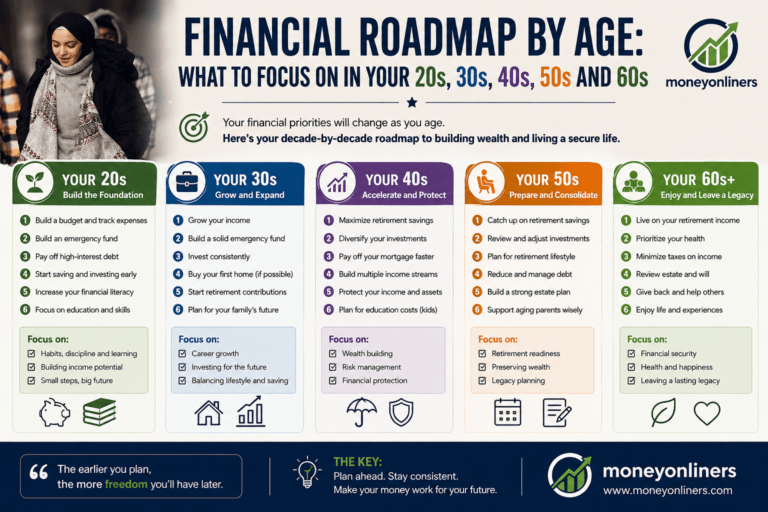
How a Long-Term Financial Plan Can Change by Age

Life Stage Likely Priorities Planning Emphasis
20s Career, emergency fund, first investments, debt Build the system
30s Home, family, income growth, retirement Increase contributions and protection
40s Peak expenses, retirement, education, net worth Accelerate asset building
50s Retirement readiness, debt reduction, catch-up saving Close major gaps
60s+ Retirement income, healthcare, estate planning Protect and distribute assets wisely

Your Age Does Not Determine Everything

Someone starting at 45 may have a stronger financial position than someone at 30.

Income, debt, family responsibilities, savings, health, career stability and goals all matter.

Use age as a planning reference—not a judgment.

What Should Happen to Your Financial Plan When Income Increases?

A raise creates financial capacity.

Without a plan, lifestyle inflation can absorb most of it.

Example

Suppose take-home income rises by:

$500 per month

One Possible Allocation

Use Amount
Increase retirement investing $175
Debt reduction $100
Emergency / sinking funds $75
Medium-term goal $75
Lifestyle increase $75

The exact split is personal.

The principle is stronger:

When income rises, allow your lifestyle to improve—but let your financial future receive a raise too.

What If Life Does Not Follow the Financial Plan?

It will not always follow it.

You Might Experience

  • Job loss
  • Reduced income
  • Unexpected medical costs
  • Divorce
  • Business failure
  • Market losses
  • Major home repairs
  • Family emergencies

A Setback Does Not Require Abandoning the Entire Plan

Instead:

  • Protect essential expenses.
  • Pause lower-priority goals if necessary.
  • Use emergency savings appropriately.
  • Avoid unnecessary new high-interest debt.
  • Reduce spending temporarily.
  • Restart contributions when conditions improve.
  • Adjust timelines instead of pretending nothing changed.
A flexible plan can bend without breaking.

MoneyOnliners Original Analysis: The Financial Plan Growth Test

MoneyOnliners evaluates whether a financial plan can grow with someone's life using six questions:

GOALS → CASH FLOW → RESILIENCE → GROWTH → PROTECTION → REVIEW

1. Goals

Does the plan clearly identify what the money is meant to accomplish?

2. Cash Flow

Does income reliably cover current living costs while leaving room for future goals?

3. Resilience

Can the plan survive an unexpected expense or income interruption?

4. Growth

Does the plan create assets through regular saving, investing and debt reduction?

5. Protection

Are major financial risks appropriately addressed?

6. Review

Is there a system for changing the plan when life changes?

The strongest financial plan is not the one with the most complicated spreadsheet. It is the one that keeps working when your real life changes.

MoneyOnliners Financial Capacity Formula

For educational planning:

Financial Capacity = Income − Essential Spending − Required Debt Payments

Example

Monthly take-home income: $5,000

Essential spending: $3,000

Required debt payments: $700

Financial Capacity

$1,300 per month

That $1,300 is the portion potentially available for:

  • Emergency savings
  • Extra debt payments
  • Investing
  • Retirement
  • Medium-term goals
  • Discretionary spending

If Income Rises to $6,000

and expenses remain relatively stable:

Financial capacity increases dramatically.

This illustrates why income growth can strengthen a financial plan without requiring extreme investment returns.

MoneyOnliners Plan Adaptability Ratio

Another original MoneyOnliners planning metric:

Plan Adaptability Ratio = Flexible Monthly Cash Flow ÷ Monthly Take-Home Income

Example

Flexible monthly cash flow:

$1,000

Take-home income:

$5,000

Adaptability Ratio

$1,000 ÷ $5,000 = 20%

A household with more flexible cash flow may have greater ability to redirect money after a job change, emergency, new child or major goal.

This ratio is an original educational framework, not a standardized financial-planning rule.

Backlink Authority Resource:

The MoneyOnliners Financial Plan Growth Test, Financial Capacity Formula and Plan Adaptability Ratio are original resources designed to help readers judge whether a financial plan is merely balanced today or flexible enough to remain useful as life changes.

MoneyOnliners Long-Term Financial Plan Scorecard

Area Question Healthy Direction
Goals Are major goals written and prioritized? Yes
Cash flow Does income exceed essential spending? Yes
Emergency savings Can unexpected costs be handled without immediate new debt? Increasingly yes
Debt Is expensive debt declining? Yes
Protection Are major household risks addressed? Yes where appropriate
Investing Are long-term contributions regular? Yes
Retirement Is retirement being funded? Yes
Fees Are financial-product costs understood? Yes
Estate basics Are beneficiaries and core documents current? Yes where relevant
Review Is the plan updated after major changes? Yes
Use the scorecard annually.

The goal is not to receive a perfect score immediately. The value is identifying the weakest part of your financial system and deciding what deserves attention next.

MoneyOnliners Research-Based Evidence Note

This article is a research-based long-term financial planning guide.

Investor.gov's current wealth-building guidance recommends understanding monthly income and expenses, controlling high-interest credit-card debt, building an emergency fund and investing regularly over time.

It currently summarizes the long-term investing concept as:

Regular Investments + Time → Wealth

Investor.gov also recommends considering retirement accounts such as eligible workplace plans and IRAs, automating contributions and using diversified investments where appropriate.

Its current guidance encourages increasing investment contributions when income rises or expenses fall.

MoneyOnliners incorporates these principles into a broader 10-step plan that also includes insurance, tax organization, beneficiary reviews, estate basics and recurring plan updates.

FTC guidance was reviewed because investment fraud can destroy years of financial progress. The FTC continues to warn that guaranteed profits, unusually high returns and claims of little or no risk are major scam warning signs.

The Financial Plan Growth Test, Financial Capacity Formula, Plan Adaptability Ratio and Long-Term Financial Plan Scorecard are original MoneyOnliners educational resources.

No personal investment return, insurance outcome or long-term financial performance is claimed in this article.

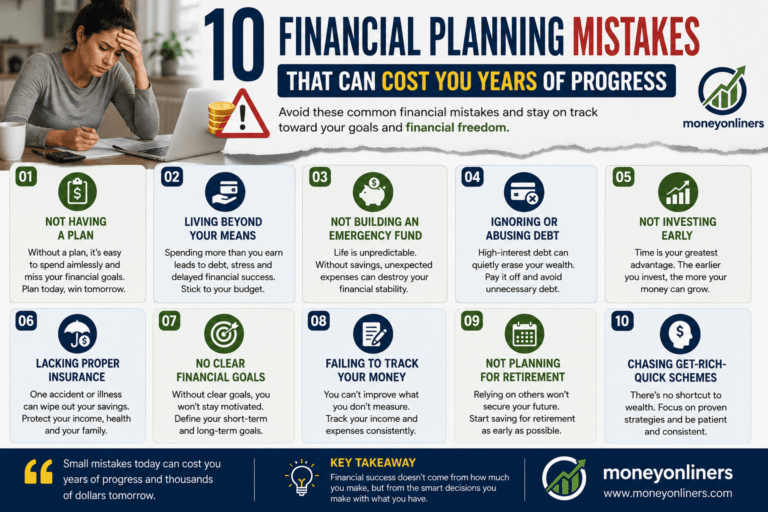
10 Long-Term Financial Planning Mistakes to Avoid

1. Planning Only for Retirement

Retirement matters, but so do emergencies, debt, housing, family responsibilities and medium-term goals.

2. Building a Budget Without Building Assets

Controlling spending is important, but long-term plans also need saving and investing systems.

3. Investing Without an Emergency Fund

Unexpected expenses can force long-term investments to be sold or create high-interest debt.

4. Ignoring High-Interest Debt

Expensive interest can consume cash flow that could otherwise build assets.

5. Treating Every Debt the Same

Interest rate, tax treatment, payment terms and financial risk differ.

6. Never Increasing Contributions

Income growth is an opportunity to accelerate future goals.

7. Ignoring Insurance and Risk Protection

One major uninsured event can undo years of progress.

8. Building the Plan Around Unrealistic Investment Returns

High projected returns make every financial goal look easier than it really is.

9. Never Updating Beneficiaries or Estate Documents

Major life changes can make outdated instructions inappropriate.

10. Creating the Plan Once and Never Reviewing It

A financial plan gradually becomes outdated as life changes.

The biggest mistake may be treating planning as a one-time project.

A useful long-term financial plan is an ongoing decision system rather than a document you complete and forget.

Why a Long-Term Financial Plan Matters

1. A long-term financial plan gives today's money a future purpose.

2. Financial goals help determine how income should be allocated.

3. Understanding cash flow provides the foundation for planning.

4. Net worth shows whether assets are growing faster than liabilities.

5. Emergency savings can reduce dependence on new debt.

6. High-interest debt can slow asset building.

7. Insurance can protect against financially devastating events.

8. Regular investing can help long-term assets grow.

9. Time can increase the potential effect of compound growth.

10. Increasing contributions after raises can accelerate progress.

11. Diversification can reduce dependence on one investment outcome.

12. Investment fees can reduce long-term wealth.

13. Retirement planning becomes harder when delayed indefinitely.

14. Taxes can affect both accumulation and retirement spending.

15. Beneficiary and estate decisions become more important as assets and family responsibilities grow.

16. Inflation changes the future purchasing power of money.

17. Life events can require priorities to change.

18. Annual reviews help keep the plan aligned with reality.

19. A setback may require adjusting the plan rather than abandoning it.

20. Ultimately, a strong long-term financial plan matters because it creates a flexible system for earning, spending, protecting and building money across different stages of life instead of relying on one goal, one account or one perfect prediction.

Incoming Link Opportunities

How to Build Wealth From Nothing: 10 Steps for Beginners
https://moneyonliners.com/how-to-build-wealth-from-nothing/

15 Wealth-Building Strategies That Can Grow Your Money Over Time
https://moneyonliners.com/wealth-building-strategies/

10 Wealth-Building Habits That Can Make a Big Difference Over 10 Years
https://moneyonliners.com/wealth-building-habits/

20 Assets That Can Help Build Wealth Over the Long Term
https://moneyonliners.com/assets-that-build-wealth/

How Long Does It Take to Build Wealth? 8 Factors That Matter Most
https://moneyonliners.com/how-long-does-it-take-to-build-wealth/

High-Priority Incoming Links

$0 to $100,000 Net Worth: A Realistic Roadmap for Building Your First Six Figures
https://moneyonliners.com/0-to-100000-net-worth/

How to Calculate Your Net Worth in 5 Simple Steps
https://moneyonliners.com/how-to-calculate-net-worth/

Negative Net Worth? 10 Steps That Can Help You Turn It Around
https://moneyonliners.com/negative-net-worth/

Retirement Planning: 15 Things to Start Doing Before You Retire
https://moneyonliners.com/retirement-planning/

How Much Money Do You Really Need to Retire Comfortably?
https://moneyonliners.com/how-much-money-do-you-need-to-retire/

Topic Cluster Incoming Links

Starting Retirement Savings Late? 10 Moves That Can Help You Catch Up
https://moneyonliners.com/starting-retirement-savings-late/

Financial Independence: 10 Steps to Take More Control of Your Money and Future
https://moneyonliners.com/financial-independence/

How Much Money Do You Need for Financial Independence?
https://moneyonliners.com/how-much-money-for-financial-independence/

10 Financial Independence Mistakes That Can Set You Back Years
https://moneyonliners.com/financial-independence-mistakes/

15 Ways to Increase Your Net Worth Without Becoming a Millionaire Overnight
https://moneyonliners.com/increase-your-net-worth/

Recommended External Resources

1. Investor.gov — Build Wealth Over Time Through Saving and Investing

Build Wealth Over Time Through Saving and Investing — Investor.gov

Provides current guidance on budgeting, high-interest debt, emergency savings, regular investing, retirement accounts and increasing contributions as income improves.

2. Investor.gov — Introduction to Investing

Introduction to Investing — Investor.gov

Provides a broader framework for financial goals, saving, investing, diversification, long-term planning and risk.

3. Investor.gov — Compound Interest Calculator

Compound Interest Calculator — Investor.gov

Useful for modeling long-term goals using different starting amounts, contributions, time horizons and assumed returns.

4. Investor.gov — Understanding Investment Fees

Understanding Investment Fees — Investor.gov

Explains why recurring costs should be included in long-term investment planning.

5. Investor.gov — Diversify Your Investments

Diversify Your Investments — Investor.gov

Explains why spreading investments can reduce dependence on a single company, security or asset.

6. Consumer Financial Protection Bureau — Saving

Saving — Consumer Financial Protection Bureau

Provides consumer resources for emergency savings and building financial resilience.

7. Consumer Financial Protection Bureau — Financial Well-Being

Financial Well-Being — Consumer Financial Protection Bureau

Provides broader tools and resources for understanding financial security and control over day-to-day and future finances.

8. Investor.gov — Saving and Investing Roadmap

Saving and Investing: A Roadmap to Financial Security — Investor.gov

Offers a broader educational roadmap for connecting savings, investing and financial goals.

9. Federal Trade Commission — Investment Scams

Investment Scams — Federal Trade Commission

Explains why guaranteed returns, secret investing methods, unusually high profits and little-to-no risk are major fraud warning signs.

10. FTC — How to Spot Investment Training Scams on Social Media

How to Spot Investment Training Scams on Social Media — FTC

Current August 2026 guidance warning about trading programs and promoters promising easy profits, guaranteed success and low-risk wealth.

Financial disclaimer:

This article provides general educational information and is not individualized financial, investment, tax, insurance, retirement, estate-planning or legal advice. Financial circumstances, laws, account rules, taxes, insurance needs and investment risks differ. Consider qualified professional advice when your situation requires individualized planning.

Frequently Asked Questions

What is a long-term financial plan?

A long-term financial plan is a roadmap for using income and assets to support future goals.

It usually includes spending.

It may include emergency savings, debt, insurance, investing and retirement.

Taxes and estate considerations can also become important.

The plan should be reviewed as circumstances change.

How far ahead should a financial plan look?

There is no single time horizon.

Some goals may be only months away.

Others may be 10, 20 or 40 years away.

A good plan can include several horizons at the same time.

The key is separating short-term money from long-term money.

What should I do first when building a financial plan?

Start by identifying your goals.

Then document your income and expenses.

List your assets and debts.

Calculate your net worth.

This creates the starting point for the rest of the plan.

Do I need a budget if I already have a financial plan?

Usually, yes.

The budget or spending plan controls today's cash flow.

The financial plan tells you where that cash flow should lead over time.

The two work together.

A long-term plan cannot succeed if monthly cash flow continually runs negative.

How large should an emergency fund be?

It depends on your household.

Many people build gradually toward several months of essential expenses.

A household with unstable income may prefer more.

A stable dual-income household may have different needs.

Start with a manageable initial target and strengthen it over time.

Should I pay debt or invest first?

It depends on the debt and your wider finances.

High-interest debt deserves serious attention.

Emergency savings also matter.

Employer retirement matches can be valuable where available.

Some people use a blended approach rather than choosing only one priority.

How often should I review my financial plan?

At least annually can be useful.

Also review after major life events.

A new job or raise may change contribution capacity.

Marriage, children or homeownership may change insurance and estate needs.

Retirement approaching can require a major shift in strategy.

What should I review every year?

Review income.

Review spending.

Update net worth.

Check savings, debt and investment progress.

Then review insurance, beneficiaries and major goals.

How should my financial plan change when I get a raise?

Consider increasing savings and investment contributions.

You can also accelerate debt payoff.

Some of the raise can improve your lifestyle.

The goal is avoiding a situation where every additional dollar of income immediately becomes additional spending.

Let your financial future receive part of the raise.

Should my financial plan include insurance?

Yes where relevant.

Insurance can protect against risks too large for savings to absorb comfortably.

The right coverage depends on your circumstances.

A person with dependents has different needs from someone without dependents.

Review protection as responsibilities change.

Should my financial plan include retirement even if I am young?

Yes.

You do not need a perfect retirement projection in your twenties.

However, starting contributions early can provide more time for potential compound growth.

The retirement plan can become more detailed later.

Beginning is more important than predicting every future expense today.

How much should I invest each month?

There is no universal amount.

Start with a sustainable percentage or fixed contribution.

Investor.gov currently gives examples such as 5% or 10% of income as possible regular investing amounts, while emphasizing affordability.

Increase contributions when income grows if possible.

Consistency often matters more than choosing a perfect starting percentage.

Does diversification belong in a financial plan?

Yes for many long-term investment plans.

Diversification spreads investment exposure.

It can reduce dependence on one company or security.

It cannot guarantee against market losses.

Investment risk should still match the goal and time horizon.

Do I need estate planning if I am not wealthy?

Estate planning is not only for multimillionaires.

Beneficiary designations can matter at many wealth levels.

A will or other documents may also be useful depending on family and legal circumstances.

The complexity increases with property, businesses and larger estates.

Local law matters.

What makes a financial plan realistic?

It uses real income.

It uses realistic expenses.

It does not depend on guaranteed investment returns.

It allows room for setbacks and changing priorities.

Most importantly, it is reviewed and adjusted as real life changes.

Research Methodology

Primary Planning Framework

MoneyOnliners organized the article into 10 interconnected planning areas covering goals, financial position, spending, emergency savings, debt, protection, investing, retirement, estate/tax organization and ongoing reviews.

Current Investor Education Sources

Investor.gov's current wealth-building materials were reviewed for guidance concerning:

  • Managing monthly expenses
  • Controlling high-interest debt
  • Building emergency savings
  • Investing regularly
  • Increasing contributions when income rises
  • Retirement accounts
  • Automation
  • Diversification
  • Investment fees

Consumer Financial Resilience

Consumer Financial Protection Bureau materials were included for broader savings and financial well-being resources.

Investment Fraud

FTC guidance was reviewed because fraud, guaranteed-return schemes and high-pressure investing promotions can undermine long-term financial plans.

Original MoneyOnliners Analysis

The Financial Plan Growth Test, Financial Capacity Formula, Plan Adaptability Ratio and Long-Term Financial Plan Scorecard are original MoneyOnliners educational resources.

First-Hand Evidence Standard

MoneyOnliners only presents personal budgeting results, investment performance, insurance experiences, screenshots, account histories or financial-planning outcomes when genuine first-hand evidence exists and can be accurately documented.

No personal long-term investment or financial-planning outcome is claimed in this article.

Limitations

Financial planning is highly personal.

Tax rules differ.

Estate laws differ.

Insurance needs differ.

Investment risks differ.

Household expenses differ.

Therefore, this article provides a framework rather than individualized advice.

About the Author

Ramathan Busulwa is the Founder and Editor of MoneyOnliners.com, a financial well-being and opportunity platform built around the mission:

Build More Income. Build More Freedom. Build a Better Financial Future.

MoneyOnliners is being developed as a broader system of practical education, tools, resources, structured academies and financial guidance designed to help readers improve how they earn, grow, manage, protect and build with money.

Through MoneyOnliners, Ramathan researches and publishes practical content covering money management, saving, investing, debt, compound interest, net worth, wealth building, retirement planning, financial independence, careers, income growth, online income and business.

Editorial Principles

  • Accuracy
  • Practicality
  • Transparency
  • Safety
  • Long-Term Thinking

Editorial Mission

MoneyOnliners exists to help people Build More Income. Build More Freedom. Build a Better Financial Future.

Editorial Standards

  • Separate financial planning from financial-product promotion.
  • Use realistic examples rather than guaranteed outcomes.
  • Clearly distinguish saving from investing.
  • Discuss high-interest debt.
  • Include emergency-fund planning.
  • Include financial protection and insurance where relevant.
  • Discuss investment diversification and fees.
  • Discuss retirement planning.
  • Include tax and estate considerations without pretending laws are universal.
  • Encourage regular plan reviews.
  • Warn readers about guaranteed-return investment schemes.
  • Do not fabricate personal financial results.
  • Do not fabricate screenshots, account statements or testimonials.
  • Clearly distinguish researched guidance from genuine first-hand evidence.
  • Use original MoneyOnliners frameworks where they strengthen educational and backlink authority.
  • Prioritize regulator and government sources for financial education.

Google Search Console Checklist

  • Confirm final URL: /long-term-financial-plan/
  • Confirm canonical matches the published URL.
  • Use long-term financial plan naturally in the title, introduction, headings, FAQ and conclusion.
  • Use related phrases naturally: financial planning steps, financial plan for beginners, long-term money plan, financial roadmap, personal financial plan and how to build a financial plan.
  • Use financial planning / paperwork imagery for the hero.
  • Use real people reviewing finances for the current-position section.
  • Use family imagery for insurance and financial protection.
  • Use older-adult imagery for retirement sections.
  • Use home / asset imagery where discussing wealth and estate planning.
  • Avoid repeating generic calculators or money stacks.
  • Keep every image alt description unique.
  • Confirm Recommended External Resources contains 6–10 authoritative sources.
  • Confirm Investor.gov wealth-building guidance remains current.
  • Confirm CFPB savings guidance remains live.
  • Confirm FTC investment scam guidance remains current.
  • Confirm every internal link points to a live canonical URL.
  • Check all planning tables carefully on mobile.
  • Confirm article is indexable.
  • Confirm URL appears in XML sitemap.
  • Inspect the final URL in Google Search Console.
  • Request indexing after publication if appropriate.
  • Monitor queries including “long-term financial plan,” “how to build a financial plan,” “financial planning steps,” “financial plan for beginners,” “personal financial roadmap,” “financial planning checklist,” and “long-term money plan.”

Conclusion: Build a Financial System That Can Change Without Losing Direction

A useful long-term financial plan does not require you to predict your entire future correctly.

Start With Goals

Know what you are trying to build.

Understand Today's Numbers

Income.

Expenses.

Assets.

Debt.

Net worth.

Protect the Foundation

Build emergency savings.

Manage expensive debt.

Address major financial risks.

Then Build Assets

Save regularly.

Invest for appropriate long-term goals.

Increase contributions when financial capacity improves.

Prepare for Retirement

Do not wait until retirement is close before thinking about it.

Keep the Administrative Side Current

Beneficiaries.

Insurance.

Taxes.

Estate documents.

Most Importantly, Review the Plan

Your income will change.

Your responsibilities may change.

Your goals may change.

The economy will change.

Your assets and debts will change.

The Plan Should Change Too

Not because the original plan failed.

Because a good financial plan is designed to evolve.

The goal of long-term financial planning is not to control every event that will happen over the next 30 years. It is to build enough financial strength, flexibility and direction that when life changes, your money can change direction with it instead of starting over from zero.

Similar Posts

One Comment

Leave a Reply

Your email address will not be published. Required fields are marked *