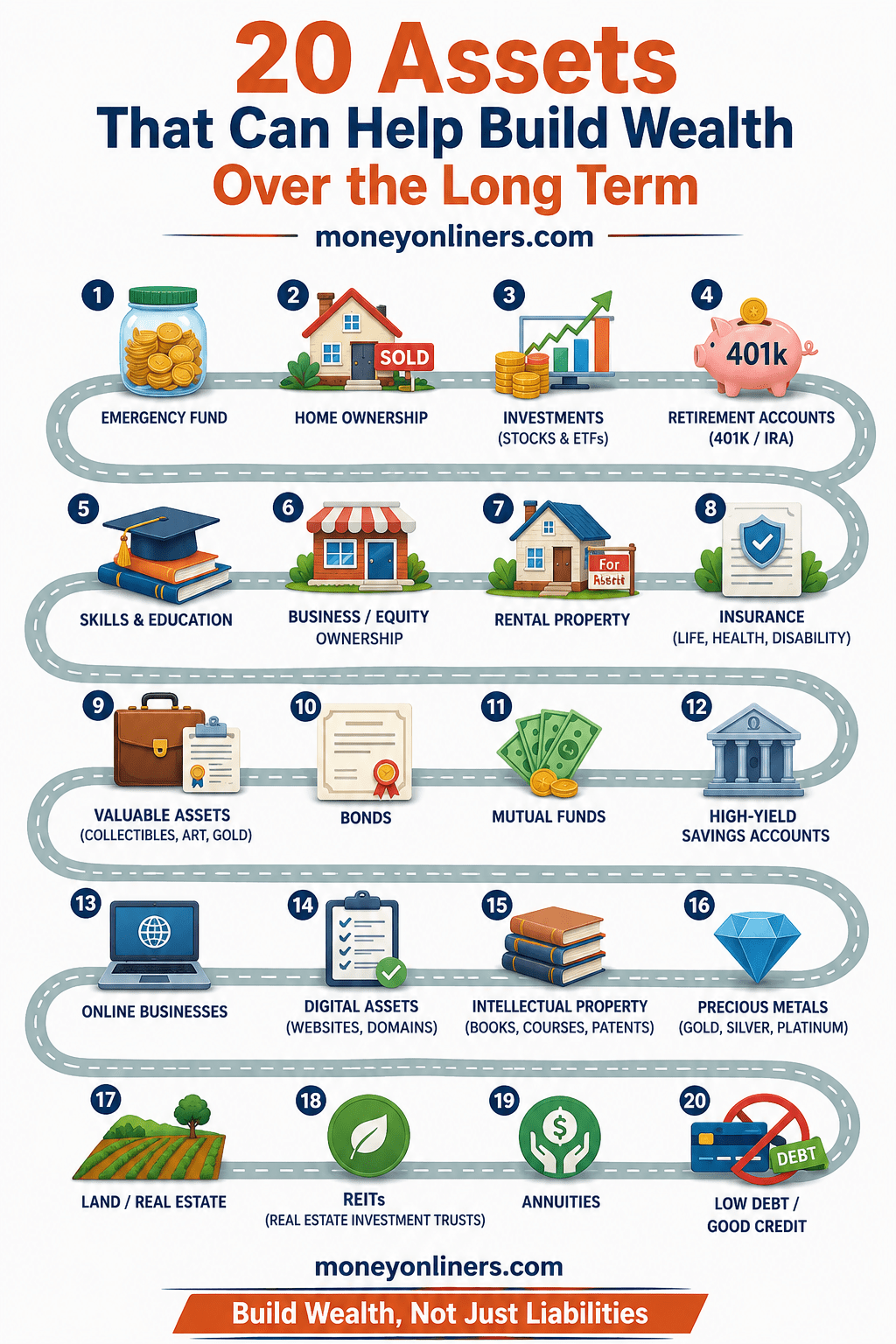
20 Assets That Can Help Build Wealth Over the Long Term
20 Assets That Can Help Build Wealth Over the Long Term
Long-term wealth is usually built by gradually converting part of your income into assets that can preserve value, generate cash flow, increase earning power or potentially appreciate over time. However, every asset comes with trade-offs, and none guarantees wealth.
Assets that can help build wealth include diversified stock funds, individual stocks, ETFs, bonds, bond funds, REITs, a sensibly purchased home, rental real estate, profitable businesses, retirement accounts, cash reserves, CDs, Treasury securities, valuable skills, intellectual property, digital products, websites, private-business equity, income-producing equipment and productive land. The best mix depends on your goals, risk tolerance, time horizon, liquidity needs and financial position.
Importantly, an asset does not become a good investment merely because its price can rise. Instead, evaluate what economic value it can produce, what it costs to own, how liquid it is and what could cause permanent loss.
SEO Details
Focus Keyword: assets that build wealth
SEO Title: 20 Assets That Can Help Build Wealth Over the Long Term
Slug: assets-that-build-wealth
Meta Description: Explore 20 assets that can help build wealth over the long term, including stocks, ETFs, bonds, real estate, retirement accounts, businesses, skills and digital assets.
Table of Contents
20 Assets That Can Help Build Wealth at a Glance
| # | Asset | What You Own | Potential Wealth Role | Key Risk |
|---|---|---|---|---|
| 1 | Broad-Market Stock Index Funds | Diversified ownership across many public companies | Long-term growth and potential dividends | Market volatility; principal can fall |
| 2 | Individual Stocks | Direct ownership in a specific public company | Capital appreciation and dividends | Company-specific and concentration risk |
| 3 | ETFs | A basket of securities traded on an exchange | Diversification, liquidity and potential growth/income | Market risk; fees and strategy risk vary |
| 4 | Bonds | Debt issued by governments or companies | Interest income and return of principal if held to maturity, subject to issuer terms | Interest-rate, inflation and credit risk |
| 5 | Bond Funds | Diversified portfolios of bonds | Income and easier diversification across issuers | Values fluctuate; no fixed maturity for many funds |
| 6 | REITs | Companies or trusts that own or finance income-producing real estate | Potential dividends and real-estate exposure | Property, rate, leverage and market risks |
| 7 | A Primary Residence | A home used as your main residence | Potential equity growth and housing utility | Maintenance, taxes, insurance, transaction and local-market risk |
| 8 | Rental Real Estate | Property rented to tenants | Potential rent, equity and appreciation | Vacancies, repairs, financing, taxes and management |
| 9 | A Profitable Small Business | Ownership in an operating business | Potential profit, equity value and control | High failure risk, illiquidity and operating demands |
| 10 | Retirement Accounts | Tax-advantaged account structures such as 401(k)s and IRAs | Tax advantages can improve long-term compounding | Rules, eligibility, limits, taxes and withdrawal restrictions |
| 11 | Cash and High-Yield Savings | Liquid deposits held for near-term needs and emergencies | Stability, liquidity and interest | Inflation can erode purchasing power |
| 12 | Certificates of Deposit | Time deposits with stated terms | Predictable interest when held under stated terms | Liquidity limits and reinvestment/inflation risk |
| 13 | Treasury Securities | Debt obligations of the U.S. government | Interest and high credit quality for U.S. dollar obligations | Interest-rate and inflation risk |
| 14 | Education and Career Skills | Human capital that can improve earning power | Potentially higher lifetime income | No guaranteed payoff; time and education costs |
| 15 | Intellectual Property | Copyrights, software, designs, books, courses or licensing rights | Potential licensing or sales income | Demand, copying, platform and legal risks |
| 16 | Digital Products | Templates, software, guides, courses and other repeatable digital goods | Potential scalable sales after creation | Marketing, competition, maintenance and platform risk |
| 17 | Websites and Online Businesses | Content sites, e-commerce stores, software or online services | Potential cash flow and resale value | Traffic, algorithm, competition and execution risk |
| 18 | Business Equity | Ownership stakes in private companies | Potential distributions and appreciation | Illiquidity, valuation uncertainty and business failure |
| 19 | Income-Producing Equipment | Tools, machinery or equipment used to generate revenue | Can support business cash flow | Depreciation, maintenance and utilization risk |
| 20 | Cash-Flowing Productive Land | Land used for agriculture, timber, leasing or other productive purposes | Potential income plus long-term land value | Location, climate, commodity, legal and liquidity risks |

1 Broad-Market Stock Index Funds
What it is: Diversified ownership across many public companies.
How it may help build wealth: Long-term growth and potential dividends.
Main risks or costs: Market volatility; principal can fall.
For beginners, diversified funds can make it easier to own many securities without selecting every company individually. However, diversification cannot guarantee a profit or prevent losses in a broad market decline.
2 Individual Stocks
What it is: Direct ownership in a specific public company.
How it may help build wealth: Capital appreciation and dividends.
Main risks or costs: Company-specific and concentration risk.
3 ETFs
What it is: A basket of securities traded on an exchange.
How it may help build wealth: Diversification, liquidity and potential growth/income.
Main risks or costs: Market risk; fees and strategy risk vary.
For beginners, diversified funds can make it easier to own many securities without selecting every company individually. However, diversification cannot guarantee a profit or prevent losses in a broad market decline.
4 Bonds
What it is: Debt issued by governments or companies.
How it may help build wealth: Interest income and return of principal if held to maturity, subject to issuer terms.
Main risks or costs: Interest-rate, inflation and credit risk.
5 Bond Funds
What it is: Diversified portfolios of bonds.
How it may help build wealth: Income and easier diversification across issuers.
Main risks or costs: Values fluctuate; no fixed maturity for many funds.
6 REITs
What it is: Companies or trusts that own or finance income-producing real estate.
How it may help build wealth: Potential dividends and real-estate exposure.
Main risks or costs: Property, rate, leverage and market risks.
7 A Primary Residence
What it is: A home used as your main residence.
How it may help build wealth: Potential equity growth and housing utility.
Main risks or costs: Maintenance, taxes, insurance, transaction and local-market risk.
Real estate should be evaluated using total ownership costs rather than purchase price alone. Therefore, financing, taxes, insurance, repairs, vacancies and transaction costs belong in the calculation.
8 Rental Real Estate
What it is: Property rented to tenants.
How it may help build wealth: Potential rent, equity and appreciation.
Main risks or costs: Vacancies, repairs, financing, taxes and management.
Real estate should be evaluated using total ownership costs rather than purchase price alone. Therefore, financing, taxes, insurance, repairs, vacancies and transaction costs belong in the calculation.
9 A Profitable Small Business
What it is: Ownership in an operating business.
How it may help build wealth: Potential profit, equity value and control.
Main risks or costs: High failure risk, illiquidity and operating demands.
10 Retirement Accounts
What it is: Tax-advantaged account structures such as 401(k)s and IRAs.
How it may help build wealth: Tax advantages can improve long-term compounding.
Main risks or costs: Rules, eligibility, limits, taxes and withdrawal restrictions.
For 2026, the IRS says the employee elective-deferral limit for most 401(k) plans is $24,500 and the IRA contribution limit is $7,500, with additional catch-up rules for eligible older savers. Always verify the rules that apply to your own plan and tax situation.
11 Cash and High-Yield Savings
What it is: Liquid deposits held for near-term needs and emergencies.
How it may help build wealth: Stability, liquidity and interest.
Main risks or costs: Inflation can erode purchasing power.
12 Certificates of Deposit
What it is: Time deposits with stated terms.
How it may help build wealth: Predictable interest when held under stated terms.
Main risks or costs: Liquidity limits and reinvestment/inflation risk.
13 Treasury Securities
What it is: Debt obligations of the U.S. government.
How it may help build wealth: Interest and high credit quality for U.S. dollar obligations.
Main risks or costs: Interest-rate and inflation risk.
14 Education and Career Skills
What it is: Human capital that can improve earning power.
How it may help build wealth: Potentially higher lifetime income.
Main risks or costs: No guaranteed payoff; time and education costs.
Human capital is different from a financial security, yet it can be one of a beginner’s most valuable wealth-building assets. For example, a skill that raises annual income can create more money to save, invest or use to build a business.
15 Intellectual Property
What it is: Copyrights, software, designs, books, courses or licensing rights.
How it may help build wealth: Potential licensing or sales income.
Main risks or costs: Demand, copying, platform and legal risks.
16 Digital Products
What it is: Templates, software, guides, courses and other repeatable digital goods.
How it may help build wealth: Potential scalable sales after creation.
Main risks or costs: Marketing, competition, maintenance and platform risk.
17 Websites and Online Businesses
What it is: Content sites, e-commerce stores, software or online services.
How it may help build wealth: Potential cash flow and resale value.
Main risks or costs: Traffic, algorithm, competition and execution risk.
18 Business Equity
What it is: Ownership stakes in private companies.
How it may help build wealth: Potential distributions and appreciation.
Main risks or costs: Illiquidity, valuation uncertainty and business failure.
19 Income-Producing Equipment
What it is: Tools, machinery or equipment used to generate revenue.
How it may help build wealth: Can support business cash flow.
Main risks or costs: Depreciation, maintenance and utilization risk.
20 Cash-Flowing Productive Land
What it is: Land used for agriculture, timber, leasing or other productive purposes.
How it may help build wealth: Potential income plus long-term land value.
Main risks or costs: Location, climate, commodity, legal and liquidity risks.
MoneyOnliners Original Analysis: The Asset Quality Framework
| Factor | Question to Ask | Why It Matters |
|---|---|---|
| Cash Flow | Can the asset produce interest, dividends, rent, profit or royalties? | Cash flow may be reinvested or used for financial goals. |
| Growth Potential | Can its economic value reasonably increase over time? | Appreciation can contribute to net-worth growth. |
| Liquidity | How quickly can it be converted to usable cash? | Low liquidity can create problems during emergencies. |
| Diversification | Does ownership reduce or increase concentration? | Heavy concentration can expose wealth to one failure. |
| Ownership Cost | What fees, taxes, repairs, interest or maintenance are required? | Costs reduce the return you actually keep. |
| Permanent-Loss Risk | What could cause a large or irreversible loss? | Protecting capital becomes increasingly important as wealth grows. |
The MoneyOnliners Three-Bucket Asset Model
1. Stability Assets
Cash, savings and other highly liquid reserves can help protect the plan from short-term shocks.
2. Growth Assets
Stocks, diversified funds, businesses and selected real estate can pursue long-term growth while accepting meaningful risk.
3. Income Assets
Bonds, rental property, profitable businesses and some dividend-paying investments may contribute cash flow.
4. Human & Productive Assets
Skills, intellectual property, equipment and digital businesses can expand earning capacity and ownership.

How These Assets Can Work Together
Most people do not need all 20 assets. In fact, collecting more asset types can create unnecessary complexity. Instead, a stronger approach is to give each asset a clear job.
Example: Early Wealth-Building Stage
| Financial Job | Possible Asset | Purpose |
|---|---|---|
| Emergency liquidity | Cash or high-yield savings | Reduce the chance that a surprise expense forces debt or an investment sale. |
| Long-term growth | Diversified stock ETF or index fund | Own many companies and participate in long-term market growth, while accepting volatility. |
| Retirement tax structure | 401(k) or IRA | Use available tax advantages while holding appropriate investments inside the account. |
| Earning-power growth | Career skills | Increase future income and investing capacity. |
Example: Later Wealth-Building Stage
As net worth, responsibilities and financial goals expand, a household might add bonds, real estate, business ownership or other assets. However, additional complexity should solve a real financial problem rather than simply make a portfolio look sophisticated.
A 401(k) or IRA is an account, not an investment itself. The assets held inside the account—such as stock funds or bond funds—determine much of the investment risk and return.
MoneyOnliners Research-Based Evidence Note
This guide is research-based and educational. MoneyOnliners does not claim to have personally purchased, tested or earned returns from every asset listed here.
Therefore, hypothetical examples are not presented as MoneyOnliners investment results, business profits, property appreciation or testimonials.
Current U.S. retirement-account limits were checked against IRS guidance. In addition, diversification, compound growth and investment-risk principles were reviewed against U.S. investor-education resources.
The Asset Quality Framework and Three-Bucket Asset Model are original MoneyOnliners explanatory frameworks created to make asset evaluation easier to understand and cite.
Finally, no asset in this article is described as guaranteed to appreciate, produce income or prevent losses.
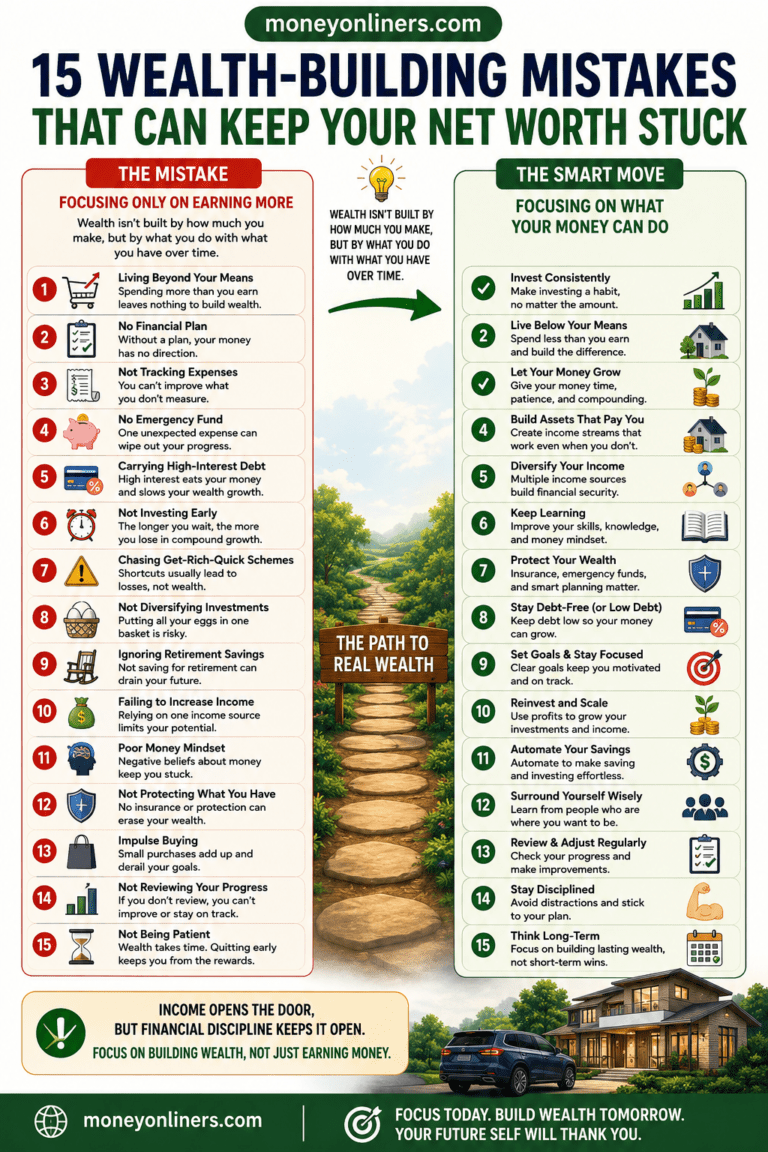
10 Mistakes to Avoid When Buying Assets to Build Wealth
1. Calling Every Purchase an Asset
A purchase can have personal value without being a strong wealth-building asset. Therefore, distinguish lifestyle spending from productive ownership.
2. Ignoring High-Interest Debt
Expensive debt can consume cash flow faster than many investments can reasonably be expected to grow.
3. Investing Emergency Money
Money needed soon generally should not depend on volatile market prices.
4. Concentrating Everything in One Asset
A single stock, property, business or speculative investment can expose a household to one major failure.
5. Ignoring Ownership Costs
Fees, taxes, insurance, repairs, interest and maintenance all reduce net returns.
6. Chasing the Asset That Recently Rose the Most
Past performance does not guarantee future results. Moreover, buying solely because an asset has recently surged can encourage emotional decisions.
7. Confusing an Account With an Investment
A retirement account is a legal and tax structure; the investments held inside it still need to be selected appropriately.
8. Buying Assets You Do Not Understand
If you cannot explain how an asset creates value, what it costs and how you could lose money, additional research may be appropriate before investing.
9. Using Too Much Leverage
Borrowing can magnify gains, but it can also magnify losses and create mandatory payments during difficult periods.
10. Expecting Fast Wealth
Long-term asset ownership is usually more realistic than searching for guaranteed high returns or rapid riches.
Incoming Link Opportunities
15 Wealth-Building Strategies That Can Grow Your Money Over Time
https://moneyonliners.com/wealth-building-strategies/
Investing for Beginners: 10 Simple Steps to Start Building Wealth
https://moneyonliners.com/investing-for-beginners/
10 Types of Investments Beginners Should Understand Before Investing
https://moneyonliners.com/types-of-investments-for-beginners/
Diversification Explained: How Many Investments Do You Actually Need?
https://moneyonliners.com/diversification-explained/
How Much Money Do You Really Need to Start Investing?
https://moneyonliners.com/how-much-money-to-start-investing/
Why Assets That Build Wealth Matter
1. Assets that build wealth can convert current income into future financial capacity.
2. Productive ownership can create potential income beyond wages.
3. Diversified financial assets can spread exposure across many securities.
4. Liquid assets can protect a long-term plan from short-term emergencies.
5. Retirement accounts can provide tax advantages when eligibility and rules are satisfied.
6. Real estate can provide housing, potential equity or rental income, although ownership costs matter.
7. Business ownership can create profit and equity, while also carrying substantial operating risk.
8. Skills can increase earning power and therefore expand future investing capacity.
9. Intellectual property can create economic value beyond hourly labor.
10. Digital assets can sometimes scale, although competition and platform dependence remain important risks.
11. Bonds can serve different portfolio roles from stocks.
12. Cash can provide stability even when its long-term growth potential is limited.
13. Ownership costs help determine whether an asset actually strengthens net worth.
14. Liquidity matters because financial needs do not always arrive when markets are favorable.
15. Diversification can reduce dependence on a single outcome, although it cannot eliminate market risk.
16. Compounding becomes more meaningful when productive assets have enough time to work.
17. Reinvesting income can increase the amount of capital producing future returns.
18. Asset selection should reflect goals rather than trends or social-media excitement.
19. A simple collection of understandable assets may be easier to manage than unnecessary complexity.
20. Ultimately, assets that build wealth matter because long-term financial strength depends increasingly on what you own, what those assets produce and how well you manage their risks.
High-Priority Incoming Links
How to Build Wealth From Nothing: 10 Steps for Beginners
https://moneyonliners.com/how-to-build-wealth-from-nothing/
Financial Independence: 10 Steps to Take More Control of Your Money and Future
https://moneyonliners.com/financial-independence/
Saving vs Investing: Where Should Your Next $1,000 Actually Go?
https://moneyonliners.com/saving-vs-investing-next-1000/
Topic Cluster Incoming Links
Stocks vs ETFs: Which Is Better for Beginner Investors?
https://moneyonliners.com/stocks-vs-etfs/
Index Funds vs ETFs: 10 Differences Beginners Should Know
https://moneyonliners.com/index-funds-vs-etfs/
Dollar-Cost Averaging: Does Investing a Little Every Month Really Work?
https://moneyonliners.com/dollar-cost-averaging/
15 Investing Mistakes Beginners Make (and How to Avoid Them)
https://moneyonliners.com/investing-mistakes-beginners/
Continue Learning on MoneyOnliners
Frequently Asked Questions
What are the best assets to build wealth?
There is no single best asset for everyone. Diversified stock funds, retirement investments, bonds, real estate, businesses and valuable skills can all play useful roles.
However, the appropriate choice depends on your goals, time horizon, risk tolerance and need for liquidity.
For many beginners, simplicity and diversification can be more practical than owning many complicated assets.
Do I need a lot of money to start buying assets?
No. Some financial assets can be purchased in relatively small amounts, depending on the brokerage or account used.
Moreover, improving skills and building emergency savings can begin before someone has a large investment portfolio.
The important step is to build a repeatable surplus between income and spending.
Is a house always a wealth-building asset?
No. A home can build equity and may appreciate, but it also carries mortgage interest, taxes, insurance, repairs and transaction costs.
Therefore, affordability matters as much as potential appreciation.
A home that consumes too much cash flow can reduce the amount available for other assets.
Are stocks better than real estate for building wealth?
Neither is universally better. Stocks can offer liquidity and easy diversification, whereas direct real estate can offer control, leverage and rental income.
On the other hand, real estate generally requires more capital, management and transaction costs.
Some investors use both, while others choose only the asset class that best fits their circumstances.
How many wealth-building assets should a beginner own?
A beginner does not need all 20 assets in this guide.
Instead, a simple system might combine emergency savings, diversified long-term investments and ongoing investment in earning power.
Additional assets can be considered when they solve a specific need and the investor understands their risks.
Recommended External Resources
1. Investor.gov — Introduction to Investing
https://www.investor.gov/introduction-investing
2. Investor.gov — Build Wealth Over Time Through Saving and Investing
https://www.investor.gov/build-wealth-over-time-through-saving-and-investing
3. Investor.gov — Diversify Your Investments
4. Investor.gov — Small Savings Add Up to Big Money
5. IRS — 2026 Retirement Contribution Limits
https://www.irs.gov/newsroom/401k-limit-increases-to-24500-for-2026-ira-limit-increases-to-7500
6. IRS — IRA Contribution Limits
7. IRS — 401(k) Contribution Limits
8. SEC — Diversifying Risk
https://www.sec.gov/resources-small-businesses/capital-raising-building-blocks/diversifying-risk
Research Methodology
How This Guide Was Built
MoneyOnliners organized this article around assets that can contribute to at least one long-term wealth function: liquidity, income, capital growth, ownership, earning power or productive capacity.
Primary Sources
For current U.S. retirement limits, we relied on IRS materials. For general investment education, diversification, compounding and risk principles, we prioritized Investor.gov and SEC educational resources.
What We Did Not Assume
We did not assume that historical returns will continue, that real estate always appreciates, that businesses become profitable or that digital products produce passive income.
Original MoneyOnliners Analysis
The Asset Quality Framework and Three-Bucket Asset Model are independently prepared MoneyOnliners educational tools. They are designed to make this article more useful as a reference and potential citation resource.
About the Author
Editorial Mission & Standards
MoneyOnliners aims to make financial topics easier to understand without promising guaranteed returns, effortless passive income or rapid wealth. Financial examples are educational illustrations rather than personalized financial advice.
Google Search Console Checklist
- Confirm the final canonical URL is https://moneyonliners.com/assets-that-build-wealth/.
- Use assets that build wealth naturally in the SEO title, introduction, headings and image alt text.
- Confirm every internal link returns a valid 200 status.
- Compress and locally host final article images where practical.
- Add descriptive image filenames and alt text.
- Check mobile layout and table scrolling.
- Request indexing in Google Search Console after publication or a major update.
- Add contextual incoming links from related investing and wealth-building posts.
Conclusion
Building wealth is not about collecting as many assets as possible. Instead, it is about gradually owning assets that have a clear financial purpose and that you can understand, afford and manage through changing conditions.
For one person, that may begin with emergency savings, diversified retirement investments and better career skills. Later, it might expand into bonds, real estate, a business or intellectual property. Meanwhile, another person may reach the same goal with a much simpler mix.
Therefore, focus less on finding the “perfect” asset and more on building a durable system: create surplus cash flow, acquire productive assets, diversify appropriately, control costs, protect against major losses and give the strategy enough time to work.

One Comment