
10 Wealth-Building Habits That Can Make a Big Difference Over 10 Years
10 Wealth-Building Habits That Can Make a Big Difference Over 10 Years
Ten years is long enough for ordinary financial habits to become surprisingly powerful. Saving a little more, increasing your income, avoiding expensive debt, investing consistently and controlling lifestyle inflation may not transform your finances next month. However, repeated for a decade, those same habits can create a very different financial life.
The most useful wealth-building habits include consistently spending less than you earn, automatically saving and investing, increasing contributions as income rises, building your earning power, eliminating high-interest debt, maintaining emergency savings, buying productive assets, diversifying investments, reviewing fees and finances regularly, and avoiding lifestyle inflation.
Individually, these actions can look small. Nevertheless, when several habits work together for 10 years, they can substantially increase the amount of money you save, invest and keep working toward future goals.
Table of Contents
10 Wealth-Building Habits at a Glance
| # | Wealth-Building Habit | What It Improves | Potential 10-Year Effect |
|---|---|---|---|
| 1 | Spend less than you earn | Financial surplus | Creates money available for assets |
| 2 | Automate saving and investing | Consistency | Reduces missed contributions |
| 3 | Increase contributions regularly | Asset accumulation | Growing income produces growing investments |
| 4 | Increase earning power | Income | Expands future savings capacity |
| 5 | Reduce high-interest debt | Cash flow | More money remains available for wealth building |
| 6 | Maintain emergency savings | Financial resilience | Reduces forced borrowing or asset sales |
| 7 | Own productive assets | Net worth | Potential income and appreciation |
| 8 | Diversify | Risk management | Reduces dependence on one investment |
| 9 | Review fees and progress | Efficiency | Reduces unnecessary financial leakage |
| 10 | Control lifestyle inflation | Savings rate | Keeps part of future raises working for you |
1 Make Spending Less Than You Earn Normal
This habit is the foundation underneath most other wealth-building strategies.
When all income is consumed, little remains available to purchase assets.
Example
Monthly take-home income:
$4,000
Monthly spending:
$3,500
Monthly Surplus
$500
Annual Surplus
$500 × 12 = $6,000
Ten Years of Contributions
$60,000
That calculation excludes investment gains, losses or interest.
Therefore, merely maintaining a recurring surplus can create meaningful capital before investment performance even enters the equation.
Do not focus only on cutting expenses. Instead, work on both sides of the equation: increase income while keeping spending growth under control.
2 Automate Saving and Investing
Willpower is unreliable.
Automation reduces the number of decisions required to make financial progress.
Example
Automatic monthly investment:
$300
Annual Contribution
$3,600
Ten-Year Contributions
$36,000
Again, this excludes investment returns.
Automation Could Include
- Workplace retirement contributions
- Automatic IRA contributions
- Recurring brokerage investments
- Emergency-fund transfers
- Debt repayments
As a result, wealth building becomes part of the financial system rather than something you remember only when money happens to be left over.
Schedule saving and investing close to payday whenever appropriate.
3 Increase Your Contributions as Your Income Grows
Starting small is useful.
However, staying permanently small can slow long-term progress.
Example Contribution Path
| Years | Monthly Investment | Annual Amount |
|---|---|---|
| Years 1–2 | $100 | $1,200 |
| Years 3–4 | $250 | $3,000 |
| Years 5–6 | $400 | $4,800 |
| Years 7–8 | $600 | $7,200 |
| Years 9–10 | $800 | $9,600 |
Total Contributions Over 10 Years
$51,600
In contrast, remaining at $100 per month for the entire decade would produce only $12,000 of contributions.
Difference
$39,600
Therefore, contribution growth can matter enormously.
4 Keep Increasing Your Earning Power
One of the best long-term wealth habits has nothing to do with choosing investments.
Instead, keep increasing the economic value of your skills.
Possible Ways to Grow Income
- Learn higher-value skills
- Earn relevant certifications
- Develop leadership ability
- Negotiate compensation
- Move into higher-paying roles
- Freelance
- Start a business
- Build digital skills
- Use AI productively
Example
Suppose your annual income rises by:
$12,000
You invest one-third of that increase:
$4,000 annually
Over 10 Years
$40,000 of additional contributions
Meanwhile, you still retain $8,000 of the annual increase for taxes, spending or other priorities.
A stronger income can accelerate nearly every other wealth-building habit.

5 Treat High-Interest Debt Like a Financial Emergency
High-interest debt can work against wealth-building progress every month.
Example
Monthly debt payment:
$500
Annual Cash Requirement
$6,000
Once the expensive debt is eliminated, the same cash flow can potentially be redirected.
Redirect Half to Investing
$250 × 12 = $3,000 annually
Over the Next 10 Years
$30,000 of contributions
Consequently, eliminating expensive debt can create both immediate relief and future investment capacity.
A high-interest credit-card balance creates a different financial decision from a reasonably priced mortgage. Therefore, review interest rate, taxes, liquidity and overall financial goals.
6 Keep Emergency Savings Available
Emergency savings are not designed to outperform stock markets.
Instead, their purpose is financial resilience.
Emergency Cash Can Help Cover
- Job loss
- Medical expenses
- Car repairs
- Home repairs
- Insurance deductibles
- Urgent travel
Why This Protects Wealth
Without accessible cash, a financial shock may force someone to:
- Borrow on a credit card
- Take an expensive personal loan
- Sell investments during a market decline
- Withdraw retirement money
Therefore, emergency savings can indirectly protect long-term compounding.
Its job is to stop short-term emergencies from damaging long-term assets.
7 Regularly Buy Productive Assets
Wealth usually becomes stronger as more of your money moves into assets capable of generating future economic value.
Examples Can Include
- Diversified stock funds
- ETFs
- Index funds
- Bonds
- Real estate
- Profitable businesses
- Intellectual property
- Digital businesses
Consumer Purchase vs Productive Asset
| Money Used For | Primary Purpose | Potential Wealth Effect |
|---|---|---|
| Luxury phone upgrade | Consumption | Usually depreciates |
| Broad-market investment | Ownership | Potential growth and income |
| Business equipment | Production | May help generate revenue |
| Professional training | Human capital | May increase earning power |
Of course, not every asset rises in value.
Nevertheless, the habit of acquiring productive assets instead of spending every surplus dollar is central to long-term wealth building.

8 Diversify Instead of Constantly Hunting for the Next Winner
Concentrated investments can create spectacular gains.
Unfortunately, they can also produce spectacular losses.
Diversification Can Spread Exposure Across
- Different companies
- Different industries
- Different countries
- Stocks and bonds
- Other appropriate asset classes
Diversification cannot eliminate market losses.
However, it can reduce dependence on one investment succeeding.
Example
Portfolio A owns one company.
Portfolio B owns hundreds of companies through a diversified fund.
If the one company in Portfolio A fails, the damage could be severe.
Portfolio B can still lose money during broad market declines, but it does not depend entirely on one company's survival.
Do not confuse a recent winner with a guaranteed long-term wealth strategy.
9 Review Your Money at Least Once a Year
A wealth-building plan should evolve as your life changes.
Review
- Income
- Savings rate
- Investment contributions
- Investment fees
- Debt balances
- Emergency reserves
- Asset allocation
- Insurance
- Beneficiaries
- Net worth
Why Fees Deserve Attention
Recurring investment costs can reduce the amount of return you keep.
Therefore, seemingly small annual expenses can become meaningful over long periods.
Track Net Worth
Assets − Liabilities = Net Worth
Your net worth does not need to increase every month because asset values fluctuate.
However, measuring it periodically can reveal whether the overall financial system is moving in the desired direction.
Did I increase earning power, reduce expensive debt, add productive assets or improve financial resilience this year?
10 Do Not Let Every Raise Become a More Expensive Lifestyle
Lifestyle inflation can quietly absorb years of income growth.
Example
Monthly take-home income rises by:
$1,000
Instead of spending the entire increase, you divide it:
| Use | Monthly Amount |
|---|---|
| Better current lifestyle | $500 |
| Additional investing | $300 |
| Additional saving/debt reduction | $200 |
Additional Annual Investment
$300 × 12 = $3,600
Ten-Year Contributions
$36,000
Meanwhile, you still improved your lifestyle by $500 each month.

What Could 10 Years of Better Wealth-Building Habits Look Like?
Consider a hypothetical person starting with limited investments.
Year 1
- $100 monthly investing
- $100 monthly emergency saving
- High-interest debt still being repaid
Year 3
- Emergency fund established
- High-interest debt eliminated
- Investing increases to $300 per month
Year 5
- Career income increases
- Investing rises to $500 per month
- Employer retirement match is fully understood
Year 8
- Investing reaches $750 per month
- Portfolio remains diversified
- Additional income stream contributes $200 per month
Year 10
- Monthly investing reaches $1,000
- No revolving high-interest debt
- Emergency savings remain intact
- Net worth is tracked annually
The exact outcome would depend on investment returns and many personal factors.
Still, notice what created the transformation.
The person did not find one magical investment.
Instead, financial capacity kept improving.
MoneyOnliners Original Analysis: The Wealth Habit Flywheel
Stage 1: Earn
Increasing skills and earning power gives the system more financial fuel.
Stage 2: Keep
A sustainable gap between income and spending creates surplus cash flow.
Stage 3: Protect
Emergency savings reduce dependence on expensive debt.
Stage 4: Remove Drag
High-interest debt and unnecessary fees are gradually reduced.
Stage 5: Own
More money moves into productive assets.
Stage 6: Reinvest
Potential investment income or business profits can be reinvested where appropriate.
Stage 7: Expand
Contributions rise as income grows.
Stage 8: Repeat
Over time, a larger financial base can make each future cycle stronger.
The strongest financial habits reinforce one another. Increasing income becomes more powerful when lifestyle inflation is controlled, while investing becomes easier when expensive debt is gone and emergency savings are available.
MoneyOnliners 10-Year Wealth Habit Scorecard
| Habit | Starting Point | 10-Year Goal |
|---|---|---|
| Income | Current income | Higher earning capacity |
| Financial surplus | Small or inconsistent | Reliable monthly surplus |
| Emergency savings | None or small | Strong accessible reserve |
| High-interest debt | Potential balances | Eliminated or tightly controlled |
| Investment contributions | Small | Substantially higher |
| Diversification | Limited knowledge | Intentional diversified approach |
| Fees | Unknown | Understood and monitored |
| Net worth | Starting value | Materially stronger financial position |
This scorecard is an original MoneyOnliners educational framework rather than a standardized financial-planning assessment.
MoneyOnliners Research-Based Evidence Note
This article is a research-based wealth-building education guide.
MoneyOnliners does not claim that the hypothetical investment contributions, income growth, debt-reduction results or 10-year scenarios in this guide were personally achieved by MoneyOnliners or its editorial team.
Current U.S. retirement-account limits are based on IRS guidance.
Furthermore, diversification, compounding, investment-fee and long-term wealth principles are informed primarily by Investor.gov and related regulatory education.
MoneyOnliners does not fabricate investment returns, net-worth results, business income, screenshots or testimonials.
The Wealth Habit Flywheel and 10-Year Wealth Habit Scorecard are original MoneyOnliners analytical resources designed to make the topic more practical and citeable.
10 Habits That Can Quietly Work Against Wealth Building
1. Spending Every Raise
Income grows, but assets never catch up.
2. Carrying Credit-Card Balances for Years
High interest can absorb future investment capacity.
3. Investing Only When Markets Feel Safe
Waiting for perfect certainty can create inconsistent investing.
4. Chasing Recent Winners
Past performance does not guarantee future results.
5. Constantly Switching Strategies
A sound long-term plan needs enough time to work.
6. Ignoring Investment Fees
Recurring expenses can reduce long-term portfolio growth.
7. Maintaining No Emergency Savings
Unexpected expenses may turn into debt or forced asset sales.
8. Never Increasing Contributions
A contribution suitable at the beginning of your career may become too small later.
9. Buying Things Mainly to Look Wealthy
Visible consumption and actual net worth are not the same thing.
10. Chasing Guaranteed Fast Wealth
Promises of unusually high returns with little risk should be treated cautiously.
Sustainable financial progress usually comes from income, saving, productive ownership, diversification, time and risk management. Therefore, avoid strategies promising guaranteed wealth or unusually high returns without meaningful risk.
Why Wealth-Building Habits Matter
1. Wealth-building habits can turn occasional financial effort into consistent progress.
2. Spending less than you earn creates money that can be redirected toward future goals.
3. Automated saving reduces dependence on memory and willpower.
4. Automatic investing can make contributions more consistent.
5. Increasing contributions allows investment growth to follow career growth.
6. Earning-power improvements can increase future wealth-building capacity.
7. High-interest debt can consume cash that might otherwise purchase assets.
8. Emergency savings can protect investments from short-term financial shocks.
9. Productive assets can potentially generate income or appreciate over time.
10. Diversification reduces dependence on one company or investment outcome.
11. Lower investment costs can help more of your return remain invested.
12. Net-worth tracking can reveal progress that is difficult to see month by month.
13. Lifestyle inflation can quietly consume the financial benefit of higher earnings.
14. Reinvesting part of additional income can accelerate asset accumulation.
15. Financial reviews help identify outdated assumptions and unnecessary expenses.
16. Long-term habits can reduce the temptation to chase short-term market trends.
17. Consistency gives compounding more opportunity to matter.
18. Several good habits working together can be stronger than one aggressive investment strategy.
19. A decade is long enough for modest financial decisions to accumulate into meaningful differences.
20. Ultimately, strong wealth-building habits help convert increasing income and consistent financial discipline into more assets, greater resilience and more financial choices over time.
Continue Learning on MoneyOnliners
Recommended External Resources
1. Investor.gov — Build Wealth Over Time Through Saving and Investing
Build Wealth Over Time Through Saving and Investing — Investor.gov
Investor education covering high-interest debt, emergency savings, budgeting, retirement accounts, automatic investing and diversification.
2. Investor.gov — Ten Building Blocks to Building Wealth
Ten Building Blocks to Building Wealth — Investor.gov
Useful guidance on budgeting, saving, investing and maintaining a long-term financial plan.
3. Investor.gov — Small Savings Add Up to Big Money
Small Savings Add Up to Big Money — Investor.gov
Explains how consistent small savings can become more meaningful over long periods through compounding.
4. Investor.gov — Diversify Your Investments
Diversify Your Investments — Investor.gov
Explains why spreading money among investments can reduce concentration risk, although diversification cannot eliminate market losses.
5. Investor.gov — Investment Products and Costs
Investment Products — Investor.gov
Provides information about investment costs, diversification, liquidity and fraud considerations.
6. IRS — 2026 401(k) and IRA Contribution Limits
2026 Retirement Contribution Limits — IRS
Official 2026 contribution limits for 401(k)s, IRAs and applicable catch-up contributions.
7. IRS — Retirement Plan Contributions
Retirement Topics: Contributions — IRS
Official information covering contribution rules across employer plans and IRAs.
8. IRS — IRA Contribution Limits
Official guidance covering annual Traditional and Roth IRA contribution limits.
9. Consumer Financial Protection Bureau — Savings
Saving — Consumer Financial Protection Bureau
Consumer-focused resources for building savings and strengthening financial resilience.
10. Federal Trade Commission — Scams
Scams — Federal Trade Commission
Consumer-protection guidance for recognizing financial, investment and business scams.
MoneyOnliners prioritizes government agencies and financial regulators for current contribution rules, investment education and consumer protection. Because limits and regulations can change, verify current official information when making financial decisions.
This article provides general educational information and is not individualized investment, financial, tax, legal or insurance advice. Investments can lose money, income can change and hypothetical calculations do not guarantee future wealth.
Frequently Asked Questions
What are wealth-building habits?
They are repeated financial behaviors that can improve long-term financial strength.
For example, saving consistently can create investment capital.
Likewise, reducing expensive debt can free future cash flow.
Increasing income can expand contribution capacity.
Together, several habits can reinforce one another.
Can 10 years really make a difference financially?
Yes, potentially.
Ten years provides time for many monthly contributions.
Income may also rise during that period.
Debt can potentially be eliminated.
As a result, contribution capacity may become substantially larger.
What is the most important wealth-building habit?
There is no single habit that is best for everyone.
However, maintaining a financial surplus is fundamental.
Without a surplus, buying assets consistently becomes difficult.
Income growth can also be powerful.
Therefore, focus on a system rather than one perfect habit.
Should I save or invest first?
Emergency savings often deserve attention before aggressive investing.
Meanwhile, high-interest debt may also require attention.
Employer retirement matching can affect the decision.
Consequently, some people save and invest simultaneously.
Use each dollar according to the job it needs to perform.
How much should I invest each month?
There is no universal amount.
Start with an amount that fits your budget.
Then increase contributions when income improves.
For example, $100 may become $250 and later $500.
Contribution growth can matter greatly over a decade.
Is $100 per month worth investing?
Yes, it can be a useful beginning.
That equals $1,200 per year.
Over 10 years, contributions alone equal $12,000.
Investment performance could increase or decrease the final value.
Ideally, increase the contribution as financial capacity grows.
What happens if I invest $500 every month for 10 years?
Your contributions alone would equal $60,000.
Investment gains could increase the final amount.
However, market losses could also occur.
Therefore, do not treat a hypothetical growth rate as guaranteed.
The contribution total itself is certain if all payments are actually made.
Should I increase my investment every year?
That can be a useful habit.
Income often increases over a career.
Directing part of each raise toward investments can prevent lifestyle inflation from consuming the entire increase.
Nevertheless, emergency needs and debt can affect the appropriate amount.
Use a sustainable contribution level.
Why is emergency savings part of wealth building?
Cash reserves can protect long-term assets.
For example, a car repair may otherwise become credit-card debt.
An emergency fund can cover the expense directly.
Therefore, fewer future dollars may be lost to high interest.
That strengthens the broader financial system.
Should I focus on earning more or spending less?
Both can help.
Spending control creates immediate surplus.
Income growth can create larger long-term upside.
As a result, combining both strategies can be more powerful.
Avoid extreme frugality that is difficult to sustain.
How does lifestyle inflation hurt wealth?
Lifestyle inflation causes expenses to rise alongside income.
Consequently, raises may never improve the savings rate.
Assets remain small despite higher earnings.
A better approach is to split future raises.
Enjoy part and invest part.
How often should I check my net worth?
There is no universal schedule.
Monthly tracking works for some people.
Others prefer quarterly or annual reviews.
Because market values fluctuate, short-term changes should not automatically trigger strategy changes.
Focus on long-term direction.
Does diversification guarantee I will not lose money?
No.
Diversified investments can still decline.
However, diversification can reduce dependence on one investment.
Therefore, it is mainly a risk-management tool.
It is not a guarantee of profit.
Should I invest every raise?
Not necessarily all of it.
You may have current priorities.
For example, housing, family needs or debt can matter.
Still, directing part of future raises toward assets can be valuable.
That allows both present living standards and future wealth to improve.
What can stop wealth-building habits from working?
High-interest debt can slow progress.
Large recurring lifestyle expenses can also reduce savings capacity.
In addition, excessive investment fees can reduce returns.
Scams and concentrated speculation can cause major losses.
Therefore, wealth building requires both growth and protection.
Research Methodology
How We Selected the 10 Habits
This MoneyOnliners guide evaluates wealth-building habits based on whether they can improve income, financial surplus, liquidity, asset ownership, investment consistency or risk management over a long period.
Income and Savings
Income growth and spending control are treated together because wealth-building capacity depends partly on the gap between money coming in and money going out.
Therefore, the article does not rely on extreme frugality as the only route to stronger finances.
Emergency Savings and Debt
Emergency savings are included because accessible cash can reduce the need for expensive borrowing or forced investment sales.
Similarly, high-interest debt is included because recurring interest can consume future investment capacity.
Investing and Diversification
Automatic investing is included because consistency can be easier when contributions occur without repeated manual decisions.
Diversification is included because dependence on one company, industry or asset can increase concentration risk.
Retirement Accounts
Current U.S. retirement contribution information is based on official Internal Revenue Service guidance.
Because contribution limits can change, figures should be reviewed during future annual updates.
Fees and Financial Leakage
Investment fees are included because recurring costs can reduce the amount of investment return retained over long periods.
Original MoneyOnliners Analysis
The Wealth Habit Flywheel and 10-Year Wealth Habit Scorecard are original MoneyOnliners editorial frameworks created to make the relationship between financial habits easier to understand and cite.
Limitations
All salary, investment, debt and 10-year contribution examples are hypothetical unless specifically identified as official current figures.
MoneyOnliners does not claim personal investment results from these scenarios.
Moreover, no investment return, income increase or wealth outcome is guaranteed.
Google Search Console Checklist
- Confirm final URL: /wealth-building-habits/
- Confirm the canonical matches the published URL.
- Use wealth-building habits naturally in the title, introduction, headings and conclusion.
- Use related phrases such as long-term wealth habits, financial habits that build wealth and 10-year wealth building naturally.
- Use career imagery for income-growth sections.
- Use a real home for asset-ownership discussion.
- Use family/lifestyle imagery for long-term outcomes.
- Avoid repeating generic laptop and calculator images.
- Keep image alt descriptions unique.
- Confirm Recommended External Resources contains 6–10 authoritative links.
- Confirm all internal links lead to live canonical URLs.
- Confirm the article is indexable.
- Confirm the URL appears in the XML sitemap.
- Check comparison tables on mobile.
- Verify current IRS figures during future annual updates.
- Inspect the published URL in Google Search Console.
- Request indexing after publication if appropriate.
- Monitor searches such as “wealth-building habits,” “habits that build wealth,” “financial habits for wealth,” and “how to build wealth in 10 years.”
Conclusion: Ten Years of Better Habits Can Change the Financial Direction of Your Life
Ten years can pass whether you build assets or not.
Therefore, the objective is to put more of those years to work for you.
Create a Surplus
Make spending less than income part of your normal financial life.
Automate Progress
Saving and investing become easier when the system does part of the work for you.
Increase Contributions
Allow your investments to grow alongside your career.
Keep Increasing Your Income
Skills and earning power can become powerful long-term assets.
Remove Expensive Debt
Keep more future cash flow available for productive uses.
Maintain Emergency Savings
Protect the long-term plan from short-term financial shocks.
Own Productive Assets
Gradually convert part of your income into ownership.
Diversify
Avoid making your financial future depend entirely on one investment succeeding.
Review Your Progress
Watch fees, debt, contributions, net worth and changes in your financial life.
Control Lifestyle Inflation
Enjoy some of your raises while allowing your future to benefit from them too.
None of these habits guarantees wealth.
However, together they can create a much stronger financial system.
Similar Posts
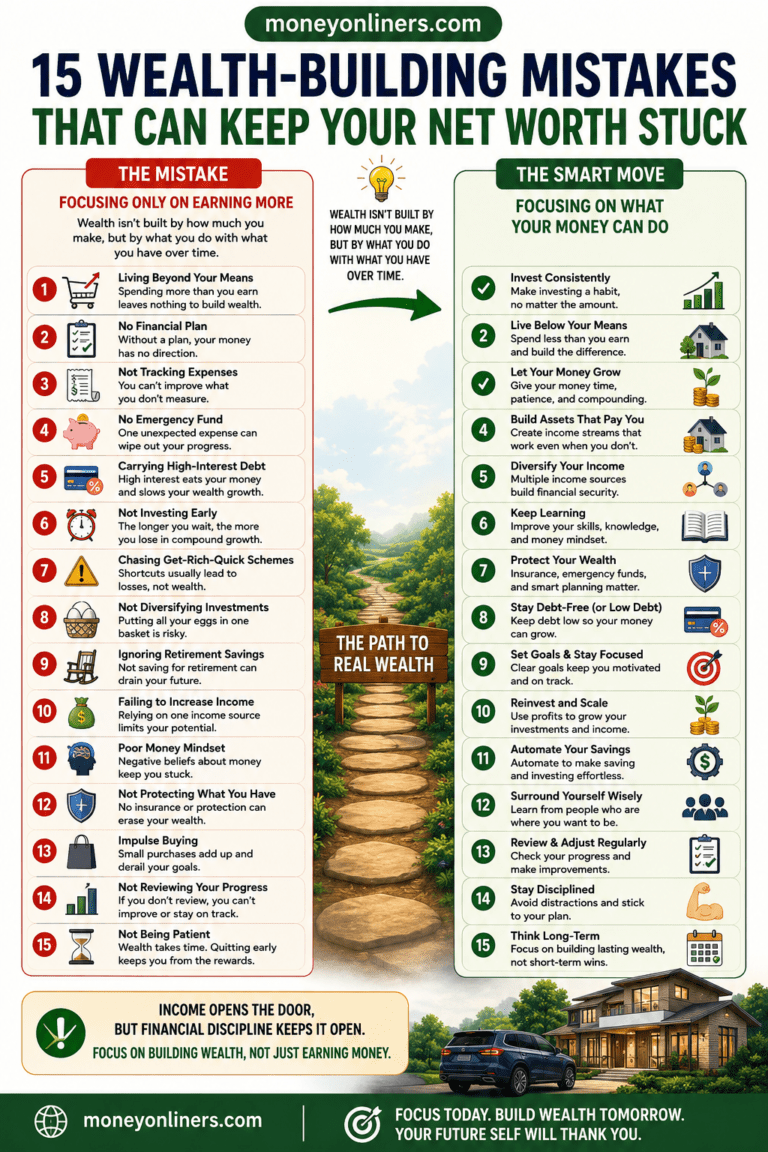
15 Wealth-Building Mistakes That Can Keep Your Net Worth Stuck
15 Wealth-Building Mistakes That Can Keep Your Net Worth Stuck | MoneyOnliners MoneyOnliners • Build Wealth → Avoid Costly Mistakes 15 Wealth-Building Mistakes That Can Keep Your Net Worth Stuck You can earn more money, receive raises and even invest occasionally while your net worth barely moves. Often, the problem is not one catastrophic financial…
How to Build Wealth From Nothing: 10 Steps for Beginners
How to Build Wealth From Nothing: 10 Steps for Beginners | MoneyOnliners MoneyOnliners • Build Wealth → Beginner Roadmap How to Build Wealth From Nothing: 10 Steps for Beginners Starting with little money does not mean you have nothing valuable to work with. Your earning ability, time, skills, spending decisions and future contributions can all…
How Long Does It Take to Build Wealth? 8 Factors That Matter Most
How Long Does It Take to Build Wealth? 8 Factors That Matter Most | MoneyOnliners MoneyOnliners • Build Wealth → Wealth Timeline How Long Does It Take to Build Wealth? 8 Factors That Matter Most Building wealth can take five years, twenty years or an entire career depending on where you start and how much…
Building Wealth in Your 20s, 30s, 40s and 50s: What Changes?
Building Wealth in Your 20s, 30s, 40s and 50s: What Changes? | MoneyOnliners MoneyOnliners • Build Wealth → Wealth by Decade Building Wealth in Your 20s, 30s, 40s and 50s: What Changes? The basic wealth-building formula does not completely change as you get older: earn, save, invest, protect your finances and give productive assets time…
Saving vs Building Wealth: Why Saving Money Alone May Not Be Enough
Saving vs Building Wealth: Why Saving Money Alone May Not Be Enough | MoneyOnliners MoneyOnliners • Save Money → Build Wealth Saving vs Building Wealth: Why Saving Money Alone May Not Be Enough Saving money is one of the most important financial habits you can build. However, saving and building wealth are not exactly the…
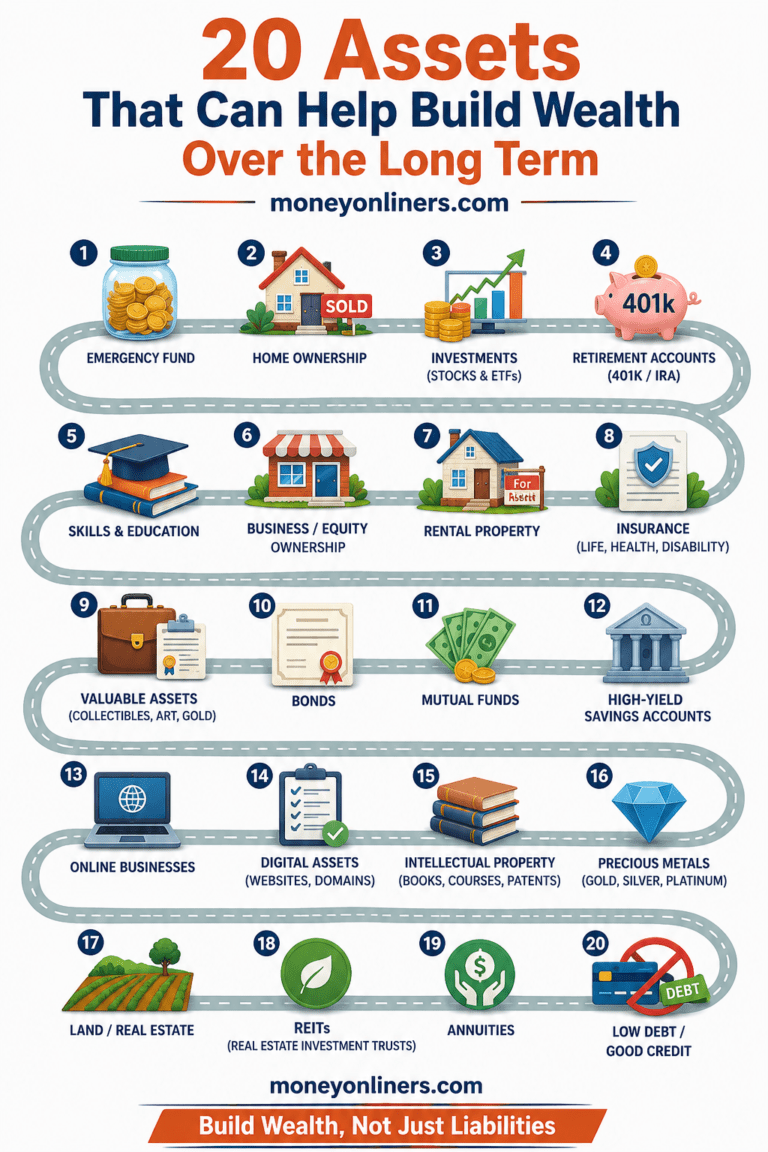
20 Assets That Can Help Build Wealth Over the Long Term
20 Assets That Can Help Build Wealth Over the Long Term | MoneyOnliners MoneyOnliners • Build Wealth → Productive Assets 20 Assets That Can Help Build Wealth Over the Long Term Long-term wealth is usually built by gradually converting part of your income into assets that can preserve value, generate cash flow, increase earning power…




One Comment