Financial Roadmap by Age: What to Focus on in Your 20s, 30s, 40s, 50s and 60s
Financial Roadmap by Age: What to Focus on in Your 20s, 30s, 40s, 50s and 60s
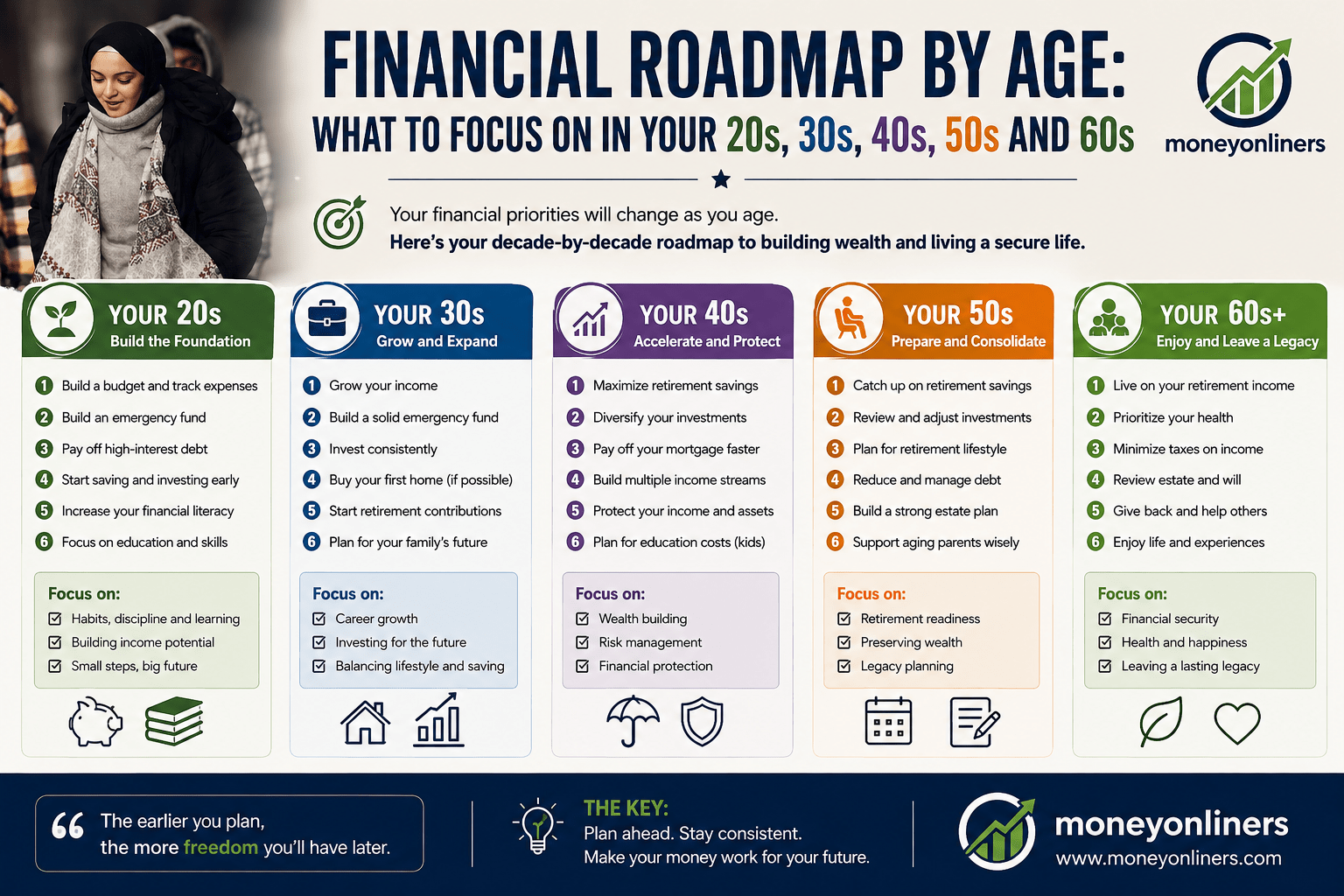
Your financial priorities should not stay exactly the same for 40 years. In your 20s, building income and basic financial stability may matter most. By your 40s and 50s, retirement, family responsibilities and net worth may deserve much more attention. Therefore, a useful financial roadmap by age should help you understand what usually matters most at each stage without pretending everyone reaches milestones on the same schedule.
A practical financial roadmap by age can look like this:
| Age | Main Financial Focus | What You Are Trying to Build |
|---|---|---|
| 20s | Income, emergency savings, debt control, investing habits | Foundation |
| 30s | Family, housing, retirement, insurance, higher savings rate | Capacity |
| 40s | Net worth, peak expenses, retirement acceleration, debt reduction | Momentum |
| 50s | Retirement readiness, catch-up saving, debt cleanup, risk review | Preparation |
| 60s | Retirement income, withdrawals, healthcare, estate planning | Transition and protection |
Age is a planning reference, not a financial scorecard. Someone beginning serious saving at 45 can still make meaningful progress, while someone at 30 may already be far ahead. The useful question is what deserves attention next from your actual starting point.
Table of Contents
Why Financial Priorities Change With Age
Your financial life can change dramatically across adulthood.
Income may rise. Meanwhile, family responsibilities, housing costs and healthcare expenses can also increase.
In Your 20s
You may have limited income but a very long investing horizon.
In Your 30s
Housing, children and insurance may become more important.
In Your 40s
Earnings may be stronger, yet expenses can also peak.
In Your 50s
Retirement becomes much less theoretical.
In Your 60s
The challenge gradually shifts from building assets toward converting those assets into reliable income and financial security.
MoneyOnliners Age-Stage Priority Matrix
| Financial Area | 20s | 30s | 40s | 50s | 60s |
|---|---|---|---|---|---|
| Income growth | Very high | Very high | High | Medium | Depends on retirement |
| Emergency savings | Build | Strengthen | Maintain | Maintain | Potentially increase liquidity |
| High-interest debt | Eliminate | Avoid / eliminate | Keep low | Reduce aggressively | Preferably minimal |
| Retirement investing | Start | Increase | Accelerate | Prioritize heavily | Shift toward income planning |
| Insurance | Basic protection | Expand with responsibilities | Review carefully | Reassess needs | Healthcare and estate focus |
| Net worth | Build positive momentum | Grow meaningfully | Accelerate | Protect and strengthen | Manage and distribute |
| Estate planning | Basic if needed | Increasingly relevant | Important | Very important | Essential to review |
This matrix is an original MoneyOnliners educational framework. It is not a universal financial rule, because actual priorities depend on income, health, debt, family structure and personal goals.
Financial Roadmap for Your 20s: Build the Foundation
Your 20s can be financially powerful even if your income is still relatively low.
The biggest advantage is time. Therefore, habits built early can continue compounding for decades.
Priority 1: Build Income Skills
At this stage, increasing earning power can be one of the highest-return financial moves available.
- Learn valuable skills
- Gain qualifications
- Build a portfolio
- Negotiate pay
- Change jobs strategically
- Explore freelancing or business
Priority 2: Build Emergency Savings
Start with a modest reserve. Afterward, work toward one month and then several months of essential expenses.
Priority 3: Avoid Expensive Debt
Credit-card balances and high-cost personal debt can absorb future income before wealth-building habits have a chance to develop.
Priority 4: Start Retirement Investing
Even modest contributions can matter because the time horizon is long.
Priority 5: Build Credit Carefully
Where credit scoring is relevant, pay obligations on time and avoid unnecessary borrowing.
Priority 6: Learn to Track Net Worth
Your first net-worth goal may simply be moving from negative to zero.
Build a financial system you can afford to strengthen for the next 40 years.

Financial Roadmap for Your 30s: Increase Capacity
Your 30s often bring higher income along with larger responsibilities.
Consequently, this decade can be financially productive but also expensive.
Priority 1: Increase Your Savings Rate
If income has grown since your 20s, let some of that increase flow toward retirement, investing and major future goals.
Priority 2: Strengthen Retirement Contributions
Retirement may still feel distant. However, the longer you delay increasing contributions, the more pressure future decades may carry.
Priority 3: Build a Strong Emergency Fund
A larger household, mortgage or children can justify a stronger cash reserve.
Priority 4: Plan Housing Carefully
Buying a home can be appropriate, but it should not automatically consume every available dollar.
Priority 5: Review Insurance
Depending on your household, relevant protection may include:
- Health insurance
- Life insurance
- Disability coverage
- Auto insurance
- Homeowners or renters insurance
Priority 6: Prepare for Children or Education
If children are part of the plan, childcare, education and insurance can become major financial categories.
Priority 7: Grow Net Worth
This is a useful decade to move beyond simply saving cash and begin accumulating productive assets.
Turn rising income into rising financial capacity instead of letting lifestyle costs absorb every raise.

Financial Roadmap for Your 40s: Accelerate Wealth Building
For many households, the 40s combine stronger earning power with some of the highest expenses of adult life.
Priority 1: Review Retirement Progress Honestly
Retirement is no longer far enough away to ignore major gaps.
Therefore, estimate whether your current contributions and assets are moving in the right direction.
Priority 2: Increase Contributions
If earnings are near their strongest levels, consider increasing retirement and long-term investment contributions.
Priority 3: Keep High-Interest Debt Out
Expensive revolving debt can be particularly damaging when retirement is becoming more important.
Priority 4: Track Net Worth Annually
At this stage, net worth can provide a useful high-level measure of whether assets are growing faster than liabilities.
Priority 5: Balance Education and Retirement
Parents may face education costs at the same time retirement needs stronger funding.
Education financing options may exist, while retirement generally cannot be financed in the same way.
Priority 6: Review Insurance and Estate Documents
As assets and family responsibilities grow, beneficiary designations and estate documents become increasingly important.
Priority 7: Protect Income
Your remaining earning years are valuable. Therefore, disability and other appropriate risk protection may deserve renewed attention.
Use peak earning years to accelerate asset growth without allowing peak expenses to consume every dollar.

Financial Roadmap for Your 50s: Close the Gaps
By your 50s, retirement planning should become much more specific.
Priority 1: Estimate Retirement Spending
Begin turning retirement from a vague account balance into an expected spending plan.
Priority 2: Increase Retirement Contributions
If you are behind, higher contributions may help narrow the gap.
Priority 3: Reduce Major Debt
Entering retirement with large required debt payments can increase the amount of income your portfolio must produce.
Priority 4: Review Investment Risk
As retirement approaches, some money has a shorter time horizon.
Therefore, asset allocation may need to become more deliberate.
Priority 5: Build Healthcare Planning Into Retirement
Healthcare can become one of retirement's largest uncertain expenses.
Priority 6: Review Beneficiaries and Estate Documents
Make sure major accounts and legal documents reflect current family circumstances.
Priority 7: Decide What Retirement Actually Means
Will you stop working completely, shift to part-time work, consult or start a small business?
Identify financial gaps while there is still time to correct them.

Financial Roadmap for Your 60s: Transition From Accumulation to Income
Your 60s may include one of the largest financial transitions of your life.
Instead of mainly building assets, you may begin relying on them.
Priority 1: Create a Retirement Income Plan
Estimate income from:
- Retirement accounts
- Pensions
- Government benefits where applicable
- Business income
- Part-time work
- Rental or other investment income
Priority 2: Plan Withdrawals
Decide which accounts may be used first while considering taxes, investment risk and required account rules.
Priority 3: Maintain Cash Reserves
A sufficient reserve can reduce the need to sell investments during poor market conditions.
Priority 4: Review Healthcare
Insurance, medical costs and possible long-term care deserve careful planning.
Priority 5: Reduce Remaining Financial Complexity
Consider simplifying unnecessary accounts, old debts and financial arrangements.
Priority 6: Review Estate Planning
Beneficiaries, wills, powers of attorney and healthcare directives should reflect current wishes.
Priority 7: Continue Investing Appropriately
Retirement does not necessarily mean every dollar should move to cash.
Because retirement may last decades, part of the portfolio may still need long-term growth.
Turn accumulated assets into a sustainable system for spending, protection and long-term security.

Which Financial Goals Should Carry Through Every Decade?
Some priorities do not disappear when your age changes.
| Financial Goal | 20s | 30s | 40s | 50s | 60s |
|---|---|---|---|---|---|
| Positive cash flow | Build | Maintain | Maintain | Maintain | Maintain |
| Emergency savings | Build | Strengthen | Maintain | Maintain | Maintain / adjust |
| Income management | Learn | Optimize | Maximize | Prepare transition | Manage income sources |
| Debt control | Develop | Maintain | Maintain | Reduce | Keep minimal |
| Investing | Start | Increase | Accelerate | Refine | Continue appropriately |
| Insurance | Basic | Expand | Review | Reassess | Healthcare focus |
| Estate planning | As needed | Begin | Strengthen | Review | Maintain |
What If You Feel Behind for Your Age?
Age-based articles can become discouraging when they imply that everyone should reach identical milestones at identical ages.
That is not realistic.
You May Have Started Late Because Of
- Low income
- Family responsibilities
- Education costs
- Health expenses
- Job loss
- Business failure
- Divorce
- Migration or relocation
Focus on the Next Best Move
If you are 45 with little retirement savings, comparing yourself with someone who began investing at 22 does not solve the problem.
Instead, ask:
- How much can I save now?
- Can I increase income?
- Which debts can I reduce?
- Can retirement be delayed slightly?
- Can future expenses be reduced?
- Are catch-up contributions available?
The best financial roadmap is always built from your current numbers forward.
How Retirement Planning Changes by Age
| Age | Retirement Focus |
|---|---|
| 20s | Start contributing and use time |
| 30s | Increase contribution rate |
| 40s | Measure progress and accelerate |
| 50s | Close gaps and estimate retirement spending |
| 60s | Build withdrawal and income strategy |
Starting Early Helps
A longer time horizon allows more contributions and more potential compound growth.
Starting Late Does Not Make Progress Impossible
Higher contribution rates, working longer, reducing future spending and increasing income can all help.
Retirement calculations depend on future returns, inflation, taxes, healthcare, lifespan and income sources. Therefore, simple age rules should not replace individualized planning.
How Net Worth Focus Changes by Age
Net worth is useful because it combines assets and liabilities.
20s
The first goal may be becoming debt-free or reaching positive net worth.
30s
Focus can shift toward meaningful asset accumulation.
40s
Higher income can create an opportunity for faster net-worth growth.
50s
Protect gains, reduce major liabilities and strengthen retirement assets.
60s
The emphasis may shift toward preserving enough assets to support spending and legacy goals.
Do not compare your net worth mechanically with someone else's age benchmark. Instead, track whether your own balance sheet is improving over time.
Income Growth Matters at Every Stage
Spending control matters, but income growth can change the entire financial roadmap.
In Your 20s
Skills and career growth can create decades of higher earning potential.
In Your 30s
Promotions and business growth can create room for larger savings contributions.
In Your 40s
Peak earning years may provide a major opportunity to accelerate retirement and net worth.
In Your 50s
Higher earnings can help close retirement gaps.
In Your 60s
Part-time work or consulting may help reduce pressure on retirement withdrawals.
MoneyOnliners Original Analysis: The Financial Stage Test
MoneyOnliners Age-Stage Transition Formula
MoneyOnliners Priority Shift Map
| Stage | Primary Question |
|---|---|
| 20s | How do I build the system? |
| 30s | How do I increase capacity? |
| 40s | How do I accelerate wealth? |
| 50s | How do I close the gaps? |
| 60s | How do I turn assets into sustainable security? |
The MoneyOnliners Age-Stage Priority Matrix, Financial Stage Test, Age-Stage Transition Formula and Priority Shift Map are original educational resources designed to help readers identify which financial priorities deserve more attention as they move through different stages of adulthood.
MoneyOnliners Research-Based Evidence Note
This article is a research-based age-stage financial planning guide.
General financial planning principles used throughout include maintaining positive cash flow, building emergency savings, controlling high-interest debt, investing regularly, increasing retirement contributions over time and reviewing insurance and estate planning as responsibilities change.
Retirement planning is treated as progressively more urgent as retirement approaches, while risk, liquidity and withdrawal planning receive more attention in later decades.
The article does not claim that every reader should reach a specific net-worth or retirement balance by a specific birthday.
Instead, MoneyOnliners emphasizes direction, financial capacity and progress from the reader's actual starting point.
The Age-Stage Priority Matrix, Financial Stage Test, Age-Stage Transition Formula and Priority Shift Map are original MoneyOnliners educational resources.
No personal retirement account, net-worth history, investment result or age-based financial outcome is claimed in this article.
10 Age-Based Financial Planning Mistakes to Avoid
1. Believing Everyone Should Reach the Same Milestones at the Same Age
Income, family responsibilities and starting points vary significantly.
2. Waiting Until Your 30s or 40s to Begin Retirement Saving
Starting earlier can provide more time for contributions and potential compound growth.
3. Letting Every Raise Become Lifestyle Inflation
Part of higher income can strengthen savings and investments.
4. Buying a Home Because Your Age Says You Should
Homeownership should fit your finances and life rather than a social timetable.
5. Ignoring Insurance as Responsibilities Increase
The financial cost of losing income can become larger when other people depend on you.
6. Funding Education While Neglecting Retirement
Parents should consider both goals together.
7. Carrying Expensive Consumer Debt Into Later Decades
High-interest debt can reduce retirement-saving capacity.
8. Waiting Until Your 60s to Think About Retirement Withdrawals
Retirement-income planning should begin before the first withdrawal.
9. Ignoring Estate Planning
Beneficiary and legal documents become increasingly important as assets and family responsibilities grow.
10. Giving Up Because You Started Late
A later start changes the strategy. However, it does not make improvement pointless.
The remaining years still matter.
Why a Financial Roadmap by Age Matters
1. First, financial priorities change as responsibilities change.
2. Your 20s provide a long runway for building habits.
3. Meanwhile, the 30s can combine higher income with higher family costs.
4. The 40s can become powerful asset-building years.
5. However, peak expenses can compete with retirement saving.
6. The 50s make retirement gaps easier to see.
7. Therefore, stronger saving may become more urgent.
8. The 60s can shift financial planning from accumulation toward income.
9. Emergency savings remains useful across all decades.
10. Likewise, high-interest debt can slow progress at any age.
11. Income growth matters early and mid-career.
12. Insurance priorities change as responsibilities change.
13. Estate planning becomes increasingly important as assets grow.
14. Net worth can provide a useful long-term direction check.
15. Retirement contributions should generally become more deliberate over time.
16. However, age benchmarks should never be treated as financial judgments.
17. Starting late can require higher contributions or a longer working horizon.
18. Annual reviews help the plan move with real life.
19. Ultimately, strong financial planning is cumulative rather than reset every decade.
20. Therefore, a practical financial roadmap by age matters because it helps you identify which financial priorities deserve the most attention now while preparing for what is likely to matter next.
Continue Learning on MoneyOnliners
Recommended External Resources
1. Investor.gov — Build Wealth Over Time Through Saving and Investing
Build Wealth Over Time Through Saving and Investing — Investor.gov
2. Investor.gov — Define Your Goals
Define Your Goals — Investor.gov
3. Investor.gov — Asset Allocation and Diversification
Asset Allocation and Diversification — Investor.gov
4. Investor.gov — Compound Interest Calculator
Compound Interest Calculator — Investor.gov
5. Consumer Financial Protection Bureau — Saving
Saving — Consumer Financial Protection Bureau
6. Consumer Financial Protection Bureau — Emergency Fund Guide
An Essential Guide to Building an Emergency Fund — CFPB
7. IRS — Retirement Topics: Contributions
Retirement Topics: Contributions — IRS
8. IRS — IRA Contribution Limits
9. Social Security Administration — Retirement Benefits
Retirement Benefits — Social Security Administration
This article provides general educational information and is not individualized financial, investment, retirement, tax, insurance, estate-planning or legal advice. Age alone does not determine the correct financial strategy. Income, health, family responsibilities, debt, location, retirement benefits and personal goals all matter.
Frequently Asked Questions
What should I focus on financially in my 20s?
Start with income growth and basic financial stability.
Build emergency savings.
Control expensive debt.
In addition, begin retirement investing if possible.
Most importantly, create habits that can strengthen as income grows.
What should I focus on financially in my 30s?
Your 30s often involve larger financial responsibilities.
Therefore, increase your savings rate as income improves.
Strengthen retirement contributions.
Review insurance and housing carefully.
Meanwhile, continue building emergency savings and net worth.
What should I focus on financially in my 40s?
The 40s can be major wealth-building years.
Review retirement progress.
Increase contributions where possible.
Keep expensive debt low.
In addition, track net worth and review estate planning.
What should I focus on financially in my 50s?
Retirement readiness becomes a central priority.
Estimate expected retirement spending.
Next, identify savings gaps.
Reduce unnecessary debt.
Finally, review investment risk, healthcare planning and estate documents.
What should I focus on financially in my 60s?
The focus gradually shifts toward retirement income.
Build a withdrawal strategy.
Maintain adequate cash reserves.
Review healthcare and estate planning.
However, some long-term investing may still be appropriate because retirement can last decades.
Is it too late to start investing in your 40s?
No.
A later start means less time for compound growth.
However, higher income may allow larger contributions.
You may also be able to reduce debt and future expenses.
Therefore, beginning now is generally more useful than continuing to delay.
Is it too late to save for retirement in your 50s?
No.
However, the strategy may need to be more aggressive and realistic.
Higher contributions may be necessary.
Working longer can also improve the plan.
In addition, expected retirement spending may need review.
Should I have a certain net worth by each age?
Age benchmarks can provide context.
Nevertheless, they should not be treated as universal requirements.
Income, housing, family structure and starting point vary.
A better measure is whether your own net worth is improving over time.
Use benchmarks as reference points rather than judgments.
Should financial goals change every decade?
Some goals change in priority rather than disappearing.
Emergency savings remains useful throughout adulthood.
Retirement investing continues across multiple decades.
Insurance needs may rise and later change.
Therefore, the plan evolves rather than resets.
How much should I save in my 20s?
Start with an amount you can sustain.
For example, a small percentage or fixed monthly contribution can build the habit.
Afterward, increase it after raises or debt payoff.
Emergency savings and retirement may both deserve funding.
The exact percentage depends on your finances.
How much should I save in my 30s?
If income has increased, consider increasing your savings rate.
Housing and family expenses may compete for cash flow.
Therefore, prioritize intentionally.
Retirement contributions should generally continue growing.
Emergency reserves may also need to become larger.
How much should I save in my 40s?
This depends on retirement progress.
Someone already ahead may need a different percentage from someone who started late.
Review current assets first.
Then estimate future retirement needs.
Increase contributions where affordable.
What if I started saving late?
Do not focus only on the missed years.
Start from today's numbers.
Increase savings if possible.
Reduce expensive debt.
Meanwhile, consider income growth and a realistic retirement timeline.
Should I pay off my mortgage before retirement?
It can be useful for some households.
Lower housing debt may reduce required retirement income.
However, mortgage interest rate, liquidity and investment needs also matter.
Therefore, there is no universal answer.
Compare the tradeoffs carefully.
What is the most important financial goal at any age?
Financial stability is foundational at every age.
Income should cover essential spending.
Emergency savings should protect against shocks.
Expensive debt should remain under control.
From there, priorities can shift toward investing, retirement and protection.
Research Methodology
Age-Stage Structure
MoneyOnliners organized the roadmap into five broad life stages: 20s, 30s, 40s, 50s and 60s.
Financial Areas Reviewed
The guide considers cash flow, emergency savings, debt, income growth, investing, retirement, insurance, housing, net worth and estate planning.
Age as Context
Age is used only as a planning reference. Therefore, the article does not assume that readers of the same age share the same income, family structure or financial progress.
Retirement Planning
The roadmap gradually increases emphasis on retirement contributions, retirement spending, investment risk, withdrawal planning and healthcare as retirement approaches.
Original MoneyOnliners Analysis
The Age-Stage Priority Matrix, Financial Stage Test, Age-Stage Transition Formula and Priority Shift Map are original MoneyOnliners educational resources.
First-Hand Evidence Standard
MoneyOnliners only presents personal retirement statements, net-worth history, investment account screenshots, debt records or age-specific financial outcomes when genuine first-hand evidence exists and can be accurately documented.
Accordingly, no personal age-based financial result is claimed in this article.
Limitations
Income, housing, debt, family responsibilities, health and retirement benefits differ substantially.
In addition, tax rules and retirement-account rules can change. Therefore, this roadmap should be used as an educational planning framework rather than an individualized prescription.
Conclusion: Your Financial Priorities Should Evolve as Your Life Evolves
A useful financial roadmap by age does not tell everyone to reach the same milestone by the same birthday.
In Your 20s
Build the foundation.
Increase skills, create emergency savings, control debt and start investing.
In Your 30s
Increase capacity.
Strengthen retirement, insurance, family planning and net worth.
In Your 40s
Accelerate progress.
Use stronger earnings to build assets and reduce financial drag.
In Your 50s
Close the gaps.
Turn retirement into a specific plan rather than a distant idea.
In Your 60s
Manage the transition.
Convert accumulated assets into sustainable income, healthcare protection and long-term security.
But Remember
You do not reset financially every decade.
Instead, strong habits carry forward while priorities change.
Emergency savings still matters.
Debt control still matters.
Income still matters.
Investing still matters.
Protection still matters.