
How Long Does It Take to Build Wealth? 8 Factors That Matter Most
How Long Does It Take to Build Wealth? 8 Factors That Matter Most
Building wealth can take five years, twenty years or an entire career depending on where you start and how much financial capacity you create along the way. There is no universal timeline. However, eight factors repeatedly shape the journey: income, savings rate, contribution amount, starting age, investment returns, debt, lifestyle costs and consistency.
So, how long does it take to build wealth? For most people, meaningful wealth building is better measured in years and decades rather than months. Someone with strong income, a high savings rate and consistent investing may accumulate substantial assets faster than someone earning the same salary but carrying expensive debt and high recurring expenses.
Starting earlier helps because investments have more time to potentially compound. Nevertheless, starting later does not make wealth building impossible. Higher contributions, stronger income, lower debt and a longer working period can all improve the outcome.
Table of Contents
Is There a Typical Wealth-Building Timeline?
There is no single timeline that applies to everyone.
For one household, the first $100,000 of net worth may take more than a decade.
Another household may reach the same milestone faster because its income, contribution rate or starting assets are substantially larger.
Wealth Is Influenced by More Than Time
- How much you earn
- How much you keep
- How much you invest
- How early you start
- Investment performance
- Debt obligations
- Housing and lifestyle costs
- Financial setbacks
Therefore, asking only how many years wealth takes can be misleading.
A more useful question is:
1 Your Starting Age
Starting age influences how much time contributions have to potentially compound.
Investor.gov summarizes the principle simply: regular investing combined with time can support long-term wealth building.
Hypothetical Example
Suppose $10,000 earns a hypothetical 7% annual return with no additional contributions.
| Years Invested | Approximate Hypothetical Value |
|---|---|
| 10 years | $19,672 |
| 20 years | $38,697 |
| 30 years | $76,123 |
| 40 years | $149,745 |
Investment markets do not produce a fixed 7% every year. Actual returns may be significantly higher or lower, and investments can lose money.
Starting Later
Starting later reduces available compounding time.
However, later starters may have stronger income and greater capacity to contribute larger amounts.
Starting early can reduce the amount future contributions need to do. Starting late increases the importance of contribution size, income and consistency.

2 Your Income
Higher income does not guarantee wealth.
Nevertheless, it can increase the amount available to save, invest and reduce debt.
Example A
Annual income:
$50,000
Annual investment contribution:
$5,000
Example B
Annual income:
$100,000
Annual investment contribution:
$20,000
Ten-Year Contributions
| Investor | Annual Contribution | 10-Year Contributions |
|---|---|---|
| A | $5,000 | $50,000 |
| B | $20,000 | $200,000 |
The investment return matters.
However, the contribution difference alone is already $150,000.
One of the fastest ways to change a long wealth timeline may be increasing your ability to earn and then keeping part of the additional income.
3 Your Savings Rate
Income alone does not determine wealth-building speed.
The percentage of income that remains available for future goals matters greatly.
Two $100,000 Households
| Household | Income | Annual Spending | Potential Surplus |
|---|---|---|---|
| A | $100,000 | $95,000 | $5,000 |
| B | $100,000 | $75,000 | $25,000 |
The second household creates five times as much potential wealth-building capital.
Therefore, two people earning the same salary can experience very different timelines.
But Extreme Frugality Is Not Required
The goal is not necessarily to minimize every expense.
Instead, aim for a sustainable surplus that can grow as income rises.
4 How Much You Actually Invest
Many wealth calculations focus heavily on investment returns.
However, contribution size can be even more important during the early stages.
Monthly Contribution Comparison
| Monthly Contribution | Annual Contribution | 10 Years of Contributions | 20 Years of Contributions |
|---|---|---|---|
| $100 | $1,200 | $12,000 | $24,000 |
| $250 | $3,000 | $30,000 | $60,000 |
| $500 | $6,000 | $60,000 | $120,000 |
| $1,000 | $12,000 | $120,000 | $240,000 |
These figures exclude all investment returns.
Increase Contributions Over Time
Investor.gov specifically encourages investors to consider increasing contributions when income rises or expenses decline.
For example, part of a raise can be redirected automatically toward retirement or brokerage investments.
Instead of asking only, “How can I earn another 1% return?” also ask, “How can I invest another $200 or $500 every month?”
5 Investment Returns
Investment returns affect how quickly assets may grow.
However, future returns cannot be known in advance.
Hypothetical $500 Monthly Contribution
| Time | Contributions | Hypothetical 5% | Hypothetical 7% |
|---|---|---|---|
| 10 years | $60,000 | About $77,600 | About $86,500 |
| 20 years | $120,000 | About $205,500 | About $260,500 |
| 30 years | $180,000 | About $416,000 | About $610,000 |
The figures above assume smooth monthly compounding at fixed hypothetical returns. Real investment markets fluctuate and actual results may differ substantially.
Do Not Chase Returns
Trying to shorten the timeline through extreme investment risk can backfire.
Diversification, time horizon and risk tolerance matter more than simply selecting the investment with the highest recent return.
6 Your Debt
Debt can slow wealth building in two ways.
First, the liability reduces net worth.
Second, monthly payments reduce the money available for investing.
Example
Monthly high-interest debt payment:
$600
Annual Cash Requirement
$7,200
Suppose the debt is eventually eliminated and $500 of that payment is redirected toward investing.
New Annual Investment Capacity
$6,000
Ten-Year Contributions
$60,000
Therefore, debt payoff can change both current net worth and future accumulation speed.
Investor.gov notes that no investment offers guaranteed returns capable of reliably overcoming high credit-card interest. Expensive revolving debt therefore deserves serious attention.
7 Your Lifestyle and Housing Costs
Some of the largest financial decisions happen outside an investment account.
Housing
Mortgage or rent can determine how much cash remains for other goals.
Vehicles
Large car payments can consume hundreds or thousands of dollars every year.
Recurring Lifestyle Costs
- Housing
- Vehicles
- Travel
- Subscriptions
- Dining
- Private education
- Entertainment
Example
Household A spends $1,000 more per month than Household B on housing and vehicles.
$1,000 × 12 = $12,000 per year
Over Ten Years
$120,000
That is before considering what invested money might potentially have earned.
This does not mean choosing the cheapest possible lifestyle. Rather, understand that large recurring expenses influence the time required to build assets.

8 Your Consistency
A good plan that is followed for years can be more useful than a perfect plan that changes every few months.
Consistency Includes
- Investing regularly
- Increasing contributions
- Maintaining emergency savings
- Avoiding unnecessary high-interest debt
- Staying diversified
- Reviewing fees
- Ignoring get-rich-quick schemes
Investor.gov emphasizes regular investing over an entire career rather than treating wealth building as a short-term event.
Why Interruptions Matter
Repeatedly stopping investments, withdrawing retirement money or abandoning a diversified strategy can slow progress.
Meanwhile, consistent contributions continue purchasing assets through both strong and weak markets.

How Different Wealth-Building Timelines Could Look
Example 1: Slow Start, Strong Career Growth
Age 25 monthly investing:
$100
Age 30:
$300 per month
Age 35:
$600 per month
Age 40:
$1,000 per month
The wealth-building process accelerates because career income and contribution capacity grow together.
Key lesson: Your starting contribution does not determine your final contribution.
Example 2: High Income, High Lifestyle
Annual income:
$150,000
Annual amount invested:
$6,000
Despite strong income, wealth accumulation may remain relatively slow because the savings rate is low.
Key lesson: High income helps only when enough survives spending.
Example 3: Moderate Income, Consistent Investing
Annual income:
$75,000
Annual investments:
$12,000
Ten-Year Contributions
$120,000
Investment growth could add more, although it is uncertain.
Key lesson: A moderate income can still build meaningful wealth when the conversion into assets is strong.
Wealth Milestones That Matter More Than Comparing Your Age
| Milestone | Why It Matters |
|---|---|
| Positive monthly surplus | You have money available beyond current consumption. |
| Starter emergency fund | Unexpected expenses become less likely to create debt. |
| High-interest debt declining | Financial leakage is shrinking. |
| First $1,000 invested | You have begun converting income into productive assets. |
| First $10,000 invested | Asset accumulation is becoming measurable. |
| First $100,000 net worth | Your asset base is becoming more substantial. |
| Investment contributions rising | Your system is strengthening with income growth. |
| Investment income covering some expenses | Assets are beginning to contribute financially. |
| Work becoming increasingly optional | Financial independence is getting closer. |
Instead of asking whether you are wealthy enough for your age, compare your current financial system with the one you had five years ago.
MoneyOnliners Original Analysis: The Wealth Timeline Formula
Financial Surplus
How much income remains after spending?
Contribution Rate
How much of that surplus actually goes toward productive assets?
Time
How many years can the strategy continue?
Asset Productivity
Do the assets have the potential to grow or produce income?
Financial Leakage
How much progress is lost to expensive debt, fees, overspending, taxes, fraud or avoidable losses?
The MoneyOnliners Wealth Timeline Scorecard
| Factor | Slower Timeline | Faster Potential Timeline |
|---|---|---|
| Income | Stagnant | Growing |
| Savings rate | Low | Higher and sustainable |
| Contributions | Irregular | Automatic and increasing |
| Debt | High-interest balances | Controlled or declining |
| Housing/lifestyle | Consumes nearly all income | Leaves financial surplus |
| Investments | Concentrated/speculative | Diversified and long-term |
| Fees | Unknown/high | Understood and reasonable |
| Consistency | Repeated stops and starts | Long-term discipline |
The Wealth Timeline Formula and Wealth Timeline Scorecard are original MoneyOnliners analytical tools designed to make the wealth-building process easier to understand and cite.
MoneyOnliners Research-Based Evidence Note
This article is a research-based wealth-building timeline guide.
MoneyOnliners does not claim that hypothetical investment balances, contribution amounts, salary examples or timelines represent personal results achieved by MoneyOnliners or its editorial team.
Investor.gov emphasizes regular investing, emergency savings, controlling high-interest credit-card debt, diversification and increasing investment contributions when financial capacity improves.
Compound-growth examples in this article are hypothetical illustrations rather than predictions.
Current 2026 retirement-account contribution figures are based on official IRS information.
MoneyOnliners does not fabricate portfolio returns, wealth timelines, account screenshots or testimonials.
The Wealth Timeline Formula and Wealth Timeline Scorecard are original MoneyOnliners analytical resources intended to improve clarity and provide a useful reader-facing framework.
7 Ways to Potentially Build Wealth Faster Without Chasing Extreme Risk
1. Increase Your Income
Stronger earning power can increase future contribution capacity.
2. Invest Part of Every Raise
This helps prevent lifestyle inflation from consuming every income increase.
3. Eliminate High-Interest Debt
Former debt payments can later become investment contributions.
4. Automate Investments
Automation reduces the number of decisions required to stay consistent.
5. Increase Contributions Regularly
A $100 monthly contribution can eventually become $500 or $1,000 as financial capacity improves.
6. Diversify
Reducing dependence on one investment can help protect accumulated progress.
7. Control Large Recurring Costs
Housing and vehicle costs can materially influence the amount available for long-term assets.
Do not try to shorten a 20-year wealth timeline into two years by taking risks you cannot financially survive. A permanent 70% or 100% loss can make the timeline substantially longer rather than shorter.
10 Mistakes That Can Add Years to Your Wealth-Building Timeline
1. Waiting for the Perfect Time to Start
Delaying reduces the amount of time available.
2. Never Increasing Contributions
Career growth should ideally improve asset accumulation.
3. Carrying Expensive Debt
Interest consumes investment capacity.
4. Spending Every Raise
Higher income then fails to improve the savings rate.
5. Keeping No Emergency Fund
Unexpected expenses can repeatedly create new debt.
6. Chasing Recent Investment Winners
Past performance does not guarantee future results.
7. Overconcentrating
One failure can erase years of progress.
8. Ignoring Fees
Recurring costs reduce the return you retain.
9. Constantly Changing Strategies
A long-term plan may never receive enough time to work.
10. Believing Wealth Should Happen Quickly
Unrealistic expectations can encourage speculation and scams.
Why Understanding How Long It Takes to Build Wealth Matters
1. Wealth building usually takes years rather than weeks.
2. Starting age affects how much compounding time is available.
3. Higher income can increase investment capacity.
4. Savings rate influences how much income becomes future capital.
5. Contribution amount can matter enormously when the portfolio is small.
6. Increasing contributions can shorten the path toward larger financial goals.
7. Investment returns influence long-term outcomes but cannot be guaranteed.
8. Diversification can reduce dependence on one investment result.
9. High-interest debt can slow net-worth growth.
10. Debt payoff can create future investment capacity.
11. Housing costs can materially influence wealth-building speed.
12. Lifestyle inflation can prevent higher income from becoming greater wealth.
13. Emergency savings can protect long-term assets.
14. Investment fees reduce the return investors retain.
15. Consistency can matter more than constantly changing investments.
16. Starting later does not eliminate the value of saving and investing.
17. Later starters may need larger contributions or a longer working period.
18. Wealth milestones can be more useful than comparing your finances with other people your age.
19. Improving several controllable financial variables can be safer than simply taking greater investment risk.
20. Ultimately, understanding how long does it take to build wealth helps you focus less on a fixed deadline and more on steadily improving income, contributions, asset ownership, financial resilience and consistency.
Continue Learning on MoneyOnliners
Recommended External Resources
1. Investor.gov — Build Wealth Over Time Through Saving and Investing
Build Wealth Over Time Through Saving and Investing — Investor.gov
Explains the role of emergency savings, high-interest debt control, regular investing, retirement accounts and diversification.
2. Investor.gov — Small Savings Add Up to Big Money
Small Savings Add Up to Big Money — Investor.gov
Provides a simple explanation of compounding and how small amounts can accumulate over longer periods.
3. Investor.gov — Introduction to Investing
Introduction to Investing — Investor.gov
Beginner-friendly information covering investing, risk and long-term financial planning.
4. Investor.gov — Diversify Your Investments
Diversify Your Investments — Investor.gov
Explains diversification and concentration risk.
5. Investor.gov — Figure Out Your Finances
Figure Out Your Finances — Investor.gov
Useful guidance for tracking income, spending, assets, liabilities and net worth.
6. IRS — 2026 Retirement Contribution Limits
2026 401(k) and IRA Contribution Limits — IRS
Official 2026 contribution limits for U.S. retirement accounts.
7. IRS — 401(k) Contribution Limits
401(k) Contribution Limits — IRS
Official information on employee deferrals and catch-up contributions.
8. IRS — Retirement Plan Contributions
Retirement Topics: Contributions — IRS
Provides current contribution guidance across retirement-plan types.
9. Consumer Financial Protection Bureau — Savings
Saving — Consumer Financial Protection Bureau
Consumer-focused resources for saving and financial resilience.
10. Federal Trade Commission — Scams
Scams — Federal Trade Commission
Consumer-protection guidance for avoiding financial and investment scams that can destroy years of accumulated wealth.
MoneyOnliners prioritizes government agencies and financial regulators for current retirement rules, investment education and consumer protection. Because financial rules and contribution limits can change, verify current official information before acting.
This article provides general educational information and is not individualized financial, investment, retirement, tax, insurance or legal advice. Investment returns are uncertain, incomes differ and no wealth-building timeline can be guaranteed.
Frequently Asked Questions
How long does it take to build wealth?
There is no universal timeline.
For many people, wealth building takes years or decades.
Income affects the speed.
Contribution rate matters too.
Starting age and investment performance also influence the result.
Can you build wealth in 10 years?
Potentially.
Ten years provides time for many contributions.
Income may increase during that period.
Debt can also be reduced.
However, the amount of wealth accumulated will vary significantly.
Can you become wealthy in five years?
Some people may build substantial net worth in five years.
However, that often requires strong income, business success, large contributions or significant starting assets.
Investment returns alone should not be expected to create guaranteed rapid wealth.
Therefore, avoid relying on extreme-return assumptions.
Focus on controllable variables.
What is the biggest factor in building wealth faster?
There is no single factor for everyone.
Income can be powerful.
Savings rate can also matter greatly.
Contribution size may be especially important early.
Usually, several factors work together.
Does starting early really make a big difference?
Yes, because starting earlier creates more time.
Compounding can then operate for longer.
However, future returns remain uncertain.
Starting later can still produce meaningful results.
Later starters may simply need larger contributions.
Is 40 too late to build wealth?
No.
Someone starting at 40 can still have decades of earning and investing ahead.
Income may also be stronger than it was at 25.
Therefore, contribution size can potentially compensate for some lost time.
Avoid using extreme risk as the main catch-up strategy.
Is 50 too late to build wealth?
No.
However, the strategy usually becomes more contribution-focused.
Retirement timing matters more.
Catch-up retirement contributions may also help eligible U.S. savers.
Spending and debt decisions become increasingly important.
How much should I invest every month to build wealth?
There is no universal amount.
Start with what your finances can sustain.
Then increase contributions as income improves.
For example, $100 may later become $500 or $1,000.
The trajectory matters as much as the starting amount.
Can $100 a month build wealth?
It can begin the process.
That equals $1,200 per year.
Over 20 years, contributions alone total $24,000.
Investment returns could raise or lower the final value.
Ideally, the contribution increases over time.
Can $500 a month build wealth?
It can contribute meaningfully.
$500 per month equals $6,000 annually.
Over 20 years, contributions alone equal $120,000.
Potential investment growth may add more.
However, returns remain uncertain.
Does paying off debt build wealth?
Reducing liabilities improves net worth.
It can also free future cash flow.
Former debt payments can later become investment contributions.
High-interest debt deserves particular attention.
Therefore, debt reduction can accelerate wealth-building progress.
Does earning more make building wealth faster?
Potentially.
Higher income creates more financial capacity.
However, increased spending can consume the benefit.
Therefore, part of additional income should ideally strengthen assets or reduce liabilities.
Income growth and discipline work best together.
Should I invest or save first?
Emergency savings usually deserve attention.
High-interest debt may also matter.
Meanwhile, employer retirement matching can affect priorities.
Some people save and invest simultaneously.
Use each dollar according to its financial job.
What slows wealth building the most?
High-interest debt can slow progress.
A low savings rate can also matter.
Large recurring lifestyle costs reduce investment capacity.
Inconsistent contributions create another problem.
Speculative losses can add even more years.
How can I tell if I am making progress?
Track net worth.
Review investment contributions.
Monitor debt balances.
Measure whether income and financial surplus are rising.
Focus on long-term trends rather than one month.
Research Methodology
How the Eight Factors Were Selected
This MoneyOnliners guide evaluates how long does it take to build wealth through factors that directly influence financial surplus, asset accumulation, compounding time and financial leakage.
Starting Age and Time
Time is included because longer investment periods create greater opportunity for compounding.
Income
Income is included because stronger earnings can increase the amount available for saving and investment.
Savings Rate
Savings rate determines how much income remains available after current spending.
Investment Contributions
Contribution amount is emphasized because early portfolio growth depends heavily on new money being added.
Investment Returns
Returns affect long-term outcomes, although future performance cannot be predicted with certainty.
Debt
Debt is included because liabilities reduce net worth and recurring payments can reduce future investment capacity.
Lifestyle Costs
Housing, transportation and recurring expenses influence how much financial surplus remains each month.
Consistency
Regular investing is included because repeatedly interrupting the plan can reduce the amount of time assets remain invested.
Primary Sources
Investor.gov resources were used for long-term investing, emergency savings, high-interest debt, diversification and contribution guidance.
Current U.S. retirement-account contribution limits were checked against official IRS information.
Original MoneyOnliners Analysis
The Wealth Timeline Formula and Wealth Timeline Scorecard are original MoneyOnliners editorial frameworks created to improve clarity and provide a citeable analytical resource.
Limitations
All investment-growth examples are hypothetical.
Real investment returns fluctuate and can be negative.
Income, taxes, inflation, family obligations and economic conditions can also materially affect wealth-building timelines.
Conclusion: Wealth Building Usually Takes Time—but You Can Influence the Speed
There is no universal answer to how long does it take to build wealth.
For some people, meaningful wealth accumulation may happen over 10 years.
For others, it may take 20, 30 or more.
Start When You Can
Earlier provides more time, but later is still better than never.
Increase Income
Your earning power can expand investment capacity.
Create a Financial Surplus
Some income must survive current spending before it can become wealth.
Invest Consistently
Recurring contributions can gradually build an asset base.
Increase Contributions
Allow your investment amount to grow alongside your career.
Control Expensive Debt
Keep more future cash flow available for productive assets.
Watch Major Lifestyle Costs
Housing and transportation decisions can change your timeline substantially.
Diversify and Control Risk
Do not make your financial future depend entirely on one investment succeeding.
Stay Consistent
A long-term plan needs enough time to work.
Similar Posts
Saving vs Building Wealth: Why Saving Money Alone May Not Be Enough
Saving vs Building Wealth: Why Saving Money Alone May Not Be Enough | MoneyOnliners MoneyOnliners • Save Money → Build Wealth Saving vs Building Wealth: Why Saving Money Alone May Not Be Enough Saving money is one of the most important financial habits you can build. However, saving and building wealth are not exactly the…
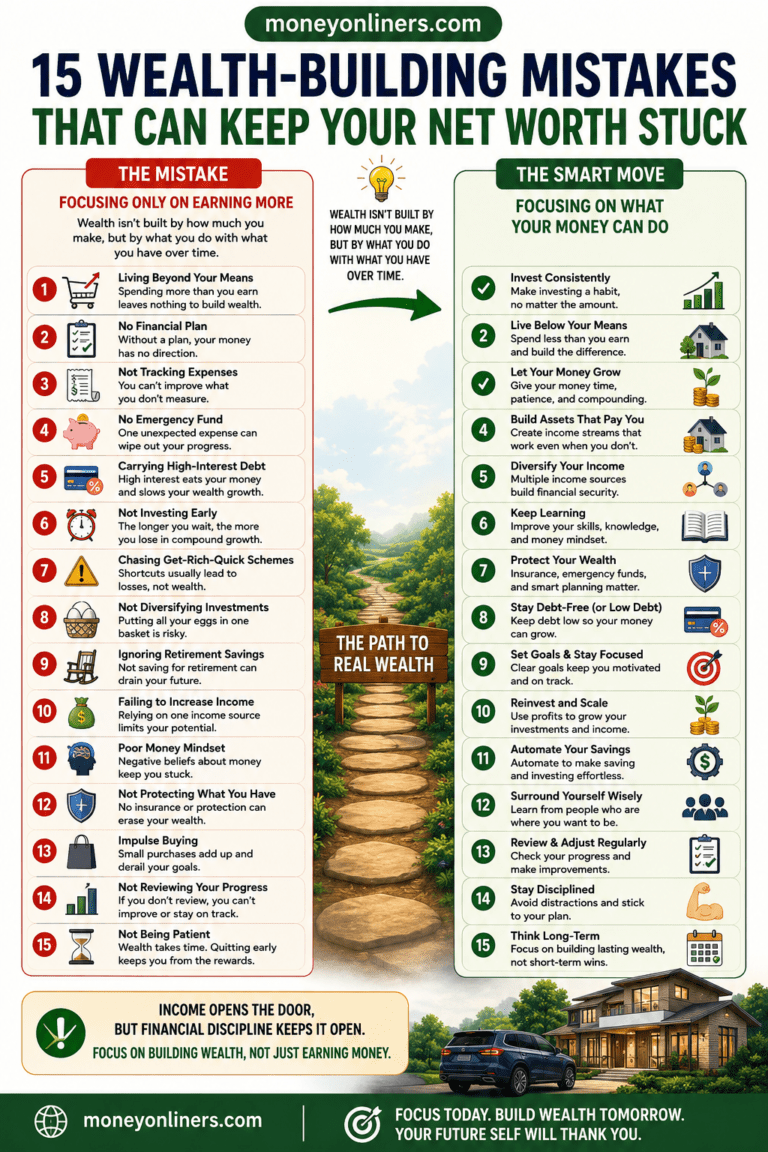
15 Wealth-Building Mistakes That Can Keep Your Net Worth Stuck
15 Wealth-Building Mistakes That Can Keep Your Net Worth Stuck | MoneyOnliners MoneyOnliners • Build Wealth → Avoid Costly Mistakes 15 Wealth-Building Mistakes That Can Keep Your Net Worth Stuck You can earn more money, receive raises and even invest occasionally while your net worth barely moves. Often, the problem is not one catastrophic financial…
Income vs Wealth: 10 Differences That Explain Why a High Salary Isn’t Everything
Income vs Wealth: 10 Differences That Explain Why a High Salary Isn’t Everything | MoneyOnliners MoneyOnliners • Build Wealth → Income vs Wealth Income vs Wealth: 10 Differences That Explain Why a High Salary Isn’t Everything A large salary can make life easier, but income alone does not tell you how financially strong someone is….
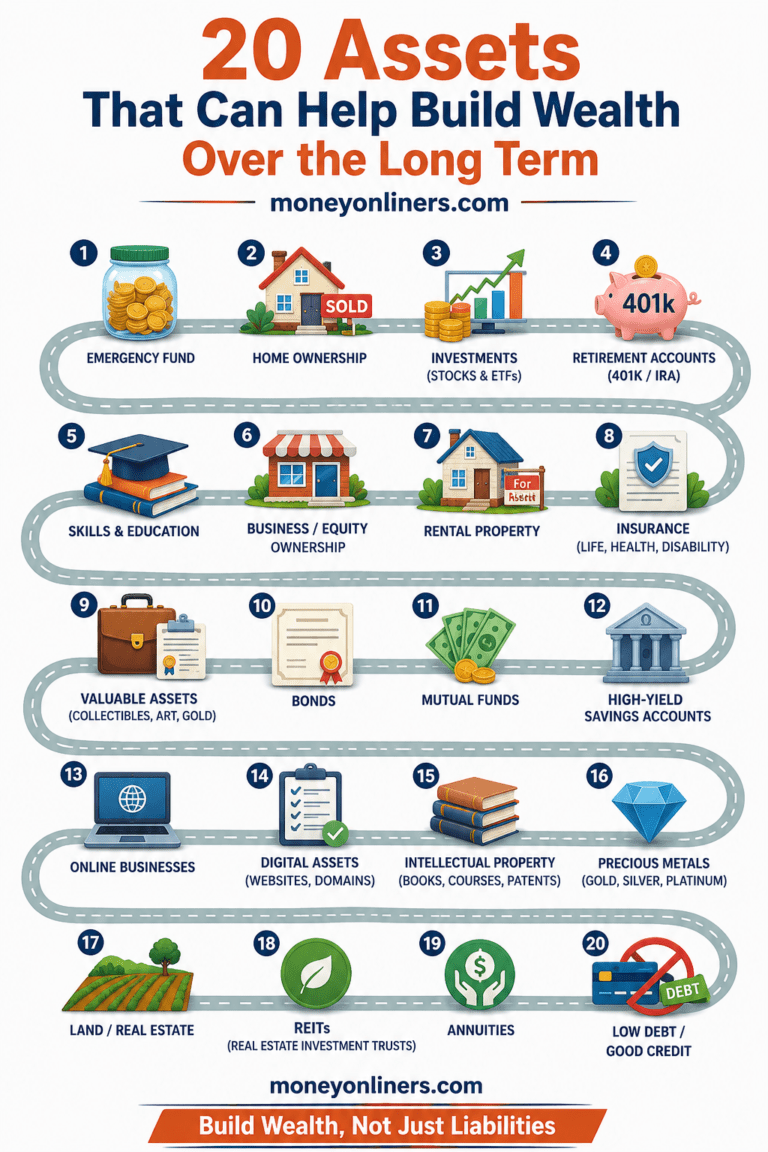
20 Assets That Can Help Build Wealth Over the Long Term
20 Assets That Can Help Build Wealth Over the Long Term | MoneyOnliners MoneyOnliners • Build Wealth → Productive Assets 20 Assets That Can Help Build Wealth Over the Long Term Long-term wealth is usually built by gradually converting part of your income into assets that can preserve value, generate cash flow, increase earning power…
Building Wealth in Your 20s, 30s, 40s and 50s: What Changes?
Building Wealth in Your 20s, 30s, 40s and 50s: What Changes? | MoneyOnliners MoneyOnliners • Build Wealth → Wealth by Decade Building Wealth in Your 20s, 30s, 40s and 50s: What Changes? The basic wealth-building formula does not completely change as you get older: earn, save, invest, protect your finances and give productive assets time…
15 Wealth-Building Strategies That Can Grow Your Money Over Time
15 Wealth-Building Strategies That Can Grow Your Money Over Time | MoneyOnliners MoneyOnliners • Build Wealth → Long-Term Growth 15 Wealth-Building Strategies That Can Grow Your Money Over Time In addition, Building wealth usually does not come from one perfect investment, one lucky business deal or one unusually high salary. More often, wealth grows when…




One Comment