10 Financial Planning Mistakes That Can Cost You Years of Progress
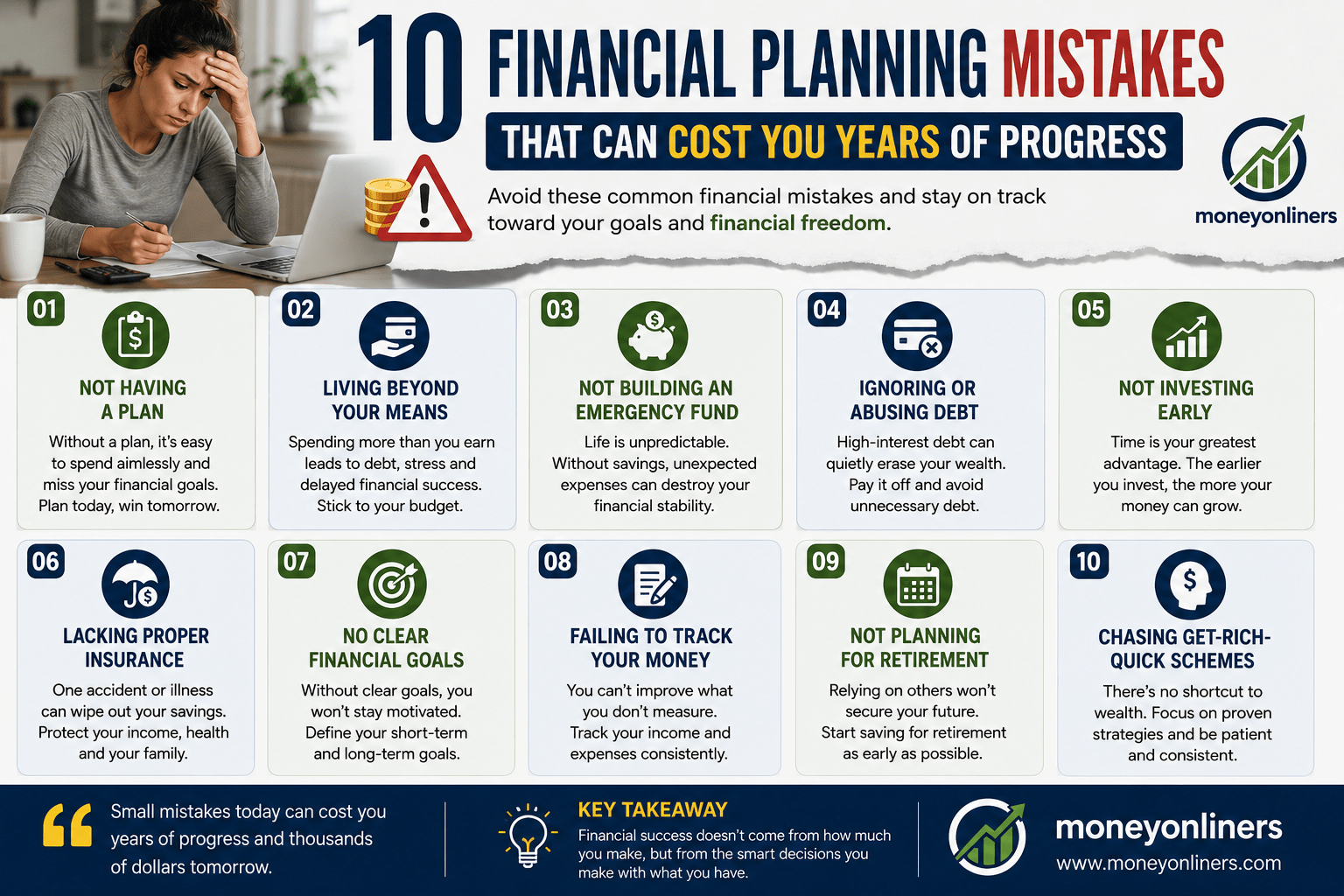
10 Financial Planning Mistakes That Can Cost You Years of Progress
Financial progress is not only about making good decisions. It is also about avoiding mistakes that quietly drain cash flow, delay investing, increase debt or leave major risks unprotected. Some errors may seem small in one month. However, repeated for five, ten or twenty years, they can materially change your financial future.
The most damaging financial planning mistakes usually involve delay, high-cost debt, inadequate cash reserves, unrealistic goals, weak insurance, poor investment discipline and failing to review the plan as life changes.
| # | Financial Planning Mistake | Possible Long-Term Effect |
|---|---|---|
| 1 | Waiting for the perfect time to start | Lost saving and compounding years |
| 2 | Ignoring cash flow | Goals remain underfunded |
| 3 | Carrying high-interest debt too long | Interest consumes future income |
| 4 | Skipping emergency savings | Unexpected costs create new debt |
| 5 | Saving without clear goals | Money lacks priority and purpose |
| 6 | Underinvesting for long-term goals | Slower asset and retirement growth |
| 7 | Letting lifestyle inflation absorb raises | Income rises without wealth rising |
| 8 | Ignoring insurance and protection | One major event can damage years of progress |
| 9 | Using unrealistic assumptions | Future goals appear easier than they really are |
| 10 | Never reviewing the plan | Old goals and strategies become outdated |
Financial mistakes become particularly expensive when they are repeated automatically. Therefore, correcting a weak system can matter more than making one perfect financial decision.
Table of Contents
Why Financial Planning Mistakes Can Cost You Years
A financial mistake does not always create an immediate crisis.
Instead, many errors work slowly.
A $300 Monthly Leak
Suppose $300 every month is repeatedly lost to avoidable debt interest, unused subscriptions or uncontrolled lifestyle spending.
Over One Year
$3,600
Over Five Years
$18,000
Over Ten Years
$36,000
That calculation ignores any investment growth the money might otherwise have earned.
Therefore, a recurring planning mistake can create both a direct cost and an opportunity cost.
1 Waiting for the Perfect Time to Start
Many people delay saving, investing or building a financial plan because their current income feels too small.
However, waiting for perfect finances can cost valuable years.
Example
Person A invests:
$300 per month for 30 years
Person B waits ten years and then invests:
$300 per month for 20 years
Direct Contributions
| Person | Years Contributing | Direct Contributions |
|---|---|---|
| A | 30 | $108,000 |
| B | 20 | $72,000 |
In addition, Person A gives the earliest contributions more time to potentially compound.
Start with an affordable amount now. Then increase it as income and cash flow improve.
2 Ignoring Monthly Cash Flow
A long-term financial plan cannot work if the monthly numbers do not support it.
Basic Formula
Example
Take-home income: $5,000
Total monthly spending: $4,850
Surplus: $150
A household with only $150 of monthly flexibility cannot realistically fund five large goals at once.
The Fix
First, measure actual spending.
Next, identify recurring expenses that provide limited value.
Meanwhile, look for ways to increase income.
Finally, direct the resulting surplus toward priority goals.
Financial planning begins with cash flow because almost every long-term goal ultimately depends on recurring monthly capacity.
3 Carrying High-Interest Debt for Too Long
High-interest debt can work directly against wealth building.
Example
Suppose you carry:
$8,000 of credit-card debt at 25% APR
The exact interest cost depends on payments and new charges. Nevertheless, a high rate can absorb substantial cash that might otherwise build savings or investments.
Why the Damage Compounds
Interest reduces current cash flow.
As a result, emergency savings can grow more slowly.
Then future emergencies may require more borrowing.
Build enough emergency savings to reduce the chance of immediate re-borrowing, then make expensive debt reduction a major priority.

4 Skipping Emergency Savings
An investment plan without emergency savings can be fragile.
Imagine This
You invest regularly for several years.
Then an unexpected repair, medical expense or job interruption occurs.
Without accessible savings, you may need to borrow or sell investments at an inconvenient time.
A Better Sequence
Emergency Savings Can Protect
- Retirement accounts
- Investment portfolios
- Debt payoff plans
- Monthly cash flow
- Major future goals
Emergency savings does not replace investing. Instead, it helps protect your ability to continue investing when life becomes expensive.
5 Saving Without Clear Financial Goals
Saving money is useful, but a savings account without a purpose can become difficult to manage.
Instead of One Generic Savings Balance
Separate money by purpose where practical.
| Goal | Target | Timeline |
|---|---|---|
| Emergency fund | $12,000 | 24 months |
| Vehicle replacement | $15,000 | 4 years |
| Home down payment | $50,000 | 7 years |
| Retirement | Long-term portfolio goal | 20+ years |
Why This Helps
Specific goals make it easier to decide how much to save and how much risk the money can tolerate.
Give each important dollar a job, target amount and approximate deadline.
6 Underinvesting for Long-Term Goals
Cash is useful for emergencies and near-term spending.
However, keeping every long-term dollar in cash can create another risk: losing purchasing power over time.
Long-Term Goals May Include
- Retirement
- Financial independence
- Long-term wealth building
- Education many years away
Why Time Matters
A longer investment horizon may provide more time to recover from market declines.
Therefore, suitable diversified investments can play an important role for some long-term goals.
Investment values can decline, and the appropriate asset mix depends on time horizon, risk tolerance and personal circumstances.
7 Letting Lifestyle Inflation Absorb Every Raise
Higher income creates an opportunity to improve both current life and future financial strength.
Unfortunately, many households allow spending to rise almost as quickly as income.
Example
Monthly take-home pay rises by:
$800
Possible Allocation
| Use | Amount |
|---|---|
| Retirement | $250 |
| Emergency / sinking funds | $150 |
| Long-term investing | $150 |
| Lifestyle improvement | $250 |
The exact split is personal. Nevertheless, automatically assigning part of each raise to future goals can prevent savings from remaining flat for decades.
8 Ignoring Insurance and Financial Protection
Building assets is only one side of financial planning.
Protecting those assets and the income that creates them also matters.
Depending on Your Situation, Review
- Health insurance
- Auto insurance
- Homeowners or renters insurance
- Life insurance
- Disability coverage
- Liability protection
Why Protection Matters
A household may spend years building savings but still be vulnerable to one uninsured event.
Therefore, appropriate insurance can function as part of the financial plan rather than as a separate administrative task.

9 Using Unrealistic Financial Assumptions
A financial plan can look excellent on paper when the assumptions are too optimistic.
Common Unrealistic Assumptions
- Income will rise every year
- Investments will earn the same return every year
- Housing costs will not increase
- Healthcare will remain inexpensive
- No major emergency will occur
- Retirement spending will be very low
Example
If a retirement plan only works when investments earn 12% every year, the plan may be too dependent on optimistic assumptions.
Use Scenarios Instead
| Scenario | Question |
|---|---|
| Conservative | What happens if returns or income are lower? |
| Base case | What happens under reasonable assumptions? |
| Strong outcome | What if income or returns are better? |
A stronger plan can survive imperfect outcomes rather than requiring everything to go exactly right.
10 Never Reviewing Your Financial Plan
Your life can change significantly in one year, let alone ten.
Review After
- A raise
- Job loss
- Marriage
- Childbirth
- Home purchase
- Major debt payoff
- Business launch
- Retirement approaching
Annual Review Questions
- Did income increase?
- Did spending change?
- Did net worth improve?
- Is emergency savings sufficient?
- Are major debts shrinking?
- Are retirement contributions adequate?
- Have beneficiaries changed?
- Are upcoming expenses funded?
How to Recover If You Have Made Several Financial Planning Mistakes
Discovering several problems at once can feel overwhelming.
However, you do not need to fix everything simultaneously.
Step 1: Stop New Damage
Prevent additional high-interest debt and unnecessary financial leakage.
Step 2: Stabilize Cash Flow
Make sure essential spending is consistently covered.
Step 3: Build a Cash Buffer
Create enough emergency savings to reduce immediate fragility.
Step 4: Attack Expensive Debt
Prioritize liabilities that create the greatest recurring cost.
Step 5: Restart Long-Term Contributions
Once the foundation improves, strengthen investing and retirement saving.
Step 6: Increase Income
Career growth, qualifications, business or side income can accelerate recovery.
Step 7: Review Every Year
Measure progress and redirect money as each problem is solved.
MoneyOnliners Original Analysis: The Progress Leak Test
MoneyOnliners Recovery Priority Map
MoneyOnliners Progress Cost Formula
The MoneyOnliners Progress Leak Test, Recovery Priority Map and Progress Cost Formula are original educational frameworks designed to help readers identify recurring financial weaknesses and decide which problems deserve attention first.
MoneyOnliners Financial Planning Recovery Scorecard
| Question | Stronger Direction |
|---|---|
| Is monthly cash flow positive? | Yes |
| Is emergency savings growing? | Yes |
| Is high-interest debt declining? | Yes |
| Are financial goals clearly defined? | Yes |
| Are long-term contributions recurring? | Yes where appropriate |
| Does saving increase when income rises? | Preferably |
| Are major risks reviewed? | Yes |
| Are assumptions realistic? | Preferably conservative |
| Is net worth reviewed? | At least annually |
| Is the financial plan updated? | Yes |
MoneyOnliners Research-Based Evidence Note
This article is a research-based guide to common financial planning mistakes.
The framework combines widely used personal-finance principles involving cash flow, emergency savings, high-interest debt, saving, long-term investing, diversification, insurance and periodic financial reviews.
Illustrative calculations are intentionally simple so readers can see how recurring costs and delays can accumulate over time.
Investment examples do not guarantee future returns.
The Progress Leak Test, Recovery Priority Map, Progress Cost Formula and Financial Planning Recovery Scorecard are original MoneyOnliners educational resources.
No personal debt payoff, investment performance, insurance claim or financial recovery outcome is claimed in this article.
Why Avoiding Financial Planning Mistakes Matters
1. First, financial progress depends on both good decisions and avoided mistakes.
2. Delay can reduce the number of years available for saving and investing.
3. Meanwhile, weak cash flow can prevent even a strong long-term plan from being funded.
4. High-interest debt can consume future income.
5. Therefore, expensive liabilities deserve serious attention.
6. Emergency savings can reduce the need for new borrowing.
7. Clear goals help determine how much to save and when.
8. Long-term goals may require investment growth as well as cash saving.
9. However, investment returns should never be treated as guaranteed.
10. Lifestyle inflation can weaken the value of future raises.
11. In addition, insurance can protect years of accumulated progress.
12. Unrealistic assumptions can make an underfunded plan appear healthy.
13. Scenario planning can expose weak assumptions earlier.
14. Annual reviews help redirect money toward changing priorities.
15. Income growth can accelerate recovery from earlier mistakes.
16. Net-worth tracking can reveal whether the overall balance sheet is improving.
17. Small monthly leaks can become large multi-year costs.
18. Nevertheless, discovering a mistake late is still better than never correcting it.
19. Strong financial systems can improve gradually rather than perfectly.
20. Ultimately, avoiding major financial planning mistakes matters because every dollar, year and decision preserved can be redirected toward savings, investments, retirement, lower debt and greater long-term financial flexibility.
Incoming Link Opportunities
10 Steps to Build a Long-Term Financial Plan That Can Grow With You
https://moneyonliners.com/long-term-financial-plan/
10-Year Financial Plan: What Should You Actually Be Planning For?
https://moneyonliners.com/10-year-financial-plan/
25 Financial Goals Worth Setting for the Next 1, 5 and 10 Years
https://moneyonliners.com/financial-goals/
How Much Should You Save Every Month for Your Future?
https://moneyonliners.com/how-much-should-you-save-every-month/
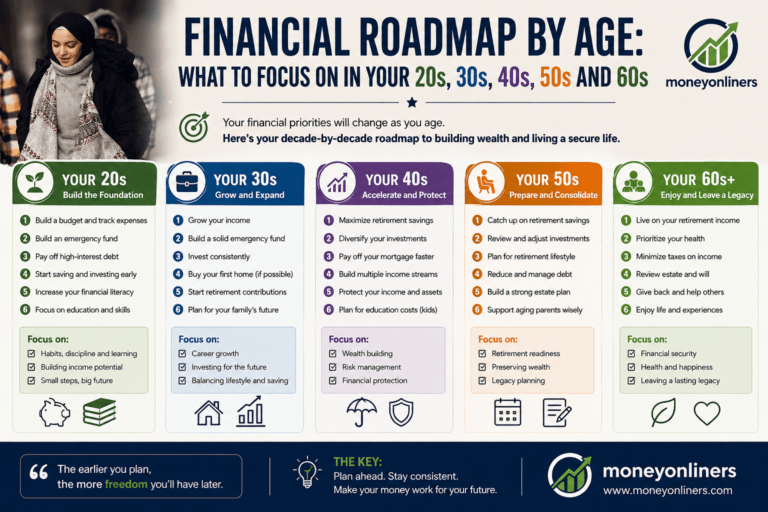
Financial Roadmap by Age: What to Focus on in Your 20s, 30s, 40s, 50s and 60s
https://moneyonliners.com/financial-roadmap-by-age/
High-Priority Incoming Links
15 Wealth-Building Mistakes That Can Keep Your Net Worth Stuck
https://moneyonliners.com/wealth-building-mistakes/
10 Retirement Planning Mistakes That Could Cost You Years of Savings
https://moneyonliners.com/retirement-planning-mistakes/
10 Net Worth Mistakes That Can Make You Think You're Richer Than You Are
https://moneyonliners.com/net-worth-mistakes/
10 Compound Interest Mistakes That Can Give You Unrealistic Expectations
https://moneyonliners.com/compound-interest-mistakes/
Topic Cluster Incoming Links
How to Build Wealth From Nothing: 10 Steps for Beginners
https://moneyonliners.com/how-to-build-wealth-from-nothing/
How to Calculate Your Net Worth in 5 Simple Steps
https://moneyonliners.com/how-to-calculate-net-worth/
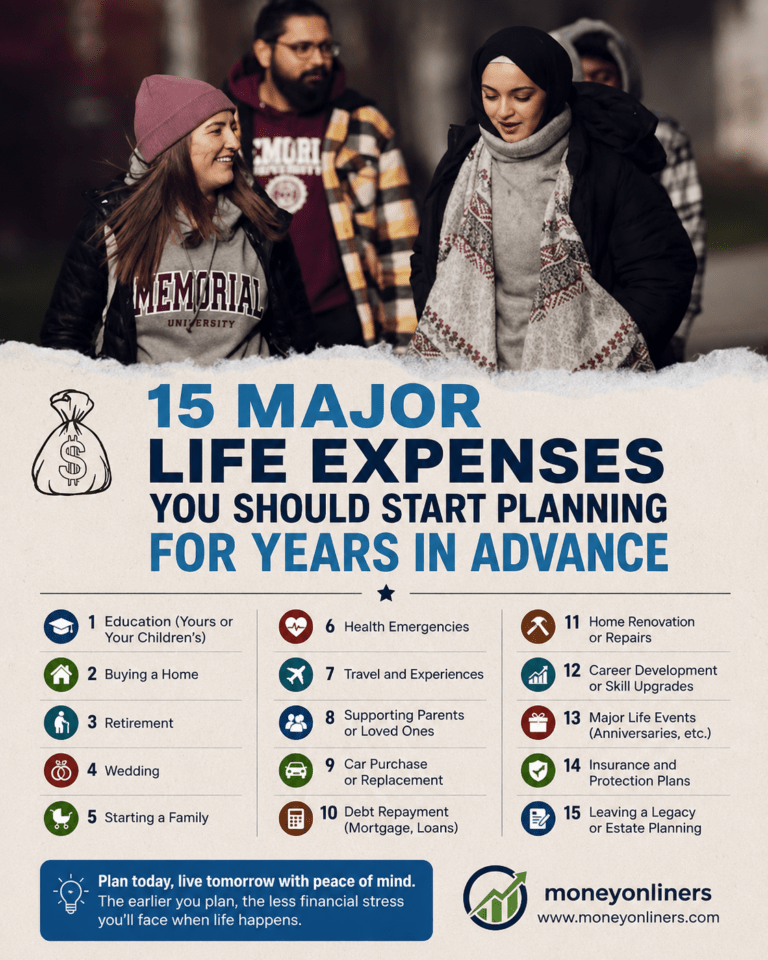
15 Major Life Expenses You Should Start Planning for Years in Advance
https://moneyonliners.com/major-life-expenses/
Starting Retirement Savings Late? 10 Moves That Can Help You Catch Up
https://moneyonliners.com/starting-retirement-savings-late/
Continue Learning on MoneyOnliners
Recommended External Resources
1. Investor.gov — Save and Invest
Save and Invest — Investor.gov
Provides educational guidance on financial goals, savings, high-interest debt, investing and risk.
2. Investor.gov — Define Your Goals
Define Your Goals — Investor.gov
Helps investors connect financial goals with realistic time horizons.
3. Investor.gov — Asset Allocation and Diversification
Asset Allocation and Diversification — Investor.gov
Explains why time horizon and risk tolerance can influence investment decisions.
4. Investor.gov — Compound Interest Calculator
Compound Interest Calculator — Investor.gov
Useful for testing different contribution amounts and long-term growth assumptions.
5. Consumer Financial Protection Bureau — Saving
Saving — Consumer Financial Protection Bureau
Provides consumer resources for building savings and financial resilience.
6. Consumer Financial Protection Bureau — Emergency Fund Guide
An Essential Guide to Building an Emergency Fund — CFPB
Explains why dedicated cash savings can help households absorb unexpected expenses.
7. Federal Trade Commission — Investment Scams
Investment Scams — Federal Trade Commission
Explains common warning signs involving guaranteed returns and unrealistic investment promises.
8. IRS — Retirement Plans
Provides official information about U.S. retirement accounts, contribution rules and plan requirements.
9. Social Security Administration — Retirement
Retirement Benefits — Social Security Administration
Provides official U.S. information about retirement benefits and claiming considerations.
This article provides general educational information and is not individualized financial, investment, retirement, insurance, tax or legal advice. Debt rates, investment risks, insurance needs, retirement rules and financial circumstances vary. Consider qualified professional advice when your situation requires individualized guidance.
Frequently Asked Questions
What are the biggest financial planning mistakes?
The biggest mistakes usually involve delay, poor cash flow, high-interest debt and inadequate emergency savings.
In addition, weak long-term investing can slow future asset growth.
Ignoring insurance can create serious financial vulnerability.
Unrealistic assumptions may also make a weak plan look stronger than it is.
Finally, never reviewing the plan can allow outdated decisions to continue for years.
What financial mistake can cost the most?
There is no universal answer.
However, carrying expensive debt for many years can be particularly costly.
Starting long-term investing very late can also create a significant opportunity cost.
Meanwhile, being seriously underinsured can expose accumulated assets to large losses.
The most damaging mistake depends on your own financial position.
Is starting to invest late a serious mistake?
Starting later reduces the amount of time available for contributions and potential compounding.
However, continuing to delay creates an even shorter timeline.
Therefore, a later start should lead to action rather than discouragement.
Higher contributions can sometimes help compensate.
Income growth and a later retirement date can also improve the plan.
Should I save before paying off debt?
A modest emergency reserve can be useful before aggressively paying debt.
Otherwise, a small emergency may create new borrowing immediately.
Afterward, very high-interest debt can deserve strong attention.
An employer retirement match may also affect the order of priorities.
Therefore, financial sequencing can be more useful than an all-or-nothing rule.
How much emergency savings should I have?
There is no universal amount.
Start with a smaller buffer if necessary.
Then work toward one month of essential expenses.
Over time, several months may provide greater resilience.
Households with variable income may prefer a larger reserve.
Is keeping all my money in cash a financial planning mistake?
Not necessarily for short-term needs.
Cash is important for emergencies and planned expenses.
However, money intended for goals decades away may face inflation risk if it never earns meaningful growth.
Therefore, long-term investing may be appropriate for some goals.
Risk tolerance and time horizon should guide the decision.
Is lifestyle inflation always bad?
No.
Enjoying some benefit from higher income is reasonable.
The problem occurs when every raise becomes permanently higher spending.
As a result, income rises while savings remain unchanged.
Directing part of each raise toward future goals can create a healthier balance.
Why is insurance part of financial planning?
Insurance can protect against losses that would otherwise be difficult to absorb.
For example, medical costs, property damage or loss of income can disrupt long-term plans.
The appropriate coverage differs by household.
Nevertheless, protection becomes increasingly important as assets and responsibilities grow.
Therefore, insurance deserves periodic review.
How often should I review my financial plan?
An annual review can be useful for many households.
In addition, review the plan after major life changes.
A raise may allow higher saving.
Marriage or children may change insurance needs.
Retirement approaching may require a completely different investment and income strategy.
What if my financial plan depends on high investment returns?
That can make the plan fragile.
Investment returns are uncertain.
Therefore, use more than one scenario.
Test what happens under lower returns.
If the plan fails under modestly weaker assumptions, higher contributions or lower future spending may be needed.
How do I know if I am making financial progress?
Track more than one number.
Monthly cash flow should improve or remain stable.
Emergency savings can grow.
Debt can decline while assets increase.
Net worth can then provide a broader measure of long-term direction.
Can financial planning mistakes be corrected later?
Yes.
However, some mistakes become more expensive the longer they continue.
Start by stopping new damage.
Then stabilize cash flow and reduce expensive debt.
Afterward, rebuild long-term savings and investments.
What if I am already behind financially?
Focus on your current numbers rather than someone else's milestones.
Increase savings where possible.
Reduce expensive debt.
Look for income-growth opportunities.
Then build a realistic plan from today forward.
Should I use financial rules such as 50/30/20?
Rules can provide a useful starting structure.
However, they should not override your actual circumstances.
Housing costs, debt and family needs differ substantially.
Therefore, use rules as guides rather than laws.
A personalized cash-flow plan is usually more useful.
What is the best way to avoid financial planning mistakes?
Measure your current financial position first.
Next, identify clear goals.
Build emergency savings and control expensive debt.
Then save and invest consistently for longer-term goals.
Finally, review the plan every year and adjust it as your life changes.
Research Methodology
Mistake Selection
MoneyOnliners selected ten mistakes that can repeatedly reduce cash flow, slow asset growth, increase financial fragility or delay long-term goals.
Planning Areas Reviewed
The article considers cash flow, debt, emergency savings, financial goals, investing, income growth, insurance, assumptions and periodic plan reviews.
Illustrative Calculations
Examples use simple arithmetic so readers can see how recurring monthly costs accumulate over several years.
Investment Risk
No fixed investment return is presented as guaranteed.
Instead, the article emphasizes time horizon, diversification and scenario planning.
Original MoneyOnliners Analysis
The Progress Leak Test, Recovery Priority Map, Progress Cost Formula and Financial Planning Recovery Scorecard are original MoneyOnliners educational resources.
First-Hand Evidence Standard
MoneyOnliners only presents genuine personal debt balances, investment histories, insurance records, account screenshots or financial-plan outcomes when verifiable first-hand evidence exists.
Accordingly, no personal financial recovery result is claimed in this article.
Limitations
Financial circumstances vary by income, location, debt, family structure, insurance coverage and risk tolerance.
In addition, investment returns and financial regulations can change. Therefore, the article should be treated as an educational framework rather than individualized advice.
Google Search Console Checklist
- Confirm final URL: /financial-planning-mistakes/
- Confirm canonical matches the published URL.
- Use financial planning mistakes naturally in the title, introduction, FAQ and conclusion.
- Use related phrases naturally: common financial mistakes, money planning mistakes, financial mistakes to avoid, personal finance mistakes and long-term financial planning errors.
- Use real planning or paperwork imagery in the hero.
- Use debt imagery only in the debt section.
- Use family imagery around insurance and protection.
- Use retirement imagery around long-term planning.
- Avoid repeating calculators or cash stacks.
- Keep every image alt description unique.
- Confirm Recommended External Resources contains 6–10 authoritative links.
- Check all internal links.
- Check all tables carefully on mobile.
- Confirm article is indexable.
- Confirm URL appears in XML sitemap.
- Inspect the published URL in Google Search Console.
- Request indexing after publication if appropriate.
- Monitor “financial planning mistakes.”
- Monitor “common financial mistakes.”
- Monitor “financial mistakes to avoid.”
- Monitor “personal finance mistakes.”
- Monitor “financial planning errors.”
Conclusion: Fix the System Before the Mistake Costs Another Year
The most expensive financial planning mistakes are often the ones allowed to continue quietly.
Delay Costs Time
Starting later means fewer years for saving and potential compound growth.
High-Interest Debt Costs Cash Flow
Interest can consume money that could otherwise build your future.
No Emergency Fund Creates Fragility
One unexpected bill can force new borrowing or investment withdrawals.
Unclear Goals Create Drift
Money without a purpose is easier to redirect toward less important spending.
Weak Protection Creates Risk
Insurance and emergency reserves can protect years of accumulated progress.
Unrealistic Assumptions Create False Confidence
A plan should remain workable even when life or markets are less favorable than expected.
Start With the Biggest Leak
Measure cash flow first.
Next, identify expensive debt and financial fragility.
Then strengthen emergency savings.
Afterward, increase long-term saving and investing.
Meanwhile, grow income where possible.
Finally, review the plan every year.