Where Could You Be Financially in 10 Years? 15 Decisions That Matter Today
Where Could You Be Financially in 10 Years? 15 Decisions That Matter Today
Ten years is long enough for ordinary financial decisions to create extraordinary differences. Saving consistently, avoiding expensive debt, increasing income and investing regularly may not transform your finances next month. However, repeated across an entire decade, those decisions can influence your emergency savings, retirement balance, net worth, debt level and freedom to make major life choices.
Where you could be financially in ten years depends less on one brilliant decision and more on the financial behaviors you repeat.
For example, consistently creating positive cash flow, building emergency savings, eliminating expensive debt, increasing income and investing for long-term goals can gradually reshape your balance sheet.
| # | Decision Today | Possible 10-Year Effect |
|---|---|---|
| 1 | Know your current financial position | Better decisions and measurable progress |
| 2 | Create positive monthly cash flow | More money available for every goal |
| 3 | Build emergency savings | Greater resilience and less crisis borrowing |
| 4 | Eliminate high-interest debt | More cash flow available for wealth building |
| 5 | Start investing consistently | More time for potential compound growth |
| 6 | Increase contributions over time | Faster accumulation of productive assets |
| 7 | Grow your income | Greater long-term financial capacity |
| 8 | Control lifestyle inflation | Raises translate into wealth rather than only spending |
| 9 | Plan major expenses early | Less dependence on debt |
| 10 | Choose housing carefully | Lower risk of becoming financially stretched |
| 11 | Protect major financial risks | Less chance one event destroys years of progress |
| 12 | Track net worth | Clear measurement of long-term direction |
| 13 | Build more than one useful asset | Greater financial resilience |
| 14 | Review the plan annually | Fewer years spent following an outdated strategy |
| 15 | Choose flexibility over appearances | More future financial freedom |
Your financial position ten years from now will probably reflect thousands of ordinary decisions rather than one perfect investment or one unusually lucky event.
Table of Contents
Why Ten Years Can Change So Much Financially
Ten years equals 120 months of opportunities to save, invest, reduce debt and increase income.
Consider a $500 Monthly Decision
Putting aside $500 every month creates direct contributions of:
That is before considering any investment gains or losses.
Now Consider Income Growth
An additional $1,000 of sustainable monthly income could create up to:
of additional gross financial capacity over ten years before considering taxes, expenses or future income changes.
Debt Works the Other Direction
High-interest balances can redirect money away from saving and investing for years.
1 Know Where You Are Financially Today
A ten-year financial transformation starts with an accurate starting point.
Record Four Numbers
- Monthly take-home income
- Monthly spending
- Total assets
- Total liabilities
Calculate Cash Flow
Calculate Net Worth
Example
Assets: $45,000
Liabilities: $32,000
Net worth: $13,000
That number does not judge your financial success. Instead, it gives you a baseline against which future progress can be measured.
Measure your starting position instead of guessing whether you are progressing.
2 Create Positive Monthly Cash Flow
Long-term goals require recurring financial capacity.
Example
Take-home income: $5,500
Total spending: $5,100
Monthly surplus: $400
That $400 can begin funding emergency savings, debt reduction and investments.
Increase the Surplus
If the surplus later reaches $900 monthly, your annual capacity becomes:
Consequently, improving cash flow can affect nearly every financial goal at once.
A strong ten-year plan usually begins with consistently spending less than the household brings in.
3 Build Emergency Savings Before Life Tests the Plan
Unexpected expenses can interrupt even a strong long-term strategy.
A Starter Goal
Begin with a smaller reserve that can absorb modest financial shocks.
A Stronger Goal
Over time, consider building several months of essential expenses based on household risk and income stability.
Example
Essential expenses:
$3,500 per month
Three months would equal:
$10,500
Emergency savings may not produce an exciting return. However, it can protect your debt-payoff, retirement and investment plans from being disrupted by unexpected costs.
4 Eliminate High-Interest Debt
Expensive debt can compete directly with wealth building.
Example
Credit-card balance: $8,000
APR: 25%
The exact cost depends on payments and additional charges. Nevertheless, leaving a high-rate balance outstanding can consume substantial future cash flow.
After the Balance Reaches Zero
Suppose the old debt payment was:
$450 per month
Redirecting that money creates:
of new capacity for savings or investing.

5 Start Investing Consistently
For suitable long-term goals, regular investing can give your money more opportunity to grow than waiting for a perfect market entry point.
Example
Invest:
$300 every month
Direct Contributions After 10 Years
If investments produce positive long-term returns, the ending value could be higher. However, markets fluctuate and losses are possible.
The Important Decision
Rather than trying to predict every market movement, establish a recurring contribution appropriate for your goal and risk tolerance.
Money needed soon generally should not be exposed to the same level of investment volatility as money intended for goals decades away.
6 Increase Your Contributions Instead of Leaving Them Frozen
Starting matters, but contribution growth can matter too.
Example Savings Escalator
| Period | Monthly Contribution |
|---|---|
| Years 1–2 | $200 |
| Years 3–4 | $300 |
| Years 5–6 | $450 |
| Years 7–8 | $600 |
| Years 9–10 | $750 |
This is only an illustration. Still, the principle is powerful: contribution increases can accompany raises, debt payoff and lower expenses.
Whenever your financial capacity improves, consider increasing the amount directed toward your future.
7 Grow Your Income Deliberately
There is a limit to how much spending can be cut, whereas earning power may have more room to grow.
Possible Income-Growth Decisions
- Build a higher-value skill
- Gain a useful qualification
- Negotiate compensation
- Change employers strategically
- Freelance
- Consult
- Start or grow a business
Example
Increasing take-home income by:
$750 per month
creates up to:
of additional capacity before considering changing taxes or expenses.
If part of that increase is saved rather than fully spent, income growth can accelerate several goals simultaneously.

8 Control Lifestyle Inflation
Higher income should improve your life. However, if every raise immediately becomes higher recurring spending, wealth may barely change.
Example Raise
$1,000 additional monthly take-home income
Possible Allocation
| Use | Amount |
|---|---|
| Retirement | $300 |
| Investing | $200 |
| Major future goal | $200 |
| Lifestyle improvement | $300 |
This approach allows your current life and future financial position to improve together.
9 Plan Major Expenses Before They Become Urgent
A future home, car, education cost or business launch can be easier to fund when the expense is identified years beforehand.
Example
Future expense:
$30,000
Time available:
5 years
Monthly Requirement
If you wait until only 12 months remain, the required amount becomes $2,500 per month.
Time does not reduce the actual cost. Instead, it spreads the funding burden across more paychecks.
10 Make Housing Decisions Carefully
Housing can become one of the largest recurring expenses in a financial plan.
Consider More Than the Purchase Price
- Mortgage or rent
- Property taxes
- Insurance
- Maintenance
- Utilities
- Repairs
- Transportation consequences
A Bigger Home Has an Opportunity Cost
An additional $700 of monthly housing costs equals:
over ten years before considering rent increases, financing costs or investment opportunity cost.
This does not mean buying a more expensive home is automatically wrong. It means housing decisions should be evaluated against retirement, emergency savings, travel, family and other goals.

11 Protect Against Major Financial Risks
Building wealth without protecting important risks can leave the financial plan vulnerable.
Depending on Your Situation, Review
- Health insurance
- Auto insurance
- Homeowners or renters insurance
- Life insurance
- Disability coverage
- Liability protection
Why This Matters Over Ten Years
One serious uninsured event can require savings that took years to accumulate.
Therefore, financial protection deserves periodic attention as income, assets and family responsibilities grow.

12 Track Your Net Worth
Income tells you what you earn. Net worth helps show what your financial decisions have built.
Example Starting Position
Assets: $80,000
Liabilities: $65,000
Net worth: $15,000
Possible 10-Year Goal
Reach $150,000 of net worth
That increase could come from saving, investing, home equity, business assets and lower debt.
Track your own trend rather than treating another household's age or net-worth benchmark as a personal judgment.
13 Build More Than One Useful Asset
Long-term financial strength can improve when wealth is not dependent on one source of value.
Useful Assets May Include
- Emergency cash
- Retirement accounts
- Diversified investments
- Home equity
- Business equity
- Income-producing assets
Do Not Confuse Assets With Consumption
Buying more expensive possessions does not automatically strengthen net worth.
14 Review Your Financial Plan Every Year
A ten-year financial plan should not remain unchanged for ten years.
Review Annually
- Income
- Spending
- Emergency savings
- Debt balances
- Retirement contributions
- Investment allocation
- Insurance
- Net worth
- Major upcoming expenses
- Beneficiaries and estate documents
Why Annual Reviews Matter
A raise can justify larger contributions. Meanwhile, a job loss may temporarily shift the priority toward liquidity.
Likewise, marriage, children, business ownership or approaching retirement can materially change what deserves attention.
A plan becomes more useful when it changes as better information becomes available.
15 Choose Financial Flexibility Over Financial Appearances
One of the most powerful ten-year decisions may be refusing to build your financial life around looking successful.
Financial Appearance Can Encourage
- Oversized housing costs
- Frequent vehicle upgrades
- Consumer debt
- Lifestyle inflation
- Low saving despite high income
Financial Flexibility Can Create
- Emergency reserves
- Lower debt
- Investment assets
- Career freedom
- Business opportunities
- Earlier retirement options
Where Could Three Different People Be in 10 Years?
The examples below are illustrative. They are not predictions or guarantees.
Scenario A: The Financial Drift Path
- No emergency fund
- Credit-card balances continue
- Income rises but spending rises equally
- Retirement contributions remain minimal
- Major purchases are financed
Ten years later, income may be higher while net worth has changed surprisingly little.
Scenario B: The Foundation Path
- Emergency fund built
- High-interest debt eliminated
- Regular retirement contributions
- Major expenses planned
- Savings rise after raises
After a decade, this person could have greater resilience, lower debt and substantially more assets.
Scenario C: The Accelerated Path
- Strong income growth
- Controlled lifestyle inflation
- High savings rate
- Regular diversified investing
- Business or additional productive assets
This path may produce faster progress. However, higher saving or investing rates are not automatically appropriate for everyone.
| Area | Drift Path | Foundation Path | Accelerated Path |
|---|---|---|---|
| Emergency savings | Low | Strong | Strong |
| Consumer debt | Persistent | Low | Low |
| Investments | Limited | Recurring | Higher recurring contributions |
| Income | Higher but absorbed | Higher with partial saving | Actively grown |
| Financial flexibility | Limited | Improving | Potentially substantial |
MoneyOnliners Original Analysis: The Future Position Map
MoneyOnliners 10-Year Direction Formula
MoneyOnliners Decision Compounding Framework
The MoneyOnliners Future Position Map, 10-Year Direction Formula and Decision Compounding Framework are original educational resources designed to help readers evaluate whether today's recurring financial decisions are moving them toward greater stability, assets and flexibility over the next decade.
MoneyOnliners 10-Year Decision Scorecard
| Question | Stronger 10-Year Direction |
|---|---|
| Is monthly cash flow positive? | Yes |
| Is the monthly surplus increasing? | Preferably |
| Is emergency savings growing? | Yes |
| Is high-interest debt falling? | Yes |
| Are retirement contributions recurring? | Yes |
| Do contributions rise after raises? | Preferably |
| Is income growing? | Preferably |
| Are major expenses planned early? | Yes |
| Is net worth improving? | Over time |
| Are productive assets increasing? | Yes |
| Are major risks protected? | Where appropriate |
| Is the plan reviewed annually? | Yes |
How to Use the Scorecard
Do not aim for perfection.
Instead, identify the two or three weakest areas and make them the next financial priorities.
MoneyOnliners Research-Based Evidence Note
This article is a research-based ten-year financial planning guide.
Investor education guidance supports linking financial goals to time horizons and creating a plan that fits the period available to reach each goal.
Long-term investing guidance also emphasizes regular contributions, time and the importance of understanding risk rather than assuming investment outcomes are guaranteed.
The article therefore distinguishes emergency and near-term savings from money intended for longer-term investment goals.
The Future Position Map, 10-Year Direction Formula, Decision Compounding Framework and 10-Year Decision Scorecard are original MoneyOnliners educational resources.
All financial scenarios are hypothetical illustrations. No personal ten-year investment, debt-payoff, income-growth or net-worth result is claimed.
10 Decisions That Can Move You Backward Over the Next 10 Years
1. Waiting for the Perfect Time to Begin
Delay reduces the time available to build savings, investments and financial habits.
2. Carrying Expensive Consumer Debt Indefinitely
High interest can redirect thousands of dollars away from future goals.
3. Spending Every Raise
Income can double while financial flexibility barely improves if expenses increase equally.
4. Keeping No Emergency Savings
Unexpected costs can repeatedly create new debt.
5. Financing Every Major Purchase
Long-term payment obligations can gradually reduce future cash flow.
6. Never Increasing Retirement Contributions
A contribution amount set years ago may become too small as income and goals change.
7. Assuming Investment Returns Are Guaranteed
Financial plans should remain workable when markets perform differently from expectations.
8. Ignoring Insurance
One major uninsured loss can damage years of accumulated progress.
9. Measuring Success Only by Income
A high salary does not automatically create a high net worth.
10. Never Reviewing the Plan
An outdated strategy can continue wasting years after circumstances change.
However, ten years of deliberate improvement can also be powerful. The direction can begin changing with the next recurring decision.
Why Financial Decisions That Matter Today Can Change the Next Decade
1. First, small recurring decisions can accumulate over many years.
2. Positive cash flow creates capacity for future goals.
3. Meanwhile, emergency savings can reduce dependence on new debt.
4. High-interest debt can consume money that could otherwise build assets.
5. Therefore, eliminating expensive debt can strengthen future cash flow.
6. Regular investing gives long-term money more time to work.
7. However, investment returns remain uncertain.
8. Increasing contributions can accelerate asset growth.
9. Income growth creates additional financial capacity.
10. Lifestyle inflation can absorb that capacity if it is not controlled.
11. In addition, early planning can make large future expenses easier to fund.
12. Housing decisions can affect cash flow for many years.
13. Appropriate insurance can protect accumulated progress.
14. Net-worth tracking can reveal whether assets are actually increasing.
15. Multiple useful assets can improve long-term resilience.
16. Annual reviews help correct problems before another decade passes.
17. Choosing flexibility can reduce dependence on one paycheck or job.
18. Redirecting completed debt payments can accelerate future goals.
19. Ultimately, financial strength is often built gradually rather than suddenly.
20. Therefore, the financial decisions that matter today can influence whether the next ten years produce greater debt and pressure or stronger cash flow, larger assets, higher net worth and more financial choices.
Continue Learning on MoneyOnliners
Recommended External Resources
1. Investor.gov — Define Your Goals
Define Your Goals — Investor.gov
Provides guidance on identifying important financial goals and connecting each goal with an appropriate time frame.
2. Investor.gov — Time Horizon
Explains the role of months, years or decades in planning for an investment goal.
3. Investor.gov — Introduction to Investing
Introduction to Investing — Investor.gov
Provides educational information on saving, investing, regular contributions, long-term growth and investment risk.
4. Investor.gov — Save and Invest
Save and Invest — Investor.gov
Provides a financial roadmap covering goals, finances, high-interest debt, rainy-day savings and investing.
5. Investor.gov — Invest for Your Goals
Invest for Your Goals — Investor.gov
Provides questions for connecting financial goals, affordability, investment amounts and risk tolerance.
6. Investor.gov — Asset Allocation and Diversification
Asset Allocation and Diversification — Investor.gov
Explains why time horizon and risk tolerance influence investment decisions.
7. Investor.gov — Compound Interest Calculator
Compound Interest Calculator — Investor.gov
Useful for testing recurring contributions under different long-term assumptions.
8. Consumer Financial Protection Bureau — Saving
Saving — Consumer Financial Protection Bureau
Provides resources related to saving and household financial resilience.
9. Consumer Financial Protection Bureau — Financial Well-Being
Provides a broader framework for thinking about financial security, resilience, goals and freedom of choice.
10. Federal Trade Commission — Investment Scams
Investment Scams — Federal Trade Commission
Provides consumer guidance on suspicious investment promises, guaranteed returns and fraud warning signs.
This article provides general educational information and is not individualized financial, investment, retirement, tax, insurance or legal advice. Investment results are uncertain, while income, debt, taxes, housing costs, family responsibilities and risk tolerance differ substantially among households.
Frequently Asked Questions
Where could I realistically be financially in 10 years?
That depends on your starting point, income and expenses.
However, ten years provides substantial time to improve cash flow, reduce debt and build assets.
For example, recurring monthly saving can accumulate into significant direct contributions.
Income growth can also increase the amount available for financial goals.
Therefore, focus on improving the variables you can control rather than predicting one exact future number.
Can my finances really change in ten years?
Yes.
Ten years equals 120 months of financial decisions.
During that period, debt can fall significantly.
Meanwhile, savings and investments can grow.
Income and financial knowledge can improve as well.
What is the most important financial decision to make today?
There is no universal answer.
Someone with high-interest debt may need to prioritize debt reduction.
Another person may urgently need emergency savings.
Someone financially stable may need stronger retirement contributions.
Therefore, begin with the weakness creating the greatest current financial drag.
How much should I save over the next 10 years?
The correct amount depends on your goals and income.
Start with an amount you can sustain.
Next, automate the contribution where practical.
Then increase it after raises, debt payoff or expense reductions.
Over time, the savings rate can become stronger.
What happens if I save $500 per month for 10 years?
You would directly contribute $60,000.
If the money is invested, the ending value could be higher or lower depending on investment performance.
Therefore, do not treat a hypothetical return as guaranteed.
The $60,000 contribution itself is the controllable part.
Time and future returns determine the remainder.
Can paying off debt change my future net worth?
Yes.
Paying debt reduces liabilities.
In addition, eliminating high-interest payments can improve future cash flow.
That cash flow can then be redirected toward savings or assets.
Therefore, debt reduction can support net worth from two directions.
Is increasing income more important than cutting expenses?
Both can matter.
Expense control can create immediate financial capacity.
However, there is a practical limit to how much essential spending can be reduced.
Income growth can therefore become increasingly powerful over a long period.
The strongest strategy often combines both.
Should I invest for the full ten years?
It depends on when the money will be needed.
Money intended for a long-term goal may be suitable for investing according to your risk tolerance.
However, money needed soon may require greater stability.
Your time horizon should influence the strategy.
Investments can lose value.
Should I buy a house within the next ten years?
Only if homeownership fits your finances and goals.
There is no rule requiring you to own a home by a particular age.
Consider the total cost of ownership.
In addition, evaluate how the purchase affects retirement and other goals.
Renting can remain appropriate for some households.
Can I build $100,000 of net worth in 10 years?
It may be possible depending on your starting point and financial capacity.
Net worth can grow through saving, investing, debt reduction, property equity and business assets.
However, the required path will differ widely.
Someone starting at negative $30,000 has a different challenge from someone already worth $60,000.
Set a milestone based on your own starting position.
Should retirement be part of a 10-year plan even if retirement is far away?
Yes.
Retirement contributions made now can have many additional years to potentially grow.
In addition, ten years of recurring contributions can build substantial direct capital.
Therefore, retirement deserves attention even when it is not the nearest goal.
The contribution level should still fit your wider financial plan.
How often should I review a 10-year financial plan?
At least annually can be useful.
In addition, review after major life changes.
A raise may justify larger contributions.
Job loss may increase the importance of cash reserves.
Marriage, children or retirement approaching can change priorities significantly.
What if I am already behind financially?
Begin from today's numbers.
Do not build your plan around regret.
First, stabilize cash flow.
Then address expensive debt and emergency savings.
Afterward, strengthen income and long-term contributions.
How important is net worth over ten years?
Net worth can be a useful direction indicator.
It combines assets and liabilities.
Therefore, saving and investing can improve it.
Debt reduction can improve it too.
Track the trend rather than obsessing over one monthly number.
What should I do today to improve my future finances?
Calculate your current cash flow.
Next, calculate net worth.
Identify the biggest financial weakness.
Then choose one recurring action to improve it.
Repeat and strengthen that action over time.
Research Methodology
Decision Selection
MoneyOnliners selected 15 recurring decisions that can influence cash flow, debt, income, savings, investment assets, financial protection and long-term flexibility.
Ten-Year Horizon
The article uses a ten-year period because 120 monthly cycles provide enough time for recurring financial behaviors to accumulate meaningful effects.
Saving and Investing
Long-term investment concepts are separated from emergency and near-term savings because different goals can require different levels of liquidity and risk.
Calculations
Direct-contribution examples use simple multiplication or division unless otherwise stated.
Therefore, they do not depend on assumed investment returns.
Original MoneyOnliners Analysis
The Future Position Map, 10-Year Direction Formula, Decision Compounding Framework and 10-Year Decision Scorecard are original MoneyOnliners educational resources.
First-Hand Evidence Standard
MoneyOnliners only presents personal ten-year financial histories, investment screenshots, debt-payoff records, income records or net-worth progress when genuine first-hand evidence exists and can be documented accurately.
Accordingly, no personal ten-year financial outcome is claimed in this article.
Limitations
Future income, investment returns, inflation, taxes, housing costs and family responsibilities are uncertain.
In addition, personal financial circumstances differ substantially. Therefore, examples should be treated as educational illustrations rather than forecasts of what any particular reader will achieve.
Conclusion: Ten Years From Now Starts With Decisions You Make Today
Where you could be financially ten years from now cannot be predicted perfectly.
However, the direction can be influenced.
Build Cash Flow
Create a recurring surplus.
Protect the Foundation
Build emergency savings and appropriate insurance.
Remove Expensive Drag
Reduce high-interest debt.
Build Productive Assets
Invest consistently for suitable long-term goals.
Increase Your Capacity
Grow income and increase contributions after raises.
Plan Major Expenses Early
Give future purchases more time to be funded.
Measure Progress
Track net worth and review the plan every year.
Most Importantly, Repeat the Good Decisions
One month rarely changes a financial life.
However, 120 months of better cash flow, lower debt, growing income and recurring asset building can create a very different financial position.
Similar Posts
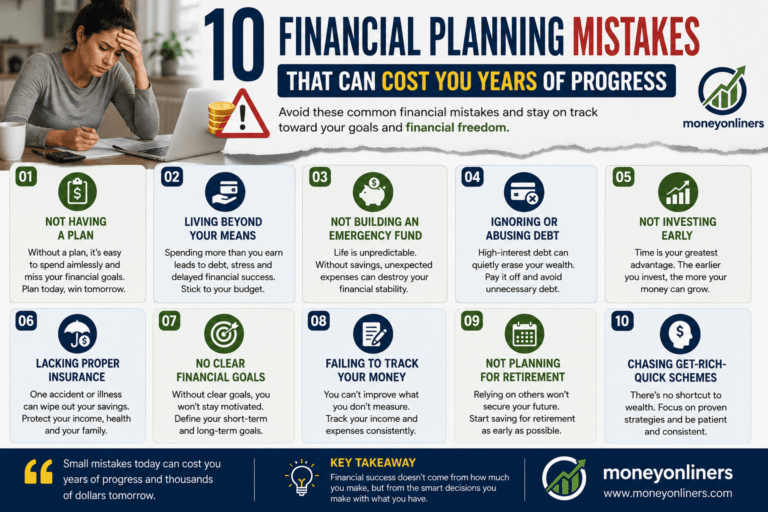
10 Financial Planning Mistakes That Can Cost You Years of Progress
10 Financial Planning Mistakes That Can Cost You Years of Progress | MoneyOnliners MoneyOnliners • Financial Planning → Mistakes to Avoid 10 Financial Planning Mistakes That Can Cost You Years of Progress Financial progress is not only about making good decisions. It is also about avoiding mistakes that quietly drain cash flow, delay investing, increase…
Where Should Your Money Go First? A 7-Step Financial Priority Checklist
Where Should Your Money Go First? A 7-Step Financial Priority Checklist | MoneyOnliners MoneyOnliners • Financial Planning → Priority Checklist Where Should Your Money Go First? A 7-Step Financial Priority Checklist When several financial goals compete for the same paycheck, knowing what to do first can be harder than knowing what to do eventually. Should…
10-Year Financial Plan: What Should You Actually Be Planning For?
10-Year Financial Plan: What Should You Actually Be Planning For? | MoneyOnliners MoneyOnliners • Financial Planning → 10-Year Roadmap 10-Year Financial Plan: What Should You Actually Be Planning For? Ten years is long enough for your career, income, family, home, investments and priorities to change dramatically—but short enough that decisions you make today can still…
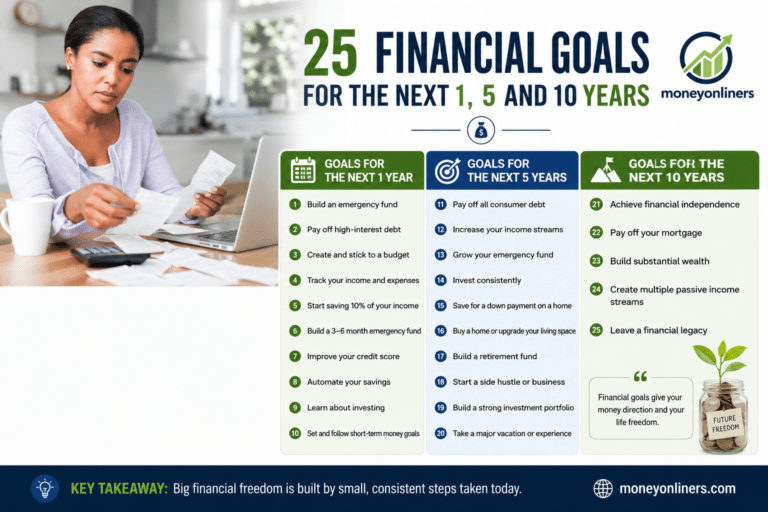
25 Financial Goals Worth Setting for the Next 1, 5 and 10 Years
25 Financial Goals Worth Setting for the Next 1, 5 and 10 Years | MoneyOnliners MoneyOnliners • Financial Planning → Goal Roadmap 25 Financial Goals Worth Setting for the Next 1, 5 and 10 Years Financial goals become much more useful when they are connected to time. Paying off a credit card may belong in…
10 Steps to Build a Long-Term Financial Plan That Can Grow With You
10 Steps to Build a Long-Term Financial Plan That Can Grow With You | MoneyOnliners MoneyOnliners • Financial Planning → Long-Term Roadmap 10 Steps to Build a Long-Term Financial Plan That Can Grow With You A strong financial plan should not assume your life will stay the same. Income changes. Families grow. Careers shift. Homes…
How Much Should You Save Every Month for Your Future?
How Much Should You Save Every Month for Your Future? | MoneyOnliners MoneyOnliners • Saving → Future Planning How Much Should You Save Every Month for Your Future? Saving $100 every month may be a strong beginning for one person and far too little for another. Meanwhile, saving 30% of income can be realistic for…