Can Compound Interest Make You a Millionaire? Let’s Look at the Numbers
Can Compound Interest Make You a Millionaire? Let's Look at the Numbers
Becoming a millionaire through compound growth is mathematically possible, but the word “millionaire” can make the process sound easier than it really is. You still need money to invest, enough time, positive long-term returns, manageable fees and the discipline to continue contributing. Compound interest can multiply what you build, but it cannot replace the need to build the investment base in the first place.
Yes, compound interest can help you become a millionaire, but only when enough money, time and investment growth work together.
For example, beginning with $0 and investing monthly at a hypothetical 7% annual return compounded monthly would require approximately:
| Time Available | Approximate Monthly Investment Needed for $1 Million | Approximate Contributions |
|---|---|---|
| 20 years | $1,920 | $460,800 |
| 30 years | $820 | $295,200 |
| 40 years | $381 | $182,880 |
| 45 years | $264 | $142,560 |
The longer timeline requires dramatically less money from you because earlier contributions receive more time to potentially compound.
A 7% investment return is not guaranteed. Actual investments fluctuate, fees and taxes can reduce returns, inflation reduces future purchasing power, and some years can produce losses.
Table of Contents
What Does “Millionaire” Actually Mean?
The basic definition usually refers to having a net worth of at least:
$1,000,000
Net Worth
Therefore, you do not necessarily need $1 million sitting in cash.
Your Assets Might Include
- Investment accounts
- Retirement accounts
- Cash
- Business ownership
- Home equity
- Other valuable assets
Then Subtract Liabilities
- Mortgage debt
- Credit-card balances
- Personal loans
- Student loans
- Other debts
A person can have a $1 million investment portfolio and still have a lower net worth if substantial debts are outstanding.
How Could Compound Growth Build $1 Million?
Compound growth means investment returns remain invested and can potentially participate in future returns.
The Process
Example
Suppose your portfolio contains:
$100,000
and gains a hypothetical:
7%
That produces:
$7,000 of growth
If the entire $107,000 remains invested, a future percentage return applies to a larger base.
At $500,000
A hypothetical 7% change equals:
$35,000
At $900,000
The same percentage equals:
$63,000
How Different Returns Change the Millionaire Math
Suppose you want to reach $1 million in 30 years with no starting balance.
| Hypothetical Annual Return | Approximate Monthly Contribution Needed |
|---|---|
| 4% | $1,441 |
| 5% | $1,202 |
| 7% | $820 |
| 8% | $671 |
| 10% | $442 |
Notice What Happens
At 4%, you need more than three times the monthly contribution required under the 10% illustration.
That makes return assumptions enormously important.
Higher return assumptions make every financial goal appear easier. That does not mean your investment will actually achieve those returns.
How Much Would You Need to Invest Each Month to Reach $1 Million?
At a Hypothetical 7%
| Years Available | Approximate Monthly Contribution | Total Contributions | Approximate Growth |
|---|---|---|---|
| 20 | $1,920 | $460,800 | $539,200 |
| 30 | $820 | $295,200 | $704,800 |
| 40 | $381 | $182,880 | $817,120 |
| 45 | $264 | $142,560 | $857,440 |
The 20-Year Investor
Needs to contribute almost:
$1,920 per month
The 45-Year Investor
Needs roughly:
$264 per month
Starting at 20 vs 30 vs 40: Millionaire Math
Suppose the goal is $1 million by age 65 and the hypothetical return is 7%.
Approximate MoneyOnliners Calculation
| Starting Age | Years Available | Approximate Monthly Contribution |
|---|---|---|
| 20 | 45 years | $264 |
| 30 | 35 years | About $555 |
| 40 | 25 years | About $1,235 |
External Reality Check
Investor.gov currently provides a similar age-based example for reaching $1 million by age 65 at a hypothetical 7% average annual return:
| Investor.gov Starting Age | Monthly Contribution for $1 Million at 65 |
|---|---|
| 18 | $254 |
| 25 | $418 |
| 35 | $883 |
| 45 | $2,033 |
| 55 | $6,032 |
The underlying lesson is consistent:
When time decreases, the required contribution rises dramatically.

Can $100 a Month Make You a Millionaire?
Not quickly.
At a hypothetical 7% annual return compounded monthly:
| Time | Total Contributions | Approximate Ending Balance |
|---|---|---|
| 20 years | $24,000 | $52,093 |
| 30 years | $36,000 | About $122,000 |
| 40 years | $48,000 | About $262,000 |
| 45 years | $54,000 | About $379,000 |
The Lesson
A $100 monthly investment can build meaningful wealth.
However, under ordinary return assumptions, it may not reach $1 million on a typical working-life timeline.
What Can Change That?
- Increasing contributions over time
- Starting earlier
- Investing for longer
- Adding lump sums
- Employer contributions where available
What If You Invest $500 a Month?
Now the mathematics change substantially.
At a Hypothetical 7%
| Time | Total Contributions | Approximate Ending Balance |
|---|---|---|
| 20 years | $120,000 | About $260,000 |
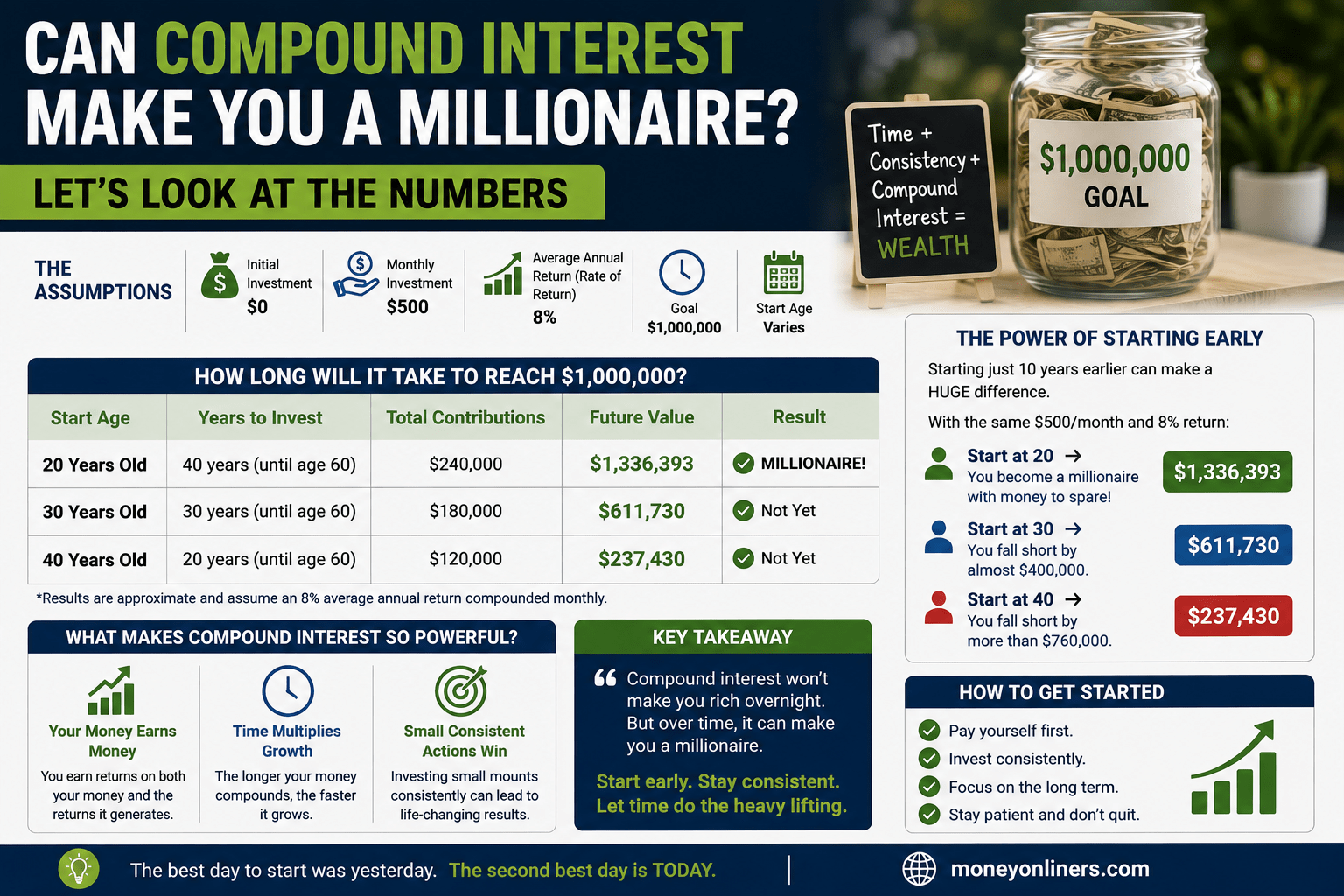
| 30 years | $180,000 | About $610,000 |
| 40 years | $240,000 | About $1.31 million |
At 40 Years
The hypothetical account crosses $1 million.
Yet you personally contributed only:
$240,000
The remaining balance comes from hypothetical compound growth.
The result depends on maintaining contributions and achieving the assumed long-term return.
What If You Invest $1,000 a Month?
Larger contributions shorten the required timeline significantly.
At a Hypothetical 7%
| Time | Total Contributions | Approximate Ending Value |
|---|---|---|
| 20 years | $240,000 | About $521,000 |
| 25 years | $300,000 | About $810,000 |
| 30 years | $360,000 | About $1.22 million |
Can One Lump Sum Eventually Become $1 Million?
Yes mathematically, but the required starting amount depends enormously on time and return.
At a Hypothetical 7% Annual Return
| Time | Approximate Lump Sum Needed Today to Reach $1 Million |
|---|---|
| 10 years | About $508,000 |
| 20 years | About $258,000 |
| 30 years | About $131,000 |
| 40 years | About $67,000 |
Why Does the Required Amount Fall?
More time creates more compounding periods.
Example
A hypothetical $67,000 invested for 40 years at 7% annually could mathematically approach $1 million.
However, the real investment journey would not deliver a perfectly smooth 7% every year.
Why the First $100,000 Can Matter So Much
Imagine a hypothetical 7% return.
On $10,000
7% = $700
On $100,000
7% = $7,000
On $500,000
7% = $35,000
On $1 Million
7% = $70,000
Again, the percentage is unchanged.
What changes is the amount of capital participating in the percentage change.
Later-stage wealth building can become increasingly influenced by the existing asset base.

How Fees Can Make the Millionaire Goal Harder
Fees reduce the amount remaining invested.
Over decades, even differences that look small can become meaningful.
Investor.gov Example
Investor.gov currently shows a hypothetical $100,000 investment growing at 4% annually for 20 years under three different annual fees:
| Annual Fee | Approximate Portfolio Value After 20 Years |
|---|---|
| 0.25% | $208,000 |
| 0.50% | $198,000 |
| 1.00% | $179,000 |
The difference between 0.25% and 1.00% fees is approximately:
$29,000
That is money that cannot help push the portfolio toward $1 million.
Do not choose an investment based on cost alone, but understand exactly what you are paying and what you receive in return.
Will $1 Million in 40 Years Feel Like $1 Million Today?
Probably not.
Inflation reduces purchasing power over time.
Example
If inflation hypothetically averaged 3%, something costing:
$100 today
would cost substantially more decades later.
This Creates Two Different Millionaire Goals
Nominal Millionaire
Your future net worth reaches $1,000,000 in future dollars.
Real Purchasing-Power Millionaire
Your future wealth has purchasing power comparable with $1 million today.
What About Taxes?
A $1 million account balance does not automatically equal $1 million of spendable after-tax money.
Tax Impact Depends on
- Account type
- Country
- Tax law
- Investment gains
- Dividends
- Retirement withdrawals
- Holding period
For U.S. Investors
Tax treatment can differ among:
- Taxable brokerage accounts
- Traditional IRAs
- Roth IRAs
- Traditional 401(k)s
- Roth 401(k)s
Taxes and inflation both matter when evaluating the real usefulness of future wealth.
Why You Should Not Chase 15% or 20% Returns Just to Reach $1 Million Faster
Compound-growth calculators can make aggressive return assumptions look irresistible.
At Higher Rates
The required contribution falls quickly.
That may tempt someone to conclude:
“I just need an investment returning 15% every year.”
That is not a safe planning assumption.
Investor.gov Emphasizes
All investments carry some degree of risk, and diversification can help reduce concentration risk but cannot eliminate market losses.
Potential Higher-Return Investments May Also Bring
- Greater volatility
- Permanent-loss risk
- Concentration risk
- Liquidity risk
- Fraud risk
Promises of high returns with little or no risk are classic investment-fraud warning signs.
MoneyOnliners Original Analysis: The Millionaire Path Test
1. Start
What amount is already invested?
2. Contribute
How much can you add every month?
3. Time
How many years are available?
4. Return
What range of investment returns is reasonable to test?
5. Retain
How much wealth remains after:
- Fees
- Taxes
- Withdrawals
- Investment losses
- Inflation
MoneyOnliners Millionaire Contribution Ratio
MoneyOnliners Research-Based Evidence Note
This article is a research-based millionaire compound-growth analysis.
Investor.gov currently describes long-term wealth building as regular investing combined with time.
It emphasizes that starting earlier increases the impact of compounding and that people beginning later generally need to invest more of their earnings to pursue the same goal.
Investor.gov's current age-based millionaire example assumes a 7% average annual return and shows monthly contribution requirements rising from $254 at age 18 to $6,032 at age 55 for a $1 million target at age 65.
MoneyOnliners independently calculated the additional 20-, 30-, 40- and 45-year millionaire scenarios in this article using monthly contributions and monthly compounding.
The primary MoneyOnliners 7% calculations produce approximate monthly contribution requirements of $1,920 over 20 years, $820 over 30 years, $381 over 40 years and $264 over 45 years.
Those figures are hypothetical mathematics rather than guaranteed outcomes.
Investor.gov's current fee guidance confirms that even seemingly modest recurring costs can materially affect long-term investment balances.
Its published example shows approximately $208,000 remaining from a hypothetical $100,000 portfolio after 20 years with a 0.25% annual fee compared with about $179,000 with a 1.00% annual fee.
MoneyOnliners therefore includes fees as part of the millionaire calculation rather than treating gross investment returns as fully available to investors.
The Millionaire Path Test, Millionaire Contribution Ratio and Millionaire Path Scorecard are original MoneyOnliners analytical resources.
10 Mistakes That Can Make the Millionaire Goal Look Easier Than It Is
1. Assuming Compound Interest Does All the Work
You still need capital entering the system.
2. Using an Unrealistic Return
The higher the assumed return, the easier every projection looks.
3. Starting Late but Keeping Contributions Too Small
Less time generally requires larger contributions.
4. Never Increasing Contributions
Future raises can create opportunities to invest more.
5. Ignoring Fees
Recurring costs reduce both current balance and future compounding.
6. Ignoring Taxes
Gross account value may not equal after-tax wealth.
7. Ignoring Inflation
A future $1 million may buy substantially less than $1 million today.
8. Carrying Expensive Debt
High-interest liabilities can work against your net worth while investments are trying to grow it.
9. Assuming You Will Never Withdraw Money
Withdrawals remove principal and future growth potential.
10. Believing a Guaranteed Millionaire Investment Scheme
Guaranteed high returns with little risk are classic investment-fraud warning signs.
Regular contributions, long time horizons, diversified investing and gradual income growth are less exciting than promises of rapid wealth—but they are much more useful foundations for realistic planning.
Why Compound Interest Can Help Build Millionaire Wealth
1. Compound growth allows previous returns to participate in future returns.
2. A larger balance can generate larger dollar changes from the same percentage return.
3. Regular contributions create the principal that can potentially compound.
4. Starting early gives contributions more time.
5. Starting later generally requires larger monthly investments.
6. A long time horizon can reduce the amount needed each month.
7. A short time horizon shifts more responsibility to your contributions.
8. Increasing contributions when income grows can accelerate progress.
9. The first $100,000 can be important because percentage returns begin affecting larger dollar amounts.
10. Millionaire net worth does not need to exist entirely in cash.
11. Retirement accounts can form part of net worth.
12. Business equity can form part of net worth.
13. Home equity can contribute to net worth.
14. Debt reduces net worth and can slow millionaire progress.
15. Fees can materially reduce long-term investment balances.
16. Taxes can reduce spendable wealth.
17. Inflation reduces the future purchasing power of $1 million.
18. Diversification can reduce reliance on one investment outcome.
19. High investment returns should never be treated as guaranteed.
20. Ultimately, asking can compound interest make you a millionaire has a qualified answer: yes, compound growth can be one of the engines that gets you there, but contributions, time, risk management, fees and realistic assumptions determine whether the mathematics has a reasonable chance of becoming reality.
Continue Learning on MoneyOnliners
Recommended External Resources
1. Investor.gov — Compound Interest Calculator
Compound Interest Calculator — Investor.gov
Allows readers to test initial investment, monthly contributions, time, estimated returns and compounding frequency.
2. Investor.gov — Introduction to Investing
Introduction to Investing — Investor.gov
Provides current age-based examples for pursuing $500,000 and $1 million by age 65 and explains the role of regular investing and time.
3. Investor.gov — Build Wealth Over Time Through Saving and Investing
Build Wealth Over Time Through Saving and Investing — Investor.gov
Provides broader guidance on long-term saving, investing and increasing contributions as income rises.
4. Investor.gov — Understanding Investment Fees
Understanding Investment Fees — Investor.gov
Explains why seemingly small recurring fees can materially reduce long-term portfolio values.
5. Investor.gov — How Fees and Expenses Affect Your Investment Portfolio
How Fees and Expenses Affect Your Investment Portfolio — Investor.gov
Provides a concrete 20-year illustration comparing different annual investment-fee levels.
6. Investor.gov — Diversify Your Investments
Diversify Your Investments — Investor.gov
Explains how diversification can help reduce concentration risk, although it cannot eliminate losses.
7. Investor.gov — Understand What It Means to Invest
Understand What It Means to Invest — Investor.gov
Explains that investments can lose principal and are not equivalent to federally insured bank deposits.
8. Investor.gov — Small Savings Add Up to Big Money
Small Savings Add Up to Big Money — Investor.gov
Provides a simple example showing how modest amounts can grow over long periods through compounding.
9. Investor.gov — Investment Products
Investment Products — Investor.gov
Provides broader guidance on diversification, liquidity, fees and investment fraud.
10. Investor.gov — Ten Things You Should Know About Investing
Ten Things You Should Know About Investing — Investor.gov
Explains investment risk, fees and why promises of high returns with little or no risk are classic fraud warning signs.
This article provides general educational information and is not individualized financial, investment, retirement, tax or legal advice. All millionaire calculations use hypothetical return assumptions. Real investment returns can be higher, lower or negative, and fees, taxes, inflation, withdrawals and market volatility can materially change outcomes.
Frequently Asked Questions
Can compound interest really make you a millionaire?
Yes, mathematically it can help.
However, compound growth needs principal to work on.
That principal usually comes from your starting investment and regular contributions.
Time also matters enormously.
Investment returns remain uncertain.
How much should I invest monthly to become a millionaire?
The answer depends on time and return.
At a hypothetical 7% over 40 years, the mathematical requirement is around $381 per month.
Over only 20 years, it is closer to $1,920 per month.
That difference comes largely from time.
Neither result is guaranteed.
Can $100 a month make me a millionaire?
Not easily within a standard 20- to 40-year period under ordinary return assumptions.
At a hypothetical 7% for 40 years, $100 monthly grows to roughly $262,000.
That is still meaningful wealth.
Increasing contributions later can change the outcome dramatically.
A $100 contribution can therefore be a starting point.
Can $500 a month make you a millionaire?
Potentially.
At a hypothetical 7% for 40 years, $500 per month mathematically grows beyond $1 million.
Total contributions would equal $240,000.
The remainder would come from hypothetical compound growth.
Actual returns will vary.
Can $1,000 a month make you a millionaire?
Yes under many long-term mathematical scenarios.
At a hypothetical 7%, $1,000 monthly reaches approximately $1.22 million after 30 years.
You would contribute $360,000 yourself.
The remainder would come from assumed investment growth.
The rate is not guaranteed.
How long does it take to become a millionaire investing?
There is no single answer.
The starting amount matters.
Monthly contributions matter.
Investment returns matter.
Time is usually one of the strongest variables.
Is 7% a guaranteed investment return?
No.
Seven percent is commonly used in long-term educational illustrations.
Investor.gov uses 7% in some of its age-based examples.
However, investments fluctuate and can lose value.
Use 7% as an assumption rather than a promise.
Can I become a millionaire starting at 40?
Potentially, yes.
The challenge is that there are fewer years available for compounding.
Therefore, monthly contributions generally need to be larger.
Increasing income and savings rate can help.
Taking reckless investment risk is not a good substitute for time.
Can I become a millionaire starting at 50?
It is mathematically possible, but the required contribution may become very large.
Investor.gov's current example shows that starting at age 55 would require about $6,032 per month to target $1 million at 65 under a hypothetical 7% return.
A longer working period can lower the required monthly amount.
Existing assets can help too.
Realistic planning becomes especially important with shorter horizons.
Does becoming a millionaire mean having $1 million in cash?
No.
Millionaire status generally refers to net worth.
That may include investments, retirement accounts, property equity, businesses and cash.
Liabilities are subtracted.
A million-dollar portfolio and a million-dollar net worth are not always the same thing.
Why does the first $100,000 matter?
A larger investment base makes percentage changes larger in dollar terms.
At 7%, $10,000 changes by $700.
At 7%, $100,000 changes by $7,000.
At $500,000, the same percentage equals $35,000.
This is why large portfolios can accelerate in dollar terms.
Can fees stop me from becoming a millionaire?
They can make the goal harder.
Fees reduce the balance available to earn future returns.
Investor.gov shows that seemingly small recurring fee differences can materially affect long-term portfolio values.
Costs should therefore be included in planning.
However, fees are only one factor among risk, service and investment quality.
Does inflation matter if I reach $1 million?
Yes.
A future $1 million may buy less than $1 million buys today.
That is why long-term goals should consider purchasing power.
Nominal millionaire status can still be meaningful.
But real financial independence may require a larger future number.
Should I chase higher returns to become a millionaire faster?
No.
Higher expected returns generally involve higher risk.
Extremely high guaranteed-return claims are classic fraud warning signs.
Increasing contributions and extending time are generally more controllable levers.
Build a realistic plan rather than trying to force the return.
What is the most realistic way to use compound growth to reach $1 million?
Start with an affordable contribution.
Increase it as income improves.
Use an appropriately diversified long-term investment strategy.
Control fees and expensive debt.
Then give the process as much time as your financial goals allow.
Research Methodology
Primary Millionaire Calculations
MoneyOnliners calculated the monthly investment needed for a $1 million future value using end-of-month contributions.
Primary Return Assumption
7% annual return compounded monthly
Time Horizons Tested
- 20 years
- 30 years
- 40 years
- 45 years
Additional Return Tests
MoneyOnliners also tested 4%, 5%, 8% and 10% return assumptions to show how sensitive millionaire projections are to the selected rate.
External Benchmark
Investor.gov's current age-based table was used as an external benchmark for a $1 million goal at age 65 using a hypothetical 7% average annual return.
Investor.gov Current Example
- Start at 18: $254/month
- Start at 25: $418/month
- Start at 35: $883/month
- Start at 45: $2,033/month
- Start at 55: $6,032/month
Fees
Investor.gov's current fee guidance was reviewed to quantify how recurring annual fees can materially reduce long-term portfolio values.
Risk
Investor.gov guidance was reviewed for the principles that investments involve risk, markets fluctuate and diversification can reduce—but not eliminate—certain risks.
Original MoneyOnliners Analysis
The Millionaire Path Test, Millionaire Contribution Ratio and Millionaire Path Scorecard are original MoneyOnliners educational resources.
First-Hand Evidence Standard
MoneyOnliners only presents genuine personal millionaire journeys, portfolio screenshots, brokerage histories or long-term investment results when verifiable first-hand evidence exists and can be represented accurately.
No personal millionaire investment outcome is claimed in this article.
Limitations
Investment returns fluctuate.
Contribution patterns change.
Fees differ.
Taxes differ.
Inflation reduces purchasing power.
Investor behavior can materially change outcomes.
Therefore, every millionaire figure in this article is an educational mathematical scenario rather than a forecast.
Conclusion: Compound Interest Can Help Make You a Millionaire—but It Needs Something to Compound
So, can compound interest make you a millionaire?
Yes, mathematically.
But Compounding Is Not the Starting Point
You first need money entering the system.
That Might Begin With $100 a Month
Then $200.
Then $500.
Then more as your income grows.
Time Changes the Required Contribution Dramatically
At a hypothetical 7%:
| Timeline | Approximate Monthly Amount for $1 Million |
|---|---|
| 20 years | $1,920 |
| 30 years | $820 |
| 40 years | $381 |
| 45 years | $264 |
The Longer the Timeline
The more of the final million can potentially come from growth rather than direct contributions.
But Do Not Forget Reality
Returns fluctuate.
Fees matter.
Taxes matter.
Inflation matters.
Debt matters.
Withdrawals happen.
Markets fall.
Millionaire Status Is Not the Only Goal
Financial security matters.
Cash flow matters.
Retirement readiness matters.
Low debt matters.
Financial freedom matters.
The Better Target
Build assets consistently.
Increase contributions when income improves.
Keep unnecessary costs under control.
Diversify appropriately.
Avoid high-return promises.
Then give your money enough time to work.
Similar Posts
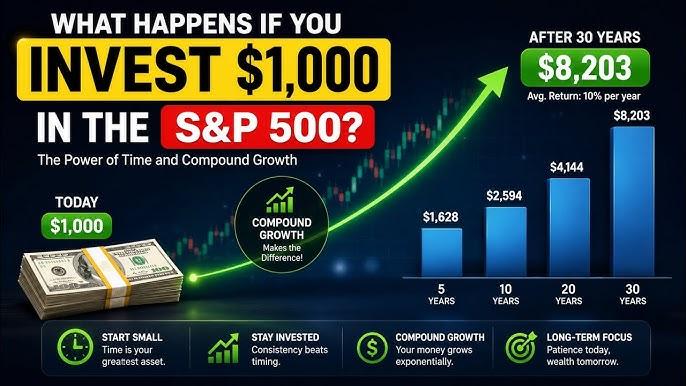
$1,000 Invested for 10, 20 and 30 Years: What Could Compound Growth Do?
$1,000 Invested for 10, 20 and 30 Years: What Could Compound Growth Do? | MoneyOnliners MoneyOnliners • Investing → Compound Growth $1,000 Invested for 10, 20 and 30 Years: What Could Compound Growth Do? One thousand dollars is not enough to guarantee financial independence, but it is large enough to demonstrate something important: time can…
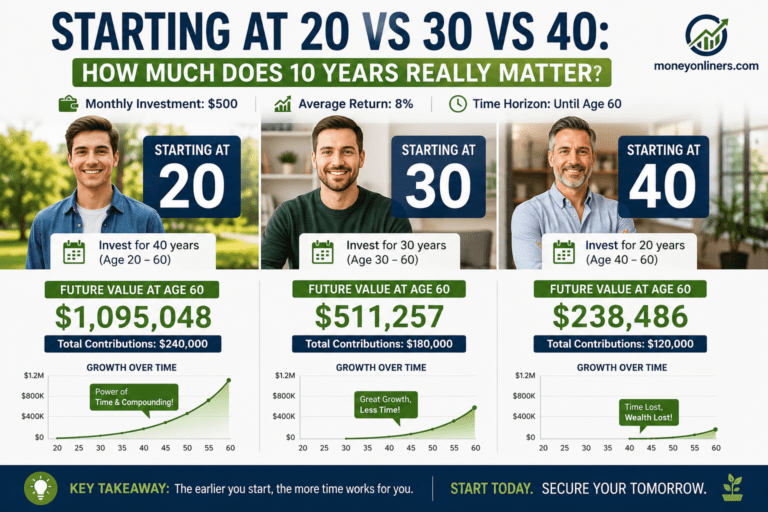
Starting at 20 vs 30 vs 40: How Much Does 10 Years Really Matter?
Starting at 20 vs 30 vs 40: How Much Does 10 Years Really Matter? | MoneyOnliners MoneyOnliners • Investing → Time Advantage Starting at 20 vs 30 vs 40: How Much Does 10 Years Really Matter? Ten years can look insignificant when retirement is decades away. However, investing from age 20 instead of 30 gives…
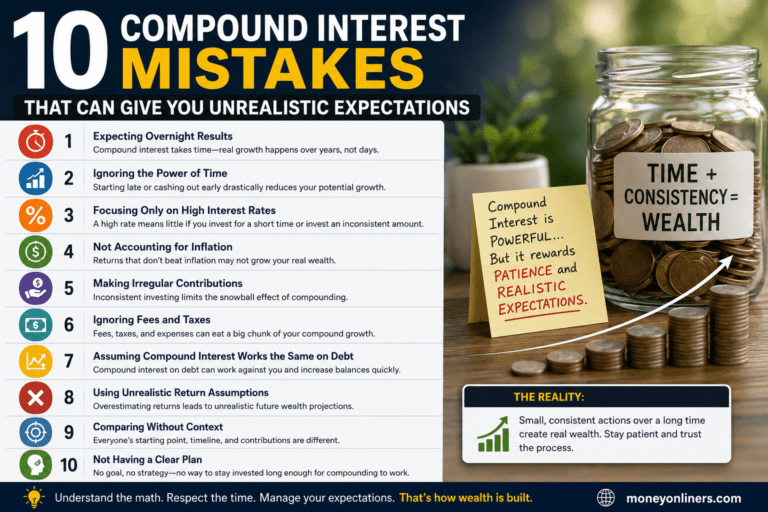
10 Compound Interest Mistakes That Can Give You Unrealistic Expectations
10 Compound Interest Mistakes That Can Give You Unrealistic Expectations | MoneyOnliners MoneyOnliners • Compound Interest → Reality Check 10 Compound Interest Mistakes That Can Give You Unrealistic Expectations Compound interest is one of the most useful ideas in long-term finance, but it is also one of the easiest to misunderstand. A calculator can make…
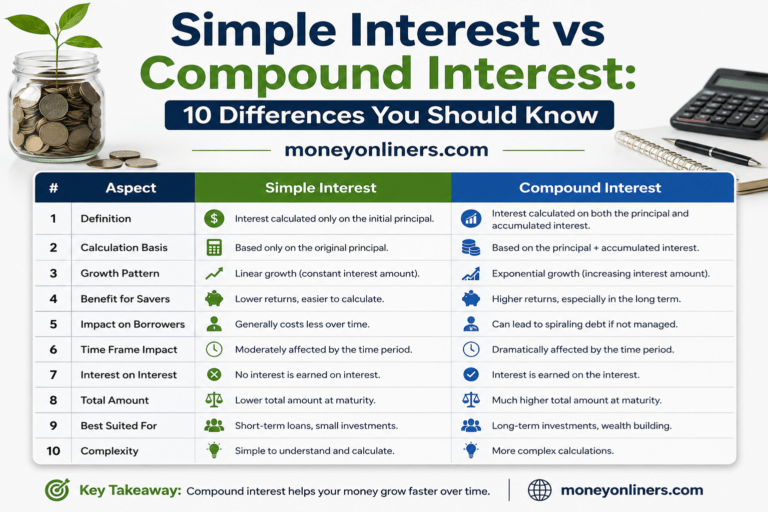
Simple Interest vs Compound Interest: 10 Differences You Should Know
Simple Interest vs Compound Interest: 10 Differences You Should Know | MoneyOnliners MoneyOnliners • Compound Interest → Comparison Guide Simple Interest vs Compound Interest: 10 Differences You Should Know Simple interest and compound interest can start with the same principal and the same stated rate yet produce different results. The difference comes from what the…
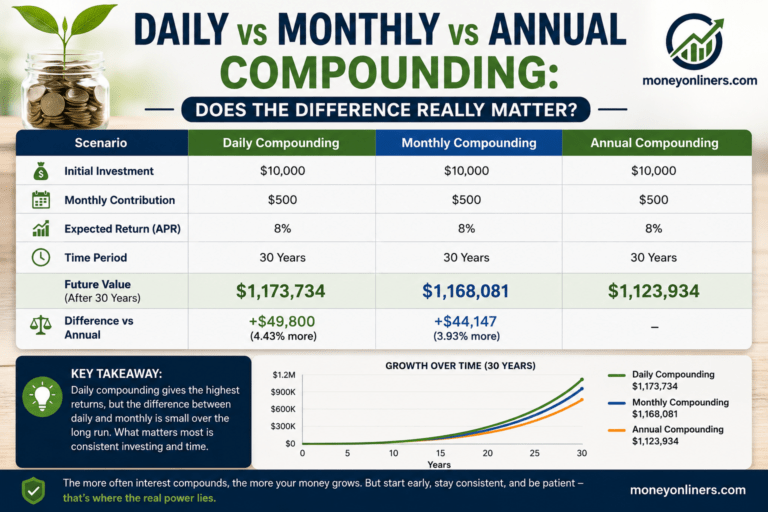
Daily vs Monthly vs Annual Compounding: Does the Difference Really Matter?
Daily vs Monthly vs Annual Compounding: Does the Difference Really Matter? | MoneyOnliners MoneyOnliners • Compound Interest → Frequency Comparison Daily vs Monthly vs Annual Compounding: Does the Difference Really Matter? Daily compounding sounds much more powerful than monthly or annual compounding. Mathematically, more frequent compounding does create a larger ending balance when the principal,…
Compound Interest Explained With 10 Simple Real-Life Examples
Compound Interest Explained With 10 Simple Real-Life Examples | MoneyOnliners MoneyOnliners • Wealth Building → Compound Interest Compound Interest Explained With 10 Simple Real-Life Examples Compound interest can sound like complicated financial mathematics, but the basic idea is remarkably simple: your money can earn a return, and later that return may begin earning additional returns…