10-Year Financial Plan: What Should You Actually Be Planning For?
10-Year Financial Plan: What Should You Actually Be Planning For?
Ten years is long enough for your career, income, family, home, investments and priorities to change dramatically—but short enough that decisions you make today can still shape many of those outcomes. A useful 10-year financial plan should therefore do more than set one savings target. It should connect the next few months with the next decade.
A practical 10-year financial plan should usually prepare for much more than retirement.
Over the next decade, you may need to plan for:
| Planning Area | What You May Need to Prepare For |
|---|---|
| Cash flow | Higher living costs, income changes and new responsibilities |
| Emergency savings | Job loss, repairs, medical costs and unexpected expenses |
| Debt | Eliminating expensive balances and managing new borrowing carefully |
| Career and income | Raises, job changes, skill development, business or side income |
| Housing | Rent changes, home purchase, mortgage costs, repairs or moving |
| Family | Marriage, children, education, caregiving and changing household costs |
| Protection | Insurance, beneficiaries and financial risk |
| Investing | Long-term asset growth and increasing contributions |
| Retirement | Building enough future assets while time is still available |
| Estate and records | Beneficiaries, important documents and future asset transfer |
A better approach is to prepare for several likely financial changes while giving yourself enough flexibility to adjust when life turns out differently.
Table of Contents
What Is a 10-Year Financial Plan?
A 10-year financial plan is a medium-to-long-term roadmap connecting your current financial position with where you would like to be approximately a decade from now.
It Is Not Just a Retirement Plan
Retirement may be part of it; however, it is only one piece of the decade.
However, ten years can also include:
- Several job changes
- Major income increases
- A home purchase
- Marriage
- Children
- Education costs
- Business creation
- Debt repayment
- Investment growth
- Major family responsibilities
It Is Also Not a Detailed Prediction
You do not need to know exactly where you will live in year seven.
You do not need to know your exact salary in year nine.
Instead, build enough financial strength so that several possible futures remain affordable.
Why Is 10 Years Such a Useful Financial Planning Horizon?
For many goals, one year can be too short for major wealth-building changes.
On the other hand, forty years can feel too distant to influence everyday behavior.
Therefore, ten years sits between those extremes.
In 10 Years You Could Potentially
Eliminate Major Debt
Credit cards, personal loans or other expensive balances could potentially be removed.
Build a Strong Emergency Fund
Cash reserves can become large enough to absorb significant shocks.
Increase Income
Skills, promotions, businesses and career changes can transform earning capacity.
Build Significant Investments
A decade gives recurring contributions time to accumulate and potentially grow.
Investor.gov's Goal-Based Principle
Investor.gov recommends defining financial goals and considering the number of years available for each one because the appropriate saving or investing approach depends partly on the goal's time frame.
Some money may be needed next year. Some may be needed in five years. Other money can remain invested beyond year ten.
MoneyOnliners Original 10-Year Plan Map
Years 1–2: Stabilize
- Understand cash flow
- Stop expensive debt from growing
- Build initial emergency savings
- Start consistent investing
- Organize insurance and financial records
Years 3–5: Expand
- Increase income
- Raise savings rate
- Build larger investments
- Prepare for property or other major goals
- Strengthen retirement contributions
Years 6–10: Consolidate
- Protect accumulated assets
- Reduce remaining unnecessary debt
- Reassess retirement trajectory
- Review family and estate needs
- Decide what the next 10 years should accomplish
1 Decide Where You Want to Be in 10 Years
Do not begin with investments.
Begin with outcomes.
Ask Yourself
- Where might I want to live?
- Do I want to own a home?
- Do I expect to support children?
- Could I start a business?
- What career level would I like to reach?
- How much debt would I like remaining?
- What net worth would represent meaningful progress?
- How prepared do I want to be for retirement?
Separate Wants From Commitments
Some goals are possibilities; however, they may still deserve preparation.
By contrast, other goals may already be likely obligations.
Example
| Goal | Priority | Target Timing |
|---|---|---|
| Emergency fund | Very high | Years 1–2 |
| Pay off credit card | Very high | Year 1 |
| Home down payment | High | Year 5 |
| Increase retirement contribution | High | Ongoing |
| Start business | Possible | Years 4–7 |
A 10-year goal can be adjusted as new information appears.
2 Fix Your Financial Starting Point
Before projecting 10 years forward, first measure today.
Calculate Monthly Cash Flow
Calculate Net Worth
Create a Starting Snapshot
| Metric | Example Starting Point |
|---|---|
| Monthly take-home income | $5,000 |
| Monthly essential spending | $3,200 |
| Debt payments | $600 |
| Monthly flexible cash flow | $1,200 |
| Emergency savings | $3,000 |
| Investments | $15,000 |
| Total debt | $20,000 |
| Current net worth | Depends on all assets and liabilities |
Therefore, those starting numbers determine how ambitious the first stage of the plan can reasonably be.

3 Build Enough Financial Resilience to Survive the Decade
Realistically, a 10-year plan should assume that something unexpected will happen.
However, you simply do not know what form it will take.
Possible Shocks
- Job loss
- Income reduction
- Vehicle repairs
- Medical costs
- Home repairs
- Family emergencies
- Business problems
That Makes Emergency Savings Foundational
CFPB describes an emergency fund as dedicated cash for unexpected expenses or financial emergencies and notes that even a small reserve can help people recover more quickly and return to larger goals.
A Staged Approach
| Stage | Potential Goal |
|---|---|
| Initial | Small cash buffer |
| Next | One month of essential expenses |
| Stronger position | Several months of essential expenses |
| Variable-income household | Potentially larger reserve |
It can reduce the chance that a short-term emergency forces you to sell long-term investments or take expensive debt.
4 Create a Debt Payoff and Future Borrowing Strategy
First, do not plan only for debt you already have.
In addition, plan for debt you may consider taking during the next decade.
Current Debt
List:
- Balance
- Interest rate
- Minimum payment
- Expected payoff date
High-Interest Debt
Investor.gov currently emphasizes paying serious attention to high-interest credit-card debt because the interest can significantly slow broader wealth-building progress.
Future Borrowing Could Include
- Mortgage
- Auto loan
- Business financing
- Education debt
- Personal loans
Before Taking New Debt Ask
- What will the payment do to monthly cash flow?
- What is the total borrowing cost?
- Will it reduce retirement contributions?
- Will it reduce emergency savings?
- Does the purchase strengthen or weaken the 10-year plan?
5 Plan for Income and Career Growth
Many financial plans focus heavily on cutting expenses; however, they barely discuss earning power.
As a result, income growth over 10 years can change almost every financial goal.
Possible Income Growth Paths
- Promotions
- New employer
- Professional qualification
- Technical skills
- Freelancing
- Remote work
- Business ownership
- Negotiating compensation
Example
Suppose monthly take-home income rises from:
$4,000 to $6,000 over several years
If lifestyle spending rises by the entire $2,000, long-term capacity changes little.
However, if $1,000 of that increase goes toward:
- Investing
- Retirement
- Debt payoff
- Home savings
the 10-year financial outcome can change substantially.
Decide what skills, qualifications or business opportunities could make higher future income more likely.
6 Prepare for Housing and Major Purchases
For many households, housing may become one of the largest financial decisions inside a 10-year plan.
You Might
- Continue renting
- Move to another city
- Buy a first home
- Upgrade to a larger home
- Pay down a mortgage
- Renovate
Do Not Plan Only for the Purchase Price
Homeownership may involve:
- Down payment
- Closing costs
- Mortgage payments
- Taxes
- Insurance
- Maintenance
- Repairs
- Utilities
Other Major Purchases
A decade may also include:
- Vehicles
- Education
- Business equipment
- Major travel
- Technology
The question is not simply whether you can make the down payment. It is whether the purchase still leaves room for savings, retirement, emergencies and ordinary life.

7 Prepare for Family and Life Changes
Likewise, your household may look very different 10 years from now.
Possible Changes
- Marriage
- Children
- Education expenses
- Divorce
- Supporting parents
- Caregiving responsibilities
- Relocation
Children Can Change Several Parts of the Plan
Including:
- Housing
- Food
- Childcare
- Insurance
- Education saving
- Estate planning
Marriage Can Change
- Household income
- Debt
- Tax situation
- Goals
- Beneficiaries
- Insurance needs
Instead, build financial capacity so those events are less likely to require financial panic.

8 Build Long-Term Investments and Retirement Savings
In addition, ten years is long enough for consistent investing to create meaningful progress.
Investor.gov's Current Principle
Example
Suppose you invest:
$500 per month for 10 years
Total Contributions
$60,000
At a hypothetical 7% annual return compounded monthly, the final balance would be roughly:
$86,500
That includes approximately:
$26,500 of hypothetical growth beyond contributions
Increase Contributions When Income Grows
Investor.gov currently recommends considering higher investment contributions when income increases or expenses decline.
Retirement Should Remain Part of the Plan Even When Retirement Is Far Away
For eligible U.S. investors, this can involve accounts such as:
- 401(k)
- 403(b)
- Traditional IRA
- Roth IRA
Ten-year investment results can differ substantially from fixed-return examples, particularly depending on asset allocation and market conditions.
9 Protect What You Are Building
By year ten, you may have substantially more income, savings, investments and property than you do today.
Consequently, protection can become increasingly important.
Insurance Review
- Health coverage
- Auto coverage
- Homeowners or renters coverage
- Life insurance if others depend on your income
- Disability coverage where appropriate
- Liability protection
Beneficiary Review
Update beneficiaries after major family changes.
Important Documents
Depending on your circumstances and local law:
- Will
- Powers of attorney
- Healthcare instructions
- Account records
- Property records
- Insurance documents
Building assets without organizing how they are protected, accessed or transferred can leave serious gaps in an otherwise strong plan.
10 Review the Plan Every Year
However, a 10-year plan that is never reviewed is unlikely to survive 10 years.
Every Year Review
- Income
- Spending
- Emergency fund
- Debt balances
- Net worth
- Investment contributions
- Retirement progress
- Housing goals
- Insurance
- Beneficiaries
- Major upcoming expenses
Ask Four Questions
Do Not Be Afraid to Move a Goal
For example, a home purchase planned for year five may move to year seven.
Meanwhile, a business goal may arrive earlier than expected.
Likewise, the arrival of a child may change the entire household budget.
What Should Years 1–2, 3–5 and 6–10 Actually Look Like?
Years 1–2: Build Stability
| Priority | Possible Action |
|---|---|
| Cash flow | Create a reliable monthly surplus |
| Emergency savings | Build initial reserve |
| Debt | Attack expensive balances |
| Investing | Start consistent contributions |
| Career | Identify income-growth opportunities |
Years 3–5: Increase Capacity
| Priority | Possible Action |
|---|---|
| Income | Seek raise, promotion, new role or business growth |
| Investments | Increase recurring contributions |
| Major goals | Build home/business/education funds |
| Protection | Review insurance as assets and family grow |
| Net worth | Track progress annually |
Years 6–10: Consolidate Progress
| Priority | Possible Action |
|---|---|
| Debt | Reduce remaining unnecessary liabilities |
| Retirement | Recalculate progress and contribution rate |
| Assets | Protect and diversify accumulated wealth |
| Estate basics | Update beneficiaries and documents |
| Next decade | Create years 11–20 plan |
A Simple 10-Year Financial Plan Example
Consider a hypothetical household with:
Monthly take-home income: $5,000
Current emergency fund: $3,000
Credit-card debt: $5,000
Investments: $10,000
Years 1–2
- Eliminate $5,000 credit-card debt
- Build emergency savings to $12,000
- Invest $300 per month
- Improve career skills
Years 3–5
- Increase investment to $500 monthly
- Build $25,000 home fund
- Increase retirement contribution after raises
- Review insurance
Years 6–10
- Increase investment to $750 monthly if affordable
- Continue home or mortgage strategy
- Build stronger retirement assets
- Update beneficiaries and estate documents
- Begin next 10-year plan
Therefore, the correct numbers depend on income, debt, location, family circumstances, housing costs and personal priorities.
Do Not Forget Inflation in a 10-Year Plan
Because prices can rise, a dollar target set today may need to be larger in year ten.
Example
Suppose something costs:
$50,000 today
At a hypothetical 3% annual inflation rate, the equivalent cost after 10 years would be roughly:
$67,200
That Can Affect
- Home prices
- Education
- Healthcare
- Travel
- Retirement spending
- Everyday living costs
For that reason, a savings goal created today should not necessarily remain unchanged for the entire decade.
What If Your 10-Year Financial Plan Goes Off Track?
Realistically, it probably will at some point.
That Does Not Mean the Plan Failed
Therefore, a financial plan should be able to absorb:
- Job changes
- Market declines
- Unexpected expenses
- Changing family priorities
- Delayed home purchases
- Periods of lower income
Use a Recovery Sequence
Example
After job loss:
- Reduce nonessential spending.
- Use emergency savings appropriately.
- Keep required debt payments current where possible.
- Pause lower-priority investments if necessary.
- Restore income.
- Rebuild emergency savings.
- Restart long-term contributions.
MoneyOnliners Original Analysis: The 10-Year Readiness Test
1. Cash
Can you absorb an unexpected financial shock?
2. Debt
Are expensive liabilities decreasing?
3. Income
Does the plan include ways to increase earning power?
4. Protection
Could one major event destroy the plan?
5. Assets
Are savings, investments and equity growing?
6. Flexibility
Can money be redirected if priorities change?
7. Review
Will the plan be updated every year?
MoneyOnliners Decade Allocation Map
MoneyOnliners Research-Based Evidence Note
This article is a research-based 10-year financial planning guide.
Investor.gov currently recommends defining specific financial goals and identifying how many years are available to reach each goal.
Its current wealth-building guidance also recommends understanding income and expenses, controlling expensive credit-card debt, building emergency savings and investing regularly for long-term goals.
Investor.gov summarizes long-term asset building with:
Regular Investments + Time → Wealth
It also recommends considering higher investment contributions when income rises or expenses fall.
CFPB financial well-being guidance describes a strong financial position as including control over current finances, the ability to absorb shocks, progress toward financial goals and greater freedom of choice.
CFPB emergency-fund guidance was reviewed because financial shocks can interrupt decade-long saving and investing plans.
FTC investment-fraud guidance was reviewed because scammers commonly promise guaranteed profits, large returns and little risk.
The 10-Year Plan Map, 10-Year Readiness Test, Decade Allocation Map and 10-Year Plan Scorecard are original MoneyOnliners analytical resources.
No personal 10-year investment performance, financial-plan outcome or asset-growth result is claimed in this article.
10 Mistakes to Avoid in a 10-Year Financial Plan
1. Planning Only for Retirement
Ten years may include housing, family, debt, career and business changes long before retirement.
2. Choosing One Giant Savings Goal
Different goals need different timelines and priorities.
3. Ignoring Emergency Savings
A financial shock can force new borrowing or long-term investment withdrawals.
4. Ignoring Income Growth
A decade provides enough time for career progression to substantially change saving capacity.
5. Assuming Housing Costs Will Stay the Same
Rent, homeownership, maintenance and relocation can change the budget significantly.
6. Keeping Investment Contributions Flat Forever
Consequently, future raises may allow substantially larger contributions.
7. Ignoring Inflation
Therefore, future goal amounts may need to increase.
8. Building the Plan Around Guaranteed Investment Returns
In reality, investments fluctuate.
9. Forgetting Insurance and Estate Basics
Likewise, protection needs often increase as income, family responsibilities and assets grow.
10. Refusing to Change the Original Plan
Instead, new information should improve the plan rather than be treated as a failure.
The goal is structure plus flexibility—not false certainty.
Why a 10-Year Financial Plan Matters
1. Ten years is long enough for meaningful financial transformation.
2. A decade can include several career changes.
3. Income growth can substantially increase saving capacity.
4. Expensive debt can potentially be eliminated during the period.
5. Emergency savings can become much stronger.
6. Consistent investments can accumulate meaningfully.
7. Retirement savings receive another decade of contributions.
8. Housing needs may change significantly.
9. Family responsibilities can change spending priorities.
10. Insurance needs may increase as responsibilities grow.
11. Beneficiary and estate decisions can become more important.
12. Inflation can change future target amounts.
13. Major purchases should be planned alongside long-term investing.
14. Income increases should strengthen financial goals as well as lifestyle.
15. Financial shocks should be expected even when their exact form is unknown.
16. Diversified investing can reduce dependence on one investment outcome.
17. High-return promises should never be the foundation of the plan.
18. Annual reviews help correct errors before they persist for a decade.
19. The final years of one plan should begin preparing for the next decade.
20. Ultimately, a useful 10-year financial plan matters because it helps you coordinate short-term stability, medium-term goals and long-term wealth building while leaving enough flexibility for your actual life to evolve.
Incoming Link Opportunities
10 Steps to Build a Long-Term Financial Plan That Can Grow With You
https://moneyonliners.com/long-term-financial-plan/
How to Build Wealth From Nothing: 10 Steps for Beginners
https://moneyonliners.com/how-to-build-wealth-from-nothing/
10 Wealth-Building Habits That Can Make a Big Difference Over 10 Years
https://moneyonliners.com/wealth-building-habits/
How Long Does It Take to Build Wealth? 8 Factors That Matter Most
https://moneyonliners.com/how-long-does-it-take-to-build-wealth/
$0 to $100,000 Net Worth: A Realistic Roadmap for Building Your First Six Figures
https://moneyonliners.com/0-to-100000-net-worth/
High-Priority Incoming Links
Financial Independence: 10 Steps to Take More Control of Your Money and Future
https://moneyonliners.com/financial-independence/
Retirement Planning: 15 Things to Start Doing Before You Retire
https://moneyonliners.com/retirement-planning/
15 Wealth-Building Strategies That Can Grow Your Money Over Time
https://moneyonliners.com/wealth-building-strategies/
20 Assets That Can Help Build Wealth Over the Long Term
https://moneyonliners.com/assets-that-build-wealth/
15 Ways to Increase Your Net Worth Without Becoming a Millionaire Overnight
https://moneyonliners.com/increase-your-net-worth/
Topic Cluster Incoming Links
How to Calculate Your Net Worth in 5 Simple Steps
https://moneyonliners.com/how-to-calculate-net-worth/
Negative Net Worth? 10 Steps That Can Help You Turn It Around
https://moneyonliners.com/negative-net-worth/
Starting at 20 vs 30 vs 40: How Much Does 10 Years Really Matter?
https://moneyonliners.com/starting-investing-at-20-vs-30-vs-40/
Can Compound Interest Make You a Millionaire? Let's Look at the Numbers
https://moneyonliners.com/can-compound-interest-make-you-a-millionaire/
Continue Learning on MoneyOnliners
Recommended External Resources
1. Investor.gov — Define Your Goals
Define Your Goals — Investor.gov
Explains why financial goals should be prioritized and connected to the number of years available to reach them.
2. Investor.gov — Invest for Your Goals
Invest for Your Goals — Investor.gov
Provides questions investors can use when connecting goals, affordability, risk tolerance and investment decisions.
3. Investor.gov — Build Wealth Over Time Through Saving and Investing
Build Wealth Over Time Through Saving and Investing — Investor.gov
Covers cash flow, high-interest debt, emergency savings, regular investing and increasing contributions over time.
4. Investor.gov — Introduction to Investing
Introduction to Investing — Investor.gov
Provides broader education on short-term savings, long-term investing, retirement, diversification and financial planning.
5. Investor.gov — Compound Interest Calculator
Compound Interest Calculator — Investor.gov
Useful for estimating how recurring investments could grow across the next decade under different assumptions.
6. Consumer Financial Protection Bureau — Emergency Fund Guide
An Essential Guide to Building an Emergency Fund — CFPB
Explains how dedicated emergency savings can help people recover from unexpected expenses and return to larger financial goals.
7. Consumer Financial Protection Bureau — Financial Well-Being
Why Financial Well-Being? — CFPB
Provides a broader framework based on current financial control, ability to absorb shocks, progress toward goals and freedom of financial choice.
8. Investor.gov — Understanding Investment Fees
Understanding Investment Fees — Investor.gov
Explains how investment costs can reduce long-term portfolio growth.
9. Investor.gov — Diversify Your Investments
Diversify Your Investments — Investor.gov
Explains how diversification can reduce concentration risk within a long-term investment plan.
10. Federal Trade Commission — Investment Scams
Investment Scams — Federal Trade Commission
Explains why guaranteed investment profits, big-money promises and claims of little or no risk are serious fraud warning signs.
This article provides general educational information and is not individualized financial, investment, retirement, tax, insurance, estate-planning or legal advice. Financial circumstances, laws, investment risks, account rules and family needs vary. Long-term investment examples are hypothetical and do not guarantee future results.
Frequently Asked Questions
What should be included in a 10-year financial plan?
Start with financial goals.
Then include cash flow, emergency savings and debt.
Career and income growth should also be considered.
Add housing, investing, retirement, insurance and family goals where relevant.
Finally, include annual reviews so the plan can change.
Is 10 years too long for a financial plan?
No.
Ten years can be a very useful horizon.
However, the plan should not be overly detailed.
The further into the future you look, the more uncertainty increases.
Therefore, use broad targets for later years and specific actions for the next one or two years.
How detailed should a 10-year plan be?
During years one and two, the plan can be relatively detailed.
By contrast, years three to five can contain clear goals with more flexibility.
Finally, years six to ten should usually focus on direction rather than exact monthly numbers.
Review those later goals as they get closer.
This keeps the plan realistic.
What should I plan for financially in the next 10 years?
Plan for both goals and risks.
Goals might include buying a home, investing, retirement or starting a business.
Risks may include job loss, healthcare costs or major repairs.
Family changes can affect expenses too.
The plan should therefore include growth and resilience.
How much should I save over 10 years?
There is no universal amount.
The correct target depends on your income and goals.
Someone planning a home purchase will have different savings needs from someone focused mainly on retirement.
Start by pricing each major goal.
Then calculate the monthly amount needed.
Should investing be part of a 10-year plan?
It can be for money that genuinely has a long enough time horizon.
Short-term goals may need more stable savings options.
Investment values can fluctuate.
Asset allocation should therefore match the goal and timing.
Do not automatically invest money needed very soon.
Can compound interest make a big difference in 10 years?
Yes, although the effect is smaller than over 20, 30 or 40 years.
Regular contributions can still build meaningful assets.
For example, $500 monthly contributes $60,000 over 10 years.
At a hypothetical 7%, the value would be roughly $86,500.
Actual returns will vary.
Should I plan to buy a house within 10 years?
Only if homeownership fits your goals and finances.
Do not buy simply because ten-year plans are supposed to include property.
Consider location, career flexibility and household needs.
Also calculate the ongoing costs.
Renting can remain appropriate for some households.
Should debt be gone by the end of 10 years?
High-interest debt should generally receive serious attention much sooner.
Longer-term debts such as mortgages may reasonably remain.
The important issue is whether debt is affordable and consistent with your larger goals.
Avoid allowing expensive revolving debt to persist indefinitely.
Track balances annually.
How often should I review my 10-year plan?
At least once per year can be useful.
Also review it after major life events.
Raises can increase financial capacity.
Job loss can temporarily reduce it.
Marriage, children and housing changes may require larger revisions.
Should income growth be part of a financial plan?
Yes.
Income determines how much financial capacity is available.
A decade gives you time to build skills and progress professionally.
That can make major goals easier without requiring unrealistic investment returns.
Income growth is one of the most important planning variables you can influence.
What if my income doubles within 10 years?
Revisit every major goal.
Increase saving and investing where appropriate.
You may also accelerate debt payoff.
Some lifestyle improvement is reasonable.
Try not to let the entire income increase disappear into permanently higher spending.
What if I lose my job during the plan?
Protect essential expenses first.
Use emergency savings where appropriate.
Reduce discretionary spending.
Pause lower-priority goals if necessary.
Then rebuild savings and contributions after income recovers.
Should inflation be included in a 10-year plan?
Yes.
Future prices may be higher.
A target that seems sufficient today may become inadequate.
Review large future goals regularly.
Adjust their target amounts as costs change.
What is the most important part of a 10-year financial plan?
Flexibility.
Goals matter.
Savings and investing matter.
However, no one can predict the next decade perfectly.
A strong plan should help you adapt without losing overall financial direction.
Research Methodology
Planning Structure
MoneyOnliners divided the decade into three phases:
- Years 1–2: Stabilize
- Years 3–5: Expand
- Years 6–10: Consolidate
Current Investor Education
Investor.gov materials were reviewed for guidance concerning financial goals, goal time horizons, monthly cash flow, high-interest debt, emergency savings, regular investing, retirement and increasing contributions when income improves.
Financial Resilience
CFPB financial well-being guidance was reviewed for its framework around present financial control, capacity to absorb shocks, progress toward goals and freedom of choice.
Emergency Savings
Current CFPB emergency-fund guidance was reviewed to support the role of liquid reserves in recovering from unexpected expenses.
Investment Fraud
FTC guidance was reviewed because guaranteed high-return investment schemes can destroy progress accumulated over many years.
Illustrative Investment Example
For example, the $500-monthly investment illustration assumes a hypothetical 7% annual return compounded monthly for 10 years.
Inflation Example
Meanwhile, the $50,000 future-cost illustration assumes a hypothetical 3% annual inflation rate for educational purposes.
Original MoneyOnliners Analysis
In addition, the 10-Year Plan Map, 10-Year Readiness Test, Decade Allocation Map and 10-Year Plan Scorecard are original MoneyOnliners educational resources.
First-Hand Evidence Standard
MoneyOnliners only presents personal 10-year financial outcomes, investment records, budgeting screenshots, account statements or planning results when genuine first-hand evidence exists and can be accurately documented.
No personal decade-long financial result is claimed in this article.
Limitations
For example, income changes.
In addition, inflation changes.
Meanwhile, investment returns fluctuate.
Likewise, tax laws can change.
Family circumstances can change as well.
Finally, housing costs can vary widely.
Therefore, a 10-year financial plan should be treated as an adaptable roadmap rather than a fixed prediction.
Google Search Console Checklist
- Confirm final URL: /10-year-financial-plan/
- Confirm canonical matches the published URL.
- Use 10-year financial plan naturally in the title, introduction, headings, FAQ and conclusion.
- Use related phrases naturally: financial plan for the next 10 years, ten-year money plan, 10-year financial goals, decade financial plan, financial planning timeline and long-term financial roadmap.
- Use financial-planning / real-person imagery for the hero.
- Use career imagery when discussing income growth.
- Use home/property imagery for housing planning.
- Use family imagery for changing household responsibilities.
- Avoid repeating generic calculators or piles of money.
- Keep image alt descriptions unique.
- Confirm Recommended External Resources contains 6–10 authoritative sources.
- Confirm Investor.gov goal-planning guidance remains current.
- Confirm CFPB emergency-fund guidance remains current.
- Confirm FTC scam guidance remains current.
- Confirm all internal links point to live canonical URLs.
- Check every planning table carefully on mobile.
- Confirm article is indexable.
- Confirm URL appears in XML sitemap.
- Inspect the final URL in Google Search Console.
- Request indexing after publication if appropriate.
- Monitor queries including “10-year financial plan,” “financial plan for next 10 years,” “10-year financial goals,” “what to plan for financially in 10 years,” “ten-year money plan,” and “financial planning timeline.”
Conclusion: You Do Not Need to Predict the Next 10 Years—You Need to Prepare for Them
A useful 10-year financial plan is not a prediction of exactly where your life will be a decade from now.
The First Years Should Build Stability
Understand cash flow.
Build emergency savings.
Reduce expensive debt.
Begin investing consistently.
The Middle Years Can Expand Your Financial Capacity
Grow income.
Increase contributions.
Prepare for housing.
Build larger assets.
The Later Years Can Consolidate Progress
Protect what you have built.
Strengthen retirement.
Reduce unnecessary liabilities.
Review beneficiaries and estate documents.
And Throughout the Entire Decade
Expect change.
For example, income will change.
At the same time, costs will change.
Meanwhile, markets will change.
Most importantly, your priorities may change.
That Is Why Annual Reviews Matter
In other words, you are not trying to make today's plan survive untouched for ten years.
Instead, you are creating a system that can be updated throughout the decade.
Similar Posts
10 Steps to Build a Long-Term Financial Plan That Can Grow With You
10 Steps to Build a Long-Term Financial Plan That Can Grow With You | MoneyOnliners MoneyOnliners • Financial Planning → Long-Term Roadmap 10 Steps to Build a Long-Term Financial Plan That Can Grow With You A strong financial plan should not assume your life will stay the same. Income changes. Families grow. Careers shift. Homes…
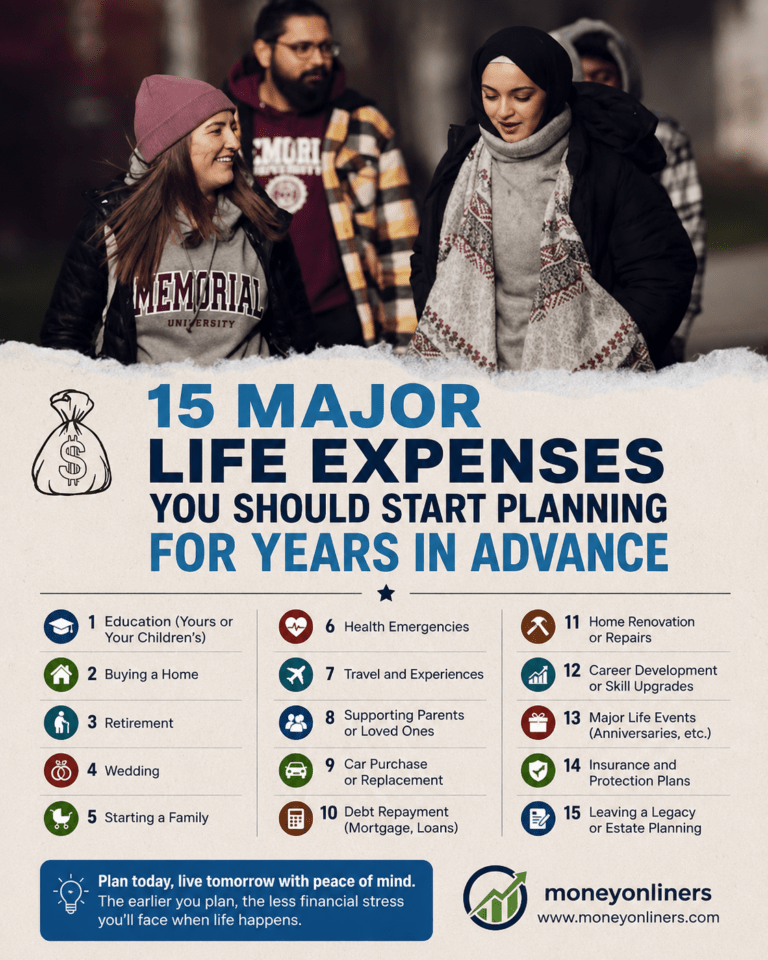
15 Major Life Expenses You Should Start Planning for Years in Advance
15 Major Life Expenses You Should Start Planning for Years in Advance | MoneyOnliners MoneyOnliners • Financial Planning → Major Expenses 15 Major Life Expenses You Should Start Planning for Years in Advance Some of the most expensive moments in life are not truly surprises. A home purchase, replacement vehicle, education, children, healthcare, retirement and…
How Much Should You Save Every Month for Your Future?
How Much Should You Save Every Month for Your Future? | MoneyOnliners MoneyOnliners • Saving → Future Planning How Much Should You Save Every Month for Your Future? Saving $100 every month may be a strong beginning for one person and far too little for another. Meanwhile, saving 30% of income can be realistic for…
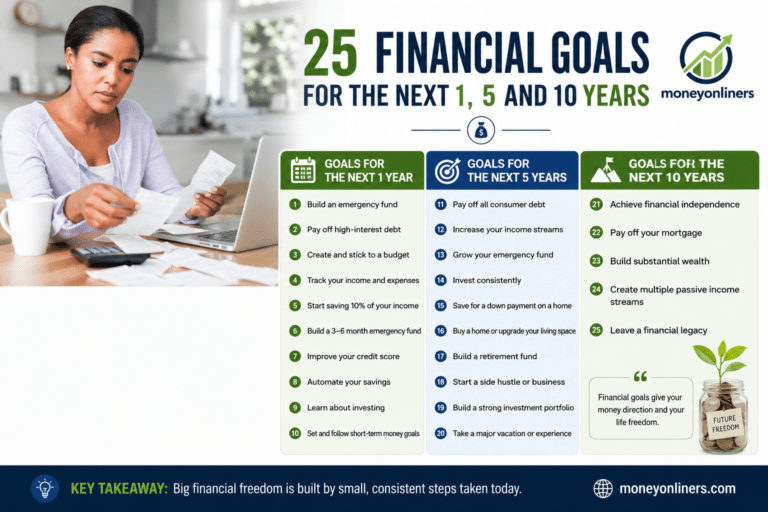
25 Financial Goals Worth Setting for the Next 1, 5 and 10 Years
25 Financial Goals Worth Setting for the Next 1, 5 and 10 Years | MoneyOnliners MoneyOnliners • Financial Planning → Goal Roadmap 25 Financial Goals Worth Setting for the Next 1, 5 and 10 Years Financial goals become much more useful when they are connected to time. Paying off a credit card may belong in…
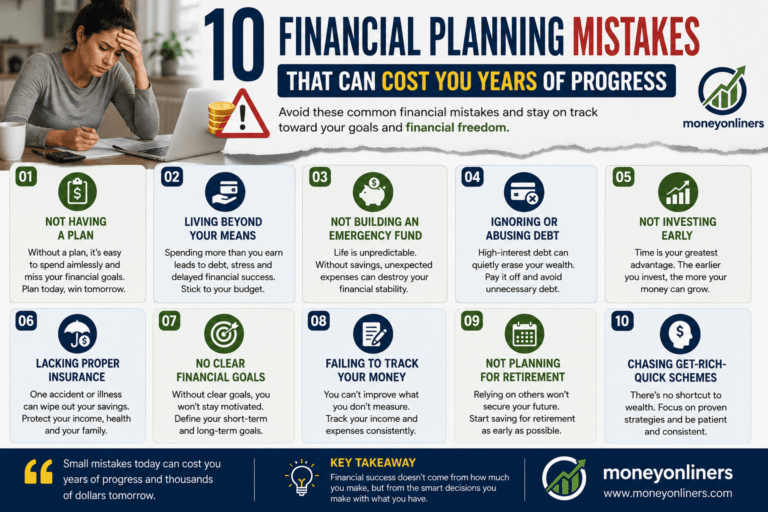
10 Financial Planning Mistakes That Can Cost You Years of Progress
10 Financial Planning Mistakes That Can Cost You Years of Progress | MoneyOnliners MoneyOnliners • Financial Planning → Mistakes to Avoid 10 Financial Planning Mistakes That Can Cost You Years of Progress Financial progress is not only about making good decisions. It is also about avoiding mistakes that quietly drain cash flow, delay investing, increase…
Short-Term vs Long-Term Financial Goals: 20 Real-Life Examples
Short-Term vs Long-Term Financial Goals: 20 Real-Life Examples | MoneyOnliners MoneyOnliners • Financial Planning → Goal Comparison Short-Term vs Long-Term Financial Goals: 20 Real-Life Examples Some financial goals belong in the next few months, while others may take decades. Building a $2,000 emergency fund is very different from funding retirement 30 years from now. Therefore,…