How Long Does It Take to Double Your Money? The Rule of 72 Explained
How Long Does It Take to Double Your Money? The Rule of 72 Explained
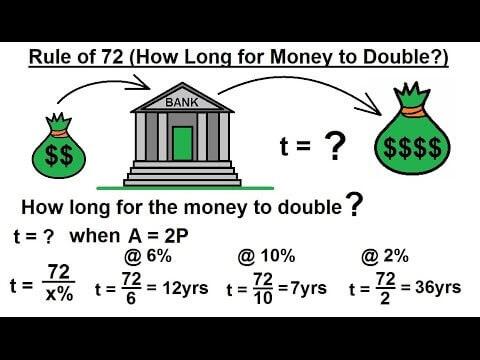
If your money is growing at 4%, 6%, 8% or 10% a year, how long might it take to become twice as much? The Rule of 72 gives you a quick estimate without needing a complicated calculator. Divide 72 by the expected annual rate, and the answer gives you an approximate doubling time.
To estimate how long does it take to double your money, use:
For example:
| Annual Return | Rule of 72 Estimate |
|---|---|
| 3% | 24 years |
| 4% | 18 years |
| 5% | 14.4 years |
| 6% | 12 years |
| 7% | 10.3 years |
| 8% | 9 years |
| 9% | 8 years |
| 10% | 7.2 years |
| 12% | 6 years |
However, this is only an approximation. Real investment returns do not arrive at the same rate every year.
Table of Contents
What Is the Rule of 72?
The Rule of 72 is a shortcut used to estimate how many years it may take money to double when growing at a fixed annual percentage rate.
Investor.gov explains the method simply: divide 72 by the expected rate of return.
Example
Suppose the expected annual return is:
8%
Then:
The Rule of 72 estimates that the money could double in roughly:
9 years
If You Start With $10,000
A simplified interpretation would be:
$10,000 → approximately $20,000 in about 9 years
assuming a steady 8% compound return.
Actual investments do not normally grow at a perfectly constant 8% every year. The Rule of 72 estimates mathematical growth under a fixed-rate assumption.
The Rule of 72 Formula
Example at 6%
72 ÷ 6 = 12 years
Example at 9%
72 ÷ 9 = 8 years
Example at 12%
72 ÷ 12 = 6 years
The formula works best as a quick mental estimate rather than a substitute for detailed investment planning.
How Long Does It Take to Double Your Money at Different Rates?
| Annual Growth Rate | Rule of 72 Estimate | Approximate Exact Doubling Time* |
|---|---|---|
| 3% | 24.0 years | 23.45 years |
| 4% | 18.0 years | 17.67 years |
| 5% | 14.4 years | 14.21 years |
| 6% | 12.0 years | 11.90 years |
| 7% | 10.29 years | 10.24 years |
| 8% | 9.0 years | 9.01 years |
| 9% | 8.0 years | 8.04 years |
| 10% | 7.2 years | 7.27 years |
| 12% | 6.0 years | 6.12 years |
*Exact comparison assumes steady annual compounding. Real investment returns vary.
Between roughly 6% and 10%, the Rule of 72 gives particularly convenient estimates for mental math.
10 Simple Rule of 72 Examples
| Example | Return | Calculation | Estimated Doubling Time |
|---|---|---|---|
| 1 | 3% | 72 ÷ 3 | 24 years |
| 2 | 4% | 72 ÷ 4 | 18 years |
| 3 | 5% | 72 ÷ 5 | 14.4 years |
| 4 | 6% | 72 ÷ 6 | 12 years |
| 5 | 7% | 72 ÷ 7 | 10.3 years |
| 6 | 8% | 72 ÷ 8 | 9 years |
| 7 | 9% | 72 ÷ 9 | 8 years |
| 8 | 10% | 72 ÷ 10 | 7.2 years |
| 9 | 12% | 72 ÷ 12 | 6 years |
| 10 | 18% | 72 ÷ 18 | 4 years |
A sustained 18% annual investment return would be extremely difficult to rely on. The example simply demonstrates the mathematics of the Rule of 72.
What Happens at a 4% Growth Rate?
Rule of 72
$1,000 Example
$1,000 → about $2,000 in approximately 18 years
$10,000 Example
$10,000 → about $20,000 in approximately 18 years
$100,000 Example
$100,000 → about $200,000 in approximately 18 years
The starting amount changes the dollar result, but not the approximate doubling time when the percentage rate is the same.
What Happens at a 6% Growth Rate?
At a hypothetical 6% annual compound rate:
$5,000 → about $10,000 in 12 years
Then, if the same rate continued:
$10,000 → about $20,000 in another 12 years
About 24 Years Total
$5,000 → approximately $20,000
That is not merely one doubling.
It is two consecutive doublings.
What Happens at a 7% Return?
The exact fixed-rate annual-compounding doubling time is roughly:
10.24 years
The Rule of 72 is therefore extremely close in this example.
Starting With $10,000
About $20,000 after roughly 10.3 years
Another 10.3 Years
About $40,000
Another 10.3 Years
About $80,000
That is approximately three mathematical doublings over roughly 31 years if a steady 7% return were actually achieved.
Some years may deliver large gains, while others may produce significant losses.

What Happens at an 8% Return?
Example
$10,000 → approximately $20,000 in 9 years
If the same hypothetical rate continued:
$20,000 → approximately $40,000 in another 9 years
And again:
$40,000 → approximately $80,000 in another 9 years
Total Time
Approximately 27 years for three doublings
At 8%, the Rule of 72 estimate of nine years is almost identical to the exact mathematical doubling time of about 9.01 years.
What Happens at a 10% Return?
Exact Mathematical Doubling Time
About 7.27 years
Again, the shortcut is very close.
$25,000 Example
$25,000 → about $50,000 in roughly 7.2 years
Second Doubling
$50,000 → about $100,000 in another 7.2 years
Total
About 14.4 years for $25,000 to become approximately $100,000
Historical averages do not create guaranteed future outcomes, and investments capable of higher returns generally involve meaningful risk.
How Accurate Is the Rule of 72?
It is surprisingly useful for quick estimates.
At 6%
Rule of 72: 12.00 years
Exact calculation: 11.90 years
At 8%
Rule of 72: 9.00 years
Exact calculation: 9.01 years
At 10%
Rule of 72: 7.20 years
Exact calculation: 7.27 years
The approximation is close enough for many mental-math comparisons.
Where Accuracy Declines
The rule becomes less precise at unusually low or unusually high rates.
That does not make it useless.
It simply means a calculator is better when precision matters.
Rule of 72 vs Exact Doubling-Time Math
The exact annual-compounding equation is based on logarithms:
For everyday financial thinking, most people do not want to calculate logarithms mentally.
That Is Why the Rule of 72 Is Useful
Rule of 72
Fast.
Easy.
Good for comparisons.
Exact Formula
More precise.
Better for detailed calculations.
Requires a calculator.
Why Compound Growth Makes Doubling Possible
Suppose $10,000 earns 8% annually.
After Year 1
$10,800
Year 2
The next 8% applies to $10,800 rather than $10,000.
$11,664
Year 3
About $12,597
The annual dollar growth increases because the balance itself grows.
By About Year 9
The mathematical balance is approximately double the starting amount.
Doubling happens because each year's positive return can potentially build on earlier gains.
You Can Also Use the Rule of 72 to Understand Inflation
The Rule of 72 can illustrate how quickly prices may approximately double under sustained inflation.
If Inflation Is 3%
At a steady 3% inflation rate, prices would roughly double in about 24 years.
If Inflation Is 6%
Example
Something costing:
$100 today
might cost roughly:
$200 after approximately 12 years
if inflation somehow remained at exactly 6%.
This is an educational use of the Rule of 72 rather than a forecast of future prices.
The Rule of 72 Can Show Why Investment Fees Matter
Imagine two portfolios before considering other differences.
Portfolio A Net Return
8%
Approximate Doubling Time
9 years
Portfolio B Net Return
7%
Approximate Doubling Time
10.3 years
Difference
About 1.3 years per doubling
Over several decades, that difference can matter substantially.
Fees matter not only because money leaves your account today, but because that money also loses its opportunity to participate in future compounding.
Why You Should Not Chase the Fastest Doubling Time
Looking at the table can create a tempting conclusion:
“Why not simply find an investment returning 18% so my money doubles every four years?”
Because return and risk are connected.
A Faster Mathematical Doubling Time Does Not Guarantee a Better Investment
Consider:
- Risk of permanent loss
- Volatility
- Diversification
- Fees
- Liquidity
- Tax treatment
- Investment legitimacy
The FTC says investment scammers commonly promise big money, guaranteed returns or unusually high profits with little risk.
No legitimate market investment can guarantee that your money will double on a fixed schedule.

MoneyOnliners Original Analysis: The Doubling-Time Framework
1. Rate
What return is being assumed?
2. Time
What doubling period does that return imply?
3. Risk
What could go wrong while pursuing that return?
4. Cost
How do fees and taxes affect the net return?
5. Reality
Is the return assumption realistic, diversified and supported—or is someone promising something that sounds too easy?
MoneyOnliners Doubling Ladder
MoneyOnliners Research-Based Evidence Note
This article is a research-based compound-growth education guide.
Investor.gov explains the Rule of 72 as dividing 72 by an investment's expected rate of return to estimate approximately how long the investment may take to double.
Investor.gov's own example shows that 9% corresponds to an approximate eight-year doubling period.
MoneyOnliners independently calculated the comparison between Rule of 72 estimates and exact annual-compounding doubling times.
For example, at 8%, the Rule of 72 gives nine years while the exact mathematical result is approximately 9.01 years.
The FTC warns that all investments involve risk and that guaranteed high-return claims can indicate fraud.
Therefore, MoneyOnliners does not use the Rule of 72 to promise that any investment will actually double within a specific period.
The Doubling-Time Framework, Doubling Ladder and Doubling-Power Score are original MoneyOnliners analytical resources.
No personal investment outcome or portfolio doubling result is claimed in this article.
10 Rule of 72 Mistakes to Avoid
1. Treating the Rule as a Guarantee
It is only an estimate.
2. Assuming Market Returns Are Fixed
Investments fluctuate.
3. Chasing the Highest Return
Higher expected returns may involve greater risk.
4. Ignoring Fees
Fees can reduce the net return and lengthen doubling time.
5. Ignoring Taxes
After-tax returns may be lower.
6. Ignoring Inflation
Doubling your nominal money does not necessarily double your purchasing power.
7. Applying the Rule to Extremely High Rates Without Caution
Accuracy declines outside its most useful range.
8. Confusing Doubling With Guaranteed Wealth
A $1,000 investment doubling still produces only $2,000.
9. Forgetting Contributions
Regular contributions can be more important than waiting for the original balance to double.
10. Believing a Promoter Who Guarantees Doubling
The FTC warns that guaranteed high-return investment claims are a common scam signal.
The Rule of 72 can estimate what a return would do. It cannot tell you whether an investment will actually earn that return.
Why Understanding How Long It Takes to Double Your Money Matters
1. The Rule of 72 makes compound growth easier to understand.
2. It converts an abstract percentage into an estimated number of years.
3. At 3%, doubling takes roughly 24 years.
4. At 4%, it takes roughly 18 years.
5. At 6%, it takes roughly 12 years.
6. At 8%, it takes roughly nine years.
7. At 9%, it takes roughly eight years.
8. At 10%, it takes roughly 7.2 years.
9. A higher rate mathematically shortens doubling time.
10. Higher returns are not automatically safer or better.
11. Investment returns are not guaranteed.
12. Compound growth allows earlier gains to participate in later gains.
13. Multiple doublings can create increasingly large dollar gains.
14. Fees can lengthen the real doubling period.
15. Taxes can reduce effective returns.
16. Inflation can double prices as well as investment balances.
17. Starting earlier can create room for more potential doubling periods.
18. Contributions can accelerate wealth building beyond compounding alone.
19. Guaranteed doubling claims should be treated skeptically.
20. Ultimately, understanding how long does it take to double your money helps turn compound growth from an abstract idea into a practical way to compare rates, time horizons, fees, inflation and investment risk.
Incoming Link Opportunities
Compound Interest Explained With 10 Simple Real-Life Examples
https://moneyonliners.com/compound-interest-explained-examples/
Simple Interest vs Compound Interest: 10 Differences You Should Know
https://moneyonliners.com/simple-interest-vs-compound-interest/
$1,000 Invested for 10, 20 and 30 Years: What Could Compound Growth Do?
https://moneyonliners.com/1000-invested-10-20-30-years/
What Happens If You Invest $100 a Month for 20 Years?
https://moneyonliners.com/invest-100-a-month-for-20-years/
Your First $100,000: Why This Wealth Milestone Can Be So Powerful
https://moneyonliners.com/first-100000-wealth-milestone/
High-Priority Incoming Links
$0 to $100,000 Net Worth: A Realistic Roadmap for Building Your First Six Figures
https://moneyonliners.com/0-to-100000-net-worth/
15 Wealth-Building Strategies That Can Grow Your Money Over Time
https://moneyonliners.com/wealth-building-strategies/
10 Wealth-Building Habits That Can Make a Big Difference Over 10 Years
https://moneyonliners.com/wealth-building-habits/
20 Assets That Can Help Build Wealth Over the Long Term
https://moneyonliners.com/assets-that-build-wealth/
Topic Cluster Incoming Links
How Long Does It Take to Build Wealth? 8 Factors That Matter Most
https://moneyonliners.com/how-long-does-it-take-to-build-wealth/
Saving vs Building Wealth: Why Saving Money Alone May Not Be Enough
https://moneyonliners.com/saving-vs-building-wealth/
How to Build Wealth From Nothing: 10 Steps for Beginners
https://moneyonliners.com/how-to-build-wealth-from-nothing/
Building Wealth in Your 20s, 30s, 40s and 50s: What Changes?
https://moneyonliners.com/building-wealth-by-age/
Continue Learning on MoneyOnliners
Recommended External Resources
1. Investor.gov — What Is Compound Interest?
What Is Compound Interest? — Investor.gov
Explains compound interest and provides the official Investor.gov Rule of 72 example.
2. Investor.gov — Compound Interest Calculator
Compound Interest Calculator — Investor.gov
Allows readers to calculate future values using different starting amounts, rates, contributions and time periods.
3. Investor.gov — Introduction to Investing
Introduction to Investing — Investor.gov
Provides beginner guidance on investment risk, returns, diversification and compound growth.
4. Investor.gov — Build Wealth Over Time Through Saving and Investing
Build Wealth Over Time Through Saving and Investing — Investor.gov
Explains how regular saving, investing and time can contribute to long-term wealth building.
5. Investor.gov — Understanding Investment Fees
Understanding Investment Fees — Investor.gov
Useful for understanding how costs can reduce net returns and lengthen the time needed for money to double.
6. Investor.gov — Diversify Your Investments
Diversify Your Investments — Investor.gov
Explains diversification and why investors should not chase one potentially high-return asset simply to shorten doubling time.
7. Consumer Financial Protection Bureau — How Does Compound Interest Work?
How Does Compound Interest Work? — CFPB
Provides a simple explanation of earning interest on previous interest.
8. Federal Trade Commission — Investment Scams
Investment Scams — Federal Trade Commission
Explains common warning signs including guaranteed returns and promises of large profits with little risk.
9. Federal Trade Commission — 2026 Investment Scam Warning
How to Spot and Avoid Investment Scams — FTC
Current 2026 guidance describing fake investment returns, social-media pitches and fraudulent profit claims.
10. Consumer Financial Protection Bureau — Saving
Saving — Consumer Financial Protection Bureau
Provides resources for building emergency savings and broader financial resilience.
This article provides general educational information and is not individualized financial, investment, retirement, tax or legal advice. Rule of 72 estimates assume a steady percentage rate for mathematical illustration. Real investment returns fluctuate, losses are possible, and fees, taxes and inflation can materially affect actual doubling times.
Frequently Asked Questions
What is the Rule of 72?
The Rule of 72 is a quick doubling-time estimate.
Divide 72 by the expected annual return.
The answer gives the approximate number of years required to double.
For example, 72 divided by eight equals nine.
Therefore, 8% corresponds to roughly nine years.
How long does it take to double your money at 3%?
Use the Rule of 72.
72 ÷ 3 = 24 years
The exact annual-compounding result is approximately 23.45 years.
Therefore, the shortcut is reasonably close.
Real savings and investment rates may change.
How long does it take to double your money at 4%?
Approximately 18 years using the Rule of 72.
The exact fixed-rate result is about 17.67 years.
A $10,000 balance would therefore mathematically approach $20,000 around that point.
Taxes and fees can change the result.
Actual investment returns may fluctuate.
How long does it take to double at 5%?
Approximately 14.4 years.
72 ÷ 5 = 14.4
The exact mathematical result is about 14.21 years.
The Rule of 72 is therefore a useful estimate.
It is not a guaranteed timeline.
How long does it take to double money at 6%?
Approximately 12 years.
72 ÷ 6 = 12
The exact fixed-rate result is approximately 11.9 years.
This makes the Rule of 72 particularly convenient at 6%.
Actual investments do not provide a fixed guaranteed return.
How long does it take to double at 7%?
Approximately 10.3 years.
The exact annual-compounding result is about 10.24 years.
Therefore, the Rule of 72 is very close.
However, stock-market returns can vary dramatically from year to year.
Use 7% only as an assumption when modeling scenarios.
How long does it take to double at 8%?
Approximately nine years.
72 ÷ 8 = 9
The exact mathematical result is about 9.01 years.
This is one of the Rule of 72's most accurate examples.
Again, the return itself is not guaranteed.
How long does it take to double at 9%?
Approximately eight years.
72 ÷ 9 = 8
Investor.gov uses this example when explaining the Rule of 72.
The exact mathematical result is approximately 8.04 years.
Actual investing will be less predictable.
How long does it take to double at 10%?
Approximately 7.2 years.
The exact mathematical result is approximately 7.27 years.
The Rule of 72 therefore remains very close.
However, a 10% return is not guaranteed.
Risk should always be considered.
Can money double every seven years?
Mathematically, a return slightly above 10% would imply a doubling period near seven years.
However, investments do not produce guaranteed fixed annual returns.
A common slogan that money “doubles every seven years” can therefore be misleading if presented as certainty.
Some market periods perform better.
Others perform much worse.
Can $10,000 become $20,000?
Yes, if sufficient positive growth occurs.
At a fixed hypothetical 8%, the Rule of 72 estimates roughly nine years.
At 4%, the estimate is approximately 18 years.
At 10%, approximately 7.2 years.
Actual investment outcomes remain uncertain.
Does the Rule of 72 work for savings accounts?
Yes as a rough estimate when you know the interest rate.
For example, at 4%, the estimated doubling time is 18 years.
However, savings-account rates can change.
Taxes can also reduce effective returns.
Therefore, the actual period may differ.
Does the Rule of 72 work with stocks?
It can be used for hypothetical average-return illustrations.
However, stocks do not earn fixed interest rates.
Returns fluctuate substantially.
Therefore, the Rule of 72 cannot predict exactly when a stock portfolio will double.
It is better used as a long-term educational estimate.
Can the Rule of 72 be used for inflation?
Yes.
Divide 72 by the inflation rate.
At 3%, prices would mathematically double in about 24 years.
At 6%, approximately 12 years.
Actual inflation changes over time.
Is the Rule of 72 exact?
No.
It is an approximation.
However, it can be surprisingly accurate around many commonly discussed rates.
For precision, use the exact compound-growth formula or calculator.
For mental comparisons, the Rule of 72 is usually easier.
Research Methodology
Primary Rule
MoneyOnliners used:
Estimated Doubling Time = 72 ÷ Annual Percentage Rate
Primary External Source
Investor.gov was used to verify the Rule of 72 definition and its 9% → eight-year example.
Exact Comparison
MoneyOnliners independently compared the shortcut with the standard annual-compounding doubling formula:
Doubling Time = ln(2) ÷ ln(1 + r)
Rates Tested
- 3%
- 4%
- 5%
- 6%
- 7%
- 8%
- 9%
- 10%
- 12%
Why Exact Doubling Times Were Included
The comparison provides an original MoneyOnliners calculation showing how closely the Rule of 72 approximates exact annual compounding at commonly used rates.
Investment Risk
FTC investment-scam guidance was reviewed because doubling-time claims can be misused by promoters promising guaranteed high returns or supposedly risk-free wealth.
Inflation
The Rule of 72 is also used educationally to illustrate how sustained inflation can approximately double prices over time.
Fees
MoneyOnliners included fees because lowering the net return mathematically increases the doubling period.
Original MoneyOnliners Analysis
The Doubling-Time Framework, Doubling Ladder and Doubling-Power Score are original MoneyOnliners educational resources.
First-Hand Evidence Standard
MoneyOnliners only presents first-hand portfolio doubling results, investment screenshots or verified account histories when genuine evidence exists and can be accurately documented.
No personal portfolio-doubling result is claimed in this article.
Limitations
Real market returns vary.
Fees reduce net returns.
Taxes may reduce after-tax growth.
Inflation changes purchasing power.
Therefore, Rule of 72 results should be used as estimates rather than investment forecasts.
Google Search Console Checklist
- Confirm final URL: /how-long-does-it-take-to-double-your-money/
- Confirm canonical matches the published URL.
- Use how long does it take to double your money naturally in the title, introduction, headings, FAQ and conclusion.
- Use related phrases naturally: Rule of 72, money doubling time, double your investment, how long to double money at 7 percent, how long to double money at 10 percent and compound growth doubling.
- Use investment/lifestyle imagery for the hero.
- Use younger-adult imagery when explaining starting early.
- Use family financial-planning imagery in the risk section.
- Use retirement-age imagery where discussing multiple doubling periods.
- Avoid repeating calculator imagery.
- Keep every image alt description unique.
- Confirm Recommended External Resources contains 6–10 authoritative links.
- Confirm Investor.gov Rule of 72 guidance remains current.
- Confirm FTC investment-scam guidance remains current.
- Confirm every internal link points to a live canonical URL.
- Check all calculation tables carefully on mobile.
- Confirm the article is indexable.
- Confirm the URL appears in the XML sitemap.
- Inspect the published URL in Google Search Console.
- Request indexing after publication if appropriate.
- Monitor searches such as “how long does it take to double your money,” “Rule of 72,” “how long to double money at 7 percent,” “how long to double money at 8 percent,” “money doubling calculator” and “72 divided by return.”
Conclusion: The Rule of 72 Turns Compound Growth Into Simple Mental Math
So, how long does it take to double your money?
It depends on the rate of return.
At 4%
About:
18 years
At 6%
About:
12 years
At 8%
About:
9 years
At 10%
About:
7.2 years
The Formula Is Simple
But the Investment Decision Is Not
Return matters.
Risk matters.
Fees matter.
Taxes matter.
Inflation matters.
Diversification matters.
Time matters.
Most Importantly, a Projected Return Is Not a Promise
Real investments can rise or fall.
No legitimate investment can guarantee your money will double every seven, eight or ten years.
Similar Posts
Compound Interest on Debt: How It Can Work Against You
Compound Interest on Debt: How It Can Work Against You | MoneyOnliners MoneyOnliners • Debt → Compound Interest Compound Interest on Debt: How It Can Work Against You Compound interest can help savings and investments grow, but the same basic mathematics can become expensive when you owe money. If unpaid interest becomes part of a…
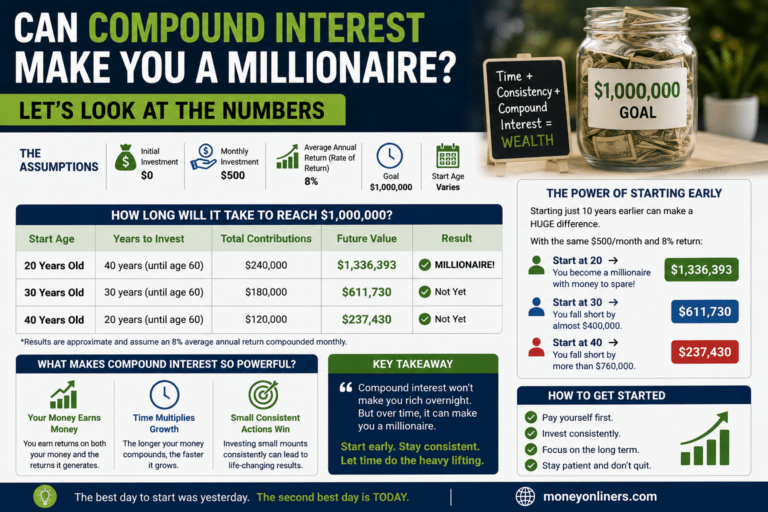
Can Compound Interest Make You a Millionaire? Let’s Look at the Numbers
Can Compound Interest Make You a Millionaire? Let’s Look at the Numbers | MoneyOnliners MoneyOnliners • Compound Interest → Millionaire Math Can Compound Interest Make You a Millionaire? Let’s Look at the Numbers Becoming a millionaire through compound growth is mathematically possible, but the word “millionaire” can make the process sound easier than it really…
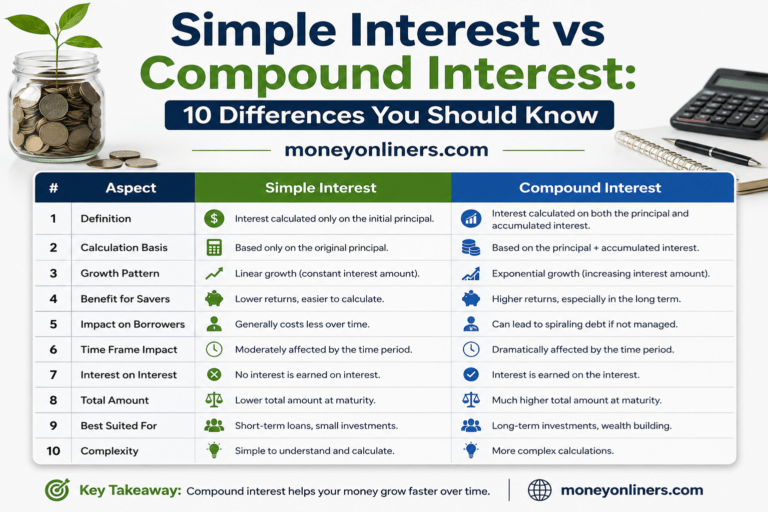
Simple Interest vs Compound Interest: 10 Differences You Should Know
Simple Interest vs Compound Interest: 10 Differences You Should Know | MoneyOnliners MoneyOnliners • Compound Interest → Comparison Guide Simple Interest vs Compound Interest: 10 Differences You Should Know Simple interest and compound interest can start with the same principal and the same stated rate yet produce different results. The difference comes from what the…
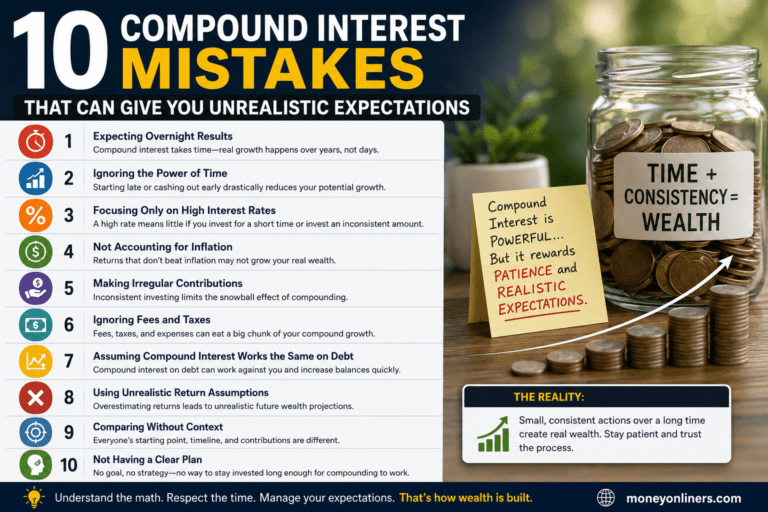
10 Compound Interest Mistakes That Can Give You Unrealistic Expectations
10 Compound Interest Mistakes That Can Give You Unrealistic Expectations | MoneyOnliners MoneyOnliners • Compound Interest → Reality Check 10 Compound Interest Mistakes That Can Give You Unrealistic Expectations Compound interest is one of the most useful ideas in long-term finance, but it is also one of the easiest to misunderstand. A calculator can make…
Starting at 20 vs 30 vs 40: How Much Does 10 Years Really Matter?
Starting at 20 vs 30 vs 40: How Much Does 10 Years Really Matter? | MoneyOnliners MoneyOnliners • Investing → Time Advantage Starting at 20 vs 30 vs 40: How Much Does 10 Years Really Matter? Ten years can look insignificant when retirement is decades away. However, investing from age 20 instead of 30 gives…
$1,000 Invested for 10, 20 and 30 Years: What Could Compound Growth Do?
$1,000 Invested for 10, 20 and 30 Years: What Could Compound Growth Do? | MoneyOnliners MoneyOnliners • Investing → Compound Growth $1,000 Invested for 10, 20 and 30 Years: What Could Compound Growth Do? One thousand dollars is not enough to guarantee financial independence, but it is large enough to demonstrate something important: time can…



One Comment