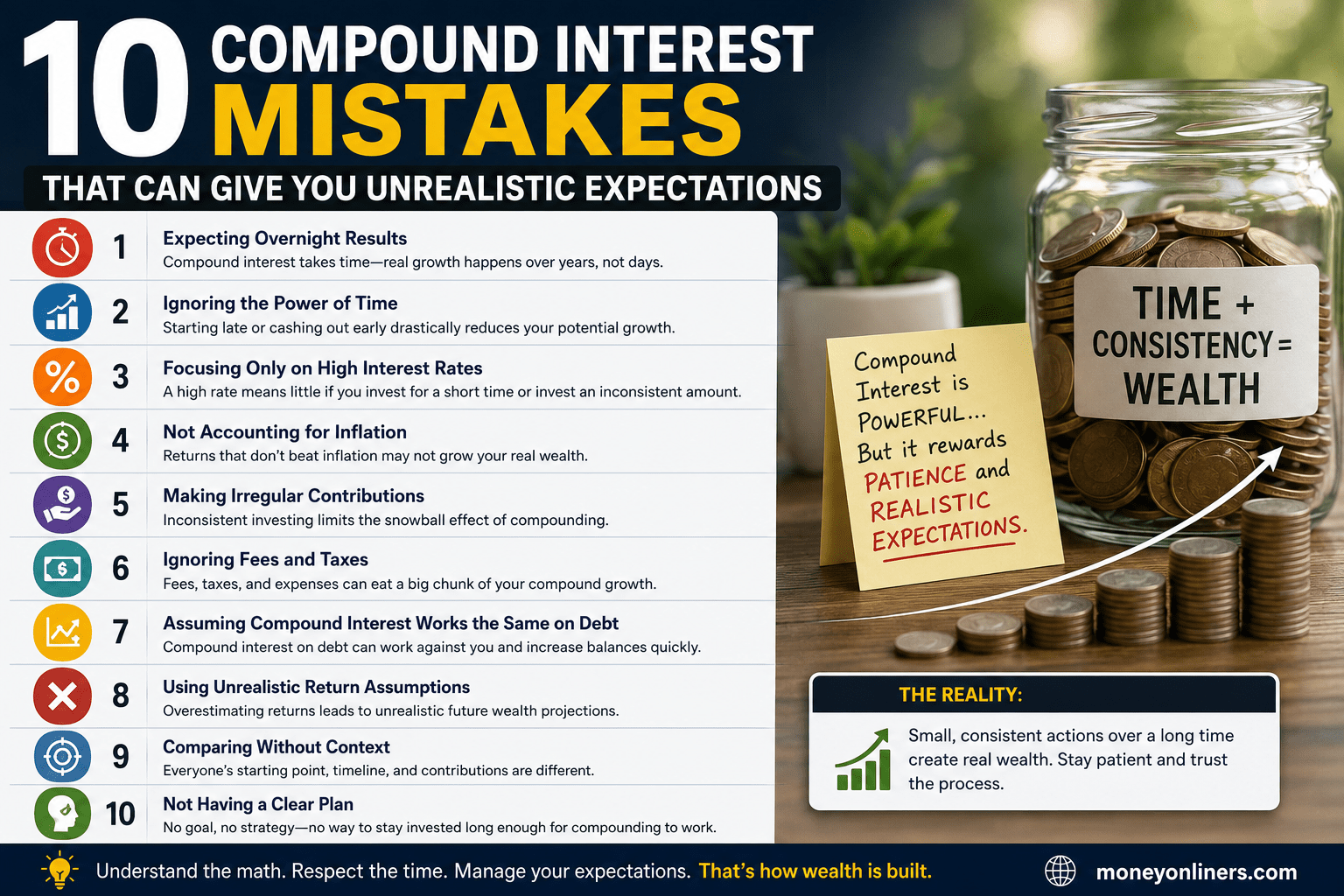
10 Compound Interest Mistakes That Can Give You Unrealistic Expectations
10 Compound Interest Mistakes That Can Give You Unrealistic Expectations
Compound interest is one of the most useful ideas in long-term finance, but it is also one of the easiest to misunderstand. A calculator can make $100, $1,000 or $10,000 appear to turn into a huge future balance, yet that result may depend on assumptions about returns, time, fees, taxes, inflation and uninterrupted investing that real life does not always deliver.
The biggest compound interest mistakes happen when people treat a mathematical illustration as a guaranteed financial future.
A projection such as:
$1,000 growing at 7% for 30 years ≈ $7,612
is mathematically valid under the assumption of a steady 7% return.
However, real investing can involve:
- Years of negative returns
- Changing contribution amounts
- Investment fees
- Taxes
- Inflation
- Withdrawals
- Behavioral mistakes
- Long stretches of weak market performance
Compound-interest calculators tell you what could happen under chosen assumptions. They do not tell you what definitely will happen.
Table of Contents
Compound Interest Is Mathematics, Not a Promise
Compound growth calculations are extremely useful because they show how money could grow when returns remain invested.
The Basic Formula
The formula is mathematically correct.
The uncertainty comes from the inputs.
If You Enter 7%
The calculator assumes 7%.
If You Enter 10%
The calculator assumes 10%.
It does not determine whether your real investment will actually earn either return.
1 Assuming You Will Earn the Same Return Every Year
One of the biggest mistakes is interpreting a 7% compound-growth calculation as:
“My investment will increase by exactly 7% every year.”
That is not how most market investments behave.
Real Markets Can Look More Like This
| Year | Hypothetical Return |
|---|---|
| 1 | +15% |
| 2 | -8% |
| 3 | +4% |
| 4 | +18% |
| 5 | -12% |
Long-term averages can emerge from extremely uneven yearly results.
Use fixed-return projections as scenario models rather than yearly forecasts.
2 Treating Historical Average Returns as Guaranteed Future Returns
Historical market averages can be useful for understanding the past.
However, they cannot promise the future.
The Wrong Conclusion
“Stocks historically returned X%, therefore I will receive X%.”
The Better Conclusion
“Historical returns can help inform a planning range, but future returns may differ.”
Investor.gov provides compound-growth calculators using an estimated interest rate, which is an important word: estimated.
Planning should allow room for returns to be lower than optimistic assumptions.
3 Forgetting That Investment Losses Interrupt the Smooth Growth Story
A calculator usually draws a smooth upward curve.
Real portfolios can fall sharply.
Example
Suppose you have:
$100,000
and the portfolio loses:
20%
New Balance
$80,000
How Much Must $80,000 Gain to Return to $100,000?
25%
Why?

4 Ignoring Investment Fees
Fees reduce the amount of money that remains invested.
That affects today.
It also affects tomorrow because money removed through fees can no longer participate in future compound growth.
Illustrative Comparison
Imagine:
Gross hypothetical return: 7%
Portfolio A Net Return
6.8%
Portfolio B Net Return
6.0%
One year may show a modest difference.
Thirty years can make that gap much larger.
Model compound growth using a realistic return after investment costs whenever possible.
5 Ignoring Taxes
A calculator may show a gross future value.
That does not always equal spendable after-tax wealth.
Tax Treatment Depends on
- Account type
- Country
- Investment type
- Income
- Holding period
- Capital gains rules
- Dividend or interest taxation
For U.S. Investors
A taxable brokerage account can have different tax consequences from:
- Traditional 401(k)
- Roth 401(k)
- Traditional IRA
- Roth IRA
6 Forgetting Inflation
A future balance can look enormous without telling you what the money will actually buy.
Suppose a Projection Shows
$1,000,000 in 40 years
That sounds much more impressive if you mentally compare it with today's purchasing power.
However, inflation means future dollars may buy less.
Nominal Growth
How much the account increases in dollar terms.
Real Growth
How much purchasing power improves after inflation is considered.

7 Assuming You Will Never Withdraw Money
Compound-growth calculators often assume the money remains untouched.
Real life can intervene.
Common Reasons for Withdrawals
- Job loss
- Medical expenses
- Home repairs
- Education costs
- Business expenses
- Family emergencies
- Major purchases
Why Withdrawals Matter
Suppose your investment balance is:
$50,000
and you withdraw:
$10,000
You did not only remove $10,000.
You also removed its opportunity to participate in future growth.
Emergency savings can reduce the chance that long-term investments need to be interrupted for short-term financial emergencies.
8 Expecting Compound Interest to Become Powerful Immediately
Compound growth is often marketed as if it transforms small sums into enormous wealth quickly.
Usually, time is the ingredient people underestimate.
$1,000 at a Hypothetical 7%
| Time | Approximate Value | Approximate Growth |
|---|---|---|
| 10 years | $1,967 | $967 |
| 20 years | $3,870 | $2,870 |
| 30 years | $7,612 | $6,612 |
After ten years, the balance has not become a fortune.
The dramatic effect becomes more visible during the later decades.
9 Focusing on Returns While Ignoring Contribution Size
Beginners sometimes spend enormous effort trying to move from a hypothetical 7% return to 9% while contributing very little.
Contribution size can be far more controllable.
Example
At a hypothetical 7% for 20 years:
| Monthly Contribution | Total Contributions | Approximate Ending Balance |
|---|---|---|
| $100 | $24,000 | $52,093 |
| $200 | $48,000 | $104,185 |
| $300 | $72,000 | $156,278 |
The Lesson
Doubling the contribution roughly doubles the ending balance under identical assumptions.
“How can I sustainably increase the amount I invest each month?”
10 Believing Someone Who Guarantees High Compound Returns
This is the most dangerous mistake on the list.
Common Claims
- “Guaranteed 3% every month”
- “Your money doubles every year”
- “No-risk trading system”
- “Secret compounding method”
- “Guaranteed passive income”
- “AI trading system that cannot lose”
The FTC states that investments involve risk and warns that scammers commonly promise large returns, guaranteed profits or little-to-no risk.
Recent 2026 FTC Guidance
The FTC has continued warning consumers about social-media investment training promotions that promise easy trading income, large profits and low risk.
The Safe Principle
The more certain someone sounds about extraordinary investment returns, the more skeptical you should become.
How Different Return Assumptions Can Change the Same $1,000
One of the easiest ways to create unrealistic expectations is choosing an optimistic rate without testing alternatives.
$1,000 With No Additional Contributions
| Hypothetical Return | 10 Years | 20 Years | 30 Years |
|---|---|---|---|
| 4% | $1,480 | $2,191 | $3,243 |
| 5% | $1,629 | $2,653 | $4,322 |
| 7% | $1,967 | $3,870 | $7,612 |
| 8% | $2,159 | $4,661 | $10,063 |
| 10% | $2,594 | $6,728 | $17,449 |
Look at the 30-Year Gap
At 4%:
$3,243
At 10%:
$17,449
The starting money is identical.
The assumption produces the enormous difference.
Instead of using only one optimistic return, model several possible rates.
Compound Interest Calculator Math vs Real Investing
| Calculator Model | Real Financial Life |
|---|---|
| Fixed return every year | Returns fluctuate |
| No market panic | Investors can sell at bad times |
| Perfect monthly contributions | Contributions may stop or change |
| No emergency withdrawals | Unexpected expenses happen |
| No fees unless entered | Investments can have recurring costs |
| No taxes unless modeled | Taxes may affect results |
| Nominal dollars | Inflation affects purchasing power |
| Assumption stays constant | Economic conditions change |
Their value comes from testing possibilities—not predicting your exact future.
MoneyOnliners Original Analysis: The Compound Growth Expectation Reality Check
1. Return
Is the assumed rate conservative, moderate or unusually optimistic?
2. Time
Will the money realistically remain invested for that long?
3. Contributions
Can you actually maintain the assumed monthly investment?
4. Costs
Are fees and taxes reflected?
5. Inflation
What might the future balance actually buy?
6. Reality
Does the projection allow for volatility, interruptions and imperfect investor behavior?
MoneyOnliners Optimism Gap Formula
MoneyOnliners Compound Growth Assumption Scorecard
| Question | More Realistic Direction |
|---|---|
| Are returns guaranteed? | No |
| Have lower-return scenarios been tested? | Yes |
| Are fees included? | Yes where known |
| Are taxes considered? | Yes where relevant |
| Is inflation considered? | Yes |
| Are contributions realistic? | Yes |
| Are withdrawals possible? | Acknowledge them |
| Could markets fall? | Absolutely |
| Is diversification considered? | Yes |
| Are guaranteed-return promoters avoided? | Always |
The MoneyOnliners Compound Growth Expectation Reality Check, Optimism Gap Formula and Compound Growth Assumption Scorecard are original educational resources designed to help readers stress-test compound-interest projections before treating them as realistic financial expectations.
MoneyOnliners Research-Based Evidence Note
This article is a research-based compound-growth reality check.
Investor.gov defines compound interest as earning interest on previously earned interest and provides calculators that allow users to enter an estimated return, contribution amount, time horizon and compounding frequency.
MoneyOnliners interprets those calculator inputs correctly as assumptions rather than guaranteed outcomes.
The numerical examples in this article were independently calculated using standard compound-growth mathematics.
The $1,000 examples test 4%, 5%, 7%, 8% and 10% annual assumptions across 10-, 20- and 30-year periods.
Those numbers are not predictions.
FTC investment-scam guidance was reviewed because unrealistic compound-growth expectations can make people vulnerable to promoters promising guaranteed income, large returns or little risk.
The FTC's August 2026 guidance specifically warns about social-media investment training promotions that promise easy trading profits or guaranteed success.
MoneyOnliners therefore distinguishes normal compound-interest education from claims of guaranteed investment performance.
The Compound Growth Expectation Reality Check, Optimism Gap Formula and Assumption Scorecard are original MoneyOnliners analytical resources.
Why Avoiding Compound Interest Mistakes Matters
1. Compound interest is a mathematical process rather than a guaranteed investment result.
2. Fixed-return calculators simplify real market behavior.
3. Investment returns can be negative in some years.
4. Historical averages do not guarantee future averages.
5. Large market losses can require even larger percentage recoveries.
6. Fees reduce the amount available to compound.
7. Taxes can reduce after-tax wealth.
8. Inflation reduces future purchasing power.
9. Withdrawals interrupt compounding.
10. Emergency savings can help protect long-term investments from premature withdrawals.
11. Compounding usually becomes more noticeable over decades.
12. Contribution size can matter more than small changes in assumed return.
13. Income growth can create room for larger contributions.
14. Diversification can reduce dependence on one investment outcome.
15. Very high projected returns can produce dramatically inflated future values.
16. Conservative scenarios can make planning more resilient.
17. Multiple return assumptions are often more useful than one perfect-looking forecast.
18. Investor behavior can materially change real results.
19. Guaranteed high-return claims deserve serious skepticism.
20. Ultimately, avoiding common compound interest mistakes helps you use compounding as a planning tool without turning an uncertain financial future into a false promise.
Incoming Link Opportunities
Compound Interest Explained With 10 Simple Real-Life Examples
https://moneyonliners.com/compound-interest-explained-examples/
Simple Interest vs Compound Interest: 10 Differences You Should Know
https://moneyonliners.com/simple-interest-vs-compound-interest/
Compound Interest on Debt: How It Can Work Against You
https://moneyonliners.com/compound-interest-on-debt/
How Long Does It Take to Double Your Money? The Rule of 72 Explained
https://moneyonliners.com/how-long-does-it-take-to-double-your-money/
Daily vs Monthly vs Annual Compounding: Does the Difference Really Matter?
https://moneyonliners.com/daily-vs-monthly-vs-annual-compounding/
High-Priority Incoming Links
What Happens If You Invest $100 a Month for 20 Years?
https://moneyonliners.com/invest-100-a-month-for-20-years/
$1,000 Invested for 10, 20 and 30 Years: What Could Compound Growth Do?
https://moneyonliners.com/1000-invested-10-20-30-years/
Starting at 20 vs 30 vs 40: How Much Does 10 Years Really Matter?
https://moneyonliners.com/starting-investing-at-20-vs-30-vs-40/
Your First $100,000: Why This Wealth Milestone Can Be So Powerful
https://moneyonliners.com/first-100000-wealth-milestone/
Topic Cluster Incoming Links
15 Wealth-Building Mistakes That Can Keep Your Net Worth Stuck
https://moneyonliners.com/wealth-building-mistakes/
10 Net Worth Mistakes That Can Make You Think You're Richer Than You Are
https://moneyonliners.com/net-worth-mistakes/
How Long Does It Take to Build Wealth? 8 Factors That Matter Most
https://moneyonliners.com/how-long-does-it-take-to-build-wealth/
10 Wealth-Building Habits That Can Make a Big Difference Over 10 Years
https://moneyonliners.com/wealth-building-habits/
Continue Learning on MoneyOnliners
Recommended External Resources
1. Investor.gov — Compound Interest Calculator
Compound Interest Calculator — Investor.gov
Useful for testing different starting balances, contributions, estimated returns, time periods and compounding frequencies.
2. Investor.gov — What Is Compound Interest?
What Is Compound Interest? — Investor.gov
Explains interest-on-interest and demonstrates how time affects compound growth.
3. Investor.gov — Introduction to Investing
Introduction to Investing — Investor.gov
Provides broader beginner education on market risk, returns, diversification and long-term investing.
4. Investor.gov — Understanding Investment Fees
Understanding Investment Fees — Investor.gov
Explains why recurring costs can materially reduce long-term investment growth.
5. Investor.gov — Diversify Your Investments
Diversify Your Investments — Investor.gov
Provides guidance on reducing concentration risk instead of depending on one high-return investment.
6. Investor.gov — Build Wealth Over Time Through Saving and Investing
Build Wealth Over Time Through Saving and Investing — Investor.gov
Provides a broader long-term framework around savings, investing, regular contributions and time.
7. Federal Trade Commission — Investment Scams
Investment Scams — Federal Trade Commission
Explains why guaranteed returns, big-profit promises and claims of little risk are major warning signs.
8. FTC — How to Spot Investment Training Scams on Social Media
How to Spot Investment Training Scams on Social Media — FTC
Current August 2026 guidance warning about trading programs that promise easy profits, guaranteed success or low-risk returns.
9. FTC — Investment Scam Losses and Warning Signs
With People Losing Big to Investment Scams, Learn How to Spot and Avoid Them — FTC
Provides current 2026 information on fake investment profits, social-media approaches and fraudulent investment platforms.
10. Consumer Financial Protection Bureau — Saving
Saving — Consumer Financial Protection Bureau
Provides practical resources for emergency savings and financial resilience, which can help protect long-term investments from avoidable withdrawals.
This article provides general educational information and is not individualized investment, financial, retirement, tax or legal advice. All future-value examples use hypothetical assumptions. Real investment returns can be higher, lower or negative, and fees, taxes, inflation, withdrawals and investor behavior can materially change outcomes.
Frequently Asked Questions
Is compound interest guaranteed?
The mathematical process is real.
A specific investment return is not guaranteed.
If an account genuinely earns a fixed contractual interest rate, the calculation may be more predictable during that rate period.
Market investments are different because their returns fluctuate.
Never assume a projected market return will occur every year.
Is 7% compound growth guaranteed?
No.
Seven percent is commonly used in educational examples.
It can help demonstrate long-term mathematics.
However, real investments can produce lower or higher returns.
Some periods may include substantial losses.
Why do compound-interest calculators look so optimistic?
They usually assume one constant return.
They may assume perfect contributions.
They may exclude fees unless you adjust the rate.
They usually do not model investor panic or unexpected withdrawals.
Therefore, they are best used for scenarios rather than exact forecasts.
Can $1,000 really become $7,000?
Mathematically, yes.
At a hypothetical 7% annual return, $1,000 becomes about $7,612 after 30 years.
However, the return must actually occur over time.
Fees and taxes can reduce the result.
Inflation also affects the future purchasing power.
Why do small changes in return make such a big difference?
Because the difference compounds repeatedly.
A higher rate creates a larger balance.
That larger balance then participates in later growth.
The effect becomes increasingly visible over long periods.
This is why optimistic assumptions can dramatically inflate future projections.
Do fees really matter that much?
Yes.
A recurring fee removes money from the account.
That money cannot generate future returns.
The longer the investment horizon, the more important this lost compounding can become.
Understand all investment costs.
Does inflation reduce compound interest?
Inflation does not necessarily reduce the nominal account balance.
Instead, it reduces what future money can buy.
A portfolio may grow 7% nominally while inflation reduces part of the real purchasing-power gain.
That difference matters greatly over decades.
Long-term plans should consider real as well as nominal growth.
What happens if I withdraw money early?
The account balance falls.
The withdrawn money no longer participates in future growth.
That can reduce the final balance by more than the withdrawal itself.
Taxes or penalties may also apply depending on the account.
Emergency savings can help protect long-term investments.
Is starting early enough by itself?
No.
Starting early gives you more time.
However, contribution size matters.
Investment choice, fees and behavior matter too.
Starting early is an advantage, not a guarantee.
What matters more: return or contributions?
Both matter.
Early in wealth building, contributions often do most of the work.
As the portfolio grows, investment returns can affect increasingly large dollar amounts.
Contribution size is generally more controllable than market returns.
Focus on both rather than chasing return alone.
Should I always use a conservative return estimate?
Using several scenarios can be more useful.
For example, compare 4%, 6% and 8% rather than relying only on one number.
This shows how sensitive the plan is to return assumptions.
A financial plan that works only under one optimistic return may be fragile.
Stress-testing can create better expectations.
Can investment returns be negative?
Yes.
Market investments can fall.
Some years may produce substantial losses.
Diversification can reduce certain risks but cannot eliminate market losses.
Long-term investing still involves uncertainty.
What does a 20% investment loss require to recover?
A portfolio falling from $100,000 to $80,000 has lost 20%.
To return from $80,000 to $100,000, it needs a 25% gain.
That is because the recovery begins from a smaller balance.
Large losses therefore matter.
Risk management should not be ignored in compound-growth projections.
Are guaranteed high compound returns a scam?
Guaranteed extraordinary investment-return claims are a major warning sign.
The FTC states that investments involve risk and warns that scammers promise guaranteed profits and little-to-no risk.
Research the investment independently.
Do not rely on social-media screenshots or testimonials.
Avoid pressure to act immediately.
What is the best way to use a compound-interest calculator?
Use multiple return scenarios.
Include realistic contributions.
Consider fees.
Think about inflation and taxes.
Treat the final number as a range of possibilities rather than a guaranteed future balance.
Research Methodology
Primary Educational Sources
Investor.gov materials were reviewed for the standard explanation of compound interest and for its compound-interest calculator.
Calculator Assumptions
Investor.gov allows users to enter an initial investment, monthly contribution, time horizon, estimated interest rate and compounding frequency.
MoneyOnliners treats each of those variables as an assumption that should be tested rather than a guaranteed financial outcome.
Return Scenarios
MoneyOnliners independently calculated $1,000 lump-sum examples at 4%, 5%, 7%, 8% and 10% over 10, 20 and 30 years.
Monthly Contribution Scenario
The $100, $200 and $300 monthly examples use a hypothetical 7% annual return compounded monthly over 20 years.
Loss-Recovery Example
The 20%-loss example uses basic arithmetic:
$100,000 → $80,000 after a 20% decline
$80,000 × 1.25 = $100,000
Fees
Investment-fee discussion is included because recurring costs remove money that otherwise could remain invested and participate in future growth.
Inflation
Inflation is included because nominal future balances do not directly represent future purchasing power.
Consumer Protection
FTC guidance was reviewed for warnings involving guaranteed investment returns, easy trading income, little-to-no risk, fake testimonials and social-media investment promotions.
Original MoneyOnliners Analysis
The Compound Growth Expectation Reality Check, Optimism Gap Formula and Compound Growth Assumption Scorecard are original MoneyOnliners educational resources.
First-Hand Evidence Standard
MoneyOnliners only presents real investment screenshots, portfolio histories, fees, returns or account experiments when genuine first-hand evidence exists and can be accurately documented.
No personal long-term investment performance is claimed in this article.
Limitations
Future investment returns are unknown.
Fees differ.
Taxes differ.
Inflation changes.
Investor behavior changes.
Therefore, every compound-growth calculation in this article should be treated as an educational scenario rather than a forecast.
Google Search Console Checklist
- Confirm final URL: /compound-interest-mistakes/
- Confirm canonical matches the published URL.
- Use compound interest mistakes naturally in the title, introduction, headings, FAQ and conclusion.
- Use related phrases naturally: compound interest expectations, compound growth mistakes, compound interest misconceptions, unrealistic investment returns, compound interest calculator mistakes and investment growth expectations.
- Use realistic investment-research imagery in the hero.
- Use market-chart imagery where discussing volatility.
- Use household or family imagery around inflation and future purchasing power.
- Use younger-investor imagery where discussing time.
- Avoid generic calculator imagery in every section.
- Keep every image alt description unique.
- Confirm Recommended External Resources contains 6–10 authoritative links.
- Confirm Investor.gov compound-interest calculator remains current.
- Confirm Investor.gov compound-interest guidance remains current.
- Confirm FTC 2026 investment-scam warnings remain current.
- Confirm all internal links point to live canonical URLs.
- Check every calculation table carefully on mobile.
- Confirm article is indexable.
- Confirm URL appears in the XML sitemap.
- Inspect the published URL in Google Search Console.
- Request indexing after publication if appropriate.
- Monitor searches such as “compound interest mistakes,” “compound interest misconceptions,” “is compound interest guaranteed,” “compound interest unrealistic expectations,” “does compound interest really work,” and “compound interest calculator assumptions.”
Conclusion: Compound Interest Is Powerful Enough Without Exaggerating It
Compound interest does not need unrealistic promises to be useful.
It Can Help Money Grow
Previous growth can participate in future growth.
Time Can Make the Effect Larger
Ten years can matter.
Twenty years can matter much more.
Thirty or forty years can transform the mathematics.
But the Future Is Not a Spreadsheet
Returns fluctuate.
Losses happen.
Fees exist.
Taxes matter.
Inflation reduces purchasing power.
Withdrawals happen.
Contributions change.
A 7% Calculator Projection Is Not a 7% Guarantee
It is simply one scenario.
A 10% Projection Can Look Amazing
But an optimistic return can dramatically inflate the ending value.
The Better Approach
Use several return assumptions.
Stress-test lower outcomes.
Increase contributions where realistic.
Understand fees.
Consider inflation.
Diversify appropriately.
Avoid guaranteed-return promoters.
Then give long-term money enough time to work.
Similar Posts
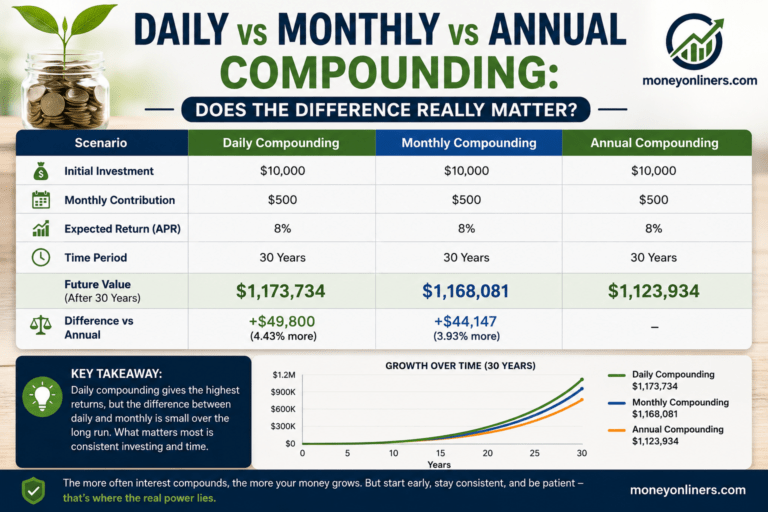
Daily vs Monthly vs Annual Compounding: Does the Difference Really Matter?
Daily vs Monthly vs Annual Compounding: Does the Difference Really Matter? | MoneyOnliners MoneyOnliners • Compound Interest → Frequency Comparison Daily vs Monthly vs Annual Compounding: Does the Difference Really Matter? Daily compounding sounds much more powerful than monthly or annual compounding. Mathematically, more frequent compounding does create a larger ending balance when the principal,…
Compound Interest on Debt: How It Can Work Against You
Compound Interest on Debt: How It Can Work Against You | MoneyOnliners MoneyOnliners • Debt → Compound Interest Compound Interest on Debt: How It Can Work Against You Compound interest can help savings and investments grow, but the same basic mathematics can become expensive when you owe money. If unpaid interest becomes part of a…
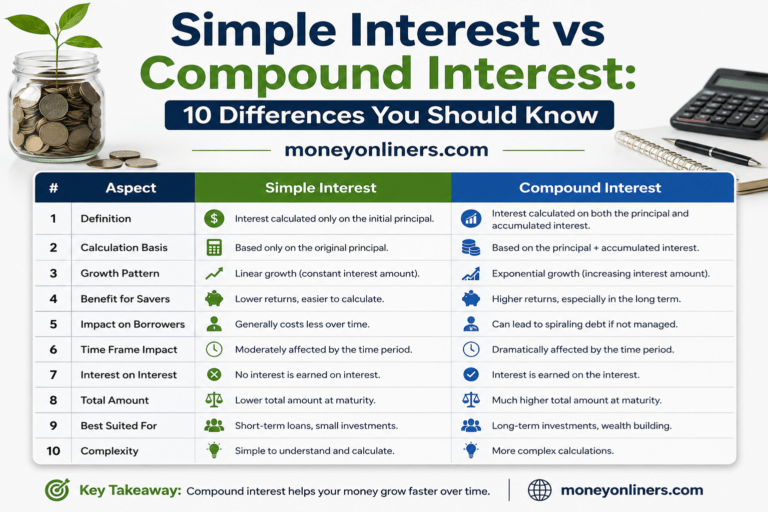
Simple Interest vs Compound Interest: 10 Differences You Should Know
Simple Interest vs Compound Interest: 10 Differences You Should Know | MoneyOnliners MoneyOnliners • Compound Interest → Comparison Guide Simple Interest vs Compound Interest: 10 Differences You Should Know Simple interest and compound interest can start with the same principal and the same stated rate yet produce different results. The difference comes from what the…
Starting at 20 vs 30 vs 40: How Much Does 10 Years Really Matter?
Starting at 20 vs 30 vs 40: How Much Does 10 Years Really Matter? | MoneyOnliners MoneyOnliners • Investing → Time Advantage Starting at 20 vs 30 vs 40: How Much Does 10 Years Really Matter? Ten years can look insignificant when retirement is decades away. However, investing from age 20 instead of 30 gives…
What Happens If You Invest $100 a Month for 20 Years?
What Happens If You Invest $100 a Month for 20 Years? | MoneyOnliners MoneyOnliners • Investing → Monthly Contributions What Happens If You Invest $100 a Month for 20 Years? One hundred dollars a month may not feel like enough to change your financial future. Yet over 20 years, those contributions add up to $24,000…
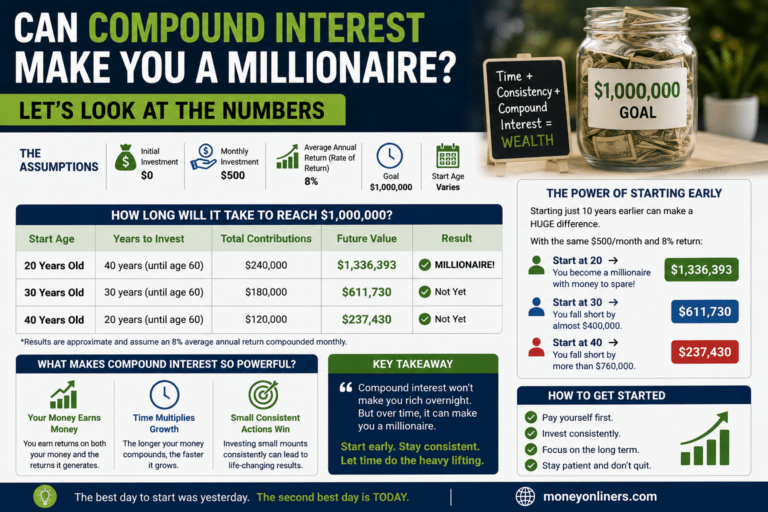
Can Compound Interest Make You a Millionaire? Let’s Look at the Numbers
Can Compound Interest Make You a Millionaire? Let’s Look at the Numbers | MoneyOnliners MoneyOnliners • Compound Interest → Millionaire Math Can Compound Interest Make You a Millionaire? Let’s Look at the Numbers Becoming a millionaire through compound growth is mathematically possible, but the word “millionaire” can make the process sound easier than it really…