Compound Interest on Debt: How It Can Work Against You
Compound Interest on Debt: How It Can Work Against You
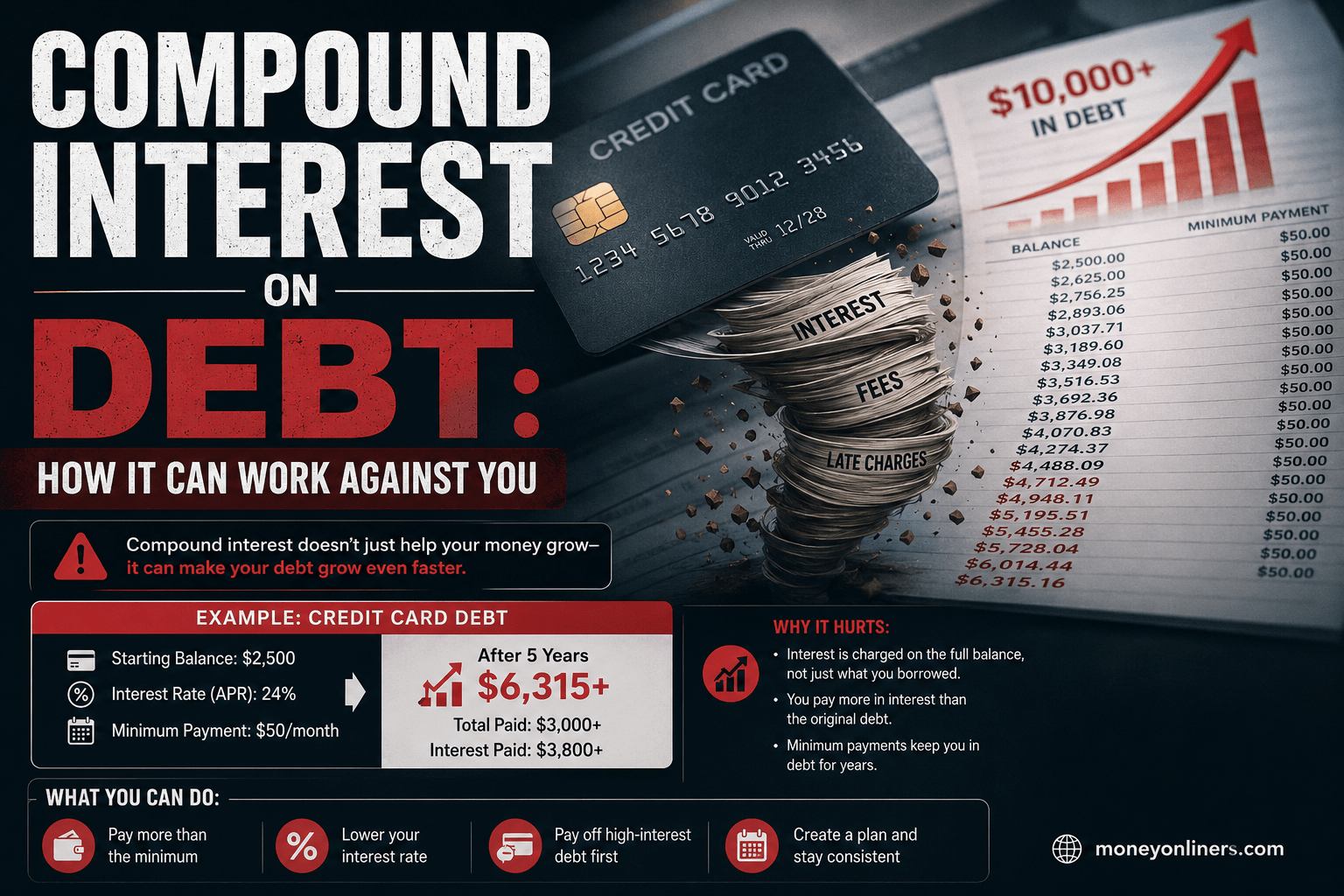
Compound interest can help savings and investments grow, but the same basic mathematics can become expensive when you owe money. If unpaid interest becomes part of a debt balance and future interest is then calculated on that larger balance, interest can begin generating more interest. High rates, long repayment periods, new borrowing and small payments can make the problem much worse.
Compound interest on debt happens when unpaid interest becomes part of the balance and future interest is calculated on that larger amount.
A simplified example:
Starting debt: $5,000
Hypothetical annual rate: 20%
No payments or new charges
| Time | Approximate Balance if 20% Compounds Daily* | Increase From Original Debt |
|---|---|---|
| 1 year | $6,107 | $1,107 |
| 2 years | $7,458 | $2,458 |
| 3 years | $9,109 | $4,109 |
| 5 years | $13,588 | $8,588 |
*Simplified mathematical illustration only. Actual credit cards and loans involve payments, statement cycles, fees, grace periods, changing balances and contract-specific interest methods.
High-interest debt can compound against you. The longer a balance remains unpaid, the more money may be consumed by interest instead of reducing principal or building wealth.
Table of Contents
What Is Compound Interest on Debt?
Compound interest on debt occurs when interest is added to a debt balance and future interest is then calculated using a balance that includes some of that prior interest.
Basic Idea
Example
Suppose you owe:
$1,000
and a simplified annual 20% interest charge is added.
After Year 1
$1,200
If That $200 Interest Remains in the Balance
The next year's 20% could be calculated on:
$1,200 instead of $1,000
After Year 2
$1,440
That second year adds $240 rather than $200.
How Can Interest Begin Earning More Interest?
The sequence is relatively simple.
Step 1: You Have Principal
$5,000 debt
Step 2: Interest Accrues
Suppose interest adds:
$100
Step 3: The Interest Becomes Part of the Balance
New balance = $5,100
Step 4: Future Interest May Be Calculated on the Larger Balance
That means part of the future interest can effectively be interest on prior interest.
Not every debt compounds in exactly the same way. Loan agreements, credit-card methods, capitalization rules, payment timing and grace periods can all change how interest actually accumulates.
Simple Interest vs Compound Interest on Debt
Simple Interest
Interest is generally calculated from outstanding principal rather than prior unpaid interest.
Compound Interest
Previously accrued interest can become part of the balance on which future interest is calculated.
$5,000 at a Simplified 20% for Three Years With No Payments
| Method | Approximate Ending Balance |
|---|---|
| Simple annual interest | $8,000 |
| Annual compound interest | $8,640 |
| Daily compounding approximation | $9,109 |
The faster balance growth occurs because interest enters future calculations sooner.
Real consumer debt products should be analyzed using their actual disclosures rather than assuming a particular compounding formula.
How Credit Card Interest Can Work Against You
Credit-card interest deserves special attention because many issuers calculate interest daily using daily or average daily balances.
Imagine a Card Balance of $5,000
If you carry the balance instead of paying it off during an available grace period, interest may begin accruing.
Then Add New Purchases
Old balance: $5,000
New purchases: $400
Potential balance before payments/interest: $5,400
Add Interest
Now even more money may be competing with your monthly payment.
This Creates Three Forces
- Existing principal
- New purchases
- Interest charges
If payments are small relative to these additions, the balance can decline very slowly—or even rise.

What Is a Daily Periodic Rate?
The CFPB explains that some credit-card issuers use a daily periodic rate to calculate interest.
Simplified Formula
24% APR Example
24% ÷ 365 ≈ 0.06575% per day
That daily percentage looks tiny.
However, it may be applied repeatedly across an outstanding balance.
On $5,000
A rough first-day interest estimate would be:
$5,000 × 0.0006575 ≈ $3.29
If the balance remains unpaid and the card's method adds prior interest to the balance, future daily interest can be calculated from a slightly larger amount.
The CFPB notes that some issuers use 360 days while others use 365 when determining daily periodic rates. Always check your card agreement and statement.
$5,000 Debt at 20%, 24% and 30%: What Could Happen?
The following examples show how dramatically rate changes the mathematics if balances were allowed to compound daily without payments or additional charges.
After Three Years
| Hypothetical APR | Starting Balance | Approximate Balance After 3 Years | Increase |
|---|---|---|---|
| 20% | $5,000 | $9,109 | $4,109 |
| 24% | $5,000 | $10,270 | $5,270 |
| 30% | $5,000 | $12,293 | $7,293 |
After Five Years
| Hypothetical APR | Approximate Balance |
|---|---|
| 20% | $13,588 |
| 24% | $16,594 |
| 30% | $22,395 |
That is not how a responsible payoff plan works. They exist only to reveal why high interest rates and time can be such a dangerous combination.
Why APR Can Matter More Than Almost Everything Else
A high interest rate means a larger percentage is being applied to the debt.
Example on $10,000
| APR | Simple One-Year Interest Illustration* |
|---|---|
| 10% | $1,000 |
| 15% | $1,500 |
| 20% | $2,000 |
| 25% | $2,500 |
| 30% | $3,000 |
*Simple comparison only. Real credit-card interest depends on daily balances, transactions, payments and issuer methodology.
The Minimum-Payment Problem
A minimum payment can keep an account current, but it does not necessarily mean the debt is disappearing quickly.
Why?
A payment may need to cover:
- Interest
- Fees
- Principal
Example
Suppose your payment is:
$150
and approximately:
$95 goes toward interest and fees
Only:
$55 reduces principal
Next Month
The balance remains relatively high, allowing more interest to accrue.
Use the payoff information on your statement or a debt calculator rather than assuming every card works the same way.
Why Paying Earlier Can Reduce Credit Card Interest
The CFPB notes that when interest is calculated daily, paying some or all of a balance earlier generally reduces the amount on which future daily interest is calculated.
Example
Suppose you owe:
$5,000
and can pay:
$1,000
After the Payment
The interest-bearing balance may be closer to:
$4,000 instead of $5,000
That can reduce subsequent interest charges.
You owe less money, and future interest has a smaller balance to work against.
What Is Interest Capitalization?
Capitalization is another way unpaid interest can increase the balance on which future interest is calculated.
Basic Process
Example
Starting loan principal:
$20,000
Unpaid accrued interest:
$2,000
If Capitalized
New principal = $22,000
Future interest may then be calculated using that larger principal.
Always verify the current terms of your specific loan rather than assuming all student, personal, mortgage or business debt capitalizes interest in the same way.
Different Types of Debt Can Accumulate Interest Differently
| Debt Type | Possible Interest Considerations |
|---|---|
| Credit cards | Daily periodic rates, average daily balances, grace periods, multiple APRs |
| Personal loans | Fixed APR, amortization, simple-interest structures, origination fees |
| Auto loans | Often amortizing or simple-interest structures; prepayment terms matter |
| Mortgages | Amortization, fixed or adjustable rates, fees and escrow costs |
| Student loans | Accrued interest and possible capitalization depending on loan rules |
| Buy-now-pay-later products | Terms, fees and late-payment structures vary |
Always check the loan agreement, statement and required disclosures.
How Compound Debt Can Damage Your Net Worth
Net worth is:
Example
Assets:
$20,000
Debt:
$15,000
Net Worth
$5,000
Suppose the debt rises to:
$18,000
while assets remain unchanged.
New Net Worth
$2,000
Your assets did not fall.
Yet your net worth declined because liabilities increased.

Ways to Reduce the Damage From High-Interest Debt
1. Stop Adding New High-Interest Debt Where Possible
New charges increase the balance that interest can work against.
2. Pay More Than the Required Minimum When Affordable
More of the payment may reach principal sooner.
3. Pay Earlier When Daily Interest Is Accruing
Reducing the balance sooner can reduce future daily interest.
4. Prioritize High-APR Debt
The debt avalanche method generally directs extra payments toward the highest interest rate first.
5. Consider a Balance Transfer Carefully
A lower promotional rate may help, but evaluate:
- Transfer fee
- Promotion length
- Regular APR afterward
- Eligibility
- Whether new purchases receive the promotion
6. Ask the Issuer About a Lower Rate
There is no guarantee, but the FTC notes that consumers can contact the credit-card company themselves and ask whether they qualify for a lower rate.
7. Use Windfalls Carefully
Tax refunds, bonuses or other irregular income can potentially reduce high-interest principal.
8. Build Emergency Savings Too
Without any cash reserve, one emergency can send the balance higher again.
Eliminating debt without creating any financial buffer can leave you vulnerable to borrowing again after the next unexpected expense.
Be Careful With Debt Relief and Interest-Reduction Scams
People dealing with expensive debt can become attractive targets for scammers.
Warning Signs
- Guaranteed debt elimination
- Guaranteed interest-rate reduction
- Promises of secret relationships with banks
- Pressure to act immediately
- Upfront fees before help is provided
- Unexpected calls asking for financial information
The FTC's 2026 debt-relief guidance specifically warns consumers about upfront charges and guarantees that all debt will be settled quickly.
Safer First Steps
- Contact the creditor directly
- Review statements carefully
- Ask about hardship options
- Check reputable nonprofit credit counseling
- Verify fees before signing anything

MoneyOnliners Original Analysis: The Debt Compounding Risk Test
1. Rate
How expensive is the borrowing?
2. Balance
How much money is currently subject to interest?
3. Time
How long is the balance likely to remain outstanding?
4. Payment
How much of each payment actually reaches principal?
5. Capitalization or Compounding
Can unpaid interest become part of the balance used for later interest calculations?
MoneyOnliners Interest Drag Ratio
MoneyOnliners Research-Based Evidence Note
This article is a research-based consumer debt education guide.
CFPB guidance was used to verify how many credit-card issuers calculate interest using daily or average daily balances.
The CFPB also explains that some daily balance methods add prior interest to the daily balance, causing interest to compound daily.
Its credit-card guidance states that paying sooner generally reduces interest when a daily interest calculation applies.
The daily periodic rate examples use the CFPB-described approach of dividing APR by 360 or 365 depending on the issuer.
MoneyOnliners independently calculated the simplified $5,000 debt scenarios using daily compounding assumptions at 20%, 24% and 30%.
Those examples intentionally exclude payments, fees and additional purchases so readers can isolate the mathematical effect of rate and compounding.
FTC 2026 guidance was reviewed for current debt-relief scam warnings, including upfront-fee demands and guaranteed settlement claims.
The Debt Compounding Risk Test, Interest Drag Ratio and Debt Risk Scorecard are original MoneyOnliners analytical resources.
No personal debt result, card statement or debt-relief experience is claimed in this article.
10 Compound Interest on Debt Mistakes to Avoid
1. Thinking the APR Is Too Small to Matter
High rates applied repeatedly can create substantial interest costs.
2. Looking Only at the Minimum Payment
A small required payment can result in very slow principal reduction.
3. Continuing to Add New Purchases
New charges make the payoff target move farther away.
4. Ignoring Daily Interest
When interest accrues daily, payment timing can matter.
5. Confusing APR With a Monthly Rate
APR is an annual percentage measure, although issuers may use periodic rates to calculate interest.
6. Assuming Every Loan Compounds the Same Way
Credit cards, mortgages, auto loans and student loans may use different structures.
7. Ignoring Capitalization
Unpaid interest that becomes principal can increase future interest costs.
8. Paying Off Low-Rate Debt While Ignoring Very High APR Debt
The highest-rate balances may create greater financial drag.
9. Having No Emergency Fund
Without cash reserves, unexpected expenses can force new borrowing.
10. Paying a Debt Relief Company Upfront
FTC guidance warns against upfront fees and guaranteed debt-relief promises.
The danger is not always one huge interest charge. It can be hundreds of smaller interest charges repeatedly slowing principal reduction month after month.
Why Understanding Compound Interest on Debt Matters
1. Compound interest can work against borrowers as well as for savers.
2. Unpaid interest may become part of the balance used for future calculations.
3. High APRs can make compounding particularly expensive.
4. Credit-card issuers may calculate interest using daily balances.
5. A daily periodic rate can make interest accrue every day.
6. Payment timing can therefore affect total interest.
7. Reducing principal sooner can reduce future interest exposure.
8. Minimum payments may produce slow payoff progress.
9. New purchases can make the balance harder to reduce.
10. Fees can create additional financial drag.
11. Different balances on the same card may carry different APRs.
12. Grace periods can help eligible borrowers avoid interest on qualifying purchases when balances are paid properly.
13. Debt structures differ, so contract terms matter.
14. Interest capitalization can increase principal.
15. Growing liabilities can reduce net worth.
16. High-interest debt payoff can free future cash flow for saving and investing.
17. Emergency savings can reduce the need to borrow again.
18. Lowering interest costs can accelerate principal repayment.
19. Debt-relief scams can make an already difficult situation worse.
20. Ultimately, understanding compound interest on debt helps borrowers see why rate, time, balance size, payment amount and capitalization can work together to make a debt far more expensive than its original principal suggests.
Incoming Link Opportunities
Compound Interest Explained With 10 Simple Real-Life Examples
https://moneyonliners.com/compound-interest-explained-examples/
Simple Interest vs Compound Interest: 10 Differences You Should Know
https://moneyonliners.com/simple-interest-vs-compound-interest/
Daily vs Monthly vs Annual Compounding: Does the Difference Really Matter?
https://moneyonliners.com/daily-vs-monthly-vs-annual-compounding/
Assets vs Liabilities: 25 Real-Life Examples That Affect Your Net Worth
https://moneyonliners.com/assets-vs-liabilities/
Negative Net Worth? 10 Steps That Can Help You Turn It Around
https://moneyonliners.com/negative-net-worth/
High-Priority Incoming Links
$0 to $100,000 Net Worth: A Realistic Roadmap for Building Your First Six Figures
https://moneyonliners.com/0-to-100000-net-worth/
15 Wealth-Building Mistakes That Can Keep Your Net Worth Stuck
https://moneyonliners.com/wealth-building-mistakes/
How to Build Wealth From Nothing: 10 Steps for Beginners
https://moneyonliners.com/how-to-build-wealth-from-nothing/
15 Ways to Increase Your Net Worth Without Becoming a Millionaire Overnight
https://moneyonliners.com/increase-your-net-worth/
Topic Cluster Incoming Links
10 Net Worth Mistakes That Can Make You Think You're Richer Than You Are
https://moneyonliners.com/net-worth-mistakes/
Net Worth vs Income: Which Number Matters More for Building Wealth?
https://moneyonliners.com/net-worth-vs-income/
10 Wealth-Building Habits That Can Make a Big Difference Over 10 Years
https://moneyonliners.com/wealth-building-habits/
Saving vs Building Wealth: Why Saving Money Alone May Not Be Enough
https://moneyonliners.com/saving-vs-building-wealth/
Continue Learning on MoneyOnliners
Recommended External Resources
1. Consumer Financial Protection Bureau — How Is Credit Card Interest Calculated?
How Does My Credit Card Company Calculate the Amount of Interest I Owe? — CFPB
Explains average daily balances, daily interest calculations, grace periods and how payments can affect interest.
2. CFPB — What Is a Daily Periodic Rate?
What Is a Daily Periodic Rate on a Credit Card? — CFPB
Explains how some issuers calculate daily interest and why prior interest can cause daily compounding.
3. CFPB — Know Before You Owe: Credit Cards
Know Before You Owe: Credit Cards — CFPB
Provides consumer guidance on APRs, interest calculations, minimum payments, card terms and ways to reduce interest charges.
4. CFPB — Credit Card Contract Definitions
Credit Card Contract Definitions — CFPB
Explains daily balance methods with and without compounding and how interest can enter daily balance calculations.
5. CFPB — How Does Compound Interest Work?
How Does Compound Interest Work? — CFPB
Provides the basic compound-interest concept used to explain why previous interest can affect later calculations.
6. FTC — Looking for Debt Relief? Here's How to Avoid a Scam
Looking for Debt Relief? Here's How to Avoid a Scam — FTC
Current 2026 guidance warning about upfront fees, guaranteed debt settlements and fake debt-relief services.
7. FTC — Avoid Credit Card Interest-Rate Reduction Scams
How to Recognize Scams to Lower Your Credit Card Interest Rate — FTC
Explains misleading promises from companies claiming special access to lower credit-card rates.
8. FTC — 2026 Credit Card Interest Rate Scam Alert
Say “No, Thanks” to Unexpected Offers to Lower Your Credit Card Interest Rate — FTC
Current consumer warning about unsolicited rate-reduction offers, upfront fees and requests for personal financial information.
9. Consumer Financial Protection Bureau — Debt Collection
Debt Collection — Consumer Financial Protection Bureau
Provides consumer resources and rights information for people dealing with debt collectors.
10. Consumer Financial Protection Bureau — Credit Cards
Credit Cards — Consumer Financial Protection Bureau
Provides broader consumer guidance on card terms, bills, interest, payments and disputes.
This article provides general educational information and is not individualized financial, credit, debt-relief, legal, tax or bankruptcy advice. Interest methods vary by lender and agreement. Always review the actual APR, periodic rate, payment terms, fees and capitalization rules that apply to your debt.
Frequently Asked Questions
What is compound interest on debt?
Compound interest on debt occurs when previously accrued interest becomes part of the balance used to calculate future interest.
The balance therefore becomes larger.
Future interest may apply to that larger amount.
The process can repeat.
This can make debt grow faster than simple interest alone.
Can credit card interest compound?
Yes, some credit-card calculation methods can compound interest.
The CFPB describes daily balance methods in which prior interest is added to the daily balance.
That causes later interest to apply to a larger amount.
Issuer practices differ.
Read your card agreement and statement carefully.
How often does credit card interest compound?
Many cards calculate interest daily.
Some agreements can use daily compounding.
Other calculation methods may differ.
The card's daily periodic rate and average daily balance can be important.
Check the issuer's disclosures rather than assuming every card behaves identically.
What is a daily periodic rate?
It is a daily interest rate used by some credit-card issuers.
It may be calculated by dividing APR by 360 or 365.
The rate is then applied according to the card's interest-calculation method.
The daily percentage looks small.
Repeated daily charges can still become expensive.
Why is high-interest debt so difficult to pay off?
A large part of each payment may be consumed by interest.
That leaves less money for principal.
The balance therefore declines slowly.
New charges can make the problem worse.
Higher APRs increase the interest drag.
Can paying more than the minimum help?
Yes.
A larger payment may reduce principal faster.
Lower principal gives future interest a smaller balance to work against.
That can reduce total interest.
The exact savings depend on the account terms.
Does paying a credit card earlier help?
It can.
The CFPB notes that when interest accrues daily, paying earlier can reduce the balance on which later daily interest is calculated.
That can reduce interest charges.
Payment timing rules vary.
Always make at least the required payment by the due date.
Is credit card interest simple or compound?
The answer depends on the issuer's method.
Some daily balance methods cause interest to compound.
Other methods may treat unpaid finance charges differently.
Do not apply one generic formula to every card.
Use the contract disclosure.
Can debt double because of interest?
Mathematically, yes if a sufficiently high interest rate is allowed to operate long enough without enough principal reduction.
However, real borrowers make payments.
Fees and new charges can also affect the balance.
Loan structures differ.
Use an actual payoff calculator for your specific debt.
How bad is 20% interest on debt?
Twenty percent is a high borrowing cost.
On a large carried balance, interest can consume a substantial share of monthly payments.
The longer the debt remains outstanding, the more expensive it can become.
Compounding can increase that cost further.
Reducing principal can therefore be very valuable.
What does interest capitalization mean?
Capitalization occurs when accrued interest becomes part of the principal balance.
Future interest can then be calculated using the larger principal.
This can increase total borrowing costs.
Capitalization rules depend on the loan.
Check your lender's terms.
Does paying debt increase net worth?
Reducing principal generally reduces liabilities.
Lower liabilities can increase net worth when assets remain unchanged.
For example, reducing debt by $5,000 can improve the liability side of your balance sheet by $5,000.
Interest payments are different because they cover borrowing cost rather than principal.
That is why understanding principal reduction matters.
Should I invest while carrying high-interest debt?
The answer depends on the interest rate, employer benefits, emergency savings and your wider finances.
High-interest debt deserves serious attention because its cost can be relatively certain while investment returns are uncertain.
Employer retirement matches may also be valuable.
Some people split money between debt reduction and investing.
The best sequence depends on your circumstances.
Can I ask my credit card company to lower my APR?
Yes, you can ask.
There is no guarantee the issuer will agree.
The FTC notes that consumers can contact their card company directly rather than paying a company that claims special access to lower rates.
Ask what options are available.
Avoid services demanding upfront fees.
How can I stop compound debt from getting worse?
Stop adding unnecessary new debt where possible.
Pay more than the minimum when affordable.
Focus extra money on high-interest balances.
Build some emergency savings so new expenses do not immediately create more debt.
Most importantly, understand exactly how your lender calculates interest.
Research Methodology
Primary Consumer Sources
MoneyOnliners reviewed Consumer Financial Protection Bureau materials explaining credit-card interest calculations, average daily balance methods, daily periodic rates, grace periods and compounding.
Daily Interest Method
CFPB guidance was used to verify that some issuers calculate interest daily and that some methods add prior interest to the daily balance.
Daily Periodic Rate
The article uses the CFPB-described concept that a daily periodic rate may be calculated from APR divided by 360 or 365 depending on issuer methodology.
Hypothetical Debt Scenarios
MoneyOnliners independently calculated simplified daily-compounding scenarios for $5,000 debts at 20%, 24% and 30% annual rates.
Why No Payments Were Used in Those Tables
The no-payment scenarios intentionally isolate the mathematical effect of rate, time and compounding.
They are not intended to model a responsible repayment plan.
Minimum Payment Discussion
Minimum-payment examples are illustrative because issuer formulas vary.
Capitalization
The article explains capitalization generically because rules vary across different loan products.
Debt Relief Fraud
FTC guidance from 2026 was reviewed for current warnings concerning upfront fees, guaranteed debt settlements and unsolicited interest-rate reduction offers.
Original MoneyOnliners Analysis
The Debt Compounding Risk Test, Interest Drag Ratio and Debt Risk Scorecard are original MoneyOnliners educational resources.
First-Hand Evidence Standard
MoneyOnliners only presents actual credit-card statements, loan balances, payment histories, debt-relief experiences or lender screenshots when genuine first-hand evidence exists and can be documented accurately.
No personal debt payoff or credit-card result is claimed in this article.
Limitations
Real debt balances change with payments.
New purchases can be added.
Fees may apply.
Interest rates can change.
Grace periods may affect interest.
Therefore, simplified examples should not replace an actual lender payoff quote or account statement.
Google Search Console Checklist
- Confirm final URL: /compound-interest-on-debt/
- Confirm canonical matches the published URL.
- Use compound interest on debt naturally in the title, introduction, headings, FAQ and conclusion.
- Use related phrases naturally: compound interest debt, credit card compound interest, daily credit card interest, how debt compounds, interest capitalization, debt interest calculation and high-interest debt.
- Use realistic debt/bill imagery in the hero.
- Use credit-card statements or household bill imagery in credit-card sections.
- Use family budgeting imagery around net-worth sections.
- Use consumer-help imagery around debt-relief warnings.
- Avoid repeating investment calculators as article images.
- Keep every image alt description unique.
- Confirm Recommended External Resources contains 6–10 authoritative links.
- Confirm CFPB credit-card interest guidance remains current.
- Confirm CFPB daily periodic rate guidance remains current.
- Confirm FTC 2026 debt-relief guidance remains current.
- Confirm every internal link points to a live canonical URL.
- Check all debt tables carefully on mobile.
- Confirm article is indexable.
- Confirm URL appears in the XML sitemap.
- Inspect the published URL in Google Search Console.
- Request indexing after publication if appropriate.
- Monitor queries including “compound interest on debt,” “does credit card interest compound,” “how does credit card interest compound,” “daily periodic rate credit card,” “compound interest debt example,” and “how debt interest works.”
Conclusion: Compound Interest Becomes Much Less Exciting When You Owe the Money
Compound growth can be useful when it increases your assets.
The mathematics become painful when the same idea increases your liabilities.
Start With Principal
That is the amount you owe.
Interest Accrues
The lender charges you for borrowing.
Unpaid Interest May Join the Balance
Depending on the debt structure, future interest may then apply to a larger amount.
High Rates Make the Problem Worse
A 20%, 24% or 30% rate can create much more financial drag than a low-rate obligation.
Time Matters Too
The longer high-interest debt remains outstanding, the more opportunity interest has to accumulate.
Payments Matter
Reducing principal decreases the balance available for future interest calculations.
New Borrowing Matters
Continuing to add charges can undo repayment progress.
And Your Net Worth Notices
Growing liabilities reduce the difference between what you own and what you owe.
The Goal Is Not Only to Make Payments
The goal is to reduce principal enough that interest has less and less money to work against.
Similar Posts
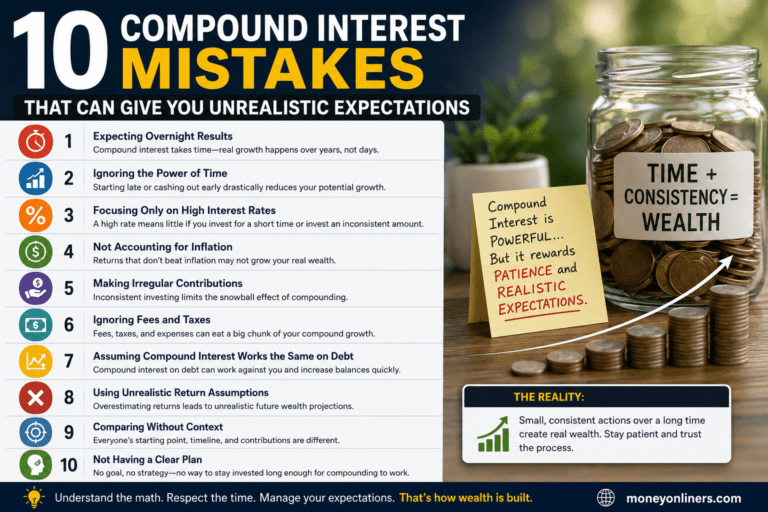
10 Compound Interest Mistakes That Can Give You Unrealistic Expectations
10 Compound Interest Mistakes That Can Give You Unrealistic Expectations | MoneyOnliners MoneyOnliners • Compound Interest → Reality Check 10 Compound Interest Mistakes That Can Give You Unrealistic Expectations Compound interest is one of the most useful ideas in long-term finance, but it is also one of the easiest to misunderstand. A calculator can make…
Starting at 20 vs 30 vs 40: How Much Does 10 Years Really Matter?
Starting at 20 vs 30 vs 40: How Much Does 10 Years Really Matter? | MoneyOnliners MoneyOnliners • Investing → Time Advantage Starting at 20 vs 30 vs 40: How Much Does 10 Years Really Matter? Ten years can look insignificant when retirement is decades away. However, investing from age 20 instead of 30 gives…
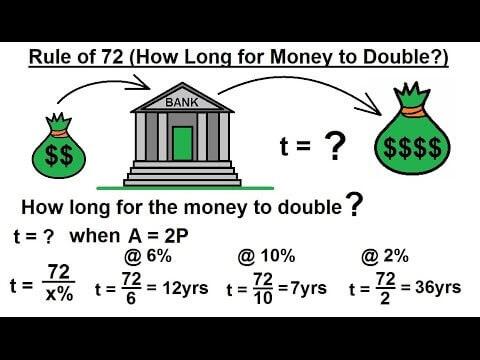
How Long Does It Take to Double Your Money? The Rule of 72 Explained
How Long Does It Take to Double Your Money? The Rule of 72 Explained | MoneyOnliners MoneyOnliners • Compound Growth → Rule of 72 How Long Does It Take to Double Your Money? The Rule of 72 Explained If your money is growing at 4%, 6%, 8% or 10% a year, how long might it…
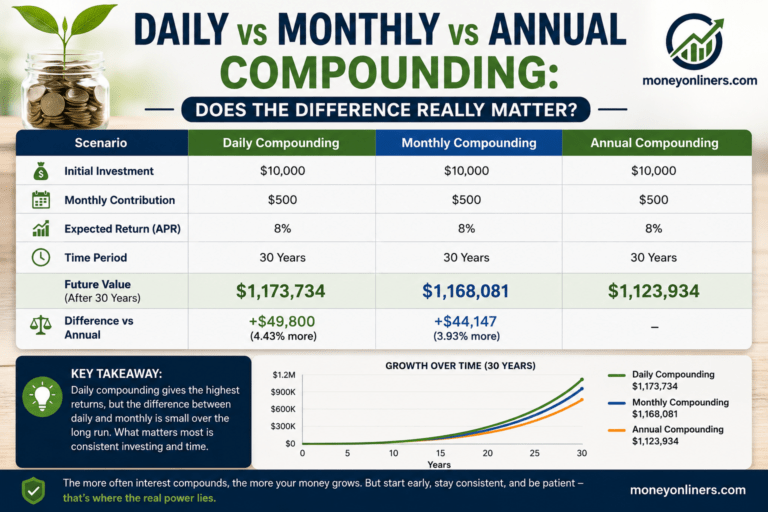
Daily vs Monthly vs Annual Compounding: Does the Difference Really Matter?
Daily vs Monthly vs Annual Compounding: Does the Difference Really Matter? | MoneyOnliners MoneyOnliners • Compound Interest → Frequency Comparison Daily vs Monthly vs Annual Compounding: Does the Difference Really Matter? Daily compounding sounds much more powerful than monthly or annual compounding. Mathematically, more frequent compounding does create a larger ending balance when the principal,…
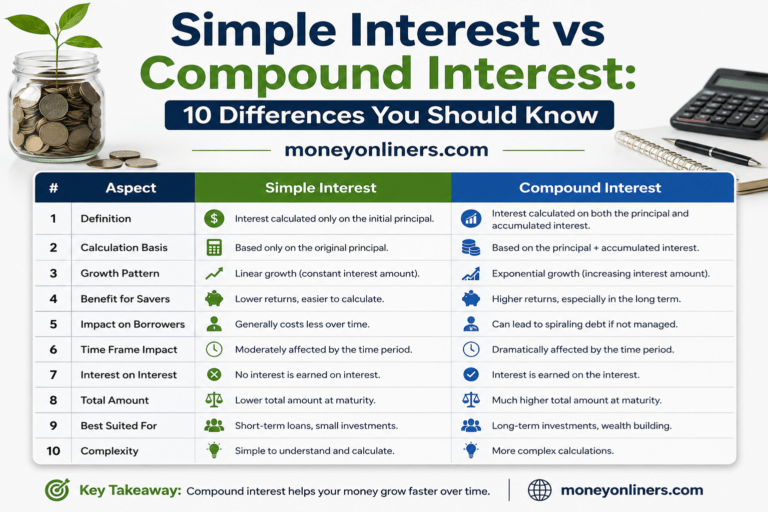
Simple Interest vs Compound Interest: 10 Differences You Should Know
Simple Interest vs Compound Interest: 10 Differences You Should Know | MoneyOnliners MoneyOnliners • Compound Interest → Comparison Guide Simple Interest vs Compound Interest: 10 Differences You Should Know Simple interest and compound interest can start with the same principal and the same stated rate yet produce different results. The difference comes from what the…
What Happens If You Invest $100 a Month for 20 Years?
What Happens If You Invest $100 a Month for 20 Years? | MoneyOnliners MoneyOnliners • Investing → Monthly Contributions What Happens If You Invest $100 a Month for 20 Years? One hundred dollars a month may not feel like enough to change your financial future. Yet over 20 years, those contributions add up to $24,000…