Simple Interest vs Compound Interest: 10 Differences You Should Know
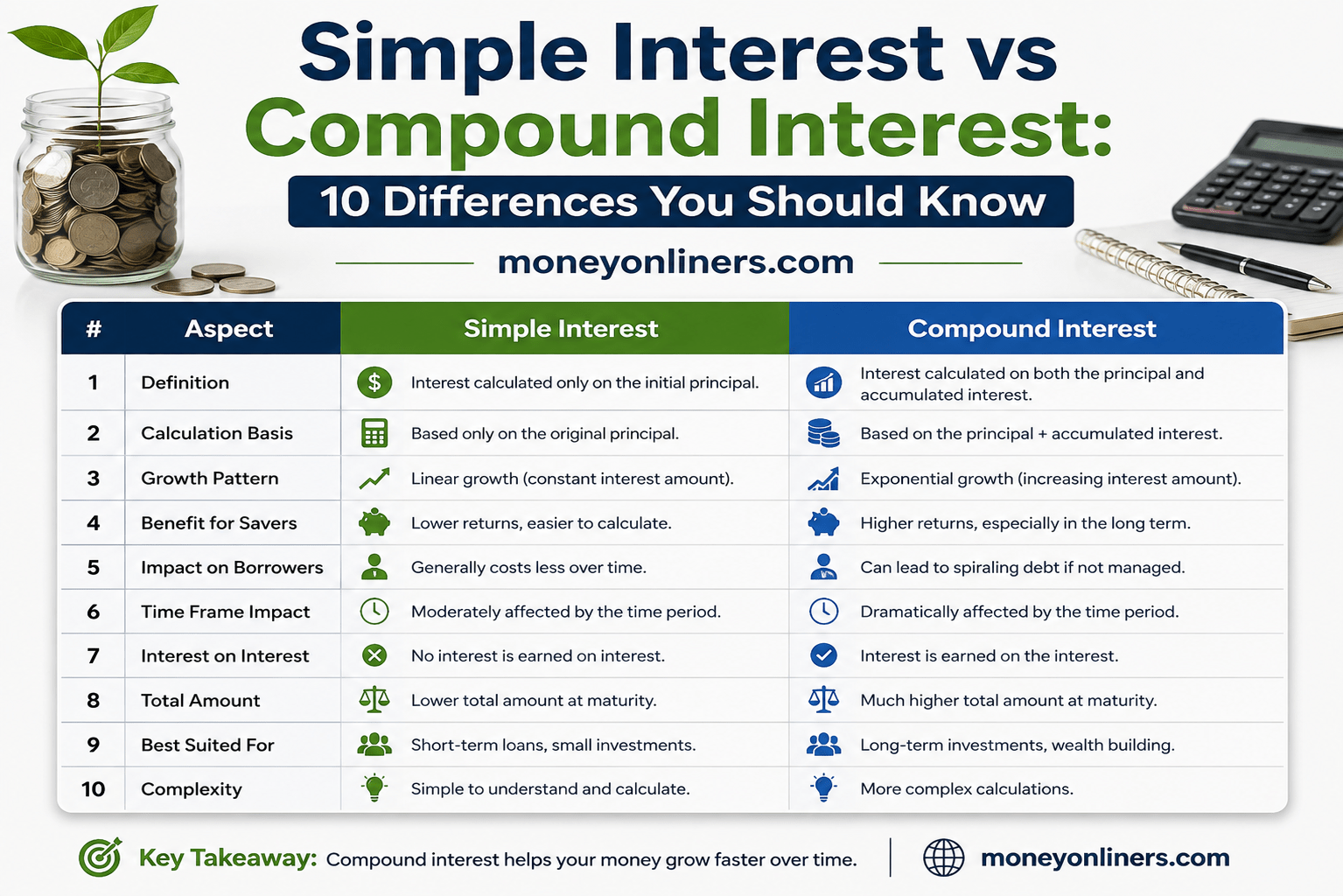
Simple Interest vs Compound Interest: 10 Differences You Should Know
Simple interest and compound interest can start with the same principal and the same stated rate yet produce different results. The difference comes from what the interest is calculated on. Simple interest generally uses the original principal, while compound interest can include previously accumulated interest. Over short periods the gap may look small. Over longer periods, it can become much larger.
In the simple interest vs compound interest comparison, simple interest is generally calculated only on the original principal, while compound interest is calculated on the principal plus accumulated interest.
Simple Interest
Compound Interest
For example, $1,000 earning 5% simple interest for 10 years becomes $1,500. The same $1,000 compounding annually at 5% becomes approximately $1,628.89.
That is a difference of about $128.89 even though the starting amount, stated rate and 10-year period are the same.
Table of Contents
Simple Interest vs Compound Interest at a Glance
| Feature | Simple Interest | Compound Interest |
|---|---|---|
| Interest calculated on | Original principal | Principal plus accumulated interest |
| Growth pattern | Generally linear under a fixed rate | Exponential under a fixed rate |
| Interest amount each period | Usually stays constant | Can grow over time |
| Formula complexity | Simpler | More complex |
| Compounding frequency matters? | No in the standard simple-interest formula | Yes |
| Long-term growth | Slower under equal assumptions | Usually faster |
| Can work in savings? | Possible depending on product | Common in deposit products |
| Can affect debt? | Yes | Yes, depending on loan terms |
| Previous interest earns interest? | No | Yes |
| Best way to compare products | Read full terms and effective cost/yield | Read full terms and effective cost/yield |
What Is Simple Interest?
Simple interest is generally calculated only on the original principal.
Formula
I
Interest earned or charged.
P
Original principal.
r
Interest rate expressed as a decimal.
t
Time.
Example
Principal:
$5,000
Rate:
5%
Time:
3 years
Interest
$5,000 × 0.05 × 3 = $750
Final Amount
$5,750
What Is Compound Interest?
Compound interest includes both the original principal and previously accumulated interest in future interest calculations.
Example
Starting amount:
$5,000
Annual rate:
5%
Year 1
$5,000 → $5,250
Year 2
$5,250 → $5,512.50
Year 3
$5,512.50 → about $5,788.13
Under simple interest, the same example would finish at $5,750.
Under annual compounding, it reaches approximately $5,788.13.
The second and third years include interest earned on previous interest.
1 The Interest Base Is Different
Simple Interest
Interest continues to be based on the original principal.
Compound Interest
The calculation base can grow because previously credited interest becomes part of the balance.
Example
Original amount:
$1,000
Rate:
5%
Simple Interest Each Year
$50
Compound Interest
Year 1:
$50
Year 2:
$52.50
The difference begins small.
Over time, however, the growing interest base matters more.
2 Simple Interest Grows Linearly; Compound Interest Can Accelerate
Simple Interest at 5%
A $1,000 balance adds:
$50 each year
Compound Interest at 5%
The dollar amount of annual interest gradually rises:
| Year | Approximate Starting Balance | Interest |
|---|---|---|
| 1 | $1,000 | $50 |
| 2 | $1,050 | $52.50 |
| 3 | $1,102.50 | $55.13 |
| 4 | $1,157.63 | $57.88 |
3 The Formulas Are Different
Simple Interest Formula
To find the total amount:
Compound Interest Formula
The compound formula includes an exponent because growth builds on previous periods.
Even when two financial products advertise the same headline rate, the actual outcome can differ if one compounds and the other does not.
4 Compound Interest Usually Produces More Long-Term Growth
$1,000 at 5% for 10 Years
| Method | Ending Amount | Total Growth |
|---|---|---|
| Simple interest | $1,500 | $500 |
| Annual compounding | About $1,628.89 | About $628.89 |
Difference
About $128.89
The difference becomes much larger with:
- More time
- Larger balances
- Higher rates
- More frequent compounding
5 Time Matters More With Compounding
Simple interest grows by a fairly predictable dollar amount when the principal and rate remain fixed.
Compound interest becomes increasingly sensitive to time.
$10,000 at a Hypothetical 6%
| Years | Simple Interest | Annual Compound Interest |
|---|---|---|
| 5 | $13,000 | About $13,382 |
| 10 | $16,000 | About $17,908 |
| 20 | $22,000 | About $32,071 |
| 30 | $28,000 | About $57,435 |
The longer the period, the more pronounced the difference becomes.

6 Compounding Frequency Can Change the Result
Compound interest may be calculated:
- Annually
- Semiannually
- Quarterly
- Monthly
- Daily
When all other terms are equal, more frequent compounding can slightly increase the final balance.
Why?
Interest is added to the principal sooner.
That slightly larger balance can then begin participating in later calculations.
Simple Interest
Standard simple interest does not depend on a compounding frequency because previously earned interest does not become part of the next interest calculation.
A product that compounds more frequently is not automatically better if its underlying rate, fees, restrictions or risks are worse.
7 Compound Interest Is Commonly Relevant to Savings
Many savings products credit interest periodically, allowing previously credited interest to become part of the balance.
Example
Starting savings:
$10,000
Hypothetical annual rate:
4%
Simple Interest After Five Years
$12,000
Annual Compound Interest After Five Years
About $12,166.53
Difference
About $166.53

8 Compound Growth Matters More in Long-Term Investing
Investment returns are not technically identical to bank interest.
However, the compounding concept is frequently used to illustrate what happens when gains and income are reinvested.
Example
An investment begins at:
$25,000
Assume a hypothetical 7% annual return for 20 years with all growth reinvested.
Hypothetical Ending Value
About $96,742
Simple 7% Growth for Comparison
$60,000
That illustrates why long-term investment discussions often emphasize reinvestment.
An investment does not actually deliver a guaranteed 7% every year. Returns fluctuate, losses occur, fees matter, and past performance cannot guarantee future results.
9 Interest Can Also Work Against Borrowers
Interest is not only something savers earn.
Borrowers pay it too.
Simple Loan Illustration
Borrow:
$10,000
Simple interest:
6% for three years
Total Simple Interest
$1,800
Total Owed Before Payments
$11,800
If Interest Compounded Annually
About $11,910.16
The difference appears modest over three years.
At higher rates and longer periods, however, debt compounding can become far more expensive.

10 Simple Interest Is Easier to Calculate
Simple Interest
You can often calculate it quickly:
$10,000 × 5% × 4 years = $2,000 interest
Compound Interest
You need to account for repeated compounding:
$10,000 × (1.05)4 = about $12,155.06
Compound Interest Earned
About $2,155.06
Calculators make compound-interest mathematics much easier.
Investor.gov provides a compound-interest calculator that lets users enter an initial amount, monthly contributions, estimated interest rate, time horizon and compounding frequency.
Real-Life Comparison: $10,000 at 5% for 10 Years
Simple Interest
Final Balance
$15,000
Annual Compound Interest
Final Balance
About $16,288.95
Extra Amount From Compounding
About $1,288.95
What Changed?
Nothing changed about:
- Starting principal
- Headline rate
- Time period
The difference came from previously earned interest becoming part of the future interest base.
Which Is Better: Simple Interest or Compound Interest?
The answer depends on whether you are earning interest or paying it.
If You Are Saving
All else being equal, compounding generally benefits the saver because previous interest can earn additional interest.
If You Are Borrowing
All else being equal, compound interest can increase the cost of unpaid debt faster than simple interest.
However, Do Not Compare Using Interest Type Alone
Also consider:
- Interest rate
- APR or APY where relevant
- Loan term
- Fees
- Payment schedule
- Compounding frequency
- Withdrawal restrictions
- Investment risk
MoneyOnliners Original Analysis: The Interest Decision Framework
1. Base
What amount is interest calculated on?
2. Rate
What percentage is being applied?
3. Time
How long does the interest have to operate?
4. Frequency
How often is interest credited or compounded?
5. Direction
Is interest working:
For You
Savings or invested assets.
Against You
Debt or unpaid borrowing.
MoneyOnliners Interest Comparison Scorecard
| Question | Simple Interest | Compound Interest |
|---|---|---|
| Does previous interest join the calculation? | No | Yes |
| Does compounding frequency matter? | Generally no | Yes |
| Does the dollar interest usually stay constant? | Yes under fixed terms | No, it can increase |
| Does time widen the difference? | Moderately | Potentially significantly |
| Easier to calculate manually? | Yes | Less so |
| Can benefit savers? | Yes | Often more under equal terms |
| Can hurt borrowers? | Yes | Potentially more under equal terms |
MoneyOnliners Interest Gap Formula
MoneyOnliners Research-Based Evidence Note
This article is a research-based interest education guide.
The CFPB defines compound interest as earning interest on both money saved and the interest already earned.
Investor.gov similarly defines compound interest as interest paid on principal and accumulated interest.
Investor.gov provides educational examples showing that compound interest becomes more noticeable over long periods and offers a calculator for testing different assumptions.
All simple-interest and compound-interest numerical examples in this article were independently calculated by MoneyOnliners using the stated hypothetical rates and periods.
They are educational calculations rather than promised financial returns.
The FTC warns that investment opportunities promising guaranteed large profits, quick wealth or little risk can indicate fraud.
MoneyOnliners therefore does not treat any hypothetical compound-investment rate as guaranteed.
The Interest Decision Framework, Comparison Scorecard and Interest Gap Formula are original MoneyOnliners educational resources.
10 Simple Interest vs Compound Interest Mistakes to Avoid
1. Assuming the Higher Headline Rate Is Always Better
Compounding, fees and terms also matter.
2. Ignoring Compounding Frequency
Monthly and annual compounding can produce different results.
3. Confusing APR and APY
They measure different aspects of interest and should not be treated as identical.
4. Assuming Investment Returns Are Fixed Interest
Market investments fluctuate.
5. Ignoring Loan Fees
Interest alone may not represent the complete borrowing cost.
6. Comparing Products With Different Time Periods
Use comparable terms.
7. Forgetting That Debt Can Compound Too
Compounding is beneficial only when you are on the receiving side.
8. Chasing Unrealistically High Compound Returns
Higher promised returns may involve higher risk or fraud.
9. Ignoring Taxes and Fees in Long-Term Examples
Real-world results may differ from clean mathematical models.
10. Assuming Compound Interest Creates Fast Wealth
Compounding usually becomes powerful through time rather than instant results.
The FTC warns that scammers often promise big profits, guaranteed returns or little-to-no risk. Legitimate investing involves uncertainty, and no compound-growth projection should be treated as a guaranteed outcome.
Why Understanding Simple Interest vs Compound Interest Matters
1. Simple interest and compound interest use different calculation bases.
2. Simple interest generally uses the original principal.
3. Compound interest includes accumulated interest.
4. Simple interest typically creates linear growth.
5. Compound interest can create accelerating growth.
6. The difference may appear small initially.
7. Time can widen the gap substantially.
8. Larger balances can make the dollar difference much greater.
9. Compounding frequency affects compound-interest outcomes.
10. Compounding frequency does not play the same role in standard simple-interest calculations.
11. Compound interest can benefit savers.
12. Compound interest can also increase the cost of debt.
13. Simple-interest loans can still be expensive if the rate is high.
14. Interest type should not be compared without considering the rate.
15. Fees can materially change real financial outcomes.
16. Investment returns are not the same as guaranteed bank interest.
17. Long-term investors can benefit from reinvesting gains.
18. Borrowers should understand how unpaid balances accumulate interest.
19. Financial calculators can make compound comparisons easier.
20. Ultimately, understanding simple interest vs compound interest helps you recognize when interest is growing from one fixed principal and when previous growth is becoming part of the next calculation.
Incoming Link Opportunities
Compound Interest Explained With 10 Simple Real-Life Examples
https://moneyonliners.com/compound-interest-explained-examples/
Your First $100,000: Why This Wealth Milestone Can Be So Powerful
https://moneyonliners.com/first-100000-wealth-milestone/
$0 to $100,000 Net Worth: A Realistic Roadmap for Building Your First Six Figures
https://moneyonliners.com/0-to-100000-net-worth/
15 Wealth-Building Strategies That Can Grow Your Money Over Time
https://moneyonliners.com/wealth-building-strategies/
Saving vs Building Wealth: Why Saving Money Alone May Not Be Enough
https://moneyonliners.com/saving-vs-building-wealth/
High-Priority Incoming Links
20 Assets That Can Help Build Wealth Over the Long Term
https://moneyonliners.com/assets-that-build-wealth/
10 Wealth-Building Habits That Can Make a Big Difference Over 10 Years
https://moneyonliners.com/wealth-building-habits/
How Long Does It Take to Build Wealth? 8 Factors That Matter Most
https://moneyonliners.com/how-long-does-it-take-to-build-wealth/
How to Build Wealth From Nothing: 10 Steps for Beginners
https://moneyonliners.com/how-to-build-wealth-from-nothing/
Topic Cluster Incoming Links
15 Ways to Increase Your Net Worth Without Becoming a Millionaire Overnight
https://moneyonliners.com/increase-your-net-worth/
Net Worth vs Income: Which Number Matters More for Building Wealth?
https://moneyonliners.com/net-worth-vs-income/
How Often Should You Calculate Your Net Worth?
https://moneyonliners.com/how-often-calculate-net-worth/
Building Wealth in Your 20s, 30s, 40s and 50s: What Changes?
https://moneyonliners.com/building-wealth-by-age/
Continue Learning on MoneyOnliners
Recommended External Resources
1. Consumer Financial Protection Bureau — How Does Compound Interest Work?
How Does Compound Interest Work? — CFPB
Provides a beginner-friendly explanation of compound interest and a two-year example.
2. Investor.gov — Compound Interest Definition
Compound Interest — Investor.gov
Defines compound interest as interest paid on principal and accumulated interest.
3. Investor.gov — What Is Compound Interest?
What Is Compound Interest? — Investor.gov
Provides educational examples showing how compound growth changes over time and explains the Rule of 72.
4. Investor.gov — Compound Interest Calculator
Compound Interest Calculator — Investor.gov
Allows readers to test starting amounts, contributions, rates, time periods and compounding frequencies.
5. CFPB — Financial Terms Glossary
Financial Terms Glossary — CFPB
Includes a concise definition of compound interest and other beginner financial terminology.
6. Investor.gov — Build Wealth Over Time Through Saving and Investing
Build Wealth Over Time Through Saving and Investing — Investor.gov
Provides broader investor education on saving, debt and long-term investing.
7. Investor.gov — Understanding Investment Fees
Understanding Investment Fees — Investor.gov
Explains why costs can reduce the amount that remains available for long-term growth.
8. Investor.gov — Diversify Your Investments
Diversify Your Investments — Investor.gov
Explains why long-term investors should understand diversification rather than simply chase the highest projected return.
9. Federal Trade Commission — Investment Scams
Investment Scams — Federal Trade Commission
Explains why guaranteed profits, unusually large returns and supposedly low-risk opportunities are major fraud warning signs.
10. FTC — Avoid Investment Scams
With People Losing Big to Investment Scams, Learn How to Spot and Avoid Them — FTC
Current 2026 consumer guidance on fake investment profits, social-media investment approaches and scam warning signs.
This article is general educational information and is not individualized financial, banking, credit, tax, investment or legal advice. Interest calculations depend on exact contract terms, rates, payment timing, fees and compounding methods. Hypothetical investment-growth examples do not represent guaranteed returns.
Frequently Asked Questions
What is the main difference between simple interest and compound interest?
Simple interest generally uses the original principal.
Compound interest uses principal plus accumulated interest.
Therefore, the calculation base can grow.
That can create faster long-term growth.
Time increases the difference.
What is simple interest in easy words?
Simple interest means interest is based on the original amount.
Suppose you invest $1,000 at 5% simple interest.
You earn $50 each year.
The annual interest does not increase.
That continues while the principal and rate remain unchanged.
What is compound interest in easy words?
Compound interest means previous interest joins the balance.
Future interest can then apply to that larger amount.
For example, $1,000 at 5% becomes $1,050 after one year.
The second year's interest applies to $1,050.
Therefore, it becomes $1,102.50.
Which grows faster, simple or compound interest?
Under equal principal, rate and time assumptions, compound interest generally grows faster.
The difference starts relatively small.
It becomes more noticeable over longer periods.
Higher rates can widen the difference too.
Compounding frequency can also matter.
Which is better for savings?
All else equal, compounding generally benefits savers.
Previously credited interest can earn additional interest.
However, compare the actual rate.
Also consider fees and restrictions.
Do not choose based on compounding alone.
Which is better for borrowers?
All else equal, simple interest is generally easier on the borrower than compound interest.
However, the headline rate matters enormously.
A lower compound rate may still cost less than a much higher simple rate.
Fees matter too.
Compare total borrowing cost.
Does compound interest always make more money?
Not automatically.
The interest rate matters.
Time matters.
Fees and withdrawals matter.
Investment returns are also uncertain.
Can investments earn simple interest?
Investment growth is often more complicated than either label.
Stocks and funds do not generally pay a guaranteed fixed interest rate.
However, reinvested gains and distributions can create compound-like growth over time.
Returns can also be negative.
Therefore, investment projections are hypothetical.
Can compound interest work against me?
Yes.
It can increase unpaid debt balances.
Interest can be added to debt.
Future interest can then apply to the larger balance.
High rates can make this particularly expensive.
Does compounding frequency matter?
Yes for compound interest.
Annual, monthly and daily compounding can produce different balances.
More frequent compounding generally creates a slightly larger result when all other terms are equal.
However, the stated rate and fees matter too.
Compare the whole product.
What is the simple interest formula?
The standard formula is:
I = P × r × t
P is principal.
r is the rate.
t is time.
What is the compound interest formula?
For annual compounding:
FV = PV × (1 + r)n
PV is the starting value.
r is the rate per period.
n is the number of periods.
What happens to $1,000 at 5% for 10 years?
Using simple interest, it becomes $1,500.
Using annual compound interest, it becomes approximately $1,628.89.
That creates an approximate difference of $128.89.
The calculation assumes no deposits or withdrawals.
It also assumes a fixed 5% rate.
Why is time important for compound interest?
Every additional period provides another chance for growth to build on previous growth.
At first, the difference may be small.
Later, a larger balance is compounding.
That can create much larger dollar changes.
Long-term examples demonstrate the effect best.
Is a guaranteed compound investment return safe?
Guaranteed high investment returns should be treated with skepticism.
Investments involve risk.
The FTC warns that scammers commonly promise large or guaranteed profits.
Verify the investment independently.
Do not rely solely on advertised projections.
Research Methodology
How Simple Interest Was Defined
MoneyOnliners uses the standard educational model in which simple interest is calculated from original principal, rate and time.
How Compound Interest Was Defined
The CFPB and Investor.gov definitions were used to verify that compound interest includes interest on previously accumulated interest.
How Calculations Were Prepared
MoneyOnliners independently calculated the numerical examples using the stated principal, rate and period assumptions.
Simple Interest Formula
I = P × r × t
Compound Interest Formula
FV = PV × (1 + r)n
Investment Examples
Investment-growth examples use hypothetical fixed rates solely to demonstrate compounding mathematics.
They do not represent predictions or guaranteed investment performance.
Compounding Frequency
The article explains frequency because CFPB and Investor.gov educational materials recognize it as an important component of compound-interest calculations.
Consumer Protection
FTC investment-scam guidance was reviewed because guaranteed compound-growth claims can be used to promote fraudulent investment opportunities.
Original MoneyOnliners Analysis
The Interest Decision Framework, Interest Comparison Scorecard and Interest Gap Formula are original MoneyOnliners educational resources.
First-Hand Evidence Standard
MoneyOnliners only uses first-hand savings-account statements, loan calculations, investment results or screenshots when genuine evidence is available and can be accurately documented.
No first-hand financial return or borrowing result is claimed in this article.
Limitations
Actual financial products can use more complicated interest calculations than the simplified examples shown here.
Rates may change.
Fees can apply.
Payments can change loan balances throughout a period.
Therefore, readers should check the exact contractual terms of any savings, investment or borrowing product.
Google Search Console Checklist
- Confirm final URL: /simple-interest-vs-compound-interest/
- Confirm canonical matches the published URL.
- Use simple interest vs compound interest naturally in the title, introduction, headings, FAQ and conclusion.
- Use related phrases naturally: simple vs compound interest, difference between simple and compound interest, simple interest formula, compound interest formula and simple interest example.
- Use financial comparison imagery in the hero.
- Use savings imagery for deposit examples.
- Use retirement imagery for long-term examples.
- Use debt or loan paperwork imagery for borrowing sections.
- Avoid using the same calculator image repeatedly.
- Keep every image alt description unique.
- Confirm Recommended External Resources contains 6–10 authoritative sources.
- Confirm CFPB compound-interest guidance remains current.
- Confirm Investor.gov calculator remains live.
- Confirm FTC scam guidance remains current.
- Confirm all internal links point to live canonical URLs.
- Check calculation tables carefully on mobile.
- Confirm the article is indexable.
- Confirm the URL appears in the XML sitemap.
- Inspect the final URL in Google Search Console.
- Request indexing after publication if appropriate.
- Monitor searches such as “simple interest vs compound interest,” “difference between simple and compound interest,” “simple vs compound interest examples,” “simple interest formula,” and “which is better simple or compound interest.”
Conclusion: The Difference Looks Small at First—and Much Bigger Later
The basic simple interest vs compound interest comparison comes down to one question:
Does previously earned interest become part of the future interest calculation?
With Simple Interest
Usually not.
Interest is generally calculated from the original principal.
With Compound Interest
Yes.
Previously accumulated interest becomes part of the balance.
That Changes the Growth Pattern
Simple interest typically grows in a straight line.
Compound interest can accelerate over time.
Time Matters
A 10-year difference may be noticeable.
A 20- or 30-year difference can become much larger.
Compounding Frequency Matters Too
Annual, monthly and daily compounding can produce slightly different results.
But Always Compare the Whole Financial Product
Rate.
Fees.
Time.
Compounding.
Risk.
Payment requirements.
All of these matter.
Similar Posts
Compound Interest Explained With 10 Simple Real-Life Examples
Compound Interest Explained With 10 Simple Real-Life Examples | MoneyOnliners MoneyOnliners • Wealth Building → Compound Interest Compound Interest Explained With 10 Simple Real-Life Examples Compound interest can sound like complicated financial mathematics, but the basic idea is remarkably simple: your money can earn a return, and later that return may begin earning additional returns…
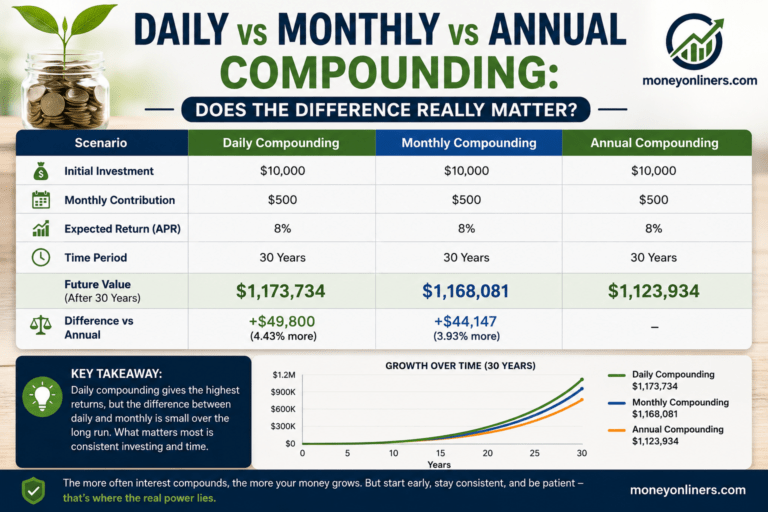
Daily vs Monthly vs Annual Compounding: Does the Difference Really Matter?
Daily vs Monthly vs Annual Compounding: Does the Difference Really Matter? | MoneyOnliners MoneyOnliners • Compound Interest → Frequency Comparison Daily vs Monthly vs Annual Compounding: Does the Difference Really Matter? Daily compounding sounds much more powerful than monthly or annual compounding. Mathematically, more frequent compounding does create a larger ending balance when the principal,…
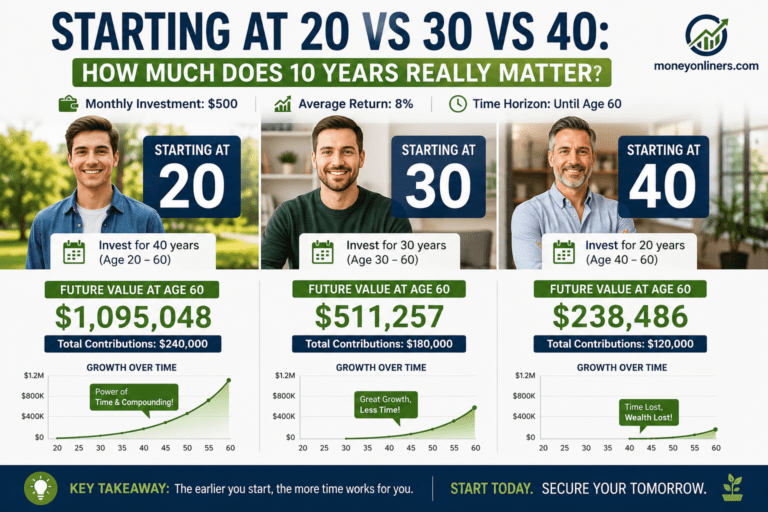
Starting at 20 vs 30 vs 40: How Much Does 10 Years Really Matter?
Starting at 20 vs 30 vs 40: How Much Does 10 Years Really Matter? | MoneyOnliners MoneyOnliners • Investing → Time Advantage Starting at 20 vs 30 vs 40: How Much Does 10 Years Really Matter? Ten years can look insignificant when retirement is decades away. However, investing from age 20 instead of 30 gives…
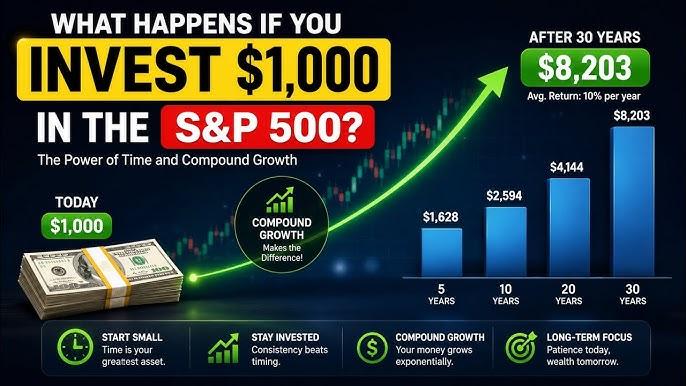
$1,000 Invested for 10, 20 and 30 Years: What Could Compound Growth Do?
$1,000 Invested for 10, 20 and 30 Years: What Could Compound Growth Do? | MoneyOnliners MoneyOnliners • Investing → Compound Growth $1,000 Invested for 10, 20 and 30 Years: What Could Compound Growth Do? One thousand dollars is not enough to guarantee financial independence, but it is large enough to demonstrate something important: time can…
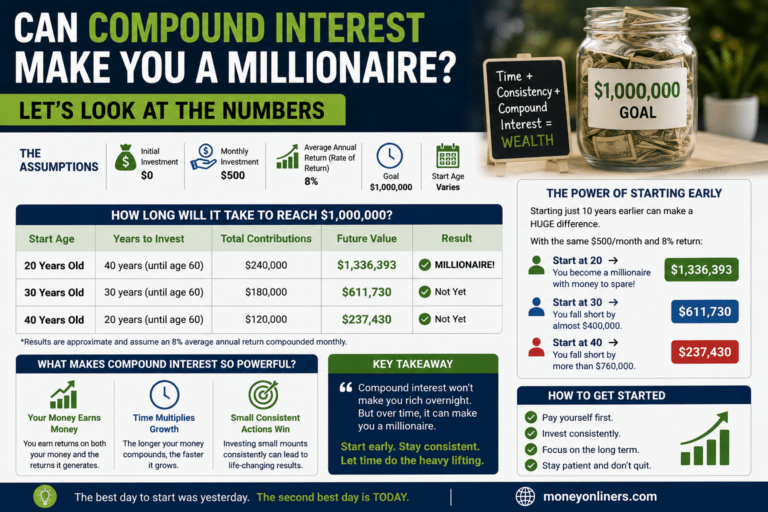
Can Compound Interest Make You a Millionaire? Let’s Look at the Numbers
Can Compound Interest Make You a Millionaire? Let’s Look at the Numbers | MoneyOnliners MoneyOnliners • Compound Interest → Millionaire Math Can Compound Interest Make You a Millionaire? Let’s Look at the Numbers Becoming a millionaire through compound growth is mathematically possible, but the word “millionaire” can make the process sound easier than it really…
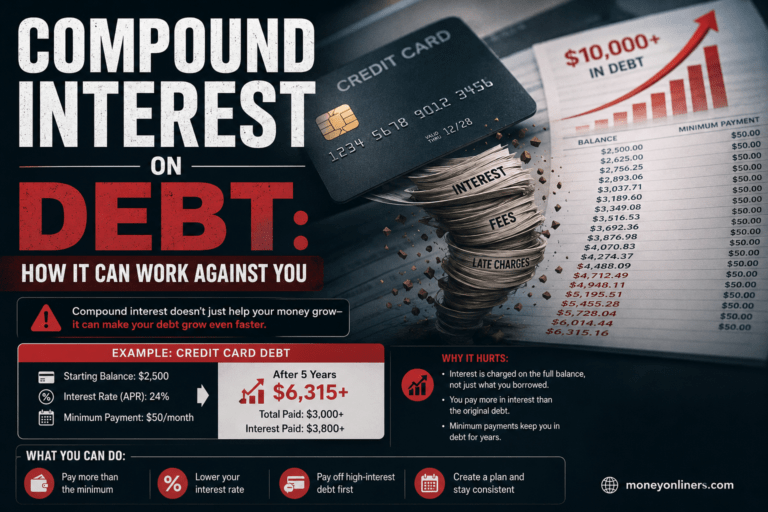
Compound Interest on Debt: How It Can Work Against You
Compound Interest on Debt: How It Can Work Against You | MoneyOnliners MoneyOnliners • Debt → Compound Interest Compound Interest on Debt: How It Can Work Against You Compound interest can help savings and investments grow, but the same basic mathematics can become expensive when you owe money. If unpaid interest becomes part of a…