Saving vs Building Wealth: Why Saving Money Alone May Not Be Enough
Saving vs Building Wealth: Why Saving Money Alone May Not Be Enough
Saving money is one of the most important financial habits you can build. However, saving and building wealth are not exactly the same thing. Cash savings can protect you from emergencies and help fund short-term goals, while long-term wealth often requires some of your money to move into productive assets with the potential to grow, generate income or increase your earning capacity.
The main difference in saving vs building wealth is purpose. Saving generally prioritizes security, liquidity and short-term financial needs. Building wealth focuses more heavily on increasing net worth over longer periods through investing, productive assets, income growth and debt reduction.
You usually need both. Emergency savings can protect you from financial shocks, while long-term investments may provide more growth potential than cash alone. Therefore, the better question is usually not “Should I save or build wealth?” but “How much of my money should remain safe and accessible, and how much can work toward longer-term growth?”
Table of Contents
Saving vs Building Wealth: Quick Comparison
| Feature | Saving Money | Building Wealth |
|---|---|---|
| Main purpose | Security and near-term goals | Long-term financial growth |
| Typical vehicles | Savings accounts, CDs, cash reserves | Investments, retirement accounts, businesses, property and other productive assets |
| Liquidity | Usually high | Varies |
| Risk | Usually lower | Usually higher |
| Growth potential | Generally lower | Potentially higher |
| Best time horizon | Short term and emergencies | Long term |
| Main threat | Inflation and low returns | Investment losses and volatility |
| Should you choose only one? | Usually no. Saving and wealth building serve different financial jobs. | |
What Does Saving Money Actually Do?
Saving means setting aside part of your income instead of spending it immediately.
That money is typically kept somewhere relatively accessible and stable.
Savings Can Be Useful For
- Emergency funds
- Rent or mortgage reserves
- Car repairs
- Medical expenses
- Upcoming vacations
- Home deposits
- Planned purchases
- Near-term bills
Investor.gov notes that savings accounts can be appropriate for short-term goals and emergency funds because the money remains readily available and can generally be kept in relatively safe places.
However, that safety comes with a trade-off: cash usually has less long-term growth potential than investments.

What Does Building Wealth Mean?
Building wealth generally means increasing the difference between what you own and what you owe.
Simple Net Worth Formula
Assets − Liabilities = Net Worth
Therefore, wealth building can involve several actions simultaneously.
- Increasing income
- Saving part of that income
- Reducing high-interest debt
- Investing consistently
- Owning productive assets
- Reinvesting potential returns
- Keeping fees under control
- Protecting existing assets
Investor.gov explicitly describes long-term investing as an important part of a wealth-building plan while also emphasizing emergency savings and debt control. That combination is important because wealth requires both growth and protection.

1 Saving Prioritizes Safety and Liquidity
The most important job of emergency savings is not to maximize return.
Instead, the money should be available when you need it.
Example
Your car suddenly requires:
$1,200 of repairs
If you have $5,000 in emergency savings, you can potentially pay the bill without selling investments or taking on new credit-card debt.
Therefore, liquidity has real financial value.
Money needed soon should generally be treated differently from money intended for goals 20 or 30 years away.
2 Building Wealth Usually Requires More Long-Term Growth
Cash can provide stability.
However, long-term financial goals such as retirement may require greater growth potential.
Example
Imagine you save:
$500 per month
Ten Years of Contributions
$60,000
If all $60,000 remains in low-growth cash indefinitely, the balance may increase mainly through new deposits and modest interest.
By contrast, money invested for long-term goals has potential to grow through investment returns.
Of course, those returns are uncertain.
Greater growth potential generally comes with greater risk. Building wealth does not mean moving emergency money into volatile investments.
3 Saving Alone Can Struggle Against Inflation
Inflation reduces purchasing power over time.
Investor.gov specifically notes that cash savings may lose purchasing power when interest fails to keep pace with rising prices.
Illustration
Suppose an item costs:
$10,000 today
If prices rise over many years, that same $10,000 may eventually buy less.
Therefore, a person can preserve the nominal number of dollars while losing some real purchasing power.
That Does Not Make Saving Bad
Emergency savings still serve an essential purpose.
Instead, inflation simply explains why long-term money may require a different strategy.
4 Wealth Building Usually Requires Asset Ownership
Saving stores money.
Wealth building goes further by gradually converting part of that money into assets.
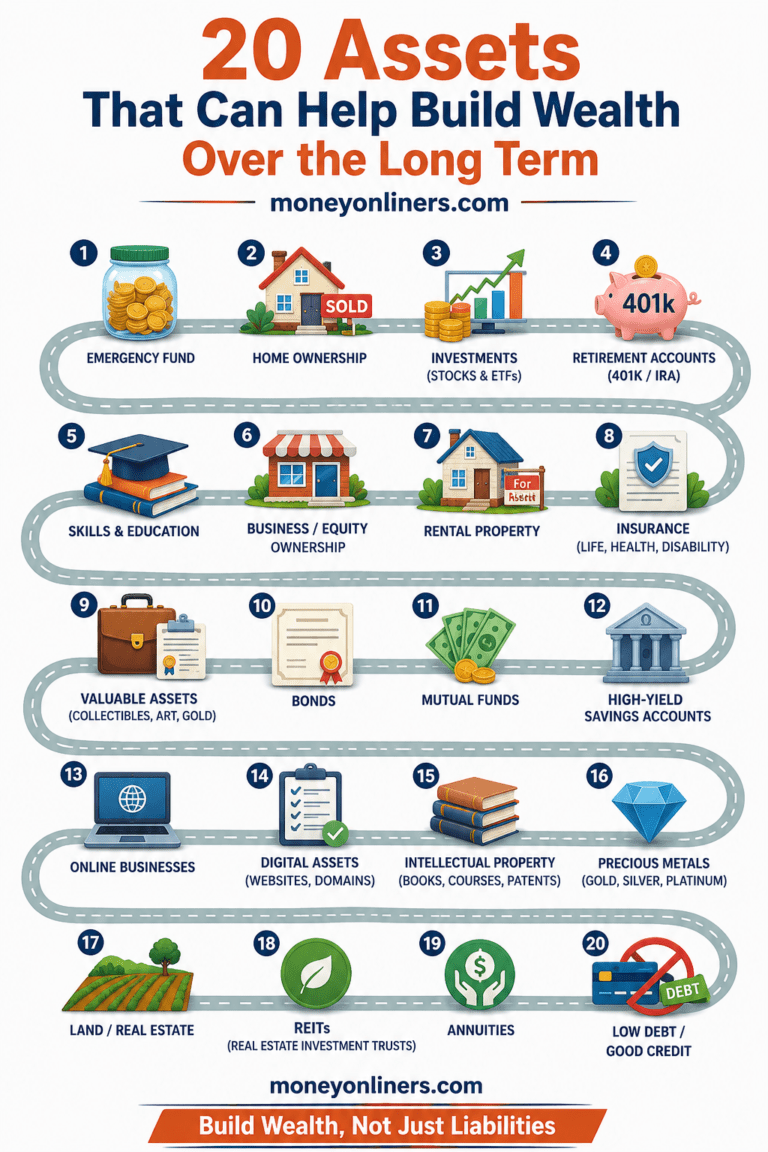
Potential Wealth-Building Assets Include
- Diversified stock funds
- ETFs
- Index funds
- Bonds
- Retirement investments
- Real estate
- Business ownership
- Intellectual property
- Income-producing equipment
The Wealth Conversion Process
Income → Saving → Financial Stability → Investing → Asset Ownership → Potential Wealth Growth
Consequently, saving can be the beginning of wealth building without necessarily being the complete process.
5 Emergency Savings Can Protect Your Investments
Saving and investing are not enemies.
In fact, savings can make investing easier to sustain.
Without Emergency Savings
A $3,000 unexpected expense might force you to:
- Sell investments
- Use a credit card
- Take a personal loan
- Withdraw retirement funds
With Emergency Savings
The same expense may be covered without disturbing long-term assets.
As a result, your investments can remain focused on long-term goals.
Savings are not separate from wealth building. They are part of the protection system that can help long-term wealth survive short-term problems.
6 Investing Introduces Risk That Saving Usually Avoids
One reason investments may provide greater long-term growth potential is that investors accept uncertainty.
Investment Risks Can Include
- Market declines
- Company failure
- Interest-rate changes
- Inflation
- Real-estate downturns
- Business failure
Therefore, investing is not simply “better saving.”
It is a different financial activity with different risks.
Diversification
Spreading investments across many securities can reduce concentration risk.
However, diversification cannot guarantee a profit or prevent losses during broad market declines.
Investor.gov specifically warns that promises of high guaranteed investment returns with little or no risk can signal fraud.
7 Growing Your Income Can Matter as Much as Investing
Someone with only $2,000 available to invest may focus entirely on finding a higher investment return.
However, increasing earning power could potentially make a larger difference.
Example
Annual income increase:
$10,000
Additional amount saved and invested each year:
$4,000
Ten Years of Additional Contributions
$40,000
That calculation excludes all investment gains or losses.
Therefore, wealth building is not only about what you do with existing money. It also includes expanding the amount of money available to work with.
8 High-Interest Debt Can Work Against Both Saving and Wealth Building
Suppose you have $5,000 in savings while carrying expensive revolving debt.
The financial picture is more complicated than the savings balance alone suggests.
Example
Savings:
$5,000
Credit-card debt:
$8,000
Your cash reserve may be useful.
Nevertheless, expensive interest charges can simultaneously weaken net worth.
Investor.gov advises consumers to take high-interest credit-card debt seriously because no investment provides guaranteed returns that offset those costs.
Maintain enough emergency liquidity for real risks while developing a deliberate plan to eliminate expensive debt.
9 Time Matters More When the Goal Is Wealth
Saving $100 produces $100 plus whatever interest the account earns.
Investing introduces the possibility of compound growth.
Hypothetical Illustration
Suppose $10,000 earns a hypothetical 7% annual return and no additional contributions are made.
| Time Invested | Approximate Hypothetical Value |
|---|---|
| 10 years | $19,672 |
| 20 years | $38,697 |
| 30 years | $76,123 |
Real markets do not produce a fixed 7% return each year. Investment values can rise or fall, and actual results may differ significantly.
Nevertheless, the example illustrates why long time horizons can make growth assets important for long-term wealth goals.
10 Different Money Should Have Different Jobs
One of the biggest financial mistakes is treating every dollar identically.
Money Needed Next Month
Usually needs stability and accessibility.
Money for a House Deposit Next Year
May also require relatively low risk.
Money for Retirement in 30 Years
Can often tolerate more short-term volatility because the time horizon is much longer.
Simple Money-by-Job Framework
| Financial Job | Possible Approach |
|---|---|
| Monthly spending | Checking/current account |
| Emergency fund | Accessible savings |
| Near-term goal | Savings, CDs or other suitable lower-risk options |
| Long-term retirement | Diversified long-term investments where appropriate |
| Business opportunity | Separate risk capital |

Example: Saving $500 a Month vs Using Different Money for Different Goals
Consider a hypothetical household with:
$500 per month available after normal expenses
Strategy A: Save Everything
The household places all $500 in savings.
Ten-Year Contributions
$500 × 120 = $60,000
Interest would add something depending on the account rate.
Strategy B: Split the Money
After establishing an appropriate emergency fund, the household directs:
| Use | Monthly Amount |
|---|---|
| Short-term savings | $150 |
| Long-term diversified investments | $350 |
Ten-Year Contributions
Savings contributions:
$18,000
Investment contributions:
$42,000
The total amount contributed remains $60,000.
However, the money now performs two different jobs.
Savings provide liquidity.
Investments pursue longer-term growth.
Key lesson: Building wealth often involves allocating money intentionally rather than automatically putting every surplus dollar in the same place.
MoneyOnliners Original Analysis: The Save-Protect-Grow Framework
Stage 1: Save
Create enough financial surplus that money is available beyond immediate spending.
Stage 2: Protect
Use accessible cash, sensible insurance and debt control to protect the financial system from major setbacks.
Stage 3: Grow
Direct long-term money toward productive assets that may increase in value or produce income.
Skipping saving can make investing fragile. Stopping at saving can limit long-term growth. Combining both can create a stronger financial system.
The MoneyOnliners Three-Money-Bucket Model
| Bucket | Purpose | Typical Time Horizon | Main Priority |
|---|---|---|---|
| Safety Money | Emergencies and essential reserves | Immediate | Liquidity |
| Goal Money | Planned near-term purchases | 1–5 years | Capital preservation |
| Wealth Money | Retirement and long-term financial independence | 10+ years | Growth with appropriate risk |
This is an original MoneyOnliners educational framework rather than a standardized investment-allocation model.
A Practical Saving-to-Wealth Roadmap
| Stage | Main Goal | Example Action |
|---|---|---|
| 1 | Create surplus | Spend less than you earn |
| 2 | Build first cash reserve | Create starter emergency savings |
| 3 | Control expensive debt | Reduce high-interest balances |
| 4 | Expand emergency fund | Build reserves based on household risk |
| 5 | Start investing | Begin sustainable recurring contributions |
| 6 | Use retirement benefits | Understand employer plans and IRA options |
| 7 | Diversify | Avoid depending on one asset or company |
| 8 | Increase contributions | Invest part of future raises |
| 9 | Build productive assets | Investments, business, property or other appropriate assets |
| 10 | Protect accumulated wealth | Review diversification, fees, insurance and fraud risk |
Saving vs Wealth-Building Checklist
- Monthly spending leaves at least some financial surplus.
- An emergency reserve is being built or maintained.
- High-interest debt is controlled or declining.
- Near-term goals are not funded entirely with volatile investments.
- Long-term money is not automatically kept only in cash.
- Retirement accounts are understood where applicable.
- Investment contributions happen consistently.
- The portfolio is appropriately diversified.
- Investment fees are understood.
- Contributions increase when financial capacity improves.
- Long-term money has enough time to tolerate appropriate investment risk.
- Guaranteed-high-return claims are treated cautiously.
MoneyOnliners Research-Based Evidence Note
This article is a research-based saving and wealth-building guide.
MoneyOnliners does not claim that the hypothetical savings balances, investment returns or household examples represent personal financial results achieved by MoneyOnliners or its editorial team.
Investor.gov guidance supports keeping emergency savings accessible while also regularly investing a portion of income for long-term goals. It also notes that investing introduces more risk than money held in a bank but offers greater opportunity to build wealth over time.
Investor.gov also identifies inflation as a potential weakness of long-term cash savings when interest does not keep pace with rising prices.
Current 2026 retirement-plan limits were reviewed against official IRS information where retirement-account examples are relevant.
MoneyOnliners does not fabricate portfolio returns, bank rates, investment screenshots or testimonials.
The Save-Protect-Grow Framework and Three-Money-Bucket Model are original MoneyOnliners analytical resources created to make this distinction easier to understand and cite.
10 Saving and Wealth-Building Mistakes to Avoid
1. Keeping No Emergency Savings
Unexpected expenses can become expensive debt.
2. Keeping Every Long-Term Dollar in Cash
This may limit long-term growth and expose purchasing power to inflation.
3. Investing Your Emergency Fund
Market declines can occur precisely when you need the money.
4. Ignoring High-Interest Debt
Expensive interest can work against saving and investing simultaneously.
5. Assuming Investment Returns Are Guaranteed
Markets can fall and investments can lose money.
6. Chasing Higher Returns With Money Needed Soon
Short time horizons generally provide less opportunity to recover from losses.
7. Leaving Contributions Permanently Small
Investment contributions should ideally grow as income and financial capacity increase.
8. Ignoring Fees
Recurring investment costs reduce the return you keep.
9. Failing to Diversify
One investment failure can create severe losses when most wealth depends on it.
10. Treating Saving and Investing as Competitors
They perform different jobs and can strengthen one another.
Do not move emergency savings into speculative investments simply because cash earns less. Likewise, do not assume an investment offering unusually high guaranteed returns is a safe replacement for savings. Higher expected return generally comes with additional risk.
Why Understanding Saving vs Building Wealth Matters
1. Saving provides liquidity for financial emergencies.
2. Wealth building focuses more heavily on long-term asset growth.
3. Emergency savings can reduce the need for high-interest debt.
4. Short-term goals usually require more stability than long-term retirement money.
5. Keeping every dollar in cash may reduce long-term growth potential.
6. Inflation can reduce the future purchasing power of cash.
7. Investing offers greater potential growth but also introduces additional risk.
8. Productive assets can potentially produce income or appreciate.
9. Diversification can reduce dependence on one investment outcome.
10. A strong emergency fund can help long-term investments remain invested during financial shocks.
11. High-interest debt can weaken both saving capacity and net worth.
12. Growing income can expand how much money is available for both saving and investing.
13. Long time horizons make compounding more relevant.
14. Retirement accounts can help convert current income into long-term assets.
15. Saving and investing should be matched to different financial goals.
16. Money needed soon should not automatically be exposed to significant market volatility.
17. Long-term money may benefit from greater growth potential than cash alone provides.
18. Wealth building requires both offense through growth and defense through financial stability.
19. A strong financial plan gives each category of money a specific job.
20. Ultimately, understanding saving vs building wealth helps you see that cash reserves create security while long-term productive assets may be needed to create greater financial growth and independence over time.
Continue Learning on MoneyOnliners
Recommended External Resources
1. Investor.gov — Build Wealth Over Time Through Saving and Investing
Build Wealth Over Time Through Saving and Investing — Investor.gov
Explains how emergency savings, high-interest debt control and regular investing can work together in a long-term wealth-building plan.
2. Investor.gov — Introduction to Investing
Introduction to Investing — Investor.gov
Explains the difference between savings for short-term needs and investing for longer-term goals.
3. Investor.gov — Save for a Rainy Day
Save for a Rainy Day — Investor.gov
Discusses emergency savings, liquidity and the effect inflation can have on cash purchasing power.
4. Investor.gov — Saving and Investing Roadmap
Saving and Investing: A Roadmap to Financial Security — Investor.gov
Provides broader education on combining long-term saving and investing as part of financial security.
5. Investor.gov — Small Savings Add Up to Big Money
Small Savings Add Up to Big Money — Investor.gov
Provides simple educational examples of long-term compounding.
6. Investor.gov — Figure Out Your Finances
Figure Out Your Finances — Investor.gov
Explains income, expenses, assets, liabilities and net-worth tracking.
7. Investor.gov — Diversify Your Investments
Diversify Your Investments — Investor.gov
Explains diversification and why spreading investments can reduce concentration risk.
8. IRS — 2026 Retirement Plan Limits
2026 Retirement Plan and IRA Cost-of-Living Adjustments — IRS
Official IRS guidance covering 2026 retirement-plan contribution limits and related adjustments.
9. Consumer Financial Protection Bureau — Savings
Saving — Consumer Financial Protection Bureau
Consumer-focused tools and guidance for building savings and financial resilience.
10. Federal Trade Commission — Scams
Scams — Federal Trade Commission
Consumer-protection information for identifying fraudulent financial, investment and wealth-building schemes.
MoneyOnliners prioritizes government agencies and financial regulators for investment education, retirement-plan rules and consumer protection. Because rules and contribution limits can change, verify current official information before making financial decisions.
This article provides general educational information and is not individualized investment, banking, financial, tax, legal or retirement advice. Savings rates change, investments can lose value, inflation varies and no wealth-building strategy guarantees a particular outcome.
Frequently Asked Questions
Is saving money the same as building wealth?
No.
Saving is part of the process.
However, saving primarily creates security and liquidity.
Building wealth usually also involves acquiring productive assets.
Therefore, the concepts overlap without being identical.
Why isn't saving money alone always enough?
Cash usually has limited long-term growth potential.
In addition, inflation can reduce purchasing power.
Long-term investments may offer greater growth potential.
However, investments also involve risk.
A balanced strategy usually gives saving and investing different jobs.
Should I save before I invest?
Building an emergency reserve first can be useful.
However, there is no universal sequence for every household.
Employer retirement matching may also matter.
High-interest debt can affect the decision.
Therefore, some people save, repay debt and invest at the same time.
How much should I keep in savings?
There is no universal number.
Job stability matters.
Housing responsibilities matter.
Family obligations matter.
Your emergency reserve should reflect the risks your household actually faces.
Should I invest my emergency fund?
Generally, emergency money needs accessibility and stability.
Stocks and other volatile assets can fall in value.
A market decline could happen just before an emergency.
Therefore, emergency funds usually serve a different purpose from long-term investments.
Keep each category aligned with its job.
Does inflation make savings useless?
No.
Savings still provide liquidity and security.
However, inflation can reduce long-term purchasing power.
Consequently, very long-term money may require more growth potential.
That is where investing can play a different role.
What is better: saving or investing?
Neither is universally better.
Saving is usually better for emergencies and short-term needs.
Investing may be more appropriate for some long-term goals.
However, investing carries additional risk.
Most financial plans need both.
Can I build wealth with only a savings account?
You can increase your cash balance.
That can strengthen net worth.
However, long-term growth may be limited compared with diversified investments or other productive assets.
Inflation also matters.
Therefore, cash alone may not be the strongest long-term wealth strategy.
How much should I invest after building emergency savings?
The appropriate amount depends on your income and goals.
Debt also matters.
Retirement benefits matter.
Some people begin with a fixed monthly amount or percentage.
Ideally, contributions increase as financial capacity improves.
What investments can help build wealth?
Diversified stock funds are one common option.
Bonds can play another role.
Real estate can also contribute to wealth.
Businesses and other productive assets may help too.
Every asset has different risks and costs.
Why does time matter so much?
Long time horizons provide more opportunity for compounding.
They also provide more time to recover from some market declines.
However, returns remain uncertain.
Starting earlier can reduce the amount that must come from later contributions.
Consistency still matters.
Should I use a 401(k) or savings account?
They serve different purposes.
Savings accounts can support emergencies and short-term goals.
A 401(k) is designed primarily for retirement.
The account also contains investments chosen from the available plan options.
Therefore, they should not be treated as direct substitutes.
Does paying off debt build wealth?
Reducing debt can improve net worth.
It can also free future cash flow.
High-interest debt is particularly important.
Once eliminated, former debt payments can potentially become investment contributions.
Therefore, debt reduction can be an important wealth-building strategy.
Can $100 a month really build wealth?
It can be a useful starting point.
That equals $1,200 of annual contributions.
Over ten years, contributions alone equal $12,000.
Investment returns could increase or decrease the final value.
Increasing contributions over time can make the strategy stronger.
What is the biggest difference between saving and building wealth?
Saving emphasizes preserving money for future use.
Wealth building emphasizes increasing long-term financial resources.
Savings can form the foundation.
Productive asset ownership can provide the growth engine.
Together, they can create a stronger financial system.
Research Methodology
How Saving Was Evaluated
This MoneyOnliners guide treats saving primarily as setting aside money for liquidity, emergencies and shorter-term financial goals.
How Wealth Building Was Evaluated
Building wealth is evaluated through net-worth growth, debt reduction, productive asset ownership, long-term investing and income growth.
Why Emergency Savings Matter
Investor.gov recommends building emergency savings so unexpected expenses are less likely to force new debt.
Therefore, saving is treated as part of wealth protection rather than an alternative to wealth building.
Why Investing Was Included
Investor.gov notes that investing involves more risk than money held in a bank but provides more opportunity to build wealth over time.
Why Inflation Matters
Long-term cash savings can lose purchasing power when interest fails to keep up with inflation.
Why Debt Was Included
High-interest debt can increase financial costs and reduce the money available for saving and investing.
Why Time Was Included
Longer investment periods provide more opportunity for compound growth, although returns remain uncertain.
Original MoneyOnliners Analysis
The Save-Protect-Grow Framework and Three-Money-Bucket Model are original MoneyOnliners educational tools designed to clarify the different roles of cash savings and long-term wealth assets.
Limitations
Savings rates, investment returns, inflation and household circumstances vary.
Moreover, appropriate asset allocation depends on personal risk tolerance, goals and time horizon.
No hypothetical calculation in this article guarantees a future result.
Conclusion: Saving Is the Foundation, but Wealth Building Usually Goes Further
Saving money matters.
It creates stability.
It helps cover emergencies.
It can protect you from expensive debt.
It also gives you the financial capacity to invest later.
But Saving Has a Different Job
Savings are designed primarily to keep money available and relatively stable.
Long-Term Wealth Needs Growth
For goals many years away, productive assets can provide greater growth potential.
That Growth Comes With Risk
Investments can fall in value.
Therefore, emergency money should not automatically become investment money.
You Need Both Defense and Offense
Savings provide defense.
Investments and productive assets provide potential growth.
The Stronger System Combines Them
Earn income.
Create surplus.
Build emergency savings.
Reduce expensive debt.
Invest long-term money.
Diversify appropriately.
Increase contributions as your capacity grows.
Then allow time to work.