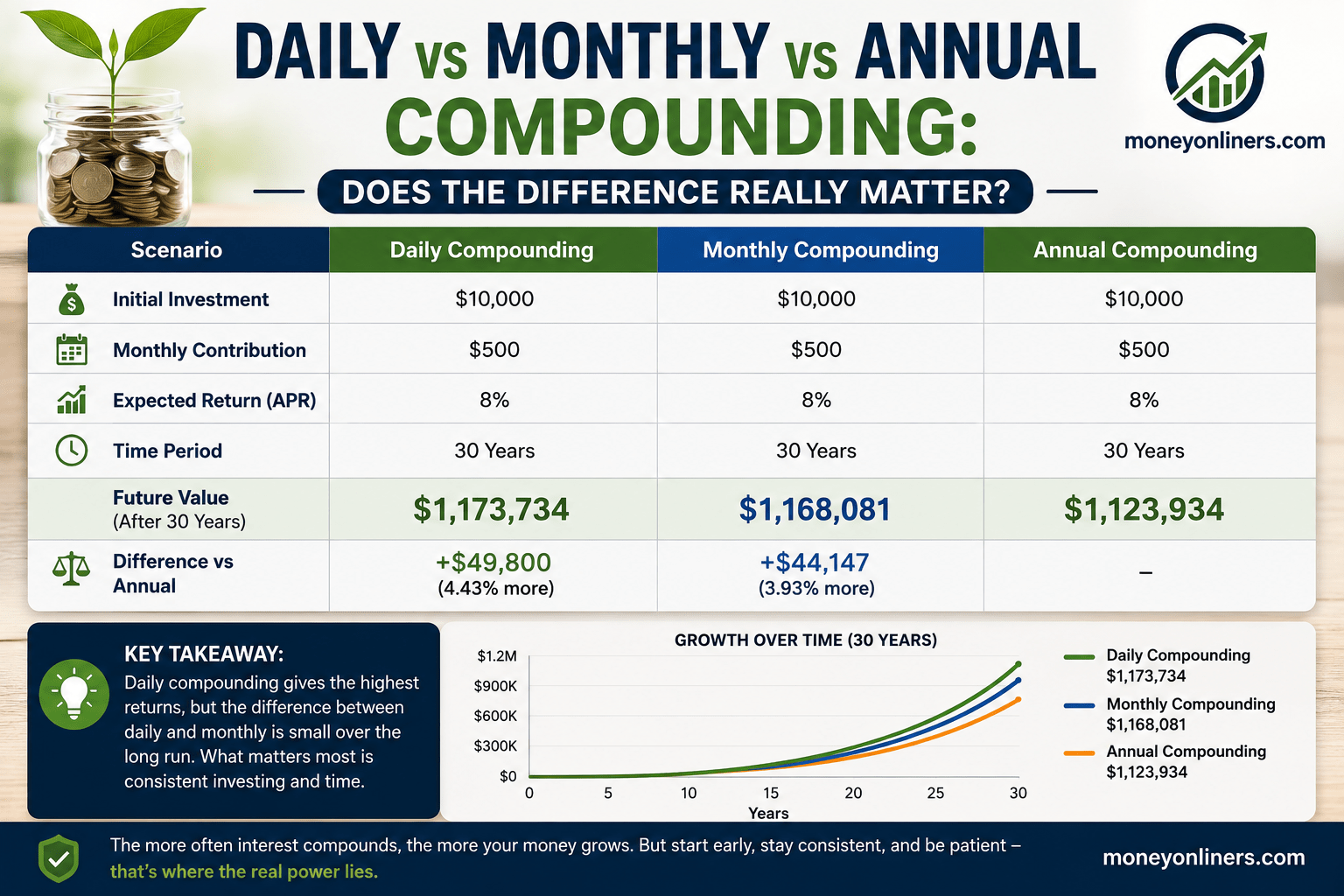
Daily vs Monthly vs Annual Compounding: Does the Difference Really Matter?
Daily vs Monthly vs Annual Compounding: Does the Difference Really Matter?
Daily compounding sounds much more powerful than monthly or annual compounding. Mathematically, more frequent compounding does create a larger ending balance when the principal, stated rate and time period are identical. However, the difference is often much smaller than people expect. In many real financial decisions, the interest rate, fees, time horizon and contribution amount matter far more than whether interest compounds 12 times or 365 times per year.
In a daily vs monthly vs annual compounding comparison, daily compounding produces the highest mathematical ending balance when every other term is identical.
However, the advantage may be relatively small.
Example: $10,000 at 5% for 20 Years
| Compounding Frequency | Approximate Ending Balance | Difference vs Annual |
|---|---|---|
| Annual | $26,532.98 | — |
| Monthly | $27,126.40 | +$593.43 |
| Daily | $27,180.96 | +$647.98 |
Daily vs Monthly Difference
Only about $54.55 after 20 years
So yes, compounding frequency matters. But in this example, the difference between monthly and daily compounding is tiny compared with the effect of the 5% rate and 20-year time horizon.
Table of Contents
What Does Compounding Frequency Mean?
Compounding frequency tells you how often previously earned interest is added to the balance and becomes eligible to participate in later interest calculations.
Annual Compounding
Interest is added once per year.
Monthly Compounding
Interest is added 12 times per year.
Daily Compounding
Interest may be compounded approximately 365 times per year.
The CFPB explains that institutions choosing to compound interest may use annual, semiannual, quarterly, monthly, daily, continuous or other disclosed compounding schedules.
The sooner interest is added to the balance, the sooner that interest can potentially begin earning additional interest.
How the Compound Interest Formula Changes With Frequency
Principal
The amount you begin with.
Rate
The stated annual interest rate.
Frequency
How many times the interest compounds each year.
Years
How long the money remains in the account.
Annual Compounding
Frequency = 1
Monthly Compounding
Frequency = 12
Daily Compounding
Frequency ≈ 365
Always read the account disclosure rather than assuming every product uses the simplified formula shown here.
Daily vs Monthly vs Annual Compounding at a Glance
| Feature | Annual | Monthly | Daily |
|---|---|---|---|
| Compounding periods per year | 1 | 12 | About 365 |
| Interest added | Once yearly | Monthly | Daily |
| Interest-on-interest starts sooner? | Slowest | Yes | Fastest |
| Ending value under identical terms | Lowest | Slightly higher | Highest |
| Typical difference vs other frequencies | Can be noticeable over long periods | Usually close to daily | Usually only slightly above monthly |
Annual How Annual Compounding Works
Suppose you deposit:
$10,000
at:
5% annual interest
After One Year
$10,500
After Two Years
$11,025
The second year's 5% applies to $10,500 rather than only the original $10,000.
Advantages
- Very easy to calculate
- Easy to explain
- Useful for comparison examples
Disadvantage vs More Frequent Compounding
Interest waits longer before it becomes part of the balance eligible for future interest.
Monthly How Monthly Compounding Works
With monthly compounding, the annual stated rate is divided into 12 periodic rates for simplified mathematical purposes.
At 5%
5% ÷ 12 ≈ 0.4167% per month
Interest is added much sooner than under annual compounding.
Why That Helps
The interest added after January can participate in February's calculation.
February's interest can then participate in March's calculation.
The process repeats throughout the year.
With identical principal and nominal rate, monthly compounding ends slightly ahead of annual compounding.

Daily How Daily Compounding Works
Daily compounding divides the annual rate across many more periods.
At 5%
5% ÷ 365 ≈ 0.0137% per day
The daily rate is tiny.
However, interest can begin joining the balance much sooner.
Why Daily Usually Beats Monthly
Interest credited earlier gets additional opportunities to compound.
But the Advantage Becomes Smaller
Moving from annual to monthly creates a meaningful increase in frequency:
1 → 12 periods
Moving from monthly to daily adds many periods:
12 → 365 periods
yet each additional improvement contributes progressively less to the final result.
$1,000 at 5%: Daily vs Monthly vs Annual Compounding
After One Year
| Frequency | Approximate Balance |
|---|---|
| Annual | $1,050.00 |
| Monthly | $1,051.16 |
| Daily | $1,051.27 |
Daily vs Annual Difference
Approximately $1.27
This is why compounding frequency should not be viewed in isolation.
On a small balance over one year, the difference may be almost irrelevant.
$10,000 at 5%: How Much Does Frequency Change?
After One Year
| Frequency | Approximate Balance |
|---|---|
| Annual | $10,500.00 |
| Monthly | $10,511.62 |
| Daily | $10,512.67 |
Monthly vs Annual Difference
About $11.62
Daily vs Monthly Difference
About $1.05
A 0.25-percentage-point difference in the actual interest rate could easily matter more than switching from monthly to daily compounding.
What Happens Over 20 Years?
Long periods widen the difference.
$10,000 at 5% for 20 Years
| Frequency | Approximate Ending Value |
|---|---|
| Annual | $26,532.98 |
| Monthly | $27,126.40 |
| Daily | $27,180.96 |
Annual vs Monthly
About $593.43
Monthly vs Daily
About $54.55
Annual vs Daily
About $647.98
Twenty years makes the annual-vs-daily difference visible.
However, monthly and daily compounding remain surprisingly close.

Interest Rate Usually Matters More Than Compounding Frequency
Suppose you are comparing two accounts.
Account A
5.00% compounded daily
Account B
5.25% compounded monthly
A common mistake would be choosing Account A simply because it compounds daily.
The higher underlying rate on Account B may produce the better outcome.
Therefore Compare
- APY
- Nominal rate
- Fees
- Minimum balances
- Withdrawal rules
- Compounding frequency
Time Usually Matters More Than Frequency Too
Consider $10,000 at 5%.
Annual Compounding for 20 Years
$26,532.98
Daily Compounding for Only 10 Years
About $16,486
The annual-compounding account with twice the time ends much larger.
Why?
Ten additional years of compound growth matter far more than increasing the number of compounding periods within each year.
For many savers, principal, rate, contribution size and time should be examined before obsessing over daily vs monthly frequency.
APY Can Make Compounding Comparisons Easier
When comparing deposit accounts, the annual percentage yield can help capture the effect of compounding in a standardized annual figure.
Why This Matters
Two accounts might both advertise a similar nominal interest rate but compound at different frequencies.
The resulting effective annual yield may differ.
Instead of Asking Only:
“Does this compound daily?”
Also Ask:
“What is the APY after compounding?”
They are not interchangeable measurements. Read how each product defines the rate being advertised.
Real-Life Savings Account Example
Imagine choosing between three hypothetical savings accounts.
| Account | Rate | Compounding | Monthly Fee |
|---|---|---|---|
| A | 5.00% | Daily | $10 |
| B | 5.00% | Monthly | $0 |
| C | 5.20% | Annual | $0 |
Which Is Best?
You cannot answer correctly from compounding frequency alone.
Account A
Daily compounding sounds attractive, but $120 of annual fees could erase the tiny frequency advantage on modest balances.
Account B
Monthly compounding with no fees may produce a stronger net result.
Account C
The higher rate could potentially outperform both despite annual compounding.

What About Daily vs Monthly Compounding on Debt?
Compounding frequency can also matter when interest works against you.
Debt Example
If unpaid interest is added to a balance more frequently, future interest may be calculated from a larger balance sooner.
But Loan Structures Vary
Borrowing products may involve:
- Simple interest
- Daily periodic rates
- Monthly billing cycles
- Capitalized interest
- Fees
- Minimum payments
Do not assume that a loan described as using a daily rate necessarily compounds exactly like a savings account.
More Important Questions
- What is the APR?
- How is interest calculated?
- When does interest capitalize?
- What fees apply?
- What happens if payments are late?
MoneyOnliners Original Analysis: The Frequency Impact Test
1. Rate
What is the actual stated interest rate?
2. Frequency
How often is the interest compounded?
3. Time
How long will the balance remain in the account?
4. Net Result
After fees, taxes and other terms, which option actually leaves the larger balance?
MoneyOnliners Frequency Advantage Formula
MoneyOnliners Research-Based Evidence Note
This article is a research-based compounding-frequency comparison.
The Consumer Financial Protection Bureau defines compound interest as earning interest on both savings and previously earned interest.
The CFPB also explains that increasing the compounding frequency can increase savings growth.
Federal Regulation DD guidance states that financial institutions choosing to compound interest may do so annually, semiannually, quarterly, monthly, daily, continuously or on another basis.
Investor.gov's compound-interest calculator allows users to select compounding frequency while testing principal, contributions, rates and time horizons.
MoneyOnliners independently calculated the annual, monthly and daily examples using standard nominal-rate compound-interest mathematics.
For the $10,000-at-5%-for-20-years comparison, annual compounding produces approximately $26,532.98, monthly compounding approximately $27,126.40 and daily compounding approximately $27,180.96.
The Frequency Impact Test, Frequency Advantage Formula and Compounding Priority Scorecard are original MoneyOnliners analytical resources.
No real bank account or personal investment return is claimed in the numerical examples.
10 Daily vs Monthly vs Annual Compounding Mistakes to Avoid
1. Assuming Daily Compounding Is Always the Best Deal
A lower rate or higher fee can erase the advantage.
2. Ignoring APY
APY can make deposit-account comparisons easier.
3. Looking Only at Frequency
Rate, fees and time may matter much more.
4. Assuming Daily and Monthly Are Dramatically Different
They are often surprisingly close.
5. Ignoring Minimum-Balance Requirements
A high-yield account may have terms that affect your actual return.
6. Ignoring Account Fees
Fees can erase years of extra compounding.
7. Confusing Nominal Rate With Effective Yield
Compounding changes the effective annual result.
8. Assuming All Debt Compounds the Same Way
Loan terms differ substantially.
9. Ignoring Time Horizon
Frequency differences become more visible over longer periods.
10. Chasing Unrealistic Returns
Compounding frequency does not make a questionable high-return investment safe.
The FTC warns that investment scams often promise big profits, guaranteed income or little-to-no risk. More frequent compounding cannot turn an unrealistic or fraudulent return into a legitimate investment.
Why Daily vs Monthly vs Annual Compounding Matters
1. Compounding frequency determines how often interest joins the balance.
2. Annual compounding adds interest once per year.
3. Monthly compounding usually adds it 12 times.
4. Daily compounding can use roughly 365 periods.
5. More frequent compounding produces a higher mathematical balance when all else is equal.
6. Annual compounding usually produces the lowest ending value among the three.
7. Monthly compounding generally beats annual compounding.
8. Daily compounding generally beats monthly compounding.
9. The daily-over-monthly difference is often relatively small.
10. Larger balances make frequency differences more noticeable.
11. Longer time horizons also widen the difference.
12. Interest rate often matters more than frequency.
13. Fees can easily erase a frequency advantage.
14. APY can simplify savings-account comparisons.
15. Contribution amount can matter far more than compounding frequency.
16. Time can matter more than daily vs monthly compounding.
17. Debt products may calculate interest differently from savings accounts.
18. Consumers should read account disclosures carefully.
19. More frequent compounding should not justify choosing an otherwise worse product.
20. Ultimately, understanding daily vs monthly vs annual compounding helps you recognize that frequency does matter—but usually as one piece of a much larger equation involving rate, principal, contributions, fees and time.
Continue Learning on MoneyOnliners
Recommended External Resources
1. Consumer Financial Protection Bureau — How Does Compound Interest Work?
How Does Compound Interest Work? — CFPB
Explains compound interest, principal, rate and compounding frequency with a simple example.
2. Investor.gov — Compound Interest Calculator
Compound Interest Calculator — Investor.gov
Allows readers to change initial investment, monthly contributions, rate, time and compounding frequency.
3. CFPB — Regulation DD Payment of Interest
Explains that institutions may use annual, monthly, daily and other compounding or crediting schedules.
4. CFPB — Official Interpretation of Compounding Policies
Official Interpretation of Payment of Interest — CFPB
Provides additional regulatory explanation of compounding and interest-crediting practices.
5. Investor.gov — Introduction to Investing
Introduction to Investing — Investor.gov
Provides broader education about returns, risk, compounding and long-term investing.
6. Investor.gov — Understanding Investment Fees
Understanding Investment Fees — Investor.gov
Useful for understanding why recurring costs can outweigh small frequency advantages.
7. Investor.gov — Build Wealth Over Time Through Saving and Investing
Build Wealth Over Time Through Saving and Investing — Investor.gov
Explains the importance of saving, regular investing and time in long-term wealth building.
8. Consumer Financial Protection Bureau — Saving
Saving — Consumer Financial Protection Bureau
Provides practical consumer resources for building savings and financial resilience.
9. Federal Trade Commission — Investment Scams
Investment Scams — Federal Trade Commission
Explains common warning signs including guaranteed profits, low-risk claims and supposed secret investment systems.
10. Investor.gov — Diversify Your Investments
Diversify Your Investments — Investor.gov
Explains why investors should focus on broader risk management rather than simply chasing the highest possible return.
This article provides general educational information and is not individualized financial, banking, investment, tax or legal advice. Actual account calculations depend on disclosed terms, rate changes, compounding and crediting rules, fees, taxes and withdrawal behavior. Investment returns are not guaranteed.
Frequently Asked Questions
Is daily compounding better than monthly compounding?
Mathematically, yes when every other term is identical.
Daily compounding allows interest to join the balance sooner.
That gives it more opportunities to earn additional interest.
However, the difference may be very small.
Always compare rate, APY and fees too.
Is monthly compounding better than annual compounding?
Yes under otherwise identical terms.
Monthly compounding adds interest sooner.
Therefore, previously earned interest can participate in future calculations earlier.
The difference becomes more noticeable over longer periods.
It can still be less important than the underlying rate.
How much better is daily than monthly compounding?
Often not very much.
For $10,000 at 5% over 20 years, daily compounding produces approximately $27,180.96.
Monthly compounding produces approximately $27,126.40.
The difference is only about $54.55.
That is why frequency should not be examined alone.
How much better is monthly than annual compounding?
The difference is usually larger than daily vs monthly.
In the same $10,000, 5%, 20-year example, monthly compounding finishes about $593 higher than annual compounding.
Time increases the difference.
Larger balances also increase it.
Still, rate may matter more.
Does daily compounding make you rich faster?
Not by itself.
It gives a modest mathematical advantage.
However, principal size matters greatly.
Contribution size and rate matter too.
Long-term wealth is not determined by compounding frequency alone.
What matters more: rate or compounding frequency?
The interest rate often matters more.
A higher-rate monthly account can outperform a lower-rate daily account.
Fees also matter.
Always compare effective yield and net outcome.
Frequency is only one variable.
What matters more: time or compounding frequency?
Time can matter far more.
Ten additional years can create much more growth than switching from monthly to daily compounding.
Long time horizons allow previous growth to keep participating.
Frequency still matters mathematically.
It is simply not always the dominant factor.
What is annual compounding?
Interest is compounded once per year.
Previously earned interest joins the balance at the annual compounding point.
Future annual interest then applies to that larger balance.
It is easy to calculate.
It usually produces less than more frequent compounding under identical terms.
What is monthly compounding?
Interest compounds 12 times each year.
Each month, credited interest becomes part of the future calculation base.
That generally produces slightly more than annual compounding.
Many financial examples use monthly compounding.
Always check the real account terms.
What is daily compounding?
Interest is calculated using daily periods.
The annual rate is effectively spread across many daily calculations.
Interest can join the balance very frequently.
That gives daily compounding a mathematical advantage.
The advantage over monthly compounding is often small.
Do all savings accounts compound daily?
No.
The CFPB explains that institutions can use different compounding and crediting schedules.
Some accounts may compound daily.
Others may use monthly or another method.
Read the product disclosures.
Is APY more useful than compounding frequency?
For deposit comparisons, APY can be very useful.
It reflects the annualized effect of compounding under the account's terms.
It can therefore simplify comparison.
However, also consider fees and access rules.
No single number tells the entire story.
Can fees erase daily-compounding benefits?
Absolutely.
A $10 monthly fee equals $120 per year.
That could be far larger than the daily-over-monthly interest advantage on a modest account balance.
Always compare net value.
Frequency alone can be misleading.
Does debt compound daily too?
Some debt products use daily periodic calculations.
Others have different structures.
Interest capitalization and payment timing can matter.
Do not assume debt works exactly like a deposit account.
Read the loan agreement.
Which compounding frequency should I choose?
If two products are otherwise identical, more frequent compounding benefits the saver.
In real life, products are rarely identical.
Compare APY.
Compare fees and restrictions.
Choose the best overall financial outcome rather than the most impressive frequency label.
Research Methodology
Primary Formula
MoneyOnliners used the standard nominal-rate compounding formula:
Future Value = Principal × (1 + Rate ÷ Frequency)Frequency × Years
Core Comparison
- Principal: $10,000
- Nominal annual rate: 5%
- Time: 20 years
- Annual frequency: 1
- Monthly frequency: 12
- Daily frequency: 365
Calculated Results
Annual: $26,532.98
Monthly: $27,126.40
Daily: $27,180.96
Primary External Sources
CFPB guidance was used to verify the definition of compound interest and the role of compounding frequency.
Regulation DD materials were reviewed to confirm that financial institutions may use annual, monthly, daily and other disclosed compounding schedules.
Investor.gov's compound-interest calculator was reviewed because it allows consumers to directly test different compounding frequencies.
Investment Risk
FTC guidance was reviewed because investment promoters can misuse compounding language to make unrealistic high-return claims appear credible.
Original MoneyOnliners Analysis
The Frequency Impact Test, Frequency Advantage Formula and Compounding Priority Scorecard are original MoneyOnliners educational resources.
First-Hand Evidence Standard
MoneyOnliners only presents actual bank-account testing, statements, screenshots or real interest-crediting observations when genuine first-hand evidence exists and can be accurately documented.
No first-hand bank account result is claimed in this article.
Limitations
Real accounts may change rates.
Interest-crediting policies can vary.
Fees can apply.
Taxes can reduce after-tax returns.
Therefore, simplified compound-interest formulas should be treated as educational comparisons rather than substitutes for account disclosures.
Conclusion: Compounding Frequency Matters—but Usually Less Than You Think
So, does daily vs monthly vs annual compounding really matter?
Yes, Mathematically
More frequent compounding produces a larger ending balance when principal, nominal rate and time are identical.
Annual Compounding
Interest joins the balance once per year.
Monthly Compounding
It joins 12 times.
Daily Compounding
It can participate in hundreds of compounding periods each year.
But Consider the $10,000 Example
At 5% for 20 years:
Annual: $26,532.98
Monthly: $27,126.40
Daily: $27,180.96
The Daily vs Monthly Difference?
Only about $54.55 over 20 years.
What Usually Matters More?
The interest rate.
The APY.
Fees.
How much money you contribute.
How long the money remains invested or saved.
Whether the rate changes.
Taxes.
Account restrictions.
So Do Not Chase Frequency Alone
A fee-free monthly-compounding account with a better yield can beat a daily-compounding account with a lower rate or costly fees.
Similar Posts
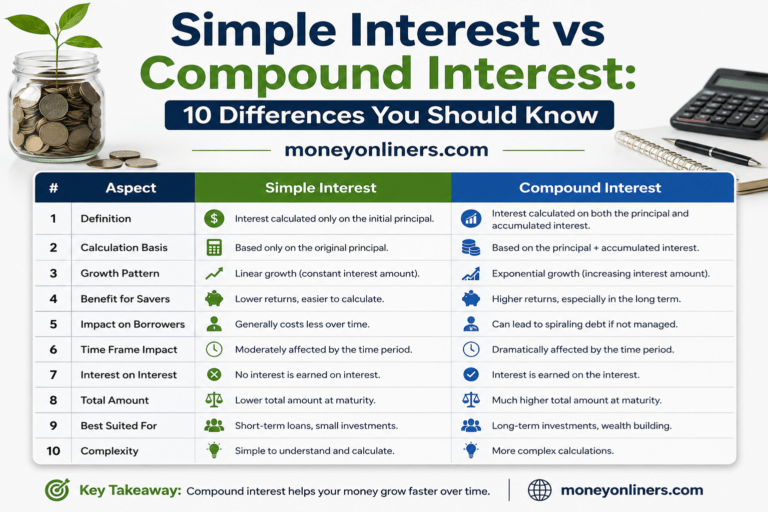
Simple Interest vs Compound Interest: 10 Differences You Should Know
Simple Interest vs Compound Interest: 10 Differences You Should Know | MoneyOnliners MoneyOnliners • Compound Interest → Comparison Guide Simple Interest vs Compound Interest: 10 Differences You Should Know Simple interest and compound interest can start with the same principal and the same stated rate yet produce different results. The difference comes from what the…
Compound Interest Explained With 10 Simple Real-Life Examples
Compound Interest Explained With 10 Simple Real-Life Examples | MoneyOnliners MoneyOnliners • Wealth Building → Compound Interest Compound Interest Explained With 10 Simple Real-Life Examples Compound interest can sound like complicated financial mathematics, but the basic idea is remarkably simple: your money can earn a return, and later that return may begin earning additional returns…
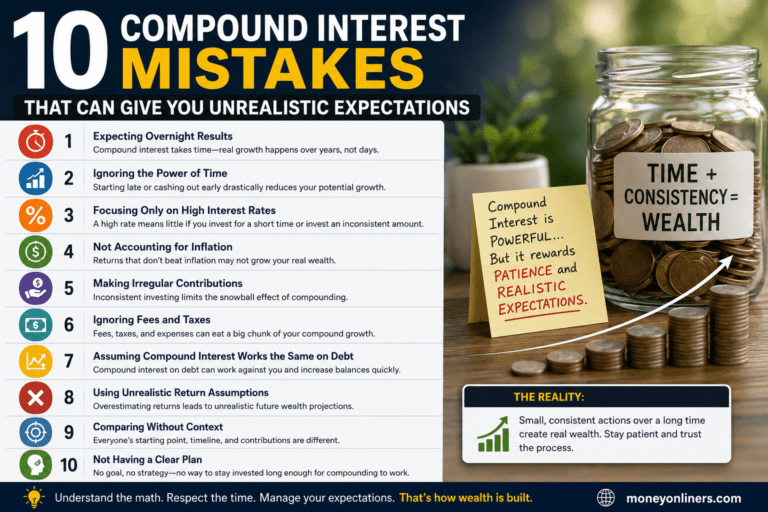
10 Compound Interest Mistakes That Can Give You Unrealistic Expectations
10 Compound Interest Mistakes That Can Give You Unrealistic Expectations | MoneyOnliners MoneyOnliners • Compound Interest → Reality Check 10 Compound Interest Mistakes That Can Give You Unrealistic Expectations Compound interest is one of the most useful ideas in long-term finance, but it is also one of the easiest to misunderstand. A calculator can make…
$1,000 Invested for 10, 20 and 30 Years: What Could Compound Growth Do?
$1,000 Invested for 10, 20 and 30 Years: What Could Compound Growth Do? | MoneyOnliners MoneyOnliners • Investing → Compound Growth $1,000 Invested for 10, 20 and 30 Years: What Could Compound Growth Do? One thousand dollars is not enough to guarantee financial independence, but it is large enough to demonstrate something important: time can…
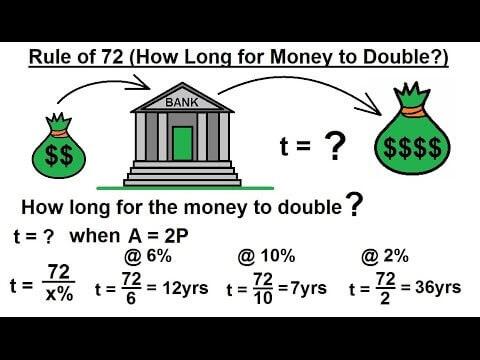
How Long Does It Take to Double Your Money? The Rule of 72 Explained
How Long Does It Take to Double Your Money? The Rule of 72 Explained | MoneyOnliners MoneyOnliners • Compound Growth → Rule of 72 How Long Does It Take to Double Your Money? The Rule of 72 Explained If your money is growing at 4%, 6%, 8% or 10% a year, how long might it…
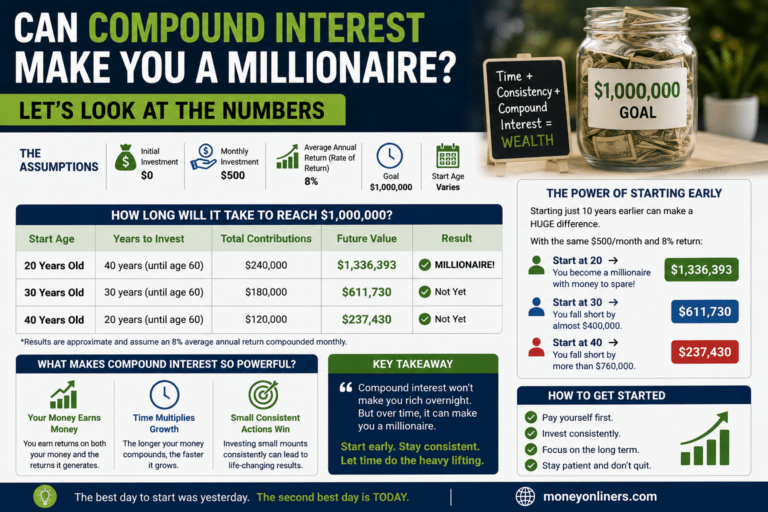
Can Compound Interest Make You a Millionaire? Let’s Look at the Numbers
Can Compound Interest Make You a Millionaire? Let’s Look at the Numbers | MoneyOnliners MoneyOnliners • Compound Interest → Millionaire Math Can Compound Interest Make You a Millionaire? Let’s Look at the Numbers Becoming a millionaire through compound growth is mathematically possible, but the word “millionaire” can make the process sound easier than it really…