
Compound Interest Explained With 10 Simple Real-Life Examples
Compound Interest Explained With 10 Simple Real-Life Examples
Compound interest can sound like complicated financial mathematics, but the basic idea is remarkably simple: your money can earn a return, and later that return may begin earning additional returns too. The effect often looks small at first. Over longer periods, however, time, contribution size and rate of return can dramatically change the final number.
Compound interest means earning interest or investment growth on both your original money and previously accumulated interest or growth.
For example, $1,000 earning a hypothetical 5% annually becomes $1,050 after one year. In year two, the 5% applies to $1,050 rather than only the original $1,000. The balance would become approximately $1,102.50.
That extra $2.50 may not look exciting. However, repeating the process for years or decades can make the effect increasingly significant.
Table of Contents
What Is Compound Interest?
Compound interest occurs when interest is calculated on both the original principal and previously accumulated interest.
Year 1
Starting amount:
$1,000
Interest rate:
5%
Interest earned:
$50
Ending balance:
$1,050
Year 2
Now the 5% applies to $1,050.
$1,050 × 5% = $52.50
New balance:
$1,102.50
The extra $2.50 came from earning interest on the previous $50 of interest.
Simple Interest vs Compound Interest
Simple Interest
Interest is calculated only on the original principal.
For example:
$1,000 × 5% = $50 per year
Compound Interest
Interest is calculated on principal plus previously accumulated interest.
Therefore, the dollar amount of interest can gradually increase.
Ten-Year Example
| Method | Starting Amount | Rate | 10-Year Ending Amount |
|---|---|---|---|
| Simple interest | $1,000 | 5% | $1,500 |
| Annual compound interest | $1,000 | 5% | About $1,629 |
The difference is approximately:
$129
Over longer periods and larger balances, that difference can become substantially greater.
The Compound Interest Formula Explained
FV = Future Value
The amount you expect the money to become under the assumed rate.
PV = Present Value
The amount you start with.
r = Rate
The assumed interest or return rate for each compounding period.
n = Number of Periods
The number of times the growth process occurs.
A compound-interest formula can calculate what would happen under an assumed rate. It does not guarantee that an investment will actually produce that rate every year.
1 $1,000 Growing at 5% for 10 Years
Suppose $1,000 earns a hypothetical 5% once per year.
Starting Amount
$1,000
After 1 Year
$1,050
After 5 Years
About $1,276
After 10 Years
About $1,629
Total Growth
About $629
No additional money was contributed in this simplified example.
Time alone allowed the accumulated interest to begin generating more interest.
2 $5,000 in a Savings Account for Five Years
Suppose $5,000 earns a hypothetical 4% annually.
Starting Balance
$5,000
After Five Years
About $6,083
Total Interest
About $1,083
Actual bank yields can change, and savings products may compound daily, monthly or on another schedule.
Nevertheless, the basic principle remains the same: previously credited interest can become part of the balance on which future interest is calculated.

3 Investing $100 Every Month for 10 Years
Compound growth becomes more interesting when regular contributions are added.
Monthly Contribution
$100
Time
10 years
Total Contributions
$12,000
Assuming a hypothetical 7% annual return with monthly compounding, the final balance would be approximately:
$17,308
Approximate Growth Beyond Contributions
$5,308
This example demonstrates an important wealth-building combination:
Regular Contributions + Time + Compound Growth
A 7% investment return is only a hypothetical assumption. Actual market results fluctuate and may be negative during some periods.
4 Investing $250 Per Month for 20 Years
Monthly Contribution
$250
Total Contributions
$60,000
At a hypothetical 7% annual return compounded monthly:
Approximate ending balance: $130,232
Approximate Growth Beyond Contributions
$70,232
In this illustration, the investment growth eventually becomes larger than the amount contributed.
5 Retirement Investing for 30 Years
Imagine starting with:
$10,000 already invested
Then adding:
$500 each month
Monthly Contributions Over 30 Years
$180,000
Including the original $10,000, total money contributed would be:
$190,000
At a hypothetical 7% annual return compounded monthly, the balance after 30 years would be approximately:
$691,150
Approximate Growth Beyond Contributions
$501,150
Again, real investment returns will not arrive in a smooth 7% pattern every year.
Nevertheless, the example shows why retirement planning gives so much importance to time and consistent contributions.

6 A $10,000 Emergency Fund Earning Interest
Emergency savings are primarily about liquidity and financial protection rather than maximizing investment returns.
Still, interest can help.
Emergency Fund
$10,000
Hypothetical Annual Interest Rate
4%
After Five Years
About $12,167
Approximate Interest Earned
$2,167
Actual savings rates change over time.
Nevertheless, allowing emergency savings to earn a competitive yield can help the reserve maintain more value than money sitting in an account paying little or no interest.
Accessibility and safety usually matter more than trying to earn stock-market-like returns with money you may need unexpectedly.
7 Compound Interest Can Work Against You in Debt
Compound interest is not automatically your friend.
When interest is added to unpaid debt and future interest applies to the larger balance, compounding can work against the borrower.
Simplified Example
Starting debt:
$5,000
Hypothetical annual interest:
20%
If no payments were made and interest compounded annually:
After One Year
$6,000
After Two Years
$7,200
After Three Years
$8,640
Increase
$3,640
Actual credit-card calculations are more complicated and typically involve periodic rates, payments, fees and different compounding practices.
Compound interest can help build assets, but high-interest debt can use the same mathematical idea against your balance sheet.
8 Simple Interest vs Compound Interest Over 10 Years
Suppose you start with $1,000 at 5%.
| Method | Year 1 | Year 5 | Year 10 |
|---|---|---|---|
| Simple interest | $1,050 | $1,250 | $1,500 |
| Compound interest | $1,050 | About $1,276 | About $1,629 |
Why the Difference Widens
Simple interest continues adding:
$50 each year
Compound interest calculates future interest on a growing balance.
Therefore, later years can add more dollars than earlier years even though the percentage rate stays the same.
9 Starting at Age 25 vs Starting at Age 35
Time can be extraordinarily important.
Consider two hypothetical investors contributing $300 per month until age 65.
Investor A Starts at Age 25
Investment period:
40 years
Total contributions:
$144,000
At a hypothetical 7% annual return:
Approximate ending balance: $787,444
Investor B Starts at Age 35
Investment period:
30 years
Total contributions:
$108,000
At the same hypothetical rate:
Approximate ending balance: $365,991
Approximate Difference
$421,453
Investor A contributed only $36,000 more personally.
The much larger final difference comes largely from an additional decade of contributions and hypothetical compound growth.
Actual returns, fees, taxes and market conditions will differ.

10 How the Rate Changes the Result: 4% vs 7%
Compounding is affected not only by time but also by the assumed rate.
Starting Amount
$10,000
Time
20 years
| Hypothetical Annual Rate | Approximate Ending Balance |
|---|---|
| 4% | $21,911 |
| 7% | $38,697 |
Difference
About $16,786
A three-percentage-point difference may initially sound small.
Over 20 years, however, repeated compounding creates a much larger gap.
Higher potential returns generally involve different risks. Investment decisions should consider diversification, fees, suitability and the possibility of loss.
5 Factors That Control Compound Growth
1. Starting Amount
A larger initial balance means a larger amount is compounding from the beginning.
2. Contribution Size
Regular contributions can be more important than the original starting amount.
3. Time
More years provide more opportunities for previous gains to potentially generate additional gains.
4. Rate of Return or Interest
Higher rates produce faster mathematical compounding under the same assumptions.
5. Fees, Taxes and Withdrawals
Anything repeatedly removing money from the compounding base can reduce future growth.
| Factor | More Favorable Direction |
|---|---|
| Starting balance | Higher |
| Regular contributions | Higher |
| Time | Longer |
| Net return | Higher after appropriate risk and costs |
| Fees | Lower where comparable and appropriate |
| Unnecessary withdrawals | Fewer |
The Rule of 72: A Quick Compound Growth Estimate
The Rule of 72 is a rough shortcut for estimating how long money might take to double at a fixed hypothetical return.
At 6%
72 ÷ 6 = approximately 12 years
At 8%
72 ÷ 8 = approximately 9 years
At 9%
72 ÷ 9 = approximately 8 years
Investor.gov also teaches the Rule of 72 as a quick educational estimate.
The Rule of 72 is only an approximation. Real investment returns do not arrive at the same fixed rate every year.
MoneyOnliners Original Analysis: The Compound Growth Engine
1. Contribute
Add money regularly.
2. Keep
Avoid unnecessary withdrawals and excessive recurring costs where possible.
3. Grow
Allow the balance to earn interest or investment returns appropriate to the account or investment.
4. Repeat
Give the process enough time to occur many times.
MoneyOnliners Compound Growth Score
| Question | Strong Direction |
|---|---|
| Are you contributing consistently? | Yes |
| Are contributions increasing with income? | Where affordable |
| Is the money being left invested long enough? | Long-term where appropriate |
| Are investment fees understood? | Yes |
| Are investments diversified? | Appropriately |
| Are high-interest debts controlled? | Yes |
| Are unnecessary withdrawals minimized? | Where appropriate |
| Are assumed returns treated as uncertain? | Always |
The MoneyOnliners Contribution vs Compounding Test
MoneyOnliners Research-Based Evidence Note
This article is a research-based compound-interest education guide.
The Consumer Financial Protection Bureau defines compound interest as earning interest on both money saved and previously earned interest.
Investor.gov similarly explains compound interest as interest earned on interest and provides examples illustrating how time affects the result.
Investor.gov also teaches the Rule of 72 as a rough educational estimate for doubling time.
The dollar scenarios in this article were independently calculated by MoneyOnliners using clearly stated hypothetical assumptions.
They are not historical investment results or predictions.
The FTC warns that legitimate investments involve risk and that guaranteed high-return investment claims are major scam warning signs.
MoneyOnliners therefore does not present any hypothetical return in this article as guaranteed.
The Compound Growth Engine, Compound Growth Score and Contribution vs Compounding Test are original MoneyOnliners educational resources.
10 Compound Interest Mistakes That Can Cost You Time or Money
1. Waiting for a Large Amount Before Starting
Small contributions can still begin building the compounding base.
2. Assuming Returns Are Guaranteed
Investment markets fluctuate.
3. Ignoring Fees
Recurring fees can reduce the amount remaining to compound.
4. Ignoring Taxes
Taxes can affect after-tax investment results depending on the account and jurisdiction.
5. Withdrawing Every Time the Balance Grows
Removing growth reduces the base available for future compounding.
6. Chasing Unrealistically High Returns
Higher promised returns may involve much greater risk—or fraud.
7. Ignoring High-Interest Debt
Compounding debt can work against you.
8. Keeping Contributions Flat Despite Higher Income
Increasing contributions can materially improve long-term outcomes.
9. Comparing Nominal Rates Without Understanding Compounding
The rate and compounding frequency can both affect the result.
10. Believing Compounding Makes Wealth Instant
Compound growth usually needs substantial time to become dramatic.
Be cautious of anyone promising “guaranteed compounding,” guaranteed monthly profits, secret trading formulas or unusually high returns with little risk. The FTC warns that legitimate investments involve risk and that guaranteed-return claims are common scam signals.
Why Compound Interest Matters
1. Compound interest allows previous interest to potentially earn additional interest.
2. Time can dramatically affect the final result.
3. Starting earlier can provide more compounding periods.
4. Regular contributions can accelerate balance growth.
5. A larger starting balance can increase early dollar growth.
6. Higher rates mathematically increase compound growth under fixed assumptions.
7. Higher investment returns are not guaranteed.
8. Investment fees can reduce the compounding base.
9. Taxes may affect after-tax results.
10. Withdrawals can reduce future compounding potential.
11. Savings accounts can use compound interest.
12. Retirement accounts can benefit from long investment horizons.
13. Monthly investing combines regular contributions with potential compound growth.
14. Compound interest can also work against borrowers.
15. High-interest debt can grow rapidly when left unpaid.
16. The Rule of 72 offers a rough doubling-time estimate.
17. Early wealth building is often driven mostly by contributions.
18. Larger portfolios can eventually experience much larger dollar changes from the same percentage return.
19. Avoiding unrealistic return promises protects the wealth-building process.
20. Ultimately, having compound interest explained clearly helps you understand why time, contributions, rates and keeping money invested can matter as much as the amount you start with.
Incoming Link Opportunities
Your First $100,000: Why This Wealth Milestone Can Be So Powerful
https://moneyonliners.com/first-100000-wealth-milestone/
$0 to $100,000 Net Worth: A Realistic Roadmap for Building Your First Six Figures
https://moneyonliners.com/0-to-100000-net-worth/
15 Ways to Increase Your Net Worth Without Becoming a Millionaire Overnight
https://moneyonliners.com/increase-your-net-worth/
20 Assets That Can Help Build Wealth Over the Long Term
https://moneyonliners.com/assets-that-build-wealth/
10 Wealth-Building Habits That Can Make a Big Difference Over 10 Years
https://moneyonliners.com/wealth-building-habits/
High-Priority Incoming Links
How Long Does It Take to Build Wealth? 8 Factors That Matter Most
https://moneyonliners.com/how-long-does-it-take-to-build-wealth/
Saving vs Building Wealth: Why Saving Money Alone May Not Be Enough
https://moneyonliners.com/saving-vs-building-wealth/
15 Wealth-Building Strategies That Can Grow Your Money Over Time
https://moneyonliners.com/wealth-building-strategies/
Building Wealth in Your 20s, 30s, 40s and 50s: What Changes?
https://moneyonliners.com/building-wealth-by-age/
Topic Cluster Incoming Links
How to Build Wealth From Nothing: 10 Steps for Beginners
https://moneyonliners.com/how-to-build-wealth-from-nothing/
Net Worth vs Income: Which Number Matters More for Building Wealth?
https://moneyonliners.com/net-worth-vs-income/
How Often Should You Calculate Your Net Worth?
https://moneyonliners.com/how-often-calculate-net-worth/
10 Net Worth Mistakes That Can Make You Think You're Richer Than You Are
https://moneyonliners.com/net-worth-mistakes/
Continue Learning on MoneyOnliners
Recommended External Resources
1. Consumer Financial Protection Bureau — How Does Compound Interest Work?
How Does Compound Interest Work? — CFPB
Provides a simple official explanation showing how interest can be earned on previous interest.
2. Investor.gov — What Is Compound Interest?
What Is Compound Interest? — Investor.gov
Explains compound interest, long-term growth and the Rule of 72 with beginner-friendly examples.
3. Investor.gov — Compound Interest Calculator
Compound Interest Calculator — Investor.gov
Allows readers to test their own starting amount, contribution level, time period and hypothetical rate.
4. Investor.gov — Build Wealth Over Time Through Saving and Investing
Build Wealth Over Time Through Saving and Investing — Investor.gov
Provides investor education on saving, debt, regular investing and long-term wealth accumulation.
5. Investor.gov — Diversify Your Investments
Diversify Your Investments — Investor.gov
Explains diversification and why chasing one high-return investment can create unnecessary concentration risk.
6. Investor.gov — Understanding Investment Fees
Understanding Investment Fees — Investor.gov
Explains how recurring investment costs can affect the amount of money that remains invested over time.
7. Consumer Financial Protection Bureau — Financial Terms Glossary
Financial Terms Glossary — CFPB
Defines compound interest and other useful financial terms for beginners.
8. Federal Trade Commission — Investment Scams
Investment Scams — Federal Trade Commission
Explains why guaranteed profits, secret investment systems and high returns with little risk are major warning signs.
9. Consumer Financial Protection Bureau — Saving
Saving — Consumer Financial Protection Bureau
Provides practical resources for building savings and emergency reserves.
10. Investor.gov — Introduction to Investing
Introduction to Investing — Investor.gov
Provides broader beginner guidance on investing, diversification, risk and long-term financial planning.
MoneyOnliners prioritizes government agencies and regulators for compound-interest education, investor protection and savings guidance.
This article provides general educational information and is not individualized financial, investment, retirement, tax or legal advice. Hypothetical rates such as 4%, 5% and 7% are used only to demonstrate mathematics. Real savings rates and investment returns can change, and investments can lose value.
Frequently Asked Questions
What is compound interest in simple terms?
Compound interest means earning interest on your original money and previously accumulated interest.
Your balance grows first.
Then future interest is calculated on that larger balance.
Over time, this can create accelerating growth.
The effect becomes more noticeable over longer periods.
What is an easy compound interest example?
Start with $1,000.
Assume 5% annual interest.
After one year, the balance becomes $1,050.
After year two, 5% applies to $1,050.
The new balance becomes $1,102.50.
What is the difference between simple and compound interest?
Simple interest is calculated only on the original principal.
Compound interest includes previous interest in the calculation.
Therefore, compound interest can grow faster over time.
The difference may be small initially.
It can become larger over long periods.
Does compound interest work with investments?
The concept is commonly used to illustrate reinvested investment growth.
However, investments do not generally produce a fixed guaranteed interest rate.
Market returns fluctuate.
Losses can occur.
Therefore, investment compound-growth examples are hypothetical.
Does compound interest work in savings accounts?
Yes, many savings accounts compound interest.
The compounding frequency varies.
Interest may be calculated daily or on another schedule.
Rates can also change.
Check the bank's account terms.
Can compound interest make me rich?
It can support long-term wealth building.
However, compound interest is not a guaranteed path to wealth.
Contribution size matters.
Time and rate matter too.
Income, spending and debt also affect financial outcomes.
How long does compound interest take to become noticeable?
It depends on the starting balance.
The contribution amount matters.
The rate matters too.
Generally, the effect becomes more noticeable as more years pass.
Long time horizons give previous growth more opportunities to compound.
Is starting early really important?
Yes, because more time creates more potential compounding periods.
Someone starting ten years earlier may contribute only moderately more money.
However, the earlier contributions have an extra decade to potentially grow.
That can create a significant difference.
Actual returns are still uncertain.
What is the Rule of 72?
It is a rough doubling-time shortcut.
Divide 72 by the assumed annual rate.
For example, 72 divided by 8 equals roughly nine years.
Therefore, money growing at a fixed 8% rate would mathematically double in roughly nine years.
It is an estimate rather than a guarantee.
Can debt compound?
Yes.
Interest can increase an unpaid debt balance.
Future interest may then apply to the larger balance.
High-interest consumer debt can therefore grow quickly.
Review debt terms carefully.
What matters more: rate or time?
Both matter.
A higher rate mathematically increases growth.
A longer period creates more compounding opportunities.
However, investors do not control market returns.
Contribution size and time are often more controllable.
What matters more: contributions or compound interest?
Early in the journey, contributions often dominate.
A small portfolio cannot generate large dollar returns from normal percentages.
As the balance grows, returns can affect larger dollar amounts.
Therefore, both matter at different stages.
Keep contributing consistently where possible.
How often should interest compound?
Different financial products use different schedules.
Some compound annually.
Others may compound monthly or daily.
More frequent compounding can increase the mathematical result when all other terms are identical.
Always compare the complete account terms rather than frequency alone.
Can fees reduce compound growth?
Yes.
Fees remove money from the investment balance.
That money can no longer participate in future growth.
Recurring fees can therefore have long-term effects.
Understand the total cost of an investment.
Are high compound returns guaranteed?
No.
Investment returns are uncertain.
The FTC warns against offers promising unusually high guaranteed profits or little risk.
Such claims can be signs of fraud.
Verify investments independently.
Research Methodology
How Compound Interest Was Defined
MoneyOnliners uses the standard definition of compound interest: interest calculated on both principal and previously accumulated interest.
Primary Educational Sources
The Consumer Financial Protection Bureau and Investor.gov were used to verify the basic compound-interest explanation and educational examples.
How the Examples Were Calculated
The numerical scenarios were independently calculated using standard compound-growth formulas.
Lump-Sum Examples
Lump-sum illustrations use:
Future Value = Present Value × (1 + Rate)Number of Periods
Monthly Contribution Examples
Monthly-contribution examples use ordinary end-of-period contribution calculations with monthly compounding.
Rates Used
The article uses hypothetical 4%, 5%, 7% and 20% rates solely for mathematical illustration.
They are not predictions or promised returns.
Investment Risk
FTC consumer guidance was reviewed because compounding is frequently misused in investment marketing to imply unrealistic guaranteed wealth.
Rule of 72
Investor.gov guidance was used to confirm the Rule of 72 as an approximate educational tool.
Original MoneyOnliners Analysis
The Compound Growth Engine, Compound Growth Score and Contribution vs Compounding Test are original MoneyOnliners educational resources.
First-Hand Evidence Standard
MoneyOnliners only uses genuine first-hand investment results, savings-account screenshots, debt statements or testing observations when verifiable evidence is actually available.
No first-hand investment-performance claim is made in this article.
Limitations
Actual investment returns vary.
Savings rates change.
Investment fees and taxes differ.
Inflation affects purchasing power.
Therefore, the examples should be treated as educational mathematical illustrations rather than forecasts.
Google Search Console Checklist
- Confirm final URL: /compound-interest-explained-examples/
- Confirm canonical matches the published URL.
- Use compound interest explained naturally in the title, introduction, headings, FAQ and conclusion.
- Use related phrases naturally: compound interest examples, how compound interest works, compound interest for beginners, simple interest vs compound interest and compound interest formula.
- Use savings imagery for early examples.
- Use young-adult imagery for starting-early sections.
- Use retirement-age imagery for the 30-year example.
- Avoid repeating generic calculators in every image.
- Keep every image alt description unique.
- Confirm Recommended External Resources contains 6–10 authoritative links.
- Confirm CFPB compound-interest guidance remains current.
- Confirm Investor.gov calculator and Rule of 72 resources remain current.
- Confirm FTC scam guidance remains current.
- Confirm all internal links point to live canonical URLs.
- Check every calculation table carefully on mobile.
- Confirm article is indexable.
- Confirm URL appears in the XML sitemap.
- Inspect the final URL in Google Search Console.
- Request indexing after publication if appropriate.
- Monitor queries such as “compound interest explained,” “compound interest examples,” “how does compound interest work,” “compound interest for beginners,” “simple interest vs compound interest,” “monthly compound interest example” and “compound interest real life examples.”
Conclusion: Compound Interest Becomes Powerful When Time Gets Involved
Compound interest can sound complicated.
The basic idea is simple.
Start With Money
That is your principal.
Earn Interest or Investment Growth
The balance increases.
Leave the Growth in Place
Future growth can then apply to a larger amount.
Add Regular Contributions
This increases the amount available to compound.
Give It Time
More years create more opportunities for the process to repeat.
Watch Costs
Fees, taxes and withdrawals can reduce the amount remaining in the system.
Be Careful With Debt
Compound interest can work against you just as effectively when you owe money.
Never Confuse an Example With a Guarantee
Investment returns fluctuate.
The goal of compound-interest calculations is to understand possibilities and tradeoffs—not to promise a particular future balance.
Similar Posts
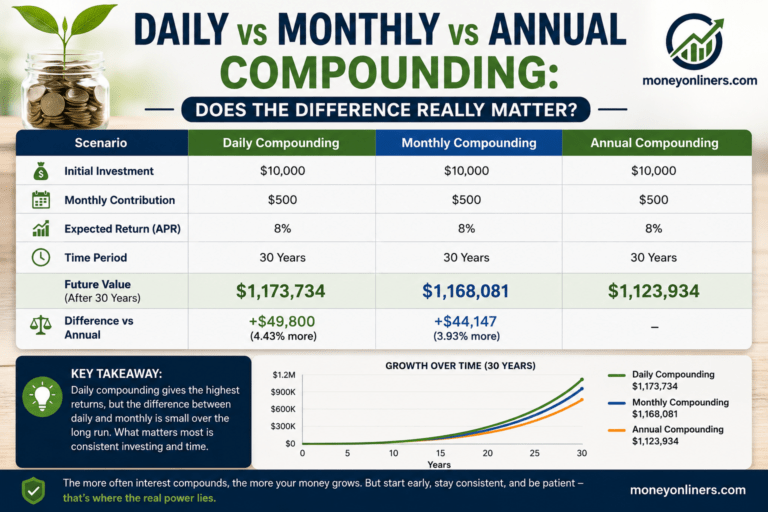
Daily vs Monthly vs Annual Compounding: Does the Difference Really Matter?
Daily vs Monthly vs Annual Compounding: Does the Difference Really Matter? | MoneyOnliners MoneyOnliners • Compound Interest → Frequency Comparison Daily vs Monthly vs Annual Compounding: Does the Difference Really Matter? Daily compounding sounds much more powerful than monthly or annual compounding. Mathematically, more frequent compounding does create a larger ending balance when the principal,…
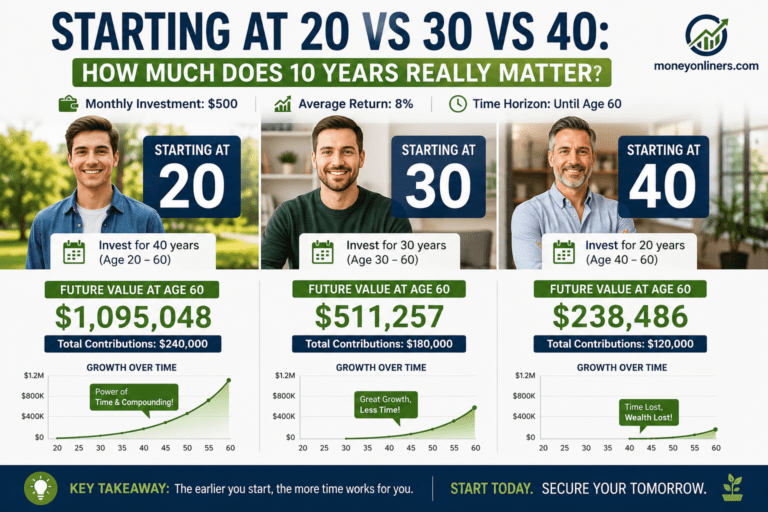
Starting at 20 vs 30 vs 40: How Much Does 10 Years Really Matter?
Starting at 20 vs 30 vs 40: How Much Does 10 Years Really Matter? | MoneyOnliners MoneyOnliners • Investing → Time Advantage Starting at 20 vs 30 vs 40: How Much Does 10 Years Really Matter? Ten years can look insignificant when retirement is decades away. However, investing from age 20 instead of 30 gives…
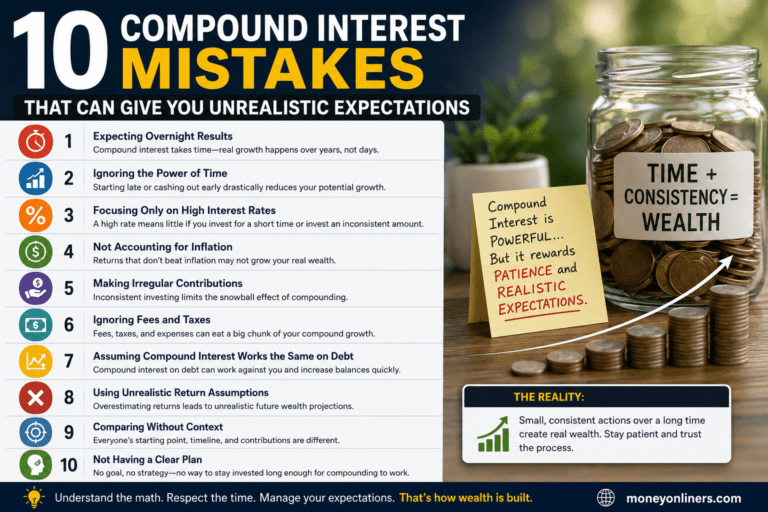
10 Compound Interest Mistakes That Can Give You Unrealistic Expectations
10 Compound Interest Mistakes That Can Give You Unrealistic Expectations | MoneyOnliners MoneyOnliners • Compound Interest → Reality Check 10 Compound Interest Mistakes That Can Give You Unrealistic Expectations Compound interest is one of the most useful ideas in long-term finance, but it is also one of the easiest to misunderstand. A calculator can make…
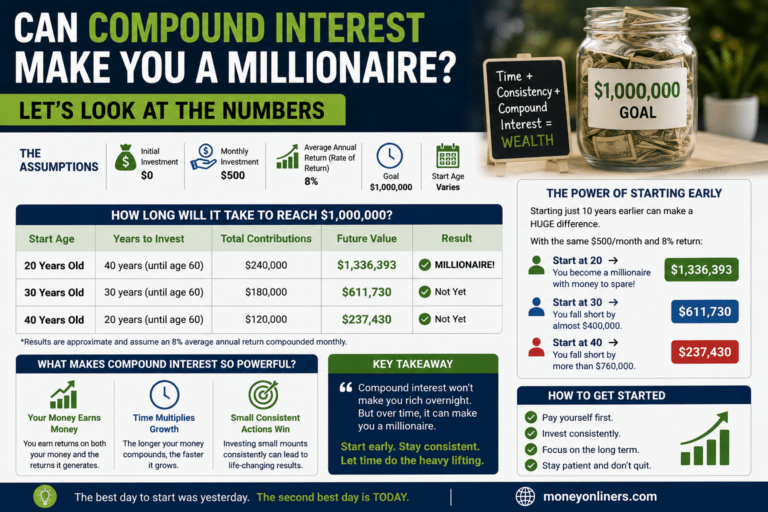
Can Compound Interest Make You a Millionaire? Let’s Look at the Numbers
Can Compound Interest Make You a Millionaire? Let’s Look at the Numbers | MoneyOnliners MoneyOnliners • Compound Interest → Millionaire Math Can Compound Interest Make You a Millionaire? Let’s Look at the Numbers Becoming a millionaire through compound growth is mathematically possible, but the word “millionaire” can make the process sound easier than it really…
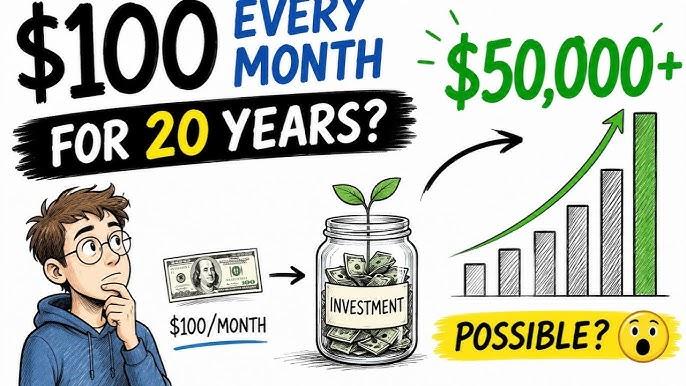
What Happens If You Invest $100 a Month for 20 Years?
What Happens If You Invest $100 a Month for 20 Years? | MoneyOnliners MoneyOnliners • Investing → Monthly Contributions What Happens If You Invest $100 a Month for 20 Years? One hundred dollars a month may not feel like enough to change your financial future. Yet over 20 years, those contributions add up to $24,000…
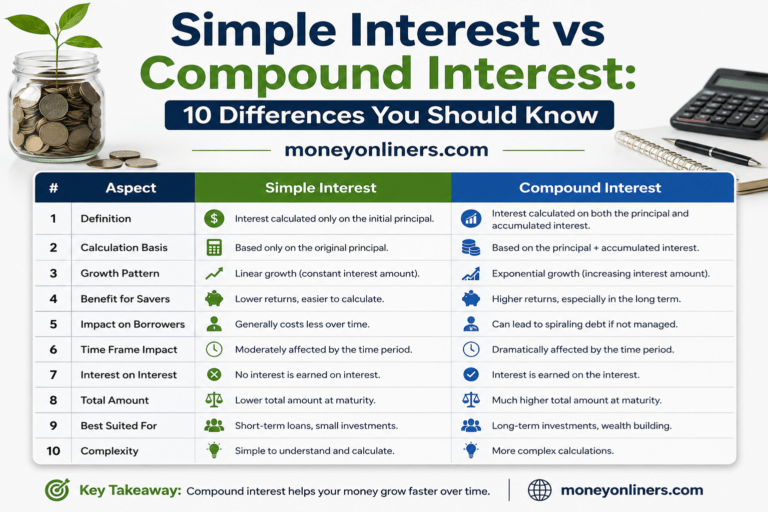
Simple Interest vs Compound Interest: 10 Differences You Should Know
Simple Interest vs Compound Interest: 10 Differences You Should Know | MoneyOnliners MoneyOnliners • Compound Interest → Comparison Guide Simple Interest vs Compound Interest: 10 Differences You Should Know Simple interest and compound interest can start with the same principal and the same stated rate yet produce different results. The difference comes from what the…
One Comment