Net Worth vs Income: Which Number Matters More for Building Wealth?
Net Worth vs Income: Which Number Matters More for Building Wealth?
A six-figure salary can look impressive, while a seven-figure net worth can look even more impressive. However, income and net worth measure completely different parts of your financial life. Income shows how much money flows in over time. Net worth shows what has accumulated after years of earning, spending, borrowing, saving and investing. For long-term wealth, both matter—but they matter in different ways.
In the net worth vs income comparison, income is usually more important for creating new financial capacity, while net worth is more useful for measuring how much wealth you have actually accumulated.
A high income can accelerate wealth building because it gives you more money to save, invest and use for debt repayment. However, high income does not guarantee high wealth. If spending and debt rise equally fast, net worth can remain low.
For long-term wealth measurement, net worth generally tells you more than income alone. For building future wealth, however, increasing income can be one of the strongest tools available.
Table of Contents
Net Worth vs Income: Quick Comparison
| Feature | Income | Net Worth |
|---|---|---|
| What it measures | Money received over time | Assets minus liabilities |
| Common time frame | Monthly or annual | A particular date |
| Examples | Salary, business income, wages, freelance earnings | Cash, investments, property equity and other assets minus debt |
| Main role | Creates financial capacity | Measures accumulated financial position |
| Can be high while the other is low? | Yes | Yes |
| Depends on employment? | Often | Not necessarily |
| Can potentially produce future income? | Income itself generally must first be saved or invested | Some assets can generate interest, dividends, rent or business income |
| Most useful for measuring wealth? | Indirectly | Generally more directly |
What Is Income?
Income is money received over a period of time.
Common Sources of Income
- Salary
- Hourly wages
- Bonuses
- Freelance income
- Business profit
- Rental income
- Interest
- Dividends
- Royalties
Gross Income vs Take-Home Income
Gross income is the amount earned before applicable taxes and deductions.
Take-home income is what actually reaches you after deductions.
Why Income Matters
Income provides the raw material for:
- Living expenses
- Emergency savings
- Debt repayment
- Retirement contributions
- Investing
- Business building
Therefore, stronger income can make wealth building easier.
Someone earning $200,000 annually but spending $195,000 may have less wealth-building capacity than the salary suggests.

What Is Net Worth?
Net worth compares the financial value of what you own with what you owe.
Formula
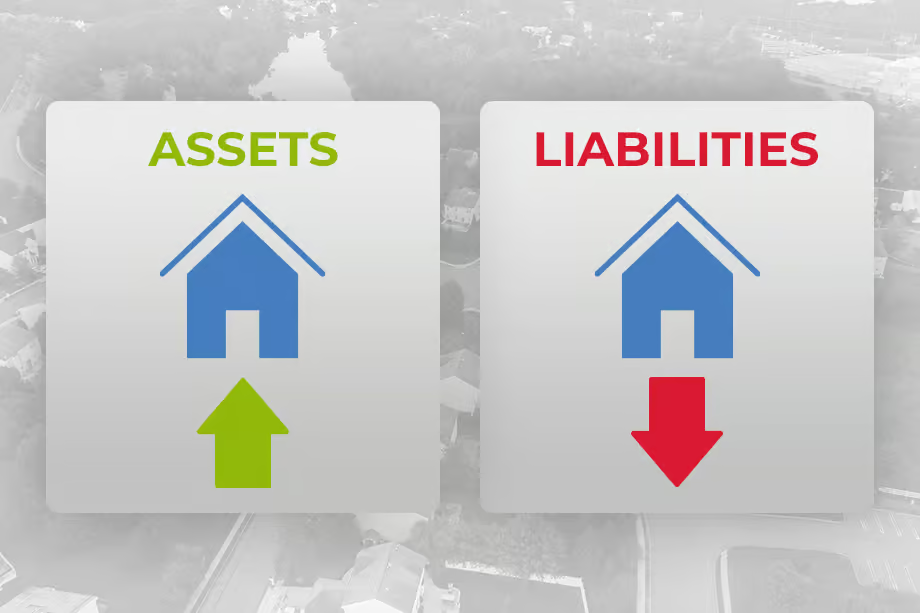
Net Worth = Total Assets − Total Liabilities
Common Assets
- Checking and savings accounts
- Retirement accounts
- Brokerage investments
- Property
- Business equity
- Vehicles
- Other meaningful financial assets
Common Liabilities
- Mortgage balances
- Credit-card debt
- Student loans
- Vehicle loans
- Personal loans
- Other debt
Example
Total assets:
$500,000
Total liabilities:
$175,000
Net Worth
$325,000
Investor.gov uses this same basic approach when describing a personal net-worth statement.
1 Income Measures Flow; Net Worth Measures Accumulation
Think of income as the water entering a container.
Net worth is closer to measuring how much financial value remains after years of inflows and outflows.
Income Example
$100,000 per year
Possible Uses
- $70,000 spending
- $10,000 debt repayment
- $15,000 investing
- $5,000 saving
The salary itself does not become wealth automatically.
Instead, the portions used to increase assets or reduce liabilities are what strengthen net worth.
2 High Income Does Not Guarantee High Net Worth
Person A
Annual income: $180,000
Assets: $80,000
Liabilities: $110,000
Approximate Net Worth
-$30,000
Person B
Annual income: $90,000
Assets: $400,000
Liabilities: $80,000
Approximate Net Worth
$320,000
Person A earns twice as much.
Nevertheless, Person B owns substantially more net financial value.
Salary measures earning power. Net worth measures what years of earning, spending, saving and borrowing have produced.
3 Net Worth Can Grow Without an Extraordinary Income
A very high salary can accelerate wealth accumulation.
However, moderate-income households can still build substantial net worth.
Example
Annual income:
$75,000
Annual investment contributions:
$12,000
Ten-Year Contributions
$120,000
That excludes investment gains or losses.
Meanwhile, debt repayment can strengthen net worth further.
If Debt Falls by $30,000
$120,000 asset contributions + $30,000 liability reduction = $150,000 of potential balance-sheet improvement before market changes
Therefore, consistent financial surplus can matter enormously even without elite income.
4 Income Can Disappear Much Faster Than Net Worth
Employment income can stop after:
- Layoff
- Career break
- Business closure
- Retirement
- Change in work circumstances
Assets do not automatically disappear because a paycheck stops.
Their market values can fluctuate, of course.
Example
A worker earns:
$150,000 annually
But has:
$5,000 savings
$20,000 investments
$90,000 consumer debt
A sudden income loss could create serious financial stress.
Another Worker
Income:
$90,000
Cash:
$40,000
Investments:
$450,000
Consumer debt:
$0
The second worker has lower current earnings but substantially greater financial resilience.
5 Net Worth Can Eventually Produce Income
One important turning point in wealth building occurs when accumulated assets begin generating meaningful cash flow.
Possible Asset-Generated Income
- Interest
- Dividends
- Rental income
- Business distributions
- Royalties
Example
Investment assets:
$500,000
Hypothetical income generated:
$15,000 annually
That $15,000 could supplement employment income.
Investment income is not guaranteed. Dividends can be cut, interest rates can change, businesses can lose money and rental property can experience vacancies or large expenses.
6 Debt Can Make a High Income Look Stronger Than the Balance Sheet Really Is
Debt is one of the biggest reasons income and net worth can tell very different stories.
Example
Annual salary:
$140,000
Assets:
$100,000
Liabilities:
$180,000
Net Worth
-$80,000
The high salary creates strong future potential.
However, the current balance sheet remains negative.
Why Debt Also Affects Future Income
Monthly debt payments reduce available cash flow.
For example:
$800 monthly debt payment = $9,600 per year
After expensive debt is eliminated, some of that money can potentially become investment capital.
7 Lifestyle Inflation Can Separate Income From Wealth
Suppose salary rises from:
$80,000 → $120,000
Meanwhile, annual spending rises from:
$70,000 → $110,000
Before Raise
$10,000 potential surplus
After Raise
$10,000 potential surplus
Income increased by $40,000.
However, wealth-building capacity did not improve.
Alternative
If spending rises only to $90,000:
$120,000 − $90,000 = $30,000 potential surplus
Consequently, the household can enjoy some lifestyle improvement while substantially increasing asset-building capacity.

8 Net Worth Usually Matters More as Retirement Gets Closer
During your working years, employment income may cover most household spending.
Retirement changes that.
Before Retirement
Salary + benefits → living expenses
After Retirement
Household income may increasingly come from:
- Social Security
- Pensions
- Retirement withdrawals
- Investment income
- Business income
- Rental income
Therefore, accumulated assets and liabilities become increasingly important.
Example
Worker A reaches retirement with:
$180,000 annual final salary
$250,000 invested
Worker B retires from:
$100,000 annual final salary
$1,200,000 invested
The higher historical salary does not automatically create the stronger retirement position.
Income matters enormously while you are accumulating wealth. Net worth and investable assets become increasingly important when employment income eventually stops.

Four Net Worth vs Income Examples
| Person | Annual Income | Assets | Debt | Net Worth | Interpretation |
|---|---|---|---|---|---|
| A | $200,000 | $100,000 | $130,000 | -$30,000 | High earning power, weak current balance sheet |
| B | $80,000 | $400,000 | $70,000 | $330,000 | Moderate income, stronger accumulated wealth |
| C | $180,000 | $900,000 | $150,000 | $750,000 | Strong income and strong net worth |
| D | $45,000 | $20,000 | $50,000 | -$30,000 | Low income and negative net worth; increasing earning power may be especially valuable |
What the Comparison Shows
The strongest position is not “high income instead of high net worth.”
Ideally, income and net worth reinforce each other.
Growing Income → Greater Surplus → More Assets + Less Debt → Higher Net Worth
Which Number Matters More for Building Wealth?
If You Are Early in Your Career
Income and earning power may deserve greater attention.
A young worker with little invested money can often change future wealth more dramatically through career growth than by searching for tiny differences in investment performance.
If You Have High-Interest Debt
Net worth and debt balances deserve serious attention.
A high salary can hide a weak balance sheet.
If You Are in Your Peak Earning Years
The conversion rate from income into assets becomes especially important.
If You Are Approaching Retirement
Net worth, investable assets, liquidity and future income sources become increasingly important.
If You Want One Number to Measure Wealth
Net worth is generally the better single wealth measurement.
However, income remains one of the strongest controllable variables for improving future net worth.
MoneyOnliners Original Analysis: The Income-to-Net-Worth Conversion Framework
1. Earn
Income creates financial capacity.
2. Retain
Some income remains after taxes and spending.
3. Deploy
The surplus is used to build emergency savings, reduce debt or buy productive assets.
4. Own
Over time, more money becomes accumulated financial ownership.
5. Measure
Net worth tracks whether the system is actually strengthening the balance sheet.
The MoneyOnliners Wealth Conversion Ratio
MoneyOnliners Net Worth vs Income Scorecard
| Question | If “Yes” | If “No” |
|---|---|---|
| Is income rising over time? | More future wealth capacity may be available | Consider career/income growth |
| Is spending rising slower than income? | Wealth conversion capacity is improving | Watch lifestyle inflation |
| Is net worth increasing over several years? | The balance sheet is strengthening | Diagnose assets and liabilities |
| Is high-interest debt declining? | Financial leakage is shrinking | Review repayment priorities |
| Are retirement contributions increasing? | Income is becoming long-term assets | Review contribution capacity |
| Could you handle an income interruption? | Financial resilience is stronger | Build liquidity |
| Are productive assets increasing? | Wealth is becoming less dependent on salary alone | Review long-term investing |
| Are recurring costs manageable? | More income can become wealth | Review housing, transport and debt |
The Income-to-Net-Worth Conversion Framework, Wealth Conversion Ratio and Net Worth vs Income Scorecard are original MoneyOnliners educational resources designed to make income-to-wealth conversion easier to analyze and reference.
MoneyOnliners Research-Based Evidence Note
This article is a research-based income and net-worth education guide.
MoneyOnliners does not claim that hypothetical salaries, debt levels, portfolio balances or net-worth examples represent personal financial results achieved by MoneyOnliners or its editorial team.
Investor.gov describes a net-worth statement as the difference between assets and liabilities and separately recommends tracking household income and expenses.
CFPB financial-well-being research also emphasizes that financial security cannot be fully measured by income, net worth or credit score alone. Day-to-day financial control, the ability to absorb shocks, progress toward goals and freedom of choice are also important.
Therefore, MoneyOnliners treats income and net worth as important but incomplete indicators of overall financial well-being.
MoneyOnliners does not fabricate salaries, investment returns, account balances, screenshots or testimonials.
The Income-to-Net-Worth Conversion Framework, Wealth Conversion Ratio and Scorecard are original MoneyOnliners analytical resources.
10 Mistakes When Comparing Net Worth vs Income
1. Assuming a High Salary Means Someone Is Wealthy
Large earnings can coexist with large debt and minimal assets.
2. Assuming a Lower Salary Means Someone Has Little Wealth
Years of saving and investing can create substantial net worth.
3. Treating Net Worth as Spendable Cash
Much of net worth may sit in a home, retirement account or private business.
4. Ignoring Debt
Assets alone do not determine net worth.
5. Ignoring Income Growth
A stronger salary can materially accelerate future asset accumulation.
6. Watching Income but Never Tracking Net Worth
You may earn more without actually becoming wealthier.
7. Watching Net Worth but Ignoring Cash Flow
A strong balance sheet can still coexist with poor monthly liquidity.
8. Comparing Gross Income With Someone Else's Net Worth
The figures measure different things and cannot be directly compared.
9. Using One Number to Define Financial Success
Financial resilience and freedom of choice matter too.
10. Chasing Wealth Through Extreme Risk
Trying to accelerate net worth through concentrated speculation can permanently damage the balance sheet.
Neither a salary nor a net-worth figure tells the complete story of someone's financial life. Use them as measurements, not as personal rankings.
Why Understanding Net Worth vs Income Matters
1. Net worth and income measure different parts of financial life.
2. Income represents money received over time.
3. Net worth represents assets minus liabilities.
4. Higher income can create greater wealth-building capacity.
5. Higher income does not automatically produce higher wealth.
6. Spending determines how much income remains available.
7. Debt reduces net worth and future cash flow.
8. Productive assets can increase net worth over time.
9. Some assets can eventually create additional income.
10. Lifestyle inflation can absorb income growth.
11. A moderate salary can still produce strong net worth over a long period.
12. A high salary with weak asset accumulation can leave net worth low.
13. Emergency savings can strengthen both net worth and financial resilience.
14. Net worth becomes increasingly important as retirement approaches.
15. Income can stop when employment stops.
16. Accumulated assets can remain after employment income disappears.
17. Tracking both income and net worth can reveal whether raises are actually improving wealth.
18. Financial well-being also depends on liquidity, security and freedom of choice.
19. The strongest long-term financial system combines growing earning power with growing ownership.
20. Ultimately, understanding net worth vs income helps you see that income is one of the most powerful tools for creating wealth, while net worth is one of the clearest measurements of how much wealth has actually accumulated.
Incoming Link Opportunities
Income vs Wealth: 10 Differences That Explain Why a High Salary Isn't Everything
https://moneyonliners.com/income-vs-wealth/
How to Calculate Your Net Worth in 5 Simple Steps
https://moneyonliners.com/how-to-calculate-net-worth/
15 Ways to Increase Your Net Worth Without Becoming a Millionaire Overnight
https://moneyonliners.com/increase-your-net-worth/
Negative Net Worth? 10 Steps That Can Help You Turn It Around
https://moneyonliners.com/negative-net-worth/
What Should Your Net Worth Be at 30, 40, 50 and 60?
https://moneyonliners.com/net-worth-by-age/
High-Priority Incoming Links
Your First $100,000: Why This Wealth Milestone Can Be So Powerful
https://moneyonliners.com/first-100000-wealth-milestone/
15 Wealth-Building Strategies That Can Grow Your Money Over Time
https://moneyonliners.com/wealth-building-strategies/
10 Wealth-Building Habits That Can Make a Big Difference Over 10 Years
https://moneyonliners.com/wealth-building-habits/
How Long Does It Take to Build Wealth? 8 Factors That Matter Most
https://moneyonliners.com/how-long-does-it-take-to-build-wealth/
Topic Cluster Incoming Links
Saving vs Building Wealth: Why Saving Money Alone May Not Be Enough
https://moneyonliners.com/saving-vs-building-wealth/
20 Assets That Can Help Build Wealth Over the Long Term
https://moneyonliners.com/assets-that-build-wealth/
Building Wealth in Your 20s, 30s, 40s and 50s: What Changes?
https://moneyonliners.com/building-wealth-by-age/
Financial Independence: 10 Steps to Take More Control of Your Money and Future
https://moneyonliners.com/financial-independence/
Continue Learning on MoneyOnliners
Recommended External Resources
1. Investor.gov — Figure Out Your Finances
Figure Out Your Finances — Investor.gov
Explains assets, liabilities, income, expenses and how to create a net-worth statement.
2. Investor.gov — Build Wealth Over Time Through Saving and Investing
Build Wealth Over Time Through Saving and Investing — Investor.gov
Covers emergency savings, debt control, regular investing and long-term wealth building.
3. Consumer Financial Protection Bureau — Financial Well-Being
Why Financial Well-Being Matters — CFPB
Explains why income and net worth alone cannot fully describe financial security and freedom of choice.
4. CFPB — Financial Well-Being Resources
Financial Well-Being Resources — CFPB
Provides tools for evaluating financial control, resilience and progress toward goals.
5. Investor.gov — Diversify Your Investments
Diversify Your Investments — Investor.gov
Explains diversification and concentration risk for long-term asset building.
6. Investor.gov — Understanding Investment Fees
Understanding Investment Fees — Investor.gov
Explains how investment costs can affect the amount of wealth investors retain over time.
7. Consumer Financial Protection Bureau — Saving
Saving — Consumer Financial Protection Bureau
Practical resources for building emergency savings and financial resilience.
8. Investor.gov — Compound Interest Calculator
Compound Interest Calculator — Investor.gov
Allows readers to test how contributions, time and hypothetical returns can affect long-term investment balances.
9. Federal Trade Commission — Investment Scams
Investment Scams — Federal Trade Commission
Provides warning signs for fraudulent investment opportunities that can destroy accumulated net worth.
10. Federal Trade Commission — How to Avoid a Scam
How to Avoid a Scam — Federal Trade Commission
Consumer-protection guidance for safeguarding income, savings and accumulated financial assets.
MoneyOnliners prioritizes government agencies and financial regulators for financial education, investor protection and consumer guidance.
This article provides general educational information and is not individualized investment, financial, retirement, tax, legal or insurance advice. Income, investment returns, debt, asset values and household circumstances vary, and no strategy guarantees a particular net-worth result.
Frequently Asked Questions
What is the difference between net worth and income?
Income measures money received over time.
Net worth measures assets minus liabilities.
Therefore, they answer different questions.
Income shows earning power.
Net worth shows accumulated financial position.
Which is more important: net worth or income?
It depends on the question.
For measuring accumulated wealth, net worth is generally more useful.
For creating new wealth-building capacity, income can be extremely important.
Ideally, both improve over time.
Neither should be evaluated completely alone.
Can you have high income and low net worth?
Yes.
High spending can consume income.
Large debts can reduce net worth.
Meanwhile, investment contributions may remain small.
Therefore, high income does not automatically mean high wealth.
Can you have low income and high net worth?
Yes.
A retiree may have little employment income but substantial accumulated assets.
A business owner may draw modest current income while holding valuable equity.
Likewise, decades of saving and investing can create wealth even after current income falls.
Income and accumulated assets are different measurements.
Does salary count toward net worth?
Salary itself is not usually added directly to net worth.
Salary is income.
However, cash you save from salary becomes an asset.
Money invested from salary also becomes an asset.
Therefore, salary influences net worth indirectly.
What increases net worth?
Adding assets can increase net worth.
Reducing liabilities can increase it too.
Examples include saving money, contributing to investments and paying down debt.
Asset appreciation can also help.
However, asset values can fall as well.
Does paying debt increase net worth?
Reducing liabilities can strengthen net worth.
High-interest debt payoff can also improve future cash flow.
That money may later support investing.
Therefore, debt reduction can affect both the current and future balance sheet.
Track the complete financial picture.
Is net worth the best measure of wealth?
It is one of the most useful simple measurements.
However, it has limitations.
A household may have substantial home equity but little cash.
Another may have pension income that is not easily represented in a basic net-worth statement.
Use net worth alongside cash flow and financial resilience.
Why is income important if net worth measures wealth?
Income creates the resources needed to build assets.
It also supports debt repayment.
Higher income can accelerate both.
However, only the portion that survives spending can strengthen wealth.
Therefore, income and financial surplus should be considered together.
Should I focus on earning more or saving more?
Both can help.
Increasing income expands financial capacity.
Saving more increases the percentage of income available for future goals.
The strongest approach often combines both.
Look for sustainable improvements rather than extreme changes.
Can someone earning $50,000 become wealthy?
Potentially.
Time matters.
Savings rate matters.
Debt and investment contributions matter too.
Future income growth can strengthen the process substantially.
Can someone earning $200,000 stay poor?
A high earner can still build little net worth.
Large spending commitments can absorb the salary.
Debt can also remain high.
Therefore, high earnings alone do not guarantee wealth.
The conversion of income into assets matters.
Should I track income and net worth every month?
Income and spending can be useful to track monthly.
Net worth may be tracked monthly, quarterly or annually.
Investment values fluctuate.
Therefore, avoid reacting too strongly to short-term net-worth changes.
Focus on long-term direction.
Does retirement income count as income?
Yes, retirement can include several income sources.
Examples may include pensions, Social Security and investment distributions.
However, withdrawals from assets may reduce the underlying portfolio.
Therefore, retirement income and net worth should be evaluated together.
The sustainability of income matters.
What should improve first: income or net worth?
There is no universal order.
A young worker may benefit greatly from increasing income.
Someone with high-interest debt may first need balance-sheet repair.
A high earner with weak investments may need a higher contribution rate.
Focus on the financial bottleneck that currently limits progress most.
Research Methodology
How Income Was Defined
MoneyOnliners treats income as money received over a period of time from employment, business activity, investments or other sources.
How Net Worth Was Defined
Net worth is defined using the conventional formula:
Total Assets − Total Liabilities = Net Worth
Primary Net Worth Source
Investor.gov guidance explains the basic net-worth statement by listing what a household owns as assets, listing debts as liabilities and subtracting liabilities from assets.
Why Income Was Treated Separately
Investor.gov also recommends separately tracking household income and expenses.
Therefore, MoneyOnliners treats cash flow and net worth as related but distinct measurements.
Why Financial Well-Being Was Included
CFPB research states that financial well-being cannot be completely described using income, net worth or credit score alone.
Its framework also considers control over current finances, the ability to absorb shocks, progress toward goals and financial freedom of choice.
How the Comparison Examples Were Built
Dollar examples were independently prepared by MoneyOnliners to illustrate how two households can have different incomes and balance sheets.
They are hypothetical rather than actual reader or editorial-team financial results.
Original MoneyOnliners Analysis
The Income-to-Net-Worth Conversion Framework, Wealth Conversion Ratio and Net Worth vs Income Scorecard are original MoneyOnliners educational resources.
First-Hand Evidence Standard
MoneyOnliners only describes first-hand testing, financial results, screenshots or personal observations when such evidence genuinely exists and can be represented accurately.
No personal salary, investment-performance or net-worth claim is made in this article.
Limitations
Net worth does not automatically show liquidity, future pension benefits, financial security or the sustainability of household spending.
Likewise, income does not reveal accumulated assets or liabilities.
For that reason, both measurements should be considered within a broader financial plan.
Google Search Console Checklist
- Confirm final URL: /net-worth-vs-income/
- Confirm canonical matches the published URL.
- Use net worth vs income naturally in the title, introduction, headings and conclusion.
- Use related phrases naturally: income vs net worth, salary vs net worth, high income low net worth, does income equal wealth and which matters more.
- Use career imagery for income sections.
- Use housing imagery for lifestyle and balance-sheet discussions.
- Use older-adult imagery for retirement sections.
- Avoid repeating generic calculator images.
- Keep every image alt description unique.
- Confirm Recommended External Resources contains 6–10 authoritative sources.
- Confirm all internal links point to live canonical URLs.
- Confirm the article is indexable.
- Confirm the URL appears in the XML sitemap.
- Check comparison tables on mobile.
- Review external resources during future updates.
- Inspect the final URL in Google Search Console.
- Request indexing after publication if appropriate.
- Monitor searches such as “net worth vs income,” “income vs net worth,” “salary vs net worth,” “which matters more income or net worth,” “high income low net worth” and “is net worth more important than salary.”
Conclusion: Income Builds the Opportunity, Net Worth Shows What You Built
So which matters more in the net worth vs income comparison?
The answer depends on what you are trying to measure.
Income Measures Capacity
It gives you money to live, save, invest and reduce debt.
Net Worth Measures Accumulation
It shows the financial value remaining after liabilities are subtracted from assets.
High Income Is Powerful
Higher earnings can dramatically increase future wealth-building capacity.
But High Income Is Not Enough
Lifestyle inflation and debt can absorb even a very large salary.
Net Worth Is the Better Wealth Scoreboard
It shows whether assets are actually accumulating and liabilities are declining.
Yet Net Worth Is Not the Whole Story
Liquidity, cash flow, resilience and financial freedom also matter.
The Strongest Financial System Uses Both Numbers
Grow your earning power.
Keep part of what you earn.
Reduce expensive liabilities.
Buy productive assets.
Protect those assets.
Then track whether net worth rises over time.
Similar Posts
What Should Your Net Worth Be at 30, 40, 50 and 60?
What Should Your Net Worth Be at 30, 40, 50 and 60? | MoneyOnliners MoneyOnliners • Build Wealth → Net Worth by Age What Should Your Net Worth Be at 30, 40, 50 and 60? Age-based net worth benchmarks can be useful, but they can also be misleading when treated as rules. A 40-year-old homeowner…
10 Net Worth Mistakes That Can Make You Think You’re Richer Than You Are
10 Net Worth Mistakes That Can Make You Think You’re Richer Than You Are | MoneyOnliners MoneyOnliners • Net Worth → Accuracy Check 10 Net Worth Mistakes That Can Make You Think You’re Richer Than You Are Net worth looks like simple math: add your assets, subtract your liabilities, and calculate the difference. However, the…
Assets vs Liabilities: 25 Real-Life Examples That Affect Your Net Worth
Assets vs Liabilities: 25 Real-Life Examples That Affect Your Net Worth | MoneyOnliners MoneyOnliners • Net Worth → Assets vs Liabilities Assets vs Liabilities: 25 Real-Life Examples That Affect Your Net Worth Understanding the difference between assets and liabilities is one of the simplest ways to understand your financial position. Assets generally represent things you…
Negative Net Worth? 10 Steps That Can Help You Turn It Around
Negative Net Worth? 10 Steps That Can Help You Turn It Around | MoneyOnliners MoneyOnliners • Build Wealth → Repair Your Net Worth Negative Net Worth? 10 Steps That Can Help You Turn It Around Seeing a negative number on your net-worth calculation can be uncomfortable. However, negative net worth is simply a financial measurement:…
How Often Should You Calculate Your Net Worth?
How Often Should You Calculate Your Net Worth? | MoneyOnliners MoneyOnliners • Net Worth → Tracking Progress How Often Should You Calculate Your Net Worth? Calculating your net worth once can show where your finances stand today. Calculating it consistently can show whether your financial direction is actually improving. The challenge is choosing a schedule…
15 Ways to Increase Your Net Worth Without Becoming a Millionaire Overnight
15 Ways to Increase Your Net Worth Without Becoming a Millionaire Overnight | MoneyOnliners MoneyOnliners • Build Wealth → Grow Net Worth 15 Ways to Increase Your Net Worth Without Becoming a Millionaire Overnight You do not need a lottery win, viral business or speculative investment to improve your financial position. Net worth usually grows…