How Much Should You Save Every Month for Your Future?
How Much Should You Save Every Month for Your Future?
Saving $100 every month may be a strong beginning for one person and far too little for another. Meanwhile, saving 30% of income can be realistic for a high earner but impossible for a household facing high housing, childcare or debt costs. Therefore, the best monthly savings target is not one universal percentage. It is an amount connected to your income, expenses, current financial position and future goals.
If you are asking how much should you save every month, a useful starting approach is to save whatever amount you can sustain consistently and then increase it as your financial capacity improves.
For example, Investor.gov currently suggests that regular investing could begin with an affordable fixed amount or approximately 5% or 10% of income. However, your total monthly saving may need to be higher because emergency savings, retirement, home goals and other future expenses can exist at the same time.
| Monthly Saving Level | Example Share of Income | Possible Situation |
|---|---|---|
| Starter | 5% | Building the saving habit while finances are tight |
| Developing | 10% | Building emergency savings and beginning long-term investing |
| Strong | 15% | Meaningful future saving while balancing current expenses |
| Aggressive | 20%+ | Faster goal funding when income and expenses permit |
Someone paying down 25% credit-card debt may need a different strategy from someone who is debt-free with a large emergency fund. Likewise, age, income, family responsibilities and retirement progress can change the appropriate target.
Table of Contents
How Much Should You Save Every Month?
There is no single monthly amount that works for everyone.
Instead, a useful savings target should answer four questions.
1. How Much Do You Earn?
Higher income can create greater saving capacity. However, income alone does not determine how much is available.
2. What Does Your Life Cost?
Housing, food, childcare, transportation, insurance and debt payments can consume very different percentages of income from one household to another.
3. What Are You Saving For?
Your monthly saving could need to fund several goals, including:
- Emergency savings
- Retirement
- Home purchase
- Education
- Vehicle replacement
- Business capital
- Financial independence
4. When Do You Need the Money?
A $20,000 goal needed in two years requires a much larger monthly contribution than the same goal needed in ten years.
Should You Save 5%, 10%, 15% or 20% of Your Income?
Percentages can provide a starting framework. Nevertheless, they should not replace an actual financial plan.
| Savings Rate | $3,000 Monthly Income | $5,000 Monthly Income | $8,000 Monthly Income |
|---|---|---|---|
| 5% | $150 | $250 | $400 |
| 10% | $300 | $500 | $800 |
| 15% | $450 | $750 | $1,200 |
| 20% | $600 | $1,000 | $1,600 |
| 25% | $750 | $1,250 | $2,000 |
5% Can Be a Real Beginning
If your finances are tight, saving 5% consistently can be more useful than setting a 20% target that you repeatedly abandon.
10% Creates More Capacity
For example, Investor.gov uses 5% and 10% as examples of regular investment amounts that some people may be able to contribute.
15% Can Become a Strong Long-Term Target
For some households, 15% may create meaningful retirement and wealth-building progress. However, whether it is sufficient depends on age, existing assets and goals.
20% or More Can Accelerate Goals
A higher savings rate can shorten the time required to build cash reserves, invest or prepare for major purchases.
Instead of asking, “What percentage is perfect?” ask, “What percentage can I maintain now, and how can I increase it over the next few years?”
Monthly Savings Examples at Different Income Levels
The table below demonstrates why percentages are often more useful than one universal dollar amount.
| Monthly Take-Home Income | 5% | 10% | 15% | 20% |
|---|---|---|---|---|
| $2,000 | $100 | $200 | $300 | $400 |
| $3,000 | $150 | $300 | $450 | $600 |
| $4,000 | $200 | $400 | $600 | $800 |
| $5,000 | $250 | $500 | $750 | $1,000 |
| $7,500 | $375 | $750 | $1,125 | $1,500 |
| $10,000 | $500 | $1,000 | $1,500 | $2,000 |
Someone earning $10,000 monthly while supporting a large household in a high-cost city may have less flexible cash flow than someone earning $6,000 with low housing costs and no expensive debt.

Where Should Your Monthly Savings Actually Go?
Saving money is only the first decision. Next, decide what financial job each dollar should perform.
One Possible Priority Order
| Priority | Purpose | Possible Destination |
|---|---|---|
| 1 | Current bills and essentials | Checking / transaction account |
| 2 | Starter emergency reserve | Accessible savings |
| 3 | Expensive debt reduction | Extra debt payment |
| 4 | Retirement | Eligible retirement accounts |
| 5 | Short-term goals | Savings / appropriate low-risk vehicle |
| 6 | Long-term wealth | Diversified investments where appropriate |
For example, an employer retirement match, extremely high-interest debt or an urgent emergency-fund need can change the sequence.
How Much Should You Save Monthly for an Emergency Fund?
First, decide how large the emergency reserve needs to become.
Example
Essential monthly expenses:
$3,500
Three-Month Emergency Goal
$10,500
If You Want It in 24 Months
If You Give Yourself 36 Months
Therefore, changing the deadline can dramatically change the monthly requirement.
Its main purpose is to protect your wider financial plan from unexpected expenses rather than maximize investment returns.
How Much Should You Save Every Month for Retirement?
Retirement saving deserves its own calculation because age, income, existing assets and retirement date all matter.
A Percentage Can Provide a Starting Point
For instance, someone earning $6,000 per month might initially target:
| Contribution Rate | Monthly Amount | Annual Amount |
|---|---|---|
| 5% | $300 | $3,600 |
| 10% | $600 | $7,200 |
| 15% | $900 | $10,800 |
| 20% | $1,200 | $14,400 |
Current 2026 U.S. Limits
For eligible U.S. savers, the 2026 employee elective-deferral limit for most 401(k), 403(b) and governmental 457 plans is:
$24,500
Meanwhile, the 2026 IRA contribution limit is:
$7,500
Additional catch-up limits may apply depending on age and plan type.
You do not need to contribute the maximum for saving to be worthwhile. Conversely, reaching the legal maximum does not automatically mean your retirement plan is sufficient.
How Much Should You Save Monthly for Short-Term Goals?
Short-term saving becomes easier when the total goal is converted into a monthly requirement.
Examples
| Goal | Amount Needed | Time | Monthly Saving |
|---|---|---|---|
| Vacation | $3,000 | 12 months | $250 |
| Car replacement | $12,000 | 36 months | $333 |
| Work equipment | $2,400 | 12 months | $200 |
| Moving fund | $6,000 | 24 months | $250 |
This simplified calculation ignores interest. As a result, it can provide a conservative starting point.
How Much Should You Save Monthly for Long-Term Goals?
Long-term goals may combine direct contributions with potential investment growth.
Example: $500 Monthly for 20 Years
Direct contributions equal:
$120,000
At a hypothetical 7% annual return compounded monthly, the account could grow to roughly:
$260,000
Example: $500 Monthly for 30 Years
Direct contributions:
$180,000
At the same hypothetical return, the ending balance could be approximately:
$610,000
Real investment returns fluctuate. In addition, fees, taxes, inflation and investor behavior can materially change the final result.

Is Saving $100 a Month Enough?
It can absolutely be enough to begin.
After One Year
$1,200 contributed
After Five Years
$6,000 contributed
After Ten Years
$12,000 contributed
If the money is invested appropriately for a long-term goal, positive returns could increase the balance further.
But $100 Does Not Need to Stay $100 Forever
A stronger approach may look like this:
| Period | Monthly Amount |
|---|---|
| Year 1 | $100 |
| Years 2–3 | $150 |
| Years 4–5 | $250 |
| Later | Increase as income allows |
What Can Saving $500 a Month Do?
Five hundred dollars monthly equals:
| Time | Direct Contributions |
|---|---|
| 1 year | $6,000 |
| 5 years | $30,000 |
| 10 years | $60,000 |
| 20 years | $120,000 |
| 30 years | $180,000 |
That money could serve very different purposes depending on the financial plan.
For One Person
It could build:
- Emergency savings
- Home down payment
- Retirement assets
For Another Person
The full $500 may need to attack expensive debt before long-term investment contributions can increase.
What About Saving $1,000 a Month?
A $1,000 monthly savings rate can create substantial financial capacity.
| Time | Direct Contributions |
|---|---|
| 1 year | $12,000 |
| 5 years | $60,000 |
| 10 years | $120,000 |
| 20 years | $240,000 |
| 30 years | $360,000 |
Nevertheless, saving $1,000 monthly is not automatically “better” if doing so causes required bills to be missed or pushes necessary expenses onto credit cards.
The goal is to create a savings level that strengthens the entire financial system rather than one account at the expense of everything else.
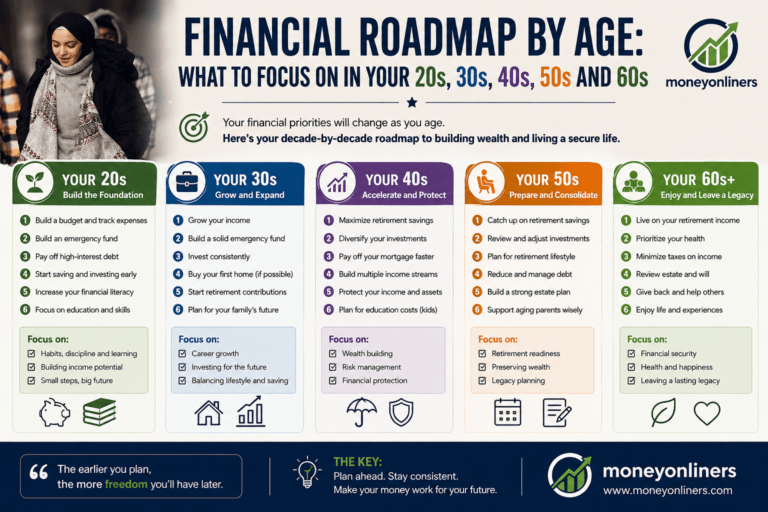
How Can Your Monthly Savings Target Change With Age?
Age alone does not determine the correct savings rate. However, life stage can change what deserves priority.
| Life Stage | Common Priorities | Potential Savings Focus |
|---|---|---|
| 20s | Emergency savings, debt, career, retirement | Build the habit and increase gradually |
| 30s | Housing, family, retirement, income growth | Increase contributions with earnings |
| 40s | Retirement, education, debt, net worth | Accelerate where possible |
| 50s | Retirement readiness, debt reduction | Close major gaps |
| 60s+ | Retirement income and reserves | Balance saving, investing and withdrawals |
Someone beginning at 45 can still make major progress. The useful question is what action improves your financial position from where you are today.
Should You Save Every Month or Pay Off Debt First?
The answer depends heavily on the interest rate and your need for emergency savings.
Example
Suppose you have:
$5,000 credit-card debt at 25% APR
Meanwhile, you have only:
$200 in cash savings
A Possible Approach
First, build a modest starter reserve.
Next, attack the expensive credit-card balance aggressively.
At the same time, consider any valuable employer retirement match that would otherwise be lost.
Finally, increase long-term saving once the expensive debt is under better control.
Reducing expensive debt can improve future saving capacity by eliminating recurring interest costs.
What Should Happen to Your Savings After a Pay Raise?
A raise is one of the easiest opportunities to increase saving without cutting existing expenses.
Example
Monthly take-home income increases by:
$600
One Possible Allocation
| Use | Amount |
|---|---|
| Increase retirement contribution | $200 |
| Emergency / sinking funds | $125 |
| Long-term investments | $125 |
| Lifestyle improvement | $150 |
The exact split is personal. Nevertheless, directing part of each raise toward future goals can prevent lifestyle inflation from absorbing every increase in income.

How Much Should You Save With Irregular Income?
Freelancers, contractors and business owners may find a fixed dollar amount difficult because monthly income can fluctuate.
Consider Saving a Percentage Instead
For example:
| Income Received | 10% Savings | 20% Savings |
|---|---|---|
| $2,500 | $250 | $500 |
| $4,000 | $400 | $800 |
| $6,000 | $600 | $1,200 |
| $8,000 | $800 | $1,600 |
Build a Larger Cash Buffer
Variable income can justify more liquidity because income interruptions may be more common.
Separate Taxes Where Necessary
Self-employed people may also need to reserve money for taxes. Therefore, tax reserves should not be confused with personal savings.
MoneyOnliners Original Analysis: The Future Savings Rate Test
MoneyOnliners Future Funding Formula
MoneyOnliners Savings Capacity Formula
MoneyOnliners Savings Escalator
MoneyOnliners Monthly Savings Scorecard
| Question | Stronger Direction |
|---|---|
| Are you saving something every month? | Yes |
| Is saving automated where possible? | Yes |
| Do you have emergency savings? | Growing |
| Is high-interest debt under control? | Yes |
| Are short-term goals funded separately? | Preferably |
| Are long-term investments recurring? | Yes where appropriate |
| Are retirement contributions growing? | Preferably |
| Does your savings rate rise after raises? | Preferably |
| Can you sustain the current amount? | Yes |
| Do you review the target annually? | Yes |
MoneyOnliners Research-Based Evidence Note
This article is a research-based monthly savings planning guide.
Current Investor.gov guidance recommends building an emergency fund and investing regularly over time. In addition, it gives 5% or 10% of income as examples of recurring investment contributions while also allowing for a fixed amount that someone can afford.
Investor.gov further recommends increasing contributions when income rises or expenses decrease. Therefore, this article treats savings rates as adjustable rather than permanent.
Current IRS guidance was reviewed for 2026 U.S. retirement-plan contribution limits.
For 2026, the employee elective-deferral limit for most 401(k), 403(b) and governmental 457 plans is $24,500.
Meanwhile, the 2026 IRA contribution limit is $7,500. Additional catch-up rules may apply depending on age and plan type.
The Future Savings Rate Test, Future Funding Formula, Savings Capacity Formula, Savings Escalator and Monthly Savings Scorecard are original MoneyOnliners educational resources.
No personal investment result or savings outcome is claimed in this article.
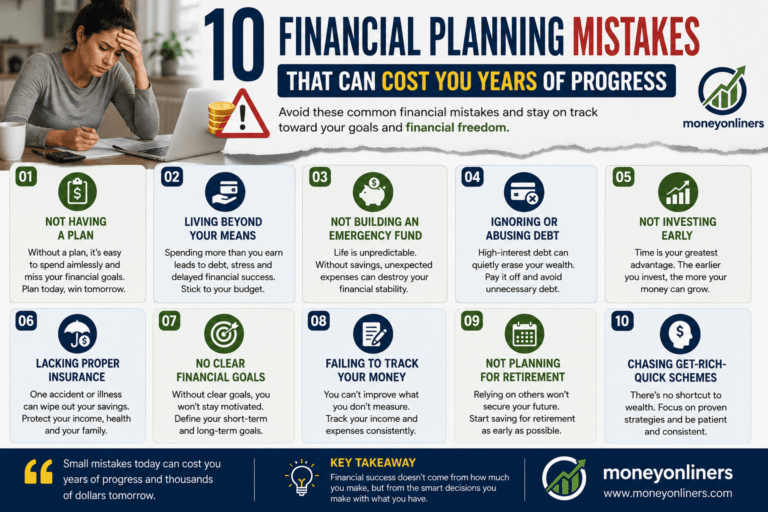
10 Monthly Saving Mistakes to Avoid
1. Believing Everyone Must Save the Same Percentage
Financial circumstances vary too much for one percentage to be universally correct.
2. Trying to Save Too Much Too Quickly
An unsustainable savings target may lead to missed bills or new credit-card debt.
3. Saving Nothing Because 20% Feels Impossible
Five percent, two percent or even a fixed small amount can still establish the habit.
4. Keeping the Same Savings Amount After Every Raise
Increasing contributions after income growth can accelerate future progress.
5. Treating Emergency Savings and Investing as the Same Thing
Emergency money generally requires more stability and accessibility than long-term investments.
6. Saving While Ignoring Extremely Expensive Debt
High-interest debt can consume future cash flow at a rapid rate.
7. Funding Retirement but Ignoring Near-Term Expenses
A balanced plan needs both future asset growth and enough cash for predictable nearer-term costs.
8. Assuming Investment Returns Will Rescue a Low Contribution Rate
Future returns are uncertain. Therefore, contribution size remains an important controllable variable.
9. Forgetting Inflation
A future goal may require more dollars than the same purchase would cost today.
10. Never Reviewing the Savings Target
Income, expenses, family responsibilities and goals change. Consequently, the monthly savings plan should change too.
A savings system that begins modestly and grows over time can be far more useful than an ideal percentage that is never implemented.
Why Saving Every Month Matters
1. First, monthly saving creates a repeatable financial habit.
2. In addition, emergency savings can reduce dependence on new debt.
3. Meanwhile, recurring investments can build long-term assets.
4. For example, small contributions can become larger as income grows.
5. Likewise, automated transfers reduce the need to make the same decision every month.
6. However, the correct savings rate differs from one household to another.
7. Therefore, percentages should be treated as planning tools rather than universal laws.
8. Moreover, high-interest debt can change the correct savings priority.
9. Similarly, emergency reserves may deserve attention before aggressive investing.
10. Over time, higher income can create room for larger contributions.
11. In addition, completed debt payments can be redirected toward future goals.
12. Short-term goals often need stable and accessible savings.
13. By contrast, long-term goals may permit more investment risk.
14. Importantly, retirement saving should not be postponed indefinitely simply because the perfect contribution rate is unknown.
15. Likewise, starting with a small amount can be more useful than waiting for ideal financial conditions.
16. Furthermore, contribution increases can sometimes matter more than trying to predict higher investment returns.
17. As a result, salary increases can become powerful savings opportunities.
18. Annual reviews help keep savings targets aligned with changing goals.
19. Ultimately, sustainable monthly saving can increase both financial security and future choices.
20. Therefore, the best answer to how much should you save every month is the amount that funds your highest priorities today, moves long-term goals forward and can grow as your financial capacity improves.
Incoming Link Opportunities
25 Financial Goals Worth Setting for the Next 1, 5 and 10 Years
https://moneyonliners.com/financial-goals/
Short-Term vs Long-Term Financial Goals: 20 Real-Life Examples
https://moneyonliners.com/short-term-vs-long-term-financial-goals/
10 Steps to Build a Long-Term Financial Plan That Can Grow With You
https://moneyonliners.com/long-term-financial-plan/
10-Year Financial Plan: What Should You Actually Be Planning For?
https://moneyonliners.com/10-year-financial-plan/
What Happens If You Invest $100 a Month for 20 Years?
https://moneyonliners.com/invest-100-a-month-for-20-years/
High-Priority Incoming Links
How to Build Wealth From Nothing: 10 Steps for Beginners
https://moneyonliners.com/how-to-build-wealth-from-nothing/
10 Wealth-Building Habits That Can Make a Big Difference Over 10 Years
https://moneyonliners.com/wealth-building-habits/
Your First $100,000: Why This Wealth Milestone Can Be So Powerful
https://moneyonliners.com/first-100000-wealth-milestone/
Retirement Planning: 15 Things to Start Doing Before You Retire
https://moneyonliners.com/retirement-planning/
How Much Should You Save for Retirement at 30, 40, 50 and 60?
https://moneyonliners.com/how-much-should-you-save-for-retirement-by-age/
Topic Cluster Incoming Links
How to Calculate Your Net Worth in 5 Simple Steps
https://moneyonliners.com/how-to-calculate-net-worth/
$0 to $100,000 Net Worth: A Realistic Roadmap for Building Your First Six Figures
https://moneyonliners.com/0-to-100000-net-worth/
15 Wealth-Building Strategies That Can Grow Your Money Over Time
https://moneyonliners.com/wealth-building-strategies/
Can Compound Interest Make You a Millionaire? Let's Look at the Numbers
https://moneyonliners.com/can-compound-interest-make-you-a-millionaire/
Continue Learning on MoneyOnliners
Recommended External Resources
1. Investor.gov — Build Wealth Over Time Through Saving and Investing
Build Wealth Over Time Through Saving and Investing — Investor.gov
Provides current guidance on emergency savings, recurring investing, retirement accounts and increasing contributions as income grows.
2. Investor.gov — Compound Interest Calculator
Compound Interest Calculator — Investor.gov
Useful for testing different monthly contributions, time periods and estimated investment returns.
3. Investor.gov — Define Your Goals
Define Your Goals — Investor.gov
Explains why financial targets should be connected to an amount and time horizon.
4. Investor.gov — Save and Invest
Save and Invest — Investor.gov
Provides broader guidance on financial goals, debt, rainy-day savings and investing.
5. Investor.gov — Understanding Investment Fees
Understanding Investment Fees — Investor.gov
Explains why long-term investment costs should be considered when estimating future wealth.
6. Consumer Financial Protection Bureau — Saving
Saving — Consumer Financial Protection Bureau
Provides practical consumer guidance on building savings and financial resilience.
7. Consumer Financial Protection Bureau — Emergency Fund Guide
An Essential Guide to Building an Emergency Fund — CFPB
Explains why dedicated emergency savings can help households absorb unexpected expenses.
8. IRS — 2026 Retirement Contribution Limits
2026 401(k) and IRA Contribution Limits — IRS
Provides the official 2026 U.S. contribution limits for 401(k) plans, IRAs and related retirement accounts.
9. IRS — Retirement Plan Contributions
Retirement Topics: Contributions — IRS
Provides broader information on retirement-plan contribution rules and annual limits.
10. Investor.gov — Asset Allocation and Diversification
Asset Allocation and Diversification — Investor.gov
Explains why time horizon and risk tolerance matter when directing long-term savings toward investments.
This article provides general educational information and is not individualized financial, investment, retirement, tax or legal advice. Savings rates, retirement needs, account rules and appropriate investment choices differ by household. Investment returns are uncertain, and contribution limits can change over time.
Frequently Asked Questions
How much should you save every month?
There is no universal dollar amount. Instead, start with an amount that fits your income, expenses and highest-priority financial goals.
For example, Investor.gov uses 5% or 10% of income as examples of regular investment contributions. However, total saving may need to include emergency reserves and other goals too.
As your financial capacity improves, consider raising the amount.
What percentage of income should I save every month?
Five percent can be a useful starting point when finances are tight. Meanwhile, 10%, 15% or 20% may create faster progress when affordable.
Nevertheless, there is no percentage that is correct for everyone.
The stronger approach is to connect the savings rate to actual goals and increase it over time.
Is saving 10% of income enough?
It can be a meaningful contribution. However, whether it is enough depends on your age, retirement timeline, existing assets and other goals.
Someone starting at 22 may have a very different situation from someone beginning at 52.
Therefore, use the percentage as a starting framework rather than a guarantee of financial readiness.
Is saving 20% of income good?
For many households, saving 20% can represent a strong rate.
However, it should not cause missed bills, neglected insurance or new high-interest debt.
Sustainability matters more than reaching a particular percentage for appearance's sake.
Is $100 a month worth saving?
Yes. Saving $100 each month equals $1,200 per year.
More importantly, it creates a recurring habit that can later be increased.
Therefore, do not dismiss a small beginning simply because the eventual goal is much larger.
Is $500 a month enough to save?
It can be substantial depending on income and goals.
Five hundred dollars monthly equals $6,000 per year and $60,000 of direct contributions over ten years.
Nevertheless, retirement, housing and family goals may require a different amount.
Is $1,000 a month a good savings amount?
Saving $1,000 monthly creates $12,000 of annual contributions.
That can build meaningful reserves and investments over time.
However, the amount should remain affordable within your wider financial plan.
Should I save before paying off debt?
Building a small emergency reserve can be useful because it reduces the chance that a minor emergency creates new debt.
Afterward, very high-interest debt may deserve aggressive attention.
Meanwhile, valuable employer retirement matching can also affect the priority order.
Should emergency savings count toward my monthly savings rate?
Yes, if you are actively building the reserve.
Emergency savings is money being directed toward your future financial security.
However, once the reserve reaches its target, the same monthly amount can be redirected toward other goals.
Should retirement contributions count as savings?
Generally, yes. Retirement contributions are long-term savings or investments.
However, employer contributions and personal contributions should be distinguished when evaluating how much of your own income you are saving.
Should employer matching contributions count toward my savings rate?
You can track them separately.
For example, you might record a 10% personal contribution plus a 4% employer match.
That makes it easier to see both your own savings behavior and total retirement funding.
What if I cannot save 10%?
Start lower.
For example, save 2%, 3% or a fixed dollar amount.
Then increase the contribution after debt payoff, a raise or an expense reduction.
Progress matters more than waiting for the perfect percentage.
What if I can save more than 20%?
Saving more can accelerate future goals when it remains sustainable.
Nevertheless, verify that essential insurance, reasonable present-day living and other important priorities are not being neglected.
Money is meant to support both present and future well-being.
How much should I save if I have irregular income?
A percentage-based system may work better than one fixed amount.
For example, you might save a chosen percentage every time income arrives.
In addition, maintaining a larger cash reserve can help manage lower-income months.
How often should I increase my monthly savings?
Review the amount at least annually.
In addition, review it after a raise, debt payoff or major expense reduction.
Each improvement in financial capacity creates an opportunity to increase saving without dramatically changing your existing lifestyle.
Research Methodology
Monthly Savings Framework
MoneyOnliners compared savings rates of 5%, 10%, 15%, 20% and 25% across several monthly income levels.
Investor Education Research
Current Investor.gov wealth-building guidance was reviewed for recurring investment contributions, emergency savings, automation and the principle of increasing contributions as financial capacity improves.
Retirement Contribution Limits
Current IRS information was reviewed for 2026 contribution limits affecting U.S. retirement accounts.
2026 Limits Used
The 2026 employee elective-deferral limit for most 401(k), 403(b) and governmental 457 plans is $24,500.
Meanwhile, the 2026 IRA contribution limit is $7,500.
Compound-Growth Examples
Long-term illustrations use hypothetical returns only to demonstrate how recurring contributions could grow. They are not forecasts.
Original MoneyOnliners Analysis
The Future Savings Rate Test, Future Funding Formula, Savings Capacity Formula, Savings Escalator and Monthly Savings Scorecard are original MoneyOnliners educational resources.
First-Hand Evidence Standard
MoneyOnliners only presents real savings records, investment screenshots, bank balances, retirement statements or personal financial results when genuine first-hand evidence exists and can be documented accurately.
Accordingly, no personal monthly savings outcome is claimed in this article.
Limitations
Income differs by household, while expenses, taxes and financial goals vary substantially.
In addition, investment returns fluctuate and retirement contribution limits can change annually. Therefore, readers should review current rules and personal circumstances before applying any example mechanically.
Google Search Console Checklist
- Confirm final URL: /how-much-should-you-save-every-month/
- Confirm canonical matches the published URL.
- Use how much should you save every month naturally in the title, introduction, FAQ and conclusion.
- Use related phrases naturally: how much should I save each month, monthly savings rate, percentage of income to save, savings per month, how much to save for the future and monthly retirement savings.
- Use real household financial-planning imagery in the hero.
- Use family imagery around household saving decisions.
- Use professional imagery around raises and income growth.
- Use older-adult imagery around long-term future and retirement saving.
- Avoid repeating calculators or cash piles in every image.
- Keep all image alt descriptions unique.
- Confirm Recommended External Resources contains 6–10 authoritative links.
- Confirm current Investor.gov saving guidance remains live.
- Confirm current IRS retirement limits before future annual updates.
- Check all internal links.
- Check savings tables carefully on mobile.
- Confirm article is indexable.
- Confirm URL appears in XML sitemap.
- Inspect the published URL in Google Search Console.
- Request indexing after publication if appropriate.
- Monitor “how much should you save every month.”
- Monitor “how much should I save each month.”
- Monitor “what percentage of income should I save.”
- Monitor “how much should I save for my future.”
- Monitor “monthly savings rate.”
Conclusion: Start With What You Can Save, Then Make the Number Grow
So, how much should you save every month for your future?
There is no single number that works for everybody.
Five Percent Can Be a Beginning
If finances are tight, a smaller percentage can establish the habit.
Ten Percent Can Build Momentum
As cash flow improves, larger contributions can strengthen emergency savings and long-term investments.
Fifteen or Twenty Percent Can Accelerate Progress
However, these higher rates should remain affordable and appropriate for your goals.
More Can Be Excellent When Sustainable
A high savings rate can shorten the path to major goals. Nevertheless, today's essential responsibilities still need to be funded.
Most Importantly, Do Not Freeze the Number Forever
Start with what you can afford.
Next, automate it.
Then, increase the amount after raises or debt payoff.
Meanwhile, direct different savings toward emergency needs, shorter-term goals and long-term investments.
Finally, review the plan every year.
Similar Posts
Financial Roadmap by Age: What to Focus on in Your 20s, 30s, 40s, 50s and 60s
Financial Roadmap by Age: What to Focus on in Your 20s, 30s, 40s, 50s and 60s | MoneyOnliners MoneyOnliners • Financial Planning → Age-Based Roadmap Financial Roadmap by Age: What to Focus on in Your 20s, 30s, 40s, 50s and 60s Your financial priorities should not stay exactly the same for 40 years. In your…
10-Year Financial Plan: What Should You Actually Be Planning For?
10-Year Financial Plan: What Should You Actually Be Planning For? | MoneyOnliners MoneyOnliners • Financial Planning → 10-Year Roadmap 10-Year Financial Plan: What Should You Actually Be Planning For? Ten years is long enough for your career, income, family, home, investments and priorities to change dramatically—but short enough that decisions you make today can still…
25 Financial Goals Worth Setting for the Next 1, 5 and 10 Years
25 Financial Goals Worth Setting for the Next 1, 5 and 10 Years | MoneyOnliners MoneyOnliners • Financial Planning → Goal Roadmap 25 Financial Goals Worth Setting for the Next 1, 5 and 10 Years Financial goals become much more useful when they are connected to time. Paying off a credit card may belong in…
10 Steps to Build a Long-Term Financial Plan That Can Grow With You
10 Steps to Build a Long-Term Financial Plan That Can Grow With You | MoneyOnliners MoneyOnliners • Financial Planning → Long-Term Roadmap 10 Steps to Build a Long-Term Financial Plan That Can Grow With You A strong financial plan should not assume your life will stay the same. Income changes. Families grow. Careers shift. Homes…
Where Should Your Money Go First? A 7-Step Financial Priority Checklist
Where Should Your Money Go First? A 7-Step Financial Priority Checklist | MoneyOnliners MoneyOnliners • Financial Planning → Priority Checklist Where Should Your Money Go First? A 7-Step Financial Priority Checklist When several financial goals compete for the same paycheck, knowing what to do first can be harder than knowing what to do eventually. Should…
10 Financial Planning Mistakes That Can Cost You Years of Progress
10 Financial Planning Mistakes That Can Cost You Years of Progress | MoneyOnliners MoneyOnliners • Financial Planning → Mistakes to Avoid 10 Financial Planning Mistakes That Can Cost You Years of Progress Financial progress is not only about making good decisions. It is also about avoiding mistakes that quietly drain cash flow, delay investing, increase…