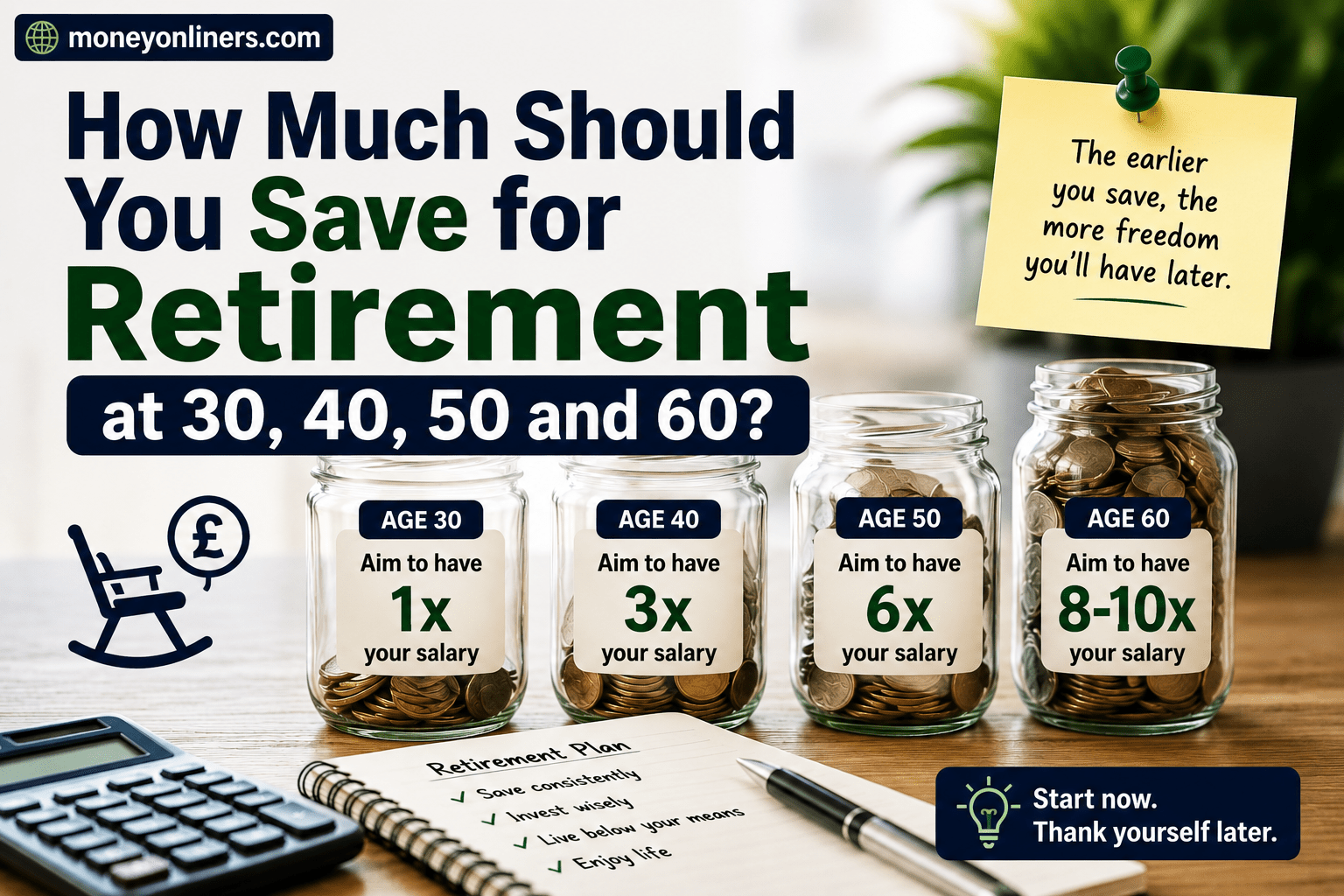
How Much Should You Save for Retirement at 30, 40, 50 and 60?
How Much Should You Save for Retirement at 30, 40, 50 and 60?
Age-based retirement benchmarks can help you check your progress, but they should never become rigid pass-or-fail rules. Your income, lifestyle, existing assets, pension benefits, debt, retirement age and future spending all affect how much you may actually need.
There is no universal answer to how much should you save for retirement at 30, 40, 50 or 60. Age-based salary multiples can provide useful checkpoints, but retirement readiness depends more directly on the relationship between your future spending, current investments, ongoing contributions, reliable retirement income and years remaining before retirement.
At 30, building the habit and using time effectively can matter most. At 40, contribution growth and lifestyle inflation deserve greater attention. At 50, you should begin calculating the actual gap between retirement spending and dependable income. By 60, the focus should increasingly shift from accumulating money to making sure your retirement income system can support the life you are preparing to live.
Table of Contents
Retirement Savings Benchmarks at 30, 40, 50 and 60
Retirement benchmarks are useful because they give you a quick way to ask whether your long-term saving is roughly moving in the right direction.
They become dangerous when they are treated as universal financial laws.
| Age | Useful Planning Perspective | Main Priority | Biggest Risk |
|---|---|---|---|
| 30 | A salary-based benchmark can provide an early checkpoint. | Create consistent saving and investing habits. | Waiting because retirement feels distant. |
| 40 | Several years of accumulation should now be visible. | Raise contributions as earnings increase. | Allowing lifestyle inflation to consume every raise. |
| 50 | Move beyond generic salary multiples. | Calculate the actual retirement-income gap. | Trying to catch up through excessive investment risk. |
| 60 | Evaluate whether total financial resources can support retirement. | Create an income and withdrawal plan. | Retiring before testing the numbers. |
A retirement benchmark should tell you where to investigate—not whether you have succeeded or failed. Pensions, living costs, retirement age, healthcare, housing and expected spending can dramatically change the amount required.
How Much Should You Save for Retirement by Age 30?
At 30, time may be one of your strongest retirement assets.
Even if your retirement account is smaller than you hoped, decades of future contributions and potential compound growth may still be available.
A Common Age-30 Checkpoint
Some retirement planning frameworks use approximately one year's salary around age 30 as a broad long-term benchmark.
Example
Annual income:
$60,000
Illustrative 1× income checkpoint:
$60,000
This does not mean someone with $25,000 or $40,000 has failed.
Career changes, education, debt repayment, housing costs and when you started working can all affect the balance.
Your Most Important Age-30 Priorities
- Start retirement contributions if you have not already.
- Automate contributions.
- Build emergency savings.
- Reduce high-interest consumer debt.
- Use employer retirement benefits where available.
- Increase contributions when income rises.
- Use a diversified investment strategy appropriate to your circumstances.

How Much Should You Save for Retirement by Age 40?
By 40, the financial decisions made during your 20s and 30s begin becoming more visible.
You still have significant time, but contribution size now deserves more attention.
Review More Than the Balance
- Current retirement portfolio
- Monthly contributions
- Current savings rate
- Income growth
- Housing costs
- Consumer debt
- Expected retirement age
- Desired retirement lifestyle
Why Age 40 Can Be a Powerful Reset
A person retiring at 65 may still have approximately 25 years available for future contributions.
That creates meaningful time to improve the trajectory.
For Example
Suppose you currently contribute $500 per month.
$500 × 12 = $6,000 annually
After a salary increase, you raise contributions to $900.
$900 × 12 = $10,800 annually
That is an additional $4,800 of annual contributions before considering any investment gains or losses.

Use income growth strategically. A larger salary does not improve retirement automatically if savings remain unchanged.
How Much Should You Save for Retirement by Age 50?
By 50, retirement planning should become much more specific.
Instead of asking only whether you have a certain multiple of salary, begin calculating the actual amount your investments may eventually need to provide.
Estimate Retirement Spending
Suppose expected annual spending is:
$65,000
Estimate Reliable Income
Expected pension and other dependable retirement income:
$25,000
Calculate the Gap
$65,000 − $25,000 = $40,000
The portfolio may therefore need to support approximately $40,000 per year.
Illustrative Portfolio Scenarios
| Withdrawal Assumption | Illustrative Portfolio |
|---|---|
| 4% | $1,000,000 |
| 3.5% | About $1,142,857 |
| 3% | About $1,333,333 |
Withdrawal rates do not guarantee portfolio longevity. Taxes, retirement length, healthcare, inflation and market performance can materially affect results.

How Much Should You Save for Retirement by Age 60?
At 60, the most important question is no longer simply, “How much should I have saved?”
The better question becomes, “Can my full financial system support the retirement I am approaching?”
Review the Whole Retirement Picture
- Investment portfolio
- Pensions
- Government retirement benefits
- Housing
- Debt
- Healthcare
- Insurance
- Taxes
- Emergency reserves
- Retirement date
- Withdrawal strategy
Example
Expected annual retirement expenses:
$70,000
Reliable annual retirement income:
$40,000
Portfolio income gap:
$70,000 − $40,000 = $30,000
| Withdrawal Assumption | Illustrative Portfolio |
|---|---|
| 4% | $750,000 |
| 3.5% | About $857,143 |
| 3% | $1,000,000 |

Test your expected retirement cash flow before leaving employment. Account balance alone cannot tell you whether your lifestyle is financially sustainable.
Should You Use Salary Multiples for Retirement Savings?
Salary multiples have one major advantage.
They are simple.
If someone tells you to aim for approximately one times salary, three times salary or another benchmark, the calculation takes seconds.
But simple does not mean complete.
Salary Benchmarks Can Be Useful When
- You want a quick progress checkpoint.
- Your income has been reasonably stable.
- Your retirement lifestyle may resemble your working lifestyle.
- You understand that the number is only a rough guide.
Salary Benchmarks Become Less Useful When
- Your salary recently increased dramatically.
- You have a substantial pension.
- You expect to relocate after retirement.
- Your retirement spending will be substantially lower.
- Your desired retirement lifestyle will cost much more.
Retirement Spending Can Matter More Than Salary
Consider two workers who each earn $100,000 annually.
Worker A
Expected portfolio-funded retirement spending:
$40,000 per year
Worker B
Expected portfolio-funded retirement spending:
$80,000 per year
25× Planning Illustration
| Portfolio Spending | Illustrative 25× Target |
|---|---|
| $40,000 | $1,000,000 |
| $80,000 | $2,000,000 |
Same salary.
A $1 million difference in this simplified portfolio illustration.
“How much will my retirement lifestyle need from my investment portfolio?” is usually more useful than “How many times my salary do I have?”
Pensions and Other Retirement Income Can Reduce How Much You Need Saved
Retirement assets should not be analyzed without considering other dependable income.
Example: No Pension
Annual spending:
$60,000
If the entire amount came from investments, a 4% illustration gives:
$60,000 ÷ 0.04 = $1,500,000
Example: $30,000 of Reliable Income
$60,000 − $30,000 = $30,000 portfolio requirement
At 4%:
$30,000 ÷ 0.04 = $750,000
What If You Are Behind on Retirement Savings?
Being behind an age benchmark is useful information.
It is not proof that retirement is impossible.
Increase Contributions
A higher contribution rate gives more money an opportunity to participate in long-term investment growth.
Use Raises Strategically
Consider directing part of each income increase toward retirement before spending habits absorb all of it.
Reduce Expensive Debt
High interest competes directly with your ability to build assets.
Increase Earning Power
Career growth can create considerably more saving capacity than attempting to cut every small expense.
Consider Working Longer
Additional working years can potentially provide:
- More contributions
- More time for investment growth
- Fewer years requiring portfolio withdrawals
Reconsider Retirement Spending
A sustainable reduction in future annual spending can reduce the size of the required portfolio.
Being behind does not make an extremely risky investment safer. Chasing exceptional returns can destroy capital and leave even less time to recover.
How Much Should You Save for Retirement Each Month?
The right monthly amount depends on how far you are from your goal.
| Monthly Contribution | Annual Contribution | 10 Years Contributions Only | 20 Years Contributions Only |
|---|---|---|---|
| $250 | $3,000 | $30,000 | $60,000 |
| $500 | $6,000 | $60,000 | $120,000 |
| $750 | $9,000 | $90,000 | $180,000 |
| $1,000 | $12,000 | $120,000 | $240,000 |
| $1,500 | $18,000 | $180,000 | $360,000 |
| $2,000 | $24,000 | $240,000 | $480,000 |
These numbers intentionally exclude investment growth, investment losses, fees and taxes so you can see exactly how much comes from your own contributions.
Why Starting Earlier Can Make Retirement Saving Easier
The primary advantage of starting earlier is time.
Hypothetical Illustration
Suppose $50,000 remains invested without additional contributions and hypothetically earns an average 6% annually.
| Time Invested | Approximate Illustrative Value |
|---|---|
| 10 years | $89,542 |
| 20 years | $160,357 |
| 30 years | $287,175 |
Real investments do not return a fixed 6% every year. Markets can experience large gains, losses and long periods of weak performance.
Starting Later Does Not Mean Retirement Is Impossible
It means your own contributions may need to do more of the work.
Other levers such as higher income, lower future spending and a later retirement date may also become more important.
Should You Save for Retirement While Paying Off Debt?
Not all debt is equal.
High-Interest Consumer Debt
A very expensive credit balance can deserve urgent attention because its interest cost may be difficult for investments to reliably overcome.
Employer Retirement Benefits
Where an employer offers a valuable retirement contribution or match, completely ignoring it can have an opportunity cost.
Emergency Savings
Avoid putting every available dollar into either retirement or debt while leaving yourself unable to handle basic emergencies.
Evaluate debt interest rates, emergency savings, employer benefits, taxes, retirement urgency and personal risk together.
MoneyOnliners Original Analysis: Retirement Catch-Up Pressure by Age
| Factor | Lower Catch-Up Pressure | Higher Catch-Up Pressure |
|---|---|---|
| Age | More years remaining | Fewer years remaining |
| Existing investments | Strong accumulated portfolio | Little invested |
| Contribution rate | Large sustainable contributions | Small or inconsistent contributions |
| Income growth | Strong future earning potential | Little expected income growth |
| Retirement spending | Moderate planned spending | Expensive planned lifestyle |
| Reliable retirement income | Strong pension or other dependable income | Portfolio must fund nearly everything |
| Retirement age | Flexible | Early fixed deadline |
A 50-year-old with substantial pension income, modest expenses and strong future contributions may face less retirement pressure than a younger person with high spending, large debt and very low savings.
MoneyOnliners Age-by-Age Retirement Priority Matrix
| Age | Primary Priority | What to Measure | What to Avoid |
|---|---|---|---|
| 30 | Build the system | Contribution habit | Waiting for a higher salary |
| 40 | Increase contributions | Savings rate | Lifestyle inflation |
| 50 | Calculate the gap | Future portfolio income need | Speculative catch-up investing |
| 60 | Prepare retirement income | Actual retirement cash flow | Relying only on a headline balance |
These are original MoneyOnliners editorial frameworks, not standardized retirement-planning ratings.
MoneyOnliners Research-Based Evidence Note
This article is a research-based retirement education guide.
MoneyOnliners does not claim first-hand retirement experience at ages 30, 40, 50 or 60.
Salary benchmarks, portfolio calculations and household examples are presented as educational planning illustrations rather than guaranteed targets.
MoneyOnliners does not fabricate investment performance, retirement outcomes, testimonials or personal retirement experiences.
The Retirement Catch-Up Pressure framework and Age-by-Age Priority Matrix are original MoneyOnliners analytical tools designed to make generic retirement benchmarks more useful and citeable.
MoneyOnliners Retirement Roadmap by Age
| Age | Priority Actions |
|---|---|
| 30 | Start or automate contributions, use available employer benefits, build emergency savings, reduce high-interest debt and increase contributions with future raises. |
| 40 | Review savings rate, current portfolio, housing costs, debt, income growth and whether your contributions are increasing as your career develops. |
| 50 | Estimate retirement spending, reliable income, healthcare, taxes, housing and the remaining portfolio gap. |
| 60 | Test the retirement budget, review pension timing, healthcare, taxes, investment allocation, emergency reserves and withdrawal strategy. |
Retirement Savings Checklist
- I know my current retirement balance.
- I know how much I contribute every month.
- I know my approximate savings rate.
- I understand available employer retirement benefits.
- I maintain emergency savings.
- I know my debt interest rates.
- I increase contributions when income grows.
- I understand that investment returns are uncertain.
- I use diversification appropriate to my circumstances.
- I have an approximate retirement age.
- I have estimated retirement spending.
- I know my likely pension or other dependable retirement income.
- I have considered healthcare.
- I have considered taxes.
- I periodically recalculate my retirement-income gap.
10 Retirement Saving Mistakes to Avoid
1. Treating an Age Benchmark as a Financial Law
Benchmarks are rough checkpoints rather than guaranteed requirements.
2. Giving Up Because You Are Behind
Future contributions, income and retirement timing can still change the outcome.
3. Waiting for a Higher Income Before Starting
Small consistent contributions can establish valuable habits and give investments more time.
4. Allowing Every Raise to Increase Spending
Income growth helps retirement only when some of the increase strengthens your future.
5. Carrying Expensive Debt Indefinitely
High interest can compete with retirement saving.
6. Keeping No Emergency Reserve
Unexpected expenses can otherwise create new debt or force investment withdrawals.
7. Taking Excessive Risk to Catch Up
Starting late does not make speculative investments safer.
8. Ignoring Retirement Spending
Account balance alone cannot tell you how expensive your future lifestyle will be.
9. Ignoring Pension and Other Reliable Income
These resources can materially reduce the burden on your investment portfolio.
10. Waiting Until Retirement to Build an Income Plan
Retirement preparation becomes stronger when income and spending are tested before the final working day.
Avoid guaranteed-return schemes, unrealistic investment promises and speculative strategies marketed as a way to make up decades of retirement saving quickly. Capital preservation becomes especially important when recovery time is limited.
Why Knowing How Much You Should Save for Retirement Matters
1. Retirement benchmarks can help you notice problems early enough to make adjustments.
2. Saving at 30 gives your contributions more time for potential long-term growth.
3. Reviewing progress at 40 can reveal whether income growth is translating into greater wealth.
4. Planning at 50 helps replace vague retirement goals with an actual income-gap calculation.
5. Reviewing retirement cash flow at 60 can expose weaknesses before employment income ends.
6. Salary multiples provide useful checkpoints but cannot measure every household accurately.
7. Retirement spending can be more important than salary when estimating the final portfolio requirement.
8. Pension income can materially reduce how much investments need to provide.
9. High-interest debt can reduce retirement contribution capacity.
10. Emergency savings can help protect retirement assets from unexpected expenses.
11. Higher income can improve retirement outcomes when part of each raise is saved.
12. Lifestyle inflation can weaken retirement progress despite rising income.
13. Starting later may require larger contributions rather than reckless investment risk.
14. Working longer can add contribution years while reducing the number of retirement years a portfolio must support.
15. Healthcare can materially change retirement spending.
16. Taxes can make gross retirement income different from spendable income.
17. Housing decisions can dramatically alter required retirement cash flow.
18. Investment returns remain uncertain at every age.
19. Retirement planning should be updated as income, family circumstances and goals change.
20. Ultimately, understanding how much should you save for retirement helps you replace generic age comparisons with a financial plan designed around the retirement life you actually expect to fund.
Continue Learning on MoneyOnliners
Recommended External Resources
Investor.gov — Retirement
Investor.gov — Compound Interest Calculator
Compound Interest Calculator — Investor.gov
Consumer Financial Protection Bureau — Retirement
Planning for Retirement — CFPB
MoneyOnliners provides general educational information and does not provide individualized retirement, investment, tax, insurance, legal or financial advice. Age-based savings benchmarks are broad planning references rather than guaranteed targets. Investments can lose value, income can change, pensions vary and retirement outcomes depend on individual circumstances.
Frequently Asked Questions
How much should you have saved for retirement at 30?
There is no mandatory amount.
Approximately one year's salary is sometimes used as a broad planning checkpoint around age 30.
However, your starting salary matters.
When you began working matters.
Consistency and future contributions can matter even more.
How much should you have saved for retirement at 40?
Many planning frameworks use several times annual income as a rough checkpoint.
The benchmark should not be treated as a pass-or-fail rule.
Current assets matter.
Future contributions matter.
Expected retirement spending matters too.
How much should you have saved at 50?
By 50, a spending-based calculation becomes increasingly useful.
Estimate retirement expenses.
Estimate dependable retirement income.
Calculate the remaining portfolio-income gap.
Then compare the required assets with your current trajectory.
How much should you have saved at 60?
By 60, focus increasingly on retirement cash flow rather than one benchmark.
Review investments.
Review pensions.
Review healthcare and taxes.
Determine whether total resources can support expected spending.
What if I have nothing saved at 30?
Start when you can.
Build emergency savings.
Reduce expensive debt.
Begin consistent contributions.
Increase them as your income develops.
What if I have nothing saved at 40?
Retirement is not automatically impossible.
You may still have decades available.
Larger contributions may become necessary.
Income development can help.
A realistic retirement age is also important.
What if I have nothing saved at 50?
Planning becomes more urgent.
Calculate expected retirement income.
Review retirement benefits.
Increase saving where realistically possible.
Consider whether working longer would strengthen the plan.
Is $100,000 enough retirement savings at 40?
It depends.
Income matters.
Future contributions matter.
Retirement lifestyle matters.
The number should be evaluated as part of the complete plan.
Is $500,000 enough at age 50?
It could represent strong progress for one household.
A large pension could make the position considerably stronger.
High future spending could make it less adequate.
Remaining contribution years matter.
Investment outcomes remain uncertain.
Is $1 million enough at age 60?
Potentially.
At a 4% illustration, $1 million corresponds mathematically to approximately $40,000 of first-year portfolio withdrawals.
Other retirement income may add to that amount.
Taxes and healthcare can reduce spendable resources.
The answer therefore depends on your lifestyle.
Should I save 10% of my income for retirement?
Ten percent can be a useful starting point for some households.
It is not universally sufficient.
Age matters.
Existing assets matter.
Retirement goals matter.
Should I save 15%?
Fifteen percent is another frequently discussed planning benchmark.
Someone starting later may need more.
Someone with substantial pension benefits may require less from personal investments.
Employer contributions may also affect the calculation.
Treat percentages as starting points rather than guarantees.
Can I be behind at 50 and still retire comfortably?
Potentially.
You may need higher contributions.
A longer working period may help.
Lower future expenses may reduce the required portfolio.
Strong pension benefits may also change the result.
Should I take more investment risk if I am behind?
Not simply because you are behind.
Higher expected returns generally involve higher uncertainty.
A major loss close to retirement can be difficult to recover from.
Savings, income, spending and retirement timing may be safer variables to adjust.
Risk should remain appropriate to your circumstances.
Does a pension reduce how much I should save?
Potentially.
A reliable pension can support part of retirement spending.
That reduces how much your investments need to provide.
Tax treatment matters.
Inflation protection should also be considered.
Research Methodology
This MoneyOnliners guide examines how much should you save for retirement at 30, 40, 50 and 60 using age benchmarks as broad planning checkpoints rather than universal requirements.
Salary multiples are included because they provide an easy way to compare progress, but retirement spending is given greater weight when estimating actual future financial needs.
Age 30 is treated primarily as a contribution-habit and long-time-horizon stage.
Age 40 focuses more heavily on savings-rate growth, income development and lifestyle inflation.
Age 50 shifts toward calculating the actual retirement-income gap rather than relying mainly on salary benchmarks.
Age 60 focuses increasingly on retirement cash flow, pensions, healthcare, taxes, housing and withdrawal planning.
Pensions and other dependable retirement income are included because they may substantially reduce the amount required from investment portfolios.
Debt and emergency reserves are included because retirement saving should be evaluated as part of a complete financial system.
Investment-return illustrations are clearly identified as hypothetical because market returns remain uncertain.
The MoneyOnliners Retirement Catch-Up Pressure framework and Age-by-Age Retirement Priority Matrix are original editorial resources designed to make age benchmarks more useful and citeable.
All numerical examples are hypothetical educational illustrations.
No salary multiple, contribution amount, investment return or retirement outcome is guaranteed.
Conclusion: Your Age Is a Checkpoint, Not a Verdict
There is no single perfect answer to how much should you save for retirement at 30, 40, 50 or 60.
At 30
Build the habit.
Give your money time.
At 40
Connect career growth with stronger contributions.
At 50
Move beyond generic benchmarks and calculate the actual retirement-income gap.
At 60
Determine whether your portfolio, pensions, reserves and other resources can support your real retirement lifestyle.
If you are ahead, continue building.
If you are approximately on track, continue reviewing.
If you are behind, respond with a plan rather than panic.
Increase contributions where possible.
Build earning power.
Reduce expensive debt.
Control major expenses.
Consider your retirement date.
Most importantly, avoid taking unnecessary investment risk simply because a generic age benchmark says you should have more.