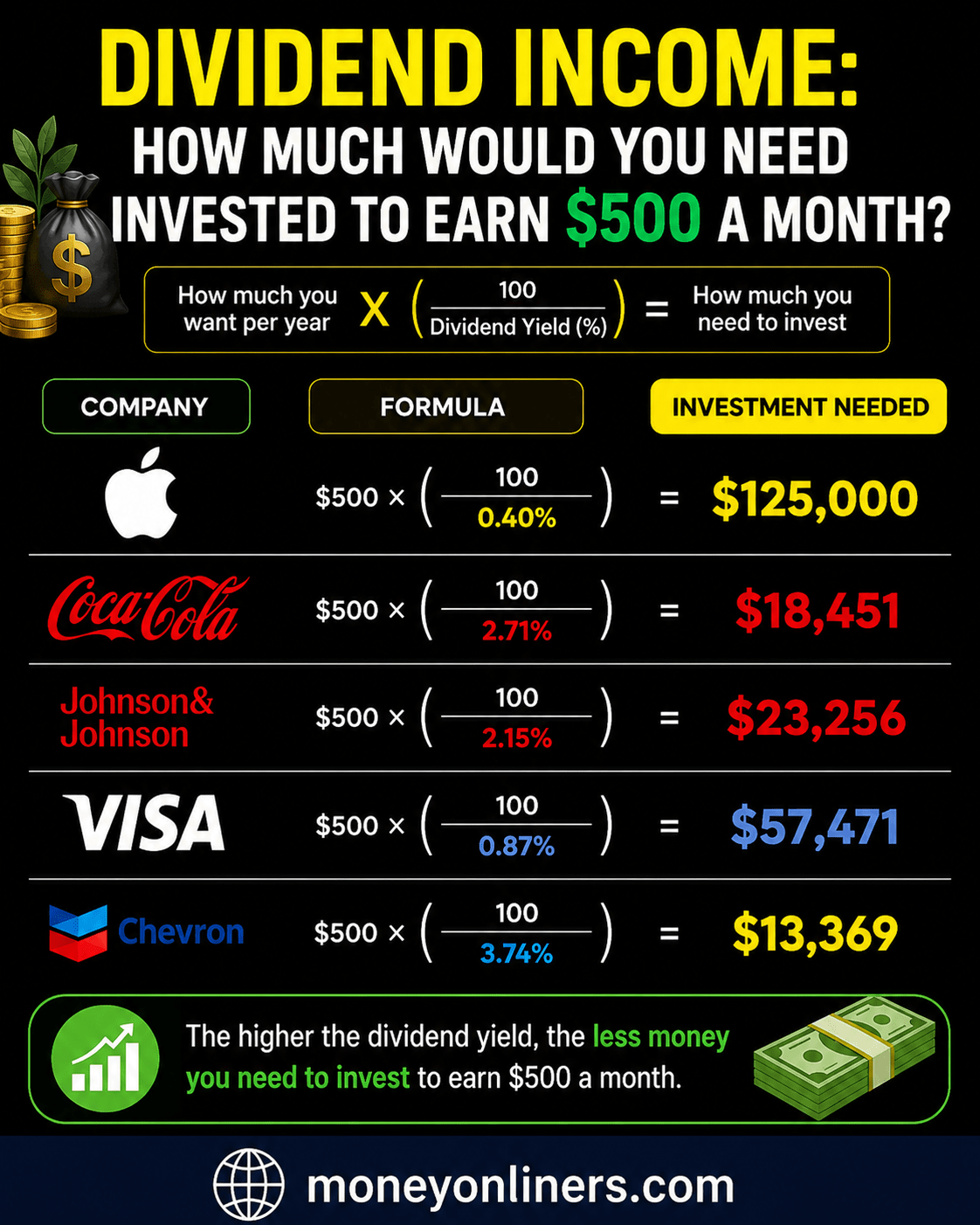
Dividend Income: How Much Would You Need Invested to Earn $500 a Month?
Dividend Income: How Much Would You Need Invested to Earn $500 a Month?
Five hundred dollars a month in dividend income equals $6,000 a year. The amount you need invested depends heavily on your portfolio's dividend yield. A higher yield reduces the mathematical capital requirement, but higher yield can also signal greater risk. This guide walks through the numbers without treating dividends as guaranteed income.
To earn $500 a month in dividend income, you need approximately $6,000 per year in dividends. At a hypothetical 2% dividend yield, that requires about $300,000 invested. At 3%, about $200,000. At 4%, about $150,000. At 5%, about $120,000. At 6%, about $100,000. These figures are mathematical illustrations before taxes and fees. Dividend payments can be reduced or eliminated, fund distributions can change, and the investments themselves can lose value.
How Much Is $500 a Month in Annual Dividend Income?
Begin by converting the monthly income goal into an annual figure.
$500 × 12 months = $6,000 per year
Your portfolio therefore needs to produce approximately $6,000 of annual distributions if you want an average of $500 per month before taxes.
The Basic Formula
Required Portfolio = Annual Dividend Goal ÷ Dividend Yield
For example, if a portfolio yields 4%:
$6,000 ÷ 0.04 = $150,000
How Much Would You Need at Different Dividend Yields?
| Hypothetical Dividend Yield | Portfolio Needed | Annual Dividend Target | Average Per Month |
|---|---|---|---|
| 2% | $300,000 | $6,000 | $500 |
| 3% | $200,000 | $6,000 | $500 |
| 4% | $150,000 | $6,000 | $500 |
| 5% | $120,000 | $6,000 | $500 |
| 6% | $100,000 | $6,000 | $500 |
| 7% | About $85,714 | $6,000 | $500 |
| 8% | $75,000 | $6,000 | $500 |
| 10% | $60,000 | $6,000 | $500 |
A 10% yield looks attractive because only $60,000 would mathematically be required. However, unusually high yields can come with substantially greater risk, unstable distributions, declining share prices or return of capital. Yield alone does not tell you whether an investment is healthy.
What Is Dividend Yield?
Dividend yield compares annual dividends with the current share price.
Dividend Yield = Annual Dividends Per Share ÷ Share Price
Simple Example
Suppose a company pays $2 per share in annual dividends.
The stock trades at $50.
$2 ÷ $50 = 4%
The dividend yield would be approximately 4%.
But Yield Changes With Share Price
Suppose the dividend remains $2 but the stock price falls to $25.
The calculated dividend yield becomes 8%.
That does not automatically mean the investment suddenly became twice as good.
The price decline may reflect serious concerns about the company.
A high dividend yield can be an opportunity, a warning sign or both. Always investigate why the yield is high.

At a 2% Dividend Yield: About $300,000
A portfolio yielding 2% would mathematically require:
$6,000 ÷ 0.02 = $300,000
A lower yield requires more capital to produce the same amount of cash income.
However, a lower yield does not automatically mean a worse investment.
Some companies retain more profits for growth rather than distributing large dividends.
At a 3% Dividend Yield: About $200,000
$6,000 ÷ 0.03 = $200,000
At a hypothetical 3% yield, approximately $200,000 would be required to produce $6,000 of annual dividends.
At a 4% Dividend Yield: About $150,000
$6,000 ÷ 0.04 = $150,000
The 4% example provides a useful middle-ground illustration.
However, it is not a promised portfolio yield and should not be treated as a universal dividend target.
At a 5% Dividend Yield: About $120,000
$6,000 ÷ 0.05 = $120,000
At this point, the required capital declines significantly.
Nevertheless, investors should examine whether the dividend is supported by the company's finances.
At a 6% Dividend Yield: About $100,000
$6,000 ÷ 0.06 = $100,000
A $100,000 portfolio yielding 6% would mathematically produce $6,000 in annual distributions.
However, a 6% dividend should still be evaluated for sustainability, diversification and total-return risk.
What About an 8% Dividend Yield?
$6,000 ÷ 0.08 = $75,000
The mathematics looks attractive.
Only $75,000 would theoretically be required.
However, a high yield can create several potential problems.
A High Yield May Be Caused By
- A sharply declining share price
- Financial distress
- Heavy company debt
- An unusually generous distribution policy
- A cyclical business at peak earnings
- A payout that may not be sustainable
- Return of investor capital in some fund structures
The SEC's Investor.gov guidance warns investors that fund distributions are not the same as investment performance. A fund can make distributions while still performing poorly, and certain distributions can include return of capital.
What About a 10% Yield?
$6,000 ÷ 0.10 = $60,000
Again, the calculation is correct.
That does not mean finding a 10% yield makes $60,000 a safe route to $500 monthly income.
Do not force an income goal onto a small portfolio by taking increasingly dangerous investment risks. A high advertised yield can disappear through dividend cuts or be overwhelmed by losses in the underlying investment.
Dividend Income Is Not the Same as Total Return
Dividend investors need to look beyond the cash payment.
Example A
An investment pays 5% in dividends.
Its market value also rises 4%.
Ignoring taxes and fees, the approximate total return would be positive.
Example B
Another investment pays an 8% dividend.
However, its share price falls 25%.
Focusing only on the dividend can hide the larger loss.
Total Return Considers More Than Income
Total Return ≈ Price Change + Income Distributions
That simplified concept can provide a more complete view than yield alone.
Receiving income from an investment does not automatically mean the investment itself is performing well.

Individual Dividend Stocks vs Dividend ETFs
| Feature | Individual Dividend Stocks | Dividend ETFs |
|---|---|---|
| Diversification | Depends on number of companies owned | Can hold many companies |
| Company research | More direct research required | Fund research still required |
| Company-specific risk | Can be significant | Potentially spread across holdings |
| Dividend control | Each company sets its policy | Fund distributions depend on holdings and strategy |
| Fees | Brokerage/trading costs may apply | Expense ratio plus applicable trading costs |
| Income guaranteed? | No | No |
Why Funds Can Simplify Diversification
Investor.gov notes that stocks carry company-specific risk and that holding different investments can reduce some of that concentration.
A dividend ETF can potentially spread your investment across many dividend-paying companies.
However, some dividend ETFs concentrate heavily in particular industries.
Look Under the Hood
- Number of holdings
- Largest holdings
- Sector allocation
- Expense ratio
- Distribution history
- Fund strategy
- Total return
Do Dividends Arrive Every Month?
Not necessarily.
Many U.S. companies traditionally pay dividends quarterly.
Some investments distribute monthly.
Others may pay semiannually or on different schedules.
Therefore, generating $6,000 annually does not necessarily mean exactly $500 arrives every calendar month.
Example
A portfolio may produce $1,500 each quarter.
That still averages $500 per month over the year.
However, cash-flow planning would need to account for the quarterly payment schedule.
Build your spending plan around the actual distribution schedule rather than assuming annual dividend income automatically arrives in twelve equal payments.
Can Companies Cut Their Dividends?
Yes.
A dividend is not the same as guaranteed bond interest or insured savings interest.
Corporate boards can reduce, suspend or eliminate dividend payments.
Reasons May Include
- Falling profits
- Economic recession
- High debt
- Cash-flow pressure
- Major acquisitions
- Business restructuring
- Need for additional investment
That means a portfolio producing $500 monthly today may not produce the same amount indefinitely.
What Is a Dividend Payout Ratio?
The payout ratio is one tool investors may use when evaluating dividend sustainability.
It broadly compares dividends paid with company earnings.
Simplified Formula
Payout Ratio = Dividends ÷ Earnings
A very high payout ratio may deserve additional investigation because a company distributing nearly all its earnings may have less room to absorb financial difficulty.
However, appropriate payout ratios differ by industry and company structure.
Do Not Use One Metric Alone
Also consider:
- Free cash flow
- Debt
- Earnings stability
- Dividend history
- Business outlook
- Capital requirements
- Industry conditions
Dividend Growth Can Matter as Much as Starting Yield
Some investors focus on companies that have historically increased their dividends over time.
A growing dividend can potentially increase income without requiring additional shares.
Simple Illustration
Imagine a portfolio generates $4,000 annually today.
If its underlying dividends increase over time, income could eventually rise toward the $6,000 target.
However, future dividend growth is never guaranteed.
Dividend Growth vs High Starting Yield
| Strategy | Potential Advantage | Potential Limitation |
|---|---|---|
| High current yield | More income now | May involve higher risk or slower growth |
| Lower yield with dividend growth | Income may increase over time | Less current income |
| Broad dividend fund | Diversification | Fund fees and changing distributions |
| Mixed total-return strategy | Balances income and growth | May require selling assets for some cash needs |
What If You Reinvest Dividends Instead of Spending Them?
During the portfolio-building stage, reinvesting dividends can purchase additional shares.
Those additional shares may then generate future dividends.
That creates another path for compound growth.
Dividend Reinvestment
Investor.gov notes that dividend reinvestment plans may allow shareholders to use dividend payments to buy additional shares.
Brokerage or plan fees may apply depending on the arrangement.
Building Stage
Contributions + dividends + potential investment growth → larger future portfolio
Income Stage
Once your portfolio reaches the desired size, you may choose to receive some or all distributions in cash instead.
If you do not need the dividend income today, reinvesting it may help you move toward a future $500-per-month target faster—although investment returns remain uncertain.

What If You Already Have $25,000 Invested?
| Dividend Yield | Annual Income | Average Monthly Income |
|---|---|---|
| 2% | $500 | About $42 |
| 3% | $750 | $62.50 |
| 4% | $1,000 | About $83 |
| 5% | $1,250 | About $104 |
| 6% | $1,500 | $125 |
A $25,000 portfolio therefore would not generally be expected to generate $500 per month from conventional moderate dividend yields.
What If You Have $50,000?
| Yield | Annual Dividend Income | Monthly Average |
|---|---|---|
| 2% | $1,000 | About $83 |
| 3% | $1,500 | $125 |
| 4% | $2,000 | About $167 |
| 5% | $2,500 | About $208 |
| 6% | $3,000 | $250 |
What If You Have $100,000?
| Yield | Annual Dividend Income | Monthly Average |
|---|---|---|
| 2% | $2,000 | About $167 |
| 3% | $3,000 | $250 |
| 4% | $4,000 | About $333 |
| 5% | $5,000 | About $417 |
| 6% | $6,000 | $500 |
This does not mean a $100,000 portfolio should target a 6% yield. It only demonstrates the mathematics.
Real-Life Example: Trying to Make $500 From $20,000
The Required Yield Is Extremely High
A fictional beginner has $20,000 and wants the portfolio to pay $500 every month.
The annual goal is $6,000.
$6,000 ÷ $20,000 = 30%
The portfolio would need to produce a 30% annual cash yield.
That is not a reasonable assumption for a conventional diversified dividend portfolio.
The investor begins finding online promotions for securities advertising extremely high distributions.
Instead of chasing them, she changes the strategy.
She continues contributing to the portfolio while reinvesting distributions.
Key lesson: If the required yield becomes extreme, increase the capital or extend the timeline rather than forcing the portfolio to take dangerous risk.
Case Study: Building Toward $150,000
The 4% Illustration
A fictional investor uses $150,000 as an educational target because a 4% dividend yield would mathematically equal $6,000 per year.
The investor does not search exclusively for securities yielding exactly 4%.
Instead, the portfolio is evaluated for diversification, quality, fees, total return and risk.
During the accumulation stage, dividends are reinvested.
Additional contributions are made every month.
Eventually, the investor may decide whether receiving distributions as cash fits the financial plan.
Key lesson: The portfolio target can be useful for planning without becoming a reason to chase a specific yield.
How Long Could It Take to Build $150,000?
That depends on your starting balance, contributions and actual investment performance.
Contribution Totals Without Investment Returns
| Monthly Contribution | Annual Contribution | 10 Years | 20 Years | 30 Years |
|---|---|---|---|---|
| $100 | $1,200 | $12,000 | $24,000 | $36,000 |
| $250 | $3,000 | $30,000 | $60,000 | $90,000 |
| $500 | $6,000 | $60,000 | $120,000 | $180,000 |
| $750 | $9,000 | $90,000 | $180,000 | $270,000 |
| $1,000 | $12,000 | $120,000 | $240,000 | $360,000 |
The table does not include investment gains, investment losses, dividends, fees or taxes.
Increasing Contributions Can Matter More Than Chasing Yield
Suppose you can increase contributions from $250 to $500 per month.
You are now adding an additional $3,000 per year to the portfolio.
That is a factor you can control much more directly than next year's market return.
Taxes Can Increase How Much You Need Invested
If your goal is to spend $500 after taxes each month, gross dividend income may need to exceed $6,000 annually.
Hypothetical Example
Assume purely for illustration that 15% of the dividend income is lost to taxes.
To retain $6,000:
$6,000 ÷ 0.85 ≈ $7,059 gross dividend income
At a hypothetical 4% yield:
$7,059 ÷ 0.04 ≈ $176,475 invested
The 15% figure is not a universal tax rate. Dividend taxation depends on the investor, account type, dividend classification and country.
Qualified vs Other Dividend Tax Treatment
Tax systems can treat different kinds of dividends differently.
Likewise, retirement and tax-advantaged accounts can change when and how taxes apply.
Readers outside the United States should use the rules applicable to their own jurisdiction.
Inflation Can Turn $500 Into a Moving Target
Five hundred dollars twenty years from now may purchase considerably less than $500 does today.
That means a long-term dividend-income goal may need to increase over time.
Why Dividend Growth Can Help
If companies increase distributions as their businesses grow, portfolio income may have a better chance of keeping pace with rising living costs.
However, dividend growth is not guaranteed.
Do Not Focus Only on Today's Yield
A long-term investor may also consider:
- Dividend growth
- Business growth
- Inflation
- Total return
- Portfolio diversification
- Fees
- Taxes
10 Dividend Income Mistakes to Avoid
1. Chasing the Highest Dividend Yield
Extremely high yields can signal serious risk.
2. Assuming Dividends Are Guaranteed
Companies can reduce or eliminate dividends.
3. Ignoring the Share Price
Large capital losses can overwhelm dividend income.
4. Ignoring Total Return
Income is only one component of investment performance.
5. Putting Everything Into One High-Yield Stock
That creates severe concentration risk.
6. Assuming Every Fund Distribution Is Dividend Income
Fund distributions can include interest, capital gains and, in some cases, return of capital.
7. Ignoring Fund Fees
Expense ratios and other costs reduce investor returns.
8. Ignoring Taxes
Gross dividends and spendable dividends can be different.
9. Spending Every Dividend While Still Building the Portfolio
Reinvestment can potentially accelerate accumulation.
10. Forcing a Small Portfolio to Produce Too Much Income
An unrealistic income target can encourage dangerous yield chasing.
Be skeptical of anyone promising unusually high guaranteed dividend or investment returns with little or no risk. Legitimate investments involve uncertainty and potential loss.
Dividend Income Checklist
- I know that $500 monthly equals $6,000 annually.
- I know the portfolio size required at my assumed yield.
- I understand that dividend yield is not guaranteed.
- I know why the investments I own pay their current yields.
- I have checked diversification.
- I understand the difference between dividend income and total return.
- I know that fund distributions may have different sources.
- I have reviewed fees.
- I have considered taxes.
- I have considered inflation.
- I know the actual distribution schedule.
- I have considered dividend reinvestment.
- I am not using emergency savings to chase dividend income.
- I understand the investments rather than buying based only on yield.
Continue Learning on MoneyOnliners
Recommended External Resources
Investor.gov — Stocks
Stocks and Dividend Payments — Investor.gov
Investor.gov — Fund Distributions
Fund Distributions — Investor Bulletin
Investor.gov — Understanding Investment Risk
Investor.gov — Introduction to Investing
Introduction to Investing — Investor.gov
Investor.gov — Five Questions Before You Invest
Five Questions to Ask Before You Invest — Investor.gov
This article provides general educational information and is not individualized financial, investment, tax or legal advice. All dividend yields and portfolio amounts shown are hypothetical mathematical illustrations. Dividends and fund distributions are not guaranteed. Investments can lose value, including loss of principal. Tax treatment, fees and investment regulations vary by account, investment and jurisdiction.
Frequently Asked Questions
How much do you need invested to earn $500 a month in dividends?
It depends on dividend yield.
At a hypothetical 4% yield, approximately $150,000 would be required to generate $6,000 per year before taxes and fees.
How much do I need at a 2% dividend yield?
Approximately $300,000.
How much do I need at 3%?
Approximately $200,000.
How much do I need at 4%?
Approximately $150,000.
How much do I need at 5%?
Approximately $120,000.
How much do I need at 6%?
Approximately $100,000.
How much do I need at 8%?
Approximately $75,000.
However, higher yields may involve greater risk and should not be treated as guaranteed.
Can $50,000 make $500 a month in dividends?
It would require an annual yield of approximately 12%.
That is substantially higher than the moderate-yield examples in this article and could involve considerable risk.
Can $100,000 generate $500 monthly?
A 6% annual yield would mathematically produce $6,000 annually.
However, a 6% dividend is not guaranteed.
Can $150,000 generate $500 monthly?
At a hypothetical 4% annual yield, yes mathematically.
Actual dividend payments and investment values can change.
Are dividends guaranteed?
No.
Companies may reduce, suspend or eliminate their dividends.
Can dividend ETFs reduce risk?
A diversified ETF may reduce dependence on one individual company.
However, it cannot eliminate market risk or guarantee distributions.
Do dividend ETFs pay every month?
Some do.
Others may distribute quarterly or according to another schedule.
Do individual stocks pay dividends monthly?
Payment schedules vary.
Many companies traditionally make quarterly payments.
What happens if a company cuts its dividend?
Your dividend income decreases unless other portfolio holdings or new contributions compensate for the reduction.
Why can a very high dividend yield be dangerous?
A high yield may result from a falling share price or an unsustainable distribution.
Is dividend yield the same as investment return?
No.
Total investment return also considers changes in the value of the investment.
Can a fund distribute money while losing value?
Yes.
Fund distributions are not the same as investment performance.
What is return of capital?
Return of capital occurs when a fund distributes some of the investor's contributed capital rather than income or gains generated by the portfolio.
Should I reinvest dividends?
During the accumulation stage, reinvesting dividends can potentially purchase more shares and support compound growth.
Whether it fits your situation depends on your financial goals.
Are dividend stocks passive income?
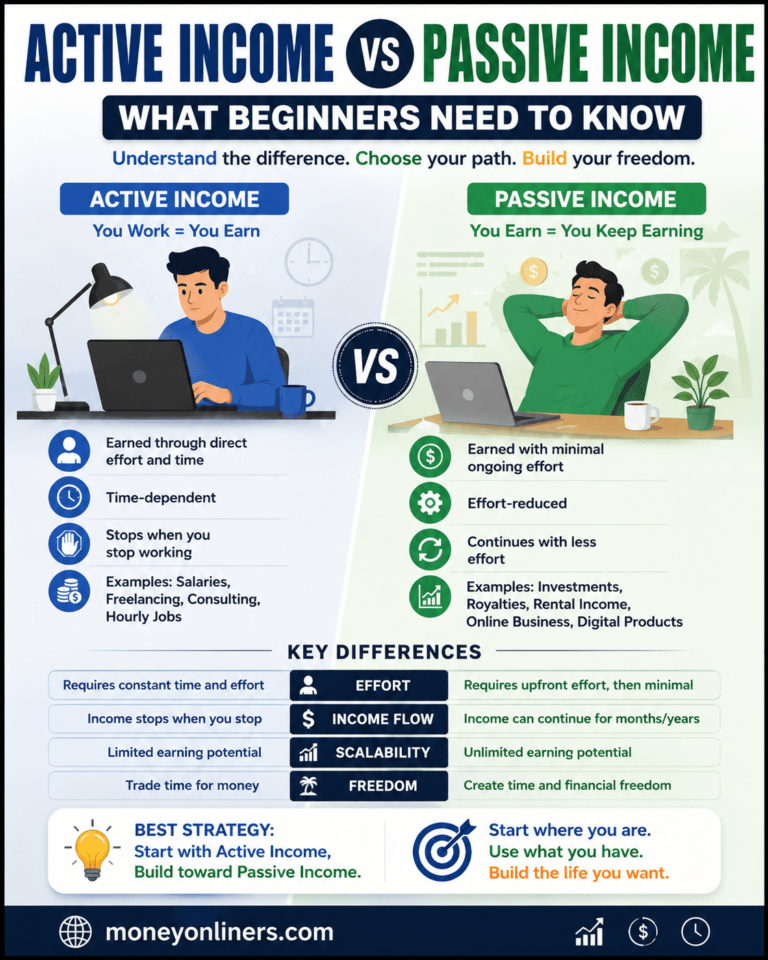
In ordinary financial usage, dividend payments are often described as passive investment income because shareholders do not operate the company to receive each payment.
Tax classifications can use different terminology.
Do taxes reduce dividend income?
Potentially.
Tax treatment depends on the dividend, account and investor's jurisdiction.
Is $500 a month in dividends enough to live on?
That depends entirely on your living costs and other income.
For many households, $500 would be supplemental income rather than complete financial independence.
Can dividend income keep up with inflation?
Some companies increase dividends over time.
However, future dividend growth is not guaranteed.
Should beginners chase high-dividend stocks?
No.
Beginners should evaluate business quality, diversification, total return, risk and dividend sustainability rather than yield alone.
What is the biggest dividend-income mistake?
One major mistake is focusing only on the current yield while ignoring the underlying company's financial condition and the possibility of losing principal.
Research Methodology
This MoneyOnliners guide begins with a $500 monthly income target, equivalent to $6,000 annually.
Portfolio requirements are calculated by dividing $6,000 by hypothetical annual dividend yields.
For example, a 4% yield mathematically requires $150,000, while a 5% yield requires $120,000 and a 6% yield requires $100,000.
These figures are calculations rather than forecasts, recommended yields or guaranteed income levels.
Investor.gov defines stock ownership as an ownership interest in a company and explains that dividend payments can be one source of investor return.
The analysis also reflects current SEC investor guidance explaining that fund distributions can include dividends, interest, capital gains or return of capital and that distributions should not be confused with overall investment performance.
Investor.gov's risk guidance is used to reinforce that all investments involve uncertainty and that greater expected returns generally involve greater risk.
The guide evaluates total return as well as cash yield because dividend income alone can hide losses in the underlying investment.
Tax calculations are clearly identified as hypothetical because dividend taxation varies substantially by investor and jurisdiction.
No dividend payment, distribution, portfolio return or future income amount is guaranteed.
Final Thoughts: $500 a Month in Dividend Income Usually Requires Significant Capital
Five hundred dollars every month equals $6,000 per year.
At a 2% Yield
You would mathematically need about $300,000.
At 3%
About $200,000.
At 4%
About $150,000.
At 5%
About $120,000.
At 6%
About $100,000.
But the Lowest Capital Requirement Is Not Automatically the Best Strategy
The temptation is to search for the highest-yielding investments so you can reach the income goal with less money.
That can create serious risk.
Dividends can be cut.
Share prices can collapse.
Fund distributions can change.
Some distributions can even include your own capital being returned.
Build the Portfolio Rather Than Forcing the Yield
Increase contributions when possible.
Reinvest dividends during the accumulation stage where appropriate.
Diversify.
Keep fees under control.
Understand every investment you own.
Evaluate total return, not simply current income.
Ultimately, building meaningful dividend income is less about finding a stock with the biggest yield and more about developing a sufficiently large, diversified and sustainable portfolio.
The goal should not simply be $500 next month.
The stronger goal is building an investment system capable of supporting income for many years without taking unnecessary risks with the capital underneath it.




One Comment