
15 Passive Income Myths That Make Building Income Look Easier Than It Is
15 Passive Income Myths That Make Building Income Look Easier Than It Is
Passive income is one of the most attractive ideas in personal finance: build something once, then keep getting paid. The problem is that social media, advertisements and income screenshots often hide the work, capital, risk, failed experiments, maintenance and expenses behind the result. Understanding the myths can help you build income more realistically.
The biggest passive income myths are that passive income requires no work, starts quickly, needs no money, produces guaranteed income, can replace a job almost immediately, always scales easily and stays passive forever. In reality, most passive or semi-passive income sources require some combination of upfront labor, financial capital, skill, marketing, maintenance, risk and patience. The realistic goal is not effortless income. It is building assets and systems that can eventually earn money with less direct work per dollar than traditional hourly income.
Why Passive Income Is So Easy to Misunderstand
Passive income is an appealing phrase because it suggests financial freedom without constant work.
That possibility is real in some forms.
An investor does not need to work for each dividend payment.
An author does not rewrite an ebook for every customer.
A course creator does not necessarily reteach every recorded lesson live.
However, focusing only on the final income hides the process that created it.
The investor first needed capital.
The author first needed to write, edit and publish the book.
The course creator first needed expertise, production work and an audience.
15 Passive Income Myths at a Glance
| # | Myth | Reality |
|---|---|---|
| 1 | Passive income means no work | Most streams require setup or maintenance |
| 2 | You can build it immediately | Many assets take months or years |
| 3 | You need no money | Low-capital models usually require more time and skill |
| 4 | You need lots of money | Digital assets can sometimes start cheaply |
| 5 | Passive income is guaranteed | Income can fall or disappear |
| 6 | High yield means better income | Higher yield can mean higher risk |
| 7 | Revenue equals profit | Expenses can consume much of the revenue |
| 8 | One asset can replace your job quickly | Reliable replacement income usually takes time |
| 9 | More income streams are always better | Too many weak streams create complexity |
| 10 | Online income stays passive forever | Platforms, search and products change |
| 11 | Rental property is completely passive | Repairs, vacancies and management remain |
| 12 | Dividend income cannot fall | Dividends can be reduced or eliminated |
| 13 | AI can automate everything | Human judgment and quality control remain important |
| 14 | Successful creators started with a perfect system | Most systems improve through testing |
| 15 | Passive income is the final goal | Financial resilience and freedom are broader goals |
Myth 1: Passive Income Means You Do No Work
The Myth
Once you create passive income, money supposedly continues forever while you do nothing.
The Reality
Most passive-income streams require work somewhere in the system.
That work may happen upfront.
Alternatively, it may occur periodically through maintenance.
Examples
- A website needs updates and security.
- A rental property needs repairs.
- A course may need refreshed lessons.
- A digital product may need customer support.
- A portfolio needs periodic review.
Passive income often means income that is less directly connected to each additional hour of labor.
Myth 2: Passive Income Can Be Built Overnight
The Myth
Create a website tonight and wake up to recurring income tomorrow.
The Reality
Many passive-income assets need time to gain traction.
Websites need traffic.
Courses need students.
Digital products need buyers.
Investment portfolios need capital.
Rental properties need suitable economics and tenants.

Myth 3: You Need No Money to Build Passive Income
The Myth
Anyone can build substantial passive income with absolutely no resources.
The Reality
Some models can begin with very little financial capital.
However, they usually require other resources instead.
Time
Writing, designing and building can take many hours.
Skills
Useful products usually require real ability.
Equipment
You may still need a computer, phone or internet access.
Distribution
Finding customers may require marketing or audience building.
Low-cost passive income often substitutes time and skill for money.
Myth 4: You Need Hundreds of Thousands of Dollars
The Myth
Passive income is only available to wealthy investors.
The Reality
Investment-based passive income can require substantial capital.
For example, producing meaningful dividend or interest income may require a large portfolio.
However, digital assets can often start with much less money.
Lower-Capital Examples
- Digital templates
- Ebooks
- Printables
- Affiliate content
- Online courses
- Niche websites
- Stock photography
Low capital does not mean easy income. It usually means more personal labor is required during the build stage.
Myth 5: Passive Income Is Guaranteed
The Myth
Once an income stream begins, the money should continue indefinitely.
The Reality
Every income source can weaken.
Investment Income Can Fall
Dividends can be cut.
Interest rates can change.
Investment values can decline.
Business Income Can Fall
Customers can disappear.
Competition can increase.
Platform rules can change.
Rental Income Can Fall
Tenants can leave.
Major repairs can eliminate months of cash flow.
Guaranteed passive-income claims deserve serious caution. Legitimate investments and businesses involve uncertainty.
Myth 6: The Highest Yield Is Always the Best Passive Income
The Myth
If one investment yields 4% and another yields 12%, the 12% investment must be better.
The Reality
Higher yields frequently reflect additional risk.
A company experiencing financial difficulty may have a very high dividend yield because its share price has collapsed.
Likewise, higher-yield debt may compensate investors for increased default risk.
Ask Why the Yield Is High
- Is the underlying asset declining?
- Is the payout sustainable?
- Is the borrower financially weak?
- Is leverage unusually high?
- Could distributions be reduced?
Myth 7: Revenue Is the Same as Passive Income Profit
The Myth
If someone posts a screenshot showing $5,000 in sales, they made $5,000.
The Reality
Revenue is not profit.
Possible Expenses
- Advertising
- Platform fees
- Payment processing
- Refunds
- Software
- Hosting
- Contractors
- Taxes
- Maintenance
Hypothetical Example
| Item | Amount |
|---|---|
| Gross digital-product sales | $5,000 |
| Advertising | -$1,200 |
| Platform/payment fees | -$500 |
| Software | -$200 |
| Refunds | -$300 |
| Contract assistance | -$500 |
| Illustrative amount before taxes | $2,300 |
Actual businesses have very different economics. The point is to separate gross sales from what remains after expenses.
Myth 8: One Passive Income Asset Can Replace Your Job Quickly
The Myth
Launch one ebook, website or investment account and quit your job soon afterward.
The Reality
Replacing employment income usually requires substantially more reliable cash flow than earning occasional side income.
A Job May Also Provide
- Predictable monthly income
- Benefits
- Insurance
- Retirement contributions
- Paid leave
- Greater short-term stability
A new online income stream may not provide any of those protections.
Treat new passive-income assets as additional income first. Let reliability prove itself over time before depending on it for essential living costs.
Myth 9: More Passive Income Streams Are Always Better
The Myth
Financial freedom requires seven, ten or twenty income streams.
The Reality
There is no required number.
Every income stream requires some level of management.
Too many unfinished or weak systems can waste time.
Compare Two Scenarios
| Portfolio A | Portfolio B |
|---|---|
| 10 weak projects earning almost nothing | 2 strong, profitable, understandable assets |
| High complexity | Lower complexity |
| Little focus | More focused maintenance |
| Hard to measure | Easier to optimize |

Myth 10: Online Passive Income Stays Passive Forever
The Myth
Once a website, video or digital product earns money, it can be ignored permanently.
The Reality
Digital assets age.
Websites Need
- Security updates
- Broken-link fixes
- Content updates
- SEO maintenance
- Speed improvements
Courses Need
- Updated lessons
- Student support
- Platform maintenance
Affiliate Content Needs
- Current product information
- Working affiliate links
- Updated pricing and features
- Disclosure compliance
The more quickly the subject changes, the more maintenance the asset may require.
Myth 11: Rental Property Is Completely Passive
The Myth
Buy a property, collect rent and do nothing else.
The Reality
Rental property can be semi-passive, especially with professional management.
However, ownership still carries responsibility.
Common Costs
- Repairs
- Vacancies
- Insurance
- Property taxes
- Legal compliance
- Management fees
- Maintenance
- Financing costs
Gross Rent Is Not Profit
A property renting for $2,000 does not automatically produce $2,000 of monthly passive income.
Net rental cash flow = Rent received − all realistic ownership and financing costs.
Myth 12: Dividend Income Cannot Fall
The Myth
Once a company pays a dividend, investors can count on that payment forever.
The Reality
Companies can reduce, suspend or eliminate dividends.
A strong dividend history can be useful information.
It is not a guarantee of future distributions.
Dividend Income Also Has Market Risk
You might receive cash dividends while the share price declines.
Therefore, evaluate total return as well as income.
Do not build an essential spending plan around dividends as though they were guaranteed salary payments.
Myth 13: AI Can Build Passive Income Automatically
The Myth
AI can create websites, books, videos and businesses automatically while you collect the money.
The Reality
AI can reduce certain kinds of work.
It can help with brainstorming, research organization, drafting, coding and workflow automation.
However, useful businesses still require judgment.
Humans Still Need to Check
- Accuracy
- Originality
- Customer usefulness
- Copyright
- Brand consistency
- Safety
- Business economics
- Quality
Myth 14: Successful Passive-Income Creators Started With a Perfect System
The Myth
Successful people discovered one perfect idea and immediately built it correctly.
The Reality
Many profitable systems evolve through experimentation.
The first product may fail.
The first website may receive little traffic.
The first course may need major changes.
Customer feedback may reveal a better opportunity.
The Small-Test Approach
| Stage | Action |
|---|---|
| 1 | Identify a real problem |
| 2 | Build a small solution |
| 3 | Test with real users |
| 4 | Measure demand |
| 5 | Improve the asset |
| 6 | Scale only after evidence appears |
Myth 15: Passive Income Is the Final Financial Goal
The Myth
Once you have passive income, your financial life is solved.
The Reality
Income is only one part of financial well-being.
You Still Need
- Emergency savings
- Responsible spending
- Debt management
- Insurance where appropriate
- Long-term planning
- Diversification
- Tax awareness
- Fraud protection
Someone can earn substantial passive income and still be financially unstable if spending, debt and risk are poorly managed.
The deeper goal is not passive income itself. It is greater financial resilience, freedom, flexibility and control.

Passive Income Reality: What Most Streams Actually Require
| Income Type | Capital | Upfront Work | Maintenance | Main Risk |
|---|---|---|---|---|
| Dividend portfolio | High | Low–Moderate | Low | Market and dividend cuts |
| Bonds | High | Low | Low | Credit and interest rates |
| Rental property | High | High | Moderate–High | Property and vacancy risk |
| Niche website | Low–Moderate | High | Moderate | Traffic and platform risk |
| Digital templates | Low | High | Low–Moderate | Demand and competition |
| Online course | Low–Moderate | High | Moderate | Demand and outdated content |
| Affiliate content | Low | High | Moderate | Traffic and merchant changes |
| Software | Low–High | Very High | Moderate | Technology and competition |
A Better Way to Think About Passive Income
Instead of asking, “How can I make money without working?” ask a stronger question.
That Might Mean
- A portfolio that generates investment income
- A property that produces rental cash flow
- A book sold repeatedly
- A template downloaded many times
- A website attracting recurring traffic
- A tool serving many users
- A video continuing to educate viewers
Real-Life Example: The “Easy” $2,000 Online Business
The Screenshot Looks Impressive
A fictional creator posts a screenshot showing $2,000 in one month of online sales.
A beginner sees the screenshot and assumes the income requires almost no work.
The Missing Context
The creator spent eight months building the audience.
The product took 60 hours to create.
Advertising cost $400.
Software cost $120.
Platform fees cost $180.
The creator also spent several hours answering customers.
The business may still be worthwhile.
However, the screenshot alone does not explain the economics.
Key lesson: Income results without time, costs and context can make a legitimate business look much easier than it actually is.
Case Study: A High-Yield Investment Looks Like Easy Income
The 12% Yield
A fictional investor discovers an investment yielding 12% annually.
That appears far more attractive than a diversified investment yielding 4%.
However, the investment's price has fallen sharply because the underlying business is struggling.
Several months later, the dividend is reduced.
The investor receives less income and also experiences a major loss in principal.
Key lesson: Yield should never be evaluated separately from the quality and risk of the underlying asset.
How Beginners Can Build Passive Income More Realistically
| Step | Action |
|---|---|
| 1 | Strengthen active income first |
| 2 | Protect essential expenses and emergency savings |
| 3 | Choose one asset you understand |
| 4 | Calculate realistic startup costs |
| 5 | Estimate ongoing maintenance |
| 6 | Validate real customer or market demand |
| 7 | Start with a small test |
| 8 | Measure net profit, not revenue |
| 9 | Automate repetitive tasks |
| 10 | Scale only after the model works |
Passive Income Myth-Busting Checklist
- I know passive income usually requires work or capital.
- I do not expect immediate results.
- I understand that income can fall.
- I do not chase unusually high guaranteed yields.
- I calculate profit rather than revenue.
- I understand ongoing maintenance.
- I know what platform or market risks exist.
- I do not depend on screenshots or testimonials alone.
- I know the tax and legal requirements that may apply.
- I am not risking emergency money.
- I am building one useful asset before starting many others.
- I have realistic expectations about time.
- I understand that passive income is one part of a larger financial plan.
Continue Learning on MoneyOnliners
Recommended External Resources
Federal Trade Commission — Avoid Income Scams
How to Avoid Income Scams — Federal Trade Commission
Federal Trade Commission — Business Opportunity Scams
When a Business Offer or Coaching Program Is a Scam — FTC
Investor.gov — Understanding Investment Risk
Investor.gov — Five Questions Before You Invest
Five Questions to Ask Before You Invest — Investor.gov
This article provides general educational information and is not individualized financial, investment, tax, legal or business advice. Passive income is not guaranteed. Investments can lose value, businesses can fail, rental properties can produce unexpected expenses and online platforms can change their rules. Research costs, risks, taxes and legal obligations before committing significant money or time.
Frequently Asked Questions
What is the biggest passive income myth?
One of the biggest myths is that passive income means earning money without work.
Most streams require upfront work, financial capital or ongoing maintenance.
Is passive income really passive?
Sometimes only partly.
Investment interest may require little ongoing work, while websites, rentals and digital businesses can require regular maintenance.
Can passive income be guaranteed?
No.
Income can decline because of market movements, customer demand, dividend cuts, vacancies or changing platform rules.
Can passive income replace a job?
Potentially, but replacing employment income generally requires reliable assets, significant capital, profitable businesses or several proven income sources.
Can you build passive income quickly?
Occasionally an asset can gain traction quickly, but many legitimate passive-income systems require months or years of development.
Do you need money to create passive income?
Not always a large amount.
Low-capital digital assets often require greater investment of time and skill.
Do you need to be rich to earn passive income?
No.
However, investment-based passive income generally scales with the amount of capital invested.
Is high-yield passive income better?
Not automatically.
Higher yield can indicate increased risk or an unsustainable payout.
Is rental property truly passive?
Usually not completely.
Repairs, vacancies, management and financing remain part of property ownership.
Are dividends guaranteed?
No.
Companies can reduce or eliminate dividends.
Is affiliate marketing passive income?
Affiliate content can produce commissions after publication.
However, traffic, merchant programs and commissions can change.
Is blogging passive income?
Evergreen articles can continue earning after publication.
Websites still require content updates, SEO and technical maintenance.
Is an online course passive income?
A recorded course can serve multiple students without repeating every class live.
However, support, marketing and lesson updates usually remain.
Can AI completely automate passive income?
No.
AI can automate some tasks, but useful businesses still require quality control, judgment, customer understanding and original value.
Do more passive income streams make you safer?
Not always.
Several strong and genuinely different income sources can improve resilience, but many weak streams can create unnecessary complexity.
Is revenue the same as passive income?
No.
Revenue is the amount received before expenses.
Profit is what remains after relevant costs.
How much maintenance does passive income require?
It varies widely.
Investment income may need periodic review, while software, rental property and content businesses can require substantial maintenance.
Can passive income disappear?
Yes.
A dividend can be cut, a tenant can leave, an affiliate program can close or a website can lose search traffic.
Should I quit my job after my first passive-income stream works?
Usually it is safer to evaluate the income's stability, taxes, expenses, emergency reserves and long-term reliability before depending on it for essential living costs.
Should beginners start several passive income projects?
Usually, focusing on one useful asset first can make execution easier.
What is the best way to build passive income?
There is no universal best method.
A practical approach is to choose an asset that fits your existing skills, capital, time and risk tolerance.
How do I know whether an income claim is realistic?
Look for information about expenses, time invested, starting capital, failures, taxes and the period over which the income was earned.
What should passive income really help you achieve?
Ideally, it should increase financial flexibility, resilience and freedom rather than simply become another number to chase.
Research Methodology
This MoneyOnliners guide evaluates common passive-income claims against the practical resources required to build income-producing assets: capital, time, skills, maintenance and risk.
Investment-related myths are analyzed by distinguishing current income yield from investment safety and total return.
Business-related myths separate gross revenue from profit because advertising, platform fees, software, contractors, refunds and taxes can materially change actual income.
Rental-property examples distinguish gross rent from net cash flow because ownership costs remain even when tenant payments are recurring.
Digital-income models are described as semi-passive where ongoing updates, search traffic, customer support, platform maintenance or marketing remain necessary.
The guide avoids guaranteed-income figures and does not treat past business or investment performance as a promise of future results.
All business and income examples are hypothetical educational illustrations.
The central editorial standard is that passive income should be explained as income generated by assets and systems rather than marketed as effortless money.
Final Thoughts: Passive Income Is Powerful—But Only When You Understand the Work Behind It
Passive income can absolutely improve a financial life.
However, the strongest strategies rarely look like the advertisements.
There Is Usually Work Before the Income
Products need to be created.
Websites need content.
Properties need capital.
Investments need savings.
There Is Usually Risk After the Income Begins
Customers can leave.
Dividends can fall.
Markets can decline.
Search rankings can change.
There Are Usually Costs
Fees matter.
Repairs matter.
Taxes matter.
Software matters.
There Is Usually Maintenance
Most assets need attention eventually.
But the Model Can Still Be Powerful
One useful template can serve many customers.
One book can sell repeatedly.
One diversified portfolio can represent ownership in many businesses.
One evergreen article can continue attracting readers.
That is the real opportunity behind passive income.
Ultimately, understanding these passive income myths can protect beginners from unrealistic expectations and expensive mistakes.
Do not chase effortless income.
Build useful assets.
Understand the risks.
Measure the real profit.
Maintain what works.
And allow passive income to become the long-term result of a stronger financial system rather than a shortcut that looks easier than it really is.
Similar Posts
10 Online Passive Income Ideas You Can Build From Home
10 Online Passive Income Ideas You Can Build From Home | MoneyOnliners MoneyOnliners • Earn More → Online Income 10 Online Passive Income Ideas You Can Build From Home The internet makes it possible to build income-producing assets without renting an office, buying large amounts of inventory or commuting to another workplace. However, online passive…
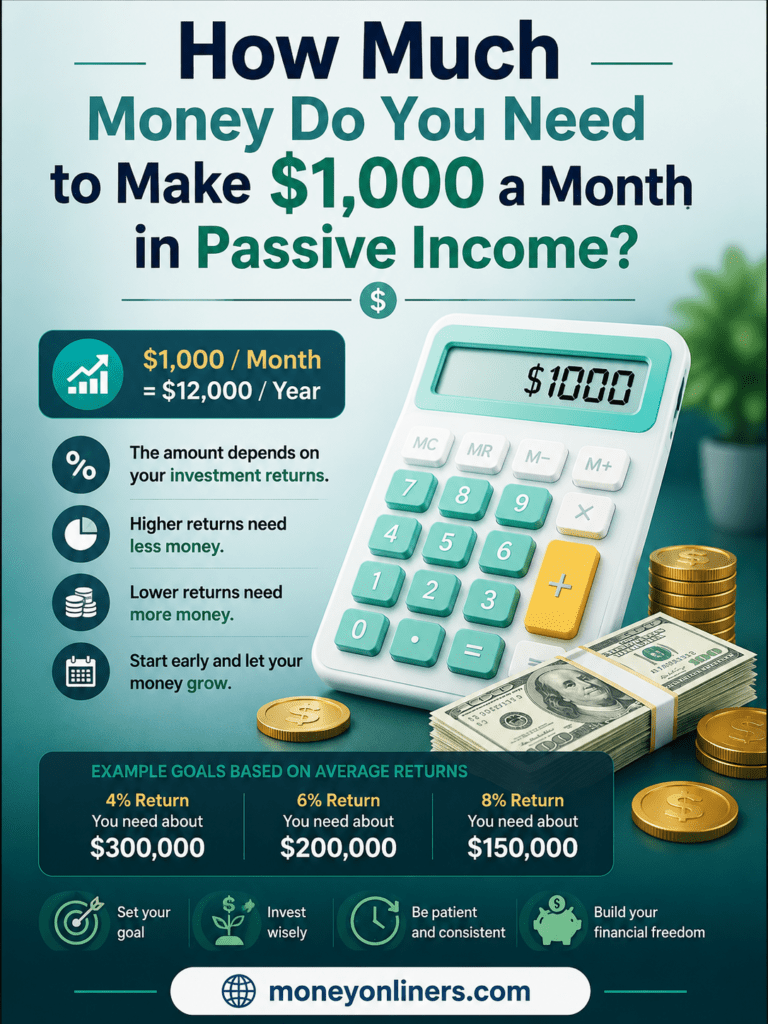
How Much Money Do You Need to Make $1,000 a Month in Passive Income?
How Much Money Do You Need to Make $1,000 a Month in Passive Income? | MoneyOnliners MoneyOnliners • Passive Income → Financial Freedom How Much Money Do You Need to Make $1,000 a Month in Passive Income? One thousand dollars a month in passive income sounds like a clear goal. The harder question is how…
25 Passive Income Ideas to Build Extra Income Over Time
25 Passive Income Ideas to Build Extra Income Over Time | MoneyOnliners MoneyOnliners • Earn More → Build Wealth 25 Passive Income Ideas to Build Extra Income Over Time Passive income is often advertised as money that appears while you sleep. Real life is usually less glamorous. Most sustainable income streams require money, skills, upfront…
10 Passive Income Mistakes That Can Waste Your Time and Money
10 Passive Income Mistakes That Can Waste Your Time and Money | MoneyOnliners MoneyOnliners • Passive Income → Smarter Decisions 10 Passive Income Mistakes That Can Waste Your Time and Money Building passive income can be worthwhile, but pursuing the wrong strategy can cost far more than money. You can spend months creating products nobody…
Passive Income vs Side Hustle: Which Is Better for Building Extra Income?
Passive Income vs Side Hustle: Which Is Better for Building Extra Income? | MoneyOnliners MoneyOnliners • Extra Income → Long-Term Growth Passive Income vs Side Hustle: Which Is Better for Building Extra Income? A side hustle can help you earn extra money relatively quickly by selling your time, skills or services. Passive income can potentially…
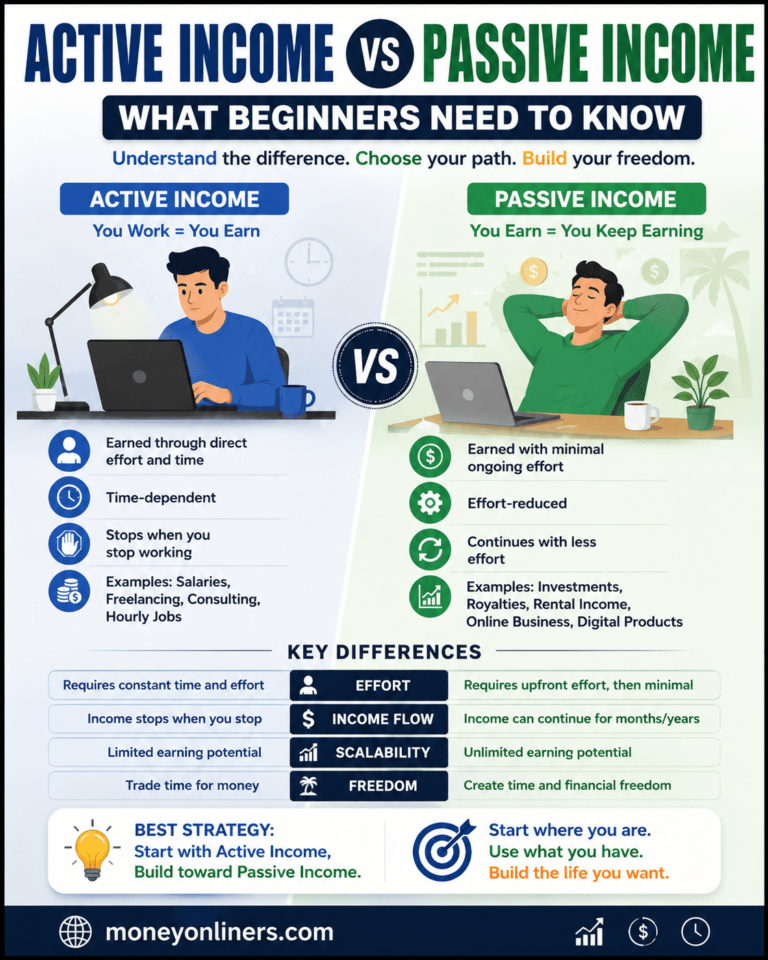
Active Income vs Passive Income: What Beginners Need to Know
Active Income vs Passive Income: What Beginners Need to Know | MoneyOnliners MoneyOnliners • Earn More → Income Building Active Income vs Passive Income: What Beginners Need to Know Most people begin by earning active income: a salary, hourly wage, freelance payment or business income that depends heavily on ongoing work. Passive income works differently….



One Comment