10 Passive Income Mistakes That Can Waste Your Time and Money
10 Passive Income Mistakes That Can Waste Your Time and Money
Building passive income can be worthwhile, but pursuing the wrong strategy can cost far more than money. You can spend months creating products nobody wants, chase dangerous investment yields, underestimate business expenses or build several income streams that never become profitable. Avoiding the wrong moves can be just as important as choosing the right passive-income idea.
The biggest passive income mistakes include expecting effortless income, chasing unusually high investment yields, risking emergency savings, creating products before validating demand, confusing revenue with profit, starting too many income streams, underestimating maintenance, depending on one platform, buying expensive tools too early and quitting reliable active income before passive income becomes stable. A stronger strategy is to start small, understand the economics, protect your financial foundation and scale only when real evidence shows that an income stream works.
Why Passive Income Mistakes Can Be Expensive
Passive income is often attractive because the goal sounds simple.
Build an asset.
Let the asset produce income.
Repeat.
However, the difficult part is deciding which assets deserve your money and time.
A failed investment can reduce your capital.
A failed digital product can consume weeks of work.
An unsuccessful website can require months of publishing without meaningful traffic.
A poorly analyzed rental property can create years of financial responsibility.
10 Passive Income Mistakes at a Glance
| # | Mistake | Main Risk | Better Approach |
|---|---|---|---|
| 1 | Expecting income with no work | Unrealistic expectations | Calculate setup and maintenance |
| 2 | Chasing the highest yield | Capital loss | Evaluate risk and sustainability |
| 3 | Using emergency money | Financial instability | Protect essential cash first |
| 4 | Building before validating demand | Wasted time and money | Test small first |
| 5 | Confusing revenue with profit | Overestimating earnings | Track all expenses |
| 6 | Starting too many income streams | Lack of focus | Build one strong asset first |
| 7 | Ignoring maintenance | Declining asset value | Budget for ongoing work |
| 8 | Depending on one platform | Platform risk | Build owned assets and diversification |
| 9 | Buying expensive tools too early | High startup costs | Validate before upgrading |
| 10 | Leaving active income too early | Cash-flow pressure | Require proven stability first |
1. Expecting Passive Income to Require No Work
One of the most damaging mistakes is assuming passive income means doing almost nothing.
What Actually Happens
The work usually occurs at a different stage.
Digital Products
You research, create, test and market the product before sales can become more automated.
Investment Income
You first need to build the capital that generates the income.
Rental Property
You must purchase, finance, insure and maintain the property.
Content Websites
You may publish for months before organic traffic becomes meaningful.
Ask how much work happens before income begins and how much maintenance continues afterward.

Calculate the Hidden Work Before Starting
| Passive-Income Asset | Upfront Work | Ongoing Work |
|---|---|---|
| Digital template | Research, design, testing | Support and updates |
| Ebook | Writing, editing, publishing | Marketing and updates |
| Online course | Planning and production | Support and revisions |
| Website | Content and SEO | Updates and maintenance |
| Rental property | Research and acquisition | Repairs and management |
| Investment portfolio | Capital accumulation | Periodic monitoring |
2. Chasing the Highest Investment Yield
High income yields can be tempting because they appear to reduce the amount of capital needed.
Consider a $6,000 Annual Income Goal
| Hypothetical Yield | Capital Needed for $6,000 |
|---|---|
| 3% | $200,000 |
| 4% | $150,000 |
| 6% | $100,000 |
| 10% | $60,000 |
| 15% | $40,000 |
The mathematics makes the higher yield look attractive.
However, risk generally matters more as the expected return rises.
High Yield May Indicate
- Financial distress
- A collapsing asset price
- High leverage
- Greater credit risk
- An unsustainable distribution
- Illiquidity
- Speculative investments
If the required yield becomes extreme, a safer response may be building more capital, extending the timeline or increasing active income—not accepting substantially more investment risk.

3. Using Emergency Savings to Build Passive Income
Investing money that may be needed for emergencies can create a serious mismatch.
Imagine This Situation
You have $5,000.
That is also your only emergency reserve.
You invest all of it because you want passive income.
The investment falls 30%.
Your balance is now approximately $3,500.
Then an urgent $4,000 expense appears.
You may be forced to sell during the decline or use expensive debt.
Money needed for near-term financial safety should not be forced into a long-term income strategy simply because passive income sounds attractive.
Before Risking Capital, Review
- Emergency savings
- Essential monthly expenses
- High-interest debt
- Upcoming major expenses
- Insurance needs
- Income stability
Passive Income Should Strengthen Financial Security
If building passive income makes you financially fragile, the strategy may be happening in the wrong order.
4. Creating a Product Before Validating Demand
This is one of the biggest time-wasting mistakes in online passive income.
The Wrong Sequence
- Choose a product idea.
- Spend three months creating it.
- Build a website.
- Buy expensive software.
- Launch.
- Discover nobody wants it.
A Better Sequence
- Identify a recurring problem.
- Research how people currently solve it.
- Talk to potential customers.
- Create the smallest useful version.
- Test whether anyone will pay.
- Improve based on feedback.
- Scale only after evidence appears.
Validate the Problem First
People do not buy products simply because they exist.
They buy solutions that feel useful enough to justify the price.
Instead of asking, “What digital product can I create?” ask, “What repeated problem can I solve in a reusable way?”

5. Confusing Revenue With Profit
A screenshot showing $10,000 in sales can look impressive.
However, sales revenue does not tell you what the owner actually kept.
Hypothetical Digital Business
| Item | Monthly Amount |
|---|---|
| Gross sales | $10,000 |
| Advertising | -$2,500 |
| Marketplace and payment fees | -$1,000 |
| Contractors | -$1,200 |
| Software | -$400 |
| Refunds | -$500 |
| Illustrative amount before taxes | $4,400 |
The business may still be profitable.
However, $10,000 in sales did not equal $10,000 in income available to spend.
The Same Problem Happens With Rentals
Gross rent is not net cash flow.
Repairs matter.
Insurance matters.
Vacancy matters.
Financing matters.
6. Starting Too Many Passive Income Streams at Once
Passive-income lists can make diversification sound like the first step.
A beginner may decide to start:
- A blog
- A YouTube channel
- An ebook
- A template shop
- An online course
- An affiliate business
- A print-on-demand store
The result can be seven unfinished projects.
Focus Before Diversification
Build one asset.
Get customers.
Understand the economics.
Improve the process.
Then consider another stream.
| Weak Approach | Stronger Approach |
|---|---|
| 7 unfinished ideas | 1 finished asset |
| No meaningful traffic | Focused audience building |
| No clear metrics | Trackable performance |
| Constant platform switching | Consistent execution |
| Learning everything at once | Deep skill development |
Diversify proven income streams—not unfinished experiments.
7. Underestimating Ongoing Maintenance
Passive assets can become less passive as they age.
A Website Can Need
- Content updates
- Plugin updates
- Security monitoring
- Broken-link repairs
- SEO improvements
- New internal links
A Course Can Need
- New screenshots
- Updated lessons
- Customer support
- Platform changes
Software Can Need
- Security updates
- Bug fixes
- Hosting
- Compatibility updates
- Customer support
A Rental Property Can Need
- Repairs
- Tenant management
- Insurance
- Legal compliance
- Vacancy management
A business can stop being profitable when maintenance costs rise faster than income.

8. Depending Entirely on One Platform
A third-party platform can make starting easier.
It can also create concentration risk.
Platforms Can Change
- Fees
- Algorithms
- Search visibility
- Affiliate commissions
- Seller requirements
- Monetization thresholds
- Account policies
Examples of Platform Dependence
A website can depend heavily on Google traffic.
A creator can depend heavily on YouTube recommendations.
An affiliate publisher can depend on one merchant.
A digital seller can depend on one marketplace.
Build Assets You Control
- Your website
- Your email list
- Your brand
- Your customer relationships
- Your original intellectual property
9. Buying Expensive Tools Before the Idea Works
New entrepreneurs sometimes spend money because buying tools feels like progress.
Possible Early Purchases
- Premium software
- Expensive themes
- Advanced automation tools
- Professional branding
- Large advertising campaigns
- High-cost courses
- Equipment upgrades
Some of these can become useful later.
However, they do not create customer demand automatically.
Start With the Minimum Useful Setup
Validate whether people want the solution.
Then upgrade tools when they solve a proven bottleneck.
Simple Example
A creator plans to sell a $15 budgeting template.
Before making the first sale, the creator spends $1,500 on branding, software and advertising.
The product eventually sells 20 copies.
Gross revenue is $300.
The business needs substantial additional sales merely to recover startup costs.
Key lesson: Keep experiments cheap until the market gives you evidence to invest more.
10. Quitting Reliable Active Income Too Early
A few successful months can make a new income stream feel permanent.
It may not be.
Online Income Can Fall Because
- Traffic declines
- Customers change
- Competition increases
- Advertising becomes more expensive
- Affiliate programs change
- Products become outdated
Investment Income Can Fall Because
- Dividends are reduced
- Interest rates change
- Portfolio values decline
- Businesses experience financial stress
Before Depending Completely on Passive Income, Consider
- Income consistency
- Emergency reserves
- Taxes
- Health insurance or benefits
- Debt obligations
- Dependents
- Business expenses
- Worst-case income declines
Let passive income prove its reliability before allowing it to carry essential financial obligations.

Real-Life Example: The Expensive Passive-Income Experiment
A Beginner Builds Too Much Before Testing
A fictional creator wants to build passive income through an online course.
Before speaking with potential customers, the creator purchases expensive recording equipment.
Next, a premium course platform is purchased.
Professional branding is commissioned.
Then 30 video lessons are recorded.
After launch, only three customers buy.
What Went Wrong?
The creator optimized production before validating demand.
A small workshop, short guide or mini-course could have tested the topic first.
Key lesson: Do not build the expensive version before the inexpensive version proves people care.
Mini Case Study: The High-Yield Trap
$50,000 With a $500 Monthly Income Goal
A fictional investor has $50,000.
The investor wants $6,000 a year in passive income.
That requires a 12% annual cash yield.
$6,000 ÷ $50,000 = 12%
Instead of recognizing that the income target is aggressive relative to the portfolio size, the investor begins selecting securities based almost entirely on yield.
Several distributions are later reduced.
One investment also experiences a substantial capital loss.
Key lesson: When the target requires extreme yield, reconsider the target, capital amount or timeframe before increasing risk.
How to Evaluate a Passive-Income Idea Before Spending Money
| Question | What It Reveals |
|---|---|
| What problem does this solve? | Customer demand |
| Who pays for the solution? | Target market |
| What is the cheapest way to test it? | Validation strategy |
| How much startup money is required? | Capital risk |
| How many hours must I invest? | Time cost |
| What expenses continue monthly? | Profitability |
| What could reduce the income? | Risk |
| Does one platform control the business? | Platform concentration |
| How much maintenance remains? | True passivity |
| What must happen to break even? | Economic feasibility |
Calculate Break-Even Before You Build
Suppose your startup cost is $600.
Your product generates $20 of net profit per sale.
$600 ÷ $20 = 30 sales to recover the initial cost
That does not mean the idea is bad.
However, now you know what success must look like before generating actual profit.
A Safer Passive-Income Roadmap
| Stage | Action |
|---|---|
| 1 | Protect essential expenses |
| 2 | Build appropriate emergency savings |
| 3 | Address expensive debt |
| 4 | Strengthen active earning power |
| 5 | Choose one income asset |
| 6 | Test with limited capital |
| 7 | Track actual profit |
| 8 | Improve the system |
| 9 | Automate repetitive work |
| 10 | Diversify after the model works |
Passive Income Mistakes Checklist
- I understand the work required before income begins.
- I understand the maintenance required afterward.
- I am not chasing an investment simply because the yield is high.
- I have protected emergency savings.
- I validated customer demand before major spending.
- I track profit rather than revenue alone.
- I am focusing on one strong system before expanding.
- I understand platform concentration risk.
- I am not buying expensive tools simply because they look professional.
- I understand applicable taxes and fees.
- I know what could cause the income stream to fail.
- I am not treating passive income as guaranteed.
- I am not planning essential expenses around unproven income.
- I have a realistic timeframe.
Continue Learning on MoneyOnliners
Recommended External Resources
Federal Trade Commission — Avoid Income Scams
How to Avoid Income Scams — Federal Trade Commission
Federal Trade Commission — Business Opportunity Scams
When a Business Offer or Coaching Program Is a Scam — FTC
Investor.gov — Understanding Investment Risk
Investor.gov — Five Questions Before You Invest
Five Questions to Ask Before You Invest — Investor.gov
IRS — Self-Employed Individuals Tax Center
Self-Employed Individuals Tax Center — IRS
This article provides general educational information and is not individualized financial, investment, tax, legal or business advice. Passive income is not guaranteed. Investments can lose value, businesses can fail, rental properties can generate unexpected expenses, customers can disappear and platforms can change their rules. Evaluate the risks, costs and legal requirements before committing significant money or time.
Frequently Asked Questions
What are the biggest passive income mistakes?
Major mistakes include expecting effortless income, chasing high yields, investing emergency savings, failing to validate demand, ignoring expenses and trying to build too many income streams simultaneously.
What is the biggest passive income mistake for beginners?
One of the biggest is assuming passive income should become profitable quickly with little work.
That expectation can lead to poor decisions and unnecessary spending.
Is passive income guaranteed?
No.
Investments, businesses, rental properties and online assets can all produce less income than expected.
Why is chasing high yield dangerous?
An unusually high yield may reflect greater financial risk, a falling asset price or an unsustainable distribution.
Should I invest my emergency fund for passive income?
Money needed for essential near-term emergencies generally needs stability and access rather than significant investment risk.
Should I build a product before finding customers?
Usually, testing customer demand first can reduce the risk of spending months building something people do not want.
What does validating demand mean?
It means gathering evidence that real potential customers have the problem and are interested in paying for a solution.
Is revenue the same as profit?
No.
Revenue is money received before expenses.
Profit is what remains after relevant costs.
Why do passive-income businesses still have expenses?
Costs may include software, hosting, advertising, marketplace fees, contractors, repairs, refunds and taxes.
How many passive-income streams should beginners build?
There is no required number.
Building one functioning asset before adding another can often make execution easier.
Is diversification still important?
Yes, particularly in investing.
However, business diversification is more useful after you have functioning systems rather than many unfinished experiments.
Is rental property truly passive?
Usually only partially.
Vacancies, repairs, taxes, insurance and management can continue.
Are digital products passive income?
They can become semi-passive because the same product may be sold repeatedly.
However, marketing, support and updates often remain.
Is blogging passive income?
Evergreen content can continue attracting visitors and revenue after publication.
Nevertheless, websites require ongoing updates and technical maintenance.
Can affiliate marketing disappear?
Yes.
Merchants can change commissions or close affiliate programs, while website traffic can also decline.
Is depending on one platform risky?
Yes.
A platform can change pricing, policies, algorithms or account rules.
Should beginners buy premium software immediately?
Not necessarily.
Validate the idea first and upgrade tools when they solve a real limitation.
Are expensive courses necessary for passive income?
No.
Education can be useful, but expensive programs do not guarantee profitable outcomes.
Should I quit my job once passive income starts?
Not simply because the income appears for a few months.
Consider stability, emergency savings, taxes, benefits and potential income declines.
Can passive income disappear?
Yes.
Dividends can fall, customers can stop buying, tenants can leave and search traffic can decline.
How do I reduce the risk of wasting money?
Start with small tests, keep startup costs controlled, understand the business model and scale after evidence appears.
How do I reduce the risk of wasting time?
Validate the customer problem before building a large product or content system.
What should I track?
Track revenue, expenses, profit, time spent, customer acquisition, conversion, maintenance and recurring costs.
How long should passive income take?
There is no standard timeframe.
Some assets may produce income quickly, while others take months or years.
What is a better passive-income goal?
Rather than chasing effortless money, build assets that can eventually produce additional income with less direct labor while strengthening your overall financial position.
Research Methodology
This MoneyOnliners guide evaluates passive-income mistakes according to four potential losses: financial capital, time, earning opportunity and long-term financial stability.
Investment-related mistakes focus on unrealistic yield expectations, concentration risk and the danger of using money needed for short-term financial security.
Business-related mistakes focus on customer-demand validation, startup costs, recurring expenses, platform dependence and the difference between revenue and actual profit.
Digital passive-income models are treated as semi-passive when continued marketing, customer service, product updates or technical maintenance remains necessary.
The guide also considers opportunity cost because months spent building an unwanted product can have real economic value even if relatively little cash was spent.
All income figures, calculations and case studies are hypothetical educational illustrations.
No investment yield, product sale, business revenue or passive-income result is guaranteed.
The central editorial principle is to protect financial stability first, validate cheaply, measure realistic net results and scale only after evidence supports the decision.
Final Thoughts: Protect Your Time and Money Before Chasing Passive Income
Passive income can be useful.
However, the wrong strategy can become expensive very quickly.
Do Not Chase Effortless Income
Understand the setup work first.
Do Not Chase Yield
Understand why an investment produces the return it advertises.
Do Not Risk Financial Safety
Protect emergency money and essential expenses.
Do Not Build Before Testing
Find evidence of demand before spending months creating a product.
Do Not Celebrate Revenue Without Expenses
What remains after costs matters more than the sales screenshot.
Do Not Build Everything at Once
One strong income-producing asset can be more useful than ten unfinished ideas.
Do Not Assume the Asset Will Maintain Itself Forever
Websites change.
Software changes.
Customers change.
Markets change.
Build Slowly Enough to Learn
Test.
Measure.
Improve.
Automate.
Then scale.
Ultimately, avoiding these passive income mistakes can protect two of your most important financial resources: your money and your time.
You do not need the fastest passive-income strategy.
You need one that makes financial sense, solves a real problem, survives realistic expenses and can still be worth owning years from now.
Similar Posts
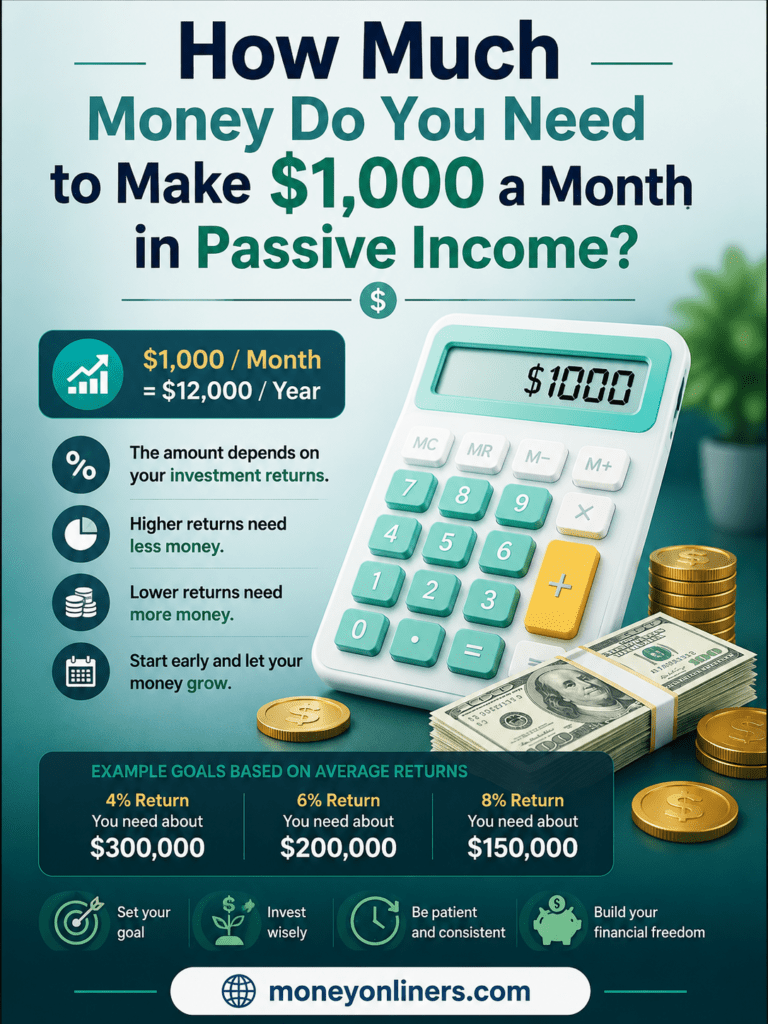
How Much Money Do You Need to Make $1,000 a Month in Passive Income?
How Much Money Do You Need to Make $1,000 a Month in Passive Income? | MoneyOnliners MoneyOnliners • Passive Income → Financial Freedom How Much Money Do You Need to Make $1,000 a Month in Passive Income? One thousand dollars a month in passive income sounds like a clear goal. The harder question is how…
Passive Income vs Side Hustle: Which Is Better for Building Extra Income?
Passive Income vs Side Hustle: Which Is Better for Building Extra Income? | MoneyOnliners MoneyOnliners • Extra Income → Long-Term Growth Passive Income vs Side Hustle: Which Is Better for Building Extra Income? A side hustle can help you earn extra money relatively quickly by selling your time, skills or services. Passive income can potentially…
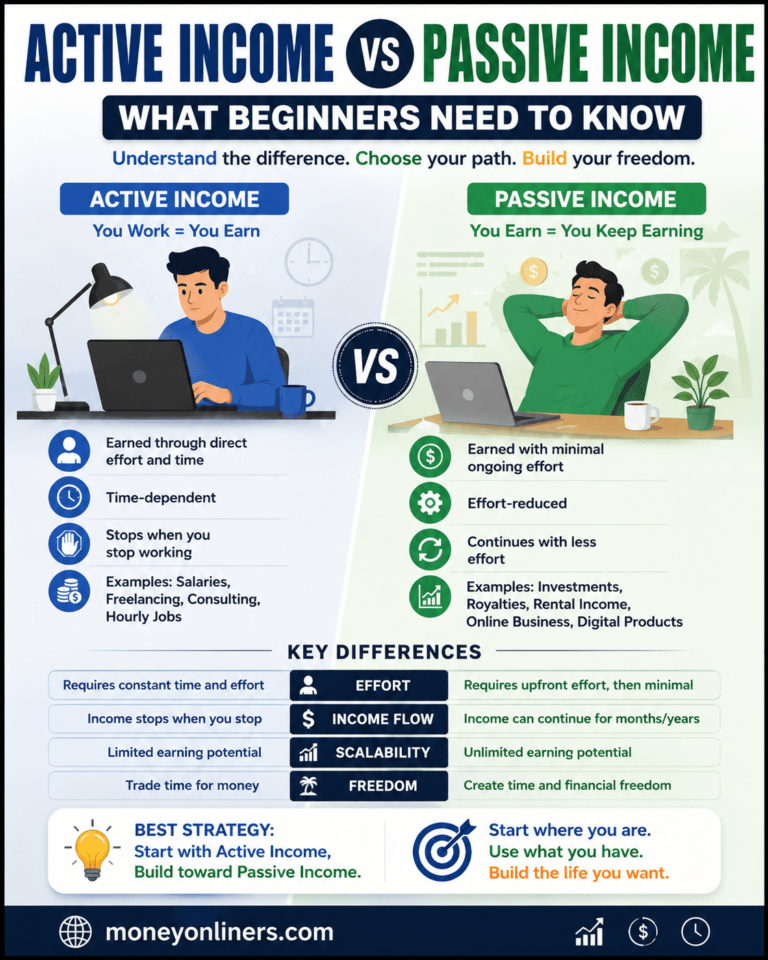
Active Income vs Passive Income: What Beginners Need to Know
Active Income vs Passive Income: What Beginners Need to Know | MoneyOnliners MoneyOnliners • Earn More → Income Building Active Income vs Passive Income: What Beginners Need to Know Most people begin by earning active income: a salary, hourly wage, freelance payment or business income that depends heavily on ongoing work. Passive income works differently….
10 Online Passive Income Ideas You Can Build From Home
10 Online Passive Income Ideas You Can Build From Home | MoneyOnliners MoneyOnliners • Earn More → Online Income 10 Online Passive Income Ideas You Can Build From Home The internet makes it possible to build income-producing assets without renting an office, buying large amounts of inventory or commuting to another workplace. However, online passive…
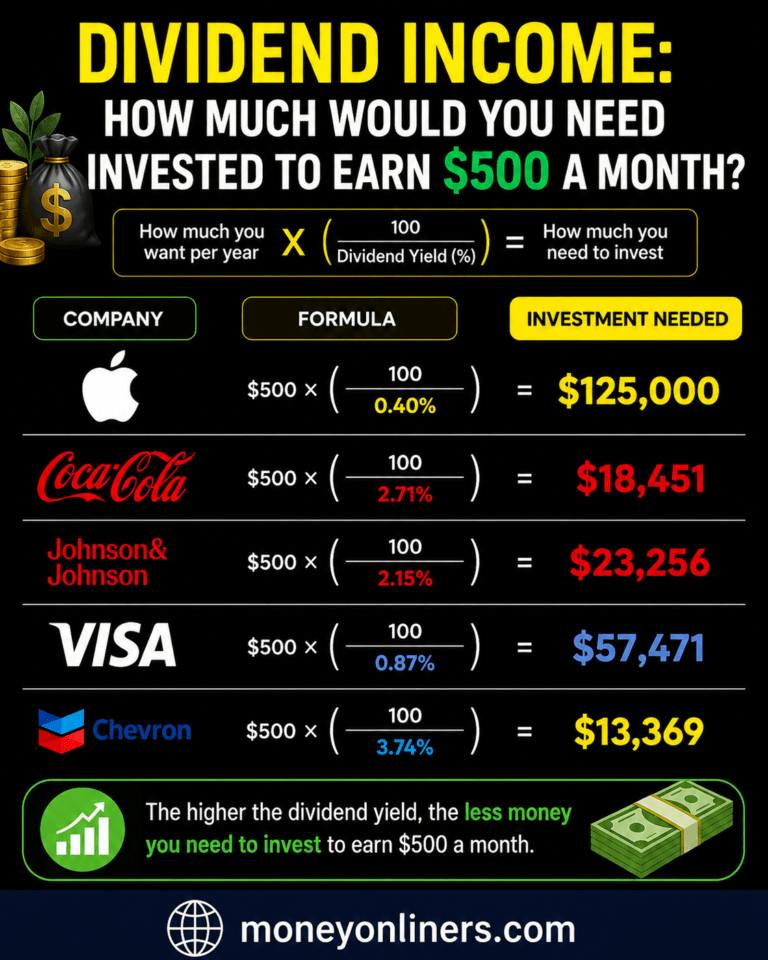
Dividend Income: How Much Would You Need Invested to Earn $500 a Month?
Dividend Income: How Much Would You Need Invested to Earn $500 a Month? | MoneyOnliners MoneyOnliners • Passive Income → Investing Dividend Income: How Much Would You Need Invested to Earn $500 a Month? Five hundred dollars a month in dividend income equals $6,000 a year. The amount you need invested depends heavily on your…
15 Passive Income Ideas You Can Start With Little Money
15 Passive Income Ideas You Can Start With Little Money | MoneyOnliners MoneyOnliners • Earn More → Passive Income 15 Passive Income Ideas You Can Start With Little Money You do not always need thousands of dollars to begin building an income-producing asset. Some passive income ideas require more time, creativity and skill than cash….