How Much Money Do You Need to Make $1,000 a Month in Passive Income?
How Much Money Do You Need to Make $1,000 a Month in Passive Income?
One thousand dollars a month in passive income sounds like a clear goal. The harder question is how much money, work or income-producing assets you need to create it. If the entire $1,000 comes from investments, the required capital can be substantial. If part comes from digital products, rental cash flow or online assets, the starting capital may be lower—but the work and business risk may be much higher.
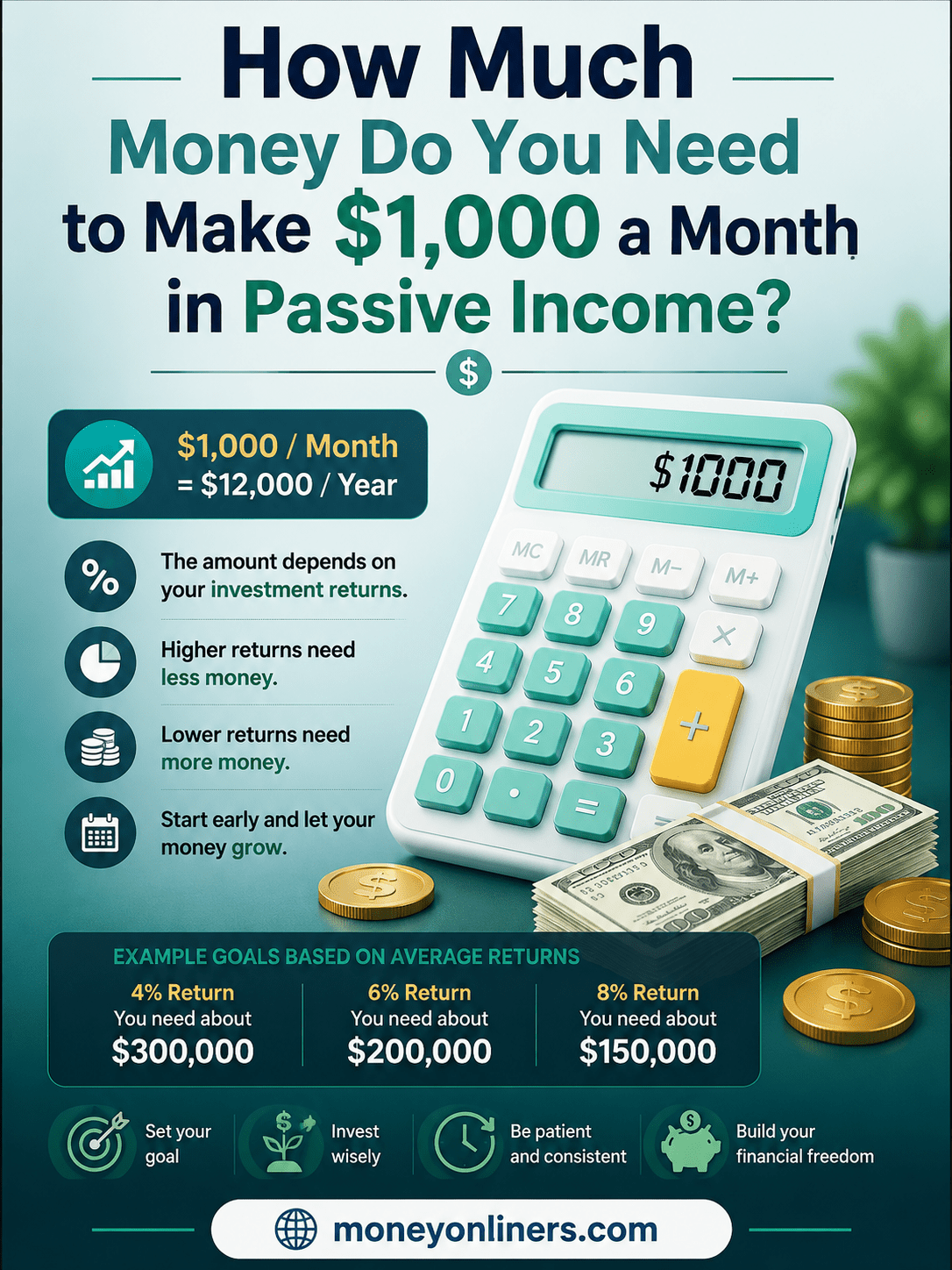
To make $1,000 per month in passive income, you need approximately $12,000 of annual net income. If that income came entirely from an investment yielding a hypothetical 4% annually, you would mathematically need about $300,000. At 5%, you would need about $240,000. At 6%, about $200,000. At 8%, about $150,000. However, higher yields usually involve additional risk, distributions can change, taxes and fees reduce what you keep, and investment values can fall. Alternatively, a combination of investments, rental cash flow and digital assets may reach $1,000 per month with less financial capital but more work and business risk.
First, Turn $1,000 a Month Into an Annual Goal
The first calculation is simple.
$1,000 × 12 months = $12,000 per year
Therefore, your income-producing assets need to generate approximately $12,000 per year before considering whether taxes, fees and expenses must also be covered.
Gross Income vs Spendable Income
If you want to actually spend $1,000 every month, your assets may need to generate more than $12,000 annually.
Taxes can reduce investment income.
Rental properties have expenses.
Digital businesses have platform and operating costs.
Therefore, $12,000 should often be viewed as the minimum gross target rather than automatically the amount you keep.
How Much Capital Do You Need at Different Yields?
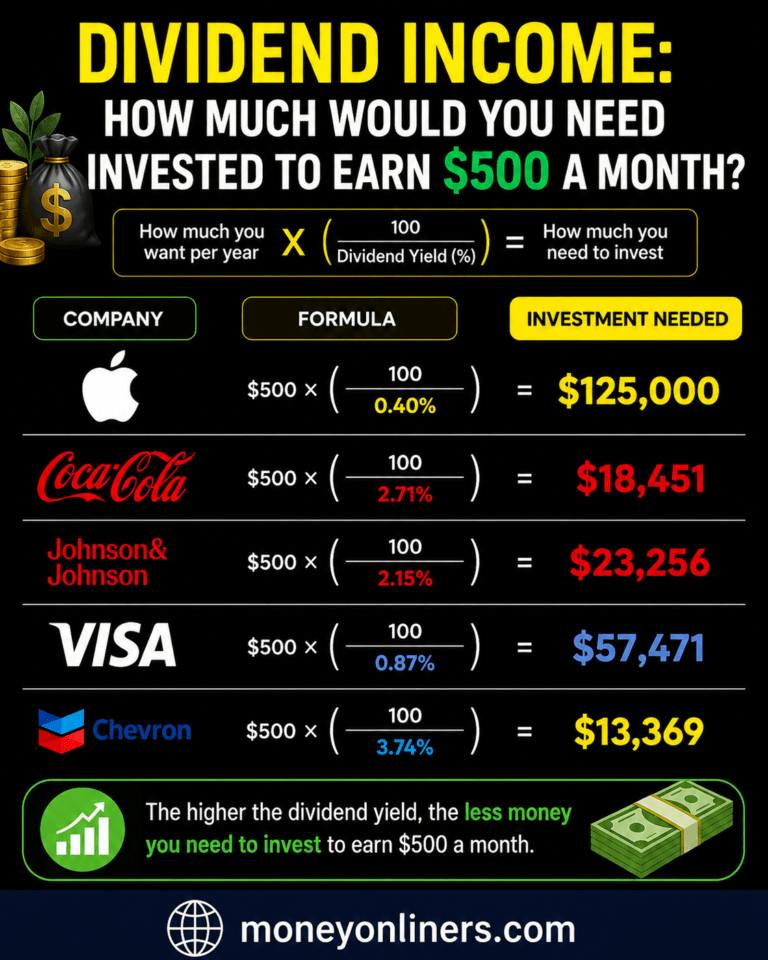
The mathematical formula is:
Required Capital = Annual Income Goal ÷ Annual Yield
For a $12,000 annual income goal:
| Hypothetical Annual Yield | Capital Needed for $12,000/Year | Approximate Monthly Income |
|---|---|---|
| 2% | $600,000 | $1,000 |
| 3% | $400,000 | $1,000 |
| 4% | $300,000 | $1,000 |
| 5% | $240,000 | $1,000 |
| 6% | $200,000 | $1,000 |
| 7% | About $171,429 | $1,000 |
| 8% | $150,000 | $1,000 |
| 10% | $120,000 | $1,000 |
| 12% | $100,000 | $1,000 |
A 10% or 12% income yield may look attractive because it dramatically reduces the capital required.
However, high yields can signal higher investment risk, unstable distributions, distressed assets or possible loss of principal.
Never choose an investment only because a calculator shows that a larger yield requires less money.
Why Higher Yield Does Not Mean Better Passive Income
Imagine two investments.
Investment A produces a hypothetical 4% annual cash yield.
Investment B advertises 12%.
At first glance, Investment B appears far better.
However, you still need to ask why the yield is so much higher.
A Higher Yield May Reflect
- Greater credit risk
- Greater market volatility
- Higher leverage
- Financial distress
- A declining asset price
- A distribution that may be reduced
- Lower liquidity
- Greater business uncertainty
Investor.gov emphasizes that all investments involve risk and that investors generally expect greater potential returns only when accepting greater uncertainty or financial risk.
Do not ask only, “What yield can I get?” Ask, “What risks must I accept to receive that yield, and is the income sustainable?”
1. How Much Would You Need in a Savings Account?
Suppose a savings account earns a hypothetical 4% annual percentage yield.
To generate $12,000 per year mathematically:
$12,000 ÷ 0.04 = $300,000
At a hypothetical 5% rate:
$12,000 ÷ 0.05 = $240,000
But Savings Rates Change
A bank can change the interest rate on a variable-rate savings account.
Therefore, the same $240,000 may not continue generating $1,000 per month indefinitely.
Taxes Matter Too
Interest income may be taxable depending on your country and circumstances.
If you need $1,000 after taxes, the required balance may be higher.
Savings-account rates, deposit insurance, tax treatment and account availability vary significantly by institution and country.
2. How Much Would You Need From Bonds?
Bonds generally involve lending money to a government, corporation or another issuer.
The issuer may make scheduled interest payments and repay principal according to the bond's terms.
Hypothetical Examples
| Income Yield | Approximate Capital Needed |
|---|---|
| 3% | $400,000 |
| 4% | $300,000 |
| 5% | $240,000 |
| 6% | $200,000 |
Bonds Are Not Risk-Free
Investor.gov identifies several important bond risks.
- Credit risk
- Interest-rate risk
- Inflation risk
- Liquidity risk
- Call risk
A bond promising substantially more income may involve substantially greater credit or market risk.

3. How Much Would You Need in Dividend Stocks?
Dividend stocks can distribute part of a company's earnings or available cash to shareholders.
However, companies do not guarantee dividends forever.
Dividends can be reduced.
They can be suspended.
The share price can also fall substantially.
Hypothetical Dividend Portfolio
| Dividend Yield | Approximate Portfolio Needed |
|---|---|
| 2% | $600,000 |
| 3% | $400,000 |
| 4% | $300,000 |
| 5% | $240,000 |
| 6% | $200,000 |
Do Not Chase Dividend Yield
A very high dividend yield can sometimes result from a sharply falling share price.
That may indicate financial difficulty rather than a wonderful income opportunity.
Passive income is not successful if you collect a high dividend while the underlying investment suffers severe permanent losses.
Dividend Income vs Total Return
Income is only one part of an investment's result.
Suppose an investment pays 6% in distributions but falls 20% in market value.
Looking only at the income would hide an important part of the financial outcome.
Therefore, investors should also consider total return.
4. How Much Would You Need in Dividend ETFs?
A dividend-focused ETF can hold many dividend-paying companies in one fund.
This may make diversification easier than depending on one company's dividend.
Illustrative Capital Requirements
| Hypothetical Fund Yield | Capital Needed |
|---|---|
| 3% | $400,000 |
| 4% | $300,000 |
| 5% | $240,000 |
But ETFs Still Carry Risk
The fund's share price can fall.
Its distributions can change.
The expense ratio reduces returns.
Some dividend ETFs may also concentrate heavily in specific industries.
Check holdings, sector concentration, distribution history, expense ratio and the fund's investment objective.
5. How Much Would You Need in REITs?
Real estate investment trusts can provide investors with exposure to income-producing property without requiring them to purchase an entire building directly.
Publicly traded REITs may distribute significant portions of their taxable income to shareholders.
Investor.gov notes that publicly traded REITs can provide regular dividend payments but also carry market and real-estate risks.
Illustrative REIT Income
| Hypothetical Distribution Yield | Approximate Capital Needed |
|---|---|
| 4% | $300,000 |
| 5% | $240,000 |
| 6% | $200,000 |
| 8% | $150,000 |
REIT Risks Matter
- Property-market declines
- Higher borrowing costs
- Interest-rate changes
- Tenant vacancies
- Sector concentration
- Distribution reductions
- Management decisions
Investor.gov warns that non-traded REITs can involve limited liquidity, difficult valuation, conflicts of interest and distributions that may partly come from offering proceeds or borrowed money rather than operating performance.

6. How Much Rental Property Do You Need for $1,000 a Month?
Rental-property income requires a different calculation.
You cannot simply look at the property's rent.
You need the amount remaining after expenses.
Example: One Property Renting for $1,800
| Item | Hypothetical Monthly Amount |
|---|---|
| Gross rent | $1,800 |
| Mortgage payment | -$600 |
| Taxes and insurance reserve | -$220 |
| Maintenance reserve | -$150 |
| Vacancy reserve | -$100 |
| Property management | -$130 |
| Illustrative monthly cash flow | $600 |
In this hypothetical example, one property does not produce $1,000 per month of net income.
Two similar properties might produce more than $1,000 before taxes—but actual property results vary dramatically.
Mortgage rates, taxes, insurance, repairs, vacancy, utilities, local laws and property prices vary widely. Do not use this example to estimate a real property without local numbers.
The Rental Property Formula
Net Rental Income = Rent − All Operating Costs − Financing Costs
Use net cash flow rather than gross rent when targeting $1,000 a month.
7. How Much Money Do You Need With Digital Products?
Digital products change the question.
Instead of requiring hundreds of thousands of dollars of investment capital, they can require more time, skills and customer acquisition.
Example: A $20 Digital Product
Ignoring costs for a moment:
$1,000 ÷ $20 = 50 sales per month
However, the real business calculation must account for fees and expenses.
Suppose You Keep $15 Per Sale
$1,000 ÷ $15 ≈ 67 sales per month
That is roughly two to three sales per day.
Possible Digital Products
- Templates
- Ebooks
- Printables
- Online courses
- Downloadable guides
- Business resources
- Digital tools
Investment passive income tends to require more capital. Digital passive income can require less capital but considerably more upfront work, marketing and business execution.
8. How Much Website Traffic Might You Need?
There is no universal answer.
Website revenue depends on monetization method, audience, country, topic and conversion rate.
For Example
Advertising income depends on pageviews and advertising rates.
Affiliate revenue depends on clicks and conversions.
Digital-product revenue depends on customer demand and pricing.
A Better Formula
Traffic × Conversion Rate × Profit Per Conversion = Income
Suppose a website receives 20,000 qualified visitors per month.
If 1% buy a product that produces $5 of net profit, the result would be:
20,000 × 1% × $5 = $1,000
Actual conversion rates can be dramatically higher or lower. Traffic alone does not guarantee income.

9. How Much Affiliate Traffic Might You Need?
Again, the exact answer depends on economics.
Example
Suppose an affiliate program pays an average $25 commission.
$1,000 ÷ $25 = 40 qualifying conversions per month
If 5% of referred visitors convert:
40 ÷ 5% = 800 referred visitors
However, that does not mean you only need 800 website visitors.
Only a portion of readers may click the affiliate link.
Merchant conversion rates can change.
Commissions can be reduced.
Affiliate Income Is Not Guaranteed
A merchant can close its program.
Search traffic can fall.
Customers can choose different products.
Therefore, affiliate revenue should not be treated like fixed interest.
10. Could Several Income Streams Reach $1,000 Together?
Yes.
This may be more realistic than expecting one small asset to generate the entire amount.
Hypothetical Mixed Passive-Income Portfolio
| Income Source | Monthly Net Income |
|---|---|
| Investment distributions | $250 |
| Digital products | $300 |
| Affiliate content | $200 |
| Rental/storage income | $150 |
| Interest income | $100 |
| Total | $1,000 |
These amounts are not expected results. Each source can fluctuate, decline or disappear.
Why Diversification Can Help
If one source weakens, another may continue.
However, multiple income streams also require more administration.
How Long Could It Take to Build Enough Capital?
If your goal is investment-based passive income, you may need years of saving and investing before the portfolio becomes large enough.
Example: Building Toward $300,000
Suppose you eventually want a $300,000 portfolio because a hypothetical 4% income rate would mathematically equal $12,000 annually.
Your path may involve regular monthly contributions and long-term investment growth.
Your Monthly Contributions Matter
| Monthly Contribution | Annual Contributions | 10 Years of Contributions | 20 Years of Contributions |
|---|---|---|---|
| $100 | $1,200 | $12,000 | $24,000 |
| $250 | $3,000 | $30,000 | $60,000 |
| $500 | $6,000 | $60,000 | $120,000 |
| $1,000 | $12,000 | $120,000 | $240,000 |
This table does not include investment gains, losses, fees or taxes.
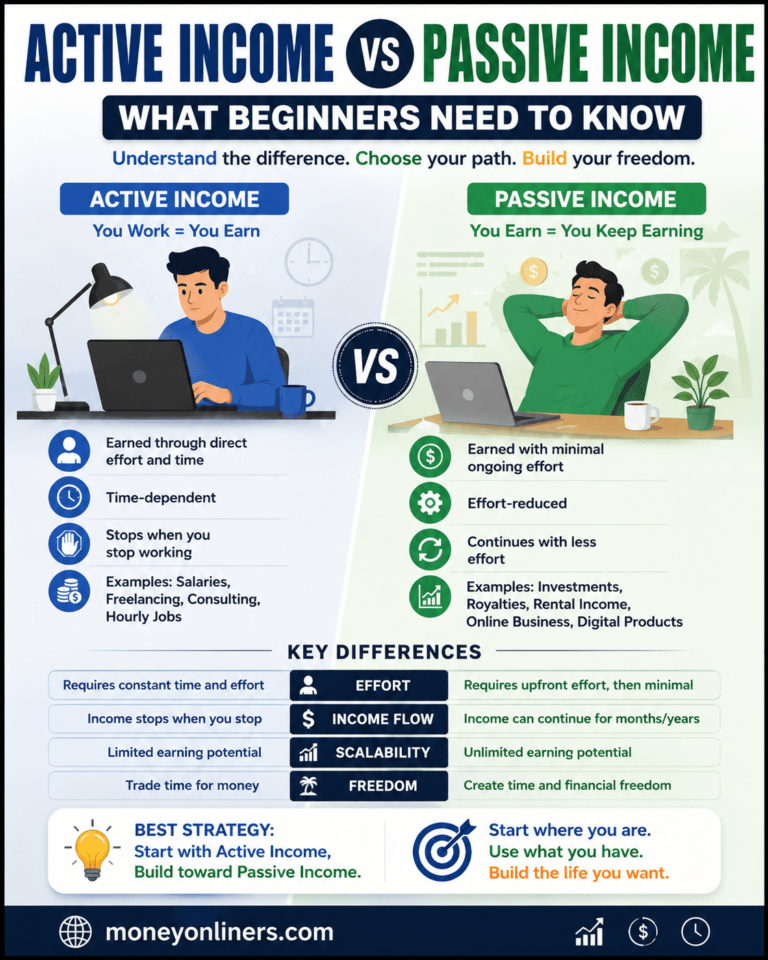
Why Increasing Active Income Can Matter
A higher salary or profitable side hustle can increase the amount available to invest each month.
That may accelerate the journey toward income-producing assets more reliably than simply searching for higher-yield investments.
You often have more control over how much you save and invest than over what return the market gives you.
Real-Life Example: Trying to Create $1,000 From $10,000
The Yield Problem
A fictional beginner has $10,000 and wants $1,000 per month in passive investment income.
That means the portfolio would need to generate $12,000 annually.
The required annual yield would be:
$12,000 ÷ $10,000 = 120%
That expectation is extremely unrealistic for conventional passive investing.
The investor begins finding online offers promising 10% every month.
Instead of assuming those offers solve the problem, he recognizes that the target income is far too large relative to his current capital.
He changes the plan.
He continues building active income, saves more aggressively and gradually grows his investment assets.
Key lesson: When the income goal is too large relative to your capital, the solution is usually more capital, more time or additional productive work—not extreme investment risk.
Case Study: $50,000 Portfolio
What Yield Would $50,000 Need?
To generate $12,000 per year:
$12,000 ÷ $50,000 = 24%
That means a $50,000 portfolio would need a 24% annual cash yield to generate $1,000 each month without using principal.
A yield that high should immediately raise questions about sustainability and risk.
Key lesson: Smaller portfolios generally produce smaller sustainable income unless you accept more risk, contribute labor or consume principal.

How Much Capital Would Different Monthly Income Goals Need?
Using a hypothetical 4% annual income rate:
| Monthly Passive Income Goal | Annual Goal | Capital Needed at 4% |
|---|---|---|
| $100/month | $1,200 | $30,000 |
| $250/month | $3,000 | $75,000 |
| $500/month | $6,000 | $150,000 |
| $750/month | $9,000 | $225,000 |
| $1,000/month | $12,000 | $300,000 |
| $2,000/month | $24,000 | $600,000 |
| $3,000/month | $36,000 | $900,000 |
| $5,000/month | $60,000 | $1,500,000 |
A 4% income rate is a hypothetical calculation tool, not a guaranteed safe withdrawal rate, guaranteed yield or MoneyOnliners investment recommendation.
Income Yield vs Withdrawal Rate
These two concepts should not be confused.
Income Yield
Income yield refers to interest, dividends, distributions or other income generated by an asset relative to its value.
Withdrawal Rate
A withdrawal rate describes how much money you remove from a portfolio, which can include both investment income and sale of principal.
If your portfolio yields only 2% but you withdraw 4%, part of the money may need to come from selling assets.
Should You Spend All the Passive Income?
Not necessarily.
Reinvesting some income can help the underlying asset grow.
Why Reinvestment Matters
If every dollar is withdrawn immediately, the portfolio receives less benefit from compound growth.
During the building stage, reinvestment can accelerate progress.
Building Stage vs Income Stage
| Stage | Typical Goal |
|---|---|
| Building stage | Reinvest income and continue adding capital |
| Transition stage | Use some income while continuing growth |
| Income stage | Use more portfolio income for living expenses |
The appropriate approach depends on your financial goal and circumstances.
Taxes Can Increase the Required Amount
If your goal is to spend $12,000 annually after taxes, you may need more than $12,000 of gross income.
Simple Illustration
Suppose your effective tax burden on an income source were hypothetically 20%.
To keep $12,000:
$12,000 ÷ 0.80 = $15,000 gross income required
At a hypothetical 4% yield:
$15,000 ÷ 0.04 = $375,000
The 20% rate is hypothetical. Tax treatment varies significantly by investment type, business activity, account type, country and individual circumstances.
Inflation Changes the Goal Over Time
One thousand dollars today will not necessarily buy the same amount of goods and services 20 years from now.
Therefore, a long-term passive-income goal should account for rising living costs.
The Goal May Need to Grow
If you build toward a fixed $1,000 monthly income target for several decades, the purchasing power of that $1,000 may be substantially lower by the time you reach it.
This is another reason growth matters in addition to current income.
Do You Need $300,000 to Make $1,000 a Month?
No.
You need approximately $300,000 only if your income comes entirely from assets producing a hypothetical 4% annual cash yield.
Different income models have different capital requirements.
| Model | Capital Requirement | Work Requirement |
|---|---|---|
| Savings interest | High | Very Low |
| Bonds | High | Low |
| Dividend investments | High | Low–Moderate |
| REITs | High | Low–Moderate |
| Rental property | Moderate–High | Moderate |
| Affiliate website | Low–Moderate | High |
| Digital products | Low | High |
| Online course | Low–Moderate | High |
| Software | Low–High | Very High |
10 Mistakes to Avoid When Targeting $1,000 a Month
1. Chasing the Highest Yield
Higher yields can come with greater risk.
2. Assuming Distributions Never Change
Dividends and other payouts can be reduced.
3. Ignoring Taxes
Your spendable income may be lower than gross income.
4. Ignoring Fees
Investment and business expenses reduce net income.
5. Confusing Rent With Rental Profit
Subtract financing, repairs, vacancies, taxes and management.
6. Confusing Revenue With Digital-Business Profit
Platform fees, software and advertising can consume revenue.
7. Expecting $10,000 to Safely Produce $1,000 Every Month
That would require unrealistic conventional investment returns.
8. Risking Emergency Savings
Long-term income goals should not destroy short-term financial security.
9. Depending on One Income Source
One company, tenant, platform or website can fail.
10. Ignoring Active Income
Increasing the amount you can save and invest may be more powerful than searching endlessly for higher yields.
Be highly skeptical of anyone claiming a relatively small investment can reliably generate $1,000 every month with guaranteed returns and little or no risk.
$1,000 Monthly Passive Income Checklist
- I know that $1,000 monthly equals $12,000 annually.
- I distinguish gross income from net income.
- I understand the yield required for my capital amount.
- I know that higher yields generally involve more risk.
- I have considered taxes.
- I have considered investment or business fees.
- I have considered inflation.
- I understand what can cause the income to decline.
- I am not risking essential emergency money.
- I understand the underlying investment or business.
- I have considered diversification.
- I know whether I will reinvest some income.
- I am building the goal gradually rather than chasing shortcuts.
Continue Learning on MoneyOnliners
Recommended External Resources
Investor.gov — Understanding Investment Risk
Investor.gov — Bonds
Investor.gov — Bond Funds and Income Funds
Bond Funds and Income Funds — Investor.gov
Investor.gov — Real Estate Investment Trusts
Real Estate Investment Trusts (REITs) — Investor.gov
This article provides general educational information and is not individualized financial, investment, tax, business or legal advice. All yields, rental examples, business calculations and income scenarios are hypothetical illustrations. Interest rates and investment distributions can change. Investments can lose value, businesses can lose money, rental properties can have vacancies and expenses, and taxes can reduce the amount of income available to spend.
Frequently Asked Questions
How much money do you need to make $1,000 a month in passive income?
It depends on the income source.
At a hypothetical 4% annual yield, approximately $300,000 would mathematically generate $12,000 per year before taxes and fees.
How much do I need at 3%?
Approximately $400,000.
How much do I need at 4%?
Approximately $300,000.
How much do I need at 5%?
Approximately $240,000.
How much do I need at 6%?
Approximately $200,000.
How much do I need at 7%?
Approximately $171,429.
How much do I need at 8%?
Approximately $150,000.
How much do I need at 10%?
Approximately $120,000.
However, a 10% cash yield should not be assumed to be sustainable or low risk.
Can $100,000 produce $1,000 a month?
It would need to generate approximately 12% annually before taxes and fees.
That level of income generally involves significantly more risk than lower-yielding conventional investments.
Can $50,000 produce $1,000 a month?
It would require approximately 24% annual income.
That is not a realistic low-risk passive-investing assumption.
Can $10,000 make $1,000 per month?
Not through conventional low-risk passive investing.
The required annual income rate would be 120%.
How much money do I need in dividend stocks for $1,000 a month?
At a hypothetical 4% dividend yield, approximately $300,000.
At 5%, approximately $240,000.
Dividends are not guaranteed.
How much money do I need in REITs?
The calculation depends on the distribution yield.
At 5%, approximately $240,000 would mathematically generate $12,000 annually.
REIT distributions and share values can change.
How much money do I need in bonds?
At a hypothetical 4% income yield, approximately $300,000.
Bonds also carry credit, interest-rate and inflation risks.
How much money do I need in savings?
At a hypothetical 4% rate, approximately $300,000.
However, savings rates can change.
Can rental property make $1,000 per month?
Yes, potentially.
However, calculate income after mortgage costs, taxes, insurance, repairs, vacancies and management.
Can digital products make $1,000 per month?
Potentially.
The amount depends on product pricing, net profit per sale, traffic and customer demand.
How many $20 products do I need to sell?
At $20 of net profit per sale, 50 sales would produce $1,000.
If only $15 remains after expenses, about 67 sales would be required.
Can affiliate marketing make $1,000 per month?
Potentially, but results depend on traffic, click-through rates, merchant conversion rates and commission amounts.
Should I chase a higher yield to need less money?
No.
Higher yields often involve greater risk or less sustainable distributions.
Is $1,000 a month truly passive?
Investment interest may require little ongoing work.
Rental properties, digital products, websites and affiliate businesses usually remain semi-passive.
Do taxes affect how much capital I need?
Yes.
If you need $1,000 per month after tax, the gross income target may need to be greater than $12,000 annually.
Does inflation affect a $1,000 passive-income target?
Yes.
The purchasing power of $1,000 can decline over long periods as prices rise.
Can several income sources combine to make $1,000?
Yes.
Investment income, interest, digital products, affiliate revenue and rental cash flow can potentially contribute portions of the total.
What is the safest way to make $1,000 a month passively?
No method is completely risk-free.
Lower-risk income sources generally require significantly more capital than higher-risk or business-based strategies.
What is the biggest mistake when targeting $1,000 per month?
One major mistake is forcing a small amount of capital to produce an unrealistically large income by chasing extreme yields.
Research Methodology
This MoneyOnliners guide begins with the annual income requirement of $12,000 and calculates illustrative capital requirements by dividing $12,000 by hypothetical annual income yields.
For example, a 4% annual yield mathematically requires $300,000, while a 5% yield requires $240,000 and a 6% yield requires $200,000.
These calculations are mathematical illustrations rather than forecasts or investment recommendations.
The guide also evaluates bonds using current Investor.gov educational guidance explaining that bonds can provide scheduled interest income while remaining subject to credit, interest-rate, inflation and liquidity risks.
REIT examples reflect Investor.gov guidance that publicly traded REITs may provide regular dividend distributions while still exposing investors to market and real-estate risks.
The article deliberately warns against focusing on unusually high yields because higher potential return generally involves greater financial risk or uncertainty.
Rental examples use net cash flow rather than gross rent because property expenses materially affect income available to the owner.
Digital-business examples calculate income using net profit per sale rather than revenue alone.
Taxes, fees and inflation are discussed separately because all three can materially change the amount of capital required to support a real-world $1,000 monthly spending goal.
No income amount, investment yield, dividend, rental cash flow or business outcome is guaranteed.
Final Thoughts: $1,000 a Month Is an Income Goal, Not a Magic Investment Number
To generate $1,000 per month, you need approximately $12,000 per year.
At 4%, That Means About $300,000
This is one useful mathematical benchmark.
At 5%, It Falls to About $240,000
At 6%, approximately $200,000.
But Higher Yield Is Not Free
The less capital a yield calculation requires, the more important it becomes to understand why the investment pays that much.
You May Not Need to Rely Entirely on Investment Capital
Rental cash flow, digital products, affiliate assets, websites and other businesses can contribute to the target.
Those strategies generally exchange some of the capital requirement for work, skill, time and business risk.
Build the Goal Gradually
You might first reach $50 per month.
Then $100.
Then $250.
Then $500.
Eventually, $1,000 may become a realistic milestone.
Focus on Sustainable Income
A lower-yield asset you understand may be far more useful than a high-yield investment that permanently destroys capital.
Ultimately, when asking how much money do you need to make $1,000 a month passive income, the mathematical answer depends on yield.
The financial answer is broader.
It depends on capital, risk, taxes, expenses, diversification, work and how reliable the income needs to be.
Build the assets first.
Protect the capital.
Increase your contributions.
Diversify intelligently.
Then allow the passive income to become the result of a stronger financial system rather than a shortcut you are trying to force.