25 Passive Income Ideas to Build Extra Income Over Time
25 Passive Income Ideas to Build Extra Income Over Time
Passive income is often advertised as money that appears while you sleep. Real life is usually less glamorous. Most sustainable income streams require money, skills, upfront work, ongoing maintenance—or some combination of all four. The goal is not zero work. The goal is to build assets and systems that can continue producing income without requiring you to sell another hour every time you get paid.
Some of the most realistic passive income ideas include dividend-producing investments, bonds, high-yield savings, CDs, REITs, rental property, renting unused space, creating digital products, selling templates, publishing ebooks, licensing photos, building niche websites, affiliate marketing, online courses, membership resources, software products and print-on-demand designs. However, nearly every idea requires either upfront capital, initial work, ongoing maintenance, financial risk or all of these. Passive income should therefore be viewed as income from assets and systems, not effortless guaranteed money.
What Is Passive Income?
In everyday financial discussions, passive income usually means income that can continue after the majority of the initial work has already been completed.
For example, an author can write an ebook once and potentially continue receiving royalties from future sales.
A property owner can collect rent after purchasing and preparing a property.
An investor may receive distributions from investments without directly operating the underlying businesses.
However, none of these examples should be interpreted as effortless.
The ebook may require updates and marketing.
The rental property needs repairs, administration and tenant management.
Investments can lose value.
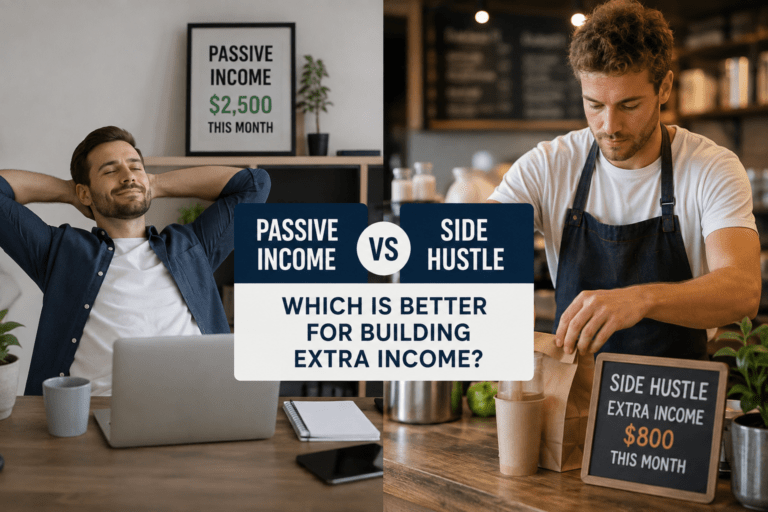
Passive Income vs Active Income
| Feature | Active Income | Passive or Semi-Passive Income |
|---|---|---|
| Typical source | Job, freelancing, consulting | Assets, products, investments or systems |
| Income tied directly to hours? | Often | Usually less directly |
| Upfront work | Moderate | Can be substantial |
| Upfront capital | Often low | Can range from almost none to very high |
| Maintenance | Continuous work | Varies considerably |
| Income guaranteed? | No | No |
25 Passive Income Ideas at a Glance
| # | Idea | Upfront Money | Upfront Work | Ongoing Work |
|---|---|---|---|---|
| 1 | High-yield savings | Required | Low | Low |
| 2 | Certificates of deposit | Required | Low | Low |
| 3 | Government securities | Required | Low | Low |
| 4 | Bonds and bond funds | Required | Low–Moderate | Low |
| 5 | Dividend-paying stocks | Required | Moderate research | Low–Moderate |
| 6 | Dividend ETFs | Required | Moderate research | Low |
| 7 | REITs | Required | Moderate research | Low |
| 8 | Rental property | High | High | Moderate–High |
| 9 | Rent a room | Low–Moderate | Moderate | Moderate |
| 10 | Rent storage space | Depends | Low–Moderate | Low–Moderate |
| 11 | Rent equipment | Moderate | Moderate | Moderate |
| 12 | Digital templates | Low | High | Low–Moderate |
| 13 | Printables | Low | High | Low–Moderate |
| 14 | Ebooks | Low | High | Low–Moderate |
| 15 | Online courses | Low–Moderate | High | Moderate |
| 16 | Stock photography | Low–Moderate | High | Low |
| 17 | License music or audio | Depends | High | Low |
| 18 | Niche website | Low–Moderate | High | Moderate |
| 19 | Affiliate content | Low | High | Moderate |
| 20 | YouTube library | Low–Moderate | High | Moderate |
| 21 | Newsletter archive | Low | High | Moderate |
| 22 | Membership resources | Low–Moderate | High | Moderate–High |
| 23 | Print-on-demand designs | Low | High | Moderate |
| 24 | Software or micro-SaaS | Low–High | Very High | Moderate |
| 25 | License intellectual property | Depends | High | Low–Moderate |
1. High-Yield Savings Accounts
A high-yield savings account can generate interest on cash while keeping the money relatively accessible.
This is one of the simplest income-producing options because there is little ongoing work after opening and funding the account.
Best For
Emergency savings, short-term goals and cash that should not be exposed to significant market volatility.
Main Limitation
Rates change.
Additionally, inflation can reduce the real purchasing power of cash even when the account earns interest.
Compare APY, fees, withdrawal access and applicable deposit protection rather than choosing an account based only on an advertised rate.
2. Certificates of Deposit
Certificates of deposit can pay interest when money is committed for a specified term.
They can require very little ongoing work once opened.
Tradeoff
The money may be less accessible until maturity.
Early withdrawals can result in penalties depending on the product.
Therefore, CDs are not automatically appropriate for emergency money you may need immediately.
3. Government Securities
Government-issued bills, notes and bonds can provide interest income.
The exact products and risks vary by country.
Main Risks
Interest-rate changes can affect market value.
Inflation can reduce purchasing power.
Government credit risk also differs significantly between countries.

4. Bonds and Bond Funds
Bonds generally represent money lent to a government, company or another issuer.
Bond investors may receive interest payments according to the security's terms.
Bond funds can provide exposure to many bonds through one investment.
Risk Still Matters
Bonds can face credit risk, interest-rate risk, inflation risk and liquidity risk.
A high yield can sometimes signal increased risk rather than a free financial advantage.
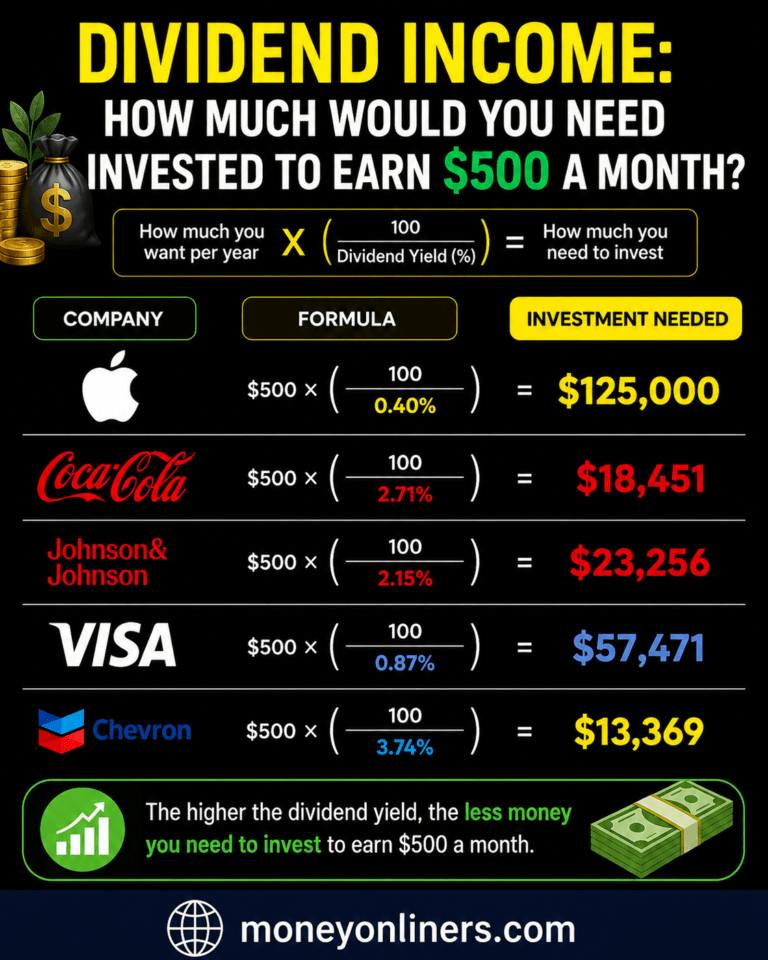
5. Dividend-Paying Stocks
Some companies distribute part of their earnings or available cash to shareholders through dividends.
Investors can receive those payments without directly working for the company.
But Dividends Are Not Guaranteed
Companies can reduce, suspend or eliminate dividends.
Share prices can also fall significantly.
Therefore, a large dividend yield should never be interpreted as guaranteed safe income.
6. Dividend ETFs
Dividend-focused ETFs can provide exposure to multiple dividend-paying companies through one fund.
This can make company diversification easier than purchasing one high-yield stock.
However, the ETF's distributions can change and the fund itself can decline in value.
Do not choose a dividend fund based only on yield. Review holdings, diversification, expense ratio, strategy and overall risk.
7. Real Estate Investment Trusts (REITs)
REITs can give investors exposure to income-producing real estate without requiring them to purchase an entire building directly.
Depending on the REIT, underlying properties might include apartments, warehouses, offices, shopping centers or specialized facilities.
Why It Can Feel Passive
You generally do not personally repair the buildings or collect tenant rent.
Main Risk
REIT values and distributions can decline.
Interest rates, property values, occupancy and borrowing costs can affect performance.
8. Long-Term Rental Property
Rental property can produce recurring income when tenants pay rent.
However, calling rental real estate effortless passive income can be misleading.
Costs Can Include
- Mortgage payments
- Taxes
- Insurance
- Repairs
- Vacancies
- Property management
- Legal compliance
- Utilities in some arrangements
The useful number is not gross rent.
It is the income remaining after realistic expenses.

9. Rent Out a Spare Room
If you already have unused living space, renting a room can create income without buying an entirely separate property.
Before Starting
Check local laws, lease restrictions, insurance, taxes, safety requirements and household privacy.
Tenant screening and ongoing management are still real work.
10. Rent Storage or Parking Space
An unused garage, parking space, secure room or storage area may be able to generate rental income where local rules permit.
This can require less maintenance than residential renting.
Risks
Insurance, security, local regulation, liability and customer access still need attention.
11. Rent Equipment You Already Own
Cameras, tools, event equipment, trailers and other valuable equipment can sometimes be rented when not in use.
It Is Semi-Passive
You may need to handle bookings, deposits, inspections, maintenance, damage and replacement.
Run the numbers carefully because depreciation and repairs reduce true profit.
12. Sell Digital Templates
Templates can include spreadsheets, budgeting systems, checklists, planners, presentation layouts, resumes, business documents and other reusable digital files.
You create the product once and can potentially sell copies repeatedly.
Why It Can Scale
The cost of delivering another digital copy is often relatively low.
However, customers, platform fees, marketing and updates still require attention.
Create a template that solves one specific recurring problem rather than making a generic product simply because digital products are popular.
13. Create Printable Products
Printable planners, worksheets, trackers, educational activities and checklists can be sold digitally.
A strong printable usually solves a clear use case.
Examples could include household budgeting, study planning, meal organization or small-business record keeping.
Main Challenge
Competition can be intense.
The product still needs good design, useful positioning and customer discovery.
14. Publish an Ebook
An ebook can continue generating sales after the writing and publishing work is complete.
Useful evergreen topics can potentially continue selling for years.
But Publishing Is Not the End
Books still need discoverability.
You may need to update outdated information, improve the cover, respond to reviews and promote the book.

15. Build an Online Course
A course converts useful knowledge into structured lessons that customers can access repeatedly.
Possible formats include video lessons, written modules, worksheets, quizzes and downloadable resources.
Courses Are Usually Semi-Passive
You still need customer support, marketing and content updates.
A course about fast-changing software may require much more maintenance than an evergreen foundational topic.
16. License Stock Photography
Photographers can license images through stock marketplaces or direct licensing arrangements.
A useful image can potentially produce multiple sales after the initial photography and editing work.
Reality Check
Large image libraries, commercial relevance and strong metadata often matter.
Individual photo earnings can be modest.
17. License Music, Audio or Sound Effects
Musicians, producers and audio creators may license music tracks, loops, sound effects or other audio assets.
One piece of intellectual property can potentially generate multiple licensing payments.
Important
Understand copyright ownership and marketplace licensing terms before uploading creative work.
18. Build an Evergreen Niche Website
A website containing useful evergreen content can potentially earn through advertising, affiliate links, sponsorships or digital products.
Older articles may continue attracting search traffic after publication.
But Websites Are Not Truly Hands-Off
Search algorithms change.
Information becomes outdated.
Broken links appear.
Technical maintenance remains necessary.
Therefore, niche websites are better described as scalable content assets than completely passive income.
19. Build Affiliate Content
Affiliate marketing can generate commissions when readers use tracked links and complete qualifying actions.
Evergreen tutorials, comparisons and resource pages may continue generating commissions after publication.
Editorial Trust Matters
Do not recommend a product simply because it pays the highest commission.
Disclose affiliate relationships clearly.
Accuracy and reader trust should come before conversion rate.
Affiliate income is never guaranteed. Traffic can fall, merchants can reduce commissions and affiliate programs can change or close.

20. Create an Evergreen YouTube Library
Videos answering evergreen questions can continue attracting viewers long after publication.
Possible revenue can include advertising, affiliate partnerships, sponsorships or related products.
Best Approach
Focus on useful videos with lasting search demand instead of depending entirely on short-lived trends.
Platform eligibility and monetization rules can change.
21. Build a Valuable Newsletter Archive
A newsletter can become more than regularly sent email.
A searchable archive of useful evergreen content can drive affiliate sales, product sales, sponsorship revenue or paid subscriptions.
However, maintaining subscriber trust and publishing useful content requires ongoing work.
22. Create a Paid Resource Membership
Members may pay recurring fees for access to templates, databases, tools, research, training or specialized resources.
Recurring revenue can become more predictable than one-time sales.
But Recurring Revenue Creates Recurring Responsibility
Customers expect continuing value.
If the library stops improving, cancellations may increase.
23. Sell Print-on-Demand Designs
Print-on-demand allows creators to upload designs that can be printed on eligible physical products when customers order.
The production and fulfillment may be handled by a third-party provider.
Potential Advantage
You may avoid purchasing large quantities of inventory upfront.
Main Challenge
Margins, returns, platform fees, marketing and intellectual-property compliance can affect profitability.
24. Build Software or a Micro-SaaS Product
A small software product that solves one specific recurring problem can potentially produce subscription or licensing revenue.
Examples might include workflow tools, calculators, reporting tools or niche business utilities.
This Is Not Zero-Work Income
Software requires maintenance.
Security problems can appear.
Users need support.
Hosting costs continue.
Competitors can emerge.
A narrow tool solving a painful problem can be more commercially useful than a large product with dozens of unnecessary features.
25. License Intellectual Property
Intellectual property can include original designs, written works, illustrations, training materials, software, music and other legally protectable creations.
Instead of selling the underlying asset completely, a creator may license permitted use under agreed terms.
Potential Advantage
One asset can potentially produce multiple licensing payments.
Main Consideration
Contracts, copyright ownership, enforcement, platform rules and tax treatment can become important.

Which Passive Income Ideas Require the Least Money?
| Idea | Typical Capital Need | Main Resource Required Instead |
|---|---|---|
| Digital templates | Low | Skill and time |
| Printables | Low | Design and market research |
| Ebooks | Low | Writing and marketing |
| Affiliate content | Low | Audience and content |
| Stock photography | Low–Moderate | Photography skills and portfolio |
| YouTube library | Low–Moderate | Production and content |
| Print-on-demand | Low | Design and marketing |
Which Passive Income Ideas Require More Capital?
| Idea | Why Capital Matters |
|---|---|
| Dividend investments | Income depends partly on invested capital and distributions |
| Bonds | More principal can produce more interest income |
| High-yield savings | Interest income scales with account balance |
| REITs | Requires investment capital |
| Rental property | Property acquisition and maintenance can require substantial money |
| Equipment rental | Requires equipment ownership |
Capital vs Work: The Passive Income Tradeoff
Most passive-income systems require you to contribute one of two scarce resources.
Money.
Or time.
Investment income generally requires capital.
Digital assets can often begin with less money but require significant upfront labor.
Real-Life Example: Turning a Skill Into a Digital Asset
A Freelancer Creates a Repeatable Template
A fictional freelance bookkeeper notices that many small-business clients struggle with the same monthly expense-tracking problem.
Instead of solving the problem manually for every customer, she builds a spreadsheet template and instructions.
Creating the first version takes several days.
She improves it after receiving customer questions.
Once established, new customers can purchase copies without requiring her to rebuild the spreadsheet from scratch each time.
The income is not fully passive because she still markets and updates the product.
However, the revenue is no longer directly tied to recreating the same service hour by hour.
Key lesson: Passive income can begin by turning repeated work into a reusable asset.
Mini Case Study: Rental Income Looks Better Before Expenses
$1,500 Rent Is Not $1,500 Profit
A fictional property generates $1,500 in monthly rent.
At first, the owner describes the property as producing $1,500 of passive income.
Then the expenses are included.
| Item | Monthly Example |
|---|---|
| Gross rent | $1,500 |
| Mortgage | -$750 |
| Insurance and taxes reserve | -$220 |
| Maintenance reserve | -$150 |
| Vacancy reserve | -$100 |
| Management | -$120 |
| Illustrative remaining cash flow | $160 |
Actual property economics vary substantially.
The example simply demonstrates the difference between revenue and profit.
Key lesson: Always subtract realistic costs before calling revenue passive income.
Passive Income Scams: Warning Signs to Avoid
Passive income is a powerful marketing phrase, which also makes it attractive to scammers.
Be Cautious When Someone Promises:
- Guaranteed daily income
- Large returns with no risk
- “Done-for-you” wealth with almost no work
- A secret system nobody else knows
- Guaranteed success
- Immediate financial freedom
- Pressure to pay today
- Large income screenshots without verifiable context
- A business opportunity where the main income comes from recruiting others
Legitimate businesses and investments do not come with guaranteed financial success.
25 Passive Income Ideas: Which Might Fit You?
You Have Capital but Little Time
Research savings products, bonds, diversified investments and REITs.
You Have Skills but Little Capital
Digital products, ebooks, courses and templates may be more accessible.
You Own Property
Room, storage or long-term rental possibilities may be worth evaluating.
You Already Create Content
Affiliate marketing, digital products or licensing can add another monetization layer.
You Can Build Software
A focused software tool may become a recurring-revenue asset.
You Are Highly Risk-Averse
Start by understanding interest-producing cash and high-quality fixed-income options before speculative ideas.
How to Evaluate Any Passive Income Idea
| Question | Why It Matters |
|---|---|
| How much money must I invest? | Determines capital risk |
| How much time is required upfront? | Shows the true setup cost |
| What ongoing work remains? | Reveals whether it is actually passive |
| What are all recurring expenses? | Separates revenue from profit |
| Can the income decline? | Tests sustainability |
| What can cause me to lose money? | Identifies financial risk |
| Does it depend on one platform? | Reveals platform concentration |
| Is the opportunity regulated where required? | Helps reduce fraud and compliance risk |
| What tax obligations apply? | Determines after-tax income |
| Can I realistically maintain it? | Tests long-term practicality |
10 Passive Income Mistakes Beginners Should Avoid
1. Believing Passive Means Zero Work
Most sustainable systems need setup or maintenance.
2. Counting Revenue as Profit
Always subtract fees, taxes, repairs, advertising and operating costs.
3. Buying Expensive Courses Before Testing the Idea
Validate demand before spending heavily.
4. Chasing Guaranteed Returns
Guaranteed high income with little or no risk is a major warning sign.
5. Starting Five Ideas at Once
Building one functioning asset can be more effective than abandoning five unfinished projects.
6. Ignoring Taxes
Income can create tax and reporting obligations.
7. Depending Entirely on One Platform
Algorithms, fees and policies can change.
8. Borrowing Heavily for an Untested Idea
Debt can turn a failed experiment into a long-term financial burden.
9. Ignoring Maintenance
Websites, courses, software, rentals and investment portfolios all need some form of review.
10. Expecting Immediate Results
Many legitimate income assets take months or years to become meaningful.
A Simple Passive Income Roadmap
| Stage | Action |
|---|---|
| 1. Protect finances | Cover essential bills and appropriate emergency savings |
| 2. Choose a resource | Decide whether you mainly have money, time, skills or property |
| 3. Pick one model | Avoid starting many unrelated ideas simultaneously |
| 4. Validate demand | Check whether real customers or markets exist |
| 5. Calculate costs | Include all setup and ongoing expenses |
| 6. Build the asset | Create the product, portfolio, property system or content |
| 7. Automate carefully | Automate payments, delivery or administration where appropriate |
| 8. Measure profit | Track net income rather than gross revenue |
| 9. Maintain | Update and protect the income-producing asset |
| 10. Reinvest selectively | Use proven cash flow to strengthen worthwhile assets |
Passive Income Checklist
- I understand exactly how the idea makes money.
- I know the upfront financial cost.
- I know how much initial work is required.
- I know what maintenance remains afterward.
- I have identified the main risks.
- I calculated profit rather than revenue alone.
- I checked taxes and legal requirements.
- I am not relying on guaranteed-income claims.
- I am not risking emergency money I may need soon.
- I understand any investment product involved.
- I checked platform dependence.
- I have a realistic timeframe.
- I know what would make me stop or change the strategy.
Continue Learning on MoneyOnliners
Recommended External Resources
Federal Trade Commission — How to Avoid Income Scams
How to Avoid Income Scams — Federal Trade Commission
Federal Trade Commission — Business and Coaching Scams
When a Business Offer or Coaching Program Is a Scam — FTC
IRS — Passive Activity and At-Risk Rules
Publication 925: Passive Activity and At-Risk Rules — IRS
Investor.gov — Introduction to Investing
Introduction to Investing — Investor.gov
This article provides general educational information and is not individualized financial, investment, tax, business or legal advice. Income is not guaranteed. Investments can lose value. Businesses can lose money. Rental property can produce vacancies and unexpected expenses. Tax treatment varies by activity, account and country. The everyday meaning of “passive income” may also differ from the legal or tax definition used in your jurisdiction.
Frequently Asked Questions
What is passive income?
Passive income generally refers to income generated by an asset or system that does not require you to perform a new unit of work for every payment.
However, most passive-income streams still require initial work, capital or ongoing maintenance.
Is passive income really passive?
Sometimes only partially.
Interest income may require very little ongoing labor.
Rental property, websites, courses and software can require substantially more maintenance.
What are the easiest passive income ideas?
Income-producing savings and investment products may require relatively little ongoing labor once established.
However, they require capital and may involve financial risk.
What passive income ideas can I start with little money?
Digital templates, ebooks, printables, affiliate content and some online creative assets may require relatively little starting capital.
Instead, they require significant time and skill.
Can I make passive income with $100?
Potentially, but expectations should remain realistic.
A small investment balance is unlikely to produce large investment income immediately.
Alternatively, $100 might help fund the basic tools needed to create a digital asset.
How much money do I need for passive income?
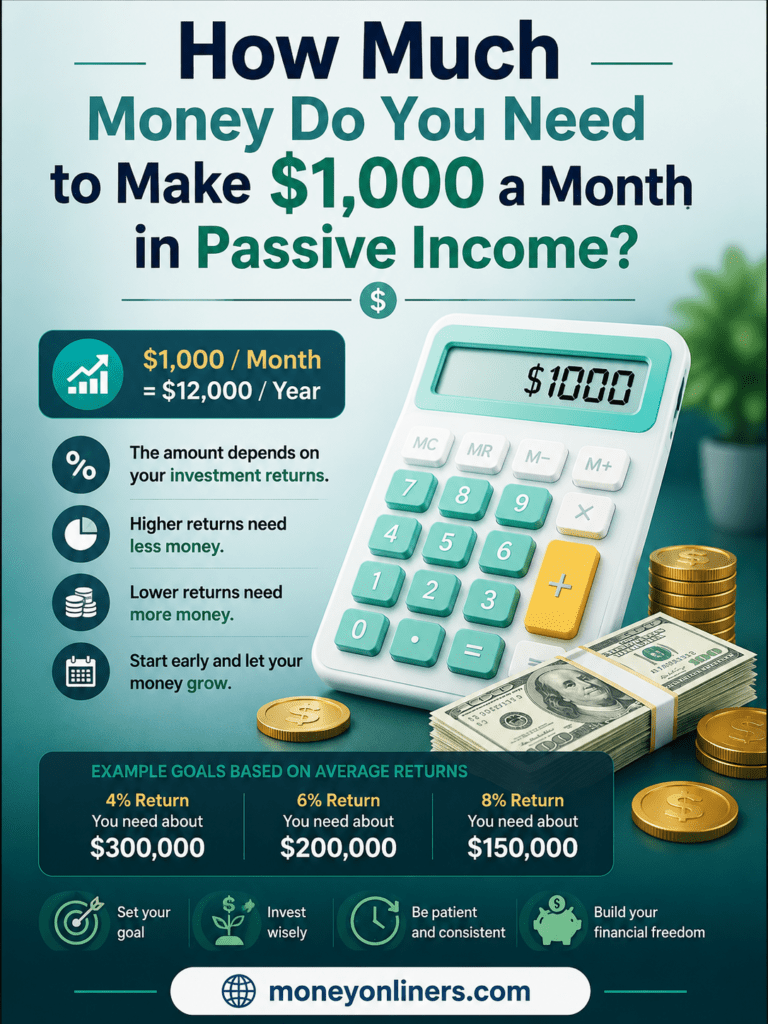
There is no universal amount.
Investment-based income generally requires capital, while digital products and content businesses can substitute more labor for money.
Can dividend stocks create passive income?
Dividend-paying stocks can distribute cash to shareholders.
However, dividends can be reduced or eliminated and share prices can fall.
Are dividend ETFs passive income?
They can produce distributions without requiring investors to operate the underlying companies.
However, fund values and distributions are not guaranteed.
Is rental property passive income?
Rental property can produce recurring income, but ownership usually involves repairs, vacancies, administration, taxes and management.
Can a property manager make rentals passive?
A property manager can reduce the owner's day-to-day workload.
However, management fees and ownership responsibilities remain.
Can blogging produce passive income?
Older evergreen content can potentially continue attracting traffic and revenue.
However, websites require updating, technical maintenance and continued traffic development.
Is affiliate marketing passive income?
Affiliate content can continue generating commissions after publication.
However, traffic, merchant terms, rankings and commission structures can change.
Are online courses passive income?
Courses can produce repeated sales after they are created.
Customer support, marketing and lesson updates can still require ongoing work.
Can ebooks create passive income?
Yes, ebooks can continue selling after publication.
However, discoverability, promotion and updates remain important.
Is YouTube passive income?
An older video may continue generating views and revenue.
Building and maintaining a successful channel generally requires ongoing content and management.
Can software generate passive income?
Subscription software can generate recurring revenue.
However, updates, security, hosting and customer support mean software income is usually semi-passive rather than fully passive.
What is the safest passive income idea?
There is no completely risk-free income source.
Different options involve different combinations of market risk, inflation risk, business risk, credit risk and operational risk.
What passive income gives the highest return?
No strategy guarantees the highest future return.
Higher potential returns generally come with higher risk, more work or both.
How long does passive income take to build?
It varies.
Investment income can begin relatively quickly once capital is invested.
A content site, digital product or software business may take months or years to become meaningful.
Should I borrow money to build passive income?
Borrowing increases financial risk.
Be particularly cautious about using expensive debt to fund an untested income idea.
How many passive income streams should I have?
There is no required number.
One profitable and well-understood stream can be more valuable than several poorly managed ones.
Should beginners build several passive income streams at once?
Usually, focusing on one viable system first can make execution easier.
Additional income streams can be added after the first model works.
Are passive income opportunities scams?
Not automatically.
However, claims of guaranteed income, huge returns, no risk and effortless success are major warning signs.
Is passive income taxable?
Income can create tax obligations, but exact treatment depends on the source and jurisdiction.
The tax definition of passive activity can also differ from the everyday meaning of passive income.
What is the biggest passive income mistake?
One major mistake is assuming passive income means guaranteed money with no work, no risk and no expenses.
Research Methodology
This MoneyOnliners guide evaluates passive-income opportunities according to five factors: required capital, upfront work, ongoing work, financial risk and realistic income sustainability.
The article intentionally uses the term passive income in its common financial-education sense while recognizing that tax authorities may use a narrower legal definition.
For example, U.S. IRS passive-activity rules generally focus on rental activities and businesses in which the taxpayer does not materially participate. Portfolio income such as ordinary interest and dividends is treated separately for those rules.
The guide also follows Federal Trade Commission consumer-protection guidance by avoiding guaranteed-income claims and warning readers about offers promising large returns, effortless earnings or guaranteed success.
Rental examples distinguish gross revenue from net cash flow because real expenses such as repairs, vacancies, taxes and management can substantially reduce actual profit.
Investment-based ideas are presented with clear warnings that principal, distributions and interest rates can change and that investment income is not guaranteed.
Digital-business ideas are described as semi-passive because content, customer support, marketing, technology and platform changes can require ongoing work.
No income amount, return or success rate is guaranteed in this article.
Final Thoughts: Build Assets, Not Passive-Income Fantasies
Passive income can become an important part of a stronger financial life.
However, sustainable passive income rarely begins passively.
Investment Income Requires Capital
Interest, dividends, bonds and REITs can require relatively little ongoing work, but meaningful income generally requires meaningful invested capital.
Digital Income Requires Upfront Work
Ebooks, templates, websites, videos, courses and software can potentially produce repeated revenue.
However, the asset must first be researched, created, marketed and maintained.
Rental Income Requires Realistic Accounting
Rent is revenue.
Repairs, taxes, insurance, vacancies and management reduce what remains.
No Income Stream Is Guaranteed
Investment values fluctuate.
Customers disappear.
Platforms change.
Competition grows.
Expenses rise.
Start With One Asset You Understand
Choose something aligned with the resources you already have—capital, skills, knowledge, property, an audience or time.
Build it carefully.
Measure actual profit.
Improve the system.
Then consider adding another income-producing asset.
Ultimately, the strongest passive income ideas are not shortcuts to instant wealth.
They are assets and systems that can gradually reduce the amount of direct labor required to generate each additional dollar of income.
Build them realistically, protect your finances while doing it, and give them enough time to become useful.