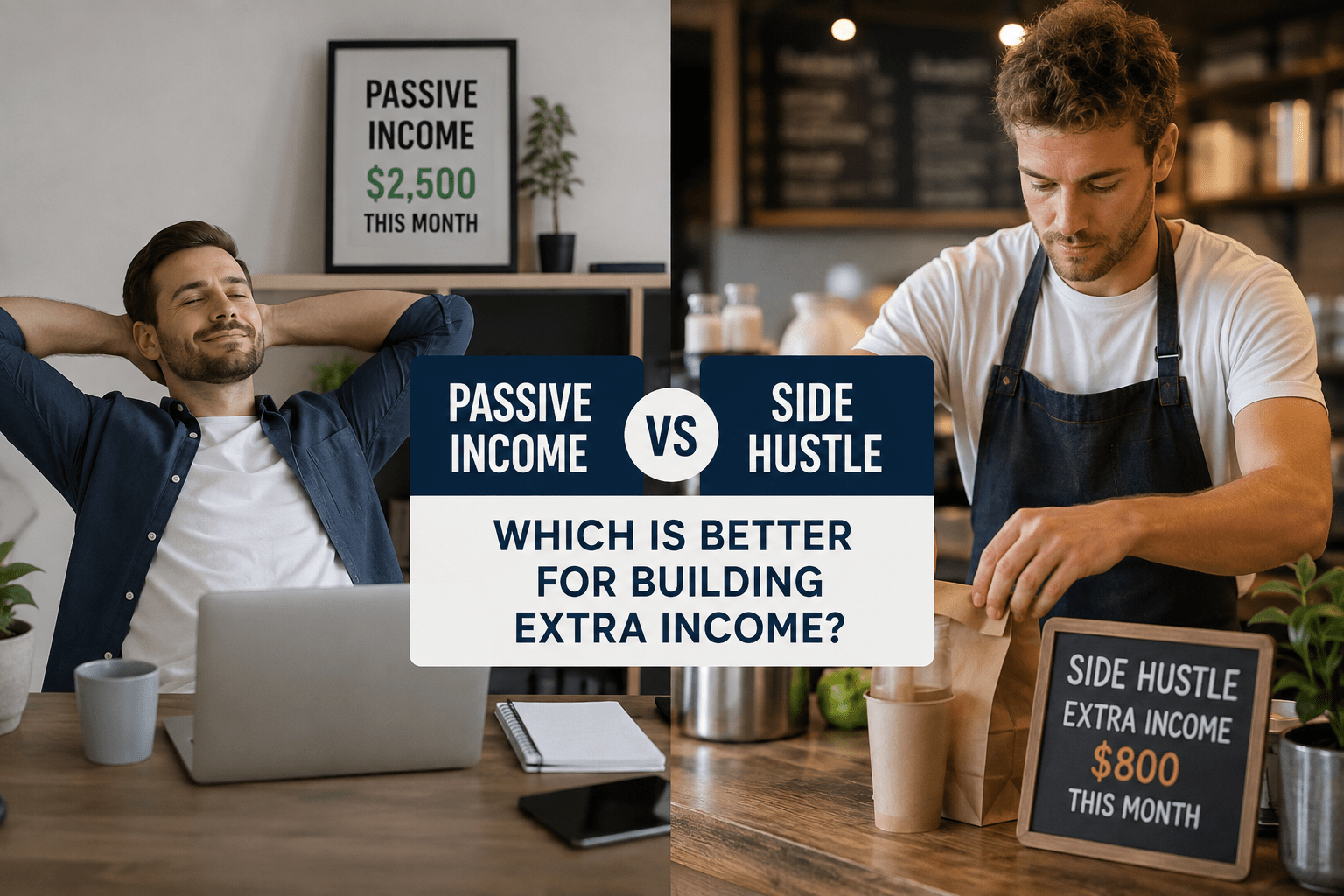
Passive Income vs Side Hustle: Which Is Better for Building Extra Income?
Passive Income vs Side Hustle: Which Is Better for Building Extra Income?
A side hustle can help you earn extra money relatively quickly by selling your time, skills or services. Passive income can potentially keep producing money after an asset or system is built, but it often takes longer, requires capital or involves substantial upfront work. The strongest choice depends on whether you need income now, want long-term scalability, have money to invest or prefer to build with skills and time.
For most beginners, a side hustle is usually better for producing extra income sooner because you can get paid directly for work such as freelancing, tutoring, delivery services, consulting or local services. Passive income is often better for longer-term scalability because assets such as investments, digital products, websites, courses or rental property may continue generating income after the initial setup. The strongest strategy is often to use side-hustle income to build savings and fund assets that can later create passive or semi-passive income.
Passive Income vs Side Hustle: What Is the Difference?
Both can increase your income beyond your primary job.
However, they usually create money in different ways.
What Is a Side Hustle?
A side hustle is additional work or a small business you operate alongside your main income source.
Common examples include freelancing, tutoring, consulting, delivery work, pet sitting, photography and local services.
Side-hustle income is often active income because you generally need to continue performing work to keep getting paid.
What Is Passive Income?
Passive income usually comes from an asset, system or investment that can potentially continue producing income after much of the initial work or capital has been provided.
Examples may include dividends, interest, rental cash flow, ebooks, digital templates, online courses and evergreen website content.
Passive Income vs Side Hustle at a Glance
| Feature | Side Hustle | Passive / Semi-Passive Income |
|---|---|---|
| Speed to first income | Potentially faster | Often slower |
| Upfront capital | Often low | Low to very high |
| Direct work required | Usually high | Lower after setup in some models |
| Scalability | Can be limited by time | Can be higher |
| Income certainty | Not guaranteed | Not guaranteed |
| Best for quick extra cash | Often stronger | Usually weaker initially |
| Best for long-term systems | Can evolve into one | Often stronger |
| Maintenance | Continuous work | Varies |
1. Side Hustles Can Produce Income Faster
If your immediate goal is to increase cash flow, a side hustle may be easier to start.
Example
Suppose you know graphic design.
You find a client who needs a social-media graphic package.
You complete the project and receive payment.
The path from work to income can be relatively direct.
Compare That With Passive Income
Creating a template store may eventually become more scalable.
However, before meaningful sales appear you may need to:
- Create the templates
- Design product pages
- Set up payments
- Build traffic
- Test pricing
- Market the products
When the immediate problem is insufficient income this month, active side-hustle work may be more practical than trying to force passive income quickly.

2. Passive Income Can Become More Scalable
A major limitation of many side hustles is time.
If you charge by the hour, there are only so many billable hours available.
Example: Freelancing
A freelancer charges $40 per hour.
Ten additional hours of work may produce $400 before taxes and expenses.
To earn another $400, the freelancer often needs to sell another ten hours.
Compare That With a Digital Product
A $20 template can potentially be sold 20 times without requiring 20 separate custom projects.
That does not mean those 20 sales are guaranteed.
However, the product is more scalable because another sale does not require rebuilding the asset from scratch.
3. Side Hustles Often Require Less Startup Capital
Many side hustles can begin using skills and equipment you already have.
Low-Cost Examples
Freelance Writing
Main requirements may be writing ability, internet access and a computer.
Tutoring
Knowledge and teaching ability can be more important than startup capital.
Virtual Assistance
Organization and digital skills can provide the main value.
Local Services
Cleaning, gardening, repairs or other services may use tools you already own.
Passive Investments Usually Need Capital
Interest, bonds, dividends and REIT income depend partly on how much money you have invested.
A small portfolio generally produces a small amount of income at moderate yields.
When financial capital is limited, a side hustle can help you create the capital that later funds passive-income assets.
4. Passive Income Often Requires More Upfront Patience
Passive-income projects can have a long delay between creation and meaningful income.
A Niche Website May Need
- Dozens of useful articles
- Search visibility
- Internal linking
- Trust and authority
- Email subscribers
- Monetization systems
An Investment Portfolio May Need
Years of regular contributions before distributions become meaningful.
A Rental Property May Need
A down payment, financing, property research and preparation before rent begins.
Passive income can be powerful precisely because the work or capital is front-loaded. That same characteristic means it may be unsuitable when you urgently need extra cash.
5. Side Hustles Can Help You Build Valuable Skills
Side hustles do more than produce money.
They can also increase earning power.
Examples
- A freelance writer learns SEO.
- A virtual assistant learns project management.
- A designer learns client communication.
- A tutor learns curriculum development.
- A photographer learns sales and marketing.
- A web developer learns product development.
Those Skills Can Later Become Assets
A writer can publish ebooks.
A designer can sell templates.
A tutor can create a course.
A developer can build software.

6. Passive Income Can Reduce Dependence on Working Hours
This is one of its strongest long-term advantages.
If your income comes entirely from active work, illness, job loss or reduced working hours may have an immediate financial effect.
Income-producing assets can potentially create another layer of financial support.
Examples
- Investment distributions
- Interest income
- Rental cash flow
- Digital-product sales
- Affiliate revenue
- Royalty income
However, these income sources are not guaranteed either.
Dividends can be cut.
Tenants can leave.
Digital-product sales can decline.
Build enough diversification that one income interruption does not immediately threaten your entire financial system.
7. Side Hustles Can Be Easier to Test
A service business can often be tested with relatively little upfront investment.
Example
Instead of creating a complete $500 course about social-media marketing, offer the service first.
Work with several clients.
Notice which problems repeat.
Then decide whether those repeated problems could become:
- A template
- A course
- A checklist
- An ebook
- A digital tool
Why This Helps
Client work can provide market research.
You learn what people actually pay for rather than guessing.
8. Passive Income Can Require More Financial Risk
Some passive-income models depend heavily on capital.
That introduces financial risk.
Dividend Stocks
Share prices can fall and dividends can be reduced.
Bonds
Credit and interest-rate risks matter.
REITs
Real-estate markets and borrowing costs can affect results.
Rental Property
Vacancies, repairs and financing costs can affect cash flow.
Online Businesses
Advertising, hosting and software expenses can exceed revenue.
Be cautious of passive-income opportunities promising guaranteed returns, guaranteed daily income or large profits with little work and no risk.
9. A Side Hustle Can Also Become a Business
A side hustle does not have to remain a one-person hourly job forever.
Stage 1: Sell Your Own Time
You perform the service yourself.
Stage 2: Improve Pricing
You raise rates as your skill and results improve.
Stage 3: Productize the Service
Instead of completely custom work, you offer standardized packages.
Stage 4: Build Systems
Templates, automation and documented processes reduce repetitive work.
Stage 5: Delegate
Other people can perform parts of the delivery.
Stage 6: Create Assets
Courses, tools, templates or recurring products can further reduce dependence on your own hours.
10. Passive Income Can Still Require Ongoing Work
| Passive-Income Type | Ongoing Work That May Remain |
|---|---|
| Rental property | Repairs, tenants, vacancies and compliance |
| Dividend portfolio | Portfolio monitoring and periodic review |
| Website | Content updates, SEO and technical maintenance |
| Affiliate content | Link updates, product reviews and traffic maintenance |
| Course | Updates and customer support |
| Software | Security, bugs, hosting and support |
| Digital products | Marketing, support and product updates |
Therefore, many strategies are more accurately called semi-passive income.
Side Hustle vs Passive Income: Startup Cost Comparison
| Income Method | Typical Capital Requirement | Main Resource |
|---|---|---|
| Freelancing | Low | Skill and time |
| Tutoring | Low | Knowledge and time |
| Local service | Low–Moderate | Labor and equipment |
| Consulting | Low | Expertise |
| Digital product | Low | Creation and marketing |
| Niche website | Low–Moderate | Content and time |
| Dividend investing | High for meaningful income | Capital |
| Rental property | Usually high | Capital and management |
Which Produces More Money?
Neither has a guaranteed advantage.
A Side Hustle Can Produce More Initially
A freelancer earning $500 per project may reach meaningful monthly income faster than a small investment portfolio.
Passive Income Can Potentially Scale Further
A successful product or large investment portfolio may eventually produce income with less additional labor.
The Result Depends On
- Your skill level
- Available capital
- Customer demand
- Pricing
- Time available
- Risk tolerance
- Marketing ability
- Asset quality
Real-Life Example: A Side Hustle Funds Passive Income
Daniel Starts Freelancing
A fictional office worker earns an additional $400 per month from freelance design.
The money is active income because Daniel must complete projects to earn it.
He Does Not Spend All of It
After setting aside money for taxes and business costs, he directs part of the surplus toward long-term investments.
He also uses his design experience to create reusable templates.
His Income Mix Changes
Initially, almost all additional income comes from client work.
Later, investment distributions and template sales begin contributing small amounts.
The passive income does not replace his freelance income immediately.
However, his financial system becomes more diversified.
Key lesson: Side hustles and passive income can complement rather than compete with each other.
Case Study: Trying Passive Income Too Early
A Beginner Needs an Extra $600 This Month
A fictional beginner has very little savings and needs $600 to cover an upcoming expense.
He decides that passive income sounds better than active work.
He starts a blog and expects advertising income almost immediately.
The website receives little traffic during the first few months.
Meanwhile, the expense is still due.
A Different Approach
He could instead use a marketable skill to earn immediate active income while building the website gradually.
Key lesson: Passive income can solve a long-term income problem, but it may be a poor solution to an urgent short-term cash problem.

Passive Income vs Side Hustle: Which Is Better for Beginners?
For many beginners, the side hustle deserves attention first.
Choose a Side Hustle First If:
- You need extra money soon.
- You have more skills than capital.
- You want to test a business idea cheaply.
- You want to improve your earning power.
- You need money to build savings or pay debt.
Consider Passive Income First If:
- You already have surplus capital.
- Your emergency savings are established.
- You have a reusable product idea.
- You already have an audience.
- You can wait for the asset to develop.
- You understand the relevant risks.
Consider Both If:
You have enough time and financial stability to build the two in a sensible order.
Earn actively → create surplus → protect your finances → build assets → reinvest → gradually reduce dependence on only one income source.
A Side Hustle-to-Passive-Income Roadmap
| Stage | Action |
|---|---|
| 1 | Choose a skill people will pay for |
| 2 | Get the first paying customer |
| 3 | Improve the skill and pricing |
| 4 | Build emergency savings |
| 5 | Address expensive debt |
| 6 | Identify repeated client problems |
| 7 | Turn repeated work into a reusable asset |
| 8 | Invest part of surplus income where appropriate |
| 9 | Automate repeatable processes |
| 10 | Diversify only after the first systems work |
What Side Hustles Can Become More Passive?
| Active Side Hustle | Possible Scalable Asset |
|---|---|
| Freelance writing | Ebook or writing templates |
| Graphic design | Design templates or licensed graphics |
| Tutoring | Recorded course or workbook |
| Photography | Stock-photo library or presets |
| Bookkeeping | Financial spreadsheet templates |
| Consulting | Course, guide or toolkit |
| Software development | Micro-SaaS product |
| Blogging | Evergreen affiliate content and digital products |
10 Mistakes to Avoid When Choosing Between the Two
1. Choosing Passive Income Because It Sounds Easier
Many passive-income assets require substantial upfront work.
2. Ignoring Immediate Cash Needs
A long-term asset may not solve a short-term financial problem.
3. Quitting Reliable Work Too Early
New income streams may be unstable.
4. Chasing High-Yield Investments
Higher income can involve greater risk.
5. Starting Too Many Side Hustles
Focus can be more productive than constant experimentation.
6. Starting Too Many Passive-Income Projects
One functioning asset is better than many unfinished projects.
7. Ignoring Taxes
Side-hustle and passive-income sources can both create tax obligations.
8. Confusing Revenue With Profit
Subtract business expenses before evaluating results.
9. Ignoring Skill Development
Increasing your value can produce faster results than searching for shortcuts.
10. Treating Side Hustles and Passive Income as Competitors
They can work together within the same financial plan.
Neither side hustles nor passive-income strategies guarantee earnings. Businesses can fail, customers can disappear and investments can lose value.
Passive Income vs Side Hustle Checklist
- I know whether I need income now or later.
- I know how much time I can realistically commit.
- I know how much startup money I can risk.
- I understand my strongest marketable skills.
- I have emergency savings appropriate to my situation.
- I understand the risks of any investment involved.
- I know what ongoing maintenance passive income requires.
- I separate revenue from net profit.
- I understand relevant taxes and business obligations.
- I am not depending on guaranteed-income claims.
- I know whether my side hustle can become more scalable.
- I am building one strong system before adding unnecessary complexity.
Continue Learning on MoneyOnliners
Recommended External Resources
Federal Trade Commission — Avoid Income Scams
How to Avoid Income Scams — Federal Trade Commission
Federal Trade Commission — Business Opportunity Scams
When a Business Offer or Coaching Program Is a Scam — FTC
Investor.gov — Introduction to Investing
Introduction to Investing — Investor.gov
IRS — Self-Employed Individuals Tax Center
Self-Employed Individuals Tax Center — IRS
This article provides general educational information and is not individualized financial, investment, tax, business or legal advice. Side-hustle earnings are not guaranteed. Passive income is not guaranteed. Businesses can lose money, investments can lose value and online platforms can change their rules. Consider your financial situation, risks, taxes and legal obligations before committing significant money or time.
Frequently Asked Questions
What is better: passive income or a side hustle?
Neither is universally better.
A side hustle can be better for earning money sooner, while passive income can offer greater scalability over time.
What is the main difference between passive income and a side hustle?
A side hustle usually requires ongoing work to earn additional income.
Passive income generally comes from assets or systems that may continue producing income after much of the initial work or capital has been provided.
Should beginners start with a side hustle?
For many beginners, yes.
A side hustle can create immediate cash flow and help build skills and investment capital.
Is a side hustle passive income?
Usually not.
Most side hustles are active income because you need to continue performing work.
Can a side hustle become passive income?
Potentially.
Repeated work can sometimes be converted into courses, templates, software, guides or other reusable products.
Is freelancing passive income?
Generally no.
Freelancers usually earn by completing new work for clients.
Can freelancing lead to passive income?
Yes.
Freelancers can potentially convert expertise and repeated processes into reusable digital assets.
Which is faster for making money?
A side hustle is often faster because payment can follow directly from completed work.
Which requires more money to start?
It depends on the model.
Investment-based passive income can require substantial capital, while many service side hustles can start cheaply.
Can passive income start with little money?
Yes.
Digital products, affiliate content and websites can begin with relatively modest capital, although they usually require more time and skill.
Can I build passive income while working a side hustle?
Yes.
This can be a practical combination because the side hustle provides cash while the passive-income asset develops.
Should I invest side-hustle income?
Potentially, after considering taxes, essential expenses, emergency savings and expensive debt.
Can passive income replace a side hustle?
Potentially, but only after the passive-income source becomes sufficiently reliable and substantial.
Can a side hustle replace a full-time job?
It can for some people, but income stability, benefits, taxes, expenses and risk should be considered before relying on it completely.
Can passive income replace a job?
Potentially, but meaningful replacement income may require significant capital, profitable assets or several reliable income sources.
What is the best side hustle for building passive income later?
A side hustle connected to a reusable skill can be useful.
Examples include writing, design, tutoring, photography, consulting and software development.
What is more scalable?
Passive or semi-passive assets can often scale more easily because additional customers may not require the same amount of additional labor.
What is safer?
There is no universal answer.
Side hustles can fail to find customers, while passive investments and businesses carry financial and market risks.
What if I need money this month?
A service-based side hustle may be more practical than building a long-term passive-income asset from scratch.
What if I already have substantial savings?
You may be in a stronger position to consider investment-based passive income while maintaining appropriate emergency reserves.
How many side hustles should I start?
Beginners may benefit from focusing on one strong opportunity before adding more.
How many passive-income streams should I build?
There is no required number.
A few strong, understandable sources can be better than many weak ones.
Is passive income easier than a side hustle?
Not necessarily.
Passive income may involve less work after setup, but the build stage can require substantial time, money or risk.
What is the biggest passive income vs side hustle mistake?
One major mistake is choosing passive income solely because it sounds easier while ignoring the speed, skill-building and cash-flow advantages that active side-hustle work can provide.
Research Methodology
This MoneyOnliners guide compares passive income and side hustles across speed to first income, startup capital, direct labor, scalability, financial risk, maintenance and long-term usefulness.
Side hustles are primarily evaluated as active-income systems because payment generally depends on continued work, services or client delivery.
Passive-income models are evaluated as asset-based or system-based income and are described as semi-passive when significant maintenance remains.
The guide does not assume passive income is automatically superior because side hustles may provide faster cash flow, skill development and the financial surplus required to build future assets.
Likewise, the article does not treat side hustles as inherently better because time-based work can have scalability limits.
The analysis separates revenue from profit and recognizes business expenses, taxes, platform fees and investment losses as relevant to actual financial outcomes.
Examples and case studies are hypothetical educational illustrations and do not represent promised earnings.
The central framework is to evaluate which method best fits the reader's current need: immediate income, skill development, capital accumulation, scalability or long-term financial diversification.
Final Thoughts: Use a Side Hustle to Earn Faster and Passive Income to Build Longer-Term Flexibility
The passive income vs side hustle question does not need one universal winner.
A Side Hustle Can Solve the Immediate Income Problem
You can sell useful skills, services and time.
That may produce money faster.
Passive Income Can Solve a Different Problem
It can help reduce the amount of new labor required to produce every additional dollar.
The Two Can Work Together
A side hustle can generate the surplus money needed to invest.
Side-hustle experience can reveal digital-product opportunities.
Active skills can become courses, templates, books or software.
Build in the Right Order
Earn.
Protect your finances.
Build savings.
Develop skills.
Create surplus.
Then gradually turn part of that surplus into income-producing assets.
Do Not Chase the Label
A profitable side hustle requiring ten hours a month may be far more useful than a supposedly passive business losing money.
Likewise, a strong asset may eventually provide more flexibility than continuously adding working hours.
Ultimately, the best choice between passive income vs side hustle depends on what your financial life needs today and what you want your income system to look like later.
Use active income for speed.
Use scalable assets for leverage.
And build both gradually when doing so strengthens your long-term financial future.