Investing for Beginners: 10 Simple Steps to Start Building Wealth
Investing for Beginners: 10 Simple Steps to Start Building Wealth
Investing can feel complicated when you are just starting. Stocks, bonds, ETFs, funds, fees, risk and market movements can make it seem like you need to become an expert before investing your first dollar. You do not. A stronger beginning is to understand your goals, build a financial foundation, learn the basics and start with a simple long-term plan you actually understand.
For beginners, investing starts with getting your financial foundation in order, defining a long-term goal, understanding risk, learning basic investment types, choosing an appropriate regulated account or platform, diversifying, paying attention to fees, investing regularly and avoiding emotional decisions. Investing involves risk and returns are never guaranteed. Money needed soon or for emergencies generally has a different purpose from money invested for long-term goals.
What Does Investing Mean?
Investing means putting money into assets with the expectation that the money may increase in value or generate income over time.
Common investments include stocks, bonds, mutual funds and exchange-traded funds.
However, investing is different from simply keeping money in a normal savings account.
Investments can rise in value.
They can also fall.
Therefore, money invested in the market should generally match an appropriate goal, time horizon and level of risk.
Investor.gov explains that investing involves assets such as stocks and bonds and that all investments involve some degree of risk.
Investing vs Saving
| Feature | Saving | Investing |
|---|---|---|
| Main purpose | Protect near-term money | Potential long-term growth |
| Typical uses | Emergency fund, upcoming bills, short-term goals | Retirement and longer-term wealth goals |
| Risk | Usually lower in insured deposit accounts | Can lose value |
| Potential return | Usually lower | Potentially higher over long periods, but not guaranteed |
| Access | Usually easier | Depends on investment and account |
| Best time horizon | Shorter-term needs | Usually longer-term goals |
10 Simple Steps for Investing for Beginners
Get Your Basic Financial Foundation in Place
Before investing aggressively, look at the rest of your financial life.
Do you have money available for normal bills?
Do you have emergency savings?
Are you carrying expensive high-interest debt?
These questions matter because investments can fall in value at the exact moment you need money.
Investor.gov's saving-and-investing roadmap includes reviewing your finances, addressing high-interest debt and building rainy-day savings before moving deeper into investing.
Do Not Invest Your Emergency Fund
Emergency savings serves a different purpose.
It needs to be available when a genuine financial shock occurs.
Investments can lose value. Money you may need for rent, food, emergency medical costs, essential repairs or near-term bills generally should not depend on the stock market being up when you need it.
Decide What You Are Investing For
Do not start with the question, “Which stock should I buy?”
Start with the goal.
Possible long-term goals may include retirement, future financial independence, education funding or another major objective.
Give the Goal a Time Horizon
Ask when you expect to need the money.
A goal several decades away can usually tolerate different investment risks from money needed in three years.
- Short horizon: Money may be needed relatively soon.
- Medium horizon: The goal is several years away.
- Long horizon: The money may remain invested for many years or decades.
Your time horizon helps shape how much investment risk may be appropriate.

Understand Your Risk Tolerance
Risk tolerance describes how comfortable and financially capable you are with investment values moving up and down.
Imagine your investments fall significantly during a difficult market.
Would you immediately sell everything?
Could you remain invested?
Your emotional reaction matters, but financial capacity matters too.
Risk Capacity and Risk Tolerance Are Not Exactly the Same
Someone may emotionally tolerate large market swings but still need the money soon.
That short time horizon can limit how much risk is appropriate.
Investor.gov identifies both time horizon and personal risk tolerance as important considerations when developing an investment approach.
Never take more investment risk simply because someone promises a higher return.
Learn the Basic Investment Types
You do not need to understand every financial product before beginning.
However, you should understand the basic categories you are considering.
| Investment | Simple Explanation | Important Risk |
|---|---|---|
| Stock | Ownership interest in a company | Company value can fall significantly |
| Bond | Money lent to a government or company | Interest-rate, credit and inflation risks |
| Mutual fund | A pooled investment containing many securities | Value depends on underlying investments and fees |
| ETF | A fund whose shares generally trade on an exchange | Market risk, fund-specific risks and costs |
| Cash or cash equivalent | Highly liquid lower-risk holdings | Inflation can reduce purchasing power |
Investor.gov lists stocks, bonds, mutual funds and ETFs among common investment categories and recommends understanding both risks and fees before investing.
Choose the Right Type of Investment Account
The investment account is the container that holds your investments.
The exact options depend heavily on your country.
In the United States, investors may encounter taxable brokerage accounts and tax-advantaged retirement accounts.
Other countries use different pension, retirement, investment and tax structures.
Compare More Than Convenience
Before opening an account, investigate:
- Whether the provider is appropriately regulated.
- Account fees.
- Trading fees or commissions.
- Available investments.
- Minimum deposits.
- Withdrawal rules.
- Tax treatment.
- Currency-conversion costs where relevant.
- Customer support and security.
Investment-account rules differ significantly by country. Check the relevant financial regulator and tax authority where you live before relying on account-specific guidance.

Learn Why Diversification Matters
Putting your entire portfolio into one company makes your financial result heavily dependent on that one business.
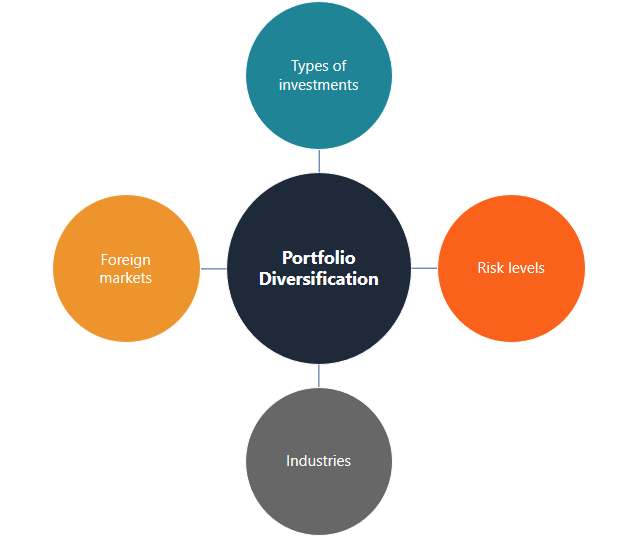
Diversification spreads investments across multiple holdings, sectors, companies or asset categories.
The objective is to reduce dependence on one investment performing well.
Investor.gov describes diversification using the familiar principle of not putting all your eggs in one basket.
Diversification Does Not Eliminate Risk
A diversified portfolio can still fall during market declines.
Diversification is a risk-management strategy, not a guarantee against loss.
Pay Close Attention to Investment Fees
Fees may look small as percentages.
However, recurring investment costs can affect long-term results.
Investor.gov warns that investment-product and service fees can have a major effect on a portfolio over time.
Common Costs to Investigate
- Fund expense ratios
- Account maintenance fees
- Advisory fees
- Trading commissions
- Transaction fees
- Currency-conversion costs
- Withdrawal or transfer charges
- Other product-specific expenses
Do not assume the cheapest product is automatically best.
Instead, understand exactly what you are paying and what you receive for the cost.
Before investing, ask: What does this investment cost to buy, hold and sell?
Start With an Amount You Can Afford to Keep Invested
You do not necessarily need thousands of dollars before you can begin learning about investing.
The appropriate starting amount depends on the platform, investment and your finances.
More important than starting with a large amount is avoiding investment contributions that compromise your essential bills.
Consistency Can Matter More Than a Dramatic First Deposit
A smaller regular contribution can create a sustainable long-term investing habit.
For example, someone might invest monthly rather than waiting years to build one large deposit.
Do not borrow money simply to make a routine beginner investment contribution unless you fully understand the risks and financial consequences.

Consider Investing Regularly Instead of Trying to Predict Every Market Move
Trying to determine the perfect moment to enter or leave the market can be difficult.
Beginners may be tempted to wait until prices look perfect.
However, nobody knows future market movements with certainty.
One long-term approach is to invest a planned amount regularly according to your financial plan.
Keep the Contribution Realistic
The goal is not to force investing regardless of your circumstances.
If essential expenses rise or income falls, your contribution may need to change.
Investor.gov highlights regular investing and long time horizons as important parts of long-term wealth building.
Review the Plan Without Reacting to Every Market Movement
Long-term investing does not mean ignoring your portfolio forever.
Review whether the investments still match your goals, time horizon and risk tolerance.
Also review fees and whether your asset allocation has changed significantly.
However, avoid assuming that every market decline requires immediate action.
Separate Market Movement From Plan Failure
Investment values fluctuate.
A temporary market decline does not automatically mean a long-term plan is wrong.
Likewise, a rapidly rising investment does not automatically mean you should put all your money into it.
How Compound Growth Works
Compounding occurs when returns can generate additional returns over time.
The longer the time period, the greater the potential effect of compounding.
However, investment returns are not guaranteed and actual market results vary.
Illustrative Example
| Monthly Contribution | Total Contributions in 10 Years | Total Contributions in 20 Years | Total Contributions in 30 Years |
|---|---|---|---|
| $50 | $6,000 | $12,000 | $18,000 |
| $100 | $12,000 | $24,000 | $36,000 |
| $250 | $30,000 | $60,000 | $90,000 |
| $500 | $60,000 | $120,000 | $180,000 |
The table above shows contributions only. It does not assume any investment return and therefore does not predict portfolio value. Actual investment values may be higher or lower and can decline.
Why Starting Earlier Can Help
More time allows more opportunities for investment returns to compound.
That does not mean younger investors are guaranteed better outcomes.
It means time can be an important advantage when a suitable long-term investment strategy is maintained.
Investor.gov identifies compound growth and time horizon as important concepts for long-term investing.
Real-Life Example: Starting Small Instead of Waiting for $10,000
Samuel Keeps Delaying His First Investment
Samuel wants to invest but believes he should wait until he has $10,000 available.
Years pass without him starting.
Eventually, he separates his emergency savings from long-term money and begins with a smaller regular investment amount that fits his budget.
He uses the process to learn how the account works and how market fluctuations feel in real life.
As his income improves, he gradually increases the contribution.
Key lesson: A sustainable beginning can be more useful than waiting indefinitely for a perfect starting amount.
Case Study: Chasing a Hot Stock Creates Too Much Risk
A Beginner Puts Almost Everything Into One Company
A fictional beginner sees repeated social-media posts about one rapidly rising stock.
Friends appear to be making money.
He fears missing out.
Instead of building a diversified plan, he invests most of his available investment money in that one company.
The share price later falls sharply.
His portfolio suffers because there were few other holdings to offset the concentrated exposure.
Key lesson: Popularity is not diversification, and a rapidly rising price does not remove investment risk.

Beginner Investing: What to Learn Before Buying Anything
Your Goal
Know what the money is intended to achieve.
Your Time Horizon
Know when you expect to need the money.
Your Risk
Understand both the possibility and consequences of losses.
Your Investment
Know what you actually own.
Your Fees
Understand what it costs to buy, hold and sell.
Your Provider
Check regulation, security and account protections.
Stocks vs Bonds vs Funds for Beginners
| Investment Type | What You Own | Potential Advantage | Main Concern |
|---|---|---|---|
| Individual stock | Part of one company | Direct company exposure | Concentration risk |
| Bond | Debt obligation | Potential income and diversification | Credit and interest-rate risk |
| Mutual fund | Pool of underlying investments | Can provide diversification | Fees and underlying-market risk |
| ETF | Fund shares traded on an exchange | Can provide broad exposure | Fees, trading and market risk |
Index Funds: A Concept Beginners Often Encounter
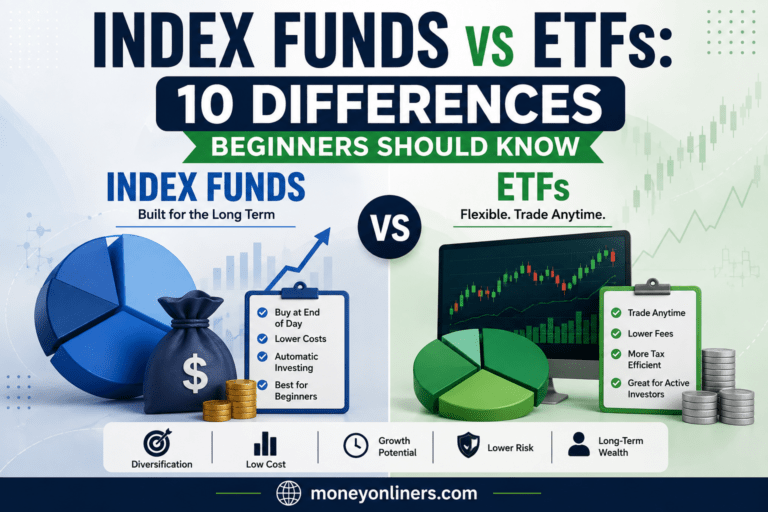
An index fund seeks to track a particular market index or benchmark rather than selecting investments solely through active management.
Index funds may be structured as mutual funds or ETFs.
They can provide broad diversification depending on the index being tracked.
However, an index fund can still lose money.
The word “index” does not mean risk-free.
Understand what an index fund tracks before buying it. A fund tracking a broad market index can be very different from one tracking a narrow industry or theme.
Investment Fees: Why Small Percentages Matter
Imagine two investments generate the same gross performance but charge different annual fees.
The investment with higher ongoing costs leaves less return available to compound.
Over long periods, the difference can become significant.
Investor.gov provides examples showing how different fee levels can materially affect hypothetical long-term portfolio values.
Questions to Ask About Fees
- Is there an account fee?
- Does the fund charge an expense ratio?
- Is there an advisory fee?
- Are there trading commissions?
- Are there currency-conversion costs?
- Are there withdrawal or transfer fees?
7 Beginner Investing Mistakes to Avoid
1. Investing Money You Need Soon
Short-term financial obligations should generally not depend on uncertain market returns.
2. Putting Everything Into One Stock
Concentration can create unnecessary exposure to one company's problems.
3. Buying Because Social Media Is Excited
Popularity does not make an investment suitable for your goals.
4. Ignoring Fees
Small recurring costs can affect long-term results.
5. Expecting Guaranteed Returns
Legitimate investing involves risk.
6. Panic-Selling Every Time Markets Fall
Reacting emotionally can pull your plan away from its original long-term purpose.
7. Investing in Something You Do Not Understand
If you cannot explain how the investment works, what it costs and what could cause you to lose money, learn more before buying.
Investment Scam Warning Signs
Be especially cautious when an investment opportunity includes:
- Guaranteed high returns.
- Claims of little or no risk.
- Pressure to invest immediately.
- Fear-of-missing-out tactics.
- Unverified testimonials.
- Promises of rapid wealth.
- Unusual payment methods.
- Pressure to keep the investment secret.
Investor.gov specifically identifies promises of high returns with little or no risk, pressure to act quickly, FOMO and fake testimonials among investment-fraud warning signs.
A Simple Beginner Investing Checklist
- I have reviewed my basic financial situation.
- I have emergency savings appropriate to my circumstances.
- I know my investing goal.
- I know when I expect to need the money.
- I understand that investments can lose value.
- I know my approximate risk tolerance.
- I understand the investment products I am considering.
- I checked whether the provider is appropriately regulated.
- I understand account and investment fees.
- I understand diversification.
- I am not relying on one stock or social-media tip.
- My investment contribution does not compromise essential bills.
- I have a regular review process.
- I know that past performance does not guarantee future results.
A Simple Beginner Investing Roadmap
| Stage | Main Question |
|---|---|
| Foundation | Are my essential finances stable enough to invest? |
| Goal | What am I investing for? |
| Timeline | When will I need the money? |
| Risk | How much loss and volatility can I realistically tolerate? |
| Account | Which regulated account structure fits the goal? |
| Investment | What exactly am I buying? |
| Diversification | Am I too dependent on one investment? |
| Fees | What does the investment cost? |
| Contribution | What amount can I invest consistently? |
| Review | Does the plan still fit my goals? |
Continue Learning on MoneyOnliners
Recommended External Resources
Investor.gov — Introduction to Investing
Introduction to Investing — Investor.gov
Investor.gov — Save and Invest
Roadmap to Saving and Investing — Investor.gov
Investor.gov — Diversification
Diversify Your Investments — Investor.gov
Investor.gov — Understanding Fees
Understanding Investment Fees — Investor.gov
Investor.gov — Investing on Your Own
Investing on Your Own — Investor.gov
This article is for general educational purposes and does not provide individualized financial, investment, tax or legal advice. Investments can lose value, including loss of principal. No investment return is guaranteed. Consider your goals, time horizon, risk tolerance, fees, tax situation and personal circumstances before investing. Where appropriate, consider consulting a qualified financial professional.
Frequently Asked Questions
What is investing for beginners?
Investing for beginners means learning how long-term investing works before committing significant money.
It includes understanding goals, risk, diversification, fees, investment products and account structures.
How much money do I need to start investing?
There is no universal starting amount.
Minimums vary by platform and investment.
The more important question is how much you can invest without compromising essential bills or emergency savings.
Should I save an emergency fund before investing?
Emergency savings serves a different purpose from long-term investments.
Having accessible money for unexpected expenses can reduce the risk of being forced to sell investments at an inconvenient time.
Should beginners buy individual stocks?
Individual stocks can be part of an investment strategy, but they expose the investor to company-specific risk.
Beginners should understand concentration risk and diversification before relying heavily on individual companies.
What is diversification?
Diversification means spreading money across different investments rather than depending heavily on one holding.
It can help manage risk but cannot guarantee against losses.
What is an ETF?
An exchange-traded fund is an investment fund whose shares generally trade on an exchange.
Depending on the fund, an ETF may hold stocks, bonds or other assets.
What is an index fund?
An index fund seeks to track a specific market index or benchmark.
It may be structured as a mutual fund or ETF.
Are index funds risk-free?
No.
Index funds can fall in value when their underlying markets decline.
What are investment fees?
Investment fees can include fund expenses, account fees, advisory charges, commissions and other costs.
Even relatively small recurring fees can affect long-term results.
Can I lose all my money investing?
Loss risk depends on the investment.
Some investments can lose a substantial portion or even all of the amount invested.
Understanding the product and diversifying appropriately are important risk-management steps.
How often should beginners invest?
Some investors use regular monthly or payday contributions.
The right frequency depends on income, account rules and financial circumstances.
Should I wait for the market to crash before investing?
Nobody knows future market movements with certainty.
Trying to predict the perfect entry point can keep money uninvested indefinitely.
A planned long-term strategy may be more practical than repeatedly guessing short-term market direction.
What is risk tolerance?
Risk tolerance refers to your willingness and ability to accept fluctuations and potential losses.
Your time horizon and financial circumstances also matter.
Are high investment returns guaranteed over the long term?
No.
Historical market performance does not guarantee future returns.
Investment values can rise or fall.
What is the biggest investing mistake beginners make?
There is no single mistake that applies to everyone.
However, investing in something you do not understand, ignoring diversification, chasing recent performance and believing guaranteed-return claims can all create serious risk.
Research Methodology
This MoneyOnliners guide was developed around beginner-investing principles published by Investor.gov, the investor-education resource of the U.S. Securities and Exchange Commission.
The guide emphasizes financial goals, time horizon, risk tolerance, diversification, understanding investment products, regular contributions, fees and investment-fraud awareness.
Investor.gov explains that all investments involve risk and that diversification can help manage risk but cannot guarantee protection against market losses.
The article deliberately avoids predicting returns, recommending specific securities or presenting past market performance as a guarantee of future results.
Because investment products, taxes, account protections and regulations differ by country, readers should verify local rules before acting on account-specific information.
Final Thoughts: Start Simple and Build Your Knowledge Alongside Your Money
Investing does not need to begin with predicting the next winning stock.
A stronger foundation starts with understanding what you are trying to accomplish.
Protect Your Financial Base
Keep essential bills and emergency money separate from long-term investments.
Know Your Goal and Time Horizon
Your timeline helps determine how much risk may be appropriate.
Understand What You Own
Learn how stocks, bonds, funds and investment accounts work before putting significant money into them.
Diversify and Watch Costs
Avoid depending unnecessarily on one investment and understand the fees that can reduce long-term results.
Build Consistency
A regular investment amount that fits your finances can be easier to maintain than waiting for the perfect market moment.
Ignore Guaranteed-Wealth Promises
Real investing involves uncertainty.
Anyone promising high returns with little or no risk deserves serious caution.
Ultimately, investing for beginners is not about becoming rich quickly.
It is about creating a sound financial foundation, understanding risk, investing according to a long-term plan and allowing consistent contributions and time to work together.




One Comment