Save $1,000 or Pay Off Debt First? Here’s How to Decide
Save $1,000 or Pay Off Debt First? Here's How to Decide
Should your next dollar go into emergency savings or toward debt? The answer depends on your interest rates, income stability, existing cash cushion and the financial risks you could face tomorrow.
If you have no emergency savings, building a small starter cushion before aggressively paying extra toward debt can reduce the chance that your next unexpected expense goes straight back onto a credit card. However, $1,000 is not a universal requirement. After establishing reasonable starter savings, high-interest debt often deserves strong priority. In many situations, saving some money while simultaneously reducing debt is the most practical approach.
Saving vs Paying Off Debt: Why the Answer Is Not Always Either-Or
Saving gives you financial protection. Paying down debt reduces what you owe and, when the debt charges interest, can lower future borrowing costs. Both goals matter.
If every spare dollar goes to a credit card and an unexpected repair arrives tomorrow, you may need to borrow again. Conversely, keeping a large cash balance while carrying extremely expensive credit card debt can allow substantial interest to accumulate.
The Consumer Financial Protection Bureau describes an emergency fund as cash reserved for unplanned expenses such as repairs, medical bills and loss of income. Without savings, even a modest financial shock can lead to borrowing that is harder to repay.
CFPB research on hypothetical savings-and-credit-card-debt decisions also found that consumers often balanced the two goals. Participants generally used some savings to reduce debt while preserving part of their cash cushion.
Save $1,000 or Pay Off Debt First? Quick Decision Table
| Situation | Likely Priority | Reason |
|---|---|---|
| $0 saved + high-interest debt | Build a modest starter cushion, then attack debt | Helps prevent a small emergency from immediately creating new debt. |
| Starter savings + 25% credit card | Debt | High-rate revolving debt can be expensive to carry. |
| Low-interest debt + unstable income | Savings | Income interruption makes accessible cash more valuable. |
| Stable income + emergency cushion + high-rate debt | Debt | Basic protection is already in place. |
| Behind on required payments | Stabilize bills first | Contact creditors and protect essential obligations. |
| Both goals are urgent | Split the money | Builds resilience while still reducing balances. |
Is $1,000 the Right Emergency Fund Target?
$1,000 is a useful round-number milestone, but it is not a universal financial rule. CFPB guidance says the amount needed in an emergency fund depends on your situation. Looking at previous unexpected expenses and their costs can help you choose a realistic target.
For one household, $1,000 may cover a common car repair or appliance replacement. For another household, a high insurance deductible, unstable income or expensive home repairs may require substantially more.
Importantly, you do not need $1,000 before savings becomes useful. Even a smaller reserve can provide some protection. A $250 or $500 starter target can therefore be meaningful when you are simultaneously carrying expensive debt.
Treat $1,000 as a milestone, not a rule. Your emergency target should reflect your actual risks, expenses, income stability and debt costs.
7 Questions to Decide What You Should Do First
1. Do You Have Any Emergency Savings?
If your savings balance is $0, consider building at least a modest buffer before sending every extra dollar to debt. Otherwise, one unexpected expense can undo part of your progress.
2. What Interest Rate Are You Paying?
A high-rate credit card deserves more urgency than a low-rate fixed loan. Once you have basic emergency protection, reducing expensive revolving debt can prevent additional interest from accumulating.
3. How Stable Is Your Income?
Predictable salary income and irregular freelance income create different risks. If your monthly income fluctuates substantially, a larger cash cushion can prevent ordinary slow months from becoming new debt.
4. What Emergency Is Most Likely?
Consider your vehicle, housing, dependents, insurance deductibles, health costs and job security. Your starter savings target should relate to risks you may realistically encounter.
5. Are You Current on Required Payments?
If you cannot make required payments, focus on stabilizing your immediate finances. CFPB and FTC guidance recommends contacting credit card companies or creditors promptly when payments become unaffordable.
6. Would Paying the Debt Leave You With Almost No Cash?
Suppose you have $1,100 saved and a $1,000 high-interest balance. Paying the entire debt would eliminate the balance but leave only $100. A $600 emergency next week could send you directly back into debt.
7. Can You Work on Both Goals?
Often, yes. If you have $300 of monthly surplus, you could temporarily put $100 into emergency savings and $200 toward high-interest debt. Once the starter fund reaches its target, redirect the entire $300 toward debt.
Three Practical Strategies
Strategy 1: Starter Emergency Fund First
This approach works well when you have no savings and frequently use credit for unexpected expenses. Build a modest starter reserve while maintaining required debt payments. Then shift most extra cash toward expensive debt.
Strategy 2: Split Savings and Debt
If both goals are urgent, divide your surplus. The exact percentages are personal. Someone might temporarily allocate 30% to savings and 70% to high-interest debt until the starter cushion is complete.
Strategy 3: Minimal Cushion, Then Aggressive Debt Payoff
If you already have enough cash for a modest emergency and carry very high-interest debt, aggressively reducing the expensive balance can make sense. Afterward, redirect the former debt payment toward a larger emergency fund.
Worked Example: You Have $300 Extra Each Month
Imagine Jordan has no emergency savings, $3,500 of credit card debt at 27% APR and $300 available after essential expenses and required payments.
Option A: Save $1,000 First
Jordan sends the entire $300 to savings until the starter fund reaches roughly $1,000. The benefit is stronger immediate protection. The drawback is that expensive credit card interest continues during the saving period.
Option B: Put Everything Toward Debt
Jordan immediately sends the entire $300 toward the card. This attacks expensive debt faster, but savings remains at zero. An unexpected repair could therefore create new borrowing.
Option C: Build $500 While Paying Debt
Jordan temporarily sends $100 to savings and $200 toward the card. Once savings reaches $500, the full $300 goes to debt. After the card is eliminated, the entire former payment goes into emergency savings.
MoneyOnliners takeaway: Option C is not automatically best for everyone, but it demonstrates why saving and debt reduction do not need to be mutually exclusive.
When Paying Off Debt First Makes More Sense
Debt may deserve stronger priority when you already have starter emergency savings, your debt carries a very high interest rate, your income is reasonably stable, and eliminating the debt would create significant monthly cash flow that can later be redirected to savings.
Highest-interest-first can be particularly useful when several debts have very different rates. After maintaining required payments, additional money can target the most expensive balance.
When Saving First Makes More Sense
Savings may deserve stronger priority when you have no accessible cash, income is irregular, your debt is relatively inexpensive, or you expect a genuine near-term financial risk. In these circumstances, accessible cash can prevent a temporary problem from becoming expensive new borrowing.
Three Realistic Case Studies
Aisha: $600 Saved and a 28% Credit Card
Aisha has stable income and $600 available for emergencies. Instead of treating $1,000 as a mandatory threshold, she keeps the $600 cushion and directs most new surplus toward her 28% credit card. Once the card is eliminated, she increases savings.
Lesson: high-interest debt can deserve priority before an arbitrary savings milestone is reached.
David: Credit Card Debt and $0 Savings
David relies on an older car for work and has no savings. He builds a $500 starter fund while maintaining required debt payments. Then he shifts most extra cash toward his credit card.
Lesson: a partial starter fund can reduce the risk of immediately recreating debt.
Michael: Irregular Income and Low-Rate Debt
Michael is self-employed and has a relatively low-rate loan. Because his monthly income fluctuates, he prioritizes a larger cash reserve before making aggressive extra payments.
Lesson: income stability and debt cost can change the decision.
What Research Says About Keeping Savings While Paying Debt
In a CFPB online experiment, more than 90% of participants used at least some hypothetical savings to reduce credit card debt. At the same time, most preserved part of their savings rather than using every available dollar.
The research does not establish one ideal allocation for every household. However, it supports the idea that reducing debt while maintaining a savings cushion is a genuine financial trade-off rather than a contradiction.
9 Mistakes to Avoid
1. Treating $1,000 as a Universal Rule
Choose a target connected to your actual risks.
2. Ignoring Extremely High Interest
Compare the security of additional savings with the cost of expensive debt.
3. Paying Debt and Leaving Yourself With $0
The next emergency may force you to borrow again.
4. Saving While Missing Required Payments
Stabilize your obligations and contact creditors if necessary.
5. Using Emergency Savings for Routine Purchases
Define an emergency before you need to make the decision.
6. Ignoring Income Stability
Irregular income can increase the value of accessible savings.
7. Never Changing Your Allocation
Once starter savings is complete, redirect more money toward high-interest debt.
8. Forgetting to Rebuild Savings
If you use your fund for a real emergency, rebuild it afterward.
9. Giving Up After a Setback
A difficult month may require an adjustment, not abandonment of the entire plan.
30-Day Save-or-Pay-Debt Action Plan
| Time | Action |
|---|---|
| Days 1–3 | List savings, debts, APRs, minimums and due dates. |
| Days 4–7 | Review actual monthly expenses and find your surplus. |
| Days 8–10 | Identify likely emergencies and choose a starter savings target. |
| Days 11–14 | Rank debts by interest rate and balance. |
| Days 15–18 | Choose savings-first, debt-first-after-a-buffer, or a temporary split. |
| Days 19–23 | Automate appropriate transfers and payments. |
| Days 24–30 | Make the first transfers and schedule a monthly review. |
Incoming Link Opportunities
Recommended External Resources
CFPB — An Essential Guide to Building an Emergency Fund
CFPB — Balancing Savings and Debt Research
CFPB — What to Do If You Can't Pay Your Credit Card Bills
The CFPB and FTC sources are U.S.-focused. General savings and debt-management principles can apply more broadly, but credit laws, lender practices and consumer protections vary by country.
Frequently Asked Questions
Should I save $1,000 or pay off debt first?
If you have no savings, consider a starter cushion while maintaining required debt payments. Once basic protection exists, high-interest debt often deserves stronger priority. $1,000 is a milestone rather than a universal requirement.
Should I pay off debt if I have no savings?
Continue required payments, but consider building some emergency cash before directing every extra dollar toward debt. Otherwise, an unexpected bill may immediately create new borrowing.
Is $1,000 enough for an emergency fund?
It depends. $1,000 can be useful starter savings, but your eventual target should reflect income stability, dependents, insurance deductibles and likely emergencies.
Should I pay off a 25% credit card before saving more?
After establishing a reasonable starter cushion, a 25% credit card generally deserves strong attention because of its high borrowing cost.
Can I save and pay debt simultaneously?
Yes. A temporary split can build emergency protection while still reducing debt. Once the starter fund is complete, redirect more of the surplus toward debt.
Should I use my existing $1,000 savings to pay debt?
Consider how much cash would remain and how likely you are to face an emergency. Using only part of the savings may sometimes provide a better balance between interest reduction and financial resilience.
What if my income changes every month?
Irregular income can justify a larger cash cushion. Build the plan around a conservative income baseline and use stronger months to accelerate savings or debt repayment.
What if I have several debts?
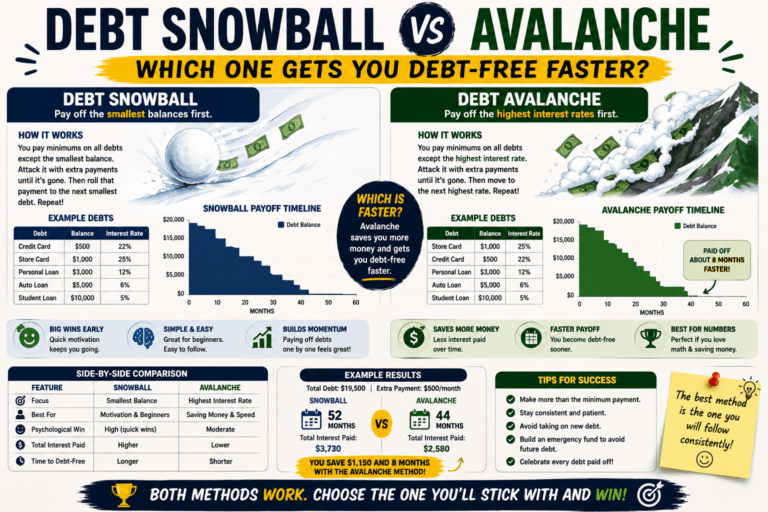
List all balances, rates and required payments. After deciding on starter savings, use a deliberate repayment method such as highest-interest-first or debt snowball.
What if I cannot make my minimum payments?
Contact creditors promptly, explain your situation and ask about manageable options. Aggressive extra payments or savings targets are secondary when required payments are already unaffordable.
What should I do after high-interest debt is gone?
Redirect the former debt payment toward your emergency fund and other financial goals rather than automatically absorbing it into everyday spending.
Research Methodology
This MoneyOnliners guide draws on Consumer Financial Protection Bureau guidance about emergency savings and research examining how consumers balance savings with credit card debt, together with CFPB and Federal Trade Commission guidance on managing unaffordable credit card payments. Examples and case studies are educational illustrations and do not guarantee an optimal outcome for every household.
About the Author
Ramathan Busulwa is the Founder and Editor of MoneyOnliners.com, a financial well-being and opportunity platform focused on helping readers earn more, manage money effectively, save consistently and build stronger long-term financial systems.
Editorial Mission
MoneyOnliners publishes practical, beginner-friendly financial education without hype, unrealistic promises or one-size-fits-all claims.
Editorial Standards
- Core claims are checked against authoritative consumer-finance guidance.
- $1,000 is presented as a possible starter milestone, not a universal rule.
- High-interest debt and emergency savings are evaluated together.
- Examples are clearly educational illustrations.
- No payoff date, savings result or financial outcome is guaranteed.
- Short paragraphs, varied sentence openings, transition wording and frequent subheadings support Yoast readability.
- Article imagery is varied across MoneyOnliners posts.
Final Verdict: Save $1,000 or Pay Off Debt?
If you have no emergency savings, building a small starter cushion can protect your debt-payoff plan from the next unexpected expense. However, you do not necessarily need exactly $1,000 before high-interest debt receives serious attention.
Once some cash protection is in place, expensive credit card debt often deserves strong priority. Still, irregular income, dependents and near-term financial risks may justify keeping a larger buffer.
Think in stages: build enough starter savings to reduce the chance of immediately borrowing again, attack high-interest debt, and then redirect the freed monthly payment toward a larger emergency fund.
This approach allows your money to do two jobs over time: protect you from the next financial shock and reduce the cost of the debt you already carry.