Emergency Fund vs Sinking Fund: Which One Should You Build First?
Emergency Fund vs Sinking Fund: Which One Should You Build First?
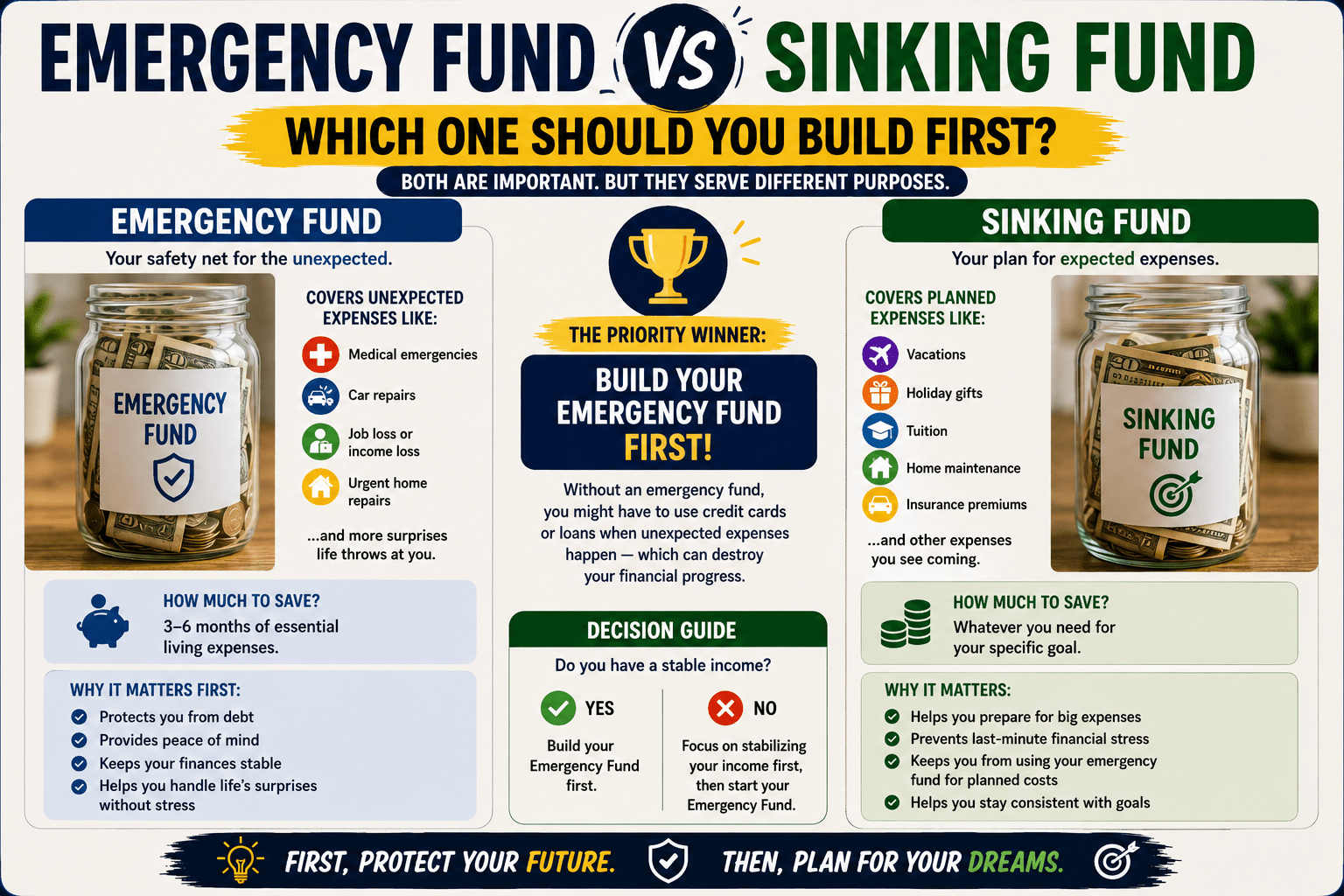
Both funds can protect your budget, but they solve different problems. An emergency fund prepares you for expenses you did not plan for. A sinking fund prepares you for expenses you know are coming.
For most people starting with little or no savings, build a small starter emergency fund first. That cash gives you immediate protection against an unplanned repair, medical bill or income disruption. After creating that first cushion, start the most important sinking funds for predictable expenses such as annual insurance, car maintenance, school costs or holiday spending. Then continue building both. The key difference is simple: emergency fund = unknown or unplanned financial shock; sinking fund = known future expense with a purpose and often a deadline.
Emergency Fund vs Sinking Fund: The Difference at a Glance
These two savings tools are often confused because both involve setting money aside before you need it. However, the reason for saving is different. That difference determines when the money should be used.
| Feature | Emergency Fund | Sinking Fund |
|---|---|---|
| Main purpose | Protect against unplanned financial shocks | Prepare for a known future cost |
| Do you know the exact expense? | Usually no | Usually yes |
| Do you know when you will need it? | Usually no | Often approximately or exactly |
| Examples | Job loss, unexpected medical bill, urgent repair | Annual insurance, Christmas, tires, school fees, vacation |
| Typical target | Starter milestone, then essential-expense based | Cost of the specific goal |
| After withdrawal | Replenish the reserve | Start again if the expense repeats |
| Should it be easy to access? | Yes, while remaining protected from casual spending | Yes when the planned expense is near |
| Which comes first? | Usually a starter emergency fund | Then high-priority predictable expenses |
An Emergency Fund Protects You From the Unexpected
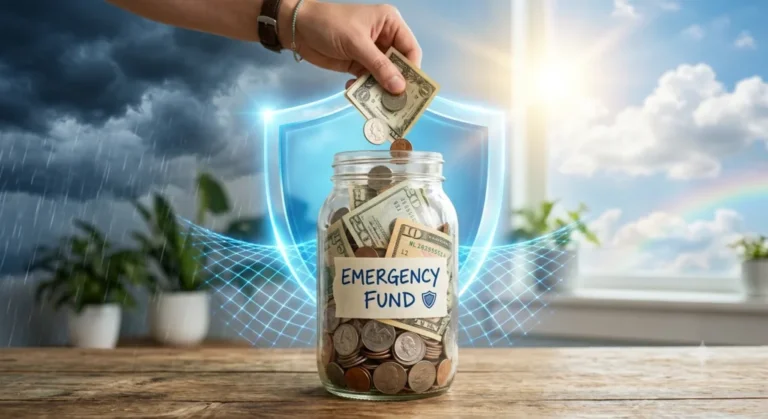
The Consumer Financial Protection Bureau defines an emergency fund as cash specifically reserved for unplanned expenses or financial emergencies. Examples include car repairs, home repairs, medical bills and loss of income.
That definition matters. If your annual insurance premium arrives exactly when expected, the bill is not really an emergency simply because it is large. It was predictable, which makes it better suited to a sinking fund.
A Sinking Fund Turns Future Bills Into Monthly Savings
A sinking fund is a practical budgeting term for money accumulated gradually for a known expense. You identify the goal, estimate its cost, determine when the money is needed and divide the target across the available saving periods.
For example, if a $600 insurance premium is due in 12 months, saving $50 per month gives you $600 by the deadline, excluding interest. Instead of treating the premium as a sudden crisis, you have prepared for it.

Which One Should You Build First?
Start With a Small Emergency Fund
If you currently have $0 saved, a starter emergency fund usually deserves first priority. Without any buffer, an unexpected $200 or $500 problem can immediately force you toward a credit card, loan, missed bill or money intended for another goal.
Current CFPB guidance describes a dedicated emergency fund as an essential way to protect yourself and one of the first steps you can take to start saving. It also emphasizes that even a small amount can provide financial security when saving is difficult.
Then Add High-Priority Sinking Funds
Once you have a basic emergency cushion, identify predictable expenses that could otherwise wreck your monthly budget. Car maintenance, annual premiums, school costs and recurring home expenses are strong candidates.
You do not need to fully complete a large emergency fund before saving one dollar for predictable bills. Instead, protect yourself with a starter buffer and then divide new savings intelligently.
Finally, Grow Both at the Same Time
After the first stage, your monthly savings can serve multiple purposes. One portion can expand your emergency fund while another portion builds the sinking funds with the nearest deadlines.
This approach prevents a common problem: spending years building a large emergency reserve while repeatedly raiding it for expenses that were predictable all along.
What Counts as a True Emergency?
The word “emergency” becomes less useful when it describes every expensive or inconvenient event. Therefore, set clear rules before you need the money.
1. The Expense Is Unplanned
A sudden vehicle breakdown can qualify. Routine oil changes do not. An unexpected medical bill may qualify, while a known annual checkup should normally be included in your budget or a healthcare sinking fund.
2. The Expense Is Necessary
An emergency usually involves something important to your health, safety, housing, income or essential transportation. A discounted television is not an emergency simply because the sale ends tomorrow.
3. The Expense Cannot Reasonably Wait
If delaying the cost would create a serious problem, emergency savings may be appropriate. Conversely, an optional purchase that can safely wait another month belongs elsewhere.
4. You Did Not Have a Better Dedicated Fund
Suppose your car needs new tires after you knew for months that the existing tires were wearing out. A car-maintenance sinking fund would have been the better tool. If no such fund exists and the tires are now unsafe, you may still need to use emergency savings—but the experience tells you which sinking fund to create next.
Ask: “Was this expense unexpected, necessary and urgent?” If the answer is yes to all three, it is much more likely to be a legitimate emergency-fund expense.
What Expenses Belong in a Sinking Fund?
Sinking funds work best for expenses that are predictable but do not fit comfortably into one month's normal spending. Some happen on a fixed date, while others are inevitable even if the exact date is uncertain.
Car Maintenance and Repairs You Can Anticipate
Oil changes, tire replacement, registration, routine servicing and scheduled maintenance are not surprising. Saving a small amount each month spreads the cost across the year.
Annual or Semiannual Insurance Premiums
If you pay insurance less frequently than monthly, divide the next premium by the number of months remaining. That monthly amount becomes your sinking-fund contribution.
Home Maintenance
Homeowners know that roofs, appliances, paint, plumbing and other components eventually need attention. Although the exact repair may not be known, regular maintenance is predictable enough to justify dedicated savings.
School and Education Costs
Uniforms, supplies, tuition installments, books and school-related activities can create pressure when several costs arrive together. A sinking fund lets parents spread those costs across earlier months.
Holidays, Birthdays and Gifts
December arrives every year. Birthdays are also predictable. Saving gradually can reduce the temptation to finance celebrations with debt.
Travel and Vacations
A planned vacation is a savings goal, not an emergency. Build the cost before booking where possible, including transportation, accommodation, food and a margin for ordinary travel expenses.
Technology Replacement
Phones and computers do not last forever. If you depend on a laptop for work, a replacement fund can prevent an aging device from becoming a future financial crisis.
| Known Expense | Estimated Cost | Time Until Needed | Illustrative Monthly Saving |
|---|---|---|---|
| Car insurance | $600 | 12 months | $50 |
| New tires | $800 | 16 months | $50 |
| Holiday gifts | $480 | 12 months | $40 |
| School costs | $900 | 9 months | $100 |
| Laptop replacement | $1,200 | 24 months | $50 |
Illustrative calculations exclude interest, price changes, taxes and account fees.
How Much Should You Put in an Emergency Fund?
There is no single dollar amount that works for every household. The CFPB says your target depends on your situation and encourages people to consider the kinds of unexpected expenses they have experienced and what those events cost.
Begin With a Starter Milestone
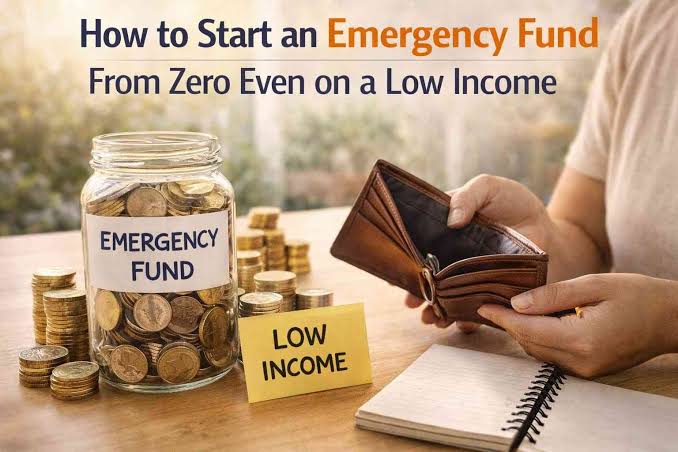
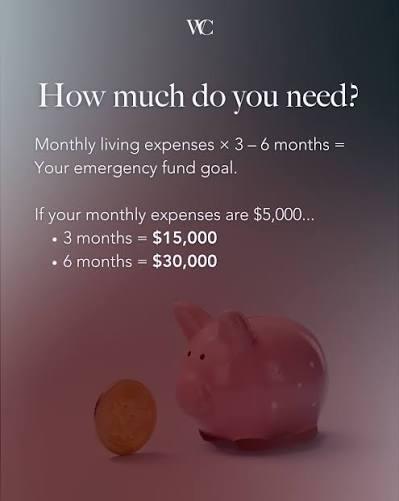
If you have no emergency savings, start with a target that feels reachable: $100, $250, $500 or $1,000. A small reserve is not the final destination, but it gives you protection while you work toward a larger goal.
Move Toward Essential Monthly Expenses
After reaching a starter milestone, calculate the expenses you would still need to cover during a job loss or serious financial disruption. Include housing, basic food, utilities, necessary transportation, insurance, healthcare and minimum required debt payments.
Adjust for Your Personal Risk
A single-income family may want more runway than a household with two stable incomes. Likewise, freelancers, seasonal workers and people with higher medical or housing risks may value a larger reserve.
Use Multi-Month Guidance as a Framework
FDIC consumer guidance notes that financial experts generally recommend at least six months of living expenses in an insured product. That can be a useful long-term benchmark, but your immediate target should remain realistic for your cash flow.
How Much Should You Put in a Sinking Fund?
Unlike an emergency fund, a sinking fund often has a calculable target. You need three pieces of information: the expected cost, the amount already saved and the time remaining.
Use the Basic Formula
(Target cost − amount already saved) ÷ number of saving periods = contribution per period.
Suppose you expect a $1,200 annual expense in 10 months and already have $200 saved. You still need $1,000. Dividing $1,000 by 10 gives a monthly target of $100.
Build a Margin for Variable Costs
Some expenses are predictable without being exact. Vehicle maintenance is a good example. If you estimate $600 but costs could be higher, a $700 or $750 target may provide useful flexibility.
Recalculate When Prices or Deadlines Change
A sinking fund is a living plan. If your target rises, your monthly contribution may need to rise as well. Alternatively, extending the deadline can reduce the required monthly amount when the purchase is flexible.
What If You Can Only Afford One Fund Right Now?
This is where priority matters most. If your available savings money is extremely limited, trying to fund ten categories at once can spread your cash too thin.
Stage 1: Create Basic Emergency Protection
Direct the first savings toward a starter emergency reserve. The exact milestone depends on your situation, but the objective is to stop operating with absolutely no buffer.
Stage 2: Identify the Nearest Predictable Financial Threat
Next, look at the calendar. Is car insurance due in three months? Are school expenses approaching? Does your vehicle need tires soon? Start the sinking fund that prevents the next known expense from becoming a crisis.
Stage 3: Divide New Savings
Once the immediate predictable expense is under control, split contributions. For example, if you can save $100 per month, you might put $60 toward emergency savings and $40 toward a sinking fund. The right split depends on deadlines and risks.
Stage 4: Add Categories Slowly
You do not need a separate fund for every possible purchase on day one. Start with the expenses that have the greatest financial impact, then add categories as your savings capacity grows.
| Your Situation | First Priority | Next Move |
|---|---|---|
| $0 saved, no major bill approaching | Starter emergency fund | Add sinking funds after first cushion |
| $300 emergency fund, annual insurance due soon | Keep starter fund intact | Prioritize insurance sinking fund |
| $1,000 emergency fund, several predictable annual costs | Maintain emergency savings | Build key sinking funds while growing emergency reserve |
| Strong emergency fund, no sinking funds | Protect existing emergency fund | Create sinking funds so predictable costs stop draining it |
| Multiple sinking funds, no emergency reserve | Build emergency protection | Temporarily slow lower-priority goals if necessary |
Four Real-Life Style Case Studies
The following examples are hypothetical. They show how emergency and sinking funds can work together under different financial circumstances.
A Parent With School Costs and No Emergency Savings
A parent knows school expenses are coming in four months, but she also has no emergency cushion. Rather than putting every available dollar into the school fund, she first builds a modest starter emergency reserve.
After reaching that first milestone, she directs most new savings toward the approaching school deadline while continuing a smaller emergency contribution.
Key lesson: a starter emergency fund can coexist with an urgent sinking-fund goal.
A Driver Keeps Calling Maintenance an Emergency
A worker has $1,000 in emergency savings, but every oil change, registration renewal and tire purchase comes from that account. The balance never grows.
He creates a vehicle sinking fund and begins contributing monthly. Routine car costs now come from the sinking fund, leaving emergency savings for genuinely unexpected breakdowns.
Key lesson: sinking funds protect the emergency fund from predictable withdrawals.
A Freelancer Needs More Emergency Protection
A freelancer already saves for annual software subscriptions and equipment replacement. However, her emergency reserve is small even though income varies substantially.
She temporarily slows a lower-priority travel sinking fund and directs the difference toward emergency savings. Once the reserve becomes stronger, she increases the travel contribution again.
Key lesson: priorities can change when income risk is high.
A Household Builds Both Automatically
A household has a starter emergency fund and several annual costs. Each payday, automatic transfers send money into separate savings buckets for emergencies, car costs and holidays.
Because every fund has a clear purpose, they can see whether a withdrawal is planned or truly unexpected.
Key lesson: automation and clear labels can make multiple savings goals easier to manage.

Emergency Fund vs Sinking Fund: Where Should You Keep the Money?
Both types of savings generally need safety and accessibility, although the exact account depends on the time horizon, banking system and products available in your country.
Keep Emergency Savings Safe and Accessible
The CFPB recommends a location that is safe, accessible and not so tempting that you spend the money on non-emergencies. A dedicated bank or credit-union savings account can work well for many people.
Match Sinking-Fund Access to the Deadline
If an expense is due in three months, you need reliable access to the money. For a longer-term goal, you may have more options, but avoid unnecessary risk when the money has a fixed near-term purpose.
Separate the Categories Clearly
You can use separate accounts, subaccounts or savings buckets if your financial institution offers them. Alternatively, one savings account plus a careful spreadsheet or budgeting app can track separate balances.
Watch Account Fees
Opening many accounts is counterproductive if each one charges fees that consume your savings. Compare minimum balances, transfer restrictions and other terms before creating a complex system.
Can You Keep Emergency and Sinking Funds in the Same Account?
Yes, technically. The important issue is whether you can reliably track how much belongs to each purpose.
One Account Can Be Simpler
If you are just beginning, one savings account may reduce complexity. You can track the internal categories separately on paper, in a spreadsheet or in your budgeting system.
Separate Buckets Can Reduce Confusion
When your savings grow, labeled buckets make it easier to see that $700 is for emergencies, $300 is for car maintenance and $200 is for annual insurance.
Do Not Double-Count the Same Money
This is crucial. If your savings account contains $1,200 and $500 is already assigned to insurance, you do not have a $1,200 emergency fund. You have $700 in emergency savings plus a $500 sinking fund.
What Happens When a Sinking Fund Is Not Big Enough?
Sometimes the planned expense arrives earlier or costs more than expected. The right response depends on how necessary and urgent the expense is.
First, Use the Sinking Fund
That money was saved specifically for this purpose. Use it without guilt. A successful sinking fund is supposed to decrease when the planned expense occurs.
Then Look for Flexible Cash Flow
If the fund is short, see whether the remaining cost can be covered from the current month's discretionary spending without disrupting essentials.
Use Emergency Savings Only When the Remaining Cost Becomes a Real Emergency
If a necessary car repair costs $900 and the vehicle fund contains $650, using $250 of emergency savings may be reasonable when the car is essential for work. Afterward, replenish the emergency fund and adjust the future car-maintenance target.
Learn From the Shortfall
A shortfall is useful information. Perhaps the target was too low, prices increased or the saving period was too short. Update the sinking-fund calculation before the next cycle.
Emergency Fund vs Sinking Fund When You Have Debt
Debt adds another claim on limited monthly cash. Still, eliminating every savings contribution until all debt disappears can leave you exposed to the next financial shock.
Build Basic Emergency Protection
A starter emergency fund can reduce the chance that a small surprise immediately creates new debt. Continue making all required debt payments while building that cushion.
Fund Predictable Essentials
If a required annual bill is approaching, a sinking fund can prevent that known expense from landing on a credit card. Therefore, some planned savings may be worthwhile even during debt repayment.
Delay Lower-Priority Wants When Necessary
A vacation sinking fund and a car-insurance sinking fund do not have equal urgency. When debt is expensive and cash flow is tight, lower-priority discretionary goals may need to slow down.
Reassess as Debt Falls
When a monthly debt payment disappears, redirect some of that freed cash toward emergency savings and sinking funds before lifestyle spending absorbs the entire difference.
A Simple Three-Account MoneyOnliners System
You do not need dozens of bank accounts. A simple structure can create enough separation for most beginners.
Account 1: Everyday Spending
Income arrives here and regular bills are paid here. Keep enough for your normal cash-flow needs without mentally counting emergency savings as spendable money.
Account 2: Emergency Savings
This account has one job: protect you from unplanned, necessary financial shocks. Give it a clear label and establish rules for withdrawals.
Account 3: Planned-Expense Savings
This account can hold several sinking-fund categories if you track them separately. For example, the total might include $400 for car costs, $300 for school expenses and $200 for gifts.
| Monthly Savings Available | Emergency Fund | Priority Sinking Funds | How to Think About It |
|---|---|---|---|
| $50 | $35 | $15 | Illustrative starter split |
| $100 | $60 | $40 | Grow protection while preparing for known costs |
| $200 | $100 | $100 | Balanced example after starter reserve |
| $300 | $150 | $150 | Adjust based on deadlines and risks |
These are examples, not required percentages. Your deadlines, income, debt and emergency-fund balance should determine the actual split.
Common Emergency Fund and Sinking Fund Mistakes
Calling Every Large Bill an Emergency
Large does not automatically mean unexpected. Annual premiums, birthdays and routine maintenance should usually be anticipated.
Building Sinking Funds but Keeping $0 for Emergencies
A beautifully organized vacation fund cannot protect you from sudden income loss. Keep some cash reserved for genuine financial shocks.
Using Emergency Money for Wants
Sales, entertainment and spontaneous travel do not become emergencies because you want them immediately. Create separate savings goals instead.
Creating Too Many Tiny Funds
Twenty categories can overwhelm a beginner. Start with a small number of high-impact goals and expand only when the system remains easy to manage.
Forgetting to Refill the Emergency Fund
Using emergency savings for a legitimate reason is not failure. However, rebuilding the balance should become a priority after the immediate crisis passes.
Forgetting That Sinking Funds Reset
Recurring expenses require recurring savings. After paying an annual premium, start preparing for next year's premium instead of waiting eleven months.
A 12-Month Plan to Build Both Funds
The exact numbers will vary, but this roadmap shows how someone starting with little savings can establish both systems without trying to do everything at once.
Months 1–2: Build Your First Cushion
Focus heavily on starter emergency savings. Meanwhile, list every non-monthly expense you expect during the next year.
Months 3–4: Start the Most Urgent Sinking Fund
Choose the known expense with the nearest important deadline. Calculate the contribution needed and begin saving for it.
Months 5–6: Continue Emergency Growth
Keep the sinking-fund contribution running while increasing emergency savings where possible. Use windfalls or extra income to accelerate either goal.
Months 7–9: Add a Second Planned Expense
If cash flow allows, introduce another high-priority sinking fund. Avoid adding categories that leave each fund with meaningless contributions.
Months 10–12: Review the Entire System
Compare actual expenses with your estimates. Increase sinking-fund targets that were consistently too low and calculate the next emergency-fund milestone.
Incoming Link Opportunities
Recommended External Resources
Consumer Financial Protection Bureau — Emergency Fund Guide
The CFPB explains what an emergency fund is, why it matters, how to build one, where to keep it and when to use it.
An Essential Guide to Building an Emergency Fund — CFPB
FDIC — Saving for the Unexpected and Your Future
The FDIC discusses emergency savings as well as shorter-term savings goals such as vacations, weddings and major purchases.
Saving for the Unexpected and Your Future — FDIC
FDIC — Starting Small Can Lead to Big Savings
The FDIC distinguishes saving for anticipated future expenses from building emergency savings for unexpected financial hardship.
Starting Small Can Lead to Big Savings — FDIC
FDIC — Goals and Saving
The FDIC explains how to define a savings goal by identifying what you need, how much it will cost, when you need the money and how you plan to save.
The CFPB and FDIC are U.S. sources. The distinction between unexpected emergency savings and planned savings goals can be applied broadly, but bank protections, taxes, account types and financial regulations differ by country.
Frequently Asked Questions
What is the main difference between an emergency fund and a sinking fund?
An emergency fund is for unplanned financial shocks.
A sinking fund is for a known future expense.
You usually do not know exactly when an emergency will happen.
With a sinking fund, you often know the goal and approximate deadline.
Keeping the purposes separate makes your budget more predictable.
Should I build an emergency fund or sinking fund first?
For most beginners with little or no savings, start with a small emergency fund.
That gives you immediate protection against unexpected expenses.
Next, create sinking funds for important predictable bills.
After the starter stage, build both simultaneously.
Adjust the split according to deadlines and financial risk.
Is a car repair an emergency or sinking-fund expense?
It depends on the repair.
Routine maintenance and predictable replacement items belong in a car sinking fund.
A sudden major mechanical failure may qualify as an emergency.
If you repeatedly use emergency savings for routine car costs, create a vehicle fund.
That separation protects your emergency reserve.
Can I have multiple sinking funds?
Yes.
You might save separately for car maintenance, insurance, school costs and holidays.
However, avoid creating so many categories that the system becomes difficult to manage.
Start with the highest-priority expenses.
Add more categories as your savings capacity grows.
Can emergency and sinking funds be in the same savings account?
Yes, if you track the categories accurately.
One account can be easier for beginners.
Separate buckets can become useful as balances grow.
Never count sinking-fund money as emergency money at the same time.
Your records should always show the true amount assigned to each purpose.
How much should I put into a sinking fund each month?
Start with the amount you still need to save.
Divide that figure by the number of months or pay periods remaining.
For example, $600 needed in 12 months equals $50 per month.
Add a margin when the final cost is uncertain.
Recalculate if the price or deadline changes.
Should I use my emergency fund if my sinking fund is short?
Use the sinking fund first.
Then determine whether the remaining cost is necessary and urgent.
If it has become a genuine financial emergency, using emergency savings may be reasonable.
Afterward, rebuild the emergency reserve.
Also adjust the sinking-fund target to reduce future shortfalls.
Should I have sinking funds if I am paying off debt?
Some sinking funds can still be useful.
Known essential bills can otherwise become new debt when they arrive.
Prioritize necessities over discretionary goals.
Continue required debt payments while maintaining basic financial protection.
As debt falls, redirect freed cash toward savings.
Is Christmas an emergency-fund expense?
Generally, no.
Christmas occurs at a predictable time each year.
Gifts, travel and celebration costs can be planned in advance.
A holiday sinking fund is therefore the better tool.
Set a spending target early and divide it across the months remaining.
What should I do after my emergency fund is fully built?
Keep the fund intact and review the target periodically.
Continue replenishing any legitimate withdrawals.
Strengthen sinking funds for predictable expenses.
Then direct additional savings toward other financial goals appropriate to your situation.
Your savings system should evolve as income, expenses and responsibilities change.
Research Methodology
This MoneyOnliners article distinguishes emergency savings from planned savings goals using current CFPB and FDIC consumer guidance. The CFPB definition of an emergency fund is used for unplanned expenses and financial emergencies. FDIC materials support separate planning for anticipated expenses and savings goals based on the amount needed and timeframe. “Sinking fund” is used here as the common personal-finance term for that planned-expense savings method. Illustrative calculations and hypothetical case studies are clearly separated from official guidance.
Final Verdict: Build a Starter Emergency Fund First, Then Build Both
In the emergency fund vs sinking fund decision, neither savings tool replaces the other. They protect different parts of your financial life.
If you are starting with no savings, create a small emergency cushion first. That gives you immediate protection against financial shocks you cannot schedule. Once you have that first buffer, identify the predictable expenses most likely to disrupt your budget and start sinking funds for them.
From there, continue growing both. Your emergency fund can move from a starter amount toward one month and eventually several months of essential expenses. Meanwhile, your sinking funds can prepare for insurance, car maintenance, school costs, home expenses, holidays and other known obligations.
The result is a stronger system: unexpected expense → emergency fund; expected expense → sinking fund. When each dollar has the right job, fewer ordinary bills turn into financial emergencies.

3 Comments