7 Steps to Build a Debt Repayment Plan You Can Actually Stick To
7 Steps to Build a Debt Repayment Plan You Can Actually Stick To
A good debt plan is not the one that looks most aggressive on paper. It is the one that fits your real income, protects essential expenses, gives every debt a clear priority and remains realistic enough to follow month after month.
To build a debt repayment plan you can stick to, first list exactly what you owe. Next, review your budget and determine an affordable payment amount. Then choose a repayment strategy, protect required payments, automate what you can, track progress and review the plan whenever your income or expenses change. The goal is sustainable progress—not a payment target so aggressive that you repeatedly abandon it.
Why Most Debt Repayment Plans Need More Than Motivation
Deciding to become debt-free is important. However, motivation alone does not tell you which debt to pay first, how much you can realistically afford, or what to do when an unexpected bill arrives.
A workable debt repayment plan turns a broad goal into a monthly system. It shows what you owe, when payments are due, which balance receives extra money and how you will measure progress.
The Consumer Financial Protection Bureau recommends knowing what you owe before building a payoff strategy. It also identifies two common approaches: paying the highest interest rate first or using the debt snowball method.
Meanwhile, the Federal Trade Commission recommends building a budget and contacting creditors early if you are struggling with payments. Those two ideas—knowing your numbers and choosing payments you can actually manage—form the foundation of this MoneyOnliners plan.
The 7-Step Debt Repayment Plan at a Glance
| Step | Action | Why It Matters |
|---|---|---|
| 1 | List every debt | You cannot prioritize what you have not measured. |
| 2 | Build a realistic monthly budget | Shows how much is actually available for repayment. |
| 3 | Choose a payoff strategy | Gives your extra money one clear target. |
| 4 | Set an affordable extra payment | Makes the plan sustainable through normal months. |
| 5 | Automate and organize payments | Reduces missed-payment risk and decision fatigue. |
| 6 | Track progress and create milestones | Keeps improvement visible. |
| 7 | Review and adjust the plan | Allows the system to survive real-life changes. |
List Every Debt You Owe
Start with facts rather than estimates. Gather recent statements and write down every debt included in your repayment plan.
For each account, record the creditor, current balance, interest rate or APR, required payment and due date. Also note whether the rate is fixed, variable or promotional.
| Debt | Balance | Rate | Required Payment | Due Date |
|---|---|---|---|---|
| Credit Card A | $2,400 | 26% | $85 | 8th |
| Store Card | $550 | 19% | $30 | 14th |
| Personal Loan | $4,800 | 10% | $165 | 20th |
| Credit Card B | $1,200 | 17% | $45 | 27th |
Why the Full Debt List Matters
Without a complete inventory, you may send extra money to one account while overlooking a more expensive balance or an upcoming due date. In addition, seeing the full picture makes it easier to choose between snowball and avalanche.
Verify Debts You Do Not Recognize
If a collector contacts you about an unfamiliar debt, do not automatically pay simply because someone demands money. In U.S. guidance, the FTC advises consumers to review debt validation information and verify that the debt belongs to them. Rules differ internationally, so use the protections applicable where you live.

Build a Budget Around What You Actually Spend
Your debt plan must coexist with housing, food, utilities, transport, insurance and other essential obligations. Therefore, calculate your normal monthly cash flow before choosing an extra debt payment.
Start With Reliable Take-Home Income
If your income is stable, use your normal take-home amount. If income changes each month, consider building the plan around a conservative baseline rather than your best month.
Separate Essentials From Flexible Spending
Next, review recent transactions. Identify fixed obligations, essential variable costs and discretionary spending. Look for realistic reductions rather than pretending every nonessential expense will disappear forever.
Calculate Your Starting Debt-Payoff Margin
Suppose monthly take-home income is $3,000. Essential and planned expenses total $2,250, while required debt payments total $450. That leaves $300 before additional savings or other priorities.
Instead of automatically committing the entire $300, the borrower might choose a sustainable $200 extra debt payment and preserve $100 of flexibility. The correct amount depends on the household's actual risks and obligations.
Do Not Build the Plan Around a Perfect Month
A plan that works only when nothing goes wrong is fragile. Car repairs, school costs, medical expenses and income fluctuations happen. Consequently, leave enough flexibility to prevent every surprise from returning to a credit card.
Choose a Debt Repayment Strategy
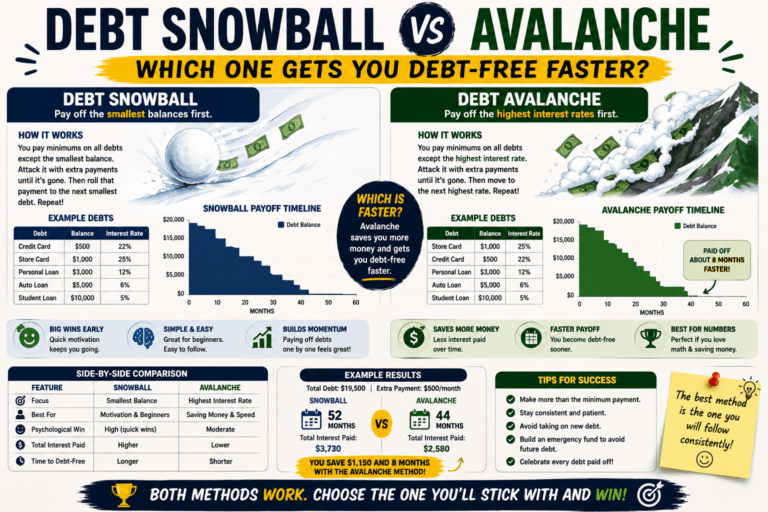
Once you know what you owe and what you can afford, choose where your extra payment will go. Two of the most common strategies are debt snowball and debt avalanche.
Option A: Debt Snowball
Snowball starts with the smallest balance. You maintain required payments elsewhere and direct your extra repayment money toward the smallest debt. Once it reaches zero, you roll that payment into the next-smallest balance.
This approach can create quick visible wins. However, the CFPB notes that you may pay more over time because the strategy does not necessarily prioritize your costliest debts.
Option B: Debt Avalanche
Avalanche starts with the highest interest rate. Again, required payments continue elsewhere, while extra money targets the most expensive debt.
The CFPB says eliminating the costliest debts first can save money in the long run. Nevertheless, progress may feel slower when the highest-rate debt has a large balance.
| Feature | Snowball | Avalanche |
|---|---|---|
| Priority | Smallest balance | Highest interest rate |
| Primary benefit | Quicker visible wins | Interest efficiency |
| Potential drawback | Can cost more interest | First payoff can take longer |
| Useful for | Motivation and simplicity | Minimizing borrowing cost |
Option C: A Deliberate Hybrid
You do not have to treat repayment strategies like rival teams. For example, you might eliminate one tiny balance for momentum and then switch to highest-interest-first.
What matters is having a rule. Constantly changing targets without a reason can scatter your extra payments and make progress harder to measure.
Set a Monthly Payment You Can Actually Maintain
This is where many repayment plans become unrealistic. A borrower sees $400 available in one unusually good month and decides $400 will be the permanent extra payment. Then a normal expense appears, the target fails and the entire plan feels broken.
Start With Your Sustainable Number
If $150 works consistently but $300 works only occasionally, consider making $150 the planned extra payment. During stronger months, you can send additional money.
Use a Base Payment Plus Extra-Payment Rule
A flexible structure can be especially useful for irregular income. For example, commit to a $75 monthly base amount and direct a chosen percentage of income above your baseline toward debt.
Protect Essential Obligations
Do not skip rent, mortgage, food, essential utilities or other critical obligations simply to make an aggressive unsecured-debt payment. Different debts can also have different consequences when unpaid, so priority is not always determined by interest rate alone.
Keep Some Protection Against New Debt
If you have no emergency savings, consider whether a modest cash cushion should be built alongside repayment. Without one, a small unexpected expense can immediately recreate the balance you just paid down.
A snowball or avalanche spreadsheet is not the first problem to solve. The FTC recommends contacting creditors early, explaining your situation and asking about a payment arrangement you can manage. If you reach an agreement, keep records and obtain the terms in writing.
Automate Payments and Organize Due Dates
A strong debt repayment plan should reduce the number of decisions you need to make each month. Automation can help, provided your bank account has enough money when scheduled payments are processed.
Automate Required Payments Where Appropriate
Automatic payments can reduce the chance of simply forgetting a due date. However, check your account balance and creditor statements rather than assuming every payment processed correctly.
Schedule the Extra Payment
If your cash flow is predictable, schedule the extra debt payment shortly after payday. This gives the repayment goal priority before discretionary spending absorbs the money.
Use a Bill Calendar
The CFPB recommends organizing monthly bills and due dates as part of managing debt. A simple calendar can show whether several payments cluster around one paycheck.
Keep a Monthly Debt Dashboard
| Track | Beginning of Month | End of Month |
|---|---|---|
| Total debt balance | $8,950 | $8,610 |
| Target debt | Credit Card A | Credit Card A |
| Extra payment | Planned: $200 | Paid: $200 |
| Emergency savings | $500 | $550 |
| Next milestone | Below $8,500 | $110 away |

Track Progress and Create Smaller Milestones
Debt payoff can take months or years. Therefore, waiting until the final balance reaches zero before acknowledging progress can make the process feel unnecessarily long.
Track Total Debt, Not Only One Account
Record your combined balance monthly. Even when your target debt has not disappeared, the total can show meaningful progress.
Create Milestones You Can Control
Useful milestones might include making three months of planned payments, reducing total debt below a round-number threshold or eliminating the first account.
Celebrate Without Recreating the Debt
A milestone reward does not need to be expensive. Choose something that acknowledges progress without putting the achievement back on a credit card.
Roll Freed Payments Forward
When a debt reaches zero, redirect its former payment to the next target. This is what allows repayment power to grow under both snowball and avalanche.
- Did every required payment get made?
- Did the planned extra payment reach the target debt?
- Did any interest rate change?
- Did total debt decrease?
- Did you add new debt, and if so, why?
- Does next month's payment still fit your budget?
Review and Adjust Without Abandoning the Plan
A repayment plan is a system, not a punishment. When your circumstances change, adjust the numbers instead of declaring the entire plan a failure.
Review After Income Changes
A raise may allow a larger extra payment. Conversely, reduced hours or lost income may require a temporary decrease. The important point is to make the adjustment deliberately.
Review After Major Expenses Change
When a childcare cost ends, a loan is paid off or insurance premiums change, decide in advance how much of the freed cash will go toward debt.
Review When Interest Rates Change
Variable rates and promotional offers can change your avalanche order. Therefore, verify current rates periodically rather than relying on an old spreadsheet.
Know When to Ask for Help
If required payments are consistently unaffordable, reputable credit counseling may be worth considering. The FTC says a good counselor should review your overall finances and help develop a plan rather than promise to fix every problem instantly.
In addition, the FTC warns against debt-relief companies that demand upfront payment or guarantee that all debts will be settled. Recent FTC guidance continues to identify those claims as scam warning signs.
A Realistic Debt Repayment Plan Example
Consider Maya, a hypothetical worker with $8,950 of consumer debt. Her take-home income averages $3,100 per month. After reviewing actual expenses, she determines that $175 is a comfortable recurring extra payment, although some months may allow more.
| Debt | Balance | Rate | Required Payment |
|---|---|---|---|
| Store Card | $450 | 18% | $30 |
| Credit Card A | $2,000 | 28% | $75 |
| Credit Card B | $1,500 | 20% | $55 |
| Personal Loan | $5,000 | 11% | $170 |
Her First Decision: Snowball or Avalanche?
Snowball would target the $450 store card. Avalanche would target the 28% Credit Card A. Maya knows she is motivated by quick wins, but she also dislikes carrying the 28% balance.
She chooses a hybrid: eliminate the $450 store card first, then switch to avalanche. This gives her an early account-level victory while preventing the high-rate card from remaining near the bottom of the plan.
Her Second Decision: How Much Extra?
Instead of committing every available dollar, Maya sets the recurring extra payment at $175. During months with overtime, she sends half of the additional take-home income to the current target.
Her Third Decision: How to Stay Consistent
She automates required payments, schedules the $175 target payment after payday and reviews balances on the last weekend of each month.
Maya's plan is not the most aggressive plan mathematically possible. It is designed around an amount she believes she can repeat. That repeatability is what makes the plan useful.
Three Mini Case Studies: Different People Need Different Plans
Daniel Uses a Base-Plus-Percentage System
Daniel's monthly income changes. Instead of promising a fixed $400 extra payment, he commits $75 every month and directs part of income above his baseline to debt.
As a result, weak months do not automatically break his plan, while strong months still accelerate repayment.
Key lesson: variable income needs a flexible payment rule.
Aisha Chooses Snowball
Aisha has five debts and feels overwhelmed by the number of payments. Although avalanche could reduce interest, two balances are small enough to eliminate relatively quickly.
She chooses snowball because reducing the number of accounts is more likely to keep her engaged.
Key lesson: behavioral sustainability can matter when choosing a method.
Chris Chooses Avalanche
Chris has one credit card at a substantially higher rate than his other debts. He is comfortable waiting longer for the first account to reach zero.
Therefore, he targets the highest-rate card and tracks each $500 balance reduction as a milestone.
Key lesson: create intermediate wins when avalanche's first payoff is far away.
12 Mistakes That Can Break a Debt Repayment Plan
1. Setting the Payment From Your Best Month
Use a repeatable amount. Send extra money during unusually strong months rather than assuming every month will look the same.
2. Forgetting Irregular Expenses
Annual insurance, school costs, holidays and maintenance still exist even when they are not monthly bills.
3. Paying Extra While Missing Other Required Payments
Your targeted payment should not cause avoidable missed payments elsewhere.
4. Ignoring Interest Rates
Even snowball users should know which debts are most expensive.
5. Constantly Changing the Target
Switch when there is a reason, not because another balance feels more interesting this week.
6. Adding New Discretionary Debt
New balances can erase progress. Identify the spending pattern that created them.
7. Having No Emergency Strategy
Without some plan for unexpected expenses, the next surprise may return straight to a card.
8. Forgetting to Roll Payments Forward
When one debt disappears, redirect the payment instead of absorbing it into lifestyle spending.
9. Never Reviewing Statements
Rates, fees and balances can change. Verify what is actually happening.
10. Treating a Setback as Failure
A temporary reduction in your extra payment is not the same as abandoning the plan.
11. Paying a Debt-Relief Company Upfront
The FTC warns that upfront payment demands for debt settlement are a major scam sign.
12. Believing Guaranteed Debt-Forgiveness Claims
Recent FTC guidance warns that anyone guaranteeing to settle all debts or obtain fast loan forgiveness is a scammer.
Your 30-Day Debt Repayment Plan Setup
| Time | Action | Result |
|---|---|---|
| Days 1–3 | Gather statements and build the debt list. | You know exactly what you owe. |
| Days 4–7 | Review income and actual spending. | You find a realistic repayment margin. |
| Days 8–10 | Compare snowball, avalanche or a deliberate hybrid. | You choose the first target. |
| Days 11–14 | Set the recurring extra payment. | Your plan gets a sustainable monthly number. |
| Days 15–18 | Organize due dates and automation. | Payments become easier to manage. |
| Days 19–23 | Create milestones and a tracking sheet. | Progress becomes visible. |
| Days 24–30 | Make the first payment and schedule the monthly review. | The plan moves from theory to routine. |
Incoming Link Opportunities
Recommended External Resources
Consumer Financial Protection Bureau — How to Reduce Your Debt
This CFPB guide explains the highest-interest-rate and snowball strategies and emphasizes choosing a strategy that fits your situation.
How to Reduce Your Debt — CFPB
Federal Trade Commission — How to Get Out of Debt
The FTC covers budgeting, contacting creditors, credit counseling, debt management plans, settlement risks and consolidation.
How to Get Out of Debt — FTC Consumer Advice
Consumer Financial Protection Bureau — Financial Empowerment Toolkit
The toolkit includes debt-reduction and money-management worksheets that can help readers organize a repayment strategy.
Your Money, Your Goals Toolkit — CFPB
FTC — Debt Relief Scam Guidance
The FTC continues to warn consumers about companies demanding upfront payment or guaranteeing fast debt relief.
Looking for Debt Relief? Here's How to Avoid a Scam — FTC
The CFPB and FTC sources above describe U.S. consumer-finance rules and protections. The planning principles in this article can be used more broadly, but debt collection, credit reporting, insolvency, lender obligations and consumer rights vary by country.
Frequently Asked Questions About Debt Repayment Plans
What is a debt repayment plan?
A debt repayment plan is a structured system for paying what you owe.
It identifies your debts and required payments.
It also determines where extra repayment money will go.
A useful plan fits within your real budget.
Finally, it includes a way to track and adjust progress.
How do I start a debt repayment plan?
Start by listing every debt.
Record the balance, interest rate, required payment and due date.
Then review your monthly budget.
Choose a repayment method and affordable extra payment.
Afterward, track the plan every month.
Should I use debt snowball or debt avalanche?
Snowball prioritizes the smallest balance.
Avalanche prioritizes the highest interest rate.
Snowball can provide faster visible wins.
Avalanche can save more interest over time.
Choose the approach that best fits your financial priorities and motivation.
How much extra should I pay toward debt?
There is no universal amount.
Start with your income, essential expenses and required obligations.
Choose an amount that can be repeated during normal months.
You can make additional payments when cash flow is stronger.
Avoid setting a target that repeatedly forces you to borrow again.
Can I build a debt plan with irregular income?
Yes.
Consider using a conservative income baseline.
Set a small base extra payment that works during weaker months.
Then create a rule for allocating part of higher income toward debt.
Review the amount as your income pattern changes.
Should I save money while paying off debt?
A cash cushion can reduce the need to borrow after an unexpected expense.
At the same time, high-interest debt can be expensive.
The appropriate balance depends on your financial risks and stability.
Do not ignore required payments.
Review your emergency savings target as your finances improve.
What happens after I pay off the first debt?
Keep the money in the repayment plan.
Redirect the finished debt's payment toward your next target.
This increases the amount attacking the remaining balances.
Update your tracking sheet.
Then continue until the debts included in the plan are gone.
What if I miss my planned extra payment?
Do not automatically abandon the plan.
First, identify why the payment was missed.
If the budget was unrealistic, reduce the recurring target.
If the problem was temporary, resume next month.
A sustainable adjustment is better than repeatedly restarting.
What if I cannot afford the minimum payments?
Contact your creditors early.
Explain what is happening and ask about manageable options.
Review your essential spending and overall budget.
Reputable credit counseling may also be appropriate.
Avoid companies promising guaranteed instant debt elimination.
How often should I review my debt repayment plan?
A brief monthly review works well for many people.
Check balances, rates and whether payments were made.
Also review the plan after major income or expense changes.
Update it when promotional or variable rates change.
The goal is to keep the plan accurate without constantly changing strategy.
Research Methodology
This MoneyOnliners article was developed using Consumer Financial Protection Bureau guidance on debt reduction, budgeting and organizing bills, together with Federal Trade Commission guidance on budgeting, creditor communication, credit counseling, debt management plans and debt-relief scams. The seven-step framework, examples, case studies, dashboard and 30-day setup plan are MoneyOnliners editorial structures designed to turn those principles into an easy-to-follow workflow. They do not guarantee a particular payoff date, interest saving or financial outcome.
Final Thoughts: Build a Plan You Can Repeat
The best debt repayment plan is not necessarily the one with the biggest monthly payment. Instead, it is the one that makes meaningful progress without collapsing every time normal life becomes expensive.
Start by knowing exactly what you owe. Then build your payment around your real budget rather than an idealized version of your spending. Choose snowball, avalanche or a deliberate hybrid so your extra money always has a clear destination.
Next, make the system easier to follow. Organize due dates, automate appropriate payments, track your total balance and create milestones that allow you to see progress before the final debt disappears.
Most importantly, expect the plan to change. Income can rise or fall. Expenses can shift. Interest rates can change. A useful repayment plan responds to those changes without losing its overall direction.
Seven practical steps are enough to begin: list, budget, choose, set, automate, track and adjust. Repeat that process consistently, and your debt repayment plan becomes more than a goal—it becomes a working financial system.
Similar Posts
15 Ways to Pay Off Credit Card Debt Faster and Cut Interest Costs
15 Ways to Pay Off Credit Card Debt Faster and Cut Interest Costs | MoneyOnliners MoneyOnliners • Manage Money → Debt Payoff 15 Ways to Pay Off Credit Card Debt Faster and Cut Interest Costs High-interest credit card balances can make progress feel painfully slow. These practical strategies can help you direct more money toward…
Debt Snowball vs Avalanche: Which One Gets You Debt-Free Faster?
Debt Snowball vs Avalanche: Which One Gets You Debt-Free Faster? | MoneyOnliners MoneyOnliners • Manage Money → Debt Payoff Debt Snowball vs Avalanche: Which One Gets You Debt-Free Faster? One method attacks your smallest balance first. The other attacks your highest interest rate. Both can eliminate debt, but they optimize different things—and choosing the right…
Debt Snowball Method: Does Paying the Smallest Debt First Really Work?
Debt Snowball Method: Does Paying the Smallest Debt First Really Work? | MoneyOnliners MoneyOnliners • Manage Money → Debt Payoff Debt Snowball Method: Does Paying the Smallest Debt First Really Work? The debt snowball method ignores interest rates at first and attacks your smallest balance instead. That may sound mathematically backward—but for some borrowers, quick…
Debt Avalanche Method: Can It Really Save You More in Interest?
Debt Avalanche Method: Can It Really Save You More in Interest? | MoneyOnliners MoneyOnliners • Manage Money → Debt Payoff Debt Avalanche Method: Can It Really Save You More in Interest? The debt avalanche method attacks your highest-interest debt first. It may not give you the quickest emotional win, but when interest rates differ, prioritizing…
10 Ways to Break the Debt Cycle and Stop Borrowing to Get By
10 Ways to Break the Debt Cycle and Stop Borrowing to Get By | MoneyOnliners MoneyOnliners • Manage Money → Debt Payoff 10 Ways to Break the Debt Cycle and Stop Borrowing to Get By If loans and credit cards keep filling the gap between paychecks, paying down balances alone may not solve the problem….
Good Debt vs Bad Debt: 15 Real-Life Examples You Should Know
Good Debt vs Bad Debt: 15 Real-Life Examples You Should Know | MoneyOnliners MoneyOnliners • Manage Money → Debt Payoff Good Debt vs Bad Debt: 15 Real-Life Examples You Should Know Not every loan is automatically good or bad. Purpose matters, but so do interest rates, fees, affordability, risk, repayment terms and what the debt…