10 Ways to Break the Debt Cycle and Stop Borrowing to Get By
10 Ways to Break the Debt Cycle and Stop Borrowing to Get By
If loans and credit cards keep filling the gap between paychecks, paying down balances alone may not solve the problem. These practical steps focus on changing the cash-flow system that keeps creating new debt.
To break the debt cycle, first identify exactly why new borrowing keeps happening. Then stabilize essential bills, stop avoidable new debt, create a realistic spending plan, build even a small emergency cushion and direct a repeatable amount toward existing balances. If required payments are becoming unaffordable, contact creditors early and consider reputable credit counseling rather than waiting for the problem to worsen.
What Does It Mean to Be Stuck in a Debt Cycle?
A debt cycle happens when borrowing is repeatedly needed to cover expenses, repay previous borrowing or bridge the gap until the next paycheck. You may make payments every month yet see little lasting improvement because new charges keep replacing the balances you reduce.
For example, imagine paying $300 toward a credit card and then charging $250 of groceries, fuel and an unexpected repair before the next payday. Technically, you made a meaningful payment. However, the household's underlying cash-flow problem remains.
Breaking this pattern requires more than choosing a debt snowball or avalanche. Those methods organize repayment. A sustainable solution also needs to address why new debt enters the system.
Common Signs You May Be in a Debt Cycle
| Warning Sign | What It Can Mean | First Response |
|---|---|---|
| Using credit for groceries or utilities every month | Routine expenses exceed available cash | Review income, essentials and recurring commitments |
| Borrowing before every payday | Cash-flow timing or an income gap is recurring | Map paydays against bill dates |
| Paying one debt with another | Repayment is being financed with new borrowing | Stop and calculate total obligations |
| Balances fall and then rise again | New spending is replacing payoff progress | Separate current spending from debt repayment |
| No emergency savings | Every surprise can become new debt | Build a starter cash buffer |
| Minimum payments consume most spare cash | Debt burden may be squeezing the budget | Contact creditors early if payments are becoming unmanageable |
10 Ways to Break the Debt Cycle
Find the Real Reason You Keep Borrowing
Before cutting expenses randomly, identify what repeatedly creates the shortage. Look at the previous two or three months of bank and credit card activity.
Separate the causes into categories: insufficient income, high fixed costs, irregular bills, discretionary overspending, emergencies, debt payments or poor timing between bills and paydays.
Once the cause is visible, your solution becomes more precise. A household with insufficient income needs a different strategy from one whose problem is uncontrolled discretionary spending.
Build a Bare-Bones Spending Plan Around Essentials
Start with housing, utilities, basic food, transportation, insurance, required debt payments and other necessities. Then compare those expenses with reliable take-home income.
If essential commitments already consume nearly everything you earn, cutting entertainment alone will not solve the problem. You may need to reduce a larger fixed expense, negotiate bills, increase income or seek help with unmanageable debts.
On the other hand, if substantial money disappears through flexible spending, assign realistic limits rather than relying on willpower at the checkout.
Stop Adding Avoidable New Debt
Debt repayment cannot gain traction when new borrowing continually replaces old balances. Therefore, create a temporary rule for discretionary purchases: if the cash is not available, postpone the purchase.
This does not mean ignoring genuine emergencies or essential needs. Instead, it separates necessary financial problems from purchases that can safely wait.
You might also remove stored card details from shopping apps, unsubscribe from promotional messages and move credit cards away from your everyday wallet if those steps reduce impulsive use.

Create a Small Emergency Buffer
Unexpected expenses are one of the fastest ways to restart borrowing. A dedicated emergency fund gives you another source of money when the car needs a repair, income temporarily drops or an urgent household bill appears.
The CFPB says the right emergency-fund amount depends on your circumstances and notes that even a small amount can provide some financial security. Therefore, you do not need to wait until you can save several months of expenses before benefiting.
A starter target might be $250, $500, $1,000 or another amount connected to your likely financial shocks. After high-interest debt becomes more manageable, you can build the reserve further.
Match Bills More Closely to Your Pay Cycle
Sometimes the problem is not total monthly income but timing. You may have enough money across the entire month yet face several large bills before your next paycheck.
Create a simple calendar showing paydays and due dates. If a creditor or service provider allows due-date changes, moving a bill may smooth the pressure between paychecks.
You can also divide monthly expenses across pay periods. For instance, instead of waiting for one paycheck to carry an entire large bill, reserve part of the cost from each paycheck.
Choose One Clear Debt Repayment Method
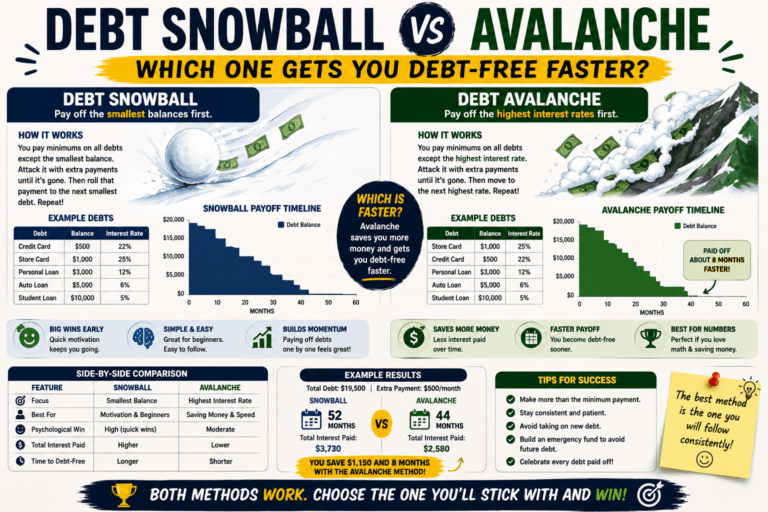
Once new borrowing is under control, organize existing balances. With the debt avalanche, extra money targets the highest interest rate first. With the debt snowball, extra money targets the smallest balance first.
Avalanche generally prioritizes interest savings, while snowball can provide quicker visible wins. Either approach can work better than scattering small extra payments randomly without a clear priority.
Keep required payments current on other debts while directing your chosen extra amount toward the target balance.
Create a Permanent Gap Between Income and Spending
Paying off debt is difficult when every dollar of income is already committed. The long-term goal is to create a recurring monthly margin.
You can create that gap from either side: spend less, earn more or combine both. Review large recurring costs first because a permanent $100 monthly reduction can have more impact than repeatedly trying to save a few dollars on one-time purchases.
Likewise, overtime, freelancing, selling unused items or another temporary income boost can accelerate repayment. However, build the base plan around income you can realistically depend on.
Plan for Irregular Expenses Before They Arrive
Not every non-monthly bill is an emergency. Car registration, annual insurance, school costs, holidays and routine maintenance may be predictable even though they do not arrive every month.
Create sinking funds for these expenses. If an annual bill is $600, setting aside $50 each month turns it into a planned expense instead of a future credit-card charge.
This distinction is powerful: emergency savings handles true surprises, while sinking funds prepare for costs you know are coming.
Contact Creditors Before the Situation Gets Worse
If you cannot keep up with required payments, do not hide from the problem. The FTC recommends contacting creditors before a debt collector becomes involved, explaining what is happening and asking whether a manageable payment arrangement is available.
Credit card borrowers can also ask the issuer directly whether a lower interest rate or affordable payment plan is possible. Keep records of conversations and request agreements in writing.
Not every creditor will approve a modification. Nevertheless, asking early is generally more useful than waiting until months of missed payments have accumulated.
Build a System That Keeps You Out of Debt
Becoming debt-free is only half the goal. The stronger outcome is creating a financial system that reduces the likelihood of returning to the same borrowing pattern.
Continue tracking spending, replenish emergency savings after using it, maintain sinking funds and keep part of the money freed by debt payoff directed toward future goals.
Once a debt disappears, redirect its old payment instead of automatically increasing lifestyle spending. That money can build emergency savings, fund future expenses or accelerate the next debt.
Realistic Example: Why Paying Debt Alone May Not Break the Cycle
Consider a household bringing home $3,200 each month. Required living costs and minimum debt payments total $3,100. That leaves only $100 of monthly margin.
Then a $350 vehicle repair arrives. With no emergency fund, the household charges the repair to a credit card. Even if it had paid an extra $100 toward debt the previous month, total borrowing rises again.
| Before Changes | Monthly Amount |
|---|---|
| Take-home income | $3,200 |
| Essential and fixed expenses | $2,500 |
| Required debt payments | $600 |
| Remaining margin | $100 |
Step 1: Create More Monthly Margin
The household reviews recurring costs and reduces them by $120. A small side-income activity produces an average of another $150 a month. The new margin becomes $370 instead of $100.
Step 2: Build a Starter Buffer
For several months, part of the new margin goes into a small emergency reserve while required debt payments continue.
Step 3: Redirect the Margin Toward Debt
After the starter buffer is established, most of the $370 monthly margin targets the highest-priority debt. Meanwhile, a smaller amount continues funding irregular expenses.
The breakthrough did not come only from paying debt faster. It came from changing the household's cash-flow structure so ordinary setbacks were less likely to create fresh borrowing.
Debt Cycle vs Healthy Money Cycle
| Debt Cycle | Healthier Money Cycle |
|---|---|
| Paycheck arrives | Paycheck arrives |
| Most income immediately covers past obligations | Essentials and planned obligations are funded |
| Little or no cash remains | A deliberate monthly margin remains |
| Unexpected or irregular expense occurs | Emergency fund or sinking fund covers appropriate expense |
| Credit or loan fills the gap | New borrowing is avoided when possible |
| Next paycheck must cover even more debt | Extra cash can reduce debt or build savings |
Three Realistic Case Studies
These MoneyOnliners cases are hypothetical educational examples. They demonstrate how different causes of repeated borrowing require different solutions.
Sarah Keeps Borrowing During the Last Week of Every Month
Sarah's monthly income covers her expenses on paper, but several large bills fall immediately after her first paycheck. By the final week, groceries and fuel frequently go onto a credit card.
She maps all due dates, moves two eligible bills later in the month and begins reserving grocery money from both paychecks. She also builds a $400 starter buffer.
Key lesson: her problem was partly cash-flow timing rather than uncontrolled spending.
Daniel Pays Off His Card, Then Fills It Again
Daniel makes large debt payments whenever he has extra money. However, car maintenance, annual fees and family celebrations repeatedly return to the credit card.
Instead of sending every spare dollar to debt, he starts small sinking funds for predictable non-monthly costs. His debt payoff is slightly less aggressive initially, but fewer new charges appear.
Key lesson: planning for irregular expenses can protect debt-payoff progress.
Grace Cannot Cut Enough to Solve the Problem
Grace reviews her spending and discovers that essentials and required debt payments consume almost all her income. There is little discretionary spending left to remove.
She contacts creditors about manageable options, cuts one larger recurring expense and focuses on increasing income rather than repeatedly attempting tiny budget cuts that cannot close the gap.
Key lesson: some debt cycles are fundamentally income-and-fixed-cost problems.

10 Mistakes That Can Keep the Debt Cycle Going
1. Paying Debt Without Fixing the Monthly Shortfall
If routine expenses still exceed available cash, balances can return after you pay them down.
2. Treating Every Irregular Expense as an Emergency
Predictable annual and seasonal costs belong in sinking funds whenever possible.
3. Keeping No Emergency Savings at All
Even a small financial shock can create new borrowing when no cash reserve exists.
4. Making an Unsustainably Large Debt Payment
An aggressive payment that leaves no money for groceries or transportation may simply force you to borrow again.
5. Ignoring Due-Date Timing
A monthly budget can look balanced while individual pay periods remain short of cash.
6. Using New Loans Without Changing Spending or Cash Flow
Consolidating balances does not automatically fix the behavior or shortfall that produced them.
7. Waiting Too Long to Contact Creditors
If required payments are becoming unaffordable, seek options before the problem becomes larger.
8. Paying Debt-Relief Companies Upfront
The FTC warns that legitimate debt-settlement providers cannot charge fees before settling a debt, and guarantees of fast debt relief are a major warning sign.
9. Focusing Only on Small Purchases
Reducing coffee spending may help, but large fixed expenses and insufficient income can matter far more.
10. Increasing Lifestyle Spending Immediately After a Debt Is Paid
Redirecting the freed payment toward savings or the next debt can turn temporary progress into a stronger financial system.
The FTC warns consumers to be skeptical of companies demanding upfront money, guaranteeing that all debts will be settled or promising fast loan forgiveness. Reputable credit counseling should begin with a thorough review of your finances rather than an instant promise to eliminate debt.
A 30-Day Plan to Start Breaking the Debt Cycle
| Time | Action | Purpose |
|---|---|---|
| Days 1–3 | List every debt, balance, rate, minimum and due date. | See the complete debt picture. |
| Days 4–7 | Review 2–3 months of spending and borrowing. | Find the recurring cause of new debt. |
| Days 8–10 | Build a bare-bones essential spending plan. | Determine the true monthly gap or surplus. |
| Days 11–14 | Identify one recurring cost to reduce and one income opportunity. | Create additional monthly margin. |
| Days 15–17 | Choose a starter emergency-fund target. | Protect against the next financial shock. |
| Days 18–20 | Create sinking funds for predictable irregular bills. | Stop foreseeable expenses from becoming debt. |
| Days 21–23 | Choose snowball or avalanche. | Give extra debt payments a clear target. |
| Days 24–26 | Contact creditors if required payments are difficult. | Explore manageable options early. |
| Days 27–30 | Automate appropriate savings/payments and schedule a monthly review. | Turn the plan into a repeatable system. |
Incoming Link Opportunities
Recommended External Resources
Consumer Financial Protection Bureau — Emergency Savings
The CFPB explains how emergency reserves can help people handle financial shocks without relying entirely on loans or credit.
An Essential Guide to Building an Emergency Fund — CFPB
Consumer Financial Protection Bureau — Debt Planning Tools
CFPB's Your Money, Your Goals materials include tools for getting a complete picture of debt, setting repayment priorities and planning how to avoid additional debt.
Debt Getting in Your Way? — CFPB
Federal Trade Commission — Getting Out of Debt
The FTC covers budgeting, creditor communication, credit counseling, debt-management plans and debt-settlement risks.
How to Get Out of Debt — FTC Consumer Advice
Federal Trade Commission — Debt Relief Scams
The FTC's 2026 consumer alert explains warning signs such as upfront fees and guarantees of fast debt relief.
Looking for Debt Relief? Here's How to Avoid a Scam — FTC
The CFPB and FTC resources are U.S.-focused. The budgeting, emergency-savings and cash-flow concepts in this guide can be useful more broadly, but debt collection laws, creditor options, insolvency rules and consumer protections differ by country.
Frequently Asked Questions
How do I break the debt cycle?
Start by identifying why new debt keeps appearing.
Next, compare essential expenses and required payments with reliable income.
Create a small emergency buffer and plan for irregular costs.
Then choose a clear repayment strategy for existing balances.
The long-term goal is to stop needing new borrowing while steadily reducing old debt.
Why do I keep going back into debt?
Recurring debt can have several causes.
Your essential costs may exceed income.
Unexpected expenses may arrive without savings available.
Discretionary spending or poor cash-flow timing can also contribute.
Review actual transactions to identify your specific pattern.
Should I stop using credit cards completely?
That depends on your situation.
If card use repeatedly creates balances you cannot repay, temporarily removing cards from everyday spending can help.
However, the deeper goal is to fix the cash-flow problem.
A card itself does not create enough income to cover expenses.
Use a system that prevents new unaffordable balances.
Should I save money while I am in debt?
A small emergency cushion can help prevent new borrowing after a financial shock.
Meanwhile, expensive debt also deserves attention.
You can work on both goals temporarily.
After starter savings is established, more money can move toward high-interest debt.
The appropriate balance depends on your risks and debt costs.
What if I do not earn enough to cover my expenses?
First, distinguish essential costs from flexible spending.
Reduce larger expenses where realistically possible.
Look for sustainable ways to increase income.
If debt payments are unaffordable, contact creditors early.
A reputable credit counselor may also help you review the complete situation.
Is debt consolidation enough to break the cycle?
Not necessarily.
Consolidation can reorganize debt and may reduce interest in some situations.
However, it does not automatically fix an ongoing monthly shortfall.
If new borrowing continues, total debt can grow again.
Compare total costs and change the underlying cash-flow system too.
What is the difference between an emergency fund and a sinking fund?
An emergency fund is for unplanned financial shocks.
A sinking fund prepares for a known future expense.
For example, an unexpected major repair may be an emergency.
Annual vehicle registration is predictable and can be funded gradually.
Using both can reduce reliance on debt.
What should I do if I cannot make my debt payments?
Contact creditors as soon as possible.
Explain what you can realistically afford.
Ask about available payment or hardship arrangements.
Keep written records of agreements.
Be cautious with companies promising guaranteed or instant debt elimination.
How much emergency savings do I need before paying debt?
There is no universal starter amount.
The CFPB says emergency savings needs depend on your circumstances.
Even a small amount can provide some protection.
Consider your likely emergency costs and income stability.
Then balance that need against the interest cost of your debt.
What should I do after I finally get out of debt?
Keep the system that helped you succeed.
Redirect former debt payments toward emergency savings and future goals.
Continue planning for irregular expenses.
Avoid automatically expanding spending to consume all newly available cash.
That is how debt payoff can become long-term financial stability.
Research Methodology
This MoneyOnliners guide was developed using Consumer Financial Protection Bureau guidance on emergency savings and debt-planning tools, together with Federal Trade Commission guidance on budgeting, creditor communication, credit counseling, debt management and debt-relief scams. The examples, case studies, monthly figures and 30-day framework are MoneyOnliners editorial illustrations intended to explain the concepts and do not guarantee a particular financial outcome.
Final Thoughts
Breaking the debt cycle is not simply about paying balances faster. If new borrowing continues every month, even a strong repayment strategy can struggle to create lasting progress.
Start by finding the recurring cause. Perhaps essential expenses are too high, income is too low, irregular bills are not being planned for or discretionary spending repeatedly exceeds the budget.
Next, build protection into the system. A small emergency reserve can help with genuine surprises, while sinking funds can prepare for predictable expenses before they arrive.
Then give existing debt a clear repayment strategy. Use snowball, avalanche or another deliberate approach that you can maintain while keeping required obligations current.
Finally, protect the progress after balances fall. Keep part of your newly freed cash directed toward savings and future expenses. That is the point where you move beyond merely paying off debt and begin building a system designed to keep you from needing it again.