Debt Snowball Method: Does Paying the Smallest Debt First Really Work?
Debt Snowball Method: Does Paying the Smallest Debt First Really Work?
The debt snowball method ignores interest rates at first and attacks your smallest balance instead. That may sound mathematically backward—but for some borrowers, quick wins can make a difficult debt plan easier to keep going.
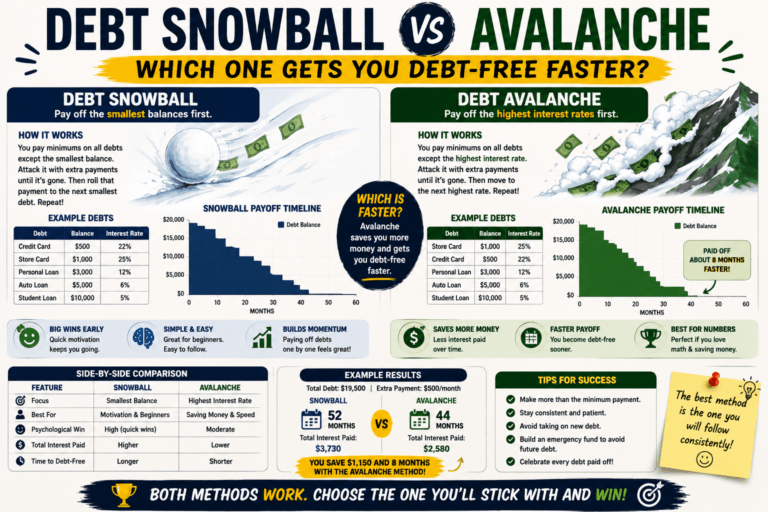
Yes, the debt snowball method can work. You make the required minimum payments on your debts, put your available extra money toward the smallest balance, and then roll that completed payment into the next-smallest debt. The method can create quick visible progress and reduce the number of balances you owe. However, because it does not prioritize interest rates, it can cost more than the debt avalanche method when larger balances carry much higher rates.
What Is the Debt Snowball Method?
The debt snowball method is a repayment strategy that orders debts from the smallest balance to the largest balance. You continue making required minimum payments on the other debts while directing your affordable extra repayment money toward the smallest debt.
After the first balance reaches zero, you do not spend the payment you just freed. Instead, that money is added to the payment on the next-smallest debt. As additional balances disappear, the amount available for the next target grows—creating the “snowball.”
The Consumer Financial Protection Bureau describes the same basic process in its debt-reduction guidance. It also notes the major trade-off: people may see progress quickly, but they may pay more overall because the strategy does not necessarily eliminate the costliest debt first.
How the Debt Snowball Method Works in 5 Steps
List Every Debt
Write down each relevant debt, its current balance, minimum payment, interest rate and due date. Even though the snowball orders debts by balance, interest rates still matter because you should understand the financial trade-off you are making.
Order the Debts From Smallest to Largest Balance
Ignore interest rates for the purpose of ordering the snowball. The smallest balance becomes Debt #1, the next-smallest becomes Debt #2, and so on.
Maintain Required Payments on the Other Debts
The snowball does not mean ignoring larger debts. Continue making required payments while focusing your affordable extra money on the smallest target.
Attack the Smallest Debt With Your Extra Money
Send your planned extra amount to the first target. Once that balance is gone, the payment previously going toward it becomes available for Debt #2.
Roll the Entire Freed Payment Forward
This is the part that makes the strategy accelerate. Keep redirecting completed payments toward the next-smallest balance until the debts in your plan are eliminated.
A Realistic Debt Snowball Example
Imagine someone has four debts. The figures below are hypothetical and simplified so you can clearly see the repayment order.
| Snowball Order | Debt | Balance | Interest Rate | Minimum Payment |
|---|---|---|---|---|
| 1 | Store Card | $300 | 20% | $25 |
| 2 | Credit Card | $850 | 18% | $40 |
| 3 | Personal Loan | $2,400 | 10% | $90 |
| 4 | Credit Card | $4,500 | 25% | $140 |
Month One: Start With the $300 Balance
Suppose the borrower can afford an additional $100 per month after making all required minimums. The first target therefore receives its $25 minimum plus the $100 extra, for a planned $125 payment.
Meanwhile, the other three accounts continue receiving their required payments. The exact payoff date will depend on interest, statement timing and how payments are applied.
After Debt #1 Is Gone
The borrower now redirects the $125 previously going toward Debt #1 to the $850 balance. Combined with that debt's existing $40 minimum, the planned payment becomes $165.
After Debt #2 Is Gone
Next, the $165 is added to the $90 payment on the personal loan. That creates a planned $255 payment toward the third target.
Finally, the Largest Balance Becomes the Target
After Debt #3 is eliminated, the $255 rolls into the $140 payment on Debt #4. The planned payment becomes $395, assuming the borrower's budget and required payments have not changed.
Debt #4 carries the highest interest rate in this example, yet the snowball leaves it until last because it has the largest balance. An avalanche strategy would likely target that 25% debt first. This is why snowball can provide quicker account-level wins while potentially costing more interest.

Does the Debt Snowball Method Really Work?
It can. “Works,” however, needs a clear definition.
If working means creating a structured path that can eventually eliminate debt when payments are affordable and consistently made, the snowball can absolutely work. The CFPB includes paying the smallest debt first as one of two basic debt-reduction strategies in its consumer tools.
If working means always producing the lowest total interest cost, the answer is different. The snowball is not designed to optimize interest expense. The CFPB warns that borrowers may pay more in total when high-interest larger debts remain outstanding while smaller balances are eliminated first.
Therefore, the important question is not whether snowball is universally best. It is whether the psychological benefit of quicker visible wins helps you execute a plan you might otherwise abandon.
Why Paying the Smallest Debt First Can Feel Powerful
You Can Reach the First Finish Line Sooner
A $250 balance can disappear much sooner than a $6,000 balance when the same extra payment is applied. Consequently, the borrower sees an account reach zero relatively early.
You Reduce the Number of Debts You Are Managing
Eliminating one balance means one fewer debt in your payoff queue. Although the remaining total may still be substantial, fewer accounts can make the plan feel simpler.
Your Payment Can Grow After Every Win
The money previously assigned to a completed debt is redirected rather than spent. Thus, the payment on later debts can become progressively larger.
Progress Becomes Easy to See
Debt repayment can take a long time. A strategy that produces visible milestones may help some people remain engaged. The CFPB specifically identifies quick progress and motivation as advantages of the smallest-debt-first approach.
Debt Snowball vs. Debt Avalanche
The snowball and avalanche use the same core idea—maintain required payments and concentrate extra money on one target—but they choose that target differently.
| Feature | Debt Snowball | Debt Avalanche |
|---|---|---|
| First target | Smallest balance | Highest interest rate |
| Main objective | Quick visible account wins | Attack the most expensive debt first |
| Motivation | Can feel faster when small debts disappear | Progress may feel slower if the first high-rate balance is large |
| Interest cost | Can cost more when expensive debts wait | Generally saves more money by eliminating highest-rate debt first |
| Best fit | Someone strongly motivated by visible wins | Someone focused on minimizing borrowing cost |
| After a debt is paid | Roll payment to next-smallest balance | Roll payment to next-highest-rate debt |
When the Avalanche Has a Clear Mathematical Advantage
Suppose your smallest debt charges 5% interest while a much larger credit-card balance charges 29%. The snowball attacks the 5% debt first. By contrast, the avalanche directs extra money to the 29% balance.
All else equal, attacking the more expensive balance reduces high-rate debt sooner. That is why the CFPB says the highest-interest-rate method can save money over the long run.
When the Snowball May Be Easier to Follow
Now imagine you have six balances under $1,000 and one large loan. Eliminating several small accounts relatively quickly could give you a strong sense of progress and simplify your monthly debt list.
For someone who has repeatedly started and abandoned repayment plans, that motivational advantage may matter. However, you should still calculate or at least understand the additional interest you may accept in exchange for that structure.
MoneyOnliners Decision Rule
Choose avalanche if minimizing interest is your main priority and you can stay motivated while tackling a potentially large first balance.
Choose snowball if early account-level wins are likely to help you remain consistent and you understand that the method may cost more.
7 Situations Where the Debt Snowball Can Make Sense
1. You Have Several Small Balances
Multiple small debts create opportunities for relatively quick eliminations. Each finished account reduces the number of balances in your plan.
2. Motivation Has Been Your Biggest Problem
If you understand the mathematics but repeatedly stop following the plan, a visible early win may be more valuable to you than a theoretically optimal strategy you do not sustain.
3. Your Interest Rates Are Fairly Similar
When rates are close together, the cost difference between repayment orders may be smaller than when one debt has an extremely high rate. Still, calculate your own numbers before assuming the difference is negligible.
4. You Need to Simplify Your Monthly Debt List
Eliminating a small account removes one required payment from the list. That can make the budget easier to manage, although the freed cash should continue toward the next debt.
5. You Are Starting With Very Little Extra Money
A borrower with only $20 or $30 extra may feel discouraged directing it toward a huge balance. Applying it to a small balance can make the first milestone appear more achievable.
6. You Like Clear, Concrete Milestones
The snowball is easy to understand: smallest, next-smallest, next-smallest. That simplicity can reduce decision fatigue.
7. You Have Already Decided the Interest Trade-Off Is Acceptable
Choosing snowball should be deliberate. Review your rates, understand that avalanche may be cheaper, and then choose snowball because its behavioral structure fits you better.

5 Times You Should Think Carefully Before Using Snowball
1. One Debt Has an Extremely High Interest Rate
Leaving an unusually expensive debt untouched beyond its minimum can be costly. Compare the snowball with the avalanche before deciding.
2. A Debt Has Serious Consequences Beyond Interest
Not every obligation should be prioritized solely by balance or APR. Secured debts, taxes, court obligations and overdue essential bills can involve different risks. Get appropriate professional guidance when necessary.
3. You Cannot Make the Required Payments
The snowball assumes you have enough cash flow to cover required payments and then direct something extra to a target. If that is not true, creditor communication and broader debt help may be more urgent than repayment ordering.
4. You Keep Adding New Balances
A snowball cannot gain much momentum if discretionary new debt replaces every balance you eliminate. Stabilizing spending and cash flow may need to happen alongside repayment.
5. You Are Choosing It Only Because Someone Said It Is Always Best
No repayment method is automatically right for every borrower. The CFPB presents both smallest-debt-first and highest-interest-first strategies with pros and cons rather than declaring one universally superior.
How to Start a Debt Snowball When Money Is Tight
Find the First $10, $25 or $50
Do not wait until you can make a dramatic extra payment. Review recurring expenses and identify the first amount you can reliably redirect without missing essential obligations.
Use One-Time Money Strategically
A bonus, refund, gift or proceeds from selling unused items can accelerate the smallest balance. However, consider whether you also need a starter emergency cushion so the next unexpected expense does not immediately become new debt.
Look for Temporary Income
Overtime, freelancing, selling unused belongings or another legitimate source of extra income can increase your snowball payment. Focus on net income after expenses and applicable taxes.
Keep the Freed Payment in the Snowball
The strategy loses much of its power when a finished payment becomes new lifestyle spending. Redirect it automatically to the next debt whenever practical.
Review the Plan Every Month
Update balances, check that required payments were made and confirm which debt is next. If a major financial change occurs, reassess whether the original repayment order still makes sense.
Three Debt Snowball Case Studies
The following MoneyOnliners examples are hypothetical. They demonstrate the method and do not promise specific payoff dates or savings.
Starting With Only $40 Extra
A worker has balances of $180, $620 and $1,900. After essential expenses and required payments, only $40 remains for extra debt repayment.
Instead of waiting for a higher income, the worker adds the $40 to the payment on the $180 balance. Once that debt is gone, its entire previous payment is redirected to the $620 debt.
Key lesson: a snowball can begin with a small amount. Consistency matters more than making the first payment look impressive.
Quick Wins vs. a High-Interest Card
A borrower has two $300 store balances and a $5,000 credit card with a much higher interest rate. Snowball would eliminate the $300 balances first, while avalanche would attack the high-rate card.
The borrower compares both approaches and realizes snowball provides earlier account closures but likely higher interest cost. She chooses avalanche because minimizing interest matters more to her than quick wins.
Key lesson: sometimes understanding snowball clearly leads you to choose a different method—and that is a good financial decision.
Six Small Debts Create Mental Overload
A household is managing six consumer balances. None is individually enormous, but keeping track of so many payments has become frustrating.
They choose snowball, eliminate the two smallest balances first and continue rolling those payments forward. The reduction in account count makes the remaining plan easier for them to follow.
Key lesson: debt management is partly mathematical and partly behavioral. A method that improves consistency can have practical value.
A 30-Day Debt Snowball Setup Plan
| When | What to Do | Goal |
|---|---|---|
| Day 1 | Collect current statements. | Verify balances, rates and minimums. |
| Days 2–3 | Build a basic budget. | Find the affordable extra payment. |
| Day 4 | Order debts from smallest to largest. | Create the snowball sequence. |
| Days 5–7 | Compare the sequence with avalanche. | Understand the potential interest trade-off. |
| Week 2 | Make required payments and send extra money to Debt #1. | Start execution. |
| Week 3 | Find one expense reduction or income boost. | Increase the snowball. |
| Week 4 | Update balances and confirm the next month's plan. | Make repayment repeatable. |
Common Debt Snowball Mistakes
Ignoring the Interest Trade-Off
Snowball is not automatically the cheapest approach. Compare rates before committing to the balance order.
Stopping Required Payments on Other Debts
The strategy calls for focusing extra money on one balance—not simply abandoning the others.
Spending the Freed Payment
When a debt reaches zero, roll its payment into the next target. Otherwise, the snowball stops growing.
Using Every Dollar of Cash for Debt
If you have no emergency buffer, a small financial shock may force you to borrow again. Consider how emergency savings fits into the overall plan.
Adding New Discretionary Debt
Repeated new balances can offset the progress you make. Reduce avoidable new borrowing while working the snowball.
Using Snowball When the Budget Is Already Broken
If you cannot cover essentials and required payments, rearranging debt order may not solve the underlying shortfall. Contact creditors early and consider reputable professional help.
What If You Cannot Afford Your Minimum Payments?
At that point, the question is no longer simply snowball versus avalanche. The Federal Trade Commission recommends contacting creditors when you are behind or struggling and trying to arrange payments you can manage.
The FTC also says consumers who are far behind on credit-card debt can ask the card company about a lower interest rate or affordable payment plan. Keep records of conversations and obtain agreements in writing.
If the situation is more complicated, reputable credit counseling may help you review your finances and repayment options. Be cautious, however, with companies promising guaranteed or rapid debt elimination.
The FTC warned in 2026 that guarantees to settle all debts or obtain fast loan forgiveness are scam signs. It also warns against prohibited upfront fees for debt-settlement help. Financial pressure is a reason to verify help more carefully—not less carefully.
Incoming Link Opportunities
Recommended External Resources
Consumer Financial Protection Bureau — How to Reduce Your Debt
This CFPB guide explains both the snowball and highest-interest-rate approaches and highlights their different advantages and disadvantages.
How to Reduce Your Debt — CFPB
CFPB — Reducing Debt Worksheet
The CFPB worksheet compares smallest-balance-first with highest-interest-first and provides a framework for organizing debts.
Reducing Debt Worksheet — CFPB
Federal Trade Commission — How to Get Out of Debt
The FTC provides guidance on budgeting, creditor communication, credit counseling, debt management plans, consolidation and risky debt-settlement offers.
How to Get Out of Debt — FTC Consumer Advice
Federal Trade Commission — Avoid Debt-Relief Scams
This 2026 FTC consumer alert explains warning signs such as guaranteed fast debt relief and improper upfront fees.
Looking for Debt Relief? Here's How to Avoid a Scam — FTC
CFPB and FTC materials describe U.S. consumer-finance practices and protections. The snowball concept can be used elsewhere, but lender rules, credit reporting, debt collection, insolvency procedures and consumer protections differ by country.
Frequently Asked Questions About the Debt Snowball Method
What is the debt snowball method?
The debt snowball method prioritizes your smallest balance first.
You maintain required payments on the other debts.
Then you direct available extra money toward the smallest target.
After it is paid off, you roll that payment into the next-smallest debt.
The process repeats until the debts in the plan are eliminated.
Does the debt snowball method actually work?
Yes, it can work as a structured debt-repayment strategy.
The CFPB includes smallest-debt-first as one of its basic debt-reduction approaches.
Its main benefit is quick visible progress.
However, it may cost more than prioritizing high-interest debt.
Consistency and sufficient cash flow remain essential.
Is debt snowball better than debt avalanche?
Neither method is best for every borrower.
Avalanche generally prioritizes minimizing interest cost.
Snowball prioritizes quick account-level wins.
Consider both the financial cost and your ability to stay motivated.
Then choose deliberately.
Why does debt snowball ignore interest rates?
Because balance size determines the repayment order.
The smallest debt is targeted first regardless of rate.
This can create faster visible wins.
The trade-off is potentially higher total interest.
You should still record and understand every interest rate before choosing the method.
Can I use debt snowball with very little extra money?
Yes.
Your first extra payment does not need to be large.
Even a modest repeatable amount can begin the process.
As debts disappear, their previous payments can be rolled forward.
Avoid making an extra payment so large that essential bills become unaffordable.
Should I keep an emergency fund while using debt snowball?
A cash cushion can reduce the chance that a small emergency immediately becomes new debt.
The appropriate amount depends on your situation.
High-interest debt also carries a real cost.
Therefore, balance emergency protection with repayment rather than assuming one rule fits everyone.
Reassess the amount as your finances improve.
What happens when I pay off the smallest debt?
Redirect the payment to the next-smallest debt.
Do not treat the freed payment as new spending money if your goal is to keep accelerating repayment.
Continue required payments elsewhere.
Update your balances.
Then repeat the process.
Should I switch from snowball to avalanche later?
You can change strategies if your priorities change.
For example, after eliminating several small balances, you may decide a remaining high-interest debt deserves immediate attention.
Review the numbers before switching.
Avoid changing methods constantly without a reason.
The goal is a plan you can consistently execute.
What debts should not simply be ordered by smallest balance?
Some obligations can carry consequences that require special attention.
Examples may include overdue housing obligations, secured loans, taxes or court-ordered debts.
The correct priority depends on your circumstances and local law.
Do not let a generic snowball list override an urgent legal or essential-living issue.
Seek qualified advice when necessary.
What if I cannot afford all my minimum payments?
Contact creditors early rather than simply choosing a snowball order.
Ask whether manageable payment arrangements are available.
Review your full budget.
Reputable credit counseling may also be useful.
Avoid companies guaranteeing instant debt elimination.
Research Methodology
This MoneyOnliners article was developed using debt-reduction guidance and worksheets from the Consumer Financial Protection Bureau and consumer debt guidance from the Federal Trade Commission. Core claims about the smallest-balance-first method, highest-interest-rate method, their trade-offs, creditor communication and debt-relief risks were checked against those sources. The examples, decision framework, 30-day plan and case studies are MoneyOnliners editorial illustrations and are not guarantees of individual repayment outcomes.
Final Verdict: Is the Debt Snowball Method Worth Using?
The debt snowball method is a legitimate repayment strategy, but its greatest strength is not mathematical efficiency. Its strength is simplicity and momentum.
By attacking the smallest balance first, you may reach your first zero balance sooner. Then, instead of spending the freed payment, you roll it into the next debt. As that process repeats, the payment directed toward later debts can grow substantially.
Nevertheless, the trade-off matters. If a large debt carries a much higher interest rate, leaving it until later can increase your total borrowing cost. In that situation, the debt avalanche may be financially stronger.
Therefore, compare both approaches before deciding. If minimizing interest will keep you motivated, choose avalanche. If eliminating individual balances quickly is what will keep you consistently paying, snowball may be the better behavioral fit.
Ultimately, the method only works when the plan is affordable and followed. Start with accurate balances, protect essential expenses, maintain required payments, stop avoidable new borrowing and keep rolling each completed payment forward.