
Retirement vs Financial Independence: Why They’re Not Exactly the Same
Retirement vs Financial Independence: Why They're Not Exactly the Same
Retirement and financial independence are often treated as interchangeable goals, but they describe different things. Retirement usually means leaving or substantially reducing paid employment. Financial independence means having enough financial resources that working for income is no longer strictly necessary. You can reach financial independence and still work—and you can retire without being fully financially independent.
The main difference between retirement vs financial independence is that retirement is primarily a life or employment status, while financial independence is primarily a financial condition.
A financially independent person may continue working because they enjoy their career, business or projects. A retired person may stop working but still depend heavily on Social Security, a pension, family support or other income sources. The two goals often overlap, but they are not automatically the same.
Table of Contents
Retirement vs Financial Independence: Quick Comparison
| Feature | Retirement | Financial Independence |
|---|---|---|
| Primary meaning | Leaving or reducing paid work | Not needing work income to fund your lifestyle |
| Typical age | Often later in life | Potentially any adult age |
| Must stop working? | Usually work is reduced or ended | No |
| Can still have a job? | Sometimes part-time | Absolutely |
| Main financial question | Can retirement income support future spending? | Can assets and dependable income cover lifestyle without required employment? |
| Social Security importance | Often significant | May be years or decades away |
| Pension importance | Can be significant | Helpful but not required |
| Healthcare challenge | Often easier after Medicare eligibility in the U.S. | Potentially harder if FI occurs well before 65 |
| Primary lifestyle benefit | Leaving work | Greater freedom of choice |
| Can overlap? | Yes — financial independence can make retirement possible. | |
Retirement asks, “Have I stopped working?” Financial independence asks, “Do I financially need to keep working?”
What Does Retirement Usually Mean?
Retirement generally describes a transition away from a primary career or full-time employment.
Retirement Income May Come From
- Social Security
- Pensions
- 401(k) withdrawals
- IRA withdrawals
- Taxable investments
- Annuities
- Rental income
- Part-time employment
A retired person may therefore no longer receive a regular employment salary while still depending on several financial-income sources.

What Does Financial Independence Mean?
Financial independence usually means having enough financial resources that your basic lifestyle no longer depends entirely on earning another paycheck.
Those Resources Could Include
- Investment portfolio
- Rental income
- Pension income
- Business income
- Cash reserves
- Other dependable assets or income streams
Financial Independence Does Not Necessarily Mean
- Never working again
- Living extravagantly
- Being extremely wealthy
- Owning millions of dollars
- Retiring at 30
It means the relationship between your resources and expenses gives you greater choice.

1 Financial Independence Does Not Require You to Stop Working
This is perhaps the biggest difference.
Retirement
Usually involves ending or substantially reducing paid employment.
Financial Independence
Means employment becomes more optional financially.
You might still:
- Work full-time
- Work part-time
- Run a business
- Freelance
- Teach
- Volunteer
- Create projects
Financial independence can change why you work even when it does not change whether you work.
2 Retirement Is Often Age-Linked; Financial Independence Is Not
Traditional retirement is commonly associated with later adulthood.
Financial independence can potentially occur at 35, 45, 55, 65 or later.
Example
A 45-year-old has:
- $1.5 million invested
- Very low debt
- $50,000 annual spending
- Enough financial flexibility to leave employment
That person may describe themselves as financially independent.
They do not have to describe themselves as retired.
Meanwhile
A 67-year-old could officially retire while having relatively limited savings and depending primarily on Social Security and pension income.
3 The Income Sources Can Look Very Different
Traditional Retiree
- Social Security
- Pension
- 401(k)
- IRA
- Other savings
Financially Independent Younger Adult
- Taxable investment portfolio
- Rental income
- Business income
- Digital or intellectual-property income
- Cash reserves
- Retirement accounts reserved for later
This distinction matters because someone reaching financial independence before traditional retirement age may need years of funding before Social Security or retirement-account access becomes part of the plan.
4 You Can Reach Financial Independence Before You Retire
Suppose your annual lifestyle costs:
$50,000
You have enough assets and dependable income to support that lifestyle without employment.
You reach that point at age 48.
But you enjoy your career and continue working until age 60.
What Happened at 48?
You became financially independent.
What Happened at 60?
You retired.
5 You Can Retire Without Being Fully Financially Independent
Some people stop working because of:
- Age
- Job loss
- Caregiving responsibilities
- Employer restructuring
- Personal choice
Their retirement income may depend heavily on:
- Social Security
- Pension payments
- Family support
- Government programs
They are retired because they no longer work.
But they may not have the level of financial flexibility usually associated with financial independence.
6 Spending Flexibility Often Matters More for Financial Independence
Someone pursuing financial independence often reaches the goal by controlling the relationship between:
- Income
- Savings rate
- Investment assets
- Annual spending
Example
Person A needs:
$40,000 per year
Person B needs:
$100,000 per year
Using a simple 25× illustration:
| Annual Portfolio Need | Illustrative 25× Target |
|---|---|
| $40,000 | $1,000,000 |
| $100,000 | $2,500,000 |
Spending therefore can dramatically change the amount required for financial independence.
The 25× shortcut is not a guarantee that a portfolio will last indefinitely.
7 Social Security and Pensions Often Matter More in Traditional Retirement
A traditional retiree may already be eligible for Social Security and pension benefits.
Someone financially independent at age 45 may not receive Social Security for many years.
Traditional Retirement Example
Annual lifestyle:
$65,000
Social Security and pension:
$40,000
Portfolio gap:
$25,000
Early Financial Independence Example
Annual lifestyle:
$65,000
Social Security today:
$0
Portfolio or other income may initially need to cover much more of the lifestyle.
The same lifestyle can require a much larger self-funded portfolio when financial independence begins decades before traditional retirement benefits.
8 Healthcare Can Be Harder for Early Financial Independence
In the United States, Medicare eligibility generally begins around age 65 for most people under the usual age-based rules.
Someone leaving employment at 45 or 50 may therefore need another healthcare solution for many years.
Possible Options May Include
- Employer continuation coverage where applicable
- Marketplace insurance
- Spouse's employer plan
- Private insurance
- Other qualifying coverage
Healthcare can therefore become a major bridge expense between financial independence and traditional retirement age.
A plan that works only because medical insurance was forgotten is not a complete financial-independence plan.

9 Financial Independence Is Often About Choice; Retirement Is Often About Time
Retirement traditionally answers:
“When can I stop working?”
Financial independence often asks:
“When does work become optional?”
That Can Change Life Decisions
Financial independence might allow someone to:
- Leave an unhealthy workplace
- Switch careers
- Work fewer hours
- Start a business
- Care for family
- Take a sabbatical
- Choose meaningful work over higher pay
CFPB's broader concept of financial well-being similarly emphasizes financial security and freedom of choice—not simply a certain account balance.
10 Retirement and Financial Independence Can Require Different Targets
Someone retiring at 67 may receive Social Security immediately and have Medicare eligibility.
Someone pursuing financial independence at 45 may need to cover decades of expenses before those benefits begin.
Illustrative Comparison
| Factor | Traditional Retirement at 67 | Financial Independence at 45 |
|---|---|---|
| Annual spending | $60,000 | $60,000 |
| Immediate Social Security | Potentially available | Not available yet |
| Medicare | Potentially available | Not yet |
| Withdrawal horizon | Potentially 20–30+ years | Potentially 40–50+ years |
| Portfolio burden | Potentially lower | Potentially much higher |
Early financial independence often requires more self-funded years, while traditional retirement can benefit from retirement systems that become available later in life.
Example 1: Financially Independent but Still Working
A hypothetical 52-year-old has enough investments and rental income to cover household spending.
Employment income is no longer necessary for basic financial security.
However, the person enjoys working three days per week.
Status: Financially independent, but not necessarily retired.
Example 2: Retired but Dependent on Retirement Benefits
A hypothetical 68-year-old stops working permanently.
Most household expenses are covered by Social Security and pension income.
Savings provide only a smaller emergency reserve.
Status: Retired, but financial independence depends heavily on external retirement-income systems.
Example 3: Financial Independence Leads Directly to Retirement
A hypothetical 60-year-old reaches a point where pensions, investments and other income can support expected spending.
The person immediately leaves work.
Status: Financial independence and retirement occur at approximately the same time.
MoneyOnliners Original Analysis: The Work-Optionality Test
| Situation | Retired? | Financially Independent? |
|---|---|---|
| Still working because income is required | No | Probably not |
| Still working although income is unnecessary | No | Potentially yes |
| Stopped working with strong self-funded resources | Yes | Potentially yes |
| Stopped working but financially dependent on others | Yes | Not necessarily |
| Working part-time by choice after reaching FI | Partially / depends on definition | Potentially yes |
MoneyOnliners Freedom Spectrum
| Stage | Description |
|---|---|
| Financial Dependence | Current lifestyle requires ongoing employment or outside support. |
| Financial Stability | Expenses are manageable and emergency reserves exist. |
| Growing Independence | Investments and other income cover an increasing share of expenses. |
| Financial Independence | Work income is no longer strictly required for the planned lifestyle. |
| Work-Optional Life | Employment, business or projects are chosen primarily for purpose rather than financial necessity. |
| Traditional Retirement | Paid work is substantially reduced or stopped, often later in life. |
Retirement describes what you do with work. Financial independence describes how dependent your lifestyle is on work income.
These frameworks are original MoneyOnliners educational tools rather than standardized financial-planning definitions.
MoneyOnliners Research-Based Evidence Note
This article is a research-based retirement and financial-independence comparison.
MoneyOnliners does not claim personal first-hand experience with every retirement or financial-independence scenario discussed.
Retirement examples, portfolio calculations and household scenarios are hypothetical educational illustrations.
Official retirement-system information should be verified through government sources where Social Security, Medicare, retirement accounts or taxes are involved.
MoneyOnliners does not fabricate FIRE outcomes, retirement results, investment returns or testimonials.
The Work-Optionality Test and MoneyOnliners Freedom Spectrum are original analytical frameworks designed to make the distinction between retirement and financial independence clearer and more citeable.
Which Goal Should You Pursue?
You do not necessarily need to choose.
Traditional Retirement May Be Your Main Goal If:
- You enjoy your career.
- You expect to work until a traditional retirement age.
- Your pension or Social Security is central to the plan.
- You prefer gradual retirement preparation.
Financial Independence May Be Your Main Goal If:
- You want work to become optional earlier.
- You value career flexibility.
- You want the freedom to reduce working hours.
- You want financial resources that support major life changes.
You May Want Both
Financial independence can become the financial foundation.
Retirement can become a later lifestyle decision.
10 Retirement vs Financial Independence Mistakes to Avoid
1. Assuming They Mean Exactly the Same Thing
The concepts overlap but describe different conditions.
2. Assuming Financial Independence Requires Never Working Again
Work can remain meaningful after it becomes financially optional.
3. Assuming Retirement Automatically Means Financial Security
Someone can stop working without having strong financial flexibility.
4. Ignoring Healthcare in Early FI
Healthcare can be one of the largest bridge expenses before Medicare age.
5. Ignoring Social Security in Traditional Retirement
For eligible retirees, claiming strategy can materially affect monthly income. CFPB notes that claiming age affects benefit payments and that early claiming can significantly reduce monthly benefits. :contentReference[oaicite:1]{index=1}
6. Using One Withdrawal Rule as a Guarantee
Withdrawal rates are planning tools, not promises.
7. Assuming Spending Will Automatically Fall in Retirement
CFPB research has found that many retirees do not experience the expected gradual spending decline, reinforcing the importance of realistic budgeting. :contentReference[oaicite:2]{index=2}
8. Ignoring Housing
Mortgage, rent, property taxes, insurance and repairs can materially affect both retirement and FI targets.
9. Chasing Extreme Investment Returns to Reach FI Faster
Higher risk can create large setbacks rather than guaranteed freedom.
10. Forgetting the Purpose of the Goal
The objective is not only a number—it is enough financial security and flexibility to support the life you value.
Avoid programs, investments or online promoters promising guaranteed early retirement or financial independence through unusually high returns. Sustainable financial independence depends on the relationship between savings, spending, income, time and investment risk.
Incoming Link Opportunities
Financial Freedom vs Financial Independence: Is There Really a Difference?
https://moneyonliners.com/financial-freedom-vs-financial-independence/
Financial Independence: 10 Steps to Take More Control of Your Money and Future
https://moneyonliners.com/financial-independence/
FIRE Movement Explained: Is Early Retirement Actually Realistic?
https://moneyonliners.com/fire-movement-early-retirement/
How Much Money Do You Need for Financial Independence?
https://moneyonliners.com/how-much-money-for-financial-independence/
Retirement Planning: 15 Things to Start Doing Before You Retire
https://moneyonliners.com/retirement-planning-before-you-retire/
Why Understanding Retirement vs Financial Independence Matters
1. Retirement describes a change in work status more directly than financial independence does.
2. Financial independence describes the relationship between your resources and your need for employment income.
3. A financially independent person can continue working.
4. A retired person can still depend heavily on pensions, Social Security or other support.
5. Financial independence can happen years before traditional retirement.
6. Retirement can happen without full financial independence.
7. Early FI may require substantially more self-funded years.
8. Healthcare becomes especially important when employment ends before Medicare eligibility.
9. Social Security can play a larger role in later traditional retirement.
10. Pension income can reduce the amount an investment portfolio must provide.
11. Financial independence depends heavily on annual spending.
12. Lower recurring expenses can reduce the amount required for work optionality.
13. Housing decisions affect both retirement and financial independence.
14. Debt can delay both goals by increasing required monthly cash flow.
15. Financial independence can create career flexibility before retirement.
16. Retirement does not necessarily mean doing nothing productive.
17. Work can remain meaningful even when income is no longer essential.
18. Financial security and freedom of choice are broader than reaching one net-worth number.
19. Both goals become stronger when supported by realistic spending, diversified assets and dependable income.
20. Ultimately, understanding retirement vs financial independence helps you decide whether your goal is simply to stop working—or to build enough financial flexibility that work becomes a choice.
High-Priority Incoming Links
Financial Freedom vs Financial Independence: Is There Really a Difference?
https://moneyonliners.com/financial-freedom-vs-financial-independence/
FIRE Movement Explained: Is Early Retirement Actually Realistic?
https://moneyonliners.com/fire-movement-early-retirement/
How Much Money Do You Need for Financial Independence?
https://moneyonliners.com/how-much-money-for-financial-independence/
How Long Does It Take to Reach Financial Independence? 7 Factors That Matter
https://moneyonliners.com/how-long-to-reach-financial-independence/
Topic Cluster Incoming Links
Can You Reach Financial Independence on an Average Income?
https://moneyonliners.com/financial-independence-average-income/
Lean FIRE vs Fat FIRE vs Coast FIRE: Which Path Fits You Best?
https://moneyonliners.com/lean-fire-vs-fat-fire-vs-coast-fire/
10 Financial Independence Mistakes That Can Set You Back Years
https://moneyonliners.com/financial-independence-mistakes/
The 4% Rule Explained: Can It Really Help You Reach Financial Independence?
https://moneyonliners.com/4-percent-rule-financial-independence/
Can You Retire With $1 Million? Here's What the Numbers Could Look Like
https://moneyonliners.com/can-you-retire-with-1-million/
Continue Learning on MoneyOnliners
Recommended External Resources
1. Consumer Financial Protection Bureau — Financial Well-Being
Why Financial Well-Being Matters — CFPB
CFPB explains financial well-being in terms of financial security, the ability to absorb shocks, progress toward goals and freedom of choice.
2. CFPB — Planning for Retirement
Planning for Retirement — CFPB
Resources covering retirement income, debt, pensions, Social Security, housing and financial decisions later in life.
3. CFPB — Planning Your Social Security Claiming Age
Planning Your Social Security Claiming Age — CFPB
Explains how Social Security claiming age affects monthly retirement benefits and why retirement expenses should be considered carefully.
4. Social Security Administration — Retirement Benefit Estimates
Get a Retirement Benefits Estimate — Social Security Administration
Use your own earnings history to estimate future benefits rather than relying on generic retirement-income assumptions.
5. Social Security Administration — Retirement Benefits
Official guidance covering eligibility, claiming and retirement-benefit planning.
6. Medicare.gov — Medicare Basics
Get Started With Medicare — Medicare.gov
Useful for understanding healthcare eligibility and planning as traditional retirement age approaches.
7. Investor.gov — Retirement
Investor education covering retirement saving and long-term investing principles.
8. Investor.gov — Asset Allocation and Diversification
Asset Allocation and Diversification — Investor.gov
Explains how time horizon and risk tolerance can affect a portfolio built for long-term financial independence or retirement.
9. IRS — Retirement Plans
Retirement Plans — Internal Revenue Service
Official information covering IRAs, employer retirement plans, distributions and current retirement-account rules.
10. Federal Trade Commission — Scam Protection
Scams — Federal Trade Commission
Useful guidance for recognizing investment and financial scams that may target people pursuing retirement or financial independence.
MoneyOnliners prioritizes government agencies and regulators for Social Security, Medicare, retirement-account rules and consumer-protection information because these areas can change. Verify current official rules when making financial decisions.
This article provides general educational information and is not individualized retirement, financial, investment, tax, insurance or legal advice. Financial independence is not defined by one universal portfolio amount or withdrawal rate. Investments can lose value, expenses change and individual circumstances differ.
Frequently Asked Questions
Is financial independence the same as retirement?
No.
The concepts overlap.
Retirement generally means stopping or reducing work.
Financial independence generally means work income is no longer strictly required.
You can therefore be financially independent and still employed.
Can you be financially independent and still work?
Yes.
That is one of the key differences.
Work can become optional financially.
You may still enjoy your career.
You may also work for purpose, social connection or additional wealth.
Can you retire without financial independence?
Yes.
Some retirees depend heavily on Social Security or pensions.
Others receive family support.
Some may have limited savings.
Retirement status alone does not guarantee financial flexibility.
Does financial independence mean early retirement?
Not necessarily.
Early retirement is one possible use of financial independence.
You could instead continue working.
You could reduce hours.
You could change careers.
What does work optional mean?
It generally means employment income is no longer necessary to maintain the planned lifestyle.
You may still work.
But losing the job would not immediately threaten ordinary living expenses.
That can increase career flexibility.
It does not eliminate all financial risk.
How much money do you need for financial independence?
There is no universal amount.
Annual spending matters greatly.
Other dependable income matters.
Healthcare matters.
The number of years that assets may need to support also matters.
Does $1 million mean you are financially independent?
Not automatically.
Someone spending $30,000 per year is in a different position from someone spending $120,000.
Debt also matters.
Other income matters.
The portfolio must be evaluated relative to the lifestyle it supports.
Can I retire if I am financially independent?
Potentially.
Financial independence can make retirement financially possible.
But healthcare and taxes still matter.
Access to retirement accounts can matter.
You should test the complete plan before leaving employment.
Is FIRE financial independence or retirement?
FIRE stands for Financial Independence, Retire Early.
The first part is the financial condition.
The second part is one possible lifestyle choice.
Some people pursue FI without retiring early.
Others pursue both.
Do you need Social Security for financial independence?
No.
Someone can potentially reach financial independence before becoming eligible for Social Security.
However, future Social Security may strengthen the long-term plan.
Eligibility and benefit amount vary.
Use your own SSA estimate.
Why can early financial independence require more money?
Assets may need to fund more years.
Social Security may not be available yet.
Medicare may not be available yet.
Inflation has more years to affect spending.
That can create a longer self-funded period.
Is financial independence only for high-income earners?
No.
Higher income can make saving easier.
But spending, savings rate and time also matter.
A moderate-income household with controlled expenses may build substantial financial independence.
There is no guaranteed path.
Should I pursue FI or traditional retirement?
That depends on what you value.
If you enjoy your career, traditional retirement may be enough.
If you want work flexibility sooner, FI may be especially attractive.
You can also pursue both.
They do not have to compete.
Does financial independence mean being rich?
Not necessarily.
Financial independence is relative to spending needs.
A modest lifestyle can require substantially fewer financial resources than an expensive lifestyle.
Security matters more than appearances.
The goal is sustainable choice.
Which is better: retirement or financial independence?
Neither is universally better.
Retirement is a lifestyle stage.
Financial independence is a financial condition.
Many people may benefit from building financial independence first.
Then retirement becomes one of several choices available later.
Research Methodology
This MoneyOnliners guide compares retirement vs financial independence by separating employment status from financial capacity.
Retirement is treated primarily as a transition away from full-time paid work, while financial independence is treated as the point where planned living expenses no longer depend entirely on ongoing employment income.
The distinction is informed by CFPB's broader financial-well-being framework, which emphasizes financial security and freedom of choice, and by its retirement guidance covering retirement income, Social Security, debt, housing and financial decisions later in life.
Age is considered because traditional retirement commonly occurs later while financial independence can potentially occur much earlier.
Social Security and pensions are treated separately because they may significantly reduce the portfolio burden during traditional retirement but may not yet be available to someone reaching financial independence early.
Healthcare is included because leaving employment before Medicare eligibility can create a significant additional expense for U.S. households.
Spending is emphasized because the resources needed for financial independence depend heavily on the lifestyle those resources must support.
Withdrawal-rate examples are hypothetical planning illustrations rather than guaranteed sustainable outcomes.
The MoneyOnliners Work-Optionality Test and Freedom Spectrum are original editorial frameworks designed to make the distinction between retirement and financial independence easier to understand and cite.
All household and investment examples are hypothetical educational illustrations.
MoneyOnliners does not claim personal financial independence or retirement outcomes through examples used in this article.
No portfolio amount, withdrawal rate or retirement timeline guarantees financial independence.
Google Search Console Checklist
- Confirm final URL: /retirement-vs-financial-independence/
- Confirm canonical matches the live URL.
- Use retirement vs financial independence naturally in the title, introduction, headings and conclusion.
- Use related terms naturally: financial independence vs retirement, FIRE, work optional, early retirement and traditional retirement.
- Use retirement-age people for traditional retirement visuals.
- Use younger/mid-life adults for financial-independence visuals.
- Include housing and healthcare imagery rather than generic calculators only.
- Keep every image alt description unique.
- Confirm Recommended External Resources contains 6–10 authoritative links.
- Confirm internal links point to live canonical URLs.
- Confirm the post is indexable.
- Confirm the URL appears in the XML sitemap.
- Check comparison tables on mobile.
- Inspect the published URL in Google Search Console.
- Request indexing after publication if appropriate.
- Monitor searches such as “retirement vs financial independence,” “financial independence vs retirement,” “is financial independence the same as retirement,” “FI vs FIRE” and “work optional meaning.”
Conclusion: Financial Independence Can Give You the Choice to Retire
So what is the difference between retirement vs financial independence?
Retirement Is Mostly About Work
You leave or substantially reduce paid employment.
Financial Independence Is Mostly About Financial Necessity
You no longer need employment income to support the lifestyle you have planned.
You Can Have One Without the Other
You can become financially independent and keep working.
You can retire and still depend heavily on Social Security, pensions or outside support.
You Can Also Have Both
For many people, financial independence eventually becomes the financial foundation that makes retirement possible.
But financial independence can provide something useful even before retirement:
Choice.
Choice to change careers.
Choice to work fewer hours.
Choice to start a business.
Choice to spend more time with family.
Choice to retire when the time is right rather than only when the paycheck becomes unnecessary.
Similar Posts
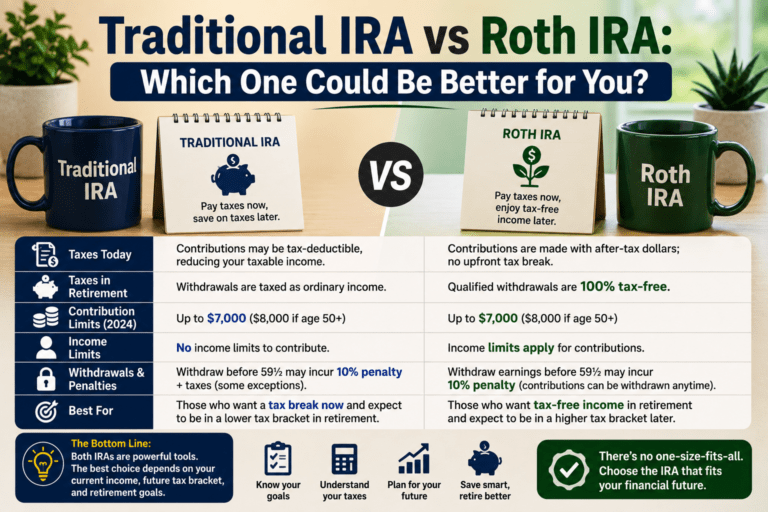
Traditional IRA vs Roth IRA: Which One Could Be Better for You?
Traditional IRA vs Roth IRA: Which One Could Be Better for You? | MoneyOnliners MoneyOnliners • Retirement → Individual Retirement Accounts Traditional IRA vs Roth IRA: Which One Could Be Better for You? Traditional and Roth IRAs can both help you build long-term retirement assets, but they offer their tax advantages at different times. A…
Starting Retirement Savings Late? 10 Moves That Can Help You Catch Up
Starting Retirement Savings Late? 10 Moves That Can Help You Catch Up | MoneyOnliners MoneyOnliners • Retirement → Catch-Up Planning Starting Retirement Savings Late? 10 Moves That Can Help You Catch Up Starting retirement savings later than planned can feel discouraging, but being behind does not mean your financial future is already decided. A stronger…
Can You Retire With $1 Million? Here’s What the Numbers Could Look Like
Can You Retire With $1 Million? Here’s What the Numbers Could Look Like | MoneyOnliners MoneyOnliners • Retirement → $1 Million Retirement Can You Retire With $1 Million? Here’s What the Numbers Could Look Like One million dollars sounds like an enormous retirement portfolio—and for some households it could support a comfortable retirement. For others,…
How Much Money Do You Really Need to Retire Comfortably?
How Much Money Do You Really Need to Retire Comfortably? | MoneyOnliners MoneyOnliners • Retirement → Retirement Income How Much Money Do You Really Need to Retire Comfortably? Is $500,000 enough to retire? What about $1 million, $1.5 million or $2 million? There is no universal retirement number because comfortable retirement depends on what you…
Retirement Planning: 15 Things to Start Doing Before You Retire
Retirement Planning: 15 Things to Start Doing Before You Retire | MoneyOnliners MoneyOnliners • Retirement → Long-Term Planning Retirement Planning: 15 Things to Start Doing Before You Retire Retirement planning is not only about building a large investment account. It is about preparing your income, expenses, healthcare, taxes, debt, housing, emergency reserves and lifestyle so…
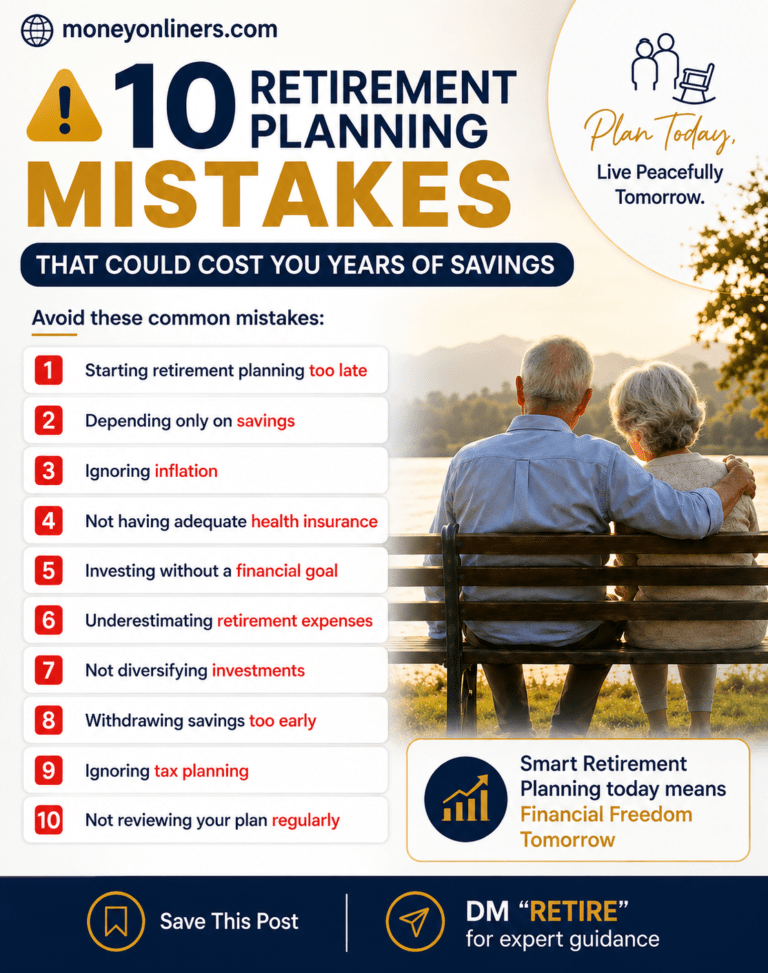
10 Retirement Planning Mistakes That Could Cost You Years of Savings
10 Retirement Planning Mistakes That Could Cost You Years of Savings | MoneyOnliners MoneyOnliners • Retirement → Avoid Costly Mistakes 10 Retirement Planning Mistakes That Could Cost You Years of Savings Retirement plans are rarely damaged by one imperfect decision alone. More often, years of small mistakes—saving too little, paying unnecessary fees, carrying expensive debt,…




One Comment