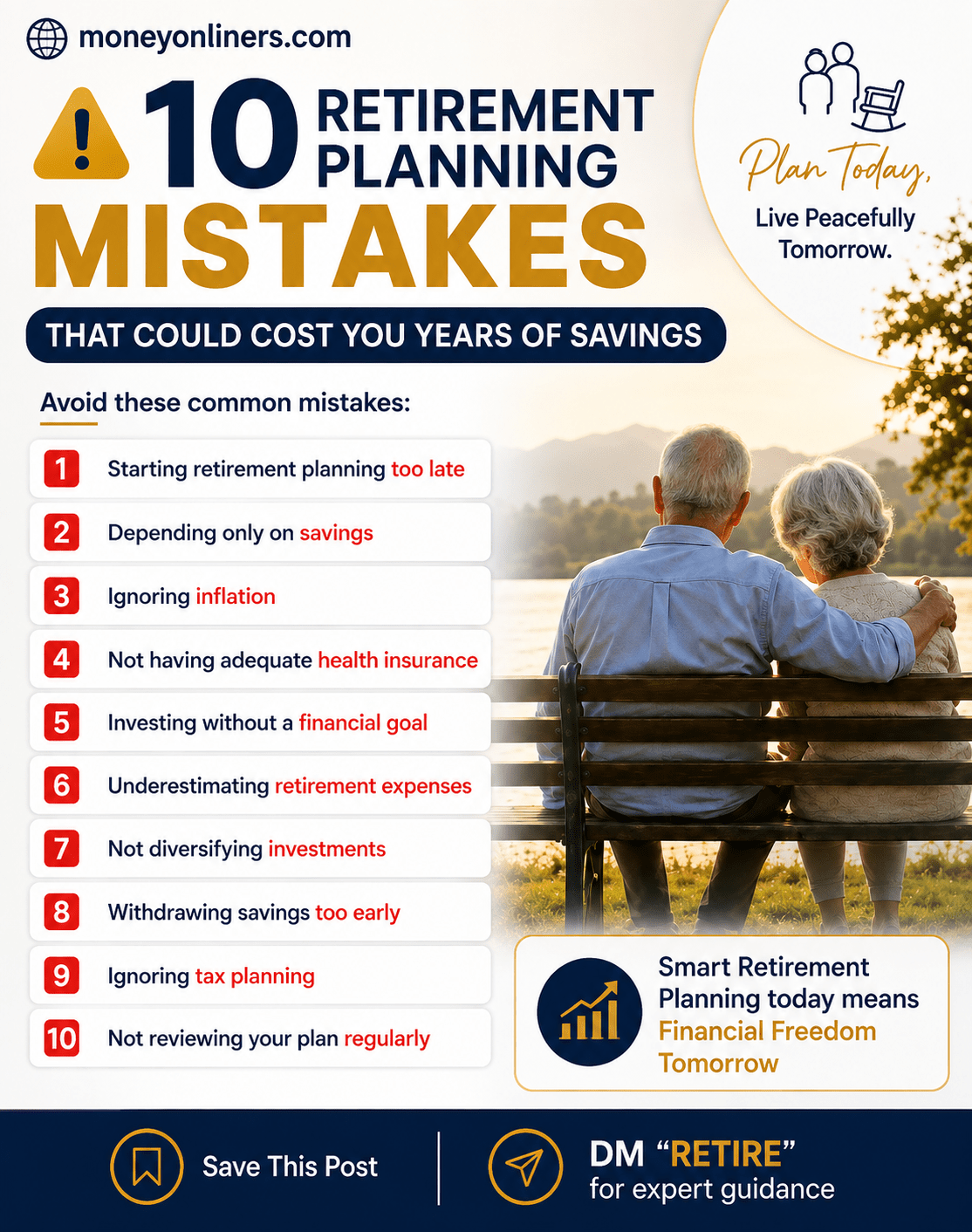
10 Retirement Planning Mistakes That Could Cost You Years of Savings
10 Retirement Planning Mistakes That Could Cost You Years of Savings
Retirement plans are rarely damaged by one imperfect decision alone. More often, years of small mistakes—saving too little, paying unnecessary fees, carrying expensive debt, ignoring healthcare, misunderstanding Social Security or withdrawing too much too early—gradually weaken the financial foundation you spent decades building.
Some of the biggest retirement planning mistakes are starting too late, contributing too little, missing valuable employer benefits, ignoring investment fees, failing to diversify, carrying expensive debt into retirement, underestimating healthcare and housing expenses, claiming Social Security without understanding the effect of timing, withdrawing too aggressively and failing to update the plan as life changes.
The good news is that many of these mistakes involve factors you can still improve. Retirement planning becomes stronger when you focus on contribution rate, costs, diversification, debt, realistic spending, taxes, retirement income and flexibility rather than trying to predict markets perfectly.
Table of Contents
10 Retirement Planning Mistakes at a Glance
| # | Mistake | Potential Consequence |
|---|---|---|
| 1 | Starting too late | Less contribution time and less potential compounding |
| 2 | Saving too little | Portfolio may not match retirement spending needs |
| 3 | Missing employer benefits | Potential employer contributions left unused |
| 4 | Ignoring fees | More investment growth lost to costs |
| 5 | Poor diversification | Too much dependence on one investment outcome |
| 6 | Carrying expensive debt | Higher required retirement cash flow |
| 7 | Underestimating expenses | Retirement budget may be unrealistic |
| 8 | Poor Social Security timing | Potentially lower lifetime monthly income |
| 9 | Withdrawing too aggressively | Portfolio may face greater depletion risk |
| 10 | Never reviewing the plan | Old assumptions remain after life changes |
1 Starting Retirement Saving Too Late
Time can be one of the most valuable retirement resources.
Starting later means future contributions have fewer years to potentially compound.
Hypothetical Example
Consider a person investing $500 per month.
| Saving Period | Own Contributions |
|---|---|
| 10 years | $60,000 |
| 20 years | $120,000 |
| 30 years | $180,000 |
That table excludes all investment gains or losses.
It simply shows how dramatically contribution time changes the amount of money you personally put into the plan.
If You Started Late
Do not respond by giving up.
Consider:
- Increasing contributions
- Saving part of every future raise
- Reducing expensive debt
- Increasing earning power
- Using catch-up contribution opportunities where eligible
- Reviewing your retirement date
The second-best retirement starting date is usually the earliest date you can realistically begin from where you are now.

2 Saving the Same Small Amount for Decades
Starting is important.
But never increasing contributions can also create a problem.
Example
You begin saving $300 per month at age 30.
Twenty years later, your salary has doubled—but your retirement contribution is still $300.
$300 × 12 = $3,600 annual saving
Now imagine gradually increasing the contribution to $900 per month.
$900 × 12 = $10,800 annually
Annual Difference
$7,200
Over ten years, that is $72,000 of additional contributions before any investment returns.
Consider increasing your contribution whenever income rises rather than allowing every raise to become permanent lifestyle inflation.
3 Missing Valuable Employer Retirement Benefits
If your employer offers matching or other retirement contributions, failing to understand the plan can be costly.
Hypothetical Example
Your contribution:
$6,000
Employer contribution:
$3,000
Total
$9,000
If you contributed too little to receive the available employer contribution, part of that potential retirement benefit could be lost.
Review
- Employer matching formula
- Vesting schedule
- Automatic enrollment
- Contribution limits
- Investment choices
- Plan fees
Never assume your workplace plan operates like someone else's. Review your actual employer plan documents.
4 Ignoring Investment Fees for 20 or 30 Years
Investment fees can look harmless because they are often expressed as small percentages.
But recurring fees reduce the amount remaining in your portfolio to compound.
Investor.gov Example
Investor.gov illustrates the effect of different annual fees on a hypothetical $100,000 portfolio earning 4% annually for 20 years.
| Annual Fee | Approximate Ending Portfolio in Investor.gov Example |
|---|---|
| 0.25% | About $208,000 |
| 0.50% | About $198,000 |
| 1.00% | About $179,000 |
The difference between the 0.25% and 1.00% examples is approximately:
$29,000
That is why fees deserve attention even when they appear small.
Look for
- Fund expense ratios
- Plan administration fees
- Advisory fees
- Trading expenses
- Annuity expenses where relevant
- Other account charges
Do not choose an investment only because it is cheap—but never assume cost does not matter.
5 Putting Too Much Retirement Money Into One Investment
A concentrated retirement portfolio can become extremely dependent on one company, industry, country or asset class.
Concentration Could Include
- Large position in employer stock
- One technology company
- One sector
- One cryptocurrency
- One speculative property
- One investment theme
Diversification
Diversification means spreading money among different investments so the portfolio does not depend entirely on one outcome.
It cannot guarantee against losses.
But it can reduce concentration risk.
A strong retirement account can be badly damaged if most of the portfolio depends on one speculative investment that fails.

6 Carrying Expensive Debt Into Retirement
Debt increases how much cash flow your retirement must produce.
Example
Credit cards and personal loans require:
$800 per month
Annual Debt Payments
$800 × 12 = $9,600
If those payments continue into retirement, the financial system must support another $9,600 annually.
At a Simple 4% Portfolio Illustration
$9,600 ÷ 0.04 = $240,000
That does not mean paying off the debt automatically “saves” $240,000.
It illustrates how a permanent annual spending obligation can materially increase portfolio requirements.
Credit-card balances, payday loans and high-interest consumer debt can be particularly damaging to retirement cash flow.
7 Underestimating What Retirement Will Actually Cost
A retirement budget based only on groceries, utilities and housing can look deceptively inexpensive.
Frequently Missed Retirement Expenses
- Home repairs
- Property taxes
- Insurance increases
- Healthcare
- Dental care
- Hearing and vision
- Vehicle replacement
- Travel
- Family support
- Home modifications
- Taxes
- Long-term care
Example
Initial estimated retirement budget:
$55,000
After adding realistic irregular costs:
$67,000
Difference
$12,000 annually
At a simple 4% illustration:
$12,000 ÷ 0.04 = $300,000

8 Claiming Social Security Without Understanding the Timing
For eligible U.S. retirees, the age at which Social Security retirement benefits are claimed can affect the monthly benefit.
The Social Security Administration states that benefits are based partly on lifetime earnings and that claiming earlier can reduce monthly retirement benefits compared with waiting longer under applicable rules.
Full Retirement Age
For people born in 1960 or later, current Social Security rules place full retirement age at 67.
Questions to Consider
- How much will I receive at 62?
- What is my full retirement age?
- What would waiting longer do to the monthly amount?
- Will I continue working?
- What is my health situation?
- What does my household income plan require?
- What benefits might a spouse receive?
Use your personalized Social Security estimate based on your own earnings history and claiming ages.
9 Withdrawing Too Much Too Early in Retirement
A large retirement portfolio can still face pressure when withdrawals are too high.
Example: $1 Million Portfolio
| First-Year Withdrawal | Starting Withdrawal Rate |
|---|---|
| $30,000 | 3% |
| $35,000 | 3.5% |
| $40,000 | 4% |
| $50,000 | 5% |
| $70,000 | 7% |
A higher withdrawal gives you more cash today.
But it also removes more money from the portfolio.
Sequence-of-Returns Risk
Poor market returns early in retirement can be especially difficult when large withdrawals occur at the same time.
During weak markets, temporarily reducing discretionary expenses can sometimes lower portfolio pressure.
10 Creating a Retirement Plan Once and Never Updating It
A retirement plan built at age 35 can become outdated by age 50.
Life changes.
Your Plan May Need Updating When
- Your income changes
- You marry or divorce
- You buy or sell a home
- You change jobs
- Your pension changes
- Retirement-account rules change
- Healthcare needs change
- You receive an inheritance
- You develop new family obligations
- Your retirement date changes
Review at Least These Areas
- Contribution rate
- Asset allocation
- Investment fees
- Beneficiaries
- Debt
- Emergency reserves
- Retirement expenses
- Social Security estimate
- Expected pension
- Retirement-income gap

MoneyOnliners Original Analysis: The Retirement Leakage Framework
| Leakage Type | Examples | What It Can Cost |
|---|---|---|
| Contribution Leakage | Starting late, saving too little, missing employer contributions | Less capital invested |
| Cost Leakage | High fees, expensive debt, unnecessary financial products | Money diverted away from long-term wealth |
| Lifestyle Leakage | Underestimated housing, healthcare and discretionary spending | Higher retirement withdrawal needs |
| Planning Leakage | Poor Social Security timing, no reviews, poor withdrawal strategy | Less efficient use of accumulated assets |
A retirement plan can fail to reach its potential even without a market crash. Small leaks repeated over decades can quietly remove significant financial capacity.
MoneyOnliners Retirement Mistake Severity Matrix
| Mistake | Can Start Early? | Can Compound for Years? | Typical Priority |
|---|---|---|---|
| Starting late | Yes | Yes | Very High |
| Saving too little | Yes | Yes | Very High |
| Ignoring fees | Yes | Yes | High |
| Poor diversification | Yes | Potentially | High |
| High-interest debt | Yes | Yes | Very High |
| Underestimating expenses | Often discovered late | Yes | Very High |
| Social Security timing | Near retirement | Can affect ongoing income | High |
| High withdrawals | Retirement | Yes | Very High |
This matrix is an original MoneyOnliners educational framework, not a standardized financial-planning score.
MoneyOnliners Research-Based Evidence Note
This article is a research-based retirement education guide.
MoneyOnliners does not claim personal first-hand retirement experience with every mistake, investment account, Social Security strategy or withdrawal situation described.
Investment-fee examples are based on current Investor.gov educational material.
Social Security claiming information is based on current Social Security Administration guidance.
Retirement planning, housing and debt risks are informed by current Consumer Financial Protection Bureau retirement resources.
Contribution-limit examples should always be checked against the applicable tax year's current IRS limits.
MoneyOnliners does not fabricate investment performance, retirement losses, Social Security outcomes, testimonials or personal retirement results.
The Retirement Leakage Framework and Retirement Mistake Severity Matrix are original MoneyOnliners analytical resources intended to make this topic more practical and citeable.
Hypothetical Case Study: How Small Mistakes Can Add Up
Consider a fictional 50-year-old worker preparing to retire at 65.
Initial Situation
- Retirement savings: $450,000
- Monthly contribution: $500
- High-interest debt payment: $600/month
- Portfolio fee: relatively high
- Expected retirement spending: $55,000/year
Problem 1: Debt
The $600 monthly payment consumes:
$7,200 per year
Problem 2: Contribution Rate
The worker contributes only:
$6,000 per year
Problem 3: Retirement Expenses
After reviewing healthcare, home repairs and vehicle replacement, realistic spending rises from $55,000 to:
$67,000 per year
Then the Worker Changes the Plan
- Attacks high-interest debt.
- Raises retirement contributions after the debt is eliminated.
- Reviews lower-cost diversified investment choices.
- Builds a realistic retirement-expense reserve.
- Uses a personalized Social Security estimate.
- Reviews retirement progress annually.
None of those changes guarantees a successful retirement.
But together they reduce several forms of financial leakage at once.
Key lesson: Fixing several ordinary mistakes can be more powerful than searching for one extraordinary investment.
Retirement Planning Mistake Prevention Checklist
- I contribute consistently to retirement.
- I increase contributions when income rises.
- I understand my employer retirement benefits.
- I know the fees inside my investments and retirement plan.
- My investments are appropriately diversified.
- I understand my risk tolerance and time horizon.
- I am reducing high-interest debt.
- I maintain emergency savings.
- I have estimated realistic retirement expenses.
- I have included healthcare.
- I have included housing repairs and maintenance.
- I have included taxes.
- I know my estimated Social Security benefits.
- I have considered claiming age carefully.
- I understand how much my portfolio may need to provide.
- I do not assume one withdrawal rate is guaranteed.
- I have discretionary spending I could adjust if necessary.
- I review beneficiaries periodically.
- I update the retirement plan after major life changes.
- I verify current rules rather than relying on outdated retirement information.
Why Avoiding Retirement Planning Mistakes Matters
1. Starting earlier gives contributions more time to participate in long-term growth.
2. Increasing contributions can make income growth work for your future.
3. Employer retirement contributions can add meaningful assets when available.
4. Investment fees reduce the amount of money remaining invested.
5. Small recurring fees can compound into meaningful differences over decades.
6. Diversification reduces dependence on one investment outcome.
7. High-interest debt can compete directly with retirement saving.
8. Required debt payments can increase the income needed after retirement.
9. Underestimated expenses can make an apparently sufficient portfolio look much weaker.
10. Housing costs continue even after a mortgage is paid off.
11. Healthcare can become increasingly important with age.
12. Social Security claiming age can affect monthly retirement income.
13. Personalized Social Security estimates are more useful than generic averages.
14. Large early withdrawals can place greater pressure on a retirement portfolio.
15. Market declines early in retirement can make aggressive withdrawals particularly challenging.
16. Spending flexibility can provide another layer of financial resilience.
17. Retirement rules can change over time.
18. A plan that was suitable ten years ago may no longer reflect current circumstances.
19. Small financial leaks can become large when repeated for decades.
20. Ultimately, avoiding major retirement planning mistakes helps more of the money you earn, save and invest remain available for the retirement life it was intended to support.
Incoming Link Opportunities
15 Retirement Expenses People Forget to Plan For
https://moneyonliners.com/retirement-expenses-people-forget/
Can You Retire With $1 Million? Here's What the Numbers Could Look Like
https://moneyonliners.com/can-you-retire-with-1-million/
Retirement Planning: 15 Things to Start Doing Before You Retire
https://moneyonliners.com/retirement-planning-before-you-retire/
How Much Money Do You Really Need to Retire Comfortably?
https://moneyonliners.com/how-much-money-to-retire-comfortably/
Starting Retirement Savings Late? 10 Moves That Can Help You Catch Up
https://moneyonliners.com/starting-retirement-savings-late/
High-Priority Incoming Links
How Much Should You Save for Retirement at 30, 40, 50 and 60?
https://moneyonliners.com/how-much-should-you-save-for-retirement-by-age/
The 4% Rule Explained: Can It Really Help You Reach Financial Independence?
https://moneyonliners.com/4-percent-rule-financial-independence/
401(k) vs IRA: 12 Differences Retirement Savers Should Know
https://moneyonliners.com/401k-vs-ira/
Traditional IRA vs Roth IRA: Which One Could Be Better for You?
https://moneyonliners.com/traditional-ira-vs-roth-ira/
Topic Cluster Incoming Links
How Much Money Do You Really Need to Retire Comfortably?
https://moneyonliners.com/how-much-money-to-retire-comfortably/
15 Retirement Expenses People Forget to Plan For
https://moneyonliners.com/retirement-expenses-people-forget/
Starting Retirement Savings Late? 10 Moves That Can Help You Catch Up
https://moneyonliners.com/starting-retirement-savings-late/
Can You Retire With $1 Million? Here's What the Numbers Could Look Like
https://moneyonliners.com/can-you-retire-with-1-million/
Continue Learning on MoneyOnliners
Recommended External Resources
1. Consumer Financial Protection Bureau — Retirement Planning
Planning for Retirement — Consumer Financial Protection Bureau
Useful consumer guidance covering retirement income, debt, housing, Social Security decisions and planning as you age.
2. Social Security Administration — 2026 Retirement Benefits Guide
Retirement Benefits — Social Security Administration
Official Social Security information explaining how retirement benefits are calculated and how claiming age affects monthly payments.
3. Social Security Administration — Personalized Benefit Estimates
Get a Retirement Benefits Estimate — SSA
Use your actual earnings record to estimate future Social Security benefits at different claiming ages.
4. Investor.gov — Understanding Investment Fees
Understanding Fees — Investor.gov
Explains how investment costs can reduce portfolio value over long periods.
5. Investor.gov — How Fees and Expenses Affect Your Portfolio
How Fees and Expenses Affect Your Investment Portfolio — Investor.gov
Includes examples illustrating how different annual fees can create large long-term differences in portfolio value.
6. Investor.gov — Asset Allocation and Diversification
Asset Allocation and Diversification — Investor.gov
Explains diversification, asset allocation, rebalancing and the relationship between risk and investment time horizon.
7. Investor.gov — Older Investors
Older Investors — Investor.gov
Covers fees, investment research, fraud protection and financial issues that can become increasingly important later in life.
8. IRS — 2026 Retirement Contribution Limits
2026 401(k) and IRA Contribution Limits — IRS
Official 2026 contribution limits for 401(k)s, IRAs and catch-up contributions.
9. IRS — 401(k) Contribution Limits
401(k) and Profit-Sharing Plan Contribution Limits — IRS
Detailed IRS guidance covering employee deferrals and overall workplace retirement-plan contribution limits.
10. FTC — Scam and Fraud Protection
Scams — Federal Trade Commission
Useful information for identifying fraudulent investment and financial schemes that could threaten retirement savings.
MoneyOnliners prioritizes government agencies and financial regulators for retirement rules, Social Security, contribution limits and investment-risk information because these areas can change. Verify the latest official guidance before making retirement, tax or investment decisions.
This article provides general educational information and is not individualized retirement, tax, investment, insurance, legal or financial advice. Hypothetical calculations are planning examples only. Investments can lose value, fees vary, tax rules change, Social Security benefits differ by individual and no retirement strategy guarantees a particular financial outcome.
Frequently Asked Questions
What is the biggest retirement planning mistake?
There is no single mistake that is always the most expensive.
Starting late can be costly.
Saving too little can also be costly.
High fees and debt can compound over time.
The biggest risk often comes from several mistakes occurring together.
Is starting retirement savings late a serious mistake?
It can make retirement harder.
You have fewer contribution years.
Investments have less time.
But starting late is still generally better than never starting.
Higher contributions and income growth can help improve the plan.
How much should I contribute to retirement?
There is no universal percentage.
Your age matters.
Current savings matter.
Pension income matters.
Expected retirement spending matters.
Why do investment fees matter so much?
Fees reduce your investment return.
That means less money remains invested.
Over long periods, the difference compounds.
Even seemingly small fee differences can create substantial long-term portfolio differences.
Review fees regularly.
Should retirement savings be diversified?
Diversification can reduce concentration risk.
It does not guarantee against investment losses.
Asset allocation should reflect your goals.
Time horizon matters.
Risk tolerance matters too.
Should I retire with debt?
It depends on the type of debt.
Very high-interest consumer debt can create significant cash-flow pressure.
A low-rate mortgage is a different situation.
Liquidity matters too.
Review interest rates and retirement cash flow together.
What retirement expenses are most often forgotten?
Home repairs are often underestimated.
Healthcare can be underestimated.
Vehicle replacement is easy to forget.
Taxes can be overlooked.
Long-term care and family support can also matter.
Can claiming Social Security too early be a mistake?
It can result in a lower monthly benefit than waiting under applicable Social Security rules.
But earlier claiming can still make sense in some situations.
Health matters.
Household income matters.
Use your personalized benefit estimates before deciding.
What is full retirement age for Social Security?
It depends on your year of birth.
For people born in 1960 or later, current full retirement age is 67.
Earlier birth years have different full retirement ages.
Social Security rules can change over time.
Check current SSA guidance.
Is withdrawing 4% always safe?
No.
Four percent is a planning reference, not a guarantee.
Portfolio allocation matters.
Retirement length matters.
Spending flexibility and market returns matter too.
Why are early retirement losses especially dangerous?
Withdrawals can force the sale of investments while portfolio values are depressed.
That leaves less capital participating in a later recovery.
This is often called sequence-of-returns risk.
Cash reserves can help.
Flexible discretionary spending may also help.
How often should I review my retirement plan?
At least periodically.
Annual reviews can be useful.
Major life events should also trigger a review.
Retirement rules and tax laws can change.
The plan should remain connected to your real circumstances.
Should I change my retirement investments as I get older?
Possibly.
Your time horizon changes.
Withdrawal needs can change.
Risk tolerance may change.
But becoming excessively conservative can also create inflation and longevity risks.
Can I fix retirement planning mistakes at 50?
Many aspects of the plan can still be improved.
Increase contributions where realistic.
Reduce expensive debt.
Review fees.
Calculate your actual retirement-income gap and consider retirement timing.
Can I fix retirement planning mistakes at 60?
You may still have meaningful options.
Review retirement timing.
Review Social Security.
Review spending and housing.
Focus on cash-flow sustainability rather than comparing yourself with younger savers.
Research Methodology
This MoneyOnliners guide evaluates retirement planning mistakes through contribution behavior, investment costs, diversification, debt, retirement expenses, Social Security timing, portfolio withdrawals and ongoing plan maintenance.
Starting late and saving too little are treated separately because contribution timing and contribution amount affect retirement accumulation differently.
Employer retirement benefits are included because employer contributions can materially increase the amount being saved for retirement.
Current 2026 contribution limits should be verified against official IRS guidance because retirement-plan limits can change annually.
Investment fees are included because current Investor.gov guidance shows that recurring fees can materially affect portfolio value over long periods.
Diversification is included because concentrating retirement savings in one investment creates dependence on one financial outcome.
Debt is included because required debt payments increase the amount of monthly retirement income needed.
Retirement expenses are evaluated beyond ordinary monthly bills because home maintenance, healthcare, taxes and irregular costs can materially change required spending.
Social Security timing is included because the Social Security Administration confirms that claiming age affects monthly retirement benefits.
Withdrawal rate examples are presented as mathematical illustrations rather than guarantees.
Sequence-of-returns risk is included because the order of investment returns can matter when withdrawals have begun.
Plan review is included because income, family, tax rules, housing and retirement goals can all change over time.
The MoneyOnliners Retirement Leakage Framework and Retirement Mistake Severity Matrix are original editorial resources designed to make the cumulative impact of retirement mistakes easier to understand and cite.
All financial examples and case studies are hypothetical unless specifically identified as official figures.
No investment return, retirement balance, tax result, Social Security outcome or withdrawal strategy is guaranteed.
Google Search Console Checklist
- Confirm final URL: /retirement-planning-mistakes/
- Confirm canonical matches the live URL.
- Use retirement planning mistakes naturally in the title, introduction, major headings and conclusion.
- Use related phrases such as costly retirement mistakes, retirement savings mistakes and mistakes before retirement naturally.
- Keep the visuals focused on different retirement realities: working years, homes, diversification and retired lifestyle.
- Use unique alt text for every image.
- Verify external retirement figures when updating the article.
- Confirm Recommended External Resources includes 6–10 strong authoritative links.
- Confirm all internal links point to live canonical URLs.
- Confirm the post is indexable.
- Confirm the URL appears in the XML sitemap.
- Check tables carefully on mobile.
- Inspect the final URL in Google Search Console.
- Request indexing after publication if appropriate.
- Monitor searches such as “retirement planning mistakes,” “retirement mistakes to avoid,” “biggest retirement mistakes,” “retirement savings mistakes” and “costly retirement mistakes.”
Conclusion: Protect the Savings You Worked Years to Build
Retirement success is not only about how much money you earn.
It is also about how much financial progress you avoid losing.
Start as Early as You Can
Time gives contributions more opportunity to work.
Increase Contributions
Do not let retirement saving remain frozen while income rises.
Understand Your Employer Benefits
Know whether your workplace contributes to your future.
Watch Your Fees
Small recurring costs can matter over decades.
Diversify
Do not make your retirement depend entirely on one investment succeeding.
Reduce Expensive Debt
Debt payments can follow you into retirement and increase the income you need.
Use a Real Retirement Budget
Include healthcare.
Housing repairs.
Taxes.
Vehicles.
Travel.
And the irregular expenses that ordinary monthly budgets forget.
Understand Social Security
Use your own benefit estimate before deciding when to claim.
Control Withdrawals
Do not assume a large portfolio can support unlimited spending.
Keep Updating the Plan
Your finances will change.
Your retirement plan should change with them.
Similar Posts
Starting Retirement Savings Late? 10 Moves That Can Help You Catch Up
Starting Retirement Savings Late? 10 Moves That Can Help You Catch Up | MoneyOnliners MoneyOnliners • Retirement → Catch-Up Planning Starting Retirement Savings Late? 10 Moves That Can Help You Catch Up Starting retirement savings later than planned can feel discouraging, but being behind does not mean your financial future is already decided. A stronger…
15 Retirement Expenses People Forget to Plan For
15 Retirement Expenses People Forget to Plan For | MoneyOnliners MoneyOnliners • Retirement → Retirement Expenses 15 Retirement Expenses People Forget to Plan For A retirement budget can look comfortable until the expenses that do not arrive every month begin appearing. Roof repairs, dental work, replacing a vehicle, helping adult children, insurance increases, taxes, travel,…
How Much Money Do You Really Need to Retire Comfortably?
How Much Money Do You Really Need to Retire Comfortably? | MoneyOnliners MoneyOnliners • Retirement → Retirement Income How Much Money Do You Really Need to Retire Comfortably? Is $500,000 enough to retire? What about $1 million, $1.5 million or $2 million? There is no universal retirement number because comfortable retirement depends on what you…
Retirement Planning: 15 Things to Start Doing Before You Retire
Retirement Planning: 15 Things to Start Doing Before You Retire | MoneyOnliners MoneyOnliners • Retirement → Long-Term Planning Retirement Planning: 15 Things to Start Doing Before You Retire Retirement planning is not only about building a large investment account. It is about preparing your income, expenses, healthcare, taxes, debt, housing, emergency reserves and lifestyle so…
How Much Should You Save for Retirement at 30, 40, 50 and 60?
How Much Should You Save for Retirement at 30, 40, 50 and 60? | MoneyOnliners MoneyOnliners • Retirement → Savings by Age How Much Should You Save for Retirement at 30, 40, 50 and 60? Age-based retirement benchmarks can help you check your progress, but they should never become rigid pass-or-fail rules. Your income, lifestyle,…
Retirement vs Financial Independence: Why They’re Not Exactly the Same
Retirement vs Financial Independence: Why They’re Not Exactly the Same | MoneyOnliners MoneyOnliners • Retirement → Financial Independence Retirement vs Financial Independence: Why They’re Not Exactly the Same Retirement and financial independence are often treated as interchangeable goals, but they describe different things. Retirement usually means leaving or substantially reducing paid employment. Financial independence means…