
Can You Retire With $1 Million? Here’s What the Numbers Could Look Like
Can You Retire With $1 Million? Here's What the Numbers Could Look Like
One million dollars sounds like an enormous retirement portfolio—and for some households it could support a comfortable retirement. For others, especially those retiring very early or facing high housing, healthcare and tax costs, $1 million may provide less financial room than expected. The answer depends on what the portfolio must actually pay for.
Yes, you may be able to retire with $1 million, but $1 million is not automatically enough for everyone. At a hypothetical 4% starting withdrawal, $1 million corresponds to $40,000 in first-year portfolio withdrawals. At 3.5%, it is $35,000; at 3%, it is $30,000.
If Social Security, a pension or other dependable retirement income covers another $25,000 to $40,000 per year, the same $1 million portfolio could support a much larger total retirement cash flow. Housing costs, taxes, healthcare, retirement age, inflation and spending flexibility can completely change the outcome.
Table of Contents
Is $1 Million Really Enough to Retire?
There is no universal yes-or-no answer.
The usefulness of a $1 million portfolio depends on the amount of spending it needs to support.
Consider Two Retirees
Retiree A
Annual spending: $45,000
Social Security: $30,000
Portfolio gap: $15,000
Retiree B
Annual spending: $100,000
Social Security: $25,000
Portfolio gap: $75,000
Both retirees have $1 million invested.
But the financial pressure on those portfolios is completely different.
How Much Income Could $1 Million Potentially Provide?
A useful first step is comparing several hypothetical starting withdrawal rates.
| Starting Withdrawal Rate | First-Year Withdrawal From $1 Million | Monthly Equivalent |
|---|---|---|
| 2.5% | $25,000 | About $2,083 |
| 3% | $30,000 | $2,500 |
| 3.5% | $35,000 | About $2,917 |
| 3.9% | $39,000 | $3,250 |
| 4% | $40,000 | About $3,333 |
| 5% | $50,000 | About $4,167 |
These are mathematical illustrations, not guaranteed sustainable withdrawal rates. A higher withdrawal gives you more income today but places more pressure on the portfolio.
Why 4% Gets So Much Attention
The 4% guideline is widely used as a retirement-planning starting point.
It should not be treated as a promise that every portfolio will last for every retirement.
Asset allocation, fees, market returns, inflation, taxes, retirement length and spending adjustments all affect outcomes.
Model multiple withdrawal levels instead of building your entire retirement around one percentage.
A Pension Can Make a $1 Million Portfolio Go Much Further
Suppose a retiree has:
- $1 million invested
- $25,000 annual pension
- $25,000 annual Social Security
Before touching the investment portfolio:
Reliable annual income = $50,000
If annual spending is $70,000:
$70,000 − $50,000 = $20,000 portfolio gap
Withdrawal Rate on $1 Million
$20,000 ÷ $1,000,000 = 2%
Housing Can Decide Whether $1 Million Feels Comfortable or Tight
Housing can be one of the biggest variables in retirement.
Retiree With a Paid-Down Home
Annual housing-related costs might mainly involve:
- Property taxes
- Insurance
- Utilities
- Repairs
- Maintenance
Retiree With a Large Mortgage or High Rent
Suppose housing costs $2,500 per month.
$2,500 × 12 = $30,000 per year
At a simple 4% portfolio illustration, $30,000 of annual portfolio-funded spending corresponds mathematically to:
$30,000 ÷ 0.04 = $750,000
That shows why housing can dominate the retirement calculation.

Downsizing Could Affect Both Sides of the Equation
A retiree who moves from a large high-maintenance house to a smaller home might potentially:
- Reduce property costs
- Reduce maintenance
- Reduce utilities
- Release home equity
Before deciding whether $1 million is enough, calculate what the home you plan to live in will actually cost.
Healthcare Can Take a Meaningful Share of Retirement Income
Healthcare should not be hidden inside a miscellaneous-expense category.
Potential Costs Include
- Medicare premiums
- Deductibles
- Drug coverage
- Medigap or Medicare Advantage costs
- Dental care
- Vision care
- Hearing care
- Long-term care
- Other out-of-pocket expenses
2026 Medicare Example
The standard Medicare Part B premium is:
$202.90 per month in 2026
Annualized:
$202.90 × 12 = $2,434.80
That is only Part B's standard premium and does not represent total healthcare spending.

Someone retiring before Medicare eligibility may need to fund private health insurance or another coverage arrangement for several years.
Do Not Confuse $40,000 of Portfolio Withdrawals With $40,000 of Spendable Money
Taxes can change the amount available for lifestyle spending.
Traditional Retirement Accounts
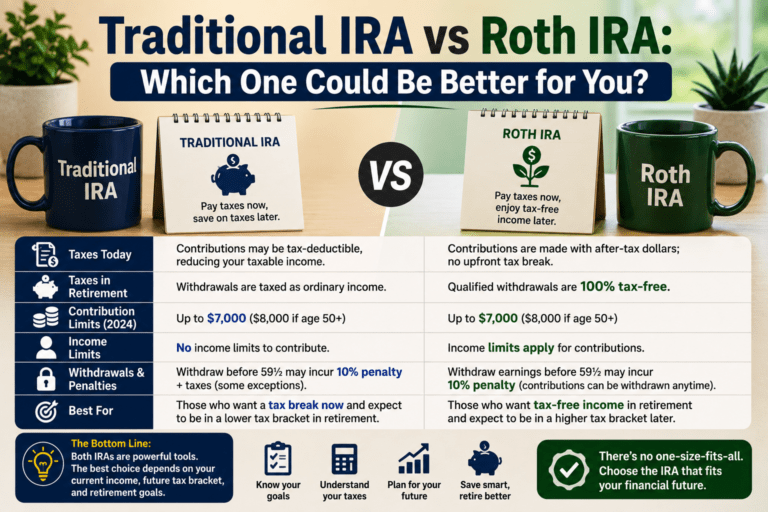
Withdrawals from tax-deferred retirement accounts are generally taxable to the extent applicable under U.S. tax rules.
Roth Accounts
Qualified Roth distributions can receive different federal tax treatment.
Taxable Accounts
Capital gains, dividends and interest may be taxed differently.
Social Security
Depending on total income, part of Social Security benefits may also be taxable.
Build your retirement budget around estimated after-tax spending rather than assuming every dollar withdrawn is available for consumption.
Retiring at 50 With $1 Million Is Different From Retiring at 70
Time horizon matters enormously.
| Retirement Age | Potential Planning Horizon | Main Challenge |
|---|---|---|
| 50 | Potentially 40+ years | Long withdrawal period and pre-Medicare healthcare |
| 55 | Potentially 35–40+ years | Long portfolio lifespan |
| 60 | Potentially 30+ years | Healthcare bridge and Social Security timing |
| 65 | Potentially 25–35 years | Balancing portfolio and retirement benefits |
| 70 | Potentially shorter portfolio horizon | Healthcare, longevity and RMD planning |
The earlier you retire, the more years your $1 million may need to support—and the greater the value of flexibility.
Inflation Can Slowly Reduce What $1 Million Can Buy
Retirement spending does not remain frozen forever.
Hypothetical Example
First-year spending:
$40,000
If inflation were 3%:
Year 2 equivalent = $41,200
Another 3%:
Year 3 equivalent = $42,436
Over decades, nominal spending may need to rise substantially just to maintain similar purchasing power.
Three Ways a $1 Million Retirement Could Look
Scenario 1: Lower-Cost Retirement
Portfolio: $1,000,000
Annual spending: $50,000
Social Security: $30,000
Portfolio gap: $20,000
Initial portfolio withdrawal rate: 2%
This retiree has considerable spending coverage from Social Security and places relatively modest initial pressure on the portfolio.
Scenario 2: Moderate Retirement
Portfolio: $1,000,000
Annual spending: $70,000
Social Security: $30,000
Portfolio gap: $40,000
Initial portfolio withdrawal rate: 4%
This can be workable under some assumptions but provides less margin than Scenario 1.
Scenario 3: High-Cost Retirement
Portfolio: $1,000,000
Annual spending: $100,000
Social Security: $25,000
Portfolio gap: $75,000
Initial portfolio withdrawal rate: 7.5%
This places much greater pressure on the portfolio and may require substantial spending reductions, additional income or a different retirement plan.
| Scenario | Annual Spending | Reliable Income | Portfolio Need | Withdrawal Rate |
|---|---|---|---|---|
| Lower Cost | $50,000 | $30,000 | $20,000 | 2% |
| Moderate | $70,000 | $30,000 | $40,000 | 4% |
| High Cost | $100,000 | $25,000 | $75,000 | 7.5% |
Can You Retire Early With $1 Million?
Potentially—but early retirement makes the numbers more demanding.
Why?
- Longer withdrawal horizon
- More years exposed to inflation
- More market cycles
- Healthcare before Medicare eligibility
- Social Security may not begin for many years
- Less time to recover from early portfolio losses
Example
A 50-year-old retiree has $1 million and needs $50,000 annually from the portfolio.
$50,000 ÷ $1,000,000 = 5%
That withdrawal may need to continue for several decades.
Compare that with a 67-year-old whose Social Security reduces the portfolio need to $25,000.
$25,000 ÷ $1,000,000 = 2.5%
The same portfolio can therefore create radically different retirement pressure.
MoneyOnliners Original Analysis: The $1 Million Retirement Pressure Test
| Factor | Lower Pressure on $1 Million | Higher Pressure on $1 Million |
|---|---|---|
| Portfolio withdrawal need | 2%–3% initial need | 5%+ initial need |
| Reliable income | Strong Social Security/pension | Portfolio funds almost everything |
| Housing | Low housing costs | Large mortgage or expensive rent |
| Retirement horizon | Later retirement | Very early retirement |
| Spending flexibility | Large discretionary component | Nearly all spending fixed |
A $1 million portfolio becomes stronger when it is responsible for a smaller share of essential expenses and when the retiree can adjust optional spending during difficult periods.
MoneyOnliners $1 Million Retirement Cash-Flow Matrix
| Annual Lifestyle | Reliable Income | Portfolio Gap | Portfolio Withdrawal Rate |
|---|---|---|---|
| $45,000 | $30,000 | $15,000 | 1.5% |
| $50,000 | $25,000 | $25,000 | 2.5% |
| $60,000 | $30,000 | $30,000 | 3% |
| $70,000 | $30,000 | $40,000 | 4% |
| $80,000 | $30,000 | $50,000 | 5% |
| $100,000 | $25,000 | $75,000 | 7.5% |
This is an original MoneyOnliners educational framework and is not a prediction of portfolio success.
MoneyOnliners Research-Based Evidence Note
This article is a research-based retirement education guide.
MoneyOnliners is not claiming personal first-hand retirement experience with a $1 million investment portfolio.
Portfolio withdrawals, Social Security amounts and household scenarios are hypothetical educational examples unless explicitly identified as official current figures.
Current Social Security and Medicare references are based on official U.S. government information.
MoneyOnliners does not fabricate retirement results, portfolio performance, withdrawal outcomes or testimonials.
The $1 Million Retirement Pressure Test and Cash-Flow Matrix are original MoneyOnliners analytical frameworks designed to make this question more useful and citeable.
10 Questions to Stress-Test a $1 Million Retirement
- What will my realistic annual retirement spending be?
- How much Social Security will I actually receive?
- Will I receive a pension?
- How much must the portfolio provide?
- What will housing cost?
- What will healthcare cost?
- How will withdrawals be taxed?
- How long might retirement last?
- Could I reduce discretionary spending during difficult markets?
- Do I maintain emergency cash outside long-term investments?
Example Stress Test
A retired couple has $1 million invested.
Their annual spending is $75,000.
Combined Social Security is $35,000.
Portfolio requirement:
$75,000 − $35,000 = $40,000
Their initial portfolio withdrawal is 4%.
Then they identify $12,000 of optional travel and entertainment spending.
Essential and core lifestyle spending is therefore closer to $63,000.
In a difficult market year, they could potentially reduce discretionary spending and lower portfolio pressure.
Key lesson: Flexibility can be a valuable retirement asset even though it never appears on a brokerage statement.

10 Mistakes to Avoid When Planning Retirement With $1 Million
1. Assuming $1 Million Is Automatically Enough
The spending requirement matters more than the headline balance.
2. Assuming $1 Million Is Automatically Too Little
Strong pensions, Social Security and moderate spending can materially change the calculation.
3. Treating 4% as a Guarantee
A withdrawal guideline is not a promise of portfolio longevity.
4. Ignoring Social Security
Reliable retirement income can substantially reduce portfolio withdrawals.
5. Ignoring Housing
Housing can consume tens of thousands of dollars per year.
6. Ignoring Healthcare
Medical expenses can materially reduce discretionary retirement income.
7. Forgetting Taxes
Gross retirement income may differ substantially from spendable income.
8. Retiring Very Early Without Adjusting the Math
A longer retirement requires the portfolio to survive more years of uncertainty.
9. Having No Spending Flexibility
A budget where every dollar is essential leaves fewer options during difficult markets.
10. Taking Excessive Investment Risk to Make $1 Million Produce More
Higher risk does not make a retirement plan safer.
Be cautious of products, investments or trading strategies claiming they can safely turn a $1 million portfolio into guaranteed high retirement income. High promised returns generally come with risk, and some guarantees can depend heavily on issuer terms and financial strength.
Why Asking “Can You Retire With $1 Million?” Matters
1. A $1 million portfolio does not produce one universally safe retirement income.
2. Annual spending determines how much financial pressure the portfolio faces.
3. Social Security can reduce the amount investments need to provide.
4. Pension income can reduce portfolio withdrawals even further.
5. Lower housing costs can make $1 million considerably more powerful.
6. A large mortgage can make the same portfolio feel much smaller.
7. Healthcare expenses can reduce retirement spending flexibility.
8. Taxes can make gross withdrawals different from usable income.
9. A Roth-heavy portfolio may have different tax characteristics from a tax-deferred portfolio.
10. Early retirement increases the number of years the portfolio may need to support.
11. Delaying Social Security can change future benefit amounts.
12. Inflation can reduce purchasing power over a long retirement.
13. Portfolio diversification can reduce dependence on one asset or market segment.
14. Emergency cash can reduce the need for forced investment sales.
15. Discretionary spending creates valuable flexibility during market declines.
16. A million dollars can be substantial without being unlimited.
17. A lower-cost retirement can make a smaller withdrawal rate possible.
18. Strong non-portfolio income can make $1 million support a larger lifestyle.
19. Retirement planning should use several scenarios instead of one perfect forecast.
20. Ultimately, asking can you retire with $1 million becomes much more useful when you connect the portfolio to your own spending, income, home, healthcare and retirement timeline.
Incoming Link Opportunities
How Much Money Do You Really Need to Retire Comfortably?
https://moneyonliners.com/how-much-money-to-retire-comfortably/
Retirement Planning: 15 Things to Start Doing Before You Retire
https://moneyonliners.com/retirement-planning-before-you-retire/
How Much Should You Save for Retirement at 30, 40, 50 and 60?
https://moneyonliners.com/how-much-should-you-save-for-retirement-by-age/
Starting Retirement Savings Late? 10 Moves That Can Help You Catch Up
https://moneyonliners.com/starting-retirement-savings-late/
401(k) vs IRA: 12 Differences Retirement Savers Should Know
https://moneyonliners.com/401k-vs-ira/
High-Priority Incoming Links
The 4% Rule Explained: Can It Really Help You Reach Financial Independence?
https://moneyonliners.com/4-percent-rule-financial-independence/
How Much Money Do You Need for Financial Independence?
https://moneyonliners.com/how-much-money-for-financial-independence/
Traditional IRA vs Roth IRA: Which One Could Be Better for You?
https://moneyonliners.com/traditional-ira-vs-roth-ira/
Continue Learning on MoneyOnliners
Recommended External Resources
1. Social Security Administration — Retirement Benefit Estimates
Get a Retirement Benefits Estimate — Social Security Administration
Use your own earnings history to estimate potential Social Security retirement benefits at different claiming ages.
2. Social Security Administration — Retirement Benefit Calculators
Social Security Benefit Calculators — SSA
Official calculators can help compare retirement benefits at different ages based on your earnings record.
3. Social Security Administration — Retirement Age and Working
Retirement Age and When You Stop Working — SSA
Explains how the age you stop working and the age you claim Social Security can affect retirement benefits.
4. Medicare — 2026 Medicare Costs
What Does Medicare Cost? — Medicare.gov
Official information covering 2026 Medicare Part A, Part B and other healthcare costs relevant to retirement planning.
5. Centers for Medicare & Medicaid Services — 2026 Premiums and Deductibles
2026 Medicare Parts A & B Premiums and Deductibles — CMS
Official 2026 Medicare premium, deductible and coinsurance figures.
6. IRS — Required Minimum Distributions
Required Minimum Distributions — IRS
Explains when withdrawals generally must begin from Traditional IRAs and many retirement-plan accounts.
7. Investor.gov — Retirement
Beginner-friendly retirement-investing guidance from the U.S. Securities and Exchange Commission.
8. Investor.gov — Asset Allocation and Diversification
Asset Allocation and Diversification — Investor.gov
Explains how time horizon and risk tolerance can affect investment allocation in retirement portfolios.
9. Consumer Financial Protection Bureau — Retirement
Planning for Retirement — CFPB
Consumer-focused retirement planning tools and guidance from the CFPB.
10. IRS — 2026 Federal Tax Inflation Adjustments
2026 Federal Tax Inflation Adjustments — IRS
Official 2026 federal tax brackets and standard deductions that may be relevant when estimating after-tax retirement income.
MoneyOnliners prioritizes government and regulatory sources for Social Security, Medicare, retirement-account and tax rules because these figures can change. Verify the latest information for the year in which you retire or make financial decisions.
This article provides general educational information and is not individualized financial, retirement, investment, tax, insurance or legal advice. All portfolio withdrawals and household examples are hypothetical illustrations. Investments can lose value, Social Security and pension amounts differ by household, healthcare costs can change and no withdrawal rate guarantees that a portfolio will last for life.
Frequently Asked Questions
Can you retire with $1 million?
Potentially, yes.
The answer depends on annual spending.
Social Security and pension income matter.
Housing and healthcare matter.
The age at which you retire matters too.
How much income can $1 million generate in retirement?
There is no guaranteed amount.
At a 3% starting withdrawal, $1 million produces $30,000 in first-year withdrawals.
At 3.5%, it produces $35,000.
At 4%, it produces $40,000.
Whether those levels are sustainable depends on the full retirement plan.
How much is 4% of $1 million?
Four percent of $1 million is $40,000.
That equals about $3,333 per month before taxes.
Other retirement income can be added.
Taxes may reduce spendable cash.
A 4% starting withdrawal is not guaranteed to be sustainable.
Can a couple retire on $1 million?
Potentially.
A couple may also receive two Social Security benefits or pension income.
Shared housing can reduce some costs.
Healthcare can still be significant.
Their combined spending determines whether the portfolio is sufficient.
Can you retire at 65 with $1 million?
Potentially.
Retiring around 65 can coincide with Medicare eligibility for many U.S. retirees.
Social Security may also cover part of spending.
A portfolio supporting only the remaining gap can face less pressure.
The result depends on actual numbers.
Can you retire at 60 with $1 million?
Potentially.
However, healthcare before Medicare eligibility may need special planning.
Social Security claiming strategy also matters.
A 60-year-old may face a longer retirement than someone retiring later.
Stress-test several scenarios.
Can you retire at 55 with $1 million?
It may be possible with sufficiently low spending and strong planning.
However, retirement could last 35 or 40 years.
Healthcare must be funded before Medicare eligibility.
Social Security generally will not yet be available.
A lower portfolio withdrawal need can materially strengthen the plan.
Can you retire at 50 with $1 million?
Early retirement at 50 creates a much longer potential withdrawal period.
The portfolio may need to support several decades.
Healthcare costs can be significant.
Social Security is still years away.
A high withdrawal rate could create substantial pressure.
Is $1 million enough if my house is paid off?
It can help considerably.
Removing a mortgage may reduce annual spending.
However, homeownership is not free.
Taxes, insurance, utilities and repairs remain.
Calculate actual housing costs.
Is $1 million enough with Social Security?
Potentially.
Social Security can reduce the amount the portfolio needs to provide.
For example, $30,000 of Social Security plus a $30,000 portfolio withdrawal creates $60,000 of gross annual cash flow.
Taxes and healthcare still matter.
Use your own Social Security estimate.
Is $1 million enough without Social Security?
That depends heavily on spending.
Without Social Security or a pension, the portfolio may need to fund nearly the entire lifestyle.
A $40,000 lifestyle puts much less pressure on $1 million than an $80,000 lifestyle.
Retirement length matters.
Withdrawal flexibility can also help.
How long will $1 million last if I spend $50,000 a year?
Simple division would suggest 20 years if there were no investment returns, taxes, fees or inflation.
Real retirement portfolios are more complicated.
Investments can rise or fall.
Spending may increase with inflation.
Therefore, simple division should not be treated as a retirement forecast.
What if I only need $30,000 from my $1 million portfolio?
That corresponds to a 3% initial withdrawal.
Additional Social Security or pension income could support the rest of the lifestyle.
A lower withdrawal places less immediate pressure on the portfolio.
Market risk still exists.
Long-term planning remains necessary.
Should I keep $1 million entirely in stocks during retirement?
That may create more volatility than some retirees are comfortable with.
Asset allocation should reflect risk tolerance.
Time horizon matters.
Income needs matter.
Diversification should be considered carefully.
Does $1 million guarantee a comfortable retirement?
No.
No portfolio balance guarantees comfort.
Spending may be too high.
Healthcare and housing can change.
Investment returns are uncertain.
Research Methodology
This MoneyOnliners guide evaluates can you retire with $1 million by focusing on the relationship between portfolio size, annual spending and dependable retirement income.
Withdrawal-rate calculations are presented at multiple levels rather than assuming one percentage is universally sustainable.
Social Security is included because it can materially reduce the annual amount required from a retirement portfolio.
Personalized Social Security benefits are not assumed because actual payments depend on earnings history and claiming age.
Pension income is separated from portfolio withdrawals because dependable income reduces the amount investments must provide.
Housing is evaluated separately because mortgage payments, rent, taxes, insurance and maintenance can represent one of the largest retirement expenses.
Healthcare is included because retirement medical spending can remain significant even after Medicare eligibility.
Current 2026 Medicare figures are drawn from official Medicare and CMS information.
Taxes are included because gross portfolio distributions may not equal spendable retirement income.
Retirement age is included because a portfolio beginning withdrawals at 50 potentially faces a much longer funding period than one beginning at 70.
Inflation is included because retirement purchasing power can change over several decades.
The MoneyOnliners $1 Million Retirement Pressure Test and Cash-Flow Matrix are original editorial frameworks designed to make the question more practical and citeable.
All portfolio and household scenarios are hypothetical educational illustrations unless explicitly identified as current official figures.
No investment return, withdrawal rate, Social Security amount or retirement outcome is guaranteed.
Google Search Console Checklist
- Confirm final URL: /can-you-retire-with-1-million/
- Confirm canonical matches the live URL.
- Use can you retire with $1 million naturally in the title, introduction and conclusion.
- Use related queries naturally: retire with one million dollars, $1 million retirement income, retire at 60 with $1 million and retire at 65 with $1 million.
- Use the distinct home, healthcare and retirement-lifestyle images included in this article.
- Keep each image's alt text unique and relevant to its section.
- Confirm all internal links point to live canonical URLs.
- Confirm the article is indexable.
- Confirm the URL appears in the XML sitemap.
- Check all scenario tables on mobile.
- Verify current Social Security, Medicare and tax-year references before future updates.
- Inspect the published URL in Google Search Console.
- Request indexing after publication if appropriate.
- Monitor searches such as “can I retire with 1 million,” “how much income does 1 million produce,” “is 1 million enough to retire,” and “retire at 60 with 1 million.”
Conclusion: $1 Million Can Be Enough—But the Lifestyle Determines the Answer
So, can you retire with $1 million?
Potentially, yes.
But the million-dollar balance is only the beginning of the calculation.
Look at Your Spending
A $50,000 lifestyle and a $100,000 lifestyle place completely different pressure on the same portfolio.
Add Social Security
Reliable retirement income can significantly reduce portfolio withdrawals.
Add Any Pension
That can reduce the gap even further.
Look at Your Home
Housing can determine whether retirement feels inexpensive or extremely costly.
Plan for Healthcare
Medicare does not eliminate all healthcare expenses.
Include Taxes
Your gross income may not equal spendable income.
Think About Your Age
A 50-year retirement requires different planning from a 25-year retirement.
Protect Purchasing Power
Inflation can gradually raise the cost of the same lifestyle.
Keep Some Flexibility
Being able to reduce optional spending can strengthen a retirement plan during difficult markets.
For one retiree, $1 million plus Social Security and a paid-down home could provide considerable financial security.
For another retiree with an expensive mortgage, high healthcare costs and a $100,000 lifestyle, $1 million may be under significant pressure.




Social Security Can Completely Change What $1 Million Looks Like
For eligible U.S. retirees, Social Security can reduce the amount that must come from investments.
Example 1
Portfolio:
$1,000,000
4% hypothetical portfolio withdrawal:
$40,000
Social Security:
$24,000 per year
Total Gross Retirement Cash Flow
$40,000 + $24,000 = $64,000
Example 2: Married Couple
Combined Social Security:
$42,000
Portfolio withdrawal:
$35,000
Total
$77,000
That produces a very different answer from looking at $1 million in isolation.
Benefits depend on earnings history and claiming age. Use your personalized Social Security estimate rather than assuming someone else's benefit.