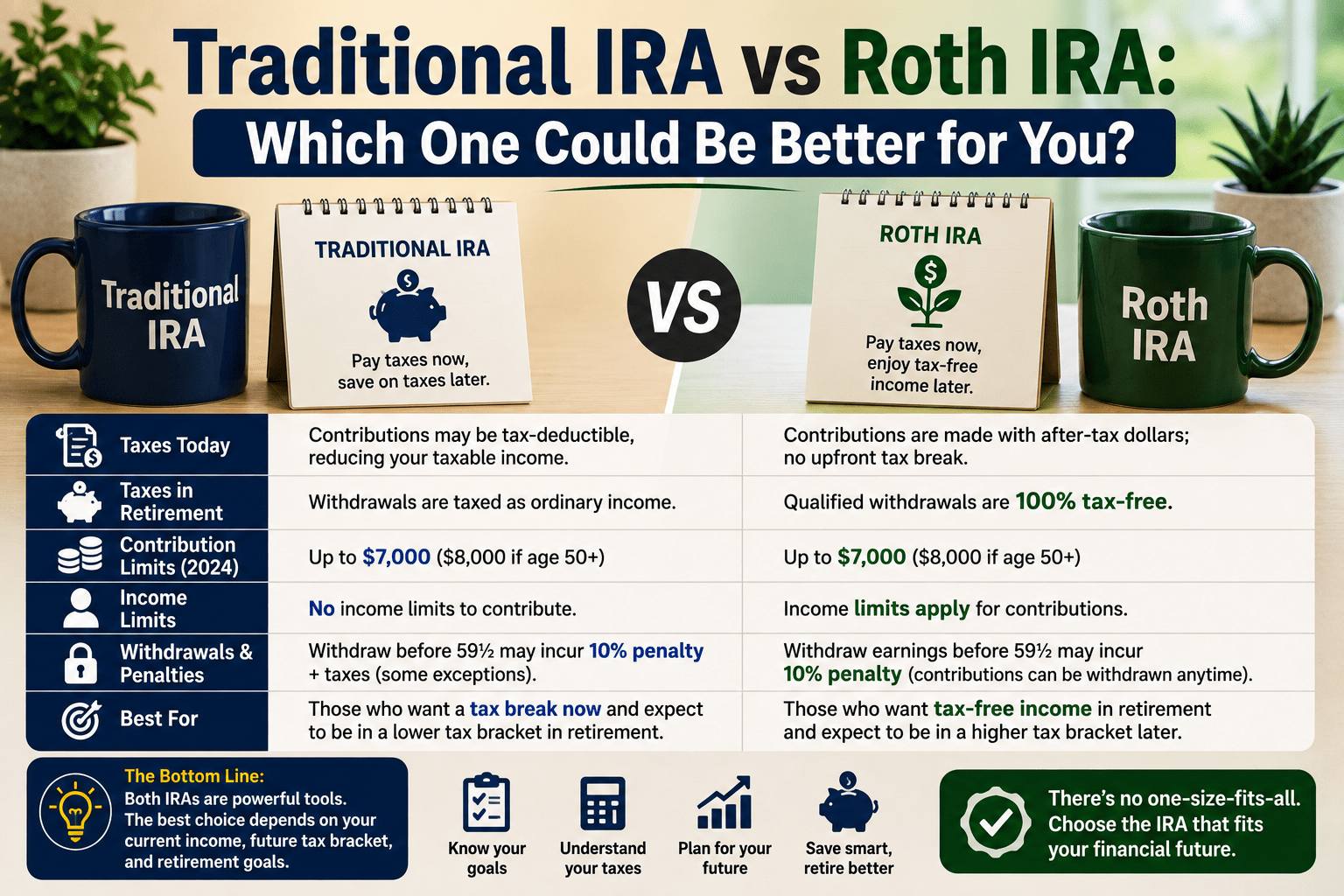
Traditional IRA vs Roth IRA: Which One Could Be Better for You?
Traditional IRA vs Roth IRA: Which One Could Be Better for You?
Traditional and Roth IRAs can both help you build long-term retirement assets, but they offer their tax advantages at different times. A Traditional IRA may provide a tax deduction today when eligibility rules allow, while a Roth IRA generally uses after-tax contributions in exchange for the potential for qualified tax-free withdrawals later.
The biggest difference between a Traditional IRA vs Roth IRA is when the primary tax benefit occurs. A Traditional IRA may allow deductible contributions depending on income, filing status and workplace retirement-plan coverage, while withdrawals of deductible contributions and earnings are generally taxable later.
Roth IRA contributions are not deductible, but qualified withdrawals can generally be tax-free. Roth IRAs also have income restrictions for direct contributions, while Traditional IRA contribution eligibility itself is not limited in the same way—although the tax deduction can phase out.
For 2026, the combined contribution limit across your Traditional and Roth IRAs is generally $7,500, or $8,600 if you are age 50 or older, subject to compensation and other IRS rules.
Table of Contents
Traditional IRA vs Roth IRA: Quick Comparison
| Feature | Traditional IRA | Roth IRA |
|---|---|---|
| 2026 combined IRA contribution limit | $7,500 total across Traditional + Roth IRAs | |
| 2026 age-50+ combined limit | $8,600 total | |
| Contributions deductible? | Potentially, subject to applicable rules | No |
| Contributions generally made with | May provide current-year deduction | After-tax money |
| Qualified retirement withdrawals | Generally taxable to the extent amounts were deductible/untaxed | Generally tax-free when requirements are met |
| Direct contribution income restriction? | No comparable contribution phase-out, but deduction may phase out | Yes |
| Required minimum distributions for original owner? | Generally yes | No during original owner's lifetime |
| Best for lower current tax rate? | Depends | Can be attractive |
| Best for higher current tax rate? | Potential deduction can be valuable | Depends on future taxes |
| Can hold both? | Yes, subject to combined contribution limits and eligibility rules | |
Traditional IRA: potentially receive part of the tax advantage now and generally pay tax later.
Roth IRA: generally pay tax now and potentially receive qualified retirement withdrawals tax-free later.
1 The Tax Benefit Happens at Different Times
Traditional IRA
A Traditional IRA may provide a tax deduction for contributions if you qualify.
Investment earnings generally grow tax-deferred while they remain inside the account.
Taxable distributions are generally included in income later.
Roth IRA
Roth IRA contributions do not provide an upfront tax deduction.
However, qualified Roth IRA distributions can generally be received tax-free.

2 Traditional IRA Contributions May Be Tax-Deductible
A Traditional IRA contribution may be fully deductible, partially deductible or nondeductible depending on your circumstances.
Factors Can Include
- Your modified adjusted gross income
- Your tax filing status
- Whether you participate in a workplace retirement plan
- Whether your spouse participates in a workplace plan
Why the Deduction Matters
Suppose you make a hypothetical deductible $7,500 contribution.
For illustration only, assume a 22% marginal federal tax rate applies.
$7,500 × 22% = $1,650
A fully deductible contribution could potentially reduce federal taxable income enough to correspond to approximately $1,650 of federal tax at that marginal rate.
Actual tax savings depend on your income, deduction eligibility, tax rate, filing status and other circumstances.
3 Roth IRA Direct Contributions Have Income Limits
Higher-income taxpayers can become partially or fully ineligible to contribute directly to a Roth IRA.
2026 Roth IRA Income Phase-Out Ranges
| Filing Status | 2026 Roth IRA Phase-Out Range |
|---|---|
| Single / Head of Household | $153,000–$168,000 |
| Married Filing Jointly | $242,000–$252,000 |
| Married Filing Separately under applicable rules | $0–$10,000 |
Within the applicable phase-out range, the maximum direct Roth contribution is reduced.
Above the applicable range, a direct Roth IRA contribution generally is not available.
The rules use modified adjusted gross income and contain filing-status details. Verify your eligibility before making a Roth IRA contribution.
4 Traditional IRA Deductions Can Also Phase Out
Traditional IRA contributions themselves are not subject to the same direct-contribution income restriction as Roth IRA contributions.
However, the deduction can phase out when you or your spouse is covered by a workplace retirement plan.
2026 — Single or Head of Household Covered at Work
$81,000–$91,000 phase-out range
2026 — Married Filing Jointly, Contributor Covered at Work
$129,000–$149,000 phase-out range
Contributor Not Covered, But Spouse Is Covered
$242,000–$252,000 phase-out range
Married Filing Separately Under Applicable Rules
$0–$10,000
“Can I contribute?” and “Can I deduct the contribution?” are two different Traditional IRA questions.
5 Traditional and Roth IRAs Share One Combined Contribution Limit
2026 IRA Limit
$7,500
Age 50 or Older
$8,600
That is generally the total you can contribute across your Traditional and Roth IRAs combined, subject to taxable compensation and other rules.
Example
You contribute:
$4,500 Traditional IRA
and:
$3,000 Roth IRA
Total
$7,500
You do not generally get a separate $7,500 limit for each type.
Contributing $7,500 to a Traditional IRA and another $7,500 to a Roth IRA could create an excess contribution if you do not qualify for additional contribution capacity under another provision.

6 Retirement Withdrawals Receive Different Tax Treatment
Traditional IRA
Traditional IRA distributions attributable to deductible contributions and investment earnings are generally taxed as ordinary income.
Nondeductible IRA contributions introduce additional basis rules.
Roth IRA
Qualified Roth IRA distributions can generally be received free of federal income tax.
Qualified treatment generally requires satisfying applicable requirements, including age and the Roth five-year rule.
Example
Imagine two accounts each distribute $40,000.
A fully taxable Traditional IRA distribution could increase taxable income by $40,000.
A qualified Roth IRA distribution could generally be received federally tax-free.
Qualification rules and the treatment of contributions, conversions and earnings can differ.
7 Traditional IRAs Have Lifetime Required Minimum Distributions; Roth IRAs Do Not for Original Owners
Traditional IRA
Traditional IRA owners generally must begin required minimum distributions under current rules when they reach the applicable RMD age.
For people subject to the current age-73 rule, distributions generally begin for the year they reach 73.
Roth IRA
The original owner of a Roth IRA is not required to take lifetime RMDs.
Beneficiaries can still be subject to distribution rules after the owner's death.
A Roth IRA may provide more flexibility for someone who does not need to withdraw the money during retirement and would prefer to leave assets invested.
8 Roth IRAs Can Offer More Flexibility for Original Contributions
Roth IRA contribution basis has different withdrawal treatment from Roth earnings.
Because Roth contributions were already made with after-tax money, returns of regular contributions generally receive different tax treatment from investment earnings.
That can provide additional flexibility compared with a Traditional IRA.
The ability to access part of an account does not mean withdrawing early is financially harmless. Money removed loses future tax-advantaged investment time.
9 The Better Account Can Depend on Your Current vs Future Tax Rate
Nobody knows exactly what tax rates will apply decades from now.
But comparing current and expected future tax situations can help frame the decision.
Traditional May Look More Attractive If
- You qualify for a valuable deduction today.
- Your current marginal tax rate is relatively high.
- You expect a materially lower taxable income in retirement.
Roth May Look More Attractive If
- Your current tax rate is relatively low.
- You expect income and tax rates to be higher later.
- You value qualified tax-free retirement withdrawals.
- You value avoiding lifetime RMDs from the Roth IRA as original owner.
10 Roth IRAs May Provide Different Estate-Planning Flexibility
Because original Roth IRA owners are not required to take lifetime RMDs, assets can potentially remain invested longer if the owner does not need withdrawals.
That can make a Roth IRA attractive in some estate-planning situations.
However, inherited IRA rules apply to beneficiaries and can require distributions.
Beneficiary type, relationship, account type and the owner's circumstances can materially affect distribution requirements. Professional tax or legal guidance may be useful for substantial estates.

Can You Have Both a Traditional IRA and Roth IRA?
Yes, potentially.
You can own both account types.
However, they share the same annual contribution limit.
2026 Example
| Account | Contribution |
|---|---|
| Traditional IRA | $2,500 |
| Roth IRA | $5,000 |
| Total | $7,500 |
Why Someone Might Use Both
A combination can create what is often called tax diversification.
You may have some retirement money that can potentially create taxable income and some that can potentially be withdrawn tax-free when Roth qualification requirements are satisfied.
Tax diversification does not guarantee lower lifetime taxes, but it can give retirees more options when deciding where future spending money should come from.
Which Could Be Better for You: Traditional IRA or Roth IRA?
Traditional IRA May Be Worth Considering If:
- You qualify for a meaningful current deduction.
- Your current tax rate is relatively high.
- You expect lower taxable income later.
- You want to reduce current taxable income where eligible.
Roth IRA May Be Worth Considering If:
- You currently have a relatively low tax rate.
- You expect higher earnings later.
- You value qualified tax-free retirement income.
- You value no lifetime RMD requirement as original owner.
You Might Consider Both If:
- You want different future tax buckets.
- You are uncertain about future tax rates.
- You qualify for Roth contributions.
- Your total contribution remains within the combined IRA limit.
The correct decision can depend on tax rates, income, workplace retirement coverage, retirement timing and future withdrawal needs.
Example 1: Younger Worker in a Lower Tax Bracket
Consider a hypothetical 27-year-old employee earning $45,000.
The employee expects income to increase substantially during their career.
A Roth IRA may deserve consideration because the worker currently pays tax at a relatively modest rate and could potentially benefit from qualified tax-free withdrawals later.
Key lesson: A lower current tax rate can make paying tax now relatively less expensive.
Example 2: High-Earning Worker Near Retirement
Consider a hypothetical 58-year-old employee currently in a relatively high tax bracket.
The worker expects taxable income to decline substantially after retirement.
If eligible for a deductible Traditional IRA contribution, the current deduction may be attractive.
Key lesson: A deduction can become more valuable when today's marginal tax rate is relatively high.
Example 3: Saver Who Wants Tax Diversification
A hypothetical worker contributes part of the annual IRA limit to a Traditional IRA and part to a Roth IRA.
The goal is not to predict tax rates perfectly.
Instead, the saver builds retirement assets with different future tax treatments.
Key lesson: Sometimes the decision does not have to be 100% Traditional or 100% Roth.
MoneyOnliners Original Analysis: The 6-Question Traditional vs Roth Decision Test
| Question | Traditional IRA May Gain Appeal When | Roth IRA May Gain Appeal When |
|---|---|---|
| What is your current tax rate? | Relatively high | Relatively low |
| What might your future tax rate be? | Potentially lower | Potentially higher |
| Can you deduct a Traditional contribution? | Yes | Deduction unavailable or less valuable |
| Are you eligible for direct Roth contributions? | Not central | Yes |
| Do you want no lifetime RMDs as original owner? | Less attractive | Roth advantage |
| Do you want tax diversification? | Using both may be worth evaluating | |
Traditional IRA vs Roth IRA is not fundamentally about which account earns more. If both hold identical investments, the investment performance can be identical before taxes. The major difference is the timing and structure of taxation.
MoneyOnliners Traditional vs Roth Scorecard
| Category | Traditional IRA | Roth IRA |
|---|---|---|
| Potential current-year deduction | Advantage | No deduction |
| Qualified tax-free retirement withdrawals | No | Advantage |
| Direct-contribution income restriction | No comparable Roth restriction | Income phase-outs apply |
| Deduction income restrictions | Can apply | Not applicable because contribution is not deductible |
| Lifetime RMDs for original owner | Generally yes | No |
| Contribution limit | Shared | Shared |
| Investment choices | Provider dependent | Provider dependent |
| Universal winner? | No — tax circumstances determine much of the decision. | |
This scorecard is an original MoneyOnliners educational framework rather than personalized tax or investment advice.
MoneyOnliners Research-Based Evidence Note
This article is a research-based retirement-account comparison.
MoneyOnliners is not claiming personal first-hand experience with every Traditional IRA provider, Roth IRA provider, tax situation or retirement-distribution scenario described.
The 2026 contribution limits, Roth income phase-outs, Traditional IRA deduction phase-outs and required-distribution principles are based primarily on official IRS retirement guidance.
Actual tax consequences depend on filing status, income, workplace retirement coverage, account basis and other individual circumstances.
MoneyOnliners does not fabricate tax savings, investment performance, retirement outcomes or testimonials.
The 6-Question Decision Test and Traditional-vs-Roth Scorecard are original MoneyOnliners frameworks created to make the comparison more useful and citeable.
Commercial Evaluation: Choosing an IRA Provider
Traditional and Roth are tax structures.
You still need to decide where to hold the IRA.
MoneyOnliners Suggests Comparing:
| Factor | What to Check |
|---|---|
| Account fee | Annual maintenance or custodial fees |
| Investment fees | Expense ratios and trading costs |
| Investment selection | ETFs, mutual funds, stocks, bonds and other permitted choices |
| Automatic investing | Whether recurring contributions are easy to configure |
| Minimum investments | Whether your preferred funds require minimum balances |
| Customer support | Phone, online and retirement-account support |
| Educational resources | Calculators, retirement tools and guidance |
| Security | Account protection practices and authentication options |
MoneyOnliners is not recommending a specific IRA provider in this article and is not claiming first-hand testing of every brokerage or financial institution. Any future provider review should clearly state whether the platform was personally tested or assessed through research.
10 Traditional IRA and Roth IRA Mistakes to Avoid
1. Assuming Roth Is Automatically Better
Tax-free qualified withdrawals are attractive, but current tax cost matters too.
2. Assuming Traditional Is Automatically Better Because of the Deduction
You may not qualify for the deduction, or a future tax strategy may make Roth more attractive.
3. Contributing Too Much Across Both Accounts
Traditional and Roth IRAs share one annual IRA contribution limit.
4. Ignoring Roth Income Limits
Direct Roth contribution eligibility can phase out.
5. Assuming Every Traditional Contribution Is Deductible
Income and workplace-plan coverage can restrict the deduction.
6. Ignoring RMD Differences
Traditional and Roth IRAs have different lifetime distribution requirements for original owners.
7. Withdrawing Retirement Money Casually
Early withdrawals can reduce future compounding and potentially create tax consequences.
8. Forgetting Beneficiary Designations
Retirement accounts should be reviewed as family and estate circumstances change.
9. Choosing Expensive Investments
The tax wrapper does not eliminate fund or advisory fees.
10. Believing the IRA Itself Creates Investment Returns
Investment performance depends on the assets held inside the IRA.
A Roth IRA does not guarantee tax-free profits from every transaction, and a Traditional IRA does not guarantee investment gains. Both are retirement-account structures; the investments held inside can lose money.
Incoming Link Opportunities
401(k) vs IRA: 12 Differences Retirement Savers Should Know
https://moneyonliners.com/401k-vs-ira/
Starting Retirement Savings Late? 10 Moves That Can Help You Catch Up
https://moneyonliners.com/starting-retirement-savings-late/
How Much Should You Save for Retirement at 30, 40, 50 and 60?
https://moneyonliners.com/how-much-should-you-save-for-retirement-by-age/
Retirement Planning: 15 Things to Start Doing Before You Retire
https://moneyonliners.com/retirement-planning-before-you-retire/
How Much Money Do You Really Need to Retire Comfortably?
https://moneyonliners.com/how-much-money-to-retire-comfortably/
Why Traditional IRA vs Roth IRA Matters
1. The choice affects when your primary federal tax advantage occurs.
2. A Traditional IRA deduction can reduce current taxable income when you qualify.
3. Roth contributions do not provide an upfront deduction.
4. Qualified Roth distributions can generally be federally tax-free.
5. Traditional IRA taxable distributions can increase retirement taxable income.
6. Roth IRA direct contributions have income restrictions.
7. Traditional IRA deductions can phase out based on income and workplace coverage.
8. Both accounts share the same annual IRA contribution limit.
9. Roth IRAs do not require lifetime RMDs from original owners.
10. Traditional IRAs generally do require RMDs under current rules.
11. Current tax rate can influence which account appears more attractive.
12. Expected future tax rate can also influence the decision.
13. Tax-rate predictions are uncertain.
14. Using both accounts can potentially create greater tax diversification.
15. IRA provider fees can affect long-term results.
16. Investment selection matters regardless of IRA type.
17. Early withdrawals can reduce future retirement assets.
18. Beneficiary and estate considerations can matter later in life.
19. Neither account is universally better for every saver.
20. Ultimately, understanding Traditional IRA vs Roth IRA helps you choose when you would prefer to receive the account's primary tax advantage and how that choice fits your broader retirement plan.
Continue Learning on MoneyOnliners
Recommended External Resources
1. IRS — Traditional and Roth IRAs
Traditional and Roth IRAs — Internal Revenue Service
Official IRS comparison covering contribution, withdrawal and required-distribution differences between Traditional and Roth IRAs.
2. IRS — 2026 Retirement Contribution Limits
2026 IRA and Retirement Contribution Limits — IRS
Official source for the 2026 $7,500 IRA contribution limit, $1,100 catch-up contribution and current income phase-out ranges.
3. IRS — IRA Contribution Limits
Explains the combined Traditional and Roth IRA contribution limit and compensation requirements.
4. IRS — Traditional IRAs
Official introduction to Traditional IRA tax advantages, deductions, distributions and related resources.
5. IRS — Topic No. 451: Individual Retirement Arrangements
Topic No. 451 — Individual Retirement Arrangements
Useful IRS overview covering Traditional and Roth IRA contributions, withdrawals and required minimum distributions.
6. IRS Publication 590-A — Contributions to IRAs
Publication 590-A — Contributions to Individual Retirement Arrangements
Detailed IRS guidance for IRA contributions, deductions, Roth eligibility, conversions and related contribution rules.
7. IRS Publication 590-B — Distributions From IRAs
Publication 590-B — Distributions From Individual Retirement Arrangements
Detailed guidance covering IRA withdrawals, taxation, qualified Roth distributions and required minimum distributions.
8. IRS — Required Minimum Distribution FAQs
Required Minimum Distribution FAQs — IRS
Official information explaining current RMD rules for Traditional IRAs and other retirement plans.
9. Investor.gov — Retirement
Investor education from the U.S. Securities and Exchange Commission covering retirement saving and investment fundamentals.
10. Investor.gov — Asset Allocation and Diversification
Asset Allocation and Diversification — Investor.gov
Explains how investment timeframe, risk tolerance and diversification can affect the portfolio held inside an IRA.
MoneyOnliners prioritizes IRS and U.S. regulatory resources for IRA contribution, tax and withdrawal rules because these rules can change. Always verify the rules applicable to the tax year in which you are making a contribution, conversion or withdrawal.
Frequently Asked Questions
Is a Roth IRA better than a Traditional IRA?
Not universally.
A Roth IRA can be attractive when your current tax rate is relatively low.
A Traditional IRA can be attractive when you qualify for a valuable current deduction.
Your future tax situation matters too.
Neither option is automatically better.
What is the main difference between a Traditional IRA and Roth IRA?
The primary difference is tax timing.
Traditional IRA contributions may provide an upfront deduction.
Taxable Traditional IRA withdrawals are generally taxed later.
Roth contributions are not deductible.
Qualified Roth withdrawals can generally be tax-free.
What is the 2026 IRA contribution limit?
The general 2026 IRA contribution limit is $7,500.
Eligible people age 50 or older can contribute an additional $1,100.
That creates a general $8,600 age-50+ limit.
The limit is shared across Traditional and Roth IRAs.
Taxable compensation and other rules also apply.
Can I contribute $7,500 to both a Traditional and Roth IRA?
Generally, no.
The $7,500 limit applies across the IRAs combined.
You can split the limit between them.
For example, $3,500 Traditional and $4,000 Roth equals $7,500.
Age-50+ savers can have a higher combined limit.
Can high-income earners contribute to a Traditional IRA?
Income does not create the same contribution restriction that applies to direct Roth contributions.
However, the Traditional IRA deduction may be limited or unavailable.
Workplace retirement coverage matters.
Filing status matters.
Verify the current IRS deduction rules.
Can high-income earners contribute directly to a Roth IRA?
Direct Roth IRA contributions have income phase-outs.
For 2026, the single/head-of-household phase-out is $153,000 to $168,000.
The married-filing-jointly range is $242,000 to $252,000.
Different rules apply to some married filing separately taxpayers.
Always calculate eligibility using the applicable modified AGI rules.
Do Traditional IRAs have required minimum distributions?
Yes, generally.
Current rules generally require Traditional IRA owners to begin RMDs at the applicable required age.
The current general age is 73 for many account owners.
Distribution requirements can change.
Check current IRS guidance.
Do Roth IRAs have required minimum distributions?
The original Roth IRA owner does not generally have lifetime RMDs.
That provides additional flexibility.
Inherited Roth IRAs can still be subject to beneficiary distribution rules.
Estate circumstances matter.
Review beneficiary rules separately.
Are Roth IRA withdrawals tax-free?
Qualified distributions generally are.
Qualification requirements apply.
The five-year rule can matter.
Age can matter.
Nonqualified distributions can receive different tax treatment.
Are Traditional IRA withdrawals taxable?
Deductible contributions and earnings are generally taxable when distributed.
Nondeductible contributions create basis.
That can make taxation more complicated.
Early withdrawals may also trigger additional tax unless an exception applies.
Keep accurate contribution records.
Which IRA is better if I am young?
A Roth IRA may deserve consideration when a young worker currently has a relatively low tax rate.
But age alone does not determine the answer.
Current income matters.
Future tax expectations matter.
Traditional deduction eligibility matters too.
Which IRA is better if I am near retirement?
It depends on your current tax situation and retirement-income expectations.
A current Traditional deduction may be valuable at a high tax rate.
Roth assets may provide valuable future tax flexibility.
RMD considerations can matter.
A mix may also be worth evaluating.
Can I convert a Traditional IRA to a Roth IRA?
Potentially.
A Roth conversion can create current taxable income.
Conversion rules differ from ordinary annual Roth contributions.
The tax consequences can be significant.
Consider current IRS guidance or professional tax assistance before making a large conversion.
Does a Roth IRA grow faster than a Traditional IRA?
Not because it is a Roth.
If both accounts hold identical investments with identical fees, their pre-tax investment performance can be the same.
The major difference is tax treatment.
Investment selection affects growth.
The account label itself does not create higher returns.
Can I lose money in a Roth IRA?
Yes.
A Roth IRA is an account structure.
The investments inside it can decline.
The same is true of a Traditional IRA.
Tax advantages do not eliminate market risk.
Research Methodology
This MoneyOnliners guide compares Traditional IRA vs Roth IRA primarily through tax timing, contribution eligibility, deductibility, withdrawal taxation, required minimum distributions and retirement flexibility.
Current 2026 contribution limits and income phase-outs are based on official Internal Revenue Service retirement guidance.
Traditional IRA contribution eligibility is distinguished from deduction eligibility because these are separate questions under U.S. tax rules.
Roth IRA income limitations are included because they can reduce or eliminate direct-contribution eligibility for higher-income taxpayers.
Withdrawal taxation is treated separately because Traditional IRA distributions and qualified Roth distributions generally receive different federal tax treatment.
Required minimum distributions are included because original Traditional IRA owners and original Roth IRA owners are treated differently under current rules.
Tax-rate comparisons are presented as planning considerations rather than predictions because future tax laws and personal income are uncertain.
Provider fees and investment selection are included because Traditional and Roth IRA tax treatment does not eliminate investment costs or market risk.
The MoneyOnliners 6-Question Traditional-vs-Roth Decision Test and comparison scorecard are original editorial resources designed to make the topic more understandable and citeable.
Hypothetical tax calculations and household examples are educational illustrations.
MoneyOnliners does not claim individualized knowledge of a reader's tax situation.
No tax saving, investment return or retirement outcome is guaranteed.
Google Search Console Checklist
- Confirm final URL: /traditional-ira-vs-roth-ira/
- Confirm the canonical matches the published URL.
- Use Traditional IRA vs Roth IRA naturally in the title, introduction, headings and conclusion.
- Use related terms naturally: Roth IRA vs Traditional IRA, IRA contribution limit, Roth IRA income limits and Traditional IRA deduction.
- Add descriptive alt text to every image.
- Keep the 2026 limits clearly labeled by year.
- Confirm the Recommended External Resources contains 6–10 authoritative links.
- Confirm all internal links point to live canonical URLs.
- Confirm the article is indexable.
- Confirm the URL appears in the XML sitemap.
- Check comparison tables on mobile.
- Inspect the published URL in Google Search Console.
- Request indexing after publication if appropriate.
- Monitor searches such as “Traditional IRA vs Roth IRA,” “Roth vs Traditional IRA,” “which IRA is better,” “Roth IRA income limits,” and “Traditional IRA tax deduction.”
Conclusion: Traditional IRA vs Roth IRA Is Mostly About Tax Timing
The Traditional IRA vs Roth IRA decision can seem complicated.
The central idea is actually straightforward.
Traditional IRA
You may receive a tax deduction today if you qualify.
Taxable withdrawals generally create income later.
Roth IRA
You generally pay the tax today.
Qualified retirement withdrawals can potentially be tax-free.
But Tax Timing Is Not the Only Difference
Roth income limits matter.
Traditional deduction rules matter.
Required minimum distributions matter.
Future tax rates matter.
Your retirement income needs matter.
Your current income matters.
And your investment choices still matter.
You May Not Need to Pick Only One Forever
Some retirement savers use both account types over the course of their careers.
Your best choice at age 25 may not be the same choice at 55.
Income changes.
Tax brackets change.
Retirement goals change.
Tax laws can change too.
Similar Posts
Can You Retire With $1 Million? Here’s What the Numbers Could Look Like
Can You Retire With $1 Million? Here’s What the Numbers Could Look Like | MoneyOnliners MoneyOnliners • Retirement → $1 Million Retirement Can You Retire With $1 Million? Here’s What the Numbers Could Look Like One million dollars sounds like an enormous retirement portfolio—and for some households it could support a comfortable retirement. For others,…
How Much Should You Save for Retirement at 30, 40, 50 and 60?
How Much Should You Save for Retirement at 30, 40, 50 and 60? | MoneyOnliners MoneyOnliners • Retirement → Savings by Age How Much Should You Save for Retirement at 30, 40, 50 and 60? Age-based retirement benchmarks can help you check your progress, but they should never become rigid pass-or-fail rules. Your income, lifestyle,…
Retirement vs Financial Independence: Why They’re Not Exactly the Same
Retirement vs Financial Independence: Why They’re Not Exactly the Same | MoneyOnliners MoneyOnliners • Retirement → Financial Independence Retirement vs Financial Independence: Why They’re Not Exactly the Same Retirement and financial independence are often treated as interchangeable goals, but they describe different things. Retirement usually means leaving or substantially reducing paid employment. Financial independence means…
Starting Retirement Savings Late? 10 Moves That Can Help You Catch Up
Starting Retirement Savings Late? 10 Moves That Can Help You Catch Up | MoneyOnliners MoneyOnliners • Retirement → Catch-Up Planning Starting Retirement Savings Late? 10 Moves That Can Help You Catch Up Starting retirement savings later than planned can feel discouraging, but being behind does not mean your financial future is already decided. A stronger…
15 Retirement Expenses People Forget to Plan For
15 Retirement Expenses People Forget to Plan For | MoneyOnliners MoneyOnliners • Retirement → Retirement Expenses 15 Retirement Expenses People Forget to Plan For A retirement budget can look comfortable until the expenses that do not arrive every month begin appearing. Roof repairs, dental work, replacing a vehicle, helping adult children, insurance increases, taxes, travel,…
10 Retirement Planning Mistakes That Could Cost You Years of Savings
10 Retirement Planning Mistakes That Could Cost You Years of Savings | MoneyOnliners MoneyOnliners • Retirement → Avoid Costly Mistakes 10 Retirement Planning Mistakes That Could Cost You Years of Savings Retirement plans are rarely damaged by one imperfect decision alone. More often, years of small mistakes—saving too little, paying unnecessary fees, carrying expensive debt,…






One Comment