401(k) vs IRA: 12 Differences Retirement Savers Should Know
401(k) vs IRA: 12 Differences Retirement Savers Should Know
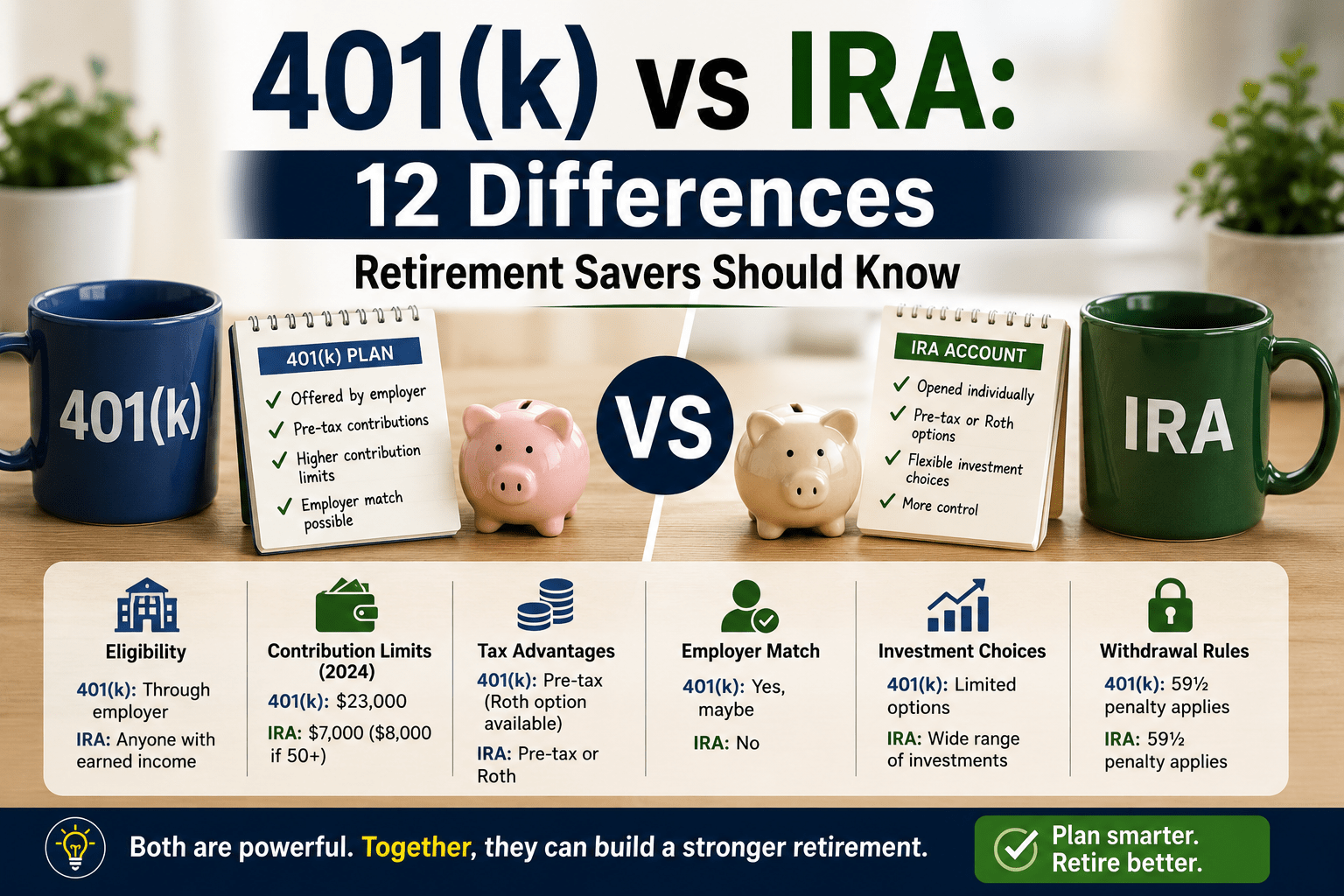
A 401(k) and an IRA can both help you build retirement assets, but they are not interchangeable. One is usually connected to your workplace, while the other is generally opened individually. Contribution limits, employer matching, investment choice, fees, income restrictions and withdrawal rules can differ considerably.
For many U.S. retirement savers, the choice between a 401(k) vs IRA is not necessarily either-or. A 401(k) generally allows substantially larger annual contributions and may include employer matching. An IRA often gives you more control over where the account is held and what investments are available.
For 2026, the employee contribution limit for most 401(k) plans is $24,500, while the combined annual contribution limit across traditional and Roth IRAs is generally $7,500. Savers who qualify may be able to contribute to both account types in the same year, subject to the relevant IRS rules.
Table of Contents
401(k) vs IRA: Quick Comparison
| Feature | 401(k) | IRA |
|---|---|---|
| Who establishes it? | Usually an employer | Usually the individual |
| 2026 basic contribution limit | $24,500 employee deferral | $7,500 total IRA contribution limit |
| 2026 general age-50+ catch-up | $8,000 where permitted | $1,100 |
| Employer match possible? | Yes | No traditional employer match |
| Investment menu | Usually selected by plan | Often much broader |
| Traditional option | Often available | Yes |
| Roth option | Available in many plans | Roth IRA available subject to rules |
| Income limits for direct Roth contribution? | Generally not the same Roth IRA income restriction | Yes |
| Possible loans? | Some plans allow them | No IRA loans |
| Control over provider | Usually limited while employed | You generally choose provider |
| Can you have both? | Yes, potentially | |
A 401(k) is often strongest for contribution capacity and employer benefits. An IRA is often strongest for individual control and investment flexibility.
1 A 401(k) Is Usually Employer-Sponsored; an IRA Is Individual
401(k)
A 401(k) is generally offered through an employer.
The employer chooses the plan provider and determines many features available to employees.
IRA
IRA stands for Individual Retirement Arrangement.
You generally open the account yourself through a financial institution or brokerage.

2 401(k)s Have Much Higher Contribution Limits
This is one of the biggest differences.
2026 401(k) Employee Limit
$24,500
2026 IRA Limit
$7,500
General Age-50+ Catch-Up Amounts for 2026
| Account | Basic Limit | General Catch-Up | Typical Maximum With General Catch-Up |
|---|---|---|---|
| 401(k) | $24,500 | $8,000 | $32,500 |
| IRA | $7,500 | $1,100 | $8,600 |
For eligible 401(k) participants ages 60, 61, 62 and 63, the 2026 higher catch-up amount can be $11,250 rather than the general $8,000 catch-up.
Limits can change from year to year. Always verify the applicable tax year's IRS limits before making contributions.
3 A 401(k) May Include Employer Matching
Employer matching is one of the strongest potential advantages of a workplace retirement plan.
Simple Illustration
Suppose you contribute:
$6,000
Your employer adds:
$3,000
Total Added to Retirement
$9,000
An ordinary IRA does not provide an employer match in the same way.
Employer contribution formulas and vesting requirements vary considerably. Review your specific workplace plan before assuming how much your employer will contribute.
4 IRAs Often Offer More Investment Choices
401(k)
A workplace plan typically offers a selected menu of investments.
That might include:
- Target-date funds
- Stock funds
- Bond funds
- Index funds
- Stable-value or cash-like options
IRA
A brokerage IRA may offer access to a much broader range of investments.
- ETFs
- Mutual funds
- Individual stocks
- Bonds
- Other investments permitted by the provider and applicable rules
An extremely broad investment menu can be useful for experienced investors but can also encourage unnecessary complexity or speculation.

5 Fees Can Be Very Different
Neither account type is automatically cheaper.
401(k) Costs May Include
- Fund expense ratios
- Administrative expenses
- Recordkeeping costs
- Advisory fees where applicable
IRA Costs May Include
- Fund expense ratios
- Trading costs where applicable
- Advisory fees
- Account fees depending on provider
Why Small Fee Differences Matter
Fees reduce the amount of investment return you keep.
Over decades, recurring differences can become meaningful.
Compare the actual investments and account costs available to you rather than assuming every IRA is cheap or every 401(k) is expensive.
6 Traditional 401(k)s and Traditional IRAs Have Different Deduction Rules
Traditional 401(k) employee contributions are generally made through payroll under the plan's tax treatment.
Traditional IRA contributions may be deductible, but the deduction can be reduced or eliminated depending on income, filing status and workplace retirement-plan coverage.
For 2026
For a single taxpayer covered by a workplace retirement plan, the traditional IRA deduction phase-out begins at $81,000 and ends at $91,000 of the applicable income measure under IRS rules.
Different ranges apply to married taxpayers.
Being allowed to contribute to a traditional IRA does not automatically mean the entire contribution is deductible.
7 Both Can Offer Roth-Style Retirement Saving
Roth 401(k)
Many workplace plans offer a Roth 401(k) option.
Roth IRA
Individuals can potentially contribute to a Roth IRA if they meet the relevant eligibility requirements.
General Roth Principle
Roth contributions are generally made with money that has already been taxed.
Qualified withdrawals can potentially be tax-free when the applicable requirements are satisfied.
Current tax rate, expected future tax rate, eligibility, withdrawal rules and broader retirement planning should all be considered.
8 Roth IRA Contributions Have Income Restrictions
Direct Roth IRA eligibility can be limited at higher incomes.
2026 Roth IRA Phase-Out Range
| Tax Filing Status | 2026 Income Phase-Out Range |
|---|---|
| Single / Head of Household | $153,000–$168,000 |
| Married Filing Jointly | $242,000–$252,000 |
| Married Filing Separately under applicable rules | $0–$10,000 |
Roth 401(k) salary deferrals are not subject to the same direct Roth IRA contribution income phase-out.
For some higher-income workers, a workplace Roth option may remain available even when a direct Roth IRA contribution is limited.
9 Withdrawal Rules Differ
Retirement accounts receive tax advantages partly because they are intended for retirement.
Taking money out early can create taxes, penalties or both depending on the account, transaction and exception involved.
Traditional Accounts
Traditional account withdrawals are generally taxable when distributed, subject to applicable rules.
Roth Accounts
Roth withdrawal treatment depends on whether the distribution is qualified and on the type of Roth account involved.
Understand withdrawal rules before moving money because taxes and penalties can materially reduce what you receive.
10 Some 401(k)s Allow Loans; IRAs Do Not
Some 401(k) plans permit participants to borrow against their account under plan rules.
IRAs do not provide an equivalent IRA loan feature.
Why a 401(k) Loan Can Be Risky
- Money leaves the invested account temporarily.
- Loan rules must be followed.
- Employment changes may complicate repayment.
- Failure to comply can create tax consequences.
The fact that a 401(k) loan may be available does not automatically make borrowing from retirement a good financial decision.
11 IRAs Can Provide More Portability and Provider Control
Your IRA normally remains with the financial institution you selected regardless of whether you change employers.
A former employer's 401(k) may potentially be:
- Left in the old plan where permitted
- Rolled into an eligible new employer plan where permitted
- Rolled into an IRA
- Handled another permitted way under applicable rules
Rollovers require care because incorrect handling can create tax consequences.
A direct trustee-to-trustee or plan-to-plan transfer can often reduce the administrative risks associated with personally receiving rollover money.
12 A 401(k) Can Be Easier to Automate; an IRA Gives You More Control
401(k) Convenience
Contributions can usually be deducted directly through payroll.
That makes retirement saving automatic.
IRA Control
You choose the provider.
You generally choose from a broader investment universe.
You also decide how and when to fund the account within applicable contribution rules.

Can You Contribute to Both a 401(k) and an IRA?
Potentially, yes.
Having access to a workplace 401(k) does not automatically prevent you from contributing to an IRA.
However, workplace-plan coverage can affect whether a traditional IRA contribution is deductible, and income can affect eligibility for direct Roth IRA contributions.
2026 Illustration
Someone younger than 50 who qualifies could potentially contribute:
$24,500 to a 401(k)
and:
$7,500 to an IRA
Combined Employee/IRA Contributions
$32,000
That is before considering employer contributions to the 401(k).
The 401(k) and IRA limits operate under separate sets of rules. IRA limits also generally apply across your traditional and Roth IRAs combined rather than giving you a separate full limit for each.
401(k) or IRA First? A Practical Decision Framework
There is no universal funding order, but this framework can help organize the decision.
Consider the 401(k) First When
- Your employer offers a valuable match.
- The investment menu is reasonable.
- Plan fees are competitive.
- You want higher contribution capacity.
- Automatic payroll saving helps you stay consistent.
Consider an IRA Alongside the 401(k) When
- You want additional retirement saving.
- You want broader investment choices.
- You prefer greater control over the provider.
- Your workplace plan has limited or expensive investment choices.
- You qualify for the tax treatment you want.
A Common Conceptual Order
| Stage | Possible Priority | Reason |
|---|---|---|
| 1 | Build emergency savings | Avoid using retirement accounts for every financial shock |
| 2 | Consider enough 401(k) contribution to capture valuable employer match | Employer contribution may materially increase saving |
| 3 | Address very high-interest debt | High interest can compete with investment progress |
| 4 | Evaluate IRA | Broader investment choice and control |
| 5 | Increase workplace contributions further | Much higher contribution capacity |
The optimal order depends on interest rates, taxes, income, employer benefits, account fees and your financial circumstances.
MoneyOnliners Original Analysis: The 5-Question 401(k) vs IRA Decision Test
| Question | If Yes | Why It Matters |
|---|---|---|
| Does your employer provide a valuable match? | 401(k) deserves strong attention | Employer contributions can increase total savings |
| Do you need to save more than the IRA limit? | 401(k) becomes more important | 2026 employee limit is substantially higher |
| Does your workplace plan have weak or costly investment choices? | IRA may become more attractive for additional savings | IRA often provides more investment choice |
| Do you want maximum provider control? | IRA has an advantage | You generally choose the institution |
| Can you fund both without weakening emergency savings or carrying expensive debt? | Using both may be worth evaluating | The accounts can complement each other |
The strongest retirement strategy may not be “401(k) versus IRA.” It may be using each account for the job it does best.
MoneyOnliners 401(k) vs IRA Scorecard
| Category | 401(k) | IRA |
|---|---|---|
| Contribution capacity | Winner | Lower |
| Employer matching | Winner | Not generally available |
| Investment choice | Plan dependent | Usually stronger |
| Provider control | Limited | Winner |
| Payroll automation | Winner | Can still automate separately |
| Portability | More decisions after job changes | Generally simpler |
| Possible employer contribution | Winner | No ordinary match |
| Best overall? | Depends on your plan—and many savers can potentially use both. | |
This scorecard is an original MoneyOnliners educational framework rather than individualized investment advice.
MoneyOnliners Research-Based Evidence Note
This article is a research-based retirement account comparison.
MoneyOnliners is not claiming personal first-hand use of every 401(k) plan, IRA provider or investment option discussed.
2026 contribution limits and income-related thresholds are based on current IRS retirement guidance.
Individual workplace plans can have additional rules, investment menus, fees and features that differ from the general comparison in this guide.
MoneyOnliners does not fabricate investment performance, account experiences, tax outcomes or retirement results.
The 5-Question Decision Test and 401(k) vs IRA Scorecard are original MoneyOnliners analytical resources intended to make the comparison more practical and citeable.
Example: A Worker Using Both a 401(k) and IRA
Consider a hypothetical 40-year-old employee.
Annual 401(k) Contribution
$15,000
Employer Contribution
$4,000
IRA Contribution
$7,500
Total Annual Retirement Contributions
$15,000 + $4,000 + $7,500 = $26,500
The employee uses the 401(k) for payroll automation and employer benefits.
The IRA provides additional retirement capacity and a broader investment menu.
Key lesson: The two accounts can complement rather than replace each other.
12 401(k) vs IRA Differences at a Glance
| # | Difference | 401(k) | IRA |
|---|---|---|---|
| 1 | Account sponsor | Employer | Individual |
| 2 | Contribution limit | Much higher | Lower |
| 3 | Employer match | Possible | No ordinary match |
| 4 | Investment menu | Plan-selected | Usually broader |
| 5 | Fees | Plan dependent | Provider dependent |
| 6 | Traditional tax rules | Payroll plan rules | Deductibility may depend on income/coverage |
| 7 | Roth option | Many plans offer one | Roth IRA available if eligible |
| 8 | Income restriction | Different treatment | Roth IRA direct contributions can phase out |
| 9 | Withdrawals | Plan/account rules | IRA rules |
| 10 | Loans | Some plans permit | Not permitted as IRA loans |
| 11 | Portability | Requires choices after employer change | Generally independent of employment |
| 12 | Control | Less provider control | More provider control |
Common 401(k) and IRA Mistakes to Avoid
1. Missing a Valuable Employer Match
Understand your workplace contribution formula.
2. Assuming an IRA Is Always Better Because It Has More Investments
More investment choices do not automatically produce better results.
3. Ignoring Fees
Compare the actual costs inside both accounts.
4. Assuming Every Traditional IRA Contribution Is Deductible
Income and workplace-plan coverage can affect deductibility.
5. Assuming Everyone Can Contribute Directly to a Roth IRA
Income restrictions can apply.
6. Treating a 401(k) Loan Like Free Money
Borrowing from retirement can carry significant financial tradeoffs.
7. Cashing Out After Changing Jobs
Taxes and penalties may materially reduce retirement savings.
8. Forgetting Beneficiary Designations
Keep account information current.
9. Investing Too Aggressively
Tax advantages do not remove investment risk.
10. Investing Too Conservatively for a Long Time Horizon
Inflation and insufficient growth can also create retirement risk.
Neither a 401(k) nor an IRA guarantees investment gains. The account is a tax-advantaged structure; the investments inside it can still rise or fall in value.
Incoming Link Opportunities
Starting Retirement Savings Late? 10 Moves That Can Help You Catch Up
https://moneyonliners.com/starting-retirement-savings-late/
How Much Should You Save for Retirement at 30, 40, 50 and 60?
https://moneyonliners.com/how-much-should-you-save-for-retirement-by-age/
How Much Money Do You Really Need to Retire Comfortably?
https://moneyonliners.com/how-much-money-to-retire-comfortably/
Retirement Planning: 15 Things to Start Doing Before You Retire
https://moneyonliners.com/retirement-planning-before-you-retire/
Why Understanding 401(k) vs IRA Matters
1. The accounts have very different annual contribution capacities.
2. Employer matching can make a workplace plan especially valuable.
3. IRA investment menus can provide greater flexibility.
4. Account fees can affect long-term returns.
5. Traditional IRA deductibility can depend on income and workplace coverage.
6. Roth IRA contribution eligibility can be limited at higher incomes.
7. Roth 401(k) rules differ from Roth IRA rules.
8. Withdrawal rules can affect access to retirement savings.
9. Some 401(k) plans permit loans while IRAs do not.
10. IRAs are generally independent of your employer.
11. 401(k)s can make automatic retirement saving very easy.
12. IRAs generally provide greater provider control.
13. Contribution limits change periodically.
14. Savers may potentially use both accounts.
15. Employer-plan quality differs significantly.
16. IRA provider quality also varies.
17. Tax treatment should be evaluated rather than assumed.
18. Investment selection matters even inside tax-advantaged accounts.
19. Retirement-account decisions should fit within your broader emergency savings, debt and retirement plan.
20. Ultimately, understanding 401(k) vs IRA helps retirement savers use each account more intentionally instead of assuming they are interchangeable.
Continue Learning on MoneyOnliners
Recommended External Resources
IRS — 2026 Retirement Contribution Limits
401(k) and IRA Contribution Limits for 2026 — IRS
IRS — 401(k) Contribution Rules
401(k) and Profit-Sharing Plan Contribution Limits — IRS
IRS — Retirement Plan Rollovers
Rollovers of Retirement Plan and IRA Distributions — IRS
Investor.gov — Retirement
This guide provides general educational information about U.S. retirement accounts and is not individualized tax, investment, legal or retirement advice. IRS contribution limits, income phase-outs and retirement rules can change. Employer plans may impose additional restrictions. Verify current IRS guidance and your specific plan documents before making financial decisions.
Frequently Asked Questions
Is a 401(k) better than an IRA?
Not universally.
A strong 401(k) may provide employer matching and higher contribution limits.
An IRA may provide more investment choices.
Fees can differ.
Many retirement savers can potentially benefit from using both.
Can I have a 401(k) and an IRA at the same time?
Yes, potentially.
Having a workplace 401(k) does not automatically prevent IRA contributions.
However, traditional IRA deductibility may be affected.
Roth IRA eligibility may also be affected by income.
Check the applicable IRS rules.
What is the 401(k) contribution limit for 2026?
The basic employee elective-deferral limit for most 401(k)s is $24,500 for 2026.
Eligible participants age 50 and older may have additional catch-up contribution capacity.
The general 2026 catch-up is $8,000.
A higher amount can apply to eligible participants ages 60 through 63.
Plan rules also matter.
What is the IRA contribution limit for 2026?
The general IRA contribution limit for 2026 is $7,500.
The age-50+ catch-up amount is $1,100.
The IRA limit applies across traditional and Roth IRA contributions combined.
Income can affect Roth contribution eligibility.
Income and workplace-plan coverage can affect traditional IRA deductibility.
Can I max out both a 401(k) and IRA?
Potentially.
The contribution limits are separate.
You must still meet the relevant IRA eligibility requirements.
Your employer plan must also permit the 401(k) contributions involved.
Tax treatment may differ.
Should I contribute to a 401(k) before an IRA?
A valuable employer match can make the 401(k) especially attractive.
After that, compare fees and investment choices.
Consider emergency savings.
Consider high-interest debt.
Then evaluate whether additional 401(k), IRA or both fits your plan.
Does an IRA have employer matching?
A standard individual IRA does not work like a workplace 401(k) employer match.
The individual generally funds the IRA.
Employer-sponsored IRA arrangements are separate structures.
This article focuses primarily on ordinary traditional and Roth IRAs.
Always identify the exact account type involved.
Can I withdraw from an IRA before retirement?
Money can sometimes be withdrawn, but taxes and penalties may apply depending on the account and circumstances.
Exceptions can exist.
Traditional and Roth rules differ.
Qualified and non-qualified distributions can differ.
Check current IRS rules before withdrawing.
Can I borrow from my IRA?
No ordinary IRA loan feature exists.
Certain 401(k) plans may permit participant loans.
Plan rules vary.
Borrowing from retirement can still create substantial tradeoffs.
Availability does not mean borrowing is wise.
Can I roll a 401(k) into an IRA?
Potentially, yes.
A rollover can be appropriate after leaving an employer in some circumstances.
Tax treatment depends on how the rollover is structured.
Direct transfers can reduce some administrative risks.
Compare old-plan fees and investments with IRA alternatives before deciding.
Is an IRA safer than a 401(k)?
The account label does not determine investment risk.
Risk depends largely on what you invest in.
A diversified 401(k) may be less risky than a highly concentrated IRA.
The reverse could also be true.
Evaluate the investments themselves.
Which account has more investment choices?
An IRA usually offers more choices when held at a broad brokerage.
A 401(k) generally offers a plan-selected menu.
A smaller menu can sometimes make investing simpler.
More choice can provide flexibility.
More choice can also create more opportunity for poor decisions.
Research Methodology
This MoneyOnliners comparison of 401(k) vs IRA focuses on 12 practical differences that can affect ordinary retirement savers.
2026 contribution limits and catch-up limits are based on current Internal Revenue Service retirement guidance.
Employer matching is treated separately because it can materially affect the economic value of a workplace retirement plan.
Investment choice is compared because 401(k) participants are typically limited to their plan's menu while IRA owners can generally select from investments offered by their chosen provider.
Fees are evaluated as plan-specific rather than assuming one account type is automatically cheaper.
Traditional tax treatment and Roth treatment are separated because contribution and withdrawal rules differ.
Income restrictions are included because direct Roth IRA eligibility and traditional IRA deductibility can be affected by income and workplace plan coverage.
Withdrawal rules and loans are included because retirement-account access differs from ordinary taxable accounts.
Portability is considered because workers frequently change employers during their careers.
The MoneyOnliners 5-Question 401(k) vs IRA Decision Test and account scorecard are original editorial frameworks designed to make the comparison more useful and citeable.
Hypothetical contribution examples are educational illustrations.
No tax benefit, investment return or retirement outcome is guaranteed.
Google Search Console Checklist
- Confirm final URL: /401k-vs-ira/
- Confirm canonical matches the live URL.
- Use 401(k) vs IRA naturally in the title, introduction, headings and conclusion.
- Use related phrases such as “IRA vs 401(k),” “401(k) contribution limit,” and “IRA contribution limit” naturally.
- Add descriptive alt text to every visual.
- Confirm the 2026 limits remain clearly identified as 2026 figures.
- Confirm every internal link points to a live canonical URL.
- Confirm the article is indexable.
- Confirm it appears in the XML sitemap.
- Check comparison tables on mobile.
- Inspect the published URL in Google Search Console.
- Request indexing after publishing if appropriate.
- Monitor queries such as “401k vs IRA,” “IRA or 401k first,” “can I have 401k and IRA,” and “401k vs Roth IRA.”
Conclusion: You May Not Need to Choose Between a 401(k) and an IRA
The debate over 401(k) vs IRA often makes the accounts sound like competitors.
They can actually complement each other.
A 401(k) Can Offer
Higher contribution capacity.
Automatic payroll saving.
Potential employer contributions.
An IRA Can Offer
Greater provider control.
A broader investment menu.
Retirement saving independent of your employer.
The Better Question
Do not ask only which account is better.
Ask what your specific 401(k) offers.
Ask what an IRA would add.
Compare fees.
Compare investments.
Understand tax treatment.
Capture valuable employer benefits where appropriate.
Maintain emergency savings.
Avoid expensive debt.
Then build a retirement strategy that can potentially use both accounts effectively.
Similar Posts
15 Retirement Expenses People Forget to Plan For
15 Retirement Expenses People Forget to Plan For | MoneyOnliners MoneyOnliners • Retirement → Retirement Expenses 15 Retirement Expenses People Forget to Plan For A retirement budget can look comfortable until the expenses that do not arrive every month begin appearing. Roof repairs, dental work, replacing a vehicle, helping adult children, insurance increases, taxes, travel,…
Retirement Planning: 15 Things to Start Doing Before You Retire
Retirement Planning: 15 Things to Start Doing Before You Retire | MoneyOnliners MoneyOnliners • Retirement → Long-Term Planning Retirement Planning: 15 Things to Start Doing Before You Retire Retirement planning is not only about building a large investment account. It is about preparing your income, expenses, healthcare, taxes, debt, housing, emergency reserves and lifestyle so…
How Much Money Do You Really Need to Retire Comfortably?
How Much Money Do You Really Need to Retire Comfortably? | MoneyOnliners MoneyOnliners • Retirement → Retirement Income How Much Money Do You Really Need to Retire Comfortably? Is $500,000 enough to retire? What about $1 million, $1.5 million or $2 million? There is no universal retirement number because comfortable retirement depends on what you…
Traditional IRA vs Roth IRA: Which One Could Be Better for You?
Traditional IRA vs Roth IRA: Which One Could Be Better for You? | MoneyOnliners MoneyOnliners • Retirement → Individual Retirement Accounts Traditional IRA vs Roth IRA: Which One Could Be Better for You? Traditional and Roth IRAs can both help you build long-term retirement assets, but they offer their tax advantages at different times. A…
How Much Should You Save for Retirement at 30, 40, 50 and 60?
How Much Should You Save for Retirement at 30, 40, 50 and 60? | MoneyOnliners MoneyOnliners • Retirement → Savings by Age How Much Should You Save for Retirement at 30, 40, 50 and 60? Age-based retirement benchmarks can help you check your progress, but they should never become rigid pass-or-fail rules. Your income, lifestyle,…
Can You Retire With $1 Million? Here’s What the Numbers Could Look Like
Can You Retire With $1 Million? Here’s What the Numbers Could Look Like | MoneyOnliners MoneyOnliners • Retirement → $1 Million Retirement Can You Retire With $1 Million? Here’s What the Numbers Could Look Like One million dollars sounds like an enormous retirement portfolio—and for some households it could support a comfortable retirement. For others,…





One Comment