FIRE Movement Explained: Is Early Retirement Actually Realistic?
FIRE Movement Explained: Is Early Retirement Actually Realistic?
The FIRE movement has inspired people to save aggressively, invest consistently and build enough financial resources to reduce their dependence on traditional employment much earlier than normal retirement age. But retiring at 35, 40 or 45 is far more complicated than multiplying expenses by 25 and leaving work forever.
The FIRE movement stands for Financial Independence, Retire Early. Followers generally try to create a large gap between income and spending, invest that surplus and eventually accumulate enough assets that employment becomes optional. A common planning shortcut is 25 times annual portfolio expenses, which corresponds mathematically to a 4% starting withdrawal rate. However, early retirement can require more conservative planning because the portfolio may need to last 40, 50 or even 60 years. FIRE can be realistic for some households, but high savings rates, strong income, controlled expenses, disciplined investing and substantial flexibility are usually required.
Table of Contents
What Is the FIRE Movement?
FIRE stands for Financial Independence, Retire Early.
The movement encourages people to build enough savings and investments that paid employment becomes optional much earlier than traditional retirement age.
It is usually associated with high savings rates, controlled spending and consistent long-term investing.
Some followers aim to stop working completely.
Others simply want enough financial independence to change careers, work fewer hours, start a business or spend more time with family.
The Core FIRE Idea
Earn more → spend intentionally → save aggressively → invest consistently → build assets → increase financial freedom.
The movement became widely associated with ideas popularized by books and personal-finance communities focused on the relationship between money, spending and life energy.
How Does FIRE Work?
The basic FIRE strategy is surprisingly simple.
Step 1: Increase the Gap Between Income and Spending
The larger the gap, the more money can potentially be invested.
Step 2: Invest the Surplus
Many FIRE followers use diversified long-term investments rather than keeping all savings in cash.
Step 3: Build Enough Assets
Eventually, the portfolio may become large enough to support some or all annual expenses.
Step 4: Reduce Dependence on Employment
At that point, full-time work may become optional rather than financially mandatory.
The FIRE strategy works because of the combination of income, spending and investing. Simply cutting spending without building assets is not the same thing as financial independence.

How Do You Calculate Your FIRE Number?
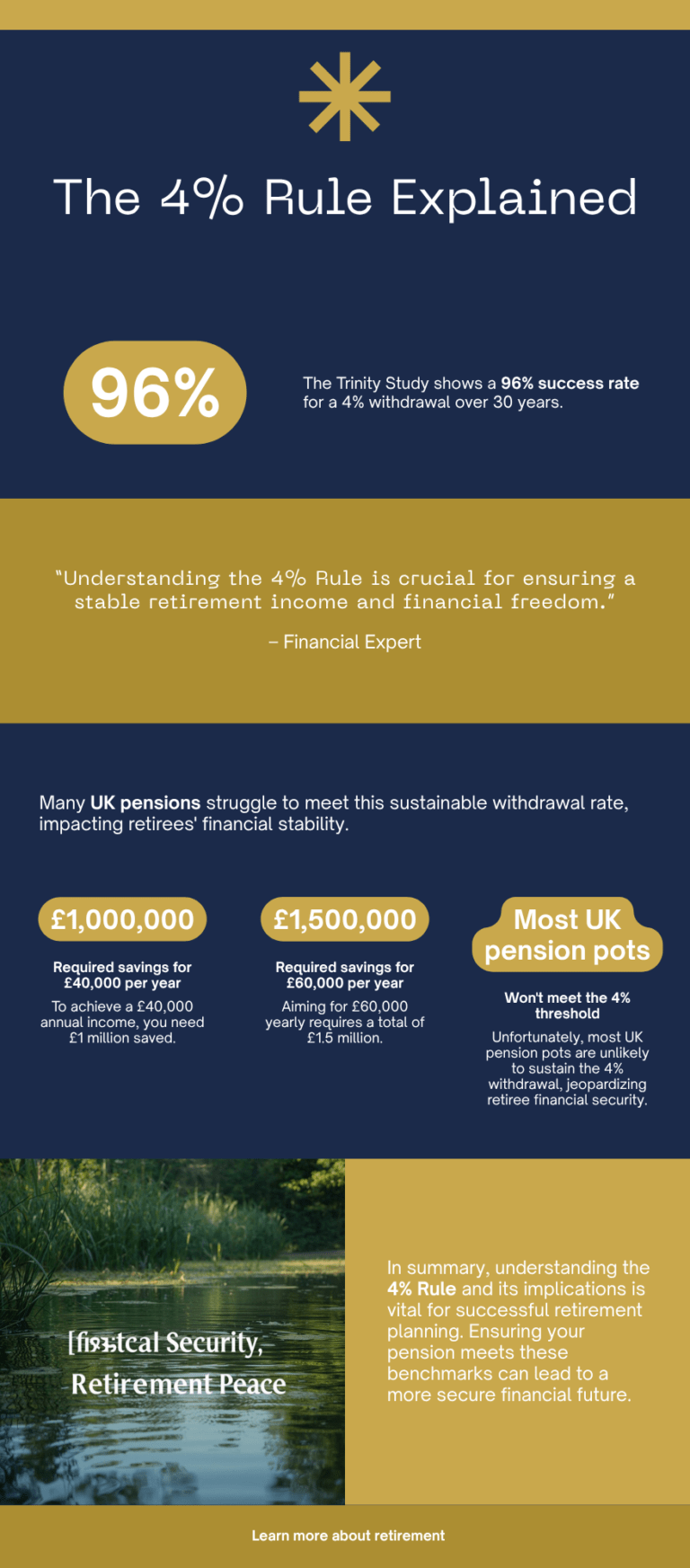
A common FIRE shortcut is to estimate annual portfolio spending and multiply it by 25.
FIRE Number ≈ Annual Portfolio Spending × 25
This comes from the 4% withdrawal framework.
Example: $40,000 Annual Spending
$40,000 × 25 = $1,000,000
Example: $60,000 Annual Spending
$60,000 × 25 = $1,500,000
FIRE Numbers at Different Spending Levels
| Annual Portfolio Spending | 25× FIRE Target |
|---|---|
| $20,000 | $500,000 |
| $30,000 | $750,000 |
| $40,000 | $1,000,000 |
| $50,000 | $1,250,000 |
| $60,000 | $1,500,000 |
| $75,000 | $1,875,000 |
| $100,000 | $2,500,000 |
Taxes, healthcare, retirement length, investment returns, inflation and other income can materially change the amount required.
Different Types of FIRE
The FIRE movement has developed several variations.
| Type | General Idea | Main Tradeoff |
|---|---|---|
| Lean FIRE | Financial independence with relatively low spending | Smaller lifestyle budget |
| Traditional FIRE | Portfolio supports a moderate lifestyle | Larger portfolio required |
| Fat FIRE | Financial independence with higher discretionary spending | Much larger portfolio required |
| Barista FIRE | Investments cover part of expenses while part-time work covers the rest | Some earned income remains necessary |
| Coast FIRE | Enough is invested early that future growth may cover later retirement needs while current income covers present expenses | Traditional full independence has not yet been reached |
Lean FIRE
Lean FIRE emphasizes lower living costs.
Because annual spending is lower, the required investment portfolio may also be smaller.
Fat FIRE
Fat FIRE aims for greater spending flexibility.
Travel, larger housing costs and more discretionary spending increase the amount of wealth required.
Barista FIRE
Barista FIRE combines investment income with part-time employment.
This can reduce the pressure on a portfolio while allowing someone to leave a demanding full-time job.
Coast FIRE
Coast FIRE focuses on building substantial retirement assets early.
Once enough has been invested, future contributions may become less important if investment growth eventually carries the portfolio toward the retirement target.
Why Savings Rate Matters So Much in FIRE
The FIRE movement often places heavy emphasis on savings rate.
Savings Rate Formula
Savings Rate = Amount Saved ÷ Income Available for Saving
Example
Suppose you have $5,000 of monthly take-home income.
You spend $3,000.
You save $2,000.
$2,000 ÷ $5,000 = 40%
A higher savings rate can accelerate FIRE in two ways.
First, You Invest More
More surplus means larger monthly contributions.
Second, You May Need Less
If higher savings come partly from sustainable lower expenses, the eventual portfolio may not need to support as expensive a lifestyle.
FIRE Is Not Only About Frugality
A common criticism of FIRE is that discussions can focus too heavily on cutting expenses.
However, increasing income can be just as powerful.
Income Growth Can Come From
Career Growth
Develop skills that qualify you for higher-paying roles.
Negotiation
Research market compensation and negotiate more effectively.
Freelancing
Use existing skills to create extra active income.
Business
Build a profitable business that can increase income beyond wages.
Side Hustles
Create an additional source of investable surplus.
Digital Skills
Improve earning power through technology, AI, marketing or other marketable skills.
Do not try to reach financial independence only by making life smaller. Increasing earning power can make FIRE more realistic without requiring extreme deprivation.

How Investing Fits Into the FIRE Movement
Saving alone usually does not create the entire FIRE result.
Long-term investing is commonly used to help accumulated capital grow.
Common Investment Categories
- Broad stock-market funds
- ETFs
- Index funds
- Bonds
- Retirement accounts
- Other diversified investments
Diversification Matters
Investor.gov describes diversification as spreading investments across different assets to reduce concentration risk.
However, diversification cannot eliminate market losses entirely.
Asset Allocation Matters Too
Investor.gov notes that the appropriate mix of stocks, bonds and cash depends partly on time horizon and tolerance for risk.
FIRE does not require speculative trading, concentrated stock bets or chasing unusually high returns. Taking more investment risk does not automatically make early retirement safer.
Is Early Retirement Actually Realistic?
For some households, yes.
For many others, a full retirement in their 30s or 40s may be extremely difficult.
FIRE Becomes More Realistic When You Have
- A strong and growing income
- A high sustainable savings rate
- Manageable housing costs
- Limited high-interest debt
- Years available for compound growth
- A diversified investment strategy
- Flexible future spending
- Healthcare planning
- Other optional income sources
FIRE Becomes Harder When You Face
- Low or unstable income
- High housing costs
- Large family responsibilities
- Medical expenses
- Expensive debt
- Late investing start
- Low savings capacity
- Very high retirement spending expectations
Why Early Retirement Is Harder Than Traditional Retirement
The earlier you stop depending on employment income, the longer your assets may need to support you.
Retiring at 65
A portfolio may need to fund several decades.
Retiring at 40
The same portfolio may need to support 50 years or more.
That Creates More Exposure To
- Market crashes
- Long periods of inflation
- Changing tax rules
- Healthcare expenses
- Housing changes
- Family responsibilities
- Unexpected major costs
Morningstar's 2026 early-retirement discussion specifically notes that younger retirees may want a more conservative starting withdrawal rate because of the longer horizon.
A rule built around a traditional retirement timeframe should not automatically be stretched across 50 or 60 years without additional analysis.
Major Risks FIRE Followers Need to Understand
1. Sequence-of-Returns Risk
A major market decline early in retirement can be particularly damaging because withdrawals continue while portfolio values are depressed.
2. Inflation Risk
A long retirement creates many years during which living costs can rise.
3. Longevity Risk
You may live much longer than expected.
4. Healthcare Risk
Medical costs can rise significantly and vary by country.
5. Tax Risk
Tax laws and withdrawal treatment can change.
6. Lifestyle Risk
The low-cost lifestyle you accept at 30 may not be the lifestyle you want at 55.
7. Investment Risk
Stocks, bonds and other investments can lose value.
8. Concentration Risk
Depending on one company, sector or speculative investment can make a FIRE plan fragile.
9. Income Risk
Rental, business or online income may not continue permanently.
10. Psychological Risk
Leaving work may change identity, routine, relationships and sense of purpose.
No portfolio size, withdrawal rule, cryptocurrency, property strategy or passive-income system can guarantee early retirement.
Healthcare Can Be One of the Biggest FIRE Challenges
Early retirees may lose access to employer-sponsored health benefits long before becoming eligible for public retirement programs.
Potential Costs Include
- Insurance premiums
- Deductibles
- Prescription medication
- Dental care
- Vision care
- Specialist treatment
- Long-term care
The effect varies dramatically across countries.
Do Not Build a FIRE Number Without Healthcare
A portfolio that covers ordinary lifestyle spending but ignores healthcare may create false confidence.
Taxes Can Change Your FIRE Number
Your annual spending target is usually based on what you need to spend.
However, the portfolio may need to withdraw more than that if taxes apply.
Hypothetical Example
You need $40,000 after taxes.
For illustration only, assume an effective 15% tax burden on relevant withdrawals.
$40,000 ÷ 0.85 ≈ $47,059
At a hypothetical 4% starting withdrawal rate:
$47,059 ÷ 0.04 ≈ $1,176,475
Actual tax treatment differs by account, investment, country and individual circumstances.
Housing Can Make or Break a FIRE Plan
Housing is often one of the largest household expenses.
Lower Housing Costs Can Help
A smaller mortgage, lower rent or paid-off home can reduce annual spending.
But Homeownership Is Not Free
- Property taxes
- Insurance
- Maintenance
- Repairs
- Utilities
- Association fees
Example
Suppose paying off a mortgage reduces annual spending from $60,000 to $48,000.
At 25×:
$60,000 × 25 = $1,500,000
versus:
$48,000 × 25 = $1,200,000
That is a $300,000 difference in the illustrative FIRE target.
Does FIRE Mean You Must Never Work Again?
No.
This is one of the biggest misconceptions about FIRE.
You Could Become Financially Independent and Still
- Work part time
- Freelance
- Run a small business
- Teach
- Consult
- Create digital products
- Volunteer
- Change careers
Optional Work Can Improve the Mathematics
Suppose annual spending is $40,000.
Part-time work provides $15,000.
The portfolio needs to provide only $25,000.
$25,000 × 25 = $625,000
Without the income, the 25× target would be $1 million.

Real-Life Example: A High-Income Household Pursues FIRE
Starting Situation
A fictional couple earns $140,000 in annual take-home income.
They spend $70,000.
That leaves approximately $70,000 before considering irregular costs and taxes already reflected in take-home income.
Approximate Savings Rate
$70,000 ÷ $140,000 = 50%
Estimated FIRE Number
If they expect the portfolio to provide $70,000 annually:
$70,000 × 25 = $1,750,000
They Reduce Future Spending
After the mortgage is eventually paid off, they estimate future spending could fall to $55,000.
$55,000 × 25 = $1,375,000
The illustrative target falls by $375,000.
Key lesson: High income can accelerate FIRE, but controlling major long-term expenses can also materially change the target.
Mini Case Study: Why a 70% Savings Rate Is Not Possible for Everyone
A fictional worker takes home $3,000 monthly.
Essential housing, food, transportation and family costs total $2,500.
Only $500 remains before irregular expenses.
Maximum Theoretical Savings Rate
$500 ÷ $3,000 ≈ 16.7%
Telling this person to save 60% or 70% without addressing income and essential expenses is not realistic.
Better Priorities
- Increase earning power
- Reduce expensive debt
- Control major recurring expenses where possible
- Build emergency savings
- Invest consistently at a sustainable level
Key lesson: FIRE timelines depend heavily on income and circumstances. High savings rates are much easier for households with substantial financial surplus.
FIRE vs Traditional Retirement
| Feature | FIRE | Traditional Retirement |
|---|---|---|
| Typical target age | Earlier than traditional retirement | Later |
| Accumulation period | Often shorter | Usually longer |
| Withdrawal period | Potentially much longer | Usually shorter |
| Savings rate | Often aggressive | May be more moderate |
| Need for flexibility | Very high | High |
| Healthcare challenge | Can be significant before traditional retirement eligibility | Depends on system and age |
A 10-Step FIRE Roadmap for Beginners
| Step | Action |
|---|---|
| 1 | Track your real annual spending |
| 2 | Calculate your current savings rate |
| 3 | Build emergency savings |
| 4 | Reduce expensive debt |
| 5 | Improve earning power |
| 6 | Increase savings sustainably |
| 7 | Invest consistently in a diversified strategy |
| 8 | Estimate several FIRE numbers |
| 9 | Plan taxes, healthcare and housing |
| 10 | Build flexibility before leaving full-time work |
FIRE Readiness Checklist
- I know my realistic annual spending.
- I know my current savings rate.
- I have emergency savings.
- I understand my debt costs.
- I am working to increase earning power.
- I invest consistently.
- I understand diversification.
- I know my approximate FIRE number.
- I have compared 4%, 3.5% and other withdrawal scenarios.
- I understand sequence-of-returns risk.
- I have considered inflation.
- I have considered healthcare.
- I have considered taxes.
- I understand housing costs after retirement.
- I have considered whether optional work could help.
- I understand that FIRE is not guaranteed.
10 FIRE Movement Mistakes to Avoid
1. Treating 25× Expenses as a Guarantee
It is a planning shortcut, not certainty.
2. Focusing Only on Cutting Spending
Increasing income can be equally important.
3. Neglecting Emergency Savings
Unexpected costs can force you to sell investments at a bad time.
4. Ignoring Healthcare
Early retirement may create years of healthcare costs before traditional retirement benefits begin.
5. Assuming 4% Automatically Works for 50 Years
Longer retirement horizons deserve additional caution.
6. Chasing High Investment Returns
Taking excessive risk does not strengthen a weak FIRE plan.
7. Ignoring Taxes
Gross withdrawals and spendable income can differ.
8. Building a Lifestyle You Hate
Extreme deprivation may make the plan unsustainable.
9. Assuming You Will Never Earn Money Again
Optional work can provide both meaning and financial flexibility.
10. Retiring From Something Without Retiring To Something
Financial independence does not automatically create purpose, community or fulfillment.
Early retirement should not require gambling with investments, sacrificing essential financial safety or building a lifestyle you cannot realistically maintain.
Continue Learning on MoneyOnliners
Recommended External Resources
Investor.gov — Introduction to Investing
Introduction to Investing — Investor.gov
Investor.gov — Asset Allocation and Diversification
Asset Allocation and Diversification — Investor.gov
Morningstar — Early Retirement Planning
What You Need to Consider Before Retiring Early — Morningstar
Morningstar — Retirement Income Research
Retirement-Income Research — Morningstar
This article provides general educational information and is not individualized financial, retirement, investment, tax, insurance or legal advice. FIRE targets, withdrawal rates and portfolio calculations are hypothetical planning illustrations. Investment returns are uncertain, markets can fall, inflation can rise and spending can change. Early retirement decisions may benefit from professional advice tailored to your circumstances.
Frequently Asked Questions
What does FIRE stand for?
FIRE stands for Financial Independence, Retire Early.
What is the FIRE movement?
The FIRE movement focuses on saving and investing aggressively enough to build financial independence earlier than traditional retirement age.
Is FIRE actually realistic?
It can be realistic for some people.
However, high income, high savings rates, controlled spending and long-term investing often make the goal much easier.
Can an average-income person reach FIRE?
Potentially, but the timeline may be longer and depend heavily on living costs, income growth and savings capacity.
What is a FIRE number?
A FIRE number is an estimate of the amount of assets needed to support financial independence.
How is the FIRE number calculated?
A common shortcut is annual portfolio spending multiplied by 25.
Why multiply expenses by 25?
Because multiplying by 25 corresponds mathematically to a 4% starting withdrawal rate.
Is 25× enough?
Not necessarily.
The appropriate target depends on retirement length, taxes, healthcare, inflation, portfolio allocation and other income.
Is the 4% rule safe for FIRE?
It can be a useful starting point, but early retirees may need a longer withdrawal period than traditional retirees.
Should early retirees use less than 4%?
Some retirement research suggests younger retirees may want to consider more conservative starting withdrawal assumptions.
What is Lean FIRE?
Lean FIRE generally means achieving financial independence while maintaining relatively low annual spending.
What is Fat FIRE?
Fat FIRE aims to support a higher-spending lifestyle and therefore requires a larger portfolio.
What is Barista FIRE?
Barista FIRE combines investments with part-time or lower-intensity work.
What is Coast FIRE?
Coast FIRE generally means having enough invested that long-term growth may carry the portfolio toward a later retirement target without requiring the same level of future contributions.
Do I need to save 50% of my income?
No specific savings rate is required for everyone.
Higher savings rates can shorten the timeline, but sustainable savings matter more than copying someone else's percentage.
Can I reach FIRE by saving 20%?
Potentially, but the timeline may be significantly longer than for someone saving 40% or 50%.
Does FIRE require extreme frugality?
No.
Income growth can also increase savings capacity.
Do I need to invest to reach FIRE?
Most FIRE strategies rely heavily on long-term investing because cash savings alone may struggle to keep pace with inflation and large portfolio targets.
Are index funds common in FIRE?
Broad diversified index funds are commonly discussed within FIRE communities, although no investment is appropriate for everyone and market risk remains.
Can I use rental property for FIRE?
Potentially.
Use net rental cash flow rather than gross rent and include vacancies, repairs, insurance, taxes and financing.
Can passive income help with FIRE?
Yes, potentially.
However, passive-income sources can fluctuate and should not automatically be treated as guaranteed.
Does FIRE mean I never work again?
No.
Many financially independent people continue working voluntarily or part time.
Can part-time work make FIRE easier?
Yes.
Reliable part-time income can reduce required portfolio withdrawals.
What is the biggest FIRE risk?
There is no single biggest risk, but early market losses, inflation, healthcare expenses and an overly aggressive withdrawal plan can all materially affect long-term sustainability.
What is sequence-of-returns risk?
It is the risk that poor investment returns early in retirement can damage a portfolio more severely because withdrawals are happening at the same time.
Do taxes matter in FIRE?
Yes.
Taxes can reduce the amount of portfolio withdrawals available for actual spending.
Does healthcare matter?
Yes.
Healthcare can become a major expense, especially when retiring before traditional retirement benefit eligibility.
Can FIRE fail?
Yes.
Poor investment performance, high inflation, unexpected spending or overly optimistic assumptions can weaken a plan.
What is the best age to reach FIRE?
There is no universal best age.
The stronger goal is reaching genuine financial independence with enough margin and flexibility to support your chosen lifestyle.
What is the biggest FIRE mistake?
One major mistake is treating a simple portfolio number as a guarantee while ignoring taxes, healthcare, inflation, retirement length and real-life spending changes.
Research Methodology
This MoneyOnliners guide evaluates the FIRE movement as a financial-independence framework rather than a promise of unusually early retirement.
The FIRE number examples use the commonly cited 25× annual-expenses shortcut, which corresponds mathematically to a 4% starting withdrawal assumption.
The guide does not present 25× or 4% as guaranteed because retirement length, market performance, inflation and spending flexibility can materially change portfolio sustainability.
Current Morningstar retirement-income research is incorporated to reflect that a 30-year base case in 2026 produced a 3.9% starting rate under its stated assumptions, while its early-retirement guidance notes that younger retirees may want to be more conservative.
Investor.gov guidance is used for investment-risk, diversification and asset-allocation principles.
Savings rate is discussed alongside income growth because aggressive saving becomes much more feasible when households have meaningful surplus income.
Housing, healthcare and taxes are discussed separately because each can materially change the portfolio required for early retirement.
FIRE variations such as Lean FIRE, Fat FIRE, Barista FIRE and Coast FIRE are presented as different lifestyle and work arrangements rather than universally superior strategies.
All calculations and case studies are hypothetical educational illustrations.
No FIRE timeline, portfolio return, withdrawal rate or early-retirement outcome is guaranteed.
Final Thoughts: FIRE Is Realistic for Some—but Financial Independence Matters More Than the Retirement Age
The FIRE movement has helped make one powerful idea more visible.
Your financial life does not have to remain completely dependent on employment forever.
Build a Gap Between Income and Spending
That creates investable surplus.
Increase Income
Higher earning power can make aggressive saving more realistic.
Invest Consistently
Long-term assets can gradually reduce dependence on wages.
Control Major Expenses
Housing, transportation, debt and healthcare can have far more impact than small everyday spending.
Use the FIRE Number Carefully
Twenty-five times annual spending can be a useful starting estimate.
It should not become a guarantee.
Plan for a Long Retirement
Someone leaving work at 40 may need far more flexibility than someone retiring at 65.
Remember That Work Can Become Optional
You do not need to promise yourself that you will never work again.
Financial independence can allow you to choose work because you want it rather than because every monthly expense depends on it.
Ultimately, the strongest version of FIRE is not about escaping work as quickly as possible.
It is about building enough financial resilience, assets and income flexibility that you gain greater control over your time.
Earn more where possible.
Spend intentionally.
Save consistently.
Invest patiently.
Protect your financial foundation.
Then let financial independence—not an arbitrary retirement age—be the real measure of progress.