Retirement Planning: 15 Things to Start Doing Before You Retire
Retirement Planning: 15 Things to Start Doing Before You Retire
Retirement planning is not only about building a large investment account. It is about preparing your income, expenses, healthcare, taxes, debt, housing, emergency reserves and lifestyle so that the transition away from full-time work is financially sustainable and emotionally manageable.
Good retirement planning should begin well before your final working day. Important steps include estimating retirement expenses, calculating likely income, building emergency savings, reducing expensive debt, reviewing investments, planning healthcare, understanding taxes, deciding where you will live, preparing for inflation, reviewing insurance, organizing estate documents, testing your retirement budget, creating a withdrawal strategy, building flexibility into the plan and deciding what you actually want retirement to look like.
Table of Contents
Why Retirement Planning Matters
Retirement changes the financial equation.
During your working years, employment income usually replenishes your bank account every month.
After retirement, your income may come from a combination of investments, pensions, government benefits, rental income, annuities, part-time work or other sources.
That means mistakes can become harder to correct.
15 Retirement Planning Priorities at a Glance
| # | Planning Step | Why It Matters |
|---|---|---|
| 1 | Estimate retirement expenses | Shows what your lifestyle may actually cost |
| 2 | Calculate retirement income | Shows how much your assets must provide |
| 3 | Build emergency savings | Reduces pressure on investments |
| 4 | Reduce expensive debt | Lowers required monthly cash flow |
| 5 | Review investments | Aligns portfolio risk with retirement needs |
| 6 | Plan healthcare | Prepares for potentially significant costs |
| 7 | Understand taxes | Improves withdrawal planning |
| 8 | Review housing | Housing can dominate retirement spending |
| 9 | Plan for inflation | Protects future purchasing power |
| 10 | Review insurance | Protects against major financial shocks |
| 11 | Organize estate documents | Clarifies financial wishes |
| 12 | Test retirement budget | Reveals unrealistic assumptions |
| 13 | Create withdrawal strategy | Coordinates portfolio spending |
| 14 | Build flexibility | Helps the plan adapt to bad markets |
| 15 | Plan retirement lifestyle | Money should support a meaningful life |
1 Estimate What Retirement Will Actually Cost
Do not begin retirement planning by guessing how much money you need invested.
Begin with spending.
Estimate Expenses Such As:
- Housing
- Food
- Utilities
- Transportation
- Healthcare
- Insurance
- Taxes
- Travel
- Home maintenance
- Family support
- Entertainment
- Unexpected expenses
Example
Suppose expected annual retirement spending is $50,000.
That number becomes the starting point for estimating how much income must come from pensions, investments and other sources.

2 Calculate Your Expected Retirement Income
Next, estimate how much reliable income you may receive after leaving full-time work.
Possible Income Sources Include:
- Pensions
- Government retirement benefits
- Investment withdrawals
- Interest income
- Rental income
- Annuity income
- Part-time work
- Business income
Example
Annual spending need: $50,000.
Pension income: $15,000.
Government retirement income: $12,000.
$50,000 − $27,000 = $23,000 needed from investments or other sources
Your investment portfolio may not need to fund your entire lifestyle if dependable income sources cover part of your expenses.
3 Build Accessible Emergency Savings
Retirement does not eliminate emergencies.
Vehicles still break down.
Homes still need repairs.
Healthcare costs can appear unexpectedly.
A cash reserve can help prevent every emergency from becoming a portfolio withdrawal.
Why Cash Reserves Matter
- They can cover unexpected costs.
- They can reduce forced investment sales.
- They can provide flexibility during market declines.
- They can reduce reliance on credit.
4 Reduce High-Interest Debt Before Retirement
High-interest debt increases the amount of income required every month.
Example
A $600 monthly debt payment equals:
$600 × 12 = $7,200 per year
Eliminating that payment before retirement may reduce the annual amount your portfolio needs to support.
Prioritize Especially Expensive Debt
- Credit cards
- Payday loans
- High-cost personal loans
- Other expensive consumer balances
Interest rates, taxes, liquidity, mortgage terms and individual circumstances all matter when deciding whether debt should be repaid early.
5 Review Your Investment Portfolio
A portfolio suitable for someone with decades before retirement may not be appropriate for someone preparing to begin withdrawals.
Review:
- Asset allocation
- Diversification
- Investment fees
- Risk tolerance
- Time horizon
- Cash needs
- Tax treatment
Sequence-of-Returns Risk Matters
Poor investment returns near the beginning of retirement can be particularly damaging because withdrawals may occur while portfolio values are depressed.
Do not chase unusually high returns simply because retirement feels close. Greater expected return generally involves greater uncertainty and potential loss.

6 Plan Carefully for Healthcare
Healthcare can become one of the largest and least predictable retirement expenses.
Potential Costs Include:
- Insurance premiums
- Deductibles
- Prescription medicine
- Dental care
- Vision care
- Specialist treatment
- Long-term care
Healthcare systems vary widely by country.
Therefore, retirement plans should reflect the actual system available where you expect to live.
A portfolio that appears sufficient before healthcare may be far less comfortable once realistic medical costs are included.
7 Understand How Taxes May Affect Retirement Income
The amount you withdraw from an account may not equal the amount available for spending.
Tax Treatment Can Differ Across:
- Taxable brokerage accounts
- Tax-deferred retirement accounts
- Tax-free or tax-advantaged accounts
- Pensions
- Rental income
- Business income
Hypothetical Example
You need $40,000 after taxes.
If a hypothetical 15% effective tax burden applied to the withdrawals involved:
$40,000 ÷ 0.85 ≈ $47,059
Actual tax treatment varies significantly by country, account type and personal circumstances.
8 Decide What Your Housing Will Look Like
Housing can be one of the largest retirement expenses.
Questions to Consider
- Will the mortgage be paid off?
- Will you continue renting?
- Would downsizing make sense?
- Will maintenance become difficult?
- Would relocation reduce living costs?
- How high are property taxes and insurance?
Example
If housing costs fall by $1,000 per month:
$1,000 × 12 = $12,000 lower annual spending
That can materially change the amount of retirement income required.

9 Plan for Inflation
Retirement may last several decades.
During that time, prices can rise substantially.
Simple Illustration
Suppose annual spending begins at $50,000.
At a hypothetical 3% annual inflation rate:
Year 2 spending ≈ $51,500
Later years may require considerably more nominal income to maintain similar purchasing power.
Do not ask only whether your income covers today's retirement expenses. Ask whether your plan can potentially keep pace with future purchasing power needs.
10 Review Your Insurance Before Retirement
Insurance needs can change substantially after leaving work.
Review Potential Needs for:
- Health insurance
- Home insurance
- Vehicle insurance
- Life insurance
- Disability coverage before retirement
- Long-term care protection where relevant
Some policies may become less necessary.
Others may become more important.
11 Organize Estate and Beneficiary Documents
Retirement planning should also include what happens if you become unable to manage your finances or after you die.
Documents to Review May Include:
- Will
- Beneficiary designations
- Power of attorney
- Healthcare directives
- Trust documents where appropriate
- Property ownership records
Estate-planning requirements vary by country and jurisdiction. Professional legal advice may be appropriate for complex situations.
12 Test Your Retirement Budget Before You Retire
One of the most practical retirement-planning exercises is to live on your projected retirement budget before leaving work.
Example
You expect retirement spending to be $4,000 per month.
Try living on approximately $4,000 for several months while still employed.
You May Discover:
- The budget is comfortable.
- Healthcare was underestimated.
- Travel spending is unrealistic.
- Housing costs are higher than expected.
- You actually need less than expected.
Testing converts a spreadsheet assumption into a real-life financial experiment.
13 Build a Retirement Withdrawal Strategy
A retirement portfolio needs a plan for turning investments into spending money.
A Withdrawal Strategy May Consider:
- How much to withdraw initially
- Which accounts to withdraw from first
- Taxes
- Inflation adjustments
- Portfolio rebalancing
- Required minimum withdrawals where applicable
- Market conditions
Do Not Treat 4% as a Guarantee
The 4% rule can be a useful planning reference.
However, retirement length, portfolio allocation, market returns and spending flexibility all matter.
A withdrawal strategy should be reviewed periodically rather than treated as a permanent rule that never changes.
14 Build Flexibility Into Your Retirement Plan
A retirement plan becomes stronger when it can adapt.
Flexible Options Might Include:
- Reducing discretionary spending during bad markets
- Delaying a major purchase
- Working part time temporarily
- Using cash reserves strategically
- Postponing large travel plans
- Adjusting withdrawal levels
15 Decide What You Actually Want Retirement to Look Like
Retirement is not only a financial event.
It is also a major lifestyle transition.
Ask Yourself:
- Where will I live?
- How will I spend my weekdays?
- Will I travel?
- Will I work part time?
- Will I volunteer?
- What relationships will I prioritize?
- What will give my days structure?
- What activities will give me purpose?
Retiring from work is easier when you also know what you are retiring toward.

MoneyOnliners Original Analysis: The 5 Layers of Retirement Readiness
| Layer | Main Question | Examples |
|---|---|---|
| Cash-Flow Readiness | Can your expected income support your lifestyle? | Budget, debt, housing, taxes |
| Risk Protection | Can unexpected events damage the plan? | Emergency savings, insurance, healthcare |
| Income Readiness | Where will retirement cash flow come from? | Pensions, benefits, investments, part-time work |
| Portfolio Readiness | Can your assets support long-term withdrawals? | Diversification, fees, withdrawal strategy |
| Lifestyle Readiness | Do you know what retirement life will actually look like? | Housing, travel, relationships, purpose |
A retirement plan can look strong on paper while still being weak in healthcare, liquidity, housing or lifestyle preparation. True retirement readiness requires several layers working together.
MoneyOnliners Research-Based Evidence Note
This article is a research-based retirement education guide.
MoneyOnliners does not claim personal first-hand experience with every retirement, investment, healthcare or tax situation described.
The calculations and case examples are educational illustrations.
Where MoneyOnliners has genuine experience with budgeting education, financial-content development, income-building strategies and long-term financial planning topics, that practical editorial experience informs the structure of this guide.
Hypothetical retirement outcomes are never presented as personal results or guaranteed outcomes.
Real-World Example: Retirement Planning 5 Years Before Retirement
A fictional couple expects to retire in five years.
Current Position
- Annual spending: $72,000
- Mortgage payment: $1,200 per month
- Retirement portfolio: $950,000
- Expected pension income: $18,000 per year
- Emergency savings: $20,000
Step 1: Review Retirement Spending
After the mortgage is expected to end, annual spending may fall to approximately $58,000.
Step 2: Subtract Pension Income
$58,000 − $18,000 = $40,000 needed from other sources
Step 3: Review Healthcare and Taxes
They realize healthcare and taxes were underestimated by approximately $8,000 annually.
Revised portfolio-income need becomes approximately $48,000.
Step 4: Test the Budget
The couple begins living on the projected retirement budget while still working.
Key lesson: Retirement planning becomes more accurate when estimates are tested before employment income disappears.
10 Retirement Planning Mistakes to Avoid
1. Planning Only Around a Portfolio Number
Expenses, taxes and healthcare matter too.
2. Ignoring Inflation
Future purchasing power can be very different from today's.
3. Carrying Expensive Debt Into Retirement
Required payments can increase financial pressure.
4. Keeping No Emergency Cash
Every surprise expense may otherwise become a portfolio withdrawal.
5. Chasing High Investment Returns
Greater risk does not make retirement safer.
6. Ignoring Healthcare
Medical expenses can materially alter retirement spending.
7. Assuming Spending Will Stay Constant
Travel, housing and healthcare may change substantially.
8. Ignoring Taxes
Gross withdrawals may not equal spendable income.
9. Retiring Without Testing the Budget
A theoretical budget can look very different in real life.
10. Retiring Without a Lifestyle Plan
Financial readiness and personal readiness are not identical.
Be cautious of guaranteed-return products, speculative investments or retirement strategies promising that your money cannot run out. No investment or withdrawal strategy removes all risk.
Retirement Planning Checklist
- I know my estimated retirement spending.
- I know my expected retirement income sources.
- I have emergency savings.
- I understand my debt payments.
- I have reviewed my investment allocation.
- I understand diversification.
- I have planned for healthcare.
- I understand the likely tax treatment of my retirement income.
- I have reviewed my housing plan.
- I have considered inflation.
- I have reviewed insurance needs.
- I have reviewed estate and beneficiary documents.
- I have tested my retirement budget.
- I have a withdrawal strategy.
- I have built spending flexibility into the plan.
- I know what I want retirement life to look like.
Incoming Link Opportunities
The 4% Rule Explained: Can It Really Help You Reach Financial Independence?
https://moneyonliners.com/4-percent-rule-financial-independence/
How Much Money Do You Need for Financial Independence?
https://moneyonliners.com/how-much-money-for-financial-independence/
How Long Does It Take to Reach Financial Independence? 7 Factors That Matter
https://moneyonliners.com/how-long-to-reach-financial-independence/
Lean FIRE vs Fat FIRE vs Coast FIRE: Which Path Fits You Best?
https://moneyonliners.com/lean-fire-vs-fat-fire-vs-coast-fire/
Continue Learning on MoneyOnliners
Recommended External Resources
Investor.gov — Introduction to Investing
Introduction to Investing — Investor.gov
Investor.gov — Asset Allocation and Diversification
Asset Allocation and Diversification — Investor.gov
Consumer Financial Protection Bureau — Consumer Tools
Consumer Financial Tools — CFPB
This article provides general educational information and is not individualized retirement, investment, tax, insurance, legal or financial advice. Retirement expenses, tax systems, healthcare costs and investment outcomes vary considerably. Investments can lose value and no withdrawal strategy guarantees that money will last for life.
Frequently Asked Questions About Retirement Planning
When should retirement planning begin?
Ideally, retirement planning begins years before retirement.
The earlier you begin, the more time you have to build assets.
You also have more time to reduce debt.
Healthcare and housing decisions can be planned gradually.
Even beginning late is generally better than not planning at all.
How much money do I need to retire?
There is no universal amount.
The answer depends on annual spending.
Other income matters too.
Taxes and healthcare should be included.
Your retirement timeframe and investment strategy also matter.
Should I pay off my mortgage before retirement?
It depends.
Eliminating a mortgage can reduce required monthly spending.
However, mortgage interest rates and liquidity matter.
Taxes may also affect the decision.
A personalized financial review may be helpful.
Should I pay off credit-card debt before retiring?
High-interest credit-card debt can create significant financial pressure.
Reducing expensive debt before retirement can improve monthly cash flow.
It may also reduce the amount your investments need to support.
Emergency savings should still be considered.
Do not leave yourself with no accessible cash solely to eliminate debt.
How much emergency savings should a retiree have?
There is no universal amount.
The appropriate reserve depends on income stability and expenses.
Healthcare risks matter.
Housing and vehicle maintenance may matter too.
The goal is enough liquidity to prevent ordinary emergencies from damaging long-term investments.
Should retirement investments become more conservative?
Often risk tolerance changes as retirement approaches.
However, becoming too conservative may create inflation risk.
Stocks can still provide long-term growth potential.
Bonds and cash can provide different forms of stability.
Asset allocation should reflect the full retirement plan.
What is sequence-of-returns risk?
Sequence risk refers to the order in which investment returns occur.
Poor returns early in retirement can be particularly damaging.
Withdrawals may continue while the portfolio is depressed.
That can leave fewer assets to participate in a recovery.
This is one reason flexibility matters.
Should I use the 4% rule?
The 4% rule can be a useful starting framework.
It should not be treated as guaranteed.
Retirement length matters.
Portfolio allocation matters.
Taxes, inflation and spending flexibility also matter.
How important is healthcare planning?
Very important.
Healthcare can become one of the largest retirement expenses.
Insurance premiums can rise.
Medical needs can increase with age.
Healthcare should therefore be included directly in retirement planning.
Can I work part time after retiring?
Yes.
Part-time work can reduce portfolio withdrawals.
It can also provide structure and social interaction.
Taxes may affect the value of the extra income.
Work does not have to disappear completely for retirement to be successful.
Research Methodology
This MoneyOnliners guide evaluates retirement planning through cash-flow preparation, debt management, healthcare, taxes, investments, inflation, housing, insurance, estate organization, withdrawal planning and lifestyle preparation.
Retirement expenses are treated as the starting point because the amount of income and assets required depends heavily on the lifestyle being funded.
Reliable income is separated from portfolio withdrawals because pensions and other dependable sources can reduce how much investments must provide.
Emergency savings are included because short-term financial shocks can otherwise force investment sales during unfavorable market conditions.
High-interest debt is included because required debt payments increase the amount of retirement cash flow needed.
Investment risk is evaluated using diversification, asset allocation and sequence-of-returns considerations rather than assuming one portfolio is appropriate for everyone.
Healthcare is treated separately because it can be both significant and unpredictable.
Tax planning is included because gross withdrawals and spendable retirement income can differ.
Inflation is included because retirement can span decades and future purchasing power matters.
The MoneyOnliners Five Layers of Retirement Readiness framework is original editorial analysis designed to help readers evaluate retirement beyond one portfolio number.
All calculations and fictional examples are hypothetical educational illustrations.
No investment return, retirement date, withdrawal rate or portfolio outcome is guaranteed.
Google Search Console Checklist
- Confirm final URL: /retirement-planning-before-you-retire/
- Confirm canonical matches the live URL.
- Use retirement planning naturally in the introduction, headings and conclusion.
- Add descriptive alt text to the featured and inline images.
- Confirm internal links point to live canonical URLs.
- Confirm the post is indexable.
- Confirm the post appears in the XML sitemap.
- Check mobile layout.
- Test external links.
- Inspect the final URL in Google Search Console.
- Request indexing after publication if appropriate.
- Monitor queries such as “retirement planning,” “things to do before retirement,” and “how to prepare for retirement.”
Conclusion: Strong Retirement Planning Begins Before Your Final Working Day
Retirement planning is easier when it begins before retirement becomes urgent.
Estimate your spending.
Understand where income will come from.
Build emergency reserves.
Reduce expensive debt.
Review your investments.
Plan for healthcare.
Understand taxes.
Think carefully about housing.
Prepare for inflation.
Review insurance.
Organize important documents.
Test your retirement budget.
Build a flexible withdrawal strategy.
And decide what you actually want your retirement years to look like.
Similar Posts
How Much Money Do You Really Need to Retire Comfortably?
How Much Money Do You Really Need to Retire Comfortably? | MoneyOnliners MoneyOnliners • Retirement → Retirement Income How Much Money Do You Really Need to Retire Comfortably? Is $500,000 enough to retire? What about $1 million, $1.5 million or $2 million? There is no universal retirement number because comfortable retirement depends on what you…
Retirement vs Financial Independence: Why They’re Not Exactly the Same
Retirement vs Financial Independence: Why They’re Not Exactly the Same | MoneyOnliners MoneyOnliners • Retirement → Financial Independence Retirement vs Financial Independence: Why They’re Not Exactly the Same Retirement and financial independence are often treated as interchangeable goals, but they describe different things. Retirement usually means leaving or substantially reducing paid employment. Financial independence means…
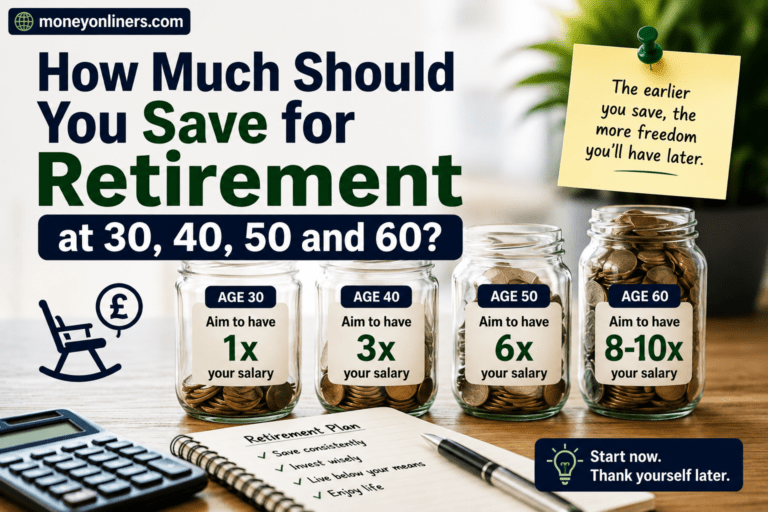
How Much Should You Save for Retirement at 30, 40, 50 and 60?
How Much Should You Save for Retirement at 30, 40, 50 and 60? | MoneyOnliners MoneyOnliners • Retirement → Savings by Age How Much Should You Save for Retirement at 30, 40, 50 and 60? Age-based retirement benchmarks can help you check your progress, but they should never become rigid pass-or-fail rules. Your income, lifestyle,…
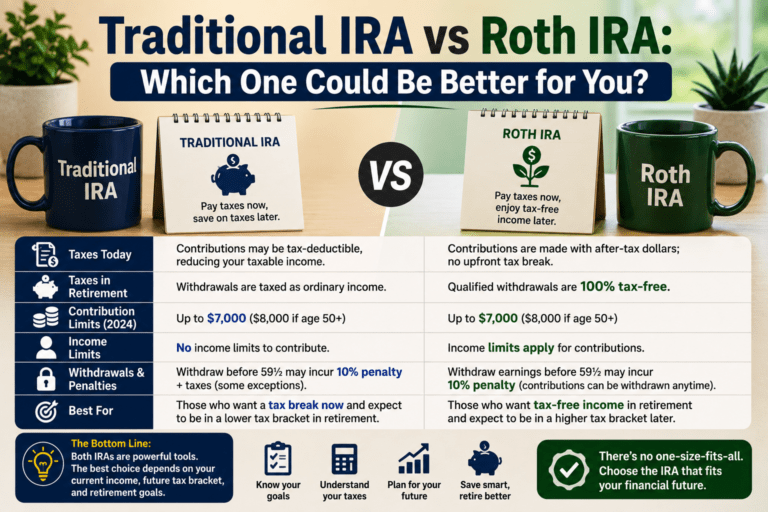
Traditional IRA vs Roth IRA: Which One Could Be Better for You?
Traditional IRA vs Roth IRA: Which One Could Be Better for You? | MoneyOnliners MoneyOnliners • Retirement → Individual Retirement Accounts Traditional IRA vs Roth IRA: Which One Could Be Better for You? Traditional and Roth IRAs can both help you build long-term retirement assets, but they offer their tax advantages at different times. A…
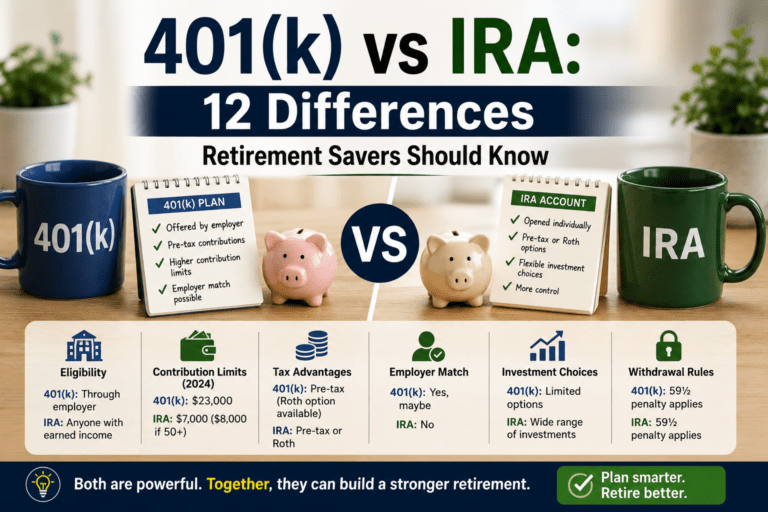
401(k) vs IRA: 12 Differences Retirement Savers Should Know
401(k) vs IRA: 12 Differences Retirement Savers Should Know | MoneyOnliners MoneyOnliners • Retirement → Retirement Accounts 401(k) vs IRA: 12 Differences Retirement Savers Should Know A 401(k) and an IRA can both help you build retirement assets, but they are not interchangeable. One is usually connected to your workplace, while the other is generally…
15 Retirement Expenses People Forget to Plan For
15 Retirement Expenses People Forget to Plan For | MoneyOnliners MoneyOnliners • Retirement → Retirement Expenses 15 Retirement Expenses People Forget to Plan For A retirement budget can look comfortable until the expenses that do not arrive every month begin appearing. Roof repairs, dental work, replacing a vehicle, helping adult children, insurance increases, taxes, travel,…