Active Income vs Passive Income: What Beginners Need to Know
Active Income vs Passive Income: What Beginners Need to Know
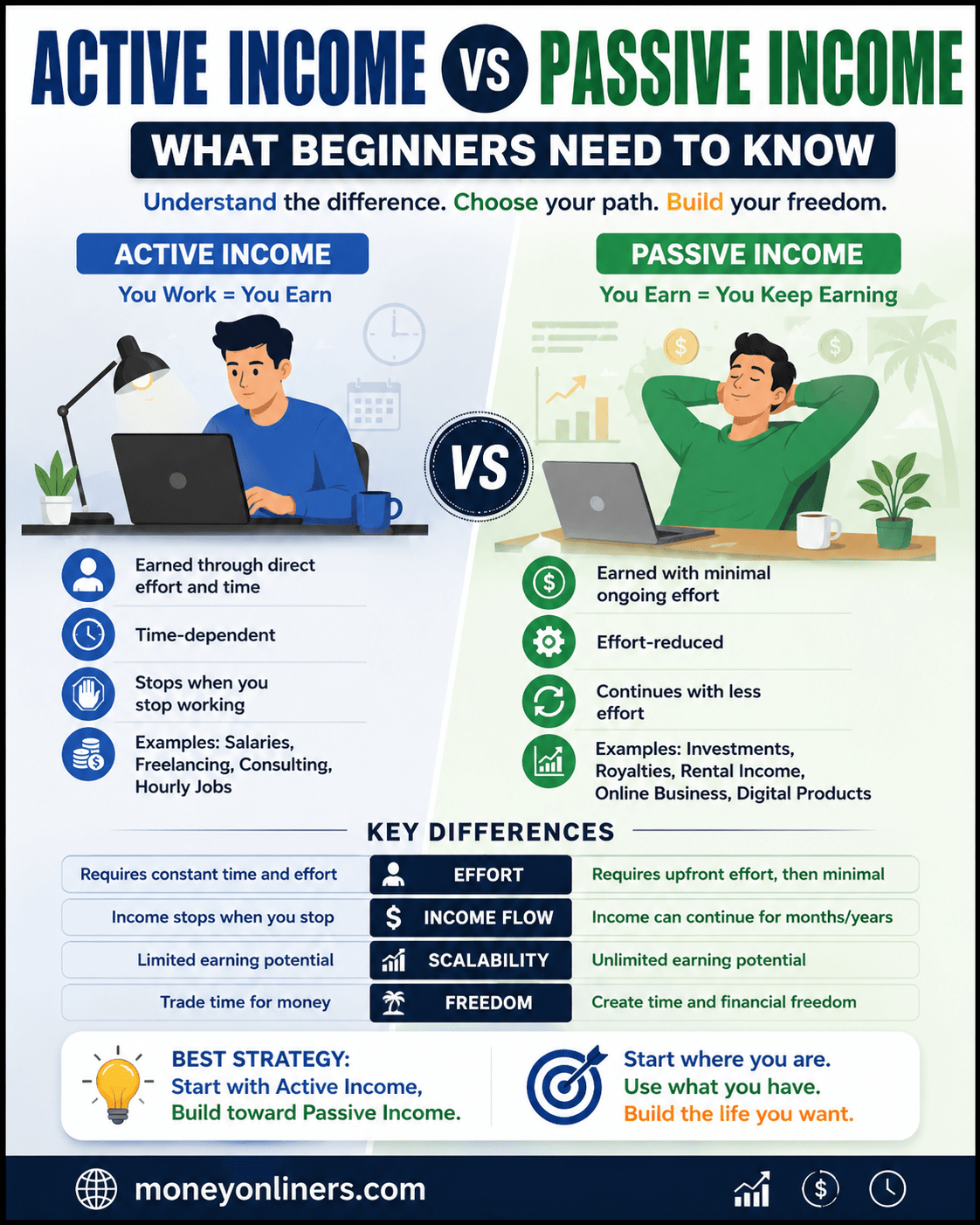
Most people begin by earning active income: a salary, hourly wage, freelance payment or business income that depends heavily on ongoing work. Passive income works differently. It can continue after the main asset or system has been created, but it usually still requires money, time, maintenance or risk. Understanding the difference can help you build income more realistically instead of chasing unrealistic “money while you sleep” promises.
Active income is money you generally earn by performing ongoing work, such as wages, salaries, freelancing, consulting or operating a business. Passive income is income generated by an asset or system that may continue producing money without requiring the same amount of direct work for every payment. Examples can include interest, certain investment distributions, rental income, ebooks, digital products and content assets. Beginners should usually focus first on building reliable active income, then use some of that income to create savings, investments and scalable assets that may eventually produce semi-passive or passive income.
What Is Active Income?
Active income generally comes from work you continue performing.
You provide labor, expertise, time or services.
In return, you receive compensation.
Common Active Income Examples
- Salary from a full-time job
- Hourly wages
- Overtime pay
- Freelancing
- Consulting
- Contract work
- Delivery work
- Tutoring
- Commission-based sales
- Service-based side hustles
If you stop doing the work, the income often slows down or stops as well.
What Is Passive Income?
Passive income generally refers to income generated by assets, systems or intellectual property that can continue earning after much of the initial work is complete.
Examples Can Include
- Interest income
- Dividend-producing investments
- Bond income
- Rental income
- Royalties
- Ebook sales
- Digital template sales
- Affiliate content
- Online courses
- Licensing income
- Revenue from evergreen content
However, the word “passive” can be misleading.
A rental property still needs maintenance.
A website still needs updates.
An online course may need customer support.
Investments can lose value.
Passive income should not automatically be interpreted as income requiring zero work, zero capital or zero risk.
Active Income vs Passive Income at a Glance
| Feature | Active Income | Passive / Semi-Passive Income |
|---|---|---|
| Main driver | Current work | Assets, systems or capital |
| Directly tied to hours? | Often | Usually less directly |
| Startup time | Depends on job or skill | Can be substantial |
| Capital required | Often relatively low | Ranges from low to very high |
| Ongoing work | Usually significant | Ranges from low to significant |
| Scalability | Often limited by available time | Can potentially scale more easily |
| Income guaranteed? | No | No |
| Main beginner role | Build reliable cash flow | Build additional long-term income sources |
1. Active Income Usually Pays Faster
One advantage of active income is speed.
If you get a job today, you may begin earning during the next payroll period.
If you find a freelance client, you may receive payment after completing the project.
By contrast, passive-income assets often take longer to build.
Example
A freelance writer can potentially earn money after completing an article this week.
Creating an ebook may take weeks or months before the first sale occurs.
When you urgently need more income, improving active income may be more practical than trying to build passive income first.

2. Active Income Is Often Easier to Understand
A job can be straightforward.
You work a certain number of hours or complete specific responsibilities.
Then you receive compensation.
Passive income can involve more variables.
A website needs traffic.
An investment needs capital.
A rental property needs tenants.
A digital product needs customers.
Therefore, passive income may involve business, investment and platform risk that beginners need to understand.
3. Passive Income Usually Requires Something Upfront
Passive income generally requires one or more of the following:
Money
Investments, property and equipment usually require capital.
Time
Websites, videos and digital products can take months to develop.
Skills
Design, writing, coding, teaching and marketing can create reusable assets.
An Existing Asset
Property, equipment, intellectual property or an audience can potentially generate income.
There Is Usually No Free Shortcut
If an idea requires very little money, it often requires more work.
If it requires little work, it may require more capital.
4. Active Income Is Often Limited by Time
There are only 24 hours in a day.
This creates a natural ceiling for many active-income models.
Example
A freelancer charging $30 per hour can increase income by working more hours.
However, there is eventually a physical limit to how many hours can be sold.
How Active Income Can Still Scale
Instead of only working more hours, you can:
- Increase your rate
- Develop more valuable skills
- Move into higher-paying work
- Create packages instead of hourly pricing
- Delegate work
- Build systems
- Move from service provider to business owner
5. Passive Income Can Be More Scalable
A digital product can potentially be sold to several customers without recreating the product from scratch each time.
An ebook can be purchased repeatedly.
A video can be watched by thousands of people.
A diversified investment can potentially produce returns without the investor working for the underlying companies.
That scalability is one reason passive income receives so much attention.
But Scalability Does Not Guarantee Demand
A product that can serve one million customers is useless if nobody wants it.
Therefore, scalability must be combined with real customer demand.
6. Active Income Can Fund Passive Income
This is one of the most useful connections between the two.
You do not necessarily choose one and abandon the other.
Active income can provide the money needed to build passive-income assets.
Example Flow
| Stage | Action |
|---|---|
| 1 | Earn salary or freelance income |
| 2 | Cover essential expenses |
| 3 | Build emergency savings |
| 4 | Pay down expensive debt |
| 5 | Save or invest part of surplus income |
| 6 | Create income-producing assets |
| 7 | Reinvest some profits |
Active income can be the engine that funds the assets that later reduce your dependence on active income.
7. Passive Income Can Be Unpredictable
A salary may be relatively predictable from month to month.
Passive income can fluctuate considerably.
Examples
Affiliate commissions can drop.
Website traffic can fall.
Dividend payments can be reduced.
Rental properties can become vacant.
Interest rates can change.
Digital-product sales may vary by season.
Do not build essential monthly obligations around passive-income projections that have not yet proven stable.
8. Passive Income Can Still Require Maintenance
| Income Stream | Possible Ongoing Work |
|---|---|
| Rental property | Repairs, tenants, taxes, vacancies |
| Niche website | Updates, SEO, security |
| Affiliate site | Broken links, product updates, traffic |
| Online course | Student support and content updates |
| Software | Hosting, security, bugs, support |
| Ebook | Marketing and occasional updates |
| Investment portfolio | Periodic review and rebalancing |
For this reason, “semi-passive” is often a more accurate description for many income sources.
9. Active Income Can Build Valuable Skills
Active income is not simply a temporary stage you should escape as quickly as possible.
Work can help you develop skills that later create scalable income opportunities.
For Example
- A designer can later sell templates.
- A teacher can create a course.
- A developer can build software.
- A consultant can write a guide.
- A photographer can license images.
- A blogger can build affiliate content.
- A freelancer can create a digital product from repeated client work.
10. Passive Income Can Require Patience
The internet often hides the build phase.
You see the finished website.
You see the ebook sales.
You see the rental income.
You see the investment distributions.
You may not see the months or years required to create the asset.
Realistic Timeline Thinking
A digital product might sell quickly.
A niche website may take much longer.
An investment portfolio may need decades to create meaningful income from a modest starting amount.
Therefore, passive income should be built with realistic expectations.
11. Active Income Can Be Increased Before You Build Passive Income
For beginners with limited money, increasing active income can be one of the most powerful first moves.
Ways to Increase Active Income
- Ask for a raise
- Apply for better-paying jobs
- Learn a higher-value skill
- Freelance outside working hours
- Offer a local service
- Do consulting
- Take contract projects
- Increase freelance rates
- Improve sales skills
A higher income can create more room for saving and investing.
That surplus can then fund passive-income assets.

12. Passive Income May Require More Risk
Passive income does not automatically mean safer income.
Investment income involves market risk.
Rental property involves property and tenant risk.
Online businesses face platform and competition risk.
Digital products may fail to sell.
Therefore, beginners should assess both potential income and potential loss.
Be extremely cautious of any passive-income opportunity promising guaranteed high returns, guaranteed daily income or large earnings with little or no work.
13. Active Income and Passive Income Can Work Together
You do not need to choose one permanently.
A strong financial system may use both.
| Income Source | Possible Role |
|---|---|
| Salary | Pay essential monthly expenses |
| Freelancing | Increase surplus income |
| Interest | Add income from cash reserves |
| Investments | Support long-term wealth building |
| Digital products | Create scalable additional revenue |
| Rental income | Potential property-based cash flow |
The Goal Is Greater Financial Flexibility
Multiple income sources can reduce dependence on a single paycheck.
However, having many weak income streams is not necessarily better than having one strong, reliable one.
Real-Life Example: From Freelancing to Digital Products
Maria Starts With Active Income
Maria provides bookkeeping services to small businesses.
Every client pays her for ongoing work.
That is active income.
She Notices a Repeated Problem
Many clients struggle with the same expense-tracking system.
Maria creates a reusable spreadsheet template and instructions.
The initial creation requires several hours.
However, once finished, multiple customers can purchase the same product.
The Income Becomes More Scalable
Maria still markets the template and provides occasional support.
Therefore, it is not completely passive.
However, she no longer needs to create a separate spreadsheet from scratch for every sale.
Key lesson: Active work can reveal problems that later become passive or semi-passive products.
Mini Case Study: $1,000 of Passive Income Is Not Automatically $1,000 of Profit
A fictional creator reports $1,000 in monthly digital-product revenue.
However, the business also has expenses.
| Item | Example |
|---|---|
| Gross sales | $1,000 |
| Marketplace fees | -$100 |
| Advertising | -$180 |
| Software | -$70 |
| Refunds | -$50 |
| Illustrative amount before taxes | $600 |
The numbers are hypothetical.
The lesson is that gross revenue and actual profit are different.
Key lesson: Passive-income claims should always be evaluated after realistic expenses.
Active Income vs Passive Income: Advantages and Disadvantages
| Income Type | Advantages | Disadvantages |
|---|---|---|
| Active income | Can start faster, predictable, skill-building | Often tied to hours and availability |
| Passive income | Potential scalability and ongoing income | Requires setup, capital, patience or risk |
Active Income Advantages
- Can provide predictable cash flow
- Often faster to start
- Can develop valuable skills
- May offer benefits through employment
- Can finance savings and investments
- Can increase relatively quickly through better skills or rates
Active Income Disadvantages
- Often limited by available working hours
- Income may stop when work stops
- Burnout can become a risk
- Job loss can interrupt income
- Some roles provide limited scalability
Passive Income Advantages
- Can reduce direct dependence on hours worked
- Some assets can scale
- Can diversify income sources
- Can potentially continue for long periods
- Can support long-term financial flexibility
Passive Income Disadvantages
- May take a long time to build
- Can require significant capital
- May still require maintenance
- Income can fluctuate
- Investments and businesses can lose money
- Online platforms can change rules
Active Income vs Passive Income: Which Should Beginners Focus On?
For many beginners, active income should come first.
Why?
Active income pays current bills.
It creates savings.
It provides capital for investments.
It can fund business experiments.
It can also help you develop marketable skills.
Then Add Passive Income Gradually
Once your basic financial foundation is stronger, you can begin redirecting some surplus income toward assets that may produce future income.
A Simple Beginner Income-Building Order
| Stage | Priority |
|---|---|
| 1 | Build reliable active income |
| 2 | Control essential expenses |
| 3 | Build emergency savings |
| 4 | Address expensive debt |
| 5 | Improve active earning power |
| 6 | Begin long-term investing where appropriate |
| 7 | Create one scalable asset |
| 8 | Measure actual profit |
| 9 | Automate carefully |
| 10 | Diversify income gradually |
Active Income Ideas for Beginners
Freelancing
Sell a specific skill to clients.
Remote Work
Earn salary or contract income online.
Local Services
Offer cleaning, repairs, tutoring, photography or other useful services.
Consulting
Sell specialized expertise.
Part-Time Work
Increase income alongside a primary job.
Online Services
Offer design, writing, editing, bookkeeping or digital assistance.
Passive Income Ideas for Beginners
Digital Templates
Create once and potentially sell repeatedly.
Ebooks
Turn useful knowledge into a reusable asset.
Affiliate Content
Earn commissions from qualifying referrals.
Investments
Use capital to build potential long-term returns.
Online Courses
Record structured teaching that multiple students can access.
Licensed Creative Work
License photography, music, graphics or other intellectual property.
Can You Turn Active Income Into Passive Income?
Yes.
This is one of the strongest long-term strategies.
Example 1: Salary → Investment Portfolio
You earn a salary.
Part of the surplus is invested regularly.
Over time, the portfolio may produce capital growth, interest or distributions.
Example 2: Freelancing → Template
You repeatedly perform the same process for clients.
You package part of that process into a reusable product.
Example 3: Consulting → Course
You notice clients ask the same questions.
You create structured educational material answering those questions.
Example 4: Photography → Licensing
You perform active photography work.
Some suitable original images are later licensed repeatedly.
What part of the work I already do could become an asset that can be sold, licensed or used more than once?
Taxes: Active Income and Passive Income May Be Treated Differently
Tax treatment depends on your country, account type and income source.
Salary may be taxed differently from investment income.
Rental income may have different rules from freelance income.
Business income may involve deductible expenses.
Interest, dividends, capital gains and royalties may also receive different treatment.
The everyday meaning of “passive income” is not necessarily the same as the tax definition used by your country's tax authority. Always check the rules that apply to your jurisdiction.
Active Income vs Passive Income and Financial Risk
| Risk | Active Income | Passive Income |
|---|---|---|
| Job loss | Can be significant | Depends on source |
| Market risk | Usually limited | Can be high for investments |
| Business risk | Depends on work model | Can be substantial |
| Platform risk | Can affect gig workers | Can affect online businesses heavily |
| Time risk | Income depends on ability to work | Build period can take a long time |
| Capital risk | Often lower | Can be significant |
10 Active Income vs Passive Income Mistakes to Avoid
1. Treating Passive Income as Effortless Money
Most systems require work, capital or maintenance.
2. Quitting Reliable Active Income Too Early
New income streams may be unstable.
3. Starting Too Many Passive-Income Projects
One completed asset is better than many unfinished ideas.
4. Ignoring Active-Income Growth
A better job or higher freelance rate can sometimes improve finances faster.
5. Counting Revenue as Profit
Subtract expenses before evaluating income.
6. Investing Emergency Money
Long-term assets can fall when cash is needed.
7. Chasing Guaranteed Passive Returns
High guaranteed income with no risk is a major warning sign.
8. Assuming Active Income Is Inferior
Reliable active income can finance nearly every other wealth-building strategy.
9. Ignoring Taxes
Different income sources can create different tax obligations.
10. Building Income Streams You Do Not Understand
Understand the product, business model and risks before committing significant time or money.
Beginner Income Checklist
- I know how much active income I earn.
- I know whether my active income covers essential expenses.
- I have considered emergency savings.
- I have reviewed expensive debt.
- I am developing valuable skills.
- I understand that passive income usually requires upfront work or capital.
- I know the difference between revenue and profit.
- I do not expect guaranteed passive income.
- I understand the risks of any investments involved.
- I know what ongoing maintenance an income stream requires.
- I am not starting too many income projects at once.
- I have checked relevant taxes and business rules.
- I am building income gradually rather than chasing shortcuts.
Continue Learning on MoneyOnliners
Recommended External Resources
Federal Trade Commission — Income Scam Guidance
How to Avoid Income Scams — Federal Trade Commission
Federal Trade Commission — Business Opportunity Scams
When a Business Offer or Coaching Program Is a Scam — FTC
Investor.gov — Introduction to Investing
Introduction to Investing — Investor.gov
IRS — Passive Activity and At-Risk Rules
Publication 925: Passive Activity and At-Risk Rules — IRS
This article provides general educational information and is not individualized financial, investment, tax, business or legal advice. Active income is not guaranteed, passive income is not guaranteed, businesses can lose money and investments can lose value. Tax treatment varies by income source and jurisdiction.
Frequently Asked Questions
What is active income?
Active income generally comes from ongoing work, such as wages, salary, freelancing, consulting or service-based business activity.
What is passive income?
Passive income generally comes from assets or systems that may continue generating income after much of the initial work or capital has been provided.
What is the main difference between active income and passive income?
Active income is usually more directly connected to current work.
Passive income is more connected to ownership of assets, systems, investments or intellectual property.
Is salary active income?
Yes.
A salary generally compensates you for ongoing work.
Is freelancing active income?
Usually yes.
You generally earn when you complete services or projects for clients.
Is rental income passive income?
Rental income is commonly described as passive income, but property ownership can involve substantial management and maintenance.
Are dividends passive income?
In everyday financial discussions, dividends are commonly treated as passive investment income.
However, tax classifications can use different terminology.
Is interest passive income?
Interest can generally be earned without performing ongoing labor.
Again, tax authorities may classify the income differently from everyday language.
Is affiliate marketing passive income?
Affiliate content can generate commissions after publication.
However, traffic, links, rankings and merchant programs still require monitoring.
Is blogging passive income?
Evergreen articles can continue producing revenue.
Nevertheless, websites require updates, maintenance and traffic development.
Is YouTube passive income?
Older videos can continue producing views and potential revenue.
Building and maintaining a channel generally requires ongoing work.
Is an online course passive income?
A recorded course can serve multiple students without repeating every lesson live.
However, marketing, support and content updates usually remain.
Which is better: active income or passive income?
Neither is universally better.
Active income is often better for generating immediate cash flow, while passive income can improve long-term scalability and income diversification.
Should beginners focus on active income first?
For many beginners, yes.
Reliable active income can cover expenses and create the surplus needed for savings, investing and asset building.
Can active income become passive income?
Yes.
Active income can fund investments, and active skills can be converted into reusable assets such as courses, ebooks, templates or software.
Can passive income replace a job?
It can for some people, but there is no guarantee.
Replacing employment income generally requires substantial assets, profitable businesses or multiple stable income sources.
How much passive income do I need before quitting my job?
There is no universal amount.
Consider essential expenses, taxes, healthcare, emergency reserves, income stability, debt and the reliability of each passive-income source.
Can passive income disappear?
Yes.
Dividends can be cut, tenants can leave, websites can lose traffic and digital-product demand can decline.
Is passive income guaranteed?
No.
Legitimate income and investment opportunities involve uncertainty.
Do I need money to build passive income?
Not always a large amount.
Low-cost digital assets can substitute more time and skill for financial capital.
Can I build passive income with little money?
Yes.
Templates, ebooks, affiliate content and other digital assets can potentially be started with modest costs.
Can active and passive income work together?
Yes.
Active income can fund passive assets, while passive income can gradually reduce dependence on only one paycheck.
What is the biggest passive-income mistake?
One major mistake is assuming passive income means guaranteed money without effort, risk or ongoing costs.
What is the biggest active-income mistake?
One major mistake is relying entirely on working more hours without also developing higher-value skills or building longer-term financial assets.
Research Methodology
This MoneyOnliners guide compares active and passive income according to the amount of direct labor required, startup capital, scalability, ongoing maintenance, income stability and financial risk.
Active income examples focus on wages, salaries, freelancing, consulting and service work because compensation is generally connected to ongoing labor.
Passive-income examples include investments, rental property and digital assets that may continue producing income after the main setup work or capital commitment has occurred.
The article intentionally describes many online and property-based models as semi-passive because they still require maintenance, marketing, customer support or administration.
Gross income is separated from actual profit because operating expenses can materially change the economic value of an income stream.
The article also distinguishes ordinary financial use of the phrase passive income from jurisdiction-specific tax definitions.
No income level, investment return or business outcome is guaranteed.
Final Thoughts: Active Income Builds the Foundation, Passive Income Can Build Flexibility
Active income and passive income are not enemies.
They can support each other.
Active Income Pays Today's Bills
A salary, freelance work or business service can provide dependable cash flow.
Active Income Can Build Your Skills
Those skills may later become reusable products or scalable businesses.
Active Income Can Fund Investments
Part of the money you earn today can potentially be turned into assets for tomorrow.
Passive Income Can Increase Flexibility
Over time, assets and systems may reduce the amount of new labor required to earn every additional dollar.
But Passive Income Is Not Magic
Investments can fall.
Businesses can fail.
Customers can disappear.
Platforms can change.
Properties need repairs.
Build in the Right Order
Strengthen active income.
Protect your financial foundation.
Develop valuable skills.
Then use surplus money, knowledge and time to build assets gradually.
Ultimately, understanding active income vs passive income helps beginners avoid chasing unrealistic shortcuts.
The strongest long-term goal is not simply to stop working.
It is to build enough skills, assets, savings and income sources that you have more control over how your money is earned and how your time is used.