What Should Your Net Worth Be at 30, 40, 50 and 60?
What Should Your Net Worth Be at 30, 40, 50 and 60?
Age-based net worth benchmarks can be useful, but they can also be misleading when treated as rules. A 40-year-old homeowner with a pension, a 40-year-old renter building a business and a 40-year-old parent paying childcare costs may have very different balance sheets. The stronger approach is to use age benchmarks as context while measuring your own assets, liabilities, savings rate, retirement progress and financial resilience.
There is no universal amount your net worth must equal at age 30, 40, 50 or 60. However, Federal Reserve data can provide useful U.S. household context. In the latest completed Survey of Consumer Finances, median family net worth was about $39,000 for households under 35, $135,600 for ages 35–44, $247,200 for ages 45–54 and $364,500 for ages 55–64.
Those figures are descriptive statistics, not financial targets. Moreover, the age groups do not correspond perfectly with someone turning exactly 30, 40, 50 or 60.
A separate retirement benchmark from Fidelity suggests roughly 1× annual salary saved for retirement by 30, 3× by 40, 6× by 50 and 8× by 60. Importantly, those are retirement-savings milestones rather than total-net-worth requirements.
Table of Contents
Net Worth by Age: Useful U.S. Benchmarks
The Federal Reserve's Survey of Consumer Finances provides one of the strongest public datasets for examining household wealth in the United States.
The most recent completed survey is the 2022 Survey of Consumer Finances, published in 2023.
| Age Group | Median Net Worth | Mean Net Worth | Closest Milestone Age |
|---|---|---|---|
| Under 35 | $39,000 | $183,500 | Around age 30 |
| 35–44 | $135,600 | $549,600 | Around age 40 |
| 45–54 | $247,200 | $975,800 | Around age 50 |
| 55–64 | $364,500 | $1,566,900 | Around age 60 |
| 65–74 | $409,900 | $1,794,600 | Early retirement years |
These figures describe U.S. families in broad age bands. They do not mean that a 30-year-old “should” have exactly $39,000 or that a 60-year-old has failed if net worth is below $364,500.
Income, homeownership, pensions, inheritance, education debt, family responsibilities, location and retirement goals can produce enormous differences between households.
Why Median Net Worth Is Often More Useful Than Average Net Worth
The difference between median and average wealth is enormous.
Median
The median represents the household in the middle: half have more net worth and half have less.
Mean
The mean adds everyone's wealth together and divides by the number of households.
Extremely wealthy households can pull the average much higher.
Example: Ages 45–54
Median net worth: $247,200
Mean net worth: $975,800
That gap is more than $700,000.
Therefore, comparing yourself only with the average can make ordinary household finances appear much further behind than they actually are relative to the middle household.
Use the median for peer context, retirement projections for future needs, and your own net-worth trend for measuring personal progress.
30 What Should Your Net Worth Be at 30?
At age 30, your biggest financial asset may still be your future earning power rather than your current investment portfolio.
Federal Reserve Context
Households with a reference person under age 35 had a 2022 median net worth of approximately:
$39,000
Again, this is not an exact age-30 target.
Retirement-Savings Context
Fidelity's retirement guideline suggests roughly:
1× annual salary saved for retirement by age 30
For someone earning $60,000, that guideline would imply approximately $60,000 of retirement savings.
However, that is not the same as saying the person's total net worth should equal $60,000.
What Matters Most at 30?
- Positive monthly cash flow
- A starter or established emergency fund
- High-interest debt under control
- Regular retirement contributions
- Growing career skills
- A rising savings rate
- Early diversified investments
Example Age-30 Balance Sheet
| Item | Amount |
|---|---|
| Emergency savings | $10,000 |
| 401(k) | $35,000 |
| IRA | $8,000 |
| Other investments | $5,000 |
| Vehicle | $12,000 |
| Total Assets | $70,000 |
| Student loans | -$20,000 |
| Vehicle loan | -$6,000 |
| Credit card | -$2,000 |
| Estimated Net Worth | $42,000 |
This is a hypothetical example rather than a required age-30 target.
Build the financial system. Your income, habits and future contribution capacity may matter more than whether your balance sheet already looks impressive.

40 What Should Your Net Worth Be at 40?
By 40, many households have had 15 to 20 years of working life.
However, this decade can also contain significant housing, childcare and family costs.
Federal Reserve Context
For households ages 35–44, median 2022 net worth was approximately:
$135,600
Retirement-Savings Context
Fidelity's separate retirement guideline is:
Approximately 3× annual salary by age 40
Example
Annual salary:
$90,000
Illustrative Fidelity retirement-savings milestone:
$270,000
Again, this refers to retirement savings—not total net worth.
Wealth Priorities Around Age 40
- Increasing retirement contributions
- Maintaining emergency reserves
- Controlling housing costs
- Building home equity where applicable
- Reducing consumer debt
- Tracking net worth
- Maintaining diversified investments
- Continuing career growth

50 What Should Your Net Worth Be at 50?
Age 50 can mark an important transition.
Retirement is no longer a distant abstract goal, yet many people may still have 15 to 20 years of earning and investing ahead.
Federal Reserve Context
Households ages 45–54 had a median 2022 net worth of approximately:
$247,200
Retirement-Savings Context
Fidelity's retirement guideline suggests:
Approximately 6× annual salary by age 50
Example
Annual salary:
$100,000
Illustrative retirement-savings benchmark:
$600,000
That retirement benchmark may be considerably higher than the Federal Reserve median total net worth for the broader 45–54 group because the two measures answer completely different questions.
2026 Catch-Up Opportunities
Eligible U.S. savers age 50 and older can use additional retirement contribution capacity.
For 2026, the general employee elective-deferral limit for many 401(k), 403(b), governmental 457 plans and the TSP is:
$24,500
The general age-50+ catch-up limit is:
$8,000
The 2026 IRA limit is:
$7,500
Eligible savers age 50+ have an IRA catch-up amount of:
$1,100
What Matters Most Around 50?
- Calculate the retirement gap
- Increase contributions where possible
- Use catch-up opportunities when appropriate
- Reduce expensive debt
- Review investment costs
- Review portfolio diversification
- Protect accumulated assets
- Estimate future retirement spending

60 What Should Your Net Worth Be at 60?
By age 60, the most useful question is usually no longer simply, “How does my net worth compare with other people?”
Instead, ask whether your assets can realistically support the life you expect after full-time employment.
Federal Reserve Context
Households ages 55–64 had a median 2022 net worth of approximately:
$364,500
Retirement-Savings Context
Fidelity's age-based guideline suggests:
Approximately 8× annual salary saved for retirement by age 60
Example
Annual income:
$100,000
Illustrative retirement-savings milestone:
$800,000
But Retirement Readiness Requires More Than One Number
- Expected annual retirement spending
- Social Security benefits
- Pension income
- Investment assets
- Cash reserves
- Mortgage and other debt
- Healthcare costs
- Tax obligations
- Retirement age
For example, someone with a paid-off home, a pension and modest spending may require less investable wealth than someone carrying a large mortgage and expecting a high-spending retirement.
Shift from comparing yourself with age averages toward testing whether your specific assets, income sources and spending plan can support retirement.

Net Worth Benchmarks vs Retirement Savings Benchmarks
These two measures are frequently confused.
Total Net Worth
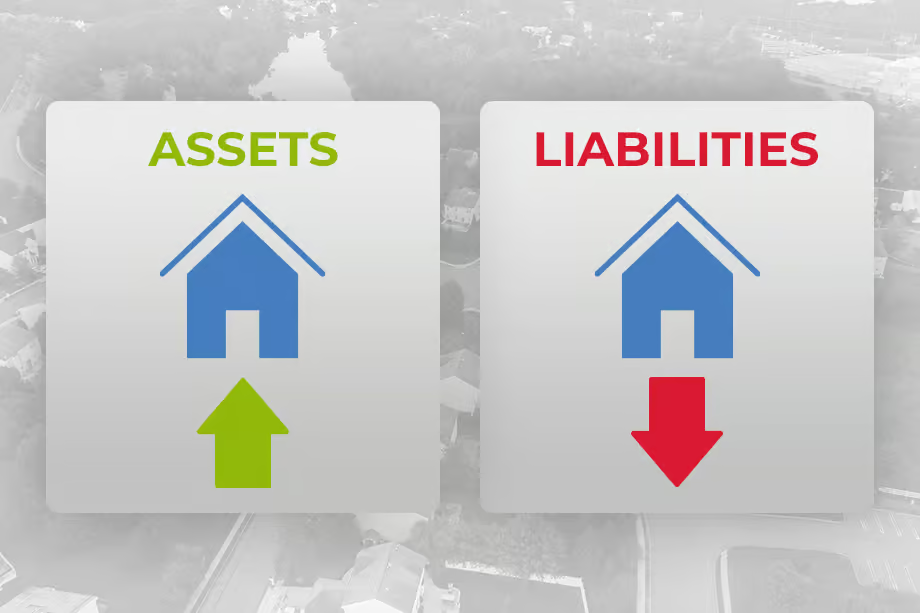
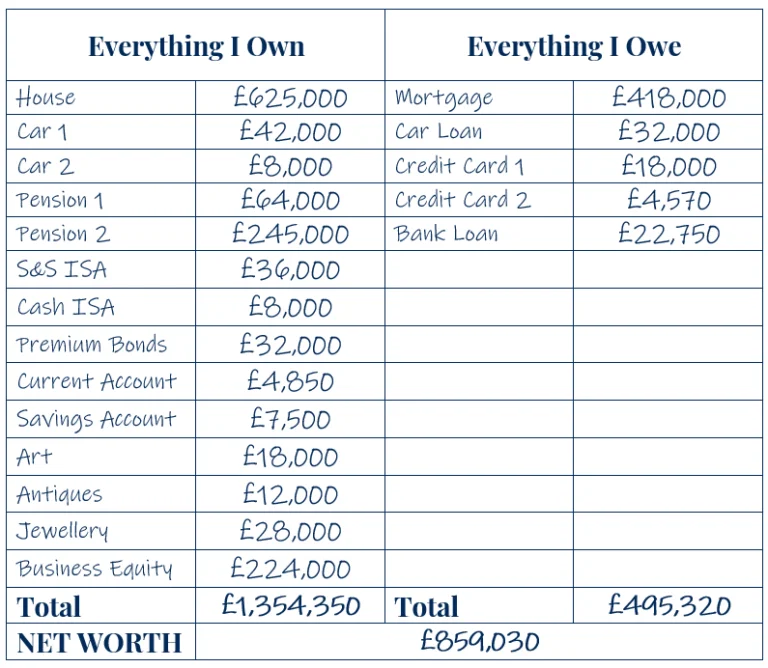
Total Assets − Total Liabilities = Net Worth
Total net worth can include:
- Cash
- Brokerage investments
- Retirement accounts
- Home equity
- Business equity
- Vehicles
- Other meaningful assets
Retirement Savings
Retirement savings benchmarks generally focus on money available or intended to finance retirement.
Fidelity Age-Based Retirement Guideline
| Age | Illustrative Retirement Savings Guideline |
|---|---|
| 30 | 1× annual income |
| 40 | 3× annual income |
| 50 | 6× annual income |
| 60 | 8× annual income |
| 67 | 10× annual income |
Someone can have $500,000 of total net worth but only $200,000 in retirement investments because much of the remaining wealth sits in home equity.
Likewise, someone renting a home may have a very high retirement portfolio without substantial real-estate equity.
Should Your Net Worth Be Based on Your Salary?
Salary multiples can be useful for retirement planning because retirement spending often relates to pre-retirement income and lifestyle.
However, salary is not a perfect way to judge total net worth.
Why?
Consider two people earning $100,000.
Person A
Age 40
No children
Low housing costs
Invests $25,000 annually
Person B
Age 40
Three children
High childcare costs
Invests $10,000 annually
Identical income does not create identical financial circumstances.
A Better Set of Questions
- Is income increasing?
- Is net worth increasing?
- Is expensive debt declining?
- Are retirement contributions increasing?
- Is the household financially resilient?
- Is retirement progress consistent with future spending needs?
Should Your Home Equity Count Toward Net Worth by Age?
Yes, home equity can generally be included in total net worth.
Example
Estimated home value:
$450,000
Mortgage balance:
$280,000
Approximate Home Equity
$170,000
That $170,000 contributes to net worth.
But Home Equity Is Not Retirement Cash
A home can provide housing and significant financial value.
However, converting home equity into spendable money generally requires selling, downsizing or borrowing against the property.
Therefore, consider tracking:
- Total net worth
- Investable net worth
- Liquid net worth
- Retirement assets
What If Your Net Worth Is Below the Benchmark for Your Age?
First, do not treat an age-group median as a financial deadline.
Instead, diagnose your own balance sheet.
1. Calculate Your Current Net Worth
Assets − Liabilities = Net Worth
2. Identify the Largest Liabilities
High-interest debt may deserve particular attention.
3. Measure Your Savings Rate
Determine how much income currently becomes savings or investments.
4. Review Retirement Contributions
Look at both employee and employer contributions.
5. Increase Earning Power
Career skills can expand future contribution capacity.
6. Control Lifestyle Inflation
Allow some of each future raise to strengthen your balance sheet.
7. Give the Strategy Time
Net-worth improvement can accelerate when increasing income, rising investment contributions and declining debt work together.
A concentrated speculative loss can make a net-worth gap much worse. Focus first on variables you can control.
MoneyOnliners Original Analysis: The Net Worth Progress Ladder
Stage 1: Stabilize
Build cash reserves and gain control over high-interest debt.
Stage 2: Build
Create consistent retirement and investment contributions.
Stage 3: Accumulate
Allow assets to grow while liabilities gradually decline.
Stage 4: Accelerate
Use higher earning years to increase contributions significantly.
Stage 5: Convert
As retirement approaches, convert accumulated net worth into a practical plan for income, spending, liquidity and financial security.
MoneyOnliners Net Worth Health Matrix
| Financial Area | 30s | 40s | 50s | 60s |
|---|---|---|---|---|
| Income growth | Very High Priority | Very High Priority | High Priority | Moderate |
| Emergency savings | High | High | High | High |
| High-interest debt | Reduce | Reduce aggressively | Strong priority | Preferably limited |
| Investment contributions | Build | Increase | Accelerate | Maximize where appropriate |
| Retirement modeling | Basic | Growing importance | Very important | Critical |
| Liquidity planning | Moderate | Moderate | High | Very High |
| Wealth protection | Moderate | High | Very High | Very High |
The Net Worth Progress Ladder and Net Worth Health Matrix are original MoneyOnliners educational frameworks rather than standardized financial-planning rules.
MoneyOnliners Age-Based Wealth Scorecard
Instead of asking only whether your net worth matches an age benchmark, evaluate these ten areas.
| Question | Healthy Long-Term Direction |
|---|---|
| Is net worth rising over multiple years? | Generally yes |
| Is income growing? | Where realistically possible |
| Are retirement contributions increasing? | Ideally |
| Is high-interest debt declining? | Yes |
| Is emergency liquidity available? | Yes |
| Are investments diversified? | Appropriately for goals and risk |
| Are major financial fees understood? | Yes |
| Are housing costs manageable? | Preferably |
| Is retirement becoming more funded each year? | Yes |
| Would a temporary income interruption be survivable? | Increasingly |
The MoneyOnliners Age-Based Wealth Scorecard is designed as an original educational framework readers and publishers can reference when evaluating financial progress beyond simplistic age-based dollar targets.
MoneyOnliners Research-Based Evidence Note
This article is a research-based net-worth benchmark guide.
MoneyOnliners does not claim that the Federal Reserve median net-worth figures represent amounts every individual should have accumulated.
The Federal Reserve's 2022 Survey of Consumer Finances is the latest completed SCF available at the time of this update. Its age categories are broad household groups rather than exact ages 30, 40, 50 and 60.
The Fidelity 1×, 3×, 6× and 8× salary benchmarks refer to retirement savings rather than total net worth and rely on specific assumptions about savings behavior, investment exposure, retirement age and retirement lifestyle.
Current 2026 retirement contribution limits were checked against IRS guidance.
MoneyOnliners does not fabricate portfolio balances, net-worth results, salaries, property values, screenshots or testimonials.
The Net Worth Progress Ladder, Net Worth Health Matrix and Age-Based Wealth Scorecard are original MoneyOnliners analytical resources.
10 Mistakes to Avoid When Comparing Net Worth by Age
1. Treating the Median as a Requirement
The median describes the middle household rather than your personal financial target.
2. Comparing Total Net Worth With Retirement Savings
These are different measurements.
3. Comparing Yourself With the Mean Only
Very wealthy households can pull averages dramatically higher.
4. Ignoring Home Equity
Home equity can represent a substantial part of total net worth.
5. Treating Home Equity as Liquid Retirement Money
Property wealth is not automatically available for daily spending.
6. Ignoring Pensions
Two households with identical net worth can have very different retirement security when one has substantial guaranteed pension income.
7. Ignoring Cost of Living
The same net worth can support very different lifestyles in different locations.
8. Ignoring Family Responsibilities
Children, caregiving and household size affect financial capacity.
9. Chasing Risk Because You Feel Behind
Higher investment risk does not guarantee faster catch-up.
10. Forgetting Your Own Progress
Moving from negative $50,000 to positive $50,000 is substantial progress even if a peer benchmark is higher.
Do not allow an age-based comparison to push you toward speculative investing, excessive leverage or unrealistic financial decisions. Benchmarks should inform planning—not create panic.
Why Net Worth by Age Matters
1. Net worth by age can provide useful context for financial progress.
2. Age determines how much working and investing time may remain.
3. Median net worth often provides more useful peer context than average net worth.
4. Federal Reserve data describes households rather than creating required targets.
5. Retirement savings and total net worth are different measures.
6. Home equity can significantly affect household net worth.
7. Liquid wealth can be much lower than total wealth.
8. Income influences how quickly future assets can be accumulated.
9. High-interest debt can materially reduce net worth.
10. Debt payoff can improve the balance sheet even during weak markets.
11. Retirement contributions become increasingly important as age increases.
12. Catch-up contributions can help eligible older savers increase retirement assets.
13. Housing affordability affects long-term wealth-building capacity.
14. Pensions can materially change how much investable wealth a household needs.
15. Retirement age changes the amount of time available to accumulate assets.
16. Spending expectations influence how much wealth may eventually be enough.
17. Financial resilience matters alongside a headline net-worth figure.
18. Starting below an age benchmark does not make future improvement impossible.
19. Your multi-year net-worth trend can be more useful than a one-time comparison with strangers.
20. Ultimately, understanding net worth by age should help you make better decisions about income, debt, saving, investing and retirement—not make you feel that one generic number determines financial success.
Incoming Link Opportunities
How to Calculate Your Net Worth in 5 Simple Steps
https://moneyonliners.com/how-to-calculate-net-worth/
Your First $100,000: Why This Wealth Milestone Can Be So Powerful
https://moneyonliners.com/first-100000-wealth-milestone/
Building Wealth in Your 20s, 30s, 40s and 50s: What Changes?
https://moneyonliners.com/building-wealth-by-age/
How Long Does It Take to Build Wealth? 8 Factors That Matter Most
https://moneyonliners.com/how-long-does-it-take-to-build-wealth/
15 Wealth-Building Mistakes That Can Keep Your Net Worth Stuck
https://moneyonliners.com/wealth-building-mistakes/
High-Priority Incoming Links
How Much Should You Save for Retirement at 30, 40, 50 and 60?
https://moneyonliners.com/how-much-should-you-save-for-retirement-by-age/
Income vs Wealth: 10 Differences That Explain Why a High Salary Isn't Everything
https://moneyonliners.com/income-vs-wealth/
20 Assets That Can Help Build Wealth Over the Long Term
https://moneyonliners.com/assets-that-build-wealth/
15 Wealth-Building Strategies That Can Grow Your Money Over Time
https://moneyonliners.com/wealth-building-strategies/
Topic Cluster Incoming Links
How to Build Wealth From Nothing: 10 Steps for Beginners
https://moneyonliners.com/how-to-build-wealth-from-nothing/
10 Wealth-Building Habits That Can Make a Big Difference Over 10 Years
https://moneyonliners.com/wealth-building-habits/
Saving vs Building Wealth: Why Saving Money Alone May Not Be Enough
https://moneyonliners.com/saving-vs-building-wealth/
Financial Independence: 10 Steps to Take More Control of Your Money and Future
https://moneyonliners.com/financial-independence/
Continue Learning on MoneyOnliners
Recommended External Resources
1. Federal Reserve — Survey of Consumer Finances
Survey of Consumer Finances — Federal Reserve
The Federal Reserve's primary hub for household income, assets, liabilities and net-worth research.
2. Federal Reserve — Changes in U.S. Family Finances From 2019 to 2022
Changes in U.S. Family Finances — Federal Reserve
The source for the age-based median and mean net-worth figures used in this article.
3. Fidelity — How Much Do I Need to Retire?
How Much Do I Need to Retire? — Fidelity
Explains Fidelity's age-based retirement-savings multiples and underlying assumptions.
4. Fidelity — Retirement Guidelines
Retirement Guidelines — Fidelity
Provides current retirement-saving guidance, including age-based savings factors and a general annual saving target.
5. Investor.gov — Figure Out Your Finances
Figure Out Your Finances — Investor.gov
Explains assets, liabilities, cash flow and net-worth calculations.
6. Investor.gov — Build Wealth Over Time
Build Wealth Over Time Through Saving and Investing — Investor.gov
Covers emergency savings, high-interest debt, regular investing and diversification.
7. IRS — 2026 Retirement Contribution Limits
2026 401(k) and IRA Contribution Limits — IRS
Official current U.S. retirement-account contribution and catch-up limits.
8. IRS — IRA Contribution Limits
Official information on Traditional and Roth IRA annual contribution limits.
9. Consumer Financial Protection Bureau — Financial Well-Being
Explains why financial security involves more than income or net worth alone.
10. Federal Trade Commission — How to Avoid a Scam
Useful consumer-protection guidance for protecting accumulated savings and assets.
The Federal Reserve age figures used here come from the 2022 Survey of Consumer Finances, which remains the latest completed SCF available when this article was updated in August 2026. They should not be presented as 2026 household measurements.
This article provides general educational information and is not individualized financial, investment, retirement, tax, legal or insurance advice. Age benchmarks are descriptive or illustrative and should not replace a financial plan based on your income, spending, pension benefits, retirement age, debt, family responsibilities and goals.
Frequently Asked Questions
What should your net worth be at 30?
There is no required amount.
For context, the Federal Reserve reported median net worth of about $39,000 for households under age 35 in its 2022 Survey of Consumer Finances.
That age category includes people younger and older than 30.
Therefore, it should not be treated as an exact age-30 target.
Focus on improving your own trajectory.
What should your net worth be at 40?
There is no universal target.
The Federal Reserve reported median net worth of about $135,600 for households ages 35–44.
Meanwhile, Fidelity's separate retirement-savings guideline suggests approximately three times annual salary by 40.
Those measurements are not interchangeable.
Use both only as context.
What should your net worth be at 50?
The answer depends on your future retirement needs.
Federal Reserve data showed median net worth of about $247,200 for households ages 45–54.
Fidelity's retirement-savings guideline is approximately six times salary by age 50.
However, pensions and home equity can materially change the picture.
Your retirement plan matters more than one peer benchmark.
What should your net worth be at 60?
Federal Reserve data showed median net worth of about $364,500 for households ages 55–64.
However, that does not tell you whether $364,500 is enough for your retirement.
Fidelity's separate retirement guideline suggests approximately eight times salary saved by age 60.
Again, retirement spending and guaranteed income sources matter.
A personalized retirement projection is more useful.
What is a good net worth by age?
A “good” net worth depends on what the assets need to accomplish.
Age provides some context.
Income provides more context.
Retirement goals provide still more.
The strongest benchmark is one connected to your actual financial plan.
Should I use median or average net worth?
Median is often more useful for peer comparison.
The average can be pulled upward by extremely wealthy households.
For example, mean net worth in several Federal Reserve age groups is many times the median.
Therefore, averages can make the typical household look unusually far behind.
Consider both but understand the difference.
Does a 401(k) count toward net worth?
Yes.
A 401(k) is a financial asset.
Its current account value can be included in total net worth.
However, withdrawal and tax rules may apply.
Therefore, retirement-account wealth is not identical to immediately spendable cash.
Does home equity count toward net worth?
Yes.
The home's current estimated value appears on the asset side.
The mortgage balance appears on the liability side.
The difference contributes to net worth.
Nevertheless, home equity is relatively illiquid.
Does Social Security count toward net worth?
Generally, expected future Social Security benefits are not added to a standard personal net-worth statement like a brokerage account.
However, Social Security can be extremely important in retirement planning.
It can reduce the amount your portfolio must provide.
Therefore, net worth and retirement income planning should be evaluated together.
Do not confuse the two calculations.
Does a pension count toward net worth?
Treatment can vary.
A defined-contribution account with a clear balance can generally be treated as an asset.
A traditional defined-benefit pension is different because it promises future income rather than necessarily providing an easily stated account balance.
Its value can still be important for retirement planning.
Avoid making simplistic comparisons between households with and without pensions.
What if my net worth is negative at 30?
Negative net worth means liabilities exceed assets.
Student debt can contribute to that situation.
However, a young worker may also have decades of future earning potential.
Focus on building income, reducing expensive debt and accumulating assets.
The current number is not permanent.
What if I have almost no net worth at 40?
Measure your starting point first.
Then review income, spending, debt and retirement contributions.
At 40, meaningful working years can still remain.
Higher future contributions can improve the trajectory.
Avoid trying to catch up only by taking excessive investment risk.
Is $1 million a good net worth at 50?
It can represent substantial financial progress.
However, the usefulness of $1 million depends on its composition.
A million dollars primarily in home equity provides different liquidity from a million-dollar diversified investment portfolio.
Debt and spending needs also matter.
Therefore, evaluate the complete financial plan.
How often should I calculate my net worth?
Quarterly or annually works well for many households.
Monthly tracking is also possible.
However, market values fluctuate.
Avoid reacting emotionally to every short-term change.
Focus primarily on multi-year progress.
How can I increase my net worth faster?
Increase income where realistically possible.
Maintain a sustainable financial surplus.
Reduce high-interest debt.
Invest consistently for long-term goals.
Then increase contributions as your financial capacity grows.
Research Methodology
Federal Reserve Data
The age-based net-worth figures in this article come from the Federal Reserve's 2022 Survey of Consumer Finances.
At the time of this August 2026 update, the 2022 SCF remains the most recent completed Survey of Consumer Finances listed by the Federal Reserve.
Why We Use Age Bands
The Federal Reserve does not report these specific statistics at exact ages 30, 40, 50 and 60.
Instead, it reports groups such as under 35, 35–44, 45–54 and 55–64.
Therefore, MoneyOnliners uses each group only as context for the nearest decade milestone.
Median vs Mean
Both statistics are shown because the large gap between them demonstrates how wealth concentration affects averages.
For most readers, the median can provide more intuitive peer context.
Retirement Savings Benchmarks
Fidelity's age-based salary multiples are included as a separate retirement-planning reference.
They are not described as total-net-worth requirements.
Fidelity Assumptions
Fidelity's guideline relies on assumptions including saving roughly 15% of income beginning around age 25, employer contributions, investment exposure and retirement around age 67.
Changing those assumptions can change the appropriate target.
Current Retirement Limits
The 2026 401(k), IRA and age-50+ catch-up amounts were checked against current IRS guidance.
Why Housing Is Treated Separately
Home equity contributes to total net worth but is less liquid than cash or many publicly traded investments.
Therefore, total net worth alone may not reveal retirement-spending capacity.
Original MoneyOnliners Analysis
The Net Worth Progress Ladder, Net Worth Health Matrix and Age-Based Wealth Scorecard are independently prepared MoneyOnliners educational frameworks.
Limitations
These U.S. benchmarks are not global benchmarks.
Currency, pension systems, homeownership, taxes, healthcare and cost of living differ substantially by country.
Moreover, household-level statistics should not automatically be applied to a single individual.
Google Search Console Checklist
- Confirm final URL: /net-worth-by-age/
- Confirm canonical matches the published URL.
- Use net worth by age naturally in the introduction, tables, headings and conclusion.
- Use related search phrases naturally: net worth at 30, net worth at 40, net worth at 50, net worth at 60, average net worth by age and median net worth by age.
- Use young-professional imagery for age 30.
- Use family/home imagery around age 40.
- Use mid-career planning imagery around age 50.
- Use pre-retirement couple imagery around age 60.
- Avoid repeating generic calculator photographs.
- Keep every image alt description unique.
- Confirm Recommended External Resources contains 6–10 authoritative sources.
- Confirm every internal link points to a live canonical URL.
- Confirm Federal Reserve figures are labeled as 2022 SCF data.
- Confirm retirement salary multiples are clearly attributed as retirement-savings guidance rather than net-worth requirements.
- Confirm the article is indexable.
- Confirm the URL appears in the XML sitemap.
- Check every comparison table on mobile.
- Update the Federal Reserve section when a newer SCF becomes available.
- Review IRS retirement limits annually.
- Inspect the published URL in Google Search Console.
- Request indexing after publication if appropriate.
- Monitor searches such as “net worth by age,” “net worth at 30,” “net worth at 40,” “net worth at 50,” “net worth at 60,” “what should my net worth be,” and “average net worth by age.”
Conclusion: Your Age Benchmark Is a Reference Point, Not a Financial Verdict
So, what should your net worth be at 30, 40, 50 or 60?
There is no universal answer.
At 30
Time, career development, debt control and building consistent investing habits may matter more than reaching an impressive headline number.
At 40
Stronger earnings can begin producing substantially greater asset accumulation if housing and lifestyle costs remain manageable.
At 50
Retirement planning becomes increasingly measurable, while catch-up contribution opportunities can help strengthen the remaining accumulation years.
At 60
The question shifts increasingly from peer comparison toward whether your assets and income sources can actually support retirement.
Use Benchmarks Carefully
Federal Reserve medians tell you something about U.S. households.
Fidelity salary multiples provide one way to evaluate retirement savings.
Neither one knows your complete financial life.
Your Own Trend Matters
Track your assets.
Track your liabilities.
Grow your income where possible.
Reduce expensive debt.
Increase productive asset ownership.
Build financial resilience.
Then compare your progress over years rather than judging your future from one age-based number.