Does Your Home Count Toward Net Worth? Here’s How the Math Works
Does Your Home Count Toward Net Worth? Here's How the Math Works
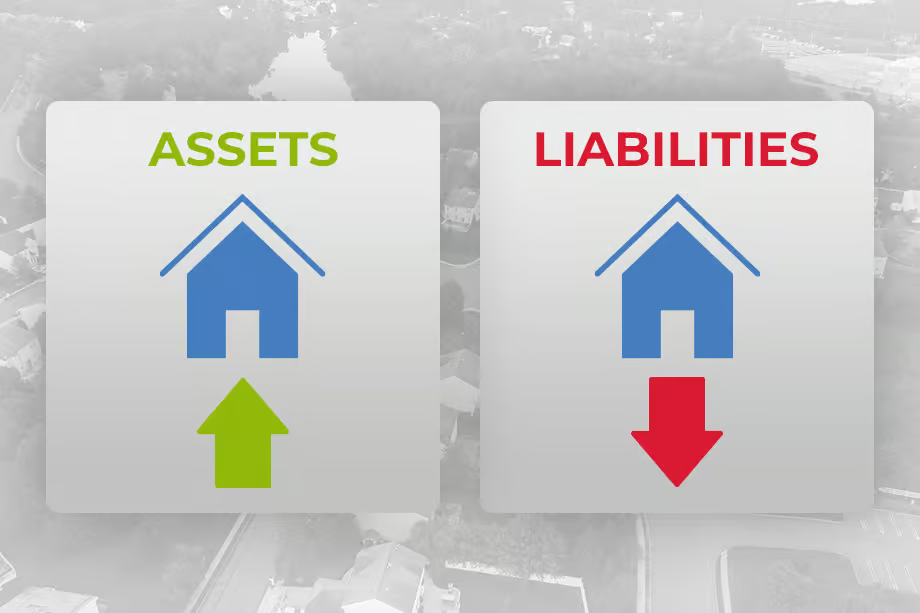
Your home may be the largest asset you own, but the number that matters for net worth is not simply the home's purchase price or today's estimated market value. You also have to account for the mortgage and any other debt secured by the property. The result is your approximate home equity—and that equity can represent a major part of household wealth.
So, does your home count toward net worth? For a standard personal net-worth calculation, generally yes.
List the home's reasonable current market value as an asset. Then list the outstanding mortgage and other property-related borrowing as liabilities.
Home Equity = Current Home Value − Mortgage and Other Home-Secured Debt
For example, if your home is worth $450,000 and you owe $280,000 on the mortgage, your approximate home equity is $170,000.
That $170,000 contributes to your overall net worth.
Table of Contents
Does Your Home Count Toward Net Worth?
For a normal household net-worth statement, your home can generally count as an asset.
However, the mortgage is a liability.
Basic Net Worth Formula
Total Assets − Total Liabilities = Net Worth
Your Home Appears on Both Sides
Asset Side
Current estimated home value:
$500,000
Liability Side
Outstanding mortgage:
$320,000
Approximate Home Equity
$500,000 − $320,000 = $180,000
The home therefore contributes approximately $180,000 to net worth before considering selling costs and other adjustments.
The Basic Home Equity Formula
Simple Version
Home Equity = Current Market Value − Outstanding Mortgage
More Complete Version
Home Equity = Current Market Value − Mortgage − HELOC − Home-Equity Loan − Other Property-Secured Debt
Example
Current home value:
$600,000
Mortgage:
$360,000
Home-equity loan:
$40,000
Approximate Equity
$600,000 − $360,000 − $40,000 = $200,000
Simple Example: How Much Does Your Home Add to Net Worth?
| Item | Amount |
|---|---|
| Current estimated home value | $450,000 |
| Mortgage balance | -$280,000 |
| Home-equity loan | $0 |
| Approximate home equity | $170,000 |
Therefore, the home contributes approximately $170,000 to the household's net worth.
Why We Say “Approximate”
The actual amount available if you sold could differ because of:
- Real-estate commissions
- Legal or closing costs
- Seller concessions
- Taxes where applicable
- Repairs
- Moving expenses
- Market price changes
How Your Home Fits Into Your Total Net Worth
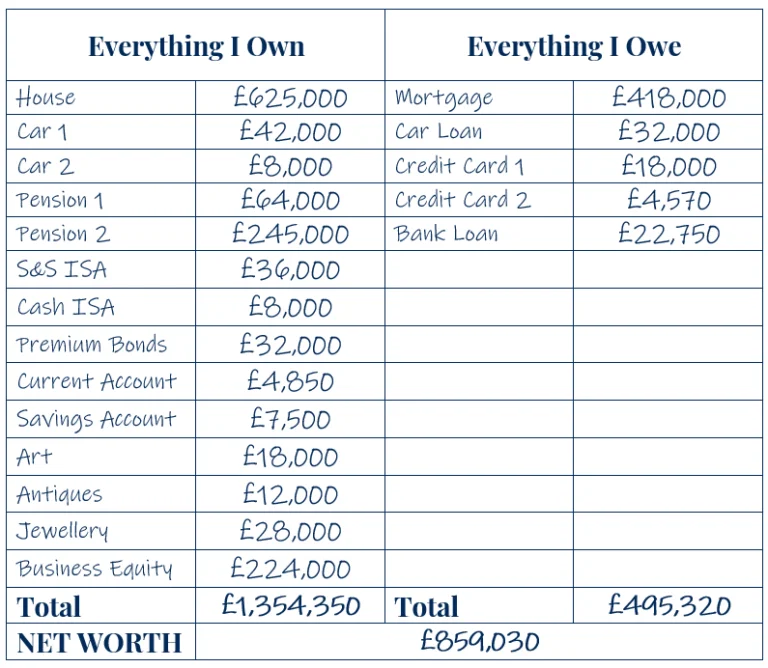
Example Household Assets
| Asset | Value |
|---|---|
| Cash and savings | $30,000 |
| 401(k) | $150,000 |
| IRA | $40,000 |
| Brokerage investments | $55,000 |
| Home | $450,000 |
| Vehicle | $25,000 |
| Total Assets | $750,000 |
Household Liabilities
| Liability | Balance |
|---|---|
| Mortgage | $280,000 |
| Vehicle loan | $10,000 |
| Student loan | $20,000 |
| Credit-card debt | $5,000 |
| Total Liabilities | $315,000 |
Total Net Worth
$750,000 − $315,000 = $435,000
How Much Comes From Home Equity?
$450,000 − $280,000 = $170,000
In this example, approximately $170,000 of the household's $435,000 net worth comes from home equity.

What Home Value Should You Use?
For a current net-worth statement, use a reasonable estimate of the home's current market value.
Possible Sources
- Recent comparable home sales
- Professional appraisal
- Real-estate agent market analysis
- Property valuation tools
- Recent purchase price if the sale was very recent
Avoid False Precision
A home does not have a perfectly known market price until an actual transaction occurs.
Therefore, it is usually better to use a reasonable conservative estimate rather than pretending the home's value is known to the exact dollar.
If several credible estimates suggest $475,000 to $500,000, consider using a reasonable conservative figure within that range rather than the highest number available.
Should You Use What You Originally Paid for the House?
Not necessarily.
Example
Original purchase price:
$250,000
Estimated current value 15 years later:
$425,000
Mortgage balance:
$120,000
Using Original Purchase Price
$250,000 − $120,000 = $130,000 equity
Using Estimated Current Value
$425,000 − $120,000 = $305,000 equity
A current net-worth statement generally aims to estimate today's financial position.
Therefore, current market value is usually more useful than a historical purchase price.
Your home's tax basis is a separate tax concept that can matter when calculating gain or other tax consequences. It is not automatically the same number you should use as current market value in a personal net-worth statement.
How Does Your Mortgage Affect Net Worth?
The outstanding mortgage balance is a liability.
Example
Home value:
$500,000
Mortgage balance:
$350,000
Approximate Equity
$150,000
Five Years Later
Suppose the home remains worth:
$500,000
But mortgage principal falls to:
$300,000
New Equity
$200,000
Even without home-price appreciation, paying down mortgage principal can increase home equity.
The portion of a mortgage payment that reduces principal improves equity. Interest, insurance, taxes and many other housing costs do not reduce the outstanding principal in the same way.
What About a Home-Equity Loan or HELOC?
A home-equity loan or outstanding home-equity line of credit generally creates another liability.
Example
Home value:
$600,000
Mortgage:
$300,000
HELOC balance:
$75,000
Approximate Home Equity
$600,000 − $300,000 − $75,000 = $225,000
Without the HELOC, equity would have been $300,000.
Therefore, borrowing against existing equity does not magically create additional wealth.
What If You Owe More Than the Home Is Worth?
This is commonly described as being underwater or having negative home equity.
Example
Current home value:
$300,000
Mortgage balance:
$325,000
Home Equity
$300,000 − $325,000 = -$25,000
The home-related portion of the balance sheet therefore contributes negative $25,000 before selling costs.
How Can Negative Equity Improve?
- Mortgage principal declines
- Home market value increases
- Extra principal payments are made
- A combination of these occurs
Home prices can fall as well as rise. A recovery plan should not depend entirely on future property appreciation.
What If Your Home Is Completely Paid Off?
If there is no mortgage or other property-secured debt, the home's full estimated current value can contribute to total net worth.
Example
Home value:
$500,000
Mortgage:
$0
Approximate Equity
$500,000
That can create a strong balance sheet.
However, you still need to distinguish property wealth from liquid wealth.
A paid-off $500,000 home does not automatically provide $500,000 of cash for everyday expenses.
Should Selling Costs Be Subtracted From Home Equity?
There are two reasonable approaches depending on what you want your net-worth statement to show.
Simple Net Worth
Market Value − Mortgage = Home Equity
This is easier to maintain and works well for routine tracking.
Conservative Liquidation Net Worth
Expected Sale Proceeds − Mortgage − Estimated Selling Costs = Net Home Value
Example
Home value:
$500,000
Mortgage:
$300,000
Hypothetical selling costs:
$30,000
Simple Equity
$200,000
Estimated Net Sale Equity
$170,000
For routine quarterly or annual tracking, simple home equity is usually easier. If you are evaluating a potential sale, downsizing decision or retirement move, estimated selling costs become more important.
Home Equity vs Liquid Net Worth
This is one of the most important distinctions in the entire article.
Household A
Home equity: $500,000
Cash: $10,000
Investments: $40,000
Total Assets Beyond Other Liabilities
A large part of this household's wealth is locked in property.
Household B
Home equity: $150,000
Cash: $50,000
Investments: $350,000
Both households may have substantial net worth.
However, Household B has far more wealth available outside the home.
Why Liquidity Matters
The CFPB has described home equity as an important source of household wealth while also noting its illiquid nature.
To access substantial equity, homeowners may need to:
- Sell the home
- Downsize
- Refinance
- Take a home-equity loan
- Use another home-equity product
Does Home Equity Count Toward Retirement Wealth?
It counts toward total net worth.
However, retirement planning should separate home equity from investable assets and expected income.
Example
Household net worth:
$1,000,000
Home equity:
$700,000
Cash and investments:
$300,000
Calling this household a “millionaire” by total net worth may be technically accurate under a basic personal balance-sheet calculation.
However, only $300,000 sits outside the home in this simplified example.
Retirement Questions to Ask
- Will you stay in the home?
- Will you downsize?
- Will the mortgage be paid off?
- How much will property taxes cost?
- What about maintenance?
- How much investable wealth do you have outside the home?
- What income will Social Security or pensions provide?

Important Exception: Some Regulatory Net Worth Tests Exclude Your Primary Residence
Do not assume every use of the words “net worth” follows exactly the same rules.
For ordinary household financial tracking, a home can generally be included as an asset.
However, certain regulatory tests use special definitions.
Accredited Investor Example
Under the SEC's accredited-investor net-worth test, the value of a person's primary residence is generally excluded.
Mortgage treatment also follows specific rules for that test.
Why This Matters
Suppose your household balance sheet shows:
$1.2 million total personal net worth including $500,000 of home equity
That does not automatically mean you satisfy a $1 million regulatory net-worth test that excludes your primary residence.
A personal financial statement, lending application, regulatory investment test, bankruptcy calculation and estate-planning document may treat certain assets and liabilities differently.
MoneyOnliners Original Analysis: The Home Equity Strength Framework
1. Value
What is the home's reasonable current market value?
2. Equity
How much remains after all property-secured debt is subtracted?
3. Liquidity
How easily can that equity be converted into usable financial resources?
4. Cost
How much does the home require each year for:
- Mortgage interest
- Property taxes
- Insurance
- Repairs
- Maintenance
- Utilities
- Association fees where applicable
The MoneyOnliners Home Equity Ratio
MoneyOnliners Home Wealth Scorecard
| Question | Why It Matters |
|---|---|
| Do you know the current estimated value? | Prevents outdated net-worth calculations |
| Do you know the exact mortgage balance? | Measures current liability accurately |
| Do you have a HELOC or second mortgage? | Prevents overstating equity |
| Is equity increasing? | Shows balance-sheet progress |
| Could you afford the home after an income shock? | Measures resilience |
| Is most of your net worth in the home? | Highlights concentration and liquidity risk |
| Are maintenance costs manageable? | Measures cash-flow sustainability |
| Does the home fit your retirement plan? | Connects property wealth with future spending |
10 Mistakes When Counting a Home Toward Net Worth
1. Counting the Full Home Value but Ignoring the Mortgage
This can dramatically overstate net worth.
2. Using the Original Purchase Price Forever
A current net-worth statement should generally reflect a reasonable current value.
3. Using the Highest Online Estimate Available
Property estimates are imperfect.
4. Forgetting a HELOC
An outstanding HELOC reduces equity.
5. Forgetting a Second Mortgage
All relevant property-secured liabilities should be included.
6. Treating Mortgage Payments as the Liability
Use the outstanding principal balance rather than the monthly payment.
7. Treating Home Equity Like Cash
Property is less liquid than money in a bank account.
8. Assuming House Prices Only Rise
Real-estate values can decline.
9. Ignoring Selling Costs When Planning a Sale
The amount received after selling may be lower than simple equity.
10. Applying Ordinary Net Worth Rules to a Special Regulatory Test
Some financial or regulatory calculations may exclude a primary residence.
Always ask why the net-worth calculation is being performed. Household financial tracking and regulatory eligibility calculations can use different rules.
Why Understanding Whether Your Home Counts Toward Net Worth Matters
1. A home can represent one of a household's largest assets.
2. The mortgage is a separate liability.
3. Home equity is the difference between value and related debt.
4. Paying mortgage principal can increase equity.
5. Home-price appreciation can increase equity.
6. Falling property values can reduce equity.
7. A HELOC can reduce the equity remaining in the property.
8. A second mortgage also affects the calculation.
9. A paid-off home can contribute its full estimated value to ordinary personal net worth.
10. Home equity is less liquid than cash.
11. High home equity does not automatically mean high retirement liquidity.
12. Two households with the same net worth can have very different financial flexibility.
13. Selling costs can reduce the cash ultimately realized from equity.
14. Housing expenses continue even after a mortgage is paid off.
15. A home can improve net worth while still creating high monthly costs.
16. An underwater mortgage creates negative home equity.
17. Conservative property valuations can make net-worth tracking more credible.
18. Total net worth and liquid net worth should often be tracked separately.
19. Certain regulatory tests may exclude a primary residence even though ordinary personal net worth includes it.
20. Ultimately, understanding does your home count toward net worth helps you distinguish the home's headline market value from the equity you actually own and the liquidity available elsewhere in your financial life.
Incoming Link Opportunities
How to Calculate Your Net Worth in 5 Simple Steps
https://moneyonliners.com/how-to-calculate-net-worth/
Assets vs Liabilities: 25 Real-Life Examples That Affect Your Net Worth
https://moneyonliners.com/assets-vs-liabilities/
What Should Your Net Worth Be at 30, 40, 50 and 60?
https://moneyonliners.com/net-worth-by-age/
15 Ways to Increase Your Net Worth Without Becoming a Millionaire Overnight
https://moneyonliners.com/increase-your-net-worth/
Net Worth vs Income: Which Number Matters More for Building Wealth?
https://moneyonliners.com/net-worth-vs-income/
High-Priority Incoming Links
20 Assets That Can Help Build Wealth Over the Long Term
https://moneyonliners.com/assets-that-build-wealth/
Your First $100,000: Why This Wealth Milestone Can Be So Powerful
https://moneyonliners.com/first-100000-wealth-milestone/
Negative Net Worth? 10 Steps That Can Help You Turn It Around
https://moneyonliners.com/negative-net-worth/
15 Wealth-Building Strategies That Can Grow Your Money Over Time
https://moneyonliners.com/wealth-building-strategies/
Topic Cluster Incoming Links
Income vs Wealth: 10 Differences That Explain Why a High Salary Isn't Everything
https://moneyonliners.com/income-vs-wealth/
Saving vs Building Wealth: Why Saving Money Alone May Not Be Enough
https://moneyonliners.com/saving-vs-building-wealth/
How Long Does It Take to Build Wealth? 8 Factors That Matter Most
https://moneyonliners.com/how-long-does-it-take-to-build-wealth/
Building Wealth in Your 20s, 30s, 40s and 50s: What Changes?
https://moneyonliners.com/building-wealth-by-age/
Continue Learning on MoneyOnliners
Recommended External Resources
1. Investor.gov — Figure Out Your Finances
Figure Out Your Finances — Investor.gov
Explains assets, liabilities and the standard personal net-worth calculation.
2. CFPB — Home Equity Contracts Market Overview
Home Equity Contracts: Market Overview — CFPB
Explains the importance of home equity as household wealth and discusses its relatively illiquid nature.
3. IRS — Tax Information for Homeowners
Publication 530: Tax Information for Homeowners — IRS
Official U.S. information covering home basis, property taxes, mortgage interest and homeowner recordkeeping.
4. IRS — Home Mortgage Interest Deduction
Publication 936: Home Mortgage Interest Deduction — IRS
Official guidance for homeowners reviewing U.S. mortgage-interest rules.
5. Investor.gov — Accredited Investors
Accredited Investors — Investor.gov
Explains the special SEC net-worth calculation in which a primary residence is generally excluded.
6. Investor.gov — Regulation Crowdfunding Investor Guidance
Regulation Crowdfunding for Investors — Investor.gov
Provides another example of a regulatory net-worth calculation that treats a primary residence differently.
7. Consumer Financial Protection Bureau — Mortgages
Mortgages — Consumer Financial Protection Bureau
Consumer resources covering mortgage shopping, home loans and homeowner protections.
8. Consumer Financial Protection Bureau — Financial Well-Being
Useful context for understanding why household wealth should be considered alongside liquidity and financial resilience.
9. Investor.gov — Build Wealth Over Time
Build Wealth Over Time Through Saving and Investing — Investor.gov
Explains saving, investing, diversification and debt management as parts of long-term wealth building.
10. Federal Trade Commission — How to Avoid a Scam
How to Avoid a Scam — Federal Trade Commission
Consumer-protection guidance for safeguarding property, cash and other financial assets.
MoneyOnliners prioritizes government agencies and regulators for mortgage, tax, net-worth and consumer-protection guidance.
This article provides general educational information and is not individualized financial, mortgage, real-estate, tax, investment, accounting or legal advice. Home values, transaction costs, mortgage balances, tax consequences and local property rules vary.
Frequently Asked Questions
Does your home count toward net worth?
Generally, yes for a standard personal net-worth statement.
The home is an asset.
Your mortgage is a liability.
The difference contributes to your net worth.
Special-purpose regulatory calculations may use different rules.
How do I calculate my home's contribution to net worth?
Start with a reasonable current market value.
Then subtract your mortgage balance.
Also subtract a HELOC or home-equity loan if applicable.
Home Value − Home-Secured Debt = Approximate Home Equity
That equity contributes to ordinary household net worth.
Is home equity the same as net worth?
No.
Home equity is only one component of net worth.
You may also own cash, retirement accounts and investments.
Likewise, you may have student loans or credit-card debt.
All meaningful assets and liabilities should be considered.
Does the mortgage reduce net worth?
Yes.
The mortgage is a liability.
As principal is repaid, that liability declines.
If the home's value stays constant, declining mortgage principal increases equity.
Home prices can also change independently.
Does paying off my mortgage increase net worth?
Principal repayment reduces a liability.
Therefore, it can strengthen home equity.
However, if the payment comes from existing cash, one asset is also being reduced as the liability falls.
The complete balance-sheet effect depends on where the money comes from.
Future interest savings can improve cash flow as well.
Does a paid-off house count fully toward net worth?
For ordinary personal net-worth tracking, generally yes.
If the home is worth $500,000 and no secured debt remains, approximately $500,000 appears on the asset side.
However, selling costs may reduce eventual cash proceeds.
The home is also illiquid compared with cash.
Therefore, total and liquid net worth are different.
Should I subtract real-estate commissions from net worth?
You can, but you do not always need to.
A simple personal net-worth statement often uses current home value minus debt.
A conservative liquidation estimate can subtract expected sale costs.
The best method depends on the purpose of the calculation.
Use the same methodology consistently when tracking changes over time.
Should I use Zillow or another automated home estimate?
An automated estimate can provide a starting point.
However, it is still an estimate.
Recent comparable sales and professional valuation may improve accuracy.
Avoid treating one automated estimate as an exact sale price.
Conservative estimates can make net-worth tracking more credible.
Does a HELOC reduce net worth?
An outstanding HELOC is a liability.
Therefore, it reduces the equity remaining in the home.
Borrowing $50,000 against home equity does not automatically create $50,000 of new wealth.
It creates cash or another asset while creating additional debt.
Track both sides of the transaction.
What happens if my mortgage is bigger than my home's value?
You have negative home equity.
For example, a $300,000 home with a $325,000 mortgage has approximately negative $25,000 equity.
Mortgage principal reduction can improve the position.
Higher future home values could also help.
However, appreciation is not guaranteed.
Is my home a liquid asset?
Not in the same way as cash.
Selling a home takes time and usually involves transaction costs.
Borrowing against the property creates debt.
Therefore, home equity is relatively illiquid.
Track liquid assets separately when useful.
Should my home count toward retirement savings?
It counts toward total net worth.
However, it should not automatically be treated as though it were an investment account available for retirement withdrawals.
You may need to sell, downsize or borrow against the property to access substantial equity.
Retirement planning should therefore distinguish home equity from investable assets.
Future housing needs also matter.
Can I be a millionaire mostly because of my house?
Under a basic household net-worth calculation, yes.
For example, $800,000 of home equity plus $250,000 of other net assets would produce $1.05 million net worth.
However, most of that wealth would be illiquid.
A regulatory definition of millionaire or accredited investor may also use different rules.
Always check the context.
Does home appreciation increase net worth?
Generally, yes if the home's current value increases while related liabilities remain unchanged.
For example, a $50,000 rise in home value can increase home equity by approximately $50,000 before transaction costs.
However, market values can also decline.
Do not assume future appreciation.
Update estimates periodically.
Why would a regulatory net-worth test exclude my house?
Some regulations use special definitions for specific purposes.
The SEC accredited-investor test is one example.
Its rules generally exclude the value of a primary residence.
This does not mean your home has no value in ordinary personal finance.
It means the regulatory test follows a different definition.
Research Methodology
How Home Equity Was Defined
MoneyOnliners uses the standard household approach of treating a home's reasonable current value as an asset while treating associated mortgage debt as a liability.
Primary Net Worth Framework
Investor.gov describes net worth as the difference between what you own and what you owe.
Why Home Equity Was Included
Home equity represents the difference between property value and debt secured against that value.
CFPB research describes home equity as a significant source of household wealth.
Why Liquidity Was Discussed
The CFPB also notes that home equity is illiquid.
Therefore, total net worth can overstate immediately accessible financial resources if much of the household's wealth sits in the primary residence.
How Home Values Were Treated
The article recommends reasonable current-market estimates rather than automatically using original purchase prices.
Why Selling Costs Were Discussed
A routine balance-sheet estimate and a liquidation-value calculation answer slightly different questions.
Therefore, the article distinguishes simple home equity from estimated net sale proceeds.
Why Regulatory Exceptions Were Included
Investor.gov materials show that certain SEC net-worth tests exclude a primary residence.
This is included so readers do not incorrectly assume that every legal or regulatory definition of net worth matches ordinary household accounting.
Tax Sources
IRS Publications 530 and 936 were included for readers who need official U.S. information about homeowner basis, property taxes and mortgage-interest rules.
Original MoneyOnliners Analysis
The Home Equity Strength Framework, Home Equity Ratio and Home Wealth Scorecard are original MoneyOnliners educational resources.
First-Hand Evidence Standard
MoneyOnliners only uses first-hand property values, mortgage balances, screenshots, purchase documents or homeowner experiences when they are genuinely available and can be represented accurately.
No personal home valuation or mortgage result is claimed in this article.
Limitations
Home values fluctuate.
Online estimates can be inaccurate.
Selling costs vary by location and transaction.
Mortgage and tax rules can change.
Therefore, examples in this article are educational illustrations rather than property valuations or financial forecasts.
Google Search Console Checklist
- Confirm final URL: /does-home-count-toward-net-worth/
- Confirm canonical matches the published URL.
- Use does your home count toward net worth naturally in the title, introduction, FAQ and conclusion.
- Use related phrases naturally: does house count in net worth, home equity net worth, mortgage and net worth, paid-off house net worth and home value minus mortgage.
- Use a real home as the hero image.
- Use family/home imagery in household-balance-sheet sections.
- Use retirement-age imagery in the retirement section.
- Avoid generic calculator images throughout the article.
- Keep every image alt description unique.
- Confirm Recommended External Resources contains 6–10 authoritative links.
- Confirm Investor.gov regulatory exception wording remains accurate during future updates.
- Confirm IRS homeowner resources remain current.
- Confirm all internal links point to live canonical URLs.
- Check home-equity calculation tables on mobile.
- Confirm the article is indexable.
- Confirm the URL appears in the XML sitemap.
- Inspect the published URL in Google Search Console.
- Request indexing after publication if appropriate.
- Monitor searches such as “does your home count toward net worth,” “does house count toward net worth,” “home equity and net worth,” “mortgage net worth calculation,” “paid off house net worth,” and “should home equity count toward retirement.”
Conclusion: Your Home Can Count Toward Net Worth—but Count the Equity, Not Just the House
So, does your home count toward net worth?
For an ordinary personal net-worth statement, generally yes.
The Home Is an Asset
Use a reasonable current market value.
The Mortgage Is a Liability
Use the outstanding loan balance.
Include Other Home-Secured Debt
A HELOC or home-equity loan also reduces the equity remaining.
Calculate Home Equity
Home Value − Home-Secured Debt = Approximate Home Equity
Remember Liquidity
A $500,000 home is not the same as $500,000 sitting in a bank or brokerage account.
Remember Selling Costs
The amount actually received after selling may be lower than simple equity.
Remember Special Definitions
Certain regulatory net-worth tests may exclude your primary residence even though your ordinary household balance sheet includes it.
Track the Bigger Picture
Home equity can be a powerful component of wealth.
However, retirement accounts, savings, investments, debt and liquidity matter too.