Income vs Wealth: 10 Differences That Explain Why a High Salary Isn’t Everything
Income vs Wealth: 10 Differences That Explain Why a High Salary Isn't Everything
A large salary can make life easier, but income alone does not tell you how financially strong someone is. One person can earn $150,000 a year and own very little after debt and spending, while another can earn $80,000, consistently buy assets and gradually build substantial net worth. Income creates opportunity. Wealth shows how much of that opportunity has been converted into lasting financial resources.
The main difference in income vs wealth is that income measures money received over a period of time, while wealth generally refers to the value of assets you own after subtracting liabilities.
A high income can help you build wealth faster. However, it does not guarantee wealth because taxes, debt, housing, lifestyle spending and poor financial decisions can consume most of the money. Meanwhile, a person with a more moderate income can still build substantial wealth by maintaining a financial surplus, investing consistently and owning productive assets over time.
Table of Contents
Income vs Wealth: Quick Comparison
| Feature | Income | Wealth |
|---|---|---|
| What it measures | Money received over time | Accumulated financial resources |
| Examples | Salary, wages, business income, interest, rent | Investments, cash, business equity, property equity and other assets minus liabilities |
| Time frame | Usually monthly or annual | Measured at a point in time |
| Can be high with low net worth? | Yes | Not applicable |
| Can generate future income? | Not by itself | Some wealth-producing assets can |
| Depends on employment? | Often | Not necessarily |
| Can survive job loss? | Employment income may stop | Existing assets remain, although values can change |
| Main long-term goal | Increase earning capacity | Increase assets and financial resilience |
1 Income Is a Flow; Wealth Is an Accumulated Position
Income is typically measured over a period such as a month or year.
Examples of Income
- Salary
- Hourly wages
- Freelance income
- Business profit
- Interest
- Rental income
- Dividends
Wealth, by contrast, is usually measured at a specific point in time.
Simple Net Worth Formula
Total Assets − Total Liabilities = Net Worth
Example
Assets:
$450,000
Liabilities:
$150,000
Net worth:
$300,000
Therefore, salary and net worth answer different financial questions.
2 A High Salary Does Not Tell You What Someone Owns
Imagine two workers.
Worker A
Salary: $180,000
Investments: $20,000
Cash: $10,000
Debt: $120,000
Worker B
Salary: $90,000
Investments: $350,000
Cash: $30,000
Debt: $60,000
Worker A earns twice as much.
However, Worker B owns substantially more financial assets relative to debt.
Approximate Net Worth
| Worker | Assets | Debt | Approximate Net Worth |
|---|---|---|---|
| A | $30,000 | $120,000 | -$90,000 |
| B | $380,000 | $60,000 | $320,000 |
As a result, salary alone gives an incomplete picture of financial strength.

3 Wealth Is Built Around Assets
Income is valuable because it gives you purchasing power.
However, wealth becomes stronger when some of that purchasing power is used to acquire assets.
Potential Wealth-Building Assets Include
- Cash reserves
- Stocks
- ETFs
- Index funds
- Bonds
- Retirement investments
- Business ownership
- Real estate equity
- Income-producing property
- Intellectual property
The Conversion Process
Income → Financial Surplus → Asset Ownership → Potential Wealth Growth
Therefore, the key question is not simply how much you earn.
A better question is how much of your income eventually becomes productive ownership.
4 Debt Can Create a Huge Gap Between Income and Wealth
Debt is one of the clearest reasons income and wealth can move in different directions.
Example
Annual salary:
$140,000
But the household has:
- $45,000 credit-card and personal-loan debt
- $35,000 vehicle debt
- A large mortgage
- Minimal investments
The household appears high-income.
Nevertheless, required debt payments may consume much of the available cash flow.
Another Household
Annual income:
$80,000
But it has:
- No revolving consumer debt
- Emergency savings
- $250,000 invested
- Growing home equity
The second household may have substantially stronger net worth despite earning less.
Income expands financial capacity. Debt determines how much of that capacity has already been promised to someone else.
5 Lifestyle Inflation Can Consume a High Salary
Higher income often leads to higher spending.
Some lifestyle improvement is reasonable.
However, wealth can stagnate when every raise automatically creates a more expensive lifestyle.
Example
Income rises from:
$80,000 → $120,000
But annual spending rises from:
$70,000 → $110,000
Financial Surplus Before Raise
$10,000
Financial Surplus After Raise
$10,000
Income increased by $40,000, yet wealth-building capacity did not improve.
Alternative
Suppose spending rises only to $90,000.
$120,000 − $90,000 = $30,000 potential surplus
Consequently, the same salary can create very different wealth outcomes depending on spending behavior.
6 Wealth Can Eventually Produce Income of Its Own
Employment income usually requires continued work.
Some assets can generate income without requiring the same direct relationship between hours worked and money received.
Examples
- Bond interest
- Bank interest
- Stock dividends
- Rental income
- Business distributions
- Royalties
Simple Illustration
Investment assets:
$500,000
Hypothetical annual income generated:
$15,000
That income could supplement employment earnings.
Over time, a sufficiently large asset base could potentially cover an increasing share of living expenses.
Investment income is not guaranteed. Dividends can be reduced, businesses can lose money, rental properties can experience vacancies and investment values can fall.
7 Income Can Disappear Faster Than Wealth
A high-paying job can feel permanent while it exists.
However, employment income can stop because of:
- Layoffs
- Business closures
- Industry changes
- Career changes
- Retirement
Existing assets do not automatically disappear when employment stops.
Their values can fluctuate, but they remain part of the household balance sheet.
Example
A worker earning $170,000 with only $10,000 in savings may experience severe financial pressure after a job loss.
Meanwhile, another worker earning $90,000 with:
- $40,000 emergency savings
- $400,000 invested
- Low monthly debt payments
may have substantially more time and flexibility after losing employment.
A high income can improve your present. Accumulated assets can help protect your future when income changes.
8 Wealth Can Create More Financial Optionality
One of the most important differences between income and wealth is choice.
A person with a high salary but very high expenses may still need every paycheck.
Meanwhile, a person with substantial assets and modest expenses may have more flexibility.
Wealth Can Potentially Make It Easier to
- Change jobs
- Take a career break
- Start a business
- Work fewer hours
- Retire
- Help family
- Move to another location
- Handle financial emergencies
This connects closely with broader financial well-being.
Financial security is not simply about earning the largest possible salary. It is also about having enough resilience and financial freedom to make choices.
9 Taxes Affect Income and Wealth in Different Ways
A high salary does not mean every dollar becomes spendable income.
Taxes may substantially reduce gross earnings.
Meanwhile, different assets can receive different tax treatment depending on the account, investment, transaction and jurisdiction.
Examples Can Include
- Ordinary employment income
- Capital gains
- Interest
- Dividends
- Traditional retirement-account withdrawals
- Qualified Roth distributions
- Property income
Retirement Accounts
For 2026, eligible U.S. workers can defer up to $24,500 into many 401(k), 403(b) and governmental 457 plans under the standard employee elective-deferral limit.
The 2026 IRA contribution limit is $7,500, with additional catch-up capacity for eligible savers age 50 and older.
Therefore, tax-advantaged accounts can help high earners and moderate earners convert current income into long-term assets more efficiently when appropriate.
Account eligibility, deductions, Roth limits and taxation differ by household. Verify current IRS guidance or consult a qualified tax professional for individualized decisions.
10 You Can Build Wealth Without an Extraordinary Salary
A large income can accelerate wealth building.
Nevertheless, it is not the only variable.
Other Important Factors Include
- Savings rate
- Debt level
- Time
- Investment contributions
- Investment returns
- Housing costs
- Fees
- Taxes
- Lifestyle inflation
Example
Annual income:
$70,000
Annual amount invested:
$12,000
Ten Years of Contributions Alone
$120,000
That excludes investment gains or losses.
Meanwhile, if the contribution eventually increases as income grows, asset accumulation could accelerate further.
A high salary gives you more wealth-building potential. Consistently converting income into assets determines how much of that potential becomes lasting wealth.

Three Income vs Wealth Examples
Example 1: High Income, Low Wealth
Annual income:
$200,000
Annual spending:
$185,000
Investments:
$25,000
Consumer debt:
$40,000
This person earns a great deal of money but retains relatively little financial capacity.
Example 2: Moderate Income, Growing Wealth
Annual income:
$85,000
Annual spending:
$60,000
Annual investing:
$15,000
Emergency savings:
$25,000
Investments:
$300,000
This household earns less but has converted more past income into lasting assets.
Example 3: High Income and High Wealth
Annual income:
$180,000
Annual investing:
$45,000
Investment portfolio:
$900,000
Low consumer debt.
Strong emergency reserves.
A high salary and disciplined asset accumulation can work together.
Key lesson: The problem is not high income. The problem is assuming high income automatically equals wealth.
MoneyOnliners Original Analysis: The Income-to-Wealth Conversion Framework
Stage 1: Earn
Income provides the raw material.
Stage 2: Retain
Some income must remain after taxes and spending.
Stage 3: Protect
Emergency savings and sensible risk management reduce the chance that financial shocks destroy progress.
Stage 4: Invest
A portion of the retained income can be directed toward productive assets.
Stage 5: Own
Over time, assets accumulate and may create income, appreciation or financial flexibility.
The MoneyOnliners Wealth Conversion Ratio
MoneyOnliners Income vs Wealth Strength Matrix
| Financial Position | Income | Assets | Interpretation |
|---|---|---|---|
| High income / low assets | High | Low | Strong earning power but weak conversion into wealth |
| Moderate income / high assets | Moderate | High | Strong historical saving and ownership |
| High income / high assets | High | High | Strong earning and accumulation system |
| Low income / low assets | Low | Low | Priority may be increasing earning power and financial stability |
Income-to-Wealth Scorecard
| Question | Healthy Direction |
|---|---|
| Is income increasing over time? | Yes, where realistic |
| Is spending rising slower than income? | Preferably |
| Is high-interest debt declining? | Yes |
| Are emergency savings available? | Yes |
| Are retirement contributions increasing? | Ideally as capacity improves |
| Are productive assets growing? | Yes |
| Is net worth moving in a stronger direction? | Over the long term |
| Are investment fees understood? | Yes |
| Could the household handle an income interruption? | Increasingly |
| Is work becoming less financially mandatory? | Potentially over time |
This scorecard is an original MoneyOnliners educational framework rather than a personalized financial assessment.
MoneyOnliners Research-Based Evidence Note
This article is a research-based income and wealth education guide.
MoneyOnliners does not claim that hypothetical salaries, debt balances, net-worth amounts or investment examples in this article represent personal results achieved by MoneyOnliners or its editorial team.
The definition of net worth is aligned with Investor.gov's educational explanation that assets minus liabilities determine net worth.
The broader distinction between income and financial well-being is informed by CFPB research explaining that people with similar incomes can experience very different levels of financial security and freedom of choice.
Current 2026 retirement-account contribution figures are based on IRS guidance.
MoneyOnliners does not fabricate portfolio balances, salary histories, personal screenshots or wealth testimonials.
The Income-to-Wealth Conversion Framework, Wealth Conversion Ratio and Income vs Wealth Strength Matrix are original MoneyOnliners analytical resources designed to make the topic more practical and citeable.
10 Mistakes High Earners Can Make That Slow Wealth Building
1. Assuming Salary Equals Wealth
Earnings and accumulated assets are different measurements.
2. Expanding Lifestyle With Every Raise
This can prevent savings capacity from improving.
3. Buying Too Much House
Large mortgage, tax, insurance and maintenance costs can absorb substantial income.
4. Financing Expensive Vehicles Repeatedly
Recurring vehicle debt can consume thousands of dollars annually.
5. Carrying Credit-Card Debt
High interest can work directly against wealth accumulation.
6. Ignoring Retirement Accounts
High earners who fail to invest can finish their careers with far fewer assets than expected.
7. Concentrating Investments
A large salary does not protect a concentrated portfolio from major investment losses.
8. Ignoring Taxes and Fees
What matters is not simply what you earn or what an investment returns, but how much remains afterward.
9. Keeping No Emergency Reserve
A high salary does not guarantee that the next paycheck will always arrive.
10. Trying to Look Wealthy
Visible consumption can increase while actual net worth remains weak.
Do not confuse financial appearance with financial strength. Expensive homes, cars, clothing or vacations may indicate high spending capacity, but they do not reveal debt, savings, investment assets or net worth.
Incoming Link Opportunities
15 Wealth-Building Strategies That Can Grow Your Money Over Time
https://moneyonliners.com/wealth-building-strategies/
How to Build Wealth From Nothing: 10 Steps for Beginners
https://moneyonliners.com/how-to-build-wealth-from-nothing/
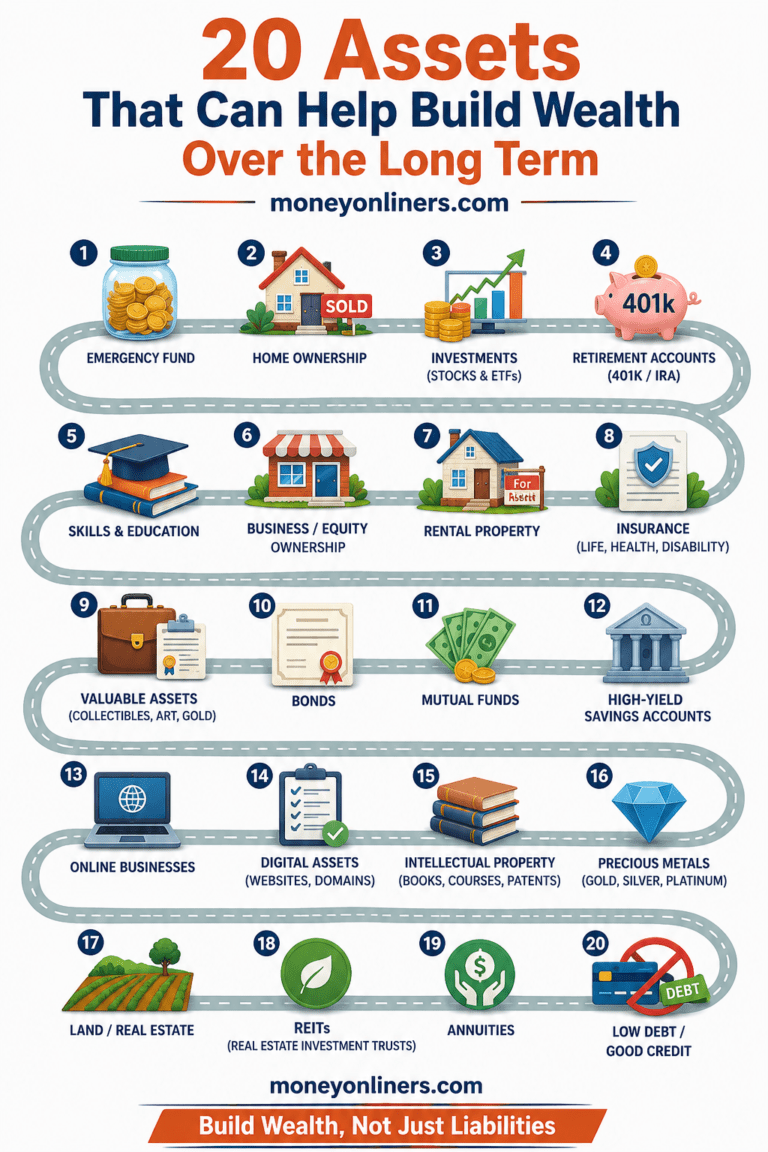
20 Assets That Can Help Build Wealth Over the Long Term
https://moneyonliners.com/assets-that-build-wealth/
10 Wealth-Building Habits That Can Make a Big Difference Over 10 Years
https://moneyonliners.com/wealth-building-habits/
Building Wealth in Your 20s, 30s, 40s and 50s: What Changes?
https://moneyonliners.com/building-wealth-by-age/
Why Understanding Income vs Wealth Matters
1. Income measures money received, while wealth reflects accumulated financial resources.
2. A high salary does not reveal how much someone owns.
3. Net worth is influenced by both assets and liabilities.
4. High-interest debt can weaken wealth even when earnings are substantial.
5. Lifestyle inflation can consume most of the financial benefit of a raise.
6. A moderate salary can still support meaningful wealth accumulation.
7. Productive assets can potentially generate future income.
8. Employment income can disappear after job loss or retirement.
9. Accumulated assets can provide financial resilience during income interruptions.
10. Wealth can create greater career and lifestyle flexibility.
11. Emergency savings form part of financial resilience even though they may not produce high returns.
12. Retirement contributions convert current earnings into long-term assets.
13. Investment fees affect how much potential return remains invested.
14. Housing decisions can influence whether income becomes wealth or recurring expense.
15. Taxes affect gross income and spendable income differently.
16. Consistent asset ownership can become more important than displaying a high-consumption lifestyle.
17. Wealth can eventually produce some income independently of employment.
18. Net worth can increase even when income is not extraordinary.
19. The strongest financial position combines useful earning power with disciplined asset accumulation.
20. Ultimately, understanding income vs wealth helps explain why the amount appearing on a paycheck matters less than how effectively that income is converted into assets, resilience and financial freedom over time.
High-Priority Incoming Links
15 Wealth-Building Strategies That Can Grow Your Money Over Time
https://moneyonliners.com/wealth-building-strategies/
10 Wealth-Building Habits That Can Make a Big Difference Over 10 Years
https://moneyonliners.com/wealth-building-habits/
20 Assets That Can Help Build Wealth Over the Long Term
https://moneyonliners.com/assets-that-build-wealth/
Financial Independence: 10 Steps to Take More Control of Your Money and Future
https://moneyonliners.com/financial-independence/
Topic Cluster Incoming Links
Building Wealth in Your 20s, 30s, 40s and 50s: What Changes?
https://moneyonliners.com/building-wealth-by-age/
Investing for Beginners: 10 Simple Steps to Start Building Wealth
https://moneyonliners.com/investing-for-beginners/
Saving vs Investing: Where Should Your Next $1,000 Actually Go?
https://moneyonliners.com/saving-vs-investing-next-1000/
Active Income vs Passive Income: What Beginners Need to Know
https://moneyonliners.com/active-income-vs-passive-income/
Continue Learning on MoneyOnliners
Recommended External Resources
1. Investor.gov — Figure Out Your Finances
Figure Out Your Finances — Investor.gov
Explains how to create a net-worth statement by listing assets, liabilities, income and expenses.
2. Consumer Financial Protection Bureau — Financial Well-Being
Why Financial Well-Being Matters — CFPB
Explains why income alone does not fully describe financial security, resilience or freedom of choice.
3. Investor.gov — Introduction to Investing
Introduction to Investing — Investor.gov
Provides beginner education on saving, investing, risk and long-term asset ownership.
4. Investor.gov — Diversify Your Investments
Diversify Your Investments — Investor.gov
Explains why diversification can reduce concentration risk while not eliminating investment losses.
5. Investor.gov — Understanding Fees
Understanding Investment Fees — Investor.gov
Useful for understanding how recurring investment costs can reduce long-term portfolio growth.
6. IRS — 2026 Retirement Contribution Limits
2026 401(k) and IRA Contribution Limits — IRS
Official 2026 limits for 401(k)s, IRAs and applicable catch-up contributions.
7. IRS — Retirement Plan Contributions
Retirement Topics: Contributions — IRS
Official guidance covering contribution limits across retirement-plan types.
8. IRS — IRA Contribution Limits
Explains annual Traditional and Roth IRA contribution limits.
9. Consumer Financial Protection Bureau — Savings
Consumer resources for building savings and improving financial resilience.
10. Federal Trade Commission — Scams
Scams — Federal Trade Commission
Consumer-protection information for identifying financial and investment scams that can destroy accumulated wealth.
MoneyOnliners prioritizes government agencies and financial regulators for investment education, retirement-account rules and consumer protection. Because tax and contribution rules can change, verify current official guidance before making financial decisions.
This article provides general educational information and is not individualized financial, investment, tax, retirement, legal or insurance advice. Income, taxes, investment returns, property values and household circumstances vary, and no strategy guarantees wealth.
Frequently Asked Questions
What is the difference between income and wealth?
Income is money received over a period of time.
For example, salary is income.
Wealth is more closely connected to accumulated assets and liabilities.
Therefore, someone can have high income but low net worth.
Likewise, someone with moderate income can accumulate substantial wealth.
Does a high salary mean you are wealthy?
No.
A high salary gives you strong earning power.
However, debt and spending can consume most of that income.
Assets determine more of the long-term wealth picture.
Therefore, salary should not be used alone to measure financial strength.
What is net worth?
Net worth is generally calculated by subtracting liabilities from assets.
Assets include things you own that have financial value.
Liabilities include debts you owe.
For example, $500,000 of assets minus $200,000 of liabilities creates $300,000 of net worth.
Net worth can be positive or negative.
Can you be wealthy on an average income?
Potentially.
A moderate-income household can consistently save and invest.
Debt can remain low.
Assets can grow over time.
Therefore, wealth is not restricted only to extremely high earners.
Why are some high earners not wealthy?
Their expenses may also be high.
Large mortgages can consume cash flow.
Consumer debt can reduce net worth.
Lifestyle inflation can absorb raises.
Consequently, high earnings may never become accumulated assets.
Is net worth more important than salary?
They measure different things.
Salary measures earning power.
Net worth measures accumulated assets minus liabilities.
Both can be useful.
For long-term financial strength, however, net worth often provides information that salary alone cannot.
How does income become wealth?
First, income must exceed spending.
Next, part of the surplus can be saved or invested.
Then assets can potentially grow or produce income.
Meanwhile, reducing debt can improve net worth.
Over time, this process can convert earnings into wealth.
Should I focus on earning more or investing more?
Both can matter.
Higher income expands potential savings capacity.
Investing converts some of that capacity into productive assets.
Therefore, income growth and investing can work together.
A larger salary is most powerful when part of it is retained.
Can wealth generate income?
Some assets can.
Bonds can pay interest.
Stocks can pay dividends.
Rental property can produce rent.
However, none of those income sources is automatically guaranteed.
Does owning a home make you wealthy?
Not automatically.
Home equity can contribute to net worth.
However, mortgages, taxes, insurance and maintenance matter.
Property values can also fall.
Therefore, housing should be evaluated within the whole financial plan.
What is lifestyle inflation?
Lifestyle inflation occurs when spending increases as income rises.
For example, raises may lead to a larger home, more expensive vehicle and higher recurring expenses.
Some lifestyle improvement is reasonable.
However, if every raise is consumed, wealth-building capacity may not improve.
Splitting future raises between lifestyle and assets can help.
How can I measure whether I am becoming wealthier?
Track net worth periodically.
Review total assets.
Subtract total liabilities.
Then compare the long-term trend.
Because investments fluctuate, focus on direction over years rather than every short-term movement.
Should high earners invest more?
Higher earnings can create more contribution capacity.
However, taxes and household obligations matter.
Emergency savings and debt matter too.
Nevertheless, increasing investments when income rises can help convert career success into lasting assets.
The appropriate amount is individual.
Can someone have high wealth and low current income?
Yes.
A retiree may no longer earn a large salary.
However, decades of saving and investing may have created substantial assets.
A business owner may also hold significant equity while drawing modest current income.
Therefore, current income and accumulated wealth can differ substantially.
Which is better: income or wealth?
They serve different roles.
Income provides current cash flow.
Wealth provides accumulated financial resources.
Ideally, strong income helps build strong wealth.
Over time, wealth may reduce dependence on income from work.
Research Methodology
How Income Was Defined
This MoneyOnliners guide treats income as money received during a period of time from employment, business activity, investments or other sources.
How Wealth Was Defined
Wealth is discussed primarily through accumulated assets, liabilities and net worth.
Investor.gov's net-worth framework supports the basic calculation of assets minus liabilities.
Why Financial Well-Being Was Included
The CFPB notes that people with similar income can have different levels of financial well-being.
Therefore, salary alone is not treated as a complete measure of financial security.
Why Debt Was Included
Debt reduces net worth and can absorb future cash flow.
Consequently, two households with identical incomes can have substantially different financial positions.
Why Lifestyle Inflation Was Included
Rising expenses can prevent income growth from becoming asset growth.
Why Asset Ownership Matters
Assets may provide liquidity, income, appreciation or ownership value.
However, returns and values are never guaranteed.
Current Retirement Account Information
Specific 2026 401(k) and IRA contribution figures were checked against current IRS guidance.
Original MoneyOnliners Analysis
The Income-to-Wealth Conversion Framework, Wealth Conversion Ratio and Income vs Wealth Strength Matrix are original MoneyOnliners educational resources.
Limitations
Household financial circumstances vary widely.
Taxes, cost of living, debt, family structure, investment returns and economic conditions can materially change outcomes.
Therefore, hypothetical examples should not be interpreted as financial forecasts.
Google Search Console Checklist
- Confirm final URL: /income-vs-wealth/
- Confirm canonical matches the published URL.
- Use income vs wealth naturally in the title, introduction, headings and conclusion.
- Use related phrases naturally: salary vs wealth, income vs net worth, high income low wealth and how income becomes wealth.
- Use professional/career imagery for income sections.
- Use housing and asset imagery when discussing net worth.
- Use family/security imagery when discussing financial freedom.
- Avoid repeating generic calculator images.
- Keep every image alt description unique.
- Confirm Recommended External Resources contains 6–10 authoritative links.
- Confirm all internal links point to live canonical URLs.
- Confirm the article is indexable.
- Confirm the URL appears in the XML sitemap.
- Check all comparison tables on mobile.
- Verify current IRS figures during future annual updates.
- Inspect the published URL in Google Search Console.
- Request indexing after publication if appropriate.
- Monitor searches such as “income vs wealth,” “salary vs net worth,” “high income low wealth,” “difference between income and wealth,” and “does high salary mean wealthy.”
Conclusion: A High Salary Is Powerful—But What You Keep and Own Matters More Over Time
Income matters.
A higher salary can make saving easier.
It can accelerate debt repayment.
It can increase retirement contributions.
It can create opportunities to buy productive assets.
However, salary is only the beginning of the wealth-building process.
Income Is What Comes In
Salary, business profit and other earnings create financial capacity.
Spending Determines What Remains
Lifestyle inflation can consume even a very large paycheck.
Debt Determines What You Already Owe
High-interest liabilities can weaken net worth and reduce flexibility.
Assets Determine What You Own
Cash, investments, businesses and property equity can form part of long-term wealth.
Time Can Strengthen the Difference
Consistently converting income into productive assets can gradually create a financial position that depends less on the next paycheck.
The Best Outcome Is Not Income or Wealth
Ideally, you build both.
Increase your earning power.
Keep a meaningful share.
Reduce expensive debt.
Buy productive assets.
Protect those assets.
Then allow the system to continue working over time.