Money Management for Beginners: Where to Start
Money Management for Beginners: Where to Start
Start with the fundamentals: understand your income, organize expenses, build a workable spending plan, create emergency savings, manage debt and set financial goals you can actually follow.
Money management for beginners starts with five simple actions: know how much money comes in, understand where it goes, cover essential expenses first, save something for unexpected costs, and create a clear plan for debt and financial goals. You do not need to master everything at once. Instead, build one simple routine, review it regularly and improve it as your finances change.
Part 1 — Money Management Basics for Beginners
1. What Is Money Management?
Money management is the process of deciding how to use the money you receive. For a beginner, that means understanding income, paying essential expenses, controlling everyday spending, saving for emergencies, handling debt responsibly and setting financial goals.
Importantly, beginners do not need a complicated financial system. A simple plan that you understand and actually use is more valuable than a perfect spreadsheet you abandon after one month.
Know what comes in → Decide what must go out → Protect what matters → Save for what comes next → Review and adjust.
2. Where Should a Beginner Start?
Before creating a complicated plan, collect the basic facts. Write down your take-home income, recurring bills, debt payments, normal spending and current savings. If income changes from month to month, review several months instead of relying on one unusually good or bad month.
Consumer.gov explains that a basic budget starts by listing income and expenses, then comparing the two. If spending exceeds income, the plan needs to change. That simple comparison is the foundation of practical money management.
Suppose monthly take-home income is $2,400. Essential bills total $1,450, debt minimums are $250, normal flexible spending is $500 and savings are $100. That leaves roughly $100 of unassigned money. You can then decide whether it should strengthen savings, accelerate debt repayment or support another priority.

3. Know Your Monthly Take-Home Income
Your financial plan should usually begin with the money actually available to spend, save and use for debt payments. For employees, that may be net pay after required deductions. For freelancers, business owners or workers with irregular income, the calculation may require more care.
If income varies, use a conservative baseline. For example, review several months and build your essential plan around a lower, dependable amount rather than assuming every month will match your highest earnings.
4. Separate Essential Expenses From Flexible Spending
| Category | Examples | How to Treat It |
|---|---|---|
| Core essentials | Housing, basic food, utilities, necessary transport | Fund first |
| Required obligations | Minimum debt payments, insurance, taxes where applicable | Plan carefully |
| Financial priorities | Emergency savings, planned goals | Include intentionally |
| Flexible needs | Clothing, household extras, variable transport | Monitor and adjust |
| Wants | Entertainment, upgrades, convenience spending | Enjoy within limits |
5. Understand Cash Flow, Not Just Monthly Totals
You can earn enough on paper and still run short before payday when bills are poorly timed. Cash flow is about when money enters and leaves your accounts. Therefore, due dates, paydays and automatic transfers deserve attention.
The CFPB notes that managing cash flow can include tracking the timing of income and expenses and, where possible, adjusting due dates with creditors or service providers. This can reduce shortages even when total monthly income is adequate.
6. Create a Simple Spending Plan
A spending plan gives your money direction. You do not need dozens of categories. Instead, start with essential bills, flexible spending, savings, debt and a small amount for irregular expenses that do not happen every month.
Consumer.gov recommends using a budget every month: make a plan at the beginning, record spending as the month progresses and review the results at the end. That feedback loop is more useful than building a plan once and never checking it again.
7. Build a Small Emergency Cushion
Unexpected expenses are easier to handle when some cash is already set aside. The CFPB describes an emergency fund as a cash reserve for unplanned expenses such as repairs, medical bills or a loss of income. Even a small amount can provide some financial security.
Your first target does not have to solve every possible emergency. Instead, choose a realistic starter amount and build from there. After reaching that milestone, reassess based on household expenses, income stability and financial responsibilities.

8. Make Minimum Debt Payments Part of the Plan
Debt should not be ignored while you focus on other goals. At minimum, understand each balance, due date, interest rate and required payment. Consumer.gov notes that falling behind or skipping minimum payments can create additional financial problems.
If payments are already difficult to manage, contact the creditor or lender early rather than waiting until the situation becomes worse. Available options depend on the account and provider, so confirm terms directly.
9. Start Saving Before Everything Feels Perfect
Waiting until every expense disappears can delay saving indefinitely. When possible, build a small savings contribution into the plan, even if the amount is modest. Over time, income increases or lower expenses can make the contribution larger.
Saving can support emergencies, planned expenses and financial goals. However, the appropriate balance between saving and debt repayment depends on your situation, especially interest rates, emergency needs and required payments.
10. Choose Only a Few Financial Goals
Trying to pursue ten goals at once can spread limited money too thin. Instead, choose one or two near-term priorities and one longer-term direction. A goal should include an amount, a reason and a realistic time frame.
Instead of “save more money,” use “save $1,000 for a starter emergency fund over 10 months.” That turns an abstract intention into a target you can review and adjust.
11. Use the Money Management Priority Ladder
Protect Essentials
Housing, food, utilities, transport and critical obligations.
Stay Current
Pay required bills and minimum debt payments.
Build a Buffer
Create starter emergency savings.
Improve the Plan
Reduce waste and organize variable spending.
Attack Priorities
Increase savings or debt progress where appropriate.
Grow Longer Term
Build toward bigger goals as your foundation improves.
12. Your First 30-Minute Money Reset
From Financial Confusion to a Simple System
Jordan earns enough to cover normal expenses but repeatedly runs short before payday. After reviewing two months of transactions, Jordan discovers several subscriptions, frequent convenience purchases and three bills clustered before the second paycheck. Jordan cancels two unused subscriptions, sets a weekly flexible-spending limit and moves one bill's due date where the provider allows it. The result is not instant wealth. However, the month becomes easier to manage because the timing and priorities are clearer.
Part 2 — Build Your First Practical Money System
13. Use Four Money Buckets
A simple system can organize money into four broad jobs: spend, protect, reduce and build. Spend covers current life. Protect includes emergency savings and necessary insurance. Reduce focuses on costly obligations. Build supports future goals and longer-term financial progress.
| Bucket | Purpose | Examples |
|---|---|---|
| Spend | Run daily life | Housing, food, utilities, transport, personal spending |
| Protect | Reduce financial shocks | Emergency fund, insurance, account security |
| Reduce | Lower costly obligations | Credit-card debt, loans, overdue balances |
| Build | Prepare for future goals | Major purchases, education, retirement, investing where appropriate |
14. Track Spending Long Enough to See Patterns
Tracking expenses is not about judging every purchase. Instead, it gives you evidence. Review several weeks or months and look for recurring patterns: subscriptions, takeout, transportation, shopping, bank fees or irregular expenses that were missing from your original plan.
The CFPB recommends checking statements carefully and looking back over several months so that less frequent costs—such as insurance, gifts, medical expenses or seasonal costs—are not overlooked.
15. Build a Monthly Money Routine
A good system needs maintenance. Once a month, update account balances, review spending, confirm upcoming bills, assess savings and debt progress, and make small adjustments. Meanwhile, a shorter weekly check-in can catch problems before they grow.
16. Automate What Should Happen Consistently
Automation can reduce the number of decisions you need to make. Depending on your accounts and cash flow, you may automate savings transfers, recurring bills or debt payments. However, automation should be monitored so that it does not create overdrafts or hide unnecessary subscriptions.
17. Use Sinking Funds for Predictable Irregular Expenses
Some expenses are not monthly, but they are still predictable. Examples include annual insurance, school costs, holiday spending, vehicle maintenance and planned travel. A sinking fund lets you save gradually instead of treating every predictable cost like an emergency.
18. Decide How to Handle Debt
Once required payments are covered and a basic emergency cushion is developing, you may want a structured debt-repayment method. Two common approaches are the debt snowball, which prioritizes smaller balances, and the debt avalanche, which prioritizes higher interest rates.
No single method is automatically best for everyone. Motivation, interest costs, cash flow and account terms all matter.
19. Protect Yourself From Lifestyle Creep
When income rises, spending can rise just as quickly. A raise can improve your finances, but only if at least some of the increase supports savings, debt reduction or other priorities. Therefore, decide in advance how you will use part of any increase.
If take-home income rises by $200 per month, you might direct $100 toward savings or debt, $50 toward a future goal and $50 toward improving current lifestyle. The exact split is personal; the important part is making the decision intentionally.
20. Manage Money on a Low Income Differently
When income is tight, the first objective may be stability rather than optimization. Prioritize essential expenses, required payments, benefits or assistance you legitimately qualify for, and small savings where possible. Cutting discretionary spending can help, but there is a limit to how much expenses can be reduced.
Therefore, longer-term improvement may also require increasing income, changing recurring costs, renegotiating obligations where possible or improving job and earning opportunities.
21. Manage Irregular Income With a Baseline
Irregular income requires flexibility. Build your essential plan around a conservative baseline, keep separate money for taxes or business costs when relevant, and use stronger months to build a buffer for weaker months.
Instead of committing every strong month to permanent lifestyle costs, direct some of the extra toward upcoming obligations and savings.
22. Manage Bank Accounts With Purpose
Banking decisions affect money management through fees, access, account security and savings behavior. Compare account costs, minimum balances, digital features, interest where relevant and applicable deposit protections in your country.

23. Protect Your Accounts From Fraud
Good money management also includes security. Use unique passwords, enable multi-factor authentication where available, avoid links in unexpected messages, monitor transactions and contact your financial institution quickly if you notice suspicious activity.
24. Set Goals in the Right Order
Financial goals can compete for the same money. You may want an emergency fund, debt reduction, a car, education, travel and investing. Instead of dividing money equally among everything, prioritize based on urgency, risk and time horizon.
| Priority Question | Why It Matters |
|---|---|
| Is this an essential obligation? | Missing it could create immediate consequences |
| Does this reduce a major financial risk? | Emergency savings may prevent new debt |
| Is expensive debt growing? | Interest can increase the cost of delay |
| Does the goal have a fixed deadline? | Time affects the required monthly amount |
| Can the goal wait? | Lower-priority goals can be sequenced later |
25. Build a Personal Financial Dashboard
26. Use a 90-Day Money Improvement Plan
Month 1 — Organize
Track income, expenses, accounts, bills and debt.
Month 2 — Stabilize
Build a starter buffer, reduce waste and fix cash-flow problems.
Month 3 — Strengthen
Increase savings or debt progress and formalize routines.
A Low-Income Money Reset
Priya's income covers essentials with little room left. Instead of copying a budget designed for a higher-income household, she lists only critical expenses, pauses two optional subscriptions, starts a $10 weekly savings transfer and applies for a legitimate transport benefit available in her area. The monthly savings amount is small, but the plan creates a buffer and prevents every unexpected cost from going straight onto a credit card.
Managing Freelance Income
Marcus earns between $2,000 and $3,400 per month. He builds his core spending plan around $2,100, keeps a separate amount for business and tax obligations, and uses stronger months to refill an income buffer. Consequently, a weaker month becomes inconvenient rather than immediately disruptive.
Part 3 — Turn the Basics Into Strong Financial Habits
27. Why Money Management for Beginners Matters
Create Control Before Chasing Perfection
Learning money management for beginners matters because financial decisions become easier when you can see what is coming in and where it is going.
In addition, a basic system can reduce the number of surprises caused by forgotten bills or irregular expenses.
For example, tracking upcoming payments can show whether a cash-flow shortage is a timing problem rather than an income problem.
More importantly, organized finances make it easier to decide which problem deserves attention first.
Therefore, good money management begins with clarity rather than a perfect spreadsheet.
Protect Yourself From Financial Shocks
A money-management system also helps you prepare for expenses that cannot be predicted precisely.
Likewise, emergency savings can reduce the need to borrow every time something unexpected happens.
However, the right emergency-fund target depends on your household, income stability and likely risks.
As a result, starting with a smaller realistic milestone can be more useful than waiting until you can save a large amount.
Furthermore, using sinking funds for predictable costs can keep true emergencies separate from expected future expenses.
Make Progress on Debt and Goals
Understanding money management for beginners also helps you balance debt repayment with saving and other priorities.
Similarly, a clear plan can show whether extra money should go toward a high-cost debt, emergency savings or an upcoming goal.
Above all, minimum required payments and essential bills should not disappear from the plan while you pursue other goals.
For that reason, reviewing priorities regularly is more practical than following a rigid rule forever.
Meanwhile, small consistent contributions can build momentum even when your financial margin is limited.
Build Better Long-Term Financial Options
Better money management can create more flexibility as income, expenses and responsibilities change.
Nevertheless, budgeting alone cannot solve every financial problem, especially when income is insufficient for essential needs.
In the same way, earning more does not automatically improve finances if spending, debt and planning remain disorganized.
Ultimately, the strongest approach combines better decisions with realistic efforts to improve both income and financial habits.
Finally, learning money management for beginners can support a broader path toward greater stability, stronger savings and more financial choices over time.
28. Create Rules for Unexpected Money
Bonuses, refunds, gifts, commissions and extra freelance income can disappear quickly when there is no plan. Consider creating a simple rule before the money arrives. For example, you might direct part toward savings, part toward debt and part toward current enjoyment.
29. Review Your Net Worth Carefully
Net worth is the value of assets minus liabilities. Tracking it can provide a broader view of financial progress, but it should not become a source of unhealthy comparison. A person can improve financially even during a period when one asset falls in value or a major necessary purchase temporarily reduces cash.
Financial progress is not one number. Look at cash flow, savings, debt, account security, goal progress and financial resilience together.
30. Improve Your Financial Habits, Not Just Your Plan
A good system is easier to maintain when habits support it. Helpful habits may include reviewing transactions, delaying impulse purchases, saving automatically, keeping bills organized and checking progress at consistent intervals.
31. Talk About Money When Finances Are Shared
When you share expenses or goals with a partner or family, communication becomes part of money management. Discuss household priorities, responsibilities, debt, savings and major purchases before they become sources of conflict.
32. Review Your System When Life Changes
A money plan should change when your life changes. Revisit it after a job change, move, marriage, new child, major debt payoff, income change or other significant event. Even without a major event, a quarterly or annual financial checkup can reveal outdated assumptions.
33. Know When Professional Help May Be Useful
Some financial situations are too complex for a general guide. Tax, legal, investment, insolvency, estate-planning and major debt issues may require qualified professionals familiar with the rules in your country or jurisdiction. Verify credentials, costs and conflicts of interest before hiring anyone.
34. Continue Learning
35. Frequently Asked Questions
Money management becomes easier when you reduce the problem into smaller decisions. The questions below cover the most common starting points for beginners.
Getting Started
What is the first step in learning money management for beginners?
Start by understanding your current financial position.
Write down your take-home income, essential expenses, debt payments and normal spending.
Then check your current savings and upcoming bills.
This creates a realistic baseline before you make changes.
After that, choose one or two priorities instead of trying to fix everything at once.
Do I need a budget to manage my money?
You need some way to plan how income will be used, but the system does not need to be complicated.
A traditional budget is one option.
A flexible spending plan can work too.
The important part is comparing income with expenses and giving important priorities a place in the plan.
Regular review matters more than the label you use.
How often should I review my finances?
A short weekly check-in can help you notice overspending or upcoming bills.
Then complete a deeper review once each month.
Quarterly and annual reviews are useful for larger goals and account changes.
You should also review the plan after a major life or income change.
The best routine is one you can maintain consistently.
Saving, Debt and Spending
Should I save money while paying off debt?
Often, some balance between saving and debt repayment is useful.
Emergency savings can reduce the chance that a new unexpected expense becomes additional debt.
However, expensive debt can also grow quickly because of interest.
Your required payments, interest rates, income stability and emergency needs all matter.
For a complicated debt situation, consider qualified financial or credit counseling appropriate to your location.
How much should I keep in an emergency fund?
There is no single amount that fits every household.
Your essential expenses, dependents, income stability and likely emergencies all affect the target.
Start with a realistic milestone if a larger goal feels unreachable.
Then increase the amount gradually as your finances improve.
Keep emergency money accessible enough for genuine emergencies while considering safety and account protections.
How can I stop overspending?
First identify where overspending happens and what triggers it.
Then create practical limits for the most difficult categories.
You can also add a waiting period before non-essential purchases.
Tracking transactions weekly helps you notice problems earlier.
If overspending is driven by deeper emotional or behavioral issues, changing the environment and routines around spending may help more than relying on willpower alone.
Low or Irregular Income
How do I manage money on a low income?
Prioritize essential living costs and required obligations first.
Next, look for recurring expenses that can be reduced without harming essential needs.
Build even a small emergency buffer when possible.
At the same time, investigate legitimate benefits, assistance or ways to improve income where appropriate.
A realistic plan should reflect your actual income rather than an idealized budget.
How do I manage irregular income?
Use several months of income history to understand your normal range.
Build essential spending around a conservative baseline rather than your best month.
During stronger months, set aside money for weaker months and upcoming obligations.
If you are self-employed, keep business and tax responsibilities separate from personal spending where appropriate.
Review the baseline whenever your income pattern changes significantly.
Goals and Long-Term Progress
How many financial goals should I work on at once?
There is no universal limit, but too many goals can dilute progress.
Many beginners benefit from choosing one or two near-term priorities.
Keep longer-term goals visible without trying to fund all of them equally.
As one priority is completed, redirect that money toward the next goal.
This creates a clearer sequence and makes progress easier to see.
How do I know whether my money management is improving?
Look for practical signs of progress rather than perfection.
You may be missing fewer bills, saving more consistently or carrying less expensive debt.
Your emergency buffer may be growing.
You may also feel more confident about upcoming expenses because they are already planned.
Review several indicators together instead of relying on one number.
36. Recommended External Resources
Budgeting and Everyday Money Management
For readers who want an official introduction to budgeting, Consumer.gov's Making a Budget guide explains the basic process of listing income, recording expenses and comparing the two. It is a useful companion to this article because it focuses on a simple monthly planning process rather than a complicated budgeting system.
The FDIC Money Smart for Adults program provides a broader financial-education curriculum covering income and expenses, spending and saving plans, savings, credit, borrowing and other everyday financial topics. Its practical modules can help readers who want to study money management in greater depth.
Saving and Emergency Preparedness
The Consumer Financial Protection Bureau's guide to building an emergency fund explains why a dedicated cash reserve can help people handle unplanned expenses and financial shocks. It is particularly useful when deciding how emergency savings should fit into a wider money-management system.
For additional saving education, the FDIC Learn Money Smart resources cover everyday financial topics and include material related to saving, spending, borrowing, banking and protecting money. These resources can be useful for beginners who prefer interactive financial education.
Spending and Cash-Flow Planning
The CFPB's Assess Your Spending resource encourages consumers to review account and credit-card history and to look back over several months so that less frequent expenses are not forgotten. This supports a more realistic spending plan and can help reveal where money is actually going.
Debt and Borrowing
If debt is an important part of your financial situation, Consumer.gov's Debt Explained resource provides introductory information about debt and repayment responsibilities. Use it alongside your account statements and lender information so that you understand balances, payment requirements and borrowing costs.
The FDIC Money Smart curriculum also includes material on borrowing basics and credit. This can help readers understand how borrowing decisions connect with the rest of a personal money-management plan.
Banking and Protecting Your Money
The FDIC Consumer Resource Center provides information on banking, deposit insurance, fraud protection and financial services. Readers in the United States can use these resources to better understand how insured bank accounts and consumer protections work. Readers elsewhere should consult the official banking regulator or deposit-protection authority in their own country.
Saving, Investing and Long-Term Goals
Once essential expenses, emergency savings and high-priority debt are under control, readers who want to learn about longer-term investing can explore the SEC's Investor.gov Save and Invest roadmap. It covers financial goals, saving, high-interest debt, emergency reserves, investment basics, diversification and risk tolerance.
Investor.gov also explains how small savings can grow over time through compounding. This is useful for understanding why consistent financial habits can matter even when the starting amount is modest.
Before investing, readers can review the SEC's Investor Preparedness Checklist, which emphasizes defining financial goals, addressing high-interest debt, understanding risk and fees, researching investments and being cautious about opportunities that sound too good to be true.
Important: These external resources are primarily U.S.-based educational sources. Banking protections, taxes, debt rules, investment regulations and financial products differ across countries. Where a decision depends on local law or regulation, use the appropriate government authority or qualified professional in your jurisdiction.
37. Research Methodology
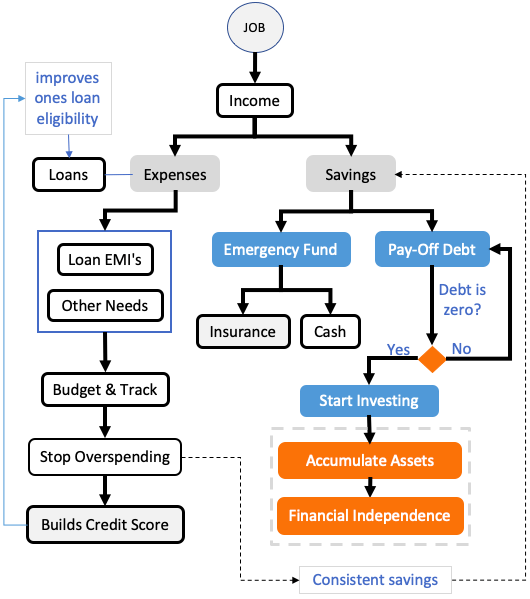
MoneyOnliners developed this guide around a practical sequence: Income → Essential Expenses → Spending → Emergency Savings → Debt → Financial Goals → Review.
The article uses educational examples rather than claims about guaranteed financial outcomes. Recommendations are designed to be adaptable because taxes, banking systems, benefits, debt rules and financial products vary by country and individual circumstances.
For foundational consumer-finance guidance, this article references official U.S. consumer resources including Consumer.gov and the Consumer Financial Protection Bureau. Readers outside the United States should also consult appropriate official authorities in their own country.
Final Thoughts
Money management for beginners is not about doing everything perfectly. It is about creating a clear starting point. Know your income, organize your expenses, cover essentials, begin saving, understand your debt and choose a few financial goals.
From there, improve one part of the system at a time. A weekly check-in and a monthly review can help you notice problems early and keep your plan realistic as life changes.
Know Your Income → Organize Expenses → Protect Essentials → Start Saving → Manage Debt → Set Goals → Review and Improve
Your Next Step
Now that you understand where to start, move to the complete cornerstone guide or choose the next practical step for your finances.