15 Money Management Tips for Better Finances
15 Money Management Tips That Actually Help
Use these practical money management tips to organize your income, control spending, build savings, manage debt and make stronger everyday financial decisions.
The most useful money management tips are simple enough to repeat: know your take-home income, plan essential expenses first, track spending, keep bills organized, save consistently, prepare for emergencies, understand your debt and review your finances regularly. You do not need to implement all 15 tips today. Instead, choose the two or three changes that would improve your finances most and build from there.
Part 1 — Build a Strong Money Management Foundation
Money management is not one financial trick. Rather, it is the way you coordinate income, expenses, bills, saving, debt and financial goals. A useful system should help you make decisions before money disappears, while also giving you enough flexibility to adjust when life changes.
For beginners, the best starting point is usually visibility. Consumer.gov explains that a basic budget shows how much money you make and how you spend it. It also recommends comparing monthly income with bills and other expenses, then using what you learn to plan the next month.
Beginner principle: Do not start by trying to optimize every dollar. First, understand your current numbers. Then protect essential expenses and improve one financial weakness at a time.

What Should You Manage First?
| Area | First Question | Useful Action |
|---|---|---|
| Income | How much money is actually available? | Use take-home income or a conservative irregular-income baseline. |
| Essentials | What must be paid? | Prioritize housing, food, utilities, necessary transport and required obligations. |
| Spending | Where is flexible money going? | Review transactions and identify patterns. |
| Savings | Could an unexpected bill create new debt? | Start building an emergency cushion. |
| Debt | What balances, rates and minimums do you have? | Organize accounts before choosing a repayment strategy. |
| Goals | What matters most next? | Choose a small number of measurable priorities. |
The FDIC's Money Smart for Adults curriculum follows a similar practical structure. Its modules cover income and expenses, spending and saving plans, savings, borrowing and debt management. That reinforces an important idea: financial improvement usually comes from coordinating several basic habits rather than relying on one isolated technique.
Part 2 — 15 Money Management Tips for Better Finances
Know Your Real Take-Home Income
Build your plan around money that is actually available to use. For employees, this may be net pay after deductions. However, freelancers and people with irregular income may need to review several months and choose a conservative baseline.
Knowing the real number prevents you from creating a spending plan around income you never receive.
Give Essential Expenses First Priority
Before allocating money to optional purchases, identify essential living costs and required obligations. Housing, basic food, utilities, necessary transport and required minimum payments generally need attention first.
When money is tight, prioritization matters even more. The FDIC Money Smart spending-and-saving module specifically addresses prioritizing bills when available money is short.
Track Your Spending Before Cutting Everything
Do not guess where your money goes. Review bank statements, card transactions, receipts or another reliable record. Then group spending into a few useful categories.
As a result, you can distinguish genuine problems from expenses that merely feel large. Tracking may reveal forgotten subscriptions, frequent convenience purchases or irregular costs that were missing from your plan.

Create a Monthly Spending Plan
A budget or spending plan gives income a purpose before the month is over. Keep it realistic. Include essential bills, flexible spending, debt payments, savings and less-frequent expenses.
Consumer.gov recommends making a plan at the beginning of the month, recording spending and reviewing the result at the end. Therefore, budgeting works best as a recurring process rather than a one-time document.
Put Savings Into the Plan
If possible, treat savings as an intentional financial priority instead of waiting to see what remains. The amount can start small. Consistency is often more useful than setting an unrealistic target that you abandon after one month.
Moreover, savings can serve different purposes. Separate emergency savings from money intended for predictable expenses or specific goals.
Build a Starter Emergency Fund
An emergency fund is money reserved for genuine unplanned expenses or financial shocks. The CFPB notes that even a small amount can provide some financial security, while regular cash flow can create opportunities to move money into emergency savings.
Your appropriate target depends on your expenses, household responsibilities and income stability. Consequently, a realistic starter milestone may be more useful than waiting for the perfect number.
Prepare for Predictable Irregular Expenses
Car maintenance, school costs, annual fees, gifts and other occasional expenses may not happen monthly, but many are predictable. Save gradually for them through sinking funds or dedicated savings categories.
This distinction matters because a predictable annual bill should not repeatedly become a financial emergency.
Know Every Debt You Owe
Create a simple debt list showing the lender, balance, interest rate, minimum payment and due date. Afterward, decide how extra repayment should be prioritized.
For example, the debt avalanche focuses on higher-interest debt, whereas the debt snowball focuses on smaller balances. The better method is the one that fits your financial situation and that you can follow consistently.
Pay Bills With a System, Not Memory
Use a calendar, reminders, automatic payments or another reliable system to track due dates. Nevertheless, automatic payments still require account monitoring because insufficient funds can create fees or missed payments.
A bill calendar can be especially helpful when several obligations fall between paydays.
Watch Your Cash Flow
Monthly totals tell only part of the story. Cash flow also considers when income arrives and when expenses leave your account. The CFPB notes that tracking this timing can reveal opportunities to adjust spending, savings or, where possible, bill due dates.
Therefore, someone can have enough monthly income overall and still experience shortages because payments are poorly timed.
Fixing a Payday Timing Problem
Imagine that Lena receives $1,400 twice each month. Most of her bills are due during the first ten days, so the first paycheck feels overwhelmed while the second has fewer obligations. After mapping due dates, she asks two providers whether payment dates can be changed. She also keeps part of the second paycheck for the next month's early bills. Her income did not change; however, her cash-flow system became more stable.
Automate Useful Financial Habits
Automation can make consistent actions easier. You might automate a savings transfer after payday or schedule recurring required payments when sufficient funds are available.
Still, automation is not “set and forget.” Review transfers, subscriptions and account balances regularly.
Reduce Recurring Waste Before Tiny Pleasures
Large recurring expenses can have more impact than occasional small purchases. Therefore, review subscriptions, bank fees, insurance costs, phone plans and other repeated charges before obsessing over every inexpensive treat.
That does not mean small spending is irrelevant. Instead, focus first on changes that produce meaningful savings without making your plan impossible to maintain.

Set Specific Financial Goals
“Save more” is difficult to measure. A goal such as “save $1,000 for a starter emergency fund” provides a target. Add a time frame, then calculate a realistic contribution.
Furthermore, avoid funding too many goals equally. Prioritize the goals that reduce risk or matter most right now.
Review Your Money Every Week and Month
A short weekly review can catch unusual spending, upcoming bills and account problems. Then use a deeper monthly review to compare your plan with what actually happened.
Because circumstances change, adjustments are normal. A budget that needs revision is not automatically a failed budget.
Improve Income as Well as Expenses
Expense control has limits. If essential costs already consume most of your income, additional cutting may not solve the underlying problem. In that case, financial improvement may also require increasing income, improving job skills, negotiating pay or developing another sustainable income source.
However, higher income works best when the money-management system improves with it. Otherwise, lifestyle costs may rise just as quickly.
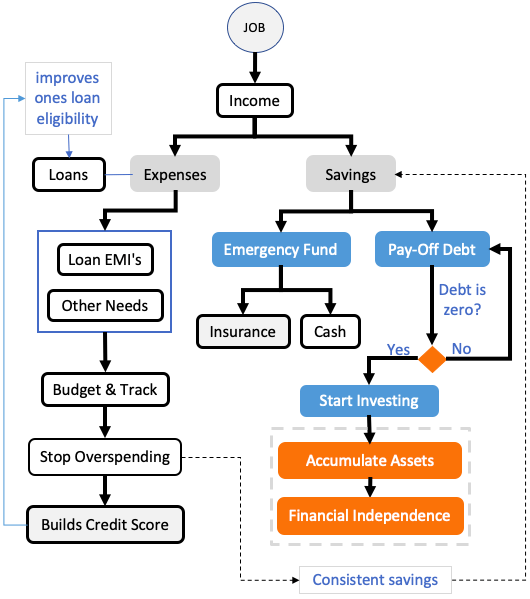
The strongest money management tips work together: organize → prioritize → spend intentionally → save → manage debt → review → improve.
Today-to-Today Money Examples: How These Tips Work in Real Life
Money management becomes easier to understand when the advice is connected to ordinary decisions. The examples below are realistic, hypothetical scenarios based on problems people regularly face: rising everyday costs, app subscriptions, irregular pay, digital payments, emergency repairs and online shopping.
Five Small Monthly Charges Become a Real Expense
Amara pays for a streaming service, cloud storage, a fitness app, a music subscription and a premium mobile app. Individually, none feels expensive. However, after reviewing her bank statement, she discovers that the combined recurring cost is $64 every month.
She keeps the two services she uses most, cancels two and downgrades one. She then moves the $35 monthly difference automatically into emergency savings. Instead of trying to stop every coffee or small treat, she first fixes a recurring expense that had been quietly reducing her cash flow.
Key lesson: Review recurring charges before cutting every small pleasure. A repeated expense can have a larger annual impact than an occasional purchase.
A 48-Hour Rule Prevents an Impulse Purchase
Daniel sees a discounted pair of headphones advertised on social media for $120. The countdown timer makes the offer feel urgent. Instead of buying immediately, he adds the item to a wish list and waits 48 hours.
Two days later, he realizes his current headphones work well and that his car insurance payment is due the following week. He skips the purchase and keeps the money available for the bill.
Key lesson: A waiting period creates distance between an emotional buying trigger and the final financial decision.
A Small Automatic Transfer Builds Consistency
Grace receives her salary twice each month. She has tried saving whatever remains at month-end, but usually little is left. She changes the system and schedules a $25 transfer to savings after each payday.
That creates a planned $50 monthly contribution before optional spending expands. If a difficult month arrives, she can adjust the transfer rather than abandoning saving permanently.
Key lesson: Saving a manageable amount on payday can turn saving from an intention into a routine.
Building a Baseline Instead of Budgeting From the Best Month
Kevin earns between $1,700 and $2,900 per month from freelance design and delivery work. Previously, he increased spending after every strong month and struggled when the next month was weaker.
He reviews six months of income and builds essential spending around $1,800. When income exceeds that baseline, he divides part of the difference among taxes or business obligations, an income buffer and a future goal. Consequently, a $2,700 month no longer becomes permission to create $2,700 of recurring lifestyle costs.
Key lesson: People with irregular income can use stronger months to prepare for weaker ones instead of treating every high-income month as permanent.
Emergency Savings Prevents a Routine Shock From Becoming Debt
Sofia depends on her phone for work, banking and family communication. Her phone suddenly stops working, and a reliable replacement costs $380. Because she has $600 in dedicated emergency savings, she can replace it without putting the full purchase on a high-interest credit card.
Afterward, she temporarily redirects part of her normal goal savings toward rebuilding the emergency fund. The expense is frustrating, but it does not create a new long-term monthly payment.
Key lesson: Emergency savings is designed for unplanned, necessary costs. After using it, rebuilding the reserve becomes a new priority.
Several Small Payments Create a Cash-Flow Problem
Marcus uses installment payment options for shoes, a tablet accessory and household items. Each payment looks affordable on its own. However, three separate installment schedules begin overlapping with rent, utilities and transport costs.
He lists every remaining payment and due date, stops adding new installment purchases and creates a calendar showing the weeks with the heaviest obligations. Once the balances are cleared, he adds a rule: no new installment purchase unless the full price could already fit within his spending plan.
Key lesson: Affordability should be judged across all obligations, not one small installment at a time.
Planning Reduces Waste Without Cutting Nutrition
A household notices that grocery spending keeps exceeding its target. Instead of choosing an arbitrary lower number, the family reviews four weeks of receipts. They find duplicate purchases, food that regularly expires and frequent last-minute convenience shopping.
They begin planning five core dinners each week, checking food already at home before shopping and keeping a small flexible amount for price changes. Their goal is not to buy the cheapest food available; rather, it is to reduce waste and repeated unplanned trips.
Key lesson: Expense tracking is most useful when it identifies the behavior behind the number.
Reality check: These scenarios are illustrative, not promises of savings or financial outcomes. Actual costs, income, banking options and consumer protections vary by household and country.
Part 3 — Turn These Money Management Tips Into a Repeatable System
Use a Simple Weekly Routine
Check
Review account balances and recent transactions.
Prepare
Look at bills and expenses due before the next payday.
Adjust
Correct overspending or move money toward an important priority.
Use a Deeper Monthly Routine
- Total your income for the month.
- Review essential and flexible expenses.
- Check bills and debt payments.
- Measure emergency and goal savings.
- Identify unexpected expenses.
- Review your top financial goal.
- Adjust the next month's plan.
Applying Only Three Tips First
David tries to improve his finances but feels overwhelmed by long financial checklists. Instead of implementing all 15 tips, he starts by tracking expenses, building a $300 starter emergency fund and reviewing money every Sunday. After two months, he understands his spending much better and has stopped using his credit card for several small surprises. He then adds a structured debt-repayment plan. The lesson is simple: sequencing useful habits can be more sustainable than changing everything at once.
Why These Money Management Tips Matter
Better Visibility
Practical money management tips matter because financial decisions improve when you know what your money is doing.
For example, tracking expenses can reveal patterns that are difficult to notice from memory alone.
In addition, a monthly plan helps connect today's spending with upcoming bills and goals.
Therefore, better visibility can reduce avoidable surprises.
Most importantly, clear numbers make it easier to choose what to improve next.
Greater Financial Resilience
Useful money management tips can also help households prepare for unexpected expenses.
Even so, emergency savings do not eliminate every financial risk.
However, a dedicated reserve may reduce the need to borrow for every surprise.
Likewise, sinking funds can prepare you for costs that are irregular but predictable.
As a result, different savings buckets can serve different financial purposes.
Stronger Spending and Debt Decisions
Another benefit of money management tips is that they can make spending decisions more intentional.
Meanwhile, organizing debts makes repayment choices easier to evaluate.
Although one repayment strategy may minimize interest, another may be easier for a particular person to maintain.
Consequently, a good financial system should consider both mathematics and behavior.
Above all, required obligations should remain visible while you work toward other goals.
Long-Term Financial Progress
Over time, consistent money management tips can support stronger financial habits.
Nevertheless, expense management alone cannot solve every income problem.
For that reason, improving earning power can be an important part of a broader financial plan.
Similarly, additional income is more useful when some of it strengthens savings, debt reduction or future goals.
Ultimately, better finances usually come from repeated decisions rather than one dramatic change.

Recommended External Resources
Creating a Monthly Budget
For a straightforward official explanation of budgeting, Consumer.gov's Making a Budget guide explains how to list expenses, record income, compare the two and review the plan each month.
Building Practical Financial Skills
The FDIC Money Smart for Adults curriculum provides financial education across 14 modules. Topics include income and expenses, spending and saving plans, savings, borrowing, credit cards and debt management.
Improving Saving Habits
Readers who want interactive financial education can explore FDIC Learn Money Smart. The program includes self-paced resources on everyday financial topics such as earning, spending, saving and borrowing.
Preparing for Unexpected Expenses
The Consumer Financial Protection Bureau's emergency-fund guide explains strategies for building savings and managing cash flow when income and expenses do not line up neatly.
Reviewing Spending Before Cutting Costs
The FDIC also recommends reviewing spending from recent months and examining recurring expenses when looking for opportunities to save. Its Saving for the Unexpected and Your Future resource connects spending reviews with short- and long-term savings goals.
Global-reader note: These resources are primarily U.S.-based educational sources. Banking rules, consumer protections, taxes, debt regulations and financial products differ by country. For decisions affected by local law or regulation, consult the appropriate government authority or qualified professional where you live.
Frequently Asked Questions
What are the best money management tips for beginners?
Start with the basics rather than complicated strategies.
Know your take-home income and essential expenses.
Track spending so you can see where flexible money goes.
Build a realistic monthly plan and start saving for emergencies.
Finally, review your finances regularly and improve one weak area at a time.
How can I manage money better every month?
Create a repeatable monthly routine.
At the beginning of the month, plan bills, spending, savings and debt payments.
During the month, monitor transactions and upcoming expenses.
At the end, compare your plan with what actually happened.
Then use that information to improve the following month's plan.
What should I do if my expenses are higher than my income?
First, confirm the numbers using actual income and recent expenses.
Prioritize essential living costs and required obligations.
Then identify expenses that can realistically be reduced or changed.
Because expense cutting has limits, also consider legitimate ways to improve income or access assistance for which you qualify.
If debt or overdue obligations have become difficult to manage, qualified local financial or credit counseling may also be appropriate.
Should I save money or pay debt first?
The answer depends on your circumstances.
A starter emergency fund can help prevent new borrowing when unexpected expenses occur.
At the same time, high-interest debt can become increasingly expensive.
Consider required payments, interest rates, emergency needs and income stability together.
Then choose a balance that protects your immediate finances while making meaningful progress.
How often should I check my finances?
A short weekly review works well for many people.
It can help you catch unusual transactions and prepare for upcoming bills.
A deeper monthly review can measure spending, savings, debt and goal progress.
Quarterly or annual checkups are useful for larger financial decisions.
You should also review the system whenever your income or household circumstances change significantly.
Research Methodology
This MoneyOnliners guide organizes money-management guidance around five practical areas: income, spending, saving, debt and financial review. Educational examples are hypothetical and are not promises of financial results.
Foundational concepts were cross-checked against official consumer-education resources, including Consumer.gov, the Consumer Financial Protection Bureau and the FDIC Money Smart program. Because financial products and laws differ internationally, readers should verify country-specific requirements with appropriate local authorities.
Final Thoughts
The best money management tips are not necessarily the most complicated. Knowing your income, prioritizing essential expenses, tracking spending, saving for emergencies, organizing debt and reviewing your finances can create a strong foundation.
Start with the changes that solve your biggest current problem. Then, once those habits become easier, add the next improvement. Over time, a collection of small financial decisions can become a reliable system for managing your money.
Continue Your Money Management Plan
Use the complete MoneyOnliners guides below to turn these tips into a structured financial system.