
12 Things to Check Before Choosing a Bank Account
12 Things to Check Before Choosing a Bank Account
A bank account can look attractive in an advertisement and still be a poor fit for your everyday money. Use these 12 checks to compare fees, access, insurance, rates and account rules before you apply.
Before choosing a bank account, check the monthly fee, minimum-balance rules, opening-deposit requirement, deposit-insurance status, ATM network, overdraft policy, APY or interest rate, mobile features, cash-deposit options, customer support, funds-availability rules and how well the account matches your actual spending and saving habits. The best bank account is not simply the one with the biggest bonus or highest advertised APY—it is the one you can use consistently without unnecessary costs or surprises.
Why Choosing the Right Bank Account Matters
A bank account becomes part of your financial system. Your income may arrive there, bills may leave from it, your debit card may connect to it and your emergency fund may sit beside it. Because the account touches so many parts of everyday money management, small differences in fees or rules can become important over time.
For example, a checking account that charges $12 each month could cost $144 a year if you do not qualify for a waiver. Meanwhile, an account with no monthly fee might still be inconvenient if you regularly pay out-of-network ATM charges or cannot deposit cash easily.
Therefore, do not choose an account by looking at one feature in isolation. Instead, compare the whole package.
12 Things to Check at a Glance
| # | What to Check | Why It Matters |
|---|---|---|
| 1 | Account type | Checking and savings are designed for different jobs |
| 2 | Monthly fees | Recurring costs can add up over time |
| 3 | Minimum-balance rules | Missing a threshold may trigger fees or reduce benefits |
| 4 | Opening deposit | Some accounts require money upfront |
| 5 | Deposit insurance | Eligible deposits should have appropriate protection |
| 6 | ATM and branch access | Convenience can affect your real banking cost |
| 7 | Overdraft policy | Insufficient funds can create charges or declined transactions |
| 8 | APY / interest | Important for savings and some checking accounts |
| 9 | Mobile and online banking | Digital tools affect everyday convenience |
| 10 | Cash and deposit options | Especially important if you handle cash or checks |
| 11 | Customer support and security | You need reliable help when something goes wrong |
| 12 | Fit with your real habits | The right account should match how you actually bank |
The 12 Things to Check Before Choosing a Bank Account
The checks below are grouped around cost, protection, access and everyday usability. As a result, you can evaluate the account in smaller steps instead of trying to judge every feature at once.
Start With the Account's Purpose and Core Costs
Choose the Right Account Type First
Before comparing banks, decide what job the account needs to perform. A checking account is generally designed for everyday transactions such as debit-card purchases, bill payments and withdrawals. A savings account is generally intended to hold money for future needs.
If your goal is to receive income and pay monthly bills, checking is usually the better starting point. If your goal is to build an emergency fund or save for a future purchase, savings is often more suitable.
Do not compare a checking account with a savings account as though they are interchangeable. First decide the job, then compare accounts within that category.
Review the Monthly Maintenance Fee
Some accounts charge a monthly service fee. By contrast, others have no monthly maintenance fee or allow the fee to be waived when you meet certain conditions.
For perspective, always convert a monthly fee into an annual amount. For example, a $5 monthly fee equals $60 a year. A $15 monthly fee equals $180 a year.
Next, ask what you receive in return. Branch access, ATM reimbursements, additional services or other benefits may have value. Nevertheless, paying a fee for features you never use makes little sense.
Understand Minimum-Balance Requirements
A bank may require a minimum balance to avoid a fee, earn a stated APY or qualify for another benefit. However, minimum-balance rules can be calculated differently.
One institution might use the daily balance. Another might use an average monthly balance. Therefore, read exactly how the requirement works instead of assuming a single number tells the whole story.
If maintaining the required amount would regularly leave you short for bills, choose a lower-requirement account.

Check the Minimum Opening Deposit
Some accounts require a particular amount to open. By comparison, others may let you open with a very small amount or no meaningful minimum.
The opening requirement matters most when your cash is limited. Therefore, do not lock money into an opening deposit if it leaves you short for rent, food, transportation or other immediate obligations.
Also remember that an opening-deposit requirement and an ongoing minimum-balance requirement are not necessarily the same thing.
Next, Check Protection and Everyday Access
Once the basic costs make sense, move on to deposit protection and the ways you will actually reach your money. In addition, consider how often you use cash, ATMs and branches.
Verify Deposit Insurance
For U.S. readers, eligible deposits at FDIC-insured banks receive federal deposit insurance. The standard amount is $250,000 per depositor, per insured bank, for each ownership category.
For example, eligible checking and savings deposits are among the products covered. However, investment products such as stocks, bonds and mutual funds are not FDIC-insured simply because they are offered through a financial institution.
Federally insured credit unions use a separate system through the National Credit Union Share Insurance Fund administered by the NCUA.
Verify the institution and product through official sources before depositing large amounts of money.
Compare ATM and Branch Access
ATM access can become a hidden cost. For instance, an institution may offer free withdrawals through its own network but charge for out-of-network use. In addition, the ATM owner may impose its own fee.
If you regularly use cash, map the ATMs near your home, work and places you visit frequently. In addition, consider whether branch access matters to you.
Someone who rarely handles cash may be comfortable with an online-first bank. On the other hand, a person who frequently deposits cash may need convenient branches or supported cash-deposit options.
Read the Overdraft and Insufficient-Funds Policy
An overdraft can occur when a transaction exceeds available funds and the institution pays it anyway. Different account policies can produce different outcomes, including declined transactions, overdraft coverage or other arrangements.
Before opening the account, ask what happens with debit-card purchases, ATM withdrawals, checks, automatic bill payments and other transactions when your balance is too low.
Also check whether the institution offers low-balance alerts, linked-account transfers or other tools that may help you avoid problems.
Compare APY and Interest the Right Way
If the account pays interest, first compare APY rather than focusing only on promotional language. APY is designed to help consumers compare annual earnings while accounting for compounding under stated assumptions.
A higher APY can help savings grow. However, it should be compared with fees, minimum-balance rules and access.
For example, a slightly higher yield may not improve your financial position if you repeatedly pay a monthly fee to qualify for it.
Rate matters most when the rest of the account also works for you.
Finally, Review Digital Tools and Practical Fit
After costs and access, review the features that affect day-to-day banking. Moreover, make sure the account works with the way you receive money, make deposits and ask for help.
Test the Mobile and Online Banking Experience
Today, many people interact with their bank more through an app than through a branch. Therefore, digital tools deserve serious attention.
For example, useful features can include transaction alerts, mobile deposits, transfers, card controls, bill pay and low-balance notifications. Nevertheless, not every customer needs every feature.
Security is equally important. Look for strong authentication options and use a unique password for your financial accounts.
Check How You Can Deposit Cash and Checks
For instance, if you are paid in cash, an online-only account may be inconvenient unless the institution provides a practical cash-deposit method. Likewise, if you receive paper checks, mobile deposit can save time.
Do not assume every account supports deposits in the same way. Before opening, ask how cash deposits, mobile check deposits and transfers from other banks work.
Also review any limits or fees that could affect your normal use.
Evaluate Customer Support and Account Security
Customer service matters most when something goes wrong. For example, a lost card, unfamiliar transaction or locked account can become stressful quickly.
Compare the support channels available: phone, secure messaging, branch help, chat or other options. In addition, check support hours if you may need help outside normal business times.
Security should include transaction monitoring, authentication and clear procedures for reporting suspected fraud.
Choose the Account That Fits Your Real Habits
Ultimately, this final check brings everything together. Even so, an account can look excellent on paper and still be wrong for you.
If you use cash every week, a distant ATM network matters. If you maintain a small balance, a high minimum requirement matters. If you are building an emergency fund, easy separation and a competitive savings rate may matter more than branch access.
Instead of asking, “Which bank is best?” ask, “Which account is best for how I actually manage money?”
Real-Life Example: The Highest APY Wasn't the Best Account
Monica Compares Two Savings Accounts
Monica wants to save $5,000 for emergencies. At first, Account A advertises a slightly higher APY but requires a balance that she may not consistently maintain. Missing the requirement can trigger a monthly fee.
By contrast, Account B offers a slightly lower APY but no monthly maintenance fee, an easier transfer process and a simple mobile app.
After comparing the likely annual interest difference with the potential annual fees, Monica chooses the account that is easier for her to maintain.
Key lesson: The highest rate does not automatically produce the best real-world result.
Case Study: Why ATM Access Can Matter More Than a Bonus
David Is Attracted by a $200 Sign-Up Offer
David finds a checking account offering a sign-up bonus. However, the institution has few convenient ATMs near him, and he withdraws cash several times each month.
Meanwhile, another account offers no bonus but has a large fee-free ATM network in his area. David estimates his likely ATM costs over one year before deciding.
Key lesson: A one-time bonus should be compared with ongoing costs and convenience.

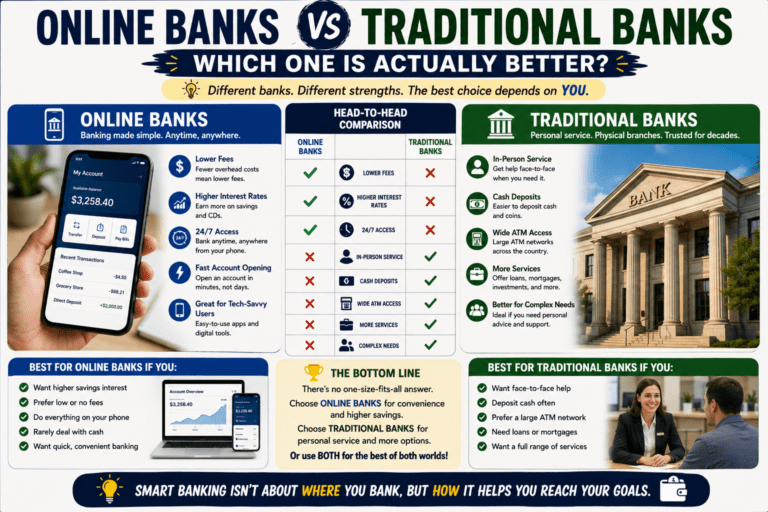
Traditional Bank vs Online Bank vs Credit Union
| Institution Type | Potential Strength | What to Check Carefully |
|---|---|---|
| Traditional bank | Branches, ATMs and broad service access | Fees, minimums and whether you actually use branch services |
| Online bank | Digital-first access and potentially competitive deposit products | Cash deposits, customer support and ATM arrangements |
| Credit union | Member-focused structure and potentially competitive services | Eligibility, network and applicable share insurance |
Ultimately, no institution type is automatically best. Therefore, the correct comparison is between actual accounts, not broad categories.
How to Compare Two Bank Accounts in 10 Minutes
Minutes 1–5
- Review monthly fees
- Confirm fee-waiver rules
- Compare minimum balances
- Verify deposit insurance
- Review APY or interest
Minutes 6–10
- Compare ATM access
- Study the overdraft policy
- Evaluate mobile features
- Confirm deposit options
- Assess customer-support access
Finally, ask which account creates fewer likely costs based on your normal behavior. A simple side-by-side comparison can prevent years of inconvenience.
Bank Account Comparison Worksheet
| Feature | Account A | Account B |
|---|---|---|
| Monthly fee | _____ | _____ |
| Fee waiver | _____ | _____ |
| Minimum balance | _____ | _____ |
| Opening deposit | _____ | _____ |
| APY | _____ | _____ |
| ATM network | _____ | _____ |
| Overdraft policy | _____ | _____ |
| Mobile deposit | _____ | _____ |
| Cash deposits | _____ | _____ |
| Customer support | _____ | _____ |
| Deposit insurance | _____ | _____ |
| Best fit for your habits? | _____ | _____ |
7 Bank Account Red Flags
1. The Fee Waiver Is Unrealistic for You
If avoiding the monthly fee requires a balance you rarely maintain, treat the fee as a likely cost rather than an exception.
2. The Bonus Is Clear but the Long-Term Terms Are Hard to Find
Promotions should never replace the account agreement. Read what happens after the introductory period ends.
3. The Advertised APY Has Conditions You Do Not Understand
Clarify exactly what balance or activity qualifies for the stated rate.
4. Cash Deposits Are Difficult
This matters particularly for people paid in cash or businesses that handle cash regularly.
5. The ATM Network Does Not Match Your Routine
Repeated out-of-network costs can reduce the value of an otherwise attractive account.
6. You Cannot Clearly Verify the Institution
Know which financial institution actually holds your money and what protection applies.
7. Customer Support Is Difficult Before You Even Open the Account
If it is difficult to get basic questions answered before becoming a customer, consider how that experience may feel during a real problem.
Which Features Matter Most for Different People?
| Person | Most Important Features to Check |
|---|---|
| First-time bank customer | Fees, minimums, ATM access, mobile banking and simple account rules |
| Cash-heavy worker | Branch access, cash deposits and ATM network |
| Emergency-fund saver | APY, insurance, easy transfers and no unnecessary monthly fees |
| Freelancer | Deposit options, transfers, recordkeeping and irregular cash-flow support |
| Frequent traveler | ATM access, card controls and travel-related transaction policies |
| Couple or family | Joint-account rules, shared access and account organization |
What Deposit Insurance Really Means
Importantly, deposit insurance is one of the most important checks because it helps protect eligible deposits if an insured institution fails.
For example, at U.S. banks, FDIC insurance is automatic for eligible deposits at FDIC-insured institutions. The standard amount is $250,000 per depositor, per insured bank, for each ownership category.
Importantly, multiple deposit accounts at the same bank in the same ownership category are combined when calculating coverage. Opening both checking and savings at the same bank does not automatically create two separate $250,000 insurance limits.
Meanwhile, international readers should verify their own country's deposit-insurance system and limits.

Before You Apply: Final Checklist
- I know whether I need checking, savings or both.
- I know the monthly fee and waiver requirements.
- I understand the minimum-balance rules.
- I know the opening-deposit requirement.
- I verified applicable deposit insurance.
- I checked ATM and branch convenience.
- I understand overdraft and insufficient-funds policies.
- I compared APY together with fees and requirements.
- I reviewed mobile and online banking tools.
- I know how to deposit cash and checks.
- I checked customer-support options.
- I chose the account based on my actual banking habits.
Continue Learning on MoneyOnliners
Recommended External Resources
Consumer Financial Protection Bureau — Bank Accounts
FDIC — Deposit Insurance
FDIC — Insured Financial Products
Are My Deposit Accounts Insured? — FDIC
NCUA — Share Insurance
National Credit Union Share Insurance Fund — NCUA
FDIC and NCUA information in this article applies to eligible U.S. institutions and accounts. Banking rules, fees and deposit-insurance limits vary by country. Verify current protection with your local regulator or deposit-insurance authority.
Frequently Asked Questions
What should I check first before choosing a bank account?
Start with the account type and purpose. Then compare fees, balance requirements, deposit insurance, ATM access, overdraft policies, APY, mobile tools and deposit options.
Should I choose the bank with the highest APY?
Not automatically. A higher APY can be useful, but fees, minimum-balance requirements and access matter too. Compare the overall value of the account.
Is a no-fee bank account always better?
No. A no-fee account can still be inconvenient or have other costs. Compare ATM access, overdraft rules, APY and customer support as well.
How important is deposit insurance?
It is an important safety consideration. For U.S. readers, verify that eligible deposits are held at an FDIC-insured bank or, for federally insured credit unions, covered through NCUA share insurance.
Should I choose a traditional bank or online bank?
That depends on your needs. Traditional banks may offer branch convenience, while online banks may emphasize digital access. Compare actual account terms rather than assuming one type is always better.
What is the biggest hidden bank-account cost?
It varies by customer. For some people it is a monthly fee; for others it may be repeated ATM costs or overdraft-related charges. Your banking habits determine which costs matter most.
Do I need a minimum balance?
It depends on the account. Some products have no ongoing minimum, while others use a balance requirement to waive fees or qualify for particular benefits.
Should I open checking and savings at the same bank?
You can, and it may simplify transfers. However, using different institutions can also work if the accounts offer better features for different purposes.
How do I know if an online bank is legitimate?
Verify the institution, applicable deposit insurance and official contact information. Do not assume every finance app is itself an insured bank simply because it offers banking-like services.
Can I switch bank accounts later?
Yes. However, move carefully. Update direct deposits and automatic payments, keep enough money in the old account for pending transactions and confirm everything has moved before closing the original account.
Research Methodology
This MoneyOnliners guide was developed using authoritative consumer-banking and deposit-insurance resources, including CFPB, FDIC and NCUA information. Real-life examples and case studies are editorial illustrations. Account fees, APYs, bonuses, overdraft policies and other features can change, so readers should verify current terms directly with the financial institution before opening an account.
Final Thoughts
In practice, choosing a bank account becomes much easier when you stop asking which bank is “best” and start asking which account best fits your money habits.
First, begin with fees, minimum balances and deposit insurance. Next, compare ATM access, overdraft policies, APY, digital tools, deposit options and customer service.
Most importantly, look beyond the promotion. After all, a sign-up bonus lasts once, but monthly fees, ATM access and account rules can affect you for years.
Use these 12 checks before applying, compare at least two realistic options and choose the account that makes everyday banking simpler, safer and easier to manage.

One Comment