17 Bank Fees You May Be Paying (and How to Avoid Them)
17 Bank Fees You May Be Paying (and How to Avoid Them)
Bank fees can quietly reduce your balance month after month. Learn which charges to look for, when they may apply, and practical ways to reduce or avoid them.
Common bank fees can include monthly maintenance, minimum-balance, ATM, overdraft, insufficient-funds, wire-transfer, stop-payment, paper-statement, check-ordering, cashier's-check, foreign-transaction, account-research, early-account-closure, dormant-account, expedited-service and other special-service charges. However, not every bank charges every fee, and policies vary considerably.
To reduce bank fees, start by reading your account's current fee schedule. Then use in-network ATMs, maintain any realistic waiver requirements, set low-balance alerts, understand overdraft choices and compare lower-cost accounts when your current account no longer fits your needs.
Why Bank Fees Deserve Your Attention
A $3 or $5 charge can seem insignificant. Nevertheless, several small charges repeated throughout the year can become meaningful. A $12 monthly maintenance fee alone equals $144 over 12 months.
More importantly, many fees are avoidable when you understand what triggers them. Federal rules require institutions to disclose fees connected with deposit accounts, so the account-opening disclosure and fee schedule should be central to your comparison.
Instead of assuming your bank is expensive or cheap, review the actual charges that match your behavior. Someone who never sends wires should not choose an account based on wire fees. Meanwhile, a person who frequently withdraws cash should pay close attention to ATM costs.
17 Bank Fees at a Glance
| # | Potential Fee | Practical Way to Reduce or Avoid It |
|---|---|---|
| 1 | Monthly maintenance | Meet a realistic waiver or choose a lower-fee account |
| 2 | Minimum-balance | Choose an account whose balance rule fits your cash flow |
| 3 | Out-of-network ATM | Use in-network ATMs or an account with reimbursement |
| 4 | ATM operator surcharge | Find surcharge-free locations before withdrawing |
| 5 | Overdraft | Use alerts and understand your overdraft choices |
| 6 | NSF / returned item | Track scheduled payments and available funds |
| 7 | Overdraft-transfer | Compare linked-transfer terms with other options |
| 8 | Domestic wire transfer | Use lower-cost transfer methods when suitable |
| 9 | International wire | Compare total transfer costs and exchange-rate effects |
| 10 | Stop payment | Use only when necessary and check the fee first |
| 11 | Paper statement | Choose electronic statements if appropriate |
| 12 | Check ordering | Order only what you need and compare options |
| 13 | Cashier's check / official check | Check whether your account includes them |
| 14 | Foreign transaction / international ATM | Review travel-related account terms before a trip |
| 15 | Account research / copies | Keep your own electronic records when possible |
| 16 | Early account closure | Understand any minimum-open period before switching |
| 17 | Dormant or special-service fees | Review inactive accounts and the full fee schedule |
The 17 Bank Fees You Should Know
Monthly Maintenance Fee
A bank or credit union may charge a recurring fee simply for maintaining a checking, savings or money-market account. Some institutions waive it when you meet requirements such as maintaining a specified balance or receiving qualifying direct deposits.
How to avoid it: First, determine whether you can reliably satisfy the waiver. If not, compare accounts with lower or no monthly maintenance charges rather than repeatedly paying for a feature you do not need.
Minimum-Balance Fee
Some accounts connect a fee waiver to a minimum balance. However, the calculation method can vary. For example, an institution may use a daily or average balance calculation.
How to avoid it: Read how the balance is calculated. Then choose an account whose requirement you can maintain without taking money away from essential expenses.
Out-of-Network ATM Fee
Your bank may charge when you use an ATM outside its network. Therefore, a convenient-looking cash withdrawal can cost more than expected.
How to avoid it: Use your institution's ATM locator before withdrawing cash. Alternatively, consider an account that provides a broader network or reimburses certain outside-network charges.

ATM Operator Surcharge
In addition to a fee from your own institution, an ATM owner may charge a separate surcharge. Consequently, one withdrawal can potentially involve more than one cost.
How to avoid it: Look for surcharge-free ATMs within your network and plan cash withdrawals rather than using the first machine you see.
Overdraft Fee
An overdraft occurs when you do not have enough available money to cover a transaction and the institution pays it anyway. Depending on the transaction and account terms, an overdraft fee may apply.
For U.S. consumer accounts, a financial institution generally cannot charge an overdraft fee for paying an ATM or one-time debit-card transaction unless the consumer has affirmatively opted into that overdraft service. Different rules can apply to checks, ACH and recurring electronic payments.
How to avoid it: Track your available balance, use low-balance alerts and understand whether you have opted into debit/ATM overdraft coverage.
Non-Sufficient Funds or Returned-Item Fee
If there is not enough money to cover a payment and the institution returns or declines the transaction, an NSF or returned-item fee may apply depending on the institution and transaction.
How to avoid it: Keep a calendar of scheduled electronic payments. Moreover, check available funds rather than relying only on a balance that may not reflect pending transactions.
Overdraft-Protection Transfer Fee
Some institutions allow you to link checking to savings or another source so money can be transferred when checking runs short. This can be less expensive than some overdraft arrangements, although transfer charges may still apply.
How to avoid it: Compare the linked-transfer cost with the institution's other overdraft options. Better still, maintain an appropriate checking buffer when your budget allows.
Domestic Wire-Transfer Fee
Wire transfers can be useful when money needs to move quickly or when a recipient specifically requires a wire. However, sending—and sometimes receiving—a wire may carry a fee.
How to avoid it: When speed is not essential, compare ACH transfers, bill pay or other available methods. Always confirm the total cost before initiating the transaction.
International Wire-Transfer Fee
International transfers can involve more than a visible wire fee. Exchange rates and intermediary-bank charges can also affect how much the recipient ultimately receives.
How to avoid it: Compare the complete cost, not simply the advertised transfer fee. In addition, confirm the exchange rate and whether intermediary charges may apply.
Stop-Payment Fee
You may ask your institution to stop payment on certain checks or transactions when appropriate. Banks can charge for this service under their account terms.
How to avoid it: Use stop-payment requests only when necessary. Before requesting one, ask what it costs, how long the order remains effective and what information is required.
Paper-Statement Fee
Some account structures may charge for mailed paper statements or offer incentives for electronic delivery.
How to avoid it: If electronic records work for you, choose e-statements. However, download important statements periodically so you retain your own records.
Check-Ordering Fee
Paper checks are less common for many consumers, yet some households and businesses still use them. Ordering new checks may carry a cost.
How to avoid it: Order only the quantity you need and check whether your account includes complimentary checks or offers lower-cost ordering options.
Cashier's Check or Official-Check Fee
Large transactions, rental deposits or other situations sometimes require a cashier's or official check. Depending on your account, obtaining one may cost money.
How to avoid it: Ask whether your account includes official checks or discounted special services. If you rarely need them, compare the occasional fee with the cost of maintaining a premium account solely for that benefit.
Foreign Transaction or International ATM Costs
Using a debit card or ATM abroad can create additional costs depending on your institution, network and transaction. Currency conversion can also affect the final amount.
How to avoid it: Before traveling, read your card's international transaction and ATM terms. Then identify lower-cost withdrawal options at your destination.
Account Research, Copy or Special-Record Fee
Requesting old statements, photocopies or account research may carry a fee, particularly when staff must retrieve historical information.
How to avoid it: Keep organized electronic records and download statements before they disappear from your normal online history.
Early Account-Closure Fee
Some accounts or promotions may have terms connected to how long the account remains open. Closing too quickly could affect a bonus or create a stated fee where permitted by the agreement.
How to avoid it: Read the account and promotional terms before opening. If you later switch banks, confirm whether a minimum-open period applies.
Dormant-Account and Other Special-Service Fees
Long-inactive accounts or specialized services can sometimes carry charges. Furthermore, account terms can include fees that will never affect most customers but matter greatly to a smaller group.
How to avoid it: Review accounts you no longer use and read the full fee schedule. Do not leave forgotten accounts open indefinitely without understanding the consequences.
Real-Life Example: How Small Fees Add Up
Marcus Reviews One Year of Banking Costs
Marcus pays a hypothetical $10 monthly maintenance fee because he does not meet his account's waiver requirement. Over 12 months, that alone costs $120.
During the same year, suppose he also makes six out-of-network ATM withdrawals at a hypothetical $3 bank fee each. That adds another $18 before considering any ATM-operator surcharges.
His illustrative annual total is now $138. After reviewing his behavior, Marcus compares accounts with no maintenance fee and a more convenient ATM network.
Key lesson: A bank fee can look small transaction by transaction while becoming meaningful when annualized.
Case Study: Avoiding an Overdraft Before It Happens
Leah Uses Low-Balance Alerts
Leah has several automatic payments scheduled near the end of the month. Previously, she checked her balance only occasionally.
She enables a low-balance alert and keeps a calendar of recurring withdrawals. One month, the alert arrives before a scheduled payment. Leah reviews her cash flow and moves available money into checking before the payment arrives.
Key lesson: Alerts do not create money, but they can give you time to respond before a timing problem becomes a fee.

Which Bank Fees Should You Check First?
If You Use Cash Often
- ATM fees
- ATM operator surcharges
- Cash-deposit options
- Branch-service charges
If Your Balance Runs Low
- Monthly maintenance fee
- Minimum-balance fee
- Overdraft fee
- NSF / returned-item policy
How to Audit Your Bank Fees in 15 Minutes
Minutes 1–5: Review Recent Statements
Search the last several statements for words such as fee, service charge, ATM, overdraft, wire and maintenance. Write down each charge and how often it occurred.
Minutes 6–10: Open the Current Fee Schedule
Match each charge to the official fee schedule. Then identify the condition that triggered it and whether the account provides a waiver or lower-cost alternative.
Minutes 11–15: Decide What to Change
Some costs can be reduced by changing behavior, such as using in-network ATMs. Others may indicate that the account itself is a poor fit. In that case, compare alternatives.
Bank Fee Audit Worksheet
| Fee | How Often? | Annual Cost | Can I Avoid It? |
|---|---|---|---|
| Monthly maintenance | _____ | _____ | _____ |
| ATM | _____ | _____ | _____ |
| Overdraft / NSF | _____ | _____ | _____ |
| Wire transfer | _____ | _____ | _____ |
| Paper statement | _____ | _____ | _____ |
| Other services | _____ | _____ | _____ |
7 Practical Ways to Avoid More Bank Fees
1. Choose an Account That Fits Your Normal Balance
A fee waiver is useful only when you can realistically satisfy it. Otherwise, compare lower-cost products.
2. Turn On Low-Balance Alerts
Alerts can warn you when your available balance approaches a level that could create problems.
3. Learn Your ATM Network
Save nearby in-network ATM locations in your phone so you are less likely to pay for convenience.
4. Keep a Calendar of Automatic Payments
Knowing when rent, subscriptions and utilities will leave your account makes cash flow easier to manage.
5. Review Overdraft Choices
Understand what you have opted into and what happens when funds are insufficient. Policies vary, so use your institution's current disclosures.
6. Use Electronic Records When Appropriate
E-statements can reduce paper-related costs on accounts that charge for mailed statements. They also make searching old transactions easier.
7. Compare Accounts Periodically
An account that worked five years ago may no longer be competitive or appropriate for your habits today.
This article explains common categories of bank fees, not charges that every institution imposes. Fee names, amounts, waiver conditions and policies differ. Always use your bank or credit union's current account disclosure and fee schedule.
Can a “Free Checking” Account Still Have Fees?
Yes, certain fees can still exist. Under U.S. rules, an account advertised as “free” or “no cost” cannot impose certain maintenance-type charges, including a monthly service fee or a fee for failing to maintain a minimum balance. However, other charges—such as certain ATM, overdraft, stop-payment or check-printing fees—may still apply.
Therefore, “free checking” should not be interpreted as “every possible banking service is free.” Read the account disclosure before opening.
Continue Learning on MoneyOnliners
Recommended External Resources
FDIC — Overdraft and Account Fees
Overdraft and Account Fees — FDIC
Consumer Financial Protection Bureau — Overdraft Options
Know Your Overdraft Options — CFPB
CFPB — Bank Accounts
Frequently Asked Questions
What are the most common bank fees?
Common categories include monthly maintenance, ATM, overdraft, insufficient-funds and special-service charges. However, each institution sets its own fee structure subject to applicable law and disclosures.
How can I avoid monthly bank fees?
Check whether your account waives the fee for qualifying direct deposit, a required balance or another condition. If the requirement does not fit your finances, compare lower-fee accounts.
How can I avoid ATM fees?
Use in-network or surcharge-free ATMs. Additionally, some accounts reimburse certain ATM charges, so check the current account terms.
Can I avoid overdraft fees?
Low-balance alerts, careful balance tracking and understanding your overdraft choices can help. For ATM and one-time debit-card overdraft services in the U.S., institutions generally need your affirmative opt-in before charging an overdraft fee for paying those transactions.
Why did my bank charge a fee even though my checking account is called free?
A “free” checking account can still have certain special-service charges. Review the account disclosure to see which fees are permitted and when they apply.
Can a bank change its fees?
Account terms can change subject to applicable disclosure and notice requirements. Therefore, read notices from your institution instead of assuming the original fee schedule remains permanent.
Are online banks always cheaper?
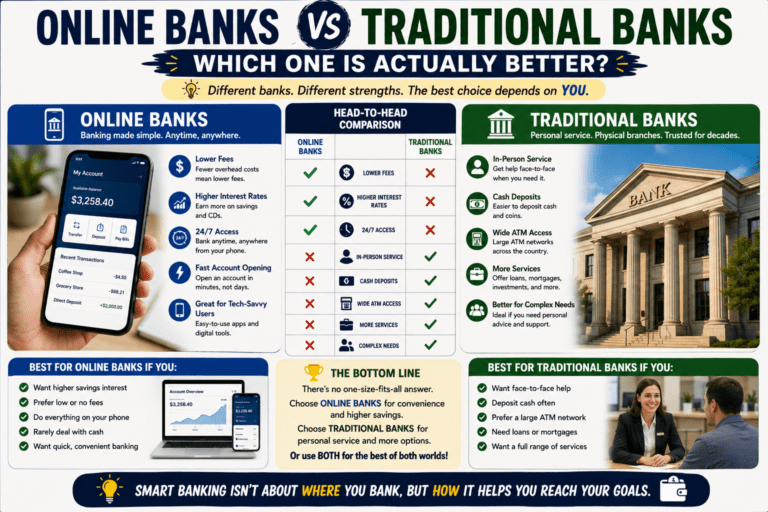
No. Some digital institutions may offer low-fee products, but costs vary by account. Compare the complete fee schedule and the services you actually use.
Is overdraft protection free?
Not necessarily. A linked-account transfer, line of credit or other overdraft arrangement can have costs. Compare the specific terms before enrolling.
Should I switch banks because of fees?
Consider switching when recurring charges cannot reasonably be avoided and another suitable account provides the services you need at a lower overall cost. Move direct deposits and automatic payments carefully before closing the old account.
Where can I find all the fees my bank charges?
Start with the deposit account disclosure and fee schedule. If anything is unclear, ask the institution to explain the charge before you open or continue using the account.
Research Methodology
This MoneyOnliners guide was developed using authoritative U.S. consumer-banking information from the FDIC and Consumer Financial Protection Bureau. Fee examples are illustrative unless specifically identified as regulatory information. Because banks and credit unions can change account pricing and policies, readers should verify current fees directly in the institution's official disclosure and fee schedule.
Final Thoughts
Bank fees are not automatically bad. Some services cost money to provide, and a fee may be reasonable when you knowingly use a valuable service. The problem begins when charges repeatedly reduce your balance without delivering value you actually need.
Start with your statements. Identify what you paid during the last few months, annualize recurring charges and determine which behaviors trigger them.
Next, compare those costs with the bank's current fee schedule and lower-cost alternatives. Sometimes one small change—such as using in-network ATMs—solves the problem. In other cases, a different account may fit better.
Ultimately, understanding these bank fees gives you more control. The less money you lose to unnecessary charges, the more you can direct toward bills, savings, debt repayment and long-term financial goals.