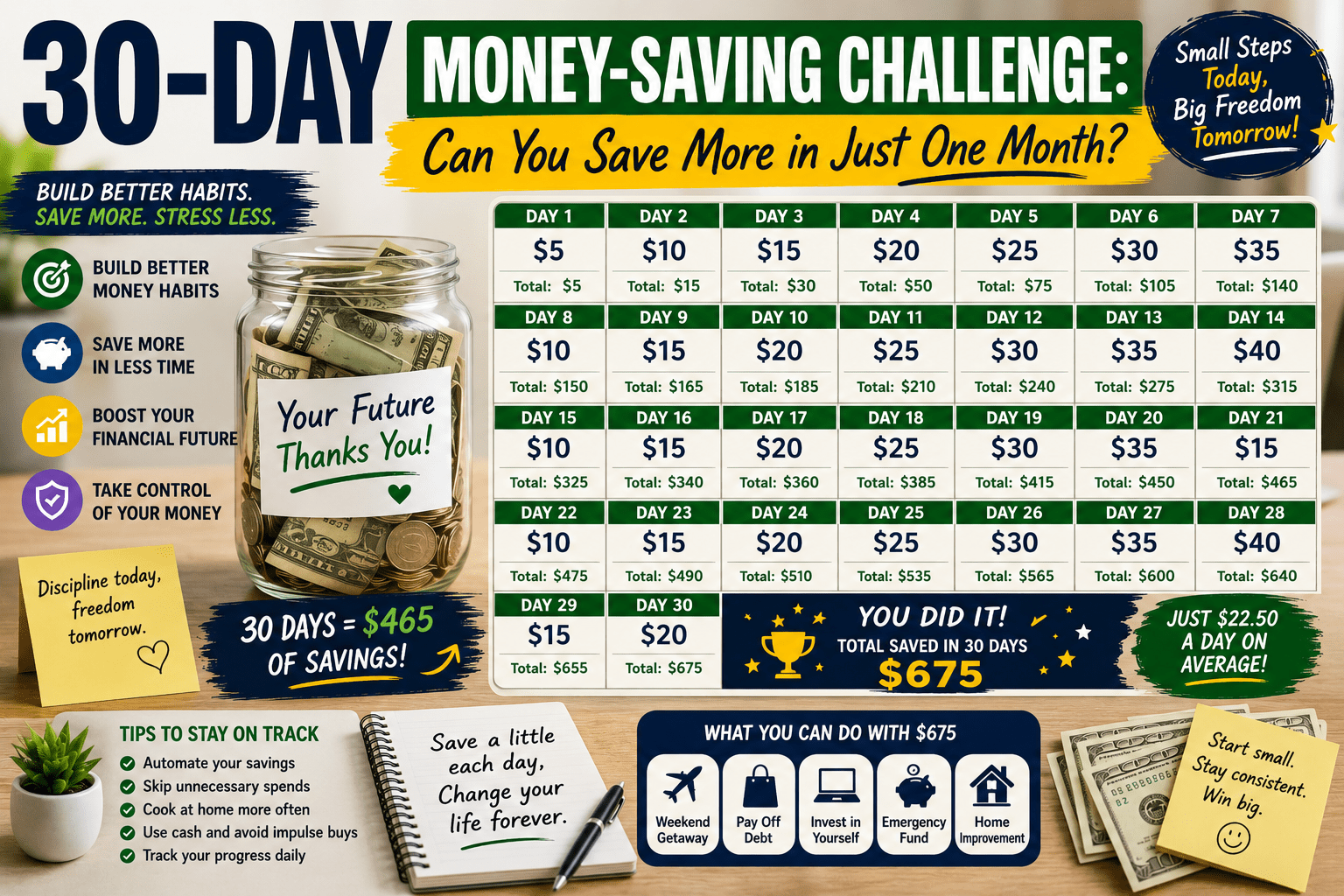
30-Day Money-Saving Challenge: Can You Save More in Just One Month?
30-Day Money-Saving Challenge: Can You Save More in Just One Month?
A one-month challenge can help you test practical savings habits without committing to a restrictive lifestyle forever. Each day focuses on one small action you can use, measure and keep if it works.
A 30-day money-saving challenge can help you save more by combining small spending changes, weekly reviews, low-cost habits and deliberate transfers. However, the challenge should not force you to skip essential expenses. Choose a realistic target, track your progress, and use the month to discover which habits are worth keeping long term.
Can You Really Save More in Just 30 Days?
Yes, but the amount depends on your income, household costs and starting point. Some people may create a meaningful balance in one month. Others may save only a small amount. Both outcomes can still be useful if the challenge reveals better habits.
The Real Goal Is More Than the Final Number
A challenge can show you where money leaks occur, which spending rules work and whether your savings target is realistic. In addition, it creates a short testing period. You are not promising to follow every rule forever.
Choose a Target That Fits Your Life
For example, one person may aim for $100, while another may choose $300 or a locally meaningful amount in another currency. The right target should stretch you slightly without making essential bills unsafe.
Start With a Baseline
Before Day 1, write down your current savings balance, expected income and major bills for the next 30 days. As a result, you can measure actual progress instead of guessing.

How to Set Up Your 30-Day Money-Saving Challenge
Step 1: Pick the Target
First, choose the amount you want to save. Keep the target realistic enough that housing, food, utilities, health and essential transport remain protected.
Step 2: Choose Where the Money Will Go
Next, use a separate savings account, bank subaccount, secure cash envelope or another appropriate method. The important part is making the balance easy to identify.
Step 3: Decide What Counts as Savings
Only count money that actually remains available for the goal. For example, if you skip a $20 purchase but spend the same $20 elsewhere, the challenge has not created $20 of savings.
Step 4: Review Every Seven Days
Finally, check progress on Days 7, 14, 21 and 28. Weekly reviews make it easier to correct course before the month ends.
| Challenge Target | Average Per Week | Approx. Per Day |
|---|---|---|
| $50 | $12.50 | $1.67 |
| $100 | $25.00 | $3.33 |
| $200 | $50.00 | $6.67 |
| $300 | $75.00 | $10.00 |
| $500 | $125.00 | $16.67 |
The table uses simple arithmetic and is only a planning aid. You do not need to save the same amount every day. In fact, many people will save more on some days and nothing on others.
Your 30-Day Money-Saving Challenge
Use each day as a small experiment. If one task does not fit your situation, adapt it rather than forcing an unrealistic rule.
Days 1–7: Understand Your Money
First, focus on tracking, simple cuts and the habits that shape everyday spending.
Day 1: Choose Your One-Month Savings Goal
Pick a realistic amount for the next 30 days. The goal can be small or ambitious, but it should not put essential bills at risk. Write the number down so the challenge has a clear finish line.
Day 2: Track Every Purchase
Record cash, cards, bank transfers and digital-wallet spending. The point is not to judge yourself. Instead, use the information to see where your money actually goes.
Day 3: Cancel One Low-Value Subscription
Review recurring charges and remove one service you barely use. Then redirect that amount toward the challenge so the saving becomes visible.
Day 4: Plan Three Low-Cost Meals
Choose three simple meals based on food you already have or affordable staples. Planning ahead can reduce both grocery waste and expensive convenience purchases.
Day 5: Have a No-Spend Day
Avoid optional purchases for one day while still paying normal bills and essential costs. Use what you already own and choose free activities.
Day 6: Use a 24-Hour Rule
For every nonessential purchase today, wait at least 24 hours. The pause gives you time to decide whether the item is really worth delaying your savings goal.
Day 7: Review Week One
Add up what you saved, what you spent and what surprised you. Keep the changes that felt realistic and adjust anything that was too strict.
Day 8: Pack Lunch or Prepare Food at Home
Replace one purchased meal with food from home. You do not need to do this every day. The challenge is about testing what works.
Day 9: Check Bank and Mobile-Money Fees
Review your accounts for ATM, transfer, maintenance or transaction charges. Learn which methods cost less and use them where practical.
Day 10: Sell One Unused Item
Choose one useful item you no longer need and sell it safely through an appropriate local channel. Add suitable proceeds to the challenge fund.
Day 11: Unsubscribe From Retail Promotions
Remove shopping emails, texts and app alerts that regularly tempt you to spend. Fewer prompts can make impulse control easier.
Day 12: Use a Grocery List
Plan your shopping before entering the store. Check what you already have, write the list and avoid adding extras unless they are genuinely needed.
Day 13: Create a Small Fun-Money Limit
Give yourself a modest amount for guilt-free personal spending. A clear allowance can make the challenge easier to maintain than eliminating all enjoyment.
Day 14: Review Week Two
Compare your actual spending with your target. If one category is causing problems, choose one new rule for the second half of the challenge.
Day 15: Reduce One Convenience Expense
Choose one repeated cost such as delivery, snacks, coffee or ride-hailing. Reduce the frequency rather than banning it completely.
Day 16: Use Cash or a Separate Wallet for One Category
Pick one category where spending feels invisible. A physical or digital limit can make the remaining amount easier to see.
Day 17: Check Your Phone or Internet Plan
Review whether you are paying for features you rarely use. Compare available options and keep only changes that still support work, school and essential communication.
Day 18: Plan Free Entertainment
Choose one free or very low-cost activity for today or the weekend. Parks, libraries, walks, sports, home game nights or community events can reduce paid entertainment.
Day 19: Transfer the Money You Avoided Spending
If you skipped an impulse purchase, canceled a charge or spent less on food, move part of that difference to savings. This turns the challenge into measurable progress.
Day 20: Create a Mini Sinking Fund
Set aside a small amount for one predictable future expense such as school supplies, annual fees, gifts or repairs. This can reduce future budget pressure.
Day 21: Review Week Three
Check the balance and identify the three strongest changes so far. Keep using those habits for the final nine days.
Day 22: Have Another No-Spend Day
Repeat the no-spend challenge, but make it easier by planning food, transport and activities beforehand.
Day 23: Remove Saved Card Details
Delete stored payment details from shopping sites or apps that trigger impulse purchases. Extra checkout friction can create a useful pause.
Day 24: Compare One Recurring Bill
Review one meaningful household cost such as insurance, phone, internet or another service. Compare equivalent alternatives before making a change.
Day 25: Redirect a Finished Payment
If any installment, subscription or regular payment has recently ended, move part of that former cost toward your savings goal.
Day 26: Use a Wish List Instead of Buying
Write down nonessential items you want today. Wait until the challenge ends before deciding whether they are still worth buying.
Day 27: Find One Small Income Boost
Consider a legitimate short-term option such as extra hours, a freelance task, selling a service or another realistic opportunity that fits your situation.
Day 28: Review Week Four
Look at what changed in food, shopping, bills, fees and savings. Decide which habits are strong enough to continue after Day 30.
Day 29: Move One Final Extra Amount
Add a final contribution based on what the budget can safely support. It can be small. The purpose is to finish the month intentionally.
Day 30: Measure the Result and Build the Next Plan
Calculate what you saved, what habits worked and what did not. Then choose one or two changes to continue next month so the challenge becomes a longer-term system.
How to Track Your Progress Without Making It Complicated
You do not need a complex spreadsheet. A notebook, phone note or simple table can work. Record the date, what you changed and how much money actually moved toward your savings goal.
| Date | Action | Money Saved | Running Total |
|---|---|---|---|
| Day 3 | Canceled unused subscription | $12 | $12 |
| Day 5 | No-spend day | $8 | $20 |
| Day 8 | Packed lunch | $7 | $27 |
| Day 10 | Sold unused item | $35 | $62 |
Separate “Spent Less” From “Saved”
Spending less is useful, but it becomes savings only when the money stays available for the goal. Therefore, transfer at least part of the difference when practical.
Use Weekly Milestones
Instead of staring at the final target every day, set weekly checkpoints. For example, a $200 goal could use four $50 weekly milestones. However, the contributions do not need to be equal.

Today-to-Today Examples and Mini Case Studies
These examples are hypothetical. They show how the challenge can be adapted to different places and financial situations.
A Lunch-and-Transport Challenge
An office worker keeps essential transport unchanged but packs lunch three days each week. He also plans errands more carefully to reduce extra trips.
At the end of each week, he transfers the difference to savings.
Key lesson: protect essential costs and target flexible spending instead.
Food Waste Becomes the Main Target
A parent checks the kitchen before shopping, plans meals and freezes suitable leftovers. As a result, fewer groceries are wasted during the challenge.
Key lesson: saving can come from using purchases better, not simply buying less.
Shopping Notifications Get Removed
A professional notices that many unplanned purchases begin with retail alerts. She turns off notifications, removes saved card details and uses a 24-hour rule.
Key lesson: changing the environment can reduce impulse spending.

Irregular Income Requires Flexible Saving
A freelancer does not use a fixed daily target. Instead, she keeps a small baseline and saves more when two client payments arrive during the month.
Key lesson: a challenge can use flexible contributions rather than equal daily amounts.
One Finished Subscription Funds the Challenge
A couple cancels an unused service and adds one no-spend day each week. They keep a small entertainment budget so the challenge does not feel punitive.
Key lesson: recurring savings and realistic enjoyment can coexist.
Business Cash Is Kept Separate
A business owner first separates business expenses from household money. Only the household share is used for the challenge.
Key lesson: do not count business revenue as personal savings before business obligations are covered.
What If You Miss a Day?
Missing one task does not ruin the challenge. Instead, continue with the next day. The purpose is to improve your financial habits, not to maintain a perfect streak.
Do Not Double-Punish Yourself
If you overspend on Day 12, do not respond by skipping essential food on Day 13. Adjust flexible spending and continue.
Repeat a Better Day Instead
If one task does not fit your life, repeat a strategy that worked well. For example, you might do another no-spend day or another meal-planning day.
Use the Mistake as Information
Ask what caused the problem. Was it stress, an unexpected bill, social pressure or an unrealistic target? Then change the plan.
How to Make the Challenge Work on a Low or Irregular Income
Use a Smaller Target
There is no minimum amount required for the challenge to count. A smaller target that protects essentials is better than a large target that creates another shortage.
Save More During Stronger Days or Weeks
For irregular earners, use a baseline amount plus extra contributions when income is stronger. As a result, the challenge can adapt to changing cash flow.
Do Not Depend Only on Expense Cuts
If essential costs already consume nearly all income, additional cutting has limits. In that situation, a small legitimate income boost may matter more than trying to reduce necessary spending further.
How to Get More Value From the Challenge
A 30-day money-saving challenge works best when each task teaches you something about your spending. Therefore, do not judge success only by the final number. Also look at whether your habits became clearer, your bills felt easier to manage and your savings decisions became more automatic.
Choose One Main Theme Each Week
For example, Week 1 can focus on awareness, Week 2 on food and shopping, Week 3 on recurring costs and Week 4 on building a stronger savings routine. This structure makes the month easier to follow because each week has a clear purpose.
Use a Visible Progress Marker
In addition, track the running total somewhere you will notice it. A notebook, spreadsheet, savings account label or simple chart can make progress easier to see. As a result, the challenge becomes more concrete than a vague promise to “save more.”
Reward Progress Without Undoing It
Meanwhile, choose a low-cost way to celebrate milestones. For instance, you might plan a free outing, movie night at home or another enjoyable activity. The reward should support motivation without erasing the savings you worked to build.
Share the Goal With Someone You Trust
Finally, accountability can help some people stay consistent. You might tell a partner, friend or family member what you are working toward. However, keep the challenge private if sharing would create pressure or conflict.
Common Mistakes During a 30-Day Savings Challenge
Making the Target Too Aggressive
First, avoid setting a target that requires you to skip essentials. If your challenge amount creates stress around food, rent or transport, reduce it. A smaller target that you complete is more useful than an unrealistic one that causes financial problems.
Counting Money You Did Not Actually Save
Next, separate “I spent less” from “I saved.” If you skip a $15 purchase but spend that $15 elsewhere, your savings balance did not increase. Therefore, transfer at least part of the difference when possible.
Trying to Change Too Many Habits at Once
In addition, too many rules can make the month exhausting. Focus on the daily task, then keep only the habits that genuinely help. Over time, a smaller number of strong routines can outperform a complicated challenge.
Restarting After One Bad Day
Finally, do not treat one mistake as a reason to quit. Continue with the next task and use the problem as feedback. As a result, the challenge remains realistic and easier to finish.
What to Do After Day 30
Keep the Three Best Habits
Choose the changes that produced useful savings without making life unnecessarily difficult. Those are the best candidates for the next month.
Drop Low-Value Rules
Some tasks may save almost nothing or require too much effort. Let them go. A good money system should become simpler over time.
Raise the Goal Carefully
If the challenge felt comfortable, increase the next target slightly. However, avoid turning one successful month into an unrealistic long-term savings rate.
Move From Challenge Mode to Routine
Finally, automate one or two habits. A recurring transfer, weekly money check-in or sinking fund can turn the 30-day experiment into a permanent system.
Incoming Link Opportunities
These MoneyOnliners articles can link to this challenge whenever readers need a practical short-term savings experiment.
Cross-Cluster Incoming Links
Recommended External Resources
Consumer.gov — Making a Budget
Consumer.gov provides a simple framework for comparing income and expenses and using actual spending to improve the next month's plan.
Consumer Financial Protection Bureau — Track Your Spending
CFPB consumer education encourages people to track spending long enough to notice surprises, recurring costs and spending patterns.
Consumer Financial Protection Bureau — Emergency Fund Guide
CFPB discusses consistent contributions, cash-flow management and small savings steps that can help build a financial cushion.
CFPB — Your Money, Your Goals
The toolkit includes practical resources for bills, cash flow, savings and financial goals.
Several external resources above are U.S.-based. The budgeting and saving principles can still be useful internationally, but account protections, public benefits, banking fees and financial products differ by country.
Frequently Asked Questions
Common Questions About a 30-Day Money-Saving Challenge
How much can I save in 30 days?
The amount depends on your income and expenses.
For example, some readers may save $50 or $100.
Others may save more during a strong income month.
However, a smaller amount can still be useful.
The goal should protect essential bills.
Do I have to save money every day?
No.
Instead, focus on the total over the month.
Some days may produce no savings.
Meanwhile, another day might include a canceled subscription or sold item.
Use weekly milestones if daily targets feel too rigid.
What if I miss a day?
Continue with the next task.
Do not restart the entire challenge.
For example, repeat a strategy that worked well if the missed task does not fit.
Use the month as an experiment rather than a perfect streak.
Consistency matters more than perfection.
Is a no-spend day safe?
Yes, when it means avoiding optional purchases.
However, essential bills, food, medicine and necessary transport still matter.
Plan the day in advance.
Use food and activities already available.
Do not create hardship merely to maintain a streak.
Can I do the challenge on a low income?
Yes, but use a smaller target.
First, protect essential expenses.
Next, focus on waste and low-value costs.
Then add income-based contributions when possible.
Most importantly, do not borrow simply to keep saving.
Should I keep the money in cash or a bank account?
Either can work depending on your situation.
A bank account may offer stronger security and clearer records.
However, cash can make a goal more visible for some people.
Compare fees, access and protections.
Choose the method that is safe and appropriate where you live.
What should I do with the money after Day 30?
Give it a clear purpose.
For example, it may become emergency savings or a sinking fund.
You can also continue building toward a larger goal.
Then keep the habits that worked best.
A challenge is most valuable when it improves the next month too.
Can I repeat the 30-day challenge?
Yes.
However, change the tasks if they become repetitive.
You can raise the target carefully.
Alternatively, focus the next challenge on one category such as food or impulse spending.
Keep the process realistic enough to maintain.
Research Methodology
This guide structures a 30-day money-saving challenge around spending awareness, food planning, impulse control, recurring costs, no-spend days, savings transfers and weekly reviews. Core principles align with public consumer education from Consumer.gov and the Consumer Financial Protection Bureau. Numerical examples use straightforward arithmetic, and all case studies are hypothetical.
Final Thoughts: One Month Can Be Enough to Change the System
A 30-day challenge will not solve every financial problem. However, it can give you a focused month to test better habits, identify money leaks and build a visible savings balance.
First, track what you spend. Next, reduce low-value costs and impulse purchases. Then move the money you keep toward a clear goal. Finally, review the results and keep the habits that worked.
The best 30-day money-saving challenge is not the one with the harshest rules. It is the one that helps you finish the month with stronger habits—and a savings system you can continue using.
Continue the Saving Money Series
Use these related MoneyOnliners guides to build on your 30-day progress.
Automate Your Savings Build Sinking Funds Save $1,000 Faster



2 Comments