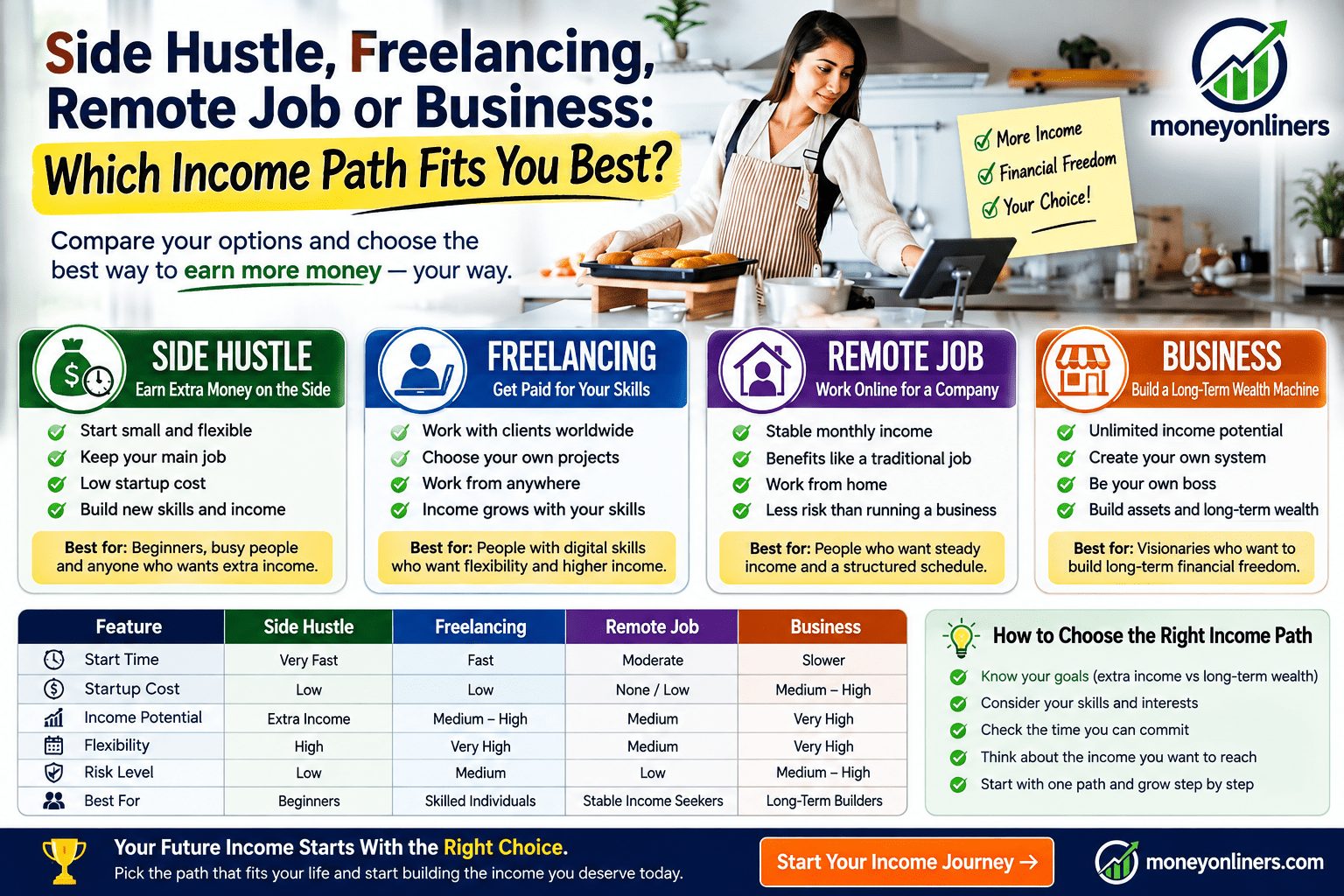
Side Hustle, Freelancing, Remote Job or Business: Which Income Path Fits You Best?
Side Hustle, Freelancing, Remote Job or Business: Which Income Path Fits You Best?
There is no single best way to earn more money. A side hustle may fit someone who wants a small second income. Freelancing can suit people who want more control over clients and pricing. A remote job may appeal to someone who values stable employment with location flexibility, while a business may offer greater ownership and scale alongside greater uncertainty. The right choice depends on your goals, skills, risk tolerance, time and preferred level of responsibility.
Which Income Path Should You Choose?
| Income Path | May Fit You Best If... | Main Tradeoff |
|---|---|---|
| Side Hustle | You want additional income without replacing your main job. | Limited time and possible burnout. |
| Freelancing | You want control over clients, projects and pricing. | Income may be inconsistent and you must find clients. |
| Remote Job | You want employment income with the ability to work away from a traditional office. | You still answer to an employer and may have fixed hours. |
| Business | You want ownership, systems and greater long-term scaling potential. | Higher complexity, responsibility and financial risk. |
You do not have to choose one path forever. Many people move from one model to another as their skills, finances and priorities change.
Table of Contents
The Four Income Paths at a Glance
Side hustles, freelancing, remote jobs and businesses often overlap, which is why the terms can become confusing.
For example, freelancing can be a side hustle when you do it alongside a full-time job. Freelancing can also become your primary income.
Likewise, a small freelance operation can eventually become a business if you develop systems, hire people or sell something beyond your individual hours.
| Feature | Side Hustle | Freelancing | Remote Job | Business |
|---|---|---|---|---|
| Main Purpose | Extra income | Sell a skill or service | Employment income | Build an owned income system |
| Who Pays You? | Customers, platforms or employer | Clients | Employer | Customers |
| Income Stability | Low–Medium | Low–Medium | Usually Higher | Low initially; varies later |
| Control | Medium | High | Low–Medium | High |
| Startup Risk | Usually Low | Usually Low | Low | Can Be Higher |
| Customer Acquisition | Sometimes | Yes | No | Yes |
| Benefits | Rare | Usually None | May Be Available | Self-Funded |
| Scale Potential | Low–Medium | Medium | Primarily Career-Based | Potentially High |

What Is a Side Hustle?
A side hustle is an income activity pursued alongside a primary job, studies, caregiving responsibilities or another main commitment.
Examples
- Freelance writing on weekends
- Online tutoring after work
- Selling digital templates
- Providing local services
- Managing social media for one small client
- Selling unused or resold items
Advantages
- You can keep your main income.
- Startup risk can be relatively low.
- You can test a skill or market before making a major career change.
- Additional income can support financial goals.
Disadvantages
- Your available time may be limited.
- Working evenings or weekends can create burnout.
- Income can be irregular.
- Some employers restrict outside work or conflicts of interest.
A side hustle may work well if you already have relatively stable primary income and want to test another income source without immediately giving up that stability.
What Is Freelancing?
Freelancers independently provide services to clients rather than working as traditional employees of those clients.
Common Freelance Services
- Writing and editing
- Graphic design
- Web development
- Video editing
- Virtual assistance
- SEO
- Bookkeeping
- Consulting
- Translation
- Marketing
Advantages
- You can often choose clients and projects.
- You may have greater control over pricing.
- Remote work is common in many freelance fields.
- You can specialize in higher-value problems.
Disadvantages
- You must find clients.
- Income may fluctuate.
- You handle much of your own administration.
- Benefits such as paid leave are generally not provided by clients.
- You may face unpaid time between projects.
Freelancing can be a side hustle, a full-time self-employment model or the beginning of a larger service business.
What Is a Remote Job?
A remote job is employment performed partly or entirely away from the employer's traditional workplace.
Remote employees typically receive wages or salary from an employer and operate within company rules, responsibilities and schedules.
Common Remote Roles
- Customer support
- Software development
- Marketing
- Sales
- Administration
- Project management
- Accounting
- Data analysis
Advantages
- Income can be more predictable.
- Some positions include employee benefits.
- You do not have to find clients continually.
- Remote work can reduce commuting.
Disadvantages
- Your employer still controls much of the work.
- Remote does not necessarily mean flexible.
- You may have fixed working hours.
- Layoffs and job loss remain possible.
“Remote” describes the work location. It does not mean a job is freelance, part-time, flexible or self-employed.
What Does Starting a Business Mean?
A business creates products or services for customers while the owner carries responsibility for operations, finances, marketing and risk.
Some businesses begin with one person and almost no capital. Others require employees, inventory, equipment or significant investment.
Examples
- Freelance agency
- Cleaning company
- Consulting firm
- Online store
- Software company
- Tutoring company
- Digital product company
- Local service business
Advantages
- Greater ownership and control.
- Potential to build systems beyond your personal working hours.
- Potential to create an asset with independent value.
- More freedom to design products, pricing and operations.
Disadvantages
- Revenue can be unpredictable.
- Financial risk can be higher.
- You must acquire customers.
- Administration can become complex.
- Ownership does not guarantee profitability.
Owning a business does not automatically mean earning more than an employee or freelancer. Profitability depends on the economics of the specific business.
Side Hustle vs Freelancing vs Remote Job vs Business
| Category | Side Hustle | Freelancing | Remote Job | Business |
|---|---|---|---|---|
| Primary Goal | Supplement income | Sell professional services | Earn employment income | Build an owned operation |
| Income Predictability | Low–Medium | Low–Medium | Medium–High | Low–Variable |
| Schedule Control | Medium–High | High | Low–Medium | High in theory; often demanding in practice |
| Pricing Control | Varies | High | Low | High |
| Customer Acquisition | Sometimes | Required | Not Usually | Required |
| Startup Capital | Usually Low | Usually Low | Very Low | Low to High |
| Benefits | Usually None | Usually None | May Be Available | Self-Funded |
| Administrative Responsibility | Low–Medium | Medium | Low | High |
| Scale Beyond Personal Hours | Limited | Possible | Mostly Through Career Growth | Potentially Strong |
| Financial Risk | Low | Low–Medium | Low | Medium–High |
Which Path Offers the Strongest Income Potential?
There is no universal winner.
Remote Job
A remote employee may earn a strong salary, especially in specialized careers. However, compensation generally remains linked to the employer's pay structure and career progression.
Freelancing
Freelancers may raise prices as skills and demand improve. Nevertheless, income also depends on finding enough clients and avoiding excessive unpaid work.
Side Hustle
A side hustle can add meaningful income, although available time may limit growth if you already work full time.
Business
A successful business can potentially scale beyond the owner's hours through employees, systems, products or technology. However, business failure and low profitability are also possible.
Which Income Path Offers the Most Stability?
A stable remote job generally provides the clearest regular-pay structure among the four models.
That does not make employment risk-free. Companies can restructure, reduce staff or close.
| Path | Typical Stability | Main Stability Risk |
|---|---|---|
| Side Hustle | Low–Medium | Irregular demand or limited time |
| Freelancing | Medium when diversified | Losing clients |
| Remote Job | Often Higher | Layoff or employer failure |
| Business | Highly Variable | Sales, cash flow and operating risk |
Stability comes from the underlying economics, not simply from the label. A freelancer with several recurring clients can sometimes have more diversified income than an employee with one employer.
Which Path Offers the Most Flexibility?
Freelancing and business ownership often provide the greatest theoretical control over schedules.
However, customer deadlines, operations and cash-flow needs may reduce that freedom in practice.
| Path | Location Flexibility | Schedule Flexibility | Work Choice |
|---|---|---|---|
| Side Hustle | Varies | Often High | Medium–High |
| Freelancing | Often High | High | High |
| Remote Job | Potentially High | Low–Medium | Low |
| Business | Varies | Potentially High | Very High |
Flexibility should therefore be evaluated separately from workload.
Which Income Path Has the Most Risk?
Business ownership generally introduces the greatest financial and operational risk because owners may invest money before knowing whether enough customers will buy.
Freelancers usually face lower startup costs, although income volatility can still be substantial.
A side hustle can offer a relatively low-risk testing environment when the person keeps primary income.
Employment may involve less direct financial risk, but relying entirely on one employer creates concentration risk.
RISK ALSO INCLUDES “HOW DEPENDENT AM I ON ONE INCOME SOURCE?”
Which Income Path Fits Different Types of People?
Side Hustle
May fit: Someone with stable employment who wants extra income or wants to test another path.
Freelancing
May fit: Someone with a marketable skill who wants more control and is comfortable finding clients.
Remote Job
May fit: Someone who values predictable employment but wants location flexibility.
Business
May fit: Someone who wants ownership and is prepared for greater uncertainty and responsibility.
If You Need Reliable Income Soon
A legitimate job may be safer than trying to build a new business from zero.
If You Already Have a Valuable Skill
Freelancing may offer a relatively direct way to test whether customers will pay for that skill.
If You Already Have a Full-Time Job
A small side hustle may allow experimentation without immediately replacing your existing income.
If You Want to Build Something Beyond Your Own Hours
Business ownership may eventually provide stronger leverage through systems, employees, intellectual property or technology.
If You Strongly Dislike Selling
A remote job may initially fit better because freelancers and business owners generally need to acquire customers.
If You Want Maximum Control
Freelancing or business ownership can provide more control, although that control comes with additional responsibility.
MoneyOnliners Original Income Path Fit Framework
The MoneyOnliners Income Path Formula
The MoneyOnliners Income Path Fit Framework, Income Path Formula and Income Path Scorecard are original educational tools designed to compare side hustles, freelancing, remote employment and business ownership based on stability, control, time, risk, skill and scalability.
MoneyOnliners Income Path Scorecard
Rate yourself from one to five on the statements below.
| Statement | If High, Consider... |
|---|---|
| I need predictable monthly income. | Remote Job |
| I want to keep my existing job while testing another income source. | Side Hustle |
| I want control over clients and pricing. | Freelancing |
| I am comfortable finding customers. | Freelancing or Business |
| I want potential to build systems beyond my own hours. | Business |
| I have limited financial capacity for failure. | Remote Job or Low-Cost Side Hustle |
| I already have a marketable professional skill. | Freelancing |
| I strongly value employee benefits. | Remote Job |
| I can tolerate irregular income. | Freelancing or Business |
| I want ownership of what I build. | Business |
Simple Decision Tree
How to Move From One Income Path to Another
Income paths are not permanent identities.
Side Hustle → Freelancing
Freelancing → Business
Remote Job → Side Hustle
Side Hustle → Business
Freelancing → Remote Job
Freelance experience can sometimes create a portfolio that helps someone qualify for employment.
Business → Employment
Returning to employment is also a valid choice. Entrepreneurship is not automatically superior to having a good job.
10 Mistakes to Avoid When Choosing an Income Path
1. Choosing Based Only on Income Screenshots
Screenshots rarely reveal costs, working hours, failed attempts or income volatility.
2. Quitting Stable Income Too Early
Testing demand before leaving employment can reduce financial pressure.
3. Treating Remote Work as Self-Employment
Remote employees still work for employers.
4. Assuming Freelancing Means Passive Income
Freelancers generally trade skills and work for client payments.
5. Calling Every Side Hustle a Business
A small income activity does not necessarily need to become a large company.
6. Starting a Business Without Customer Validation
A product or service is not commercially useful merely because you like the idea.
7. Ignoring Taxes and Expenses
Gross revenue is not the same as usable income.
8. Ignoring Employer Policies
Employees should review outside-work and conflict-of-interest rules where relevant.
9. Underestimating Burnout
Adding 20 hours of side work to a demanding job may not be sustainable.
10. Believing One Path Is Automatically Superior
The best choice depends on your life, finances and goals.
Why Side Hustle vs Freelancing vs Remote Job vs Business Matters
1. First, choosing the right income structure can affect both earnings and quality of life.
2. A side hustle can provide additional income without immediately replacing a primary job.
3. Meanwhile, freelancing can offer greater pricing and project control.
4. Remote employment can provide location flexibility while preserving an employer relationship.
5. Business ownership can create opportunities for greater control and scale.
6. However, each path also creates different responsibilities.
7. Side hustles can create time pressure.
8. Freelancers must continually manage clients and income variability.
9. Employees remain dependent on employer decisions.
10. Business owners carry substantial operational responsibility.
11. Therefore, income potential should not be the only decision factor.
12. Stability may matter more during financially fragile periods.
13. Flexibility may become more important for people with caregiving responsibilities.
14. Ownership may matter more to people pursuing long-term entrepreneurship.
15. Existing skills can also influence which path is easiest to enter.
16. Risk capacity should influence how quickly someone makes a major transition.
17. A gradual move can protect financial stability while creating new opportunities.
18. Income diversification can reduce dependence on one source.
19. Nevertheless, too many simultaneous income paths can create burnout and distraction.
20. Ultimately, understanding side hustle vs freelancing vs remote job vs business matters because the strongest income path is the one that fits your current finances, abilities, priorities and long-term goals—not the one receiving the most attention online.
Incoming Link Opportunities
Side Hustle vs Second Job: Which Is Better for Making Extra Money?
https://moneyonliners.com/side-hustle-vs-second-job/
75 Realistic Ways to Earn More Money Without Falling for Get-Rich-Quick Hype
https://moneyonliners.com/ways-to-earn-more-money/
50 Ways to Make Money From Home Without Starting a Full-Time Business
https://moneyonliners.com/ways-to-make-money-from-home/
20 High-Income Skills That Can Help You Earn More Without Working More Hours
https://moneyonliners.com/high-income-skills/
High-Priority Incoming Links
Earn More Money
https://moneyonliners.com/earn-more-money/
Freelancing
https://moneyonliners.com/freelancing/
Remote Work
https://moneyonliners.com/remote-work/
Side Hustles
https://moneyonliners.com/side-hustles/
Topic Cluster Incoming Links
Grow Your Income
https://moneyonliners.com/grow-your-income/
Jobs & Careers
https://moneyonliners.com/jobs/
Make Money Online
https://moneyonliners.com/make-money-online/
Business Academy
https://moneyonliners.com/business-academy/
Recommended External Resources
U.S. Bureau of Labor Statistics — Occupational Outlook Handbook
Occupational Outlook Handbook — U.S. Bureau of Labor Statistics
Useful for researching occupations, job duties, education requirements and career outlook information.
CareerOneStop
Provides career exploration, job-search and training resources.
U.S. Small Business Administration
Business Guide — U.S. Small Business Administration
Useful for readers considering the transition from freelance work or a side hustle into a structured business.
Internal Revenue Service — Gig Economy Tax Center
Provides general U.S. tax information relevant to freelance, gig and side income.
Federal Trade Commission — Job Scams
Job Scams — Federal Trade Commission
Useful for evaluating suspicious remote-job and work-from-home opportunities.
Federal Trade Commission — Money-Making Opportunity Scams
Money-Making Opportunity Scams — Federal Trade Commission
Employment law, tax treatment, business registration, contractor classification and licensing requirements vary by country and location. This article provides general educational information rather than individualized legal, tax, employment, financial or business advice.
Frequently Asked Questions
Is a side hustle the same as freelancing?
No.
A side hustle describes an income activity performed alongside another main commitment.
Freelancing describes independently providing services to clients.
Therefore, freelancing can be a side hustle.
It can also become someone's primary income.
Is freelancing the same as running a business?
Not always.
A freelancer may simply sell individual professional services.
A business may use systems, employees, products or processes that extend beyond one person's time.
However, freelancers are still engaging in self-employment activity.
The distinction becomes clearer as operations grow.
Is a remote job a side hustle?
It can be if the remote job is part-time and secondary to your main income.
However, many remote jobs are full-time primary employment.
The word remote only describes where work is performed.
It does not automatically mean part-time.
It also does not mean self-employed.
Which is better: freelancing or a remote job?
The answer depends on your priorities.
A remote job may provide more predictable pay.
Freelancing can provide more control over clients and prices.
However, freelancers must find customers.
Choose according to your need for stability versus control.
Which has more income potential: freelancing or business?
A business can potentially scale further because income may eventually extend beyond the owner's direct hours.
However, that does not guarantee higher profit.
A skilled freelancer can also earn strong income.
Businesses can lose money.
Compare economics rather than labels.
Should I start a side hustle before starting a business?
Testing a small version can reduce uncertainty.
A side hustle can reveal whether customers actually want the product or service.
It may also help you develop skills.
However, some business models cannot be tested easily as side hustles.
Evaluate the specific opportunity.
Should I quit my job to freelance?
That decision depends on your finances, client pipeline and risk capacity.
Some people prefer building freelance income before leaving employment.
Emergency savings can provide additional protection.
Client income can still fluctuate.
Avoid assuming that one successful month guarantees future stability.
Is remote work more secure than freelancing?
Employment generally provides more predictable compensation.
However, remote workers can still lose jobs.
Freelancers may reduce concentration risk by having multiple clients.
On the other hand, clients can cancel projects.
Neither path is completely secure.
Which income path gives the most freedom?
Freelancing and business ownership can offer substantial control.
However, customers and deadlines still create obligations.
Remote employees may have less schedule control.
Side hustlers often choose when to work but have fewer free hours overall.
Freedom should be measured alongside workload.
Which income path is best for beginners?
There is no single best path.
Someone needing stable income may prefer employment.
A person with a marketable skill might test freelancing.
Someone already employed may start with a small side hustle.
A business may become more appropriate after demand is validated.
Which income path is best with no money?
A legitimate job generally requires little direct startup capital.
Many freelance services can also start with relatively low costs when you already have equipment and skills.
Some businesses require more capital.
Others can start very small.
Avoid spending heavily before validating demand.
Can a side hustle become a full-time business?
Yes, some do.
However, many side hustles remain intentionally small.
Growth should depend on customer demand and economics.
You do not have to turn every profitable activity into a large company.
A small additional income source can still be valuable.
Can freelancing lead to a remote job?
Yes.
Freelance projects can help build experience and a portfolio.
That evidence may strengthen future job applications.
However, employers still use their own hiring criteria.
Freelancing does not guarantee employment.
Can a remote job lead to freelancing?
Skills developed through employment may later support independent services.
However, review employer policies before doing outside work.
Avoid conflicts of interest.
Do not misuse confidential information.
Professional boundaries remain important.
Can I combine a remote job and freelancing?
Some people do.
However, workload can become significant.
Employer policies may also restrict outside activity.
Calculate whether the additional income justifies the extra time.
Avoid building income at the cost of unsustainable burnout.
What is the safest income path?
No income path is completely risk-free.
Stable employment can reduce immediate income volatility.
A small side hustle can allow experimentation while preserving main income.
Freelancing can diversify clients.
The safest choice depends on your financial position and risk capacity.
Research Methodology
Comparison Method
MoneyOnliners compares the four paths using income stability, schedule control, pricing control, customer acquisition, startup requirements, administrative responsibility, financial risk and potential scalability.
Terminology
The article distinguishes a side hustle as a secondary income activity, freelancing as client-based independent service work, remote employment as employer-based work performed away from a traditional workplace, and business ownership as an owned commercial operation.
Income Potential
No fixed income amounts are assigned because actual compensation and profitability vary widely.
Risk Standard
Risk includes potential financial loss, income volatility, customer concentration, employer dependence and time-related burnout.
Original MoneyOnliners Analysis
The Income Path Fit Framework, Income Path Formula, Income Path Scorecard and transition frameworks are original MoneyOnliners educational resources.
First-Hand Evidence Standard
MoneyOnliners only presents personal freelance results, business revenue, side-hustle income, remote-job experience or financial outcomes when genuine first-hand evidence exists and can be represented accurately.
Accordingly, this article does not claim that MoneyOnliners or its founder has personally achieved specific financial results through all four income paths.
Limitations
The boundaries between these income models can overlap. A freelancer may also be a side hustler, and a freelancer may gradually build a business.
Employment rules, tax classifications and business regulations also vary by jurisdiction.
Google Search Console Checklist
- Confirm final URL: /side-hustle-vs-freelancing-vs-remote-job-vs-business/
- Confirm canonical matches the published URL.
- Confirm the page is indexable.
- Confirm the URL appears in the XML sitemap.
- Use side hustle vs freelancing vs remote job vs business naturally in the opening, comparison section, FAQ and conclusion.
- Use related phrase: side hustle vs freelancing.
- Use related phrase: freelancing vs remote job.
- Use related phrase: remote job vs business.
- Use related phrase: freelancing vs business.
- Use related phrase: best income path.
- Add an internal link from Earn More Money.
- Add an internal link from Side Hustles.
- Add an internal link from Freelancing.
- Add an internal link from Remote Work.
- Add an internal link from Jobs & Careers.
- Add an internal link from Business Academy.
- Add links from the Side Hustle Academy.
- Add links from the Freelancing Academy.
- Add links from the Remote Work Academy.
- Add links from Entrepreneurship Academy.
- Check comparison tables on mobile.
- Compress images before upload.
- Use unique image alt text.
- Verify external resource links.
- Check every internal MoneyOnliners URL before publishing.
- Inspect the final URL in Google Search Console.
- Request indexing after publication if appropriate.
- Monitor “side hustle vs freelancing.”
- Monitor “freelancing vs remote job.”
- Monitor “freelancing vs business.”
- Monitor “best income path.”
Conclusion: Choose the Income Path That Fits Your Life Now
A side hustle, freelancing, remote employment and business ownership can all be legitimate ways to build income.
However, they solve different problems.
Choose a Side Hustle When You Want to Test
Keeping your primary income while experimenting can reduce financial pressure.
Choose Freelancing When You Want Client and Pricing Control
A strong marketable skill can become a direct service, although you must also acquire customers.
Choose a Remote Job When Stability Matters
Employment may provide more predictable income while allowing you to work outside a traditional office.
Choose Business When Ownership and Scale Matter
A business may create greater long-term leverage, but it also introduces more risk and responsibility.
Remember That You Can Change Paths
You can start with employment, test a side hustle, develop freelance clients and eventually build a business—or move in the opposite direction.