25 Income Mistakes That Keep People From Earning More Money
25 Income Mistakes That Keep People From Earning More Money
Sometimes the biggest obstacle to earning more is not a lack of effort. It is repeating income decisions that keep the value of your work low, limit your opportunities or waste time on weak earning strategies. From avoiding negotiation to chasing too many side hustles, small income mistakes can compound over years.
What Income Mistakes Can Keep You From Earning More?
Common income mistakes include relying only on annual raises, failing to build valuable skills, staying underpaid without researching the market, avoiding negotiation, underpricing freelance work, confusing revenue with profit and constantly starting weak side hustles instead of building one strong income system.
Other problems include failing to document results, ignoring professional relationships, depending on one customer or employer and spending more time cutting tiny expenses than improving earning power.
The goal is not to maximize income at any cost. The stronger goal is to increase earning power in a sustainable way while protecting your time, health, financial stability and long-term opportunities.
Table of Contents
Why Income Mistakes Can Cost More Than You Think
Income decisions can compound.
If a person remains underpaid for several years, the effect is not limited to one missed raise. Lower earnings can also reduce savings, retirement contributions, investment capacity and emergency-fund growth.
Likewise, failing to build stronger skills today may reduce the number of opportunities available several years from now.
| Income Mistake | Immediate Effect | Possible Long-Term Effect |
|---|---|---|
| Not negotiating | Lower starting compensation | Future raises may build from a lower base |
| Ignoring skills | Limited job options | Slower career progression |
| Underpricing freelance work | Low project income | Burnout and weak margins |
| Depending on one client | Simple income structure | Large income shock if client leaves |
| Chasing many side hustles | Constant activity | Little depth or compounding skill |

Mistakes 1–8: Career and Salary Income Mistakes
1 Assuming Hard Work Automatically Leads to Higher Pay
Working hard matters, but effort alone does not guarantee higher compensation.
Employers may reward work based on responsibility, scarcity, measurable results, negotiation and market value rather than hours of effort alone.
Better Move
Connect your work to measurable outcomes and understand how your employer values different roles.
2 Never Researching Your Market Value
If you do not know what comparable roles pay, it becomes difficult to evaluate whether your compensation is competitive.
Market research can include job postings, occupational data, professional networks and reputable salary information.
Better Move
Review compensation periodically rather than waiting until you become frustrated.
3 Avoiding Salary Negotiation
Some people accept the first offer even when negotiation may be appropriate.
Negotiation does not guarantee a higher offer, and aggressive negotiation can backfire. Nevertheless, thoughtful negotiation may improve compensation or benefits in some situations.
4 Waiting Only for Annual Raises
Annual increases may not be enough to create significant income growth, especially when a person's responsibilities or market value have increased faster.
Career progression, specialized skills, promotions or strategic job changes may have a greater impact.
5 Staying in a Dead-End Role Too Long
Loyalty can be valuable, but remaining indefinitely in a position with little learning, responsibility or compensation growth can limit future earning potential.
Before leaving, evaluate whether the situation can improve internally.
6 Failing to Document Your Results
People often remember their duties but forget their achievements.
A record of completed projects, improvements, savings, revenue contribution and responsibilities can strengthen performance reviews, interviews and negotiations.
Example
“Managed social media” is less informative than documenting that you built a content calendar, improved response times or supported a measurable campaign result.
7 Ignoring Internal Opportunities
A better-paying opportunity does not always require changing employers.
Internal promotions, transfers, special projects and additional responsibilities may help build skills and compensation.
8 Treating Benefits as Worthless
Salary is important, but total compensation may also include retirement contributions, insurance, paid leave, bonuses, training or flexible work arrangements.
Compare complete compensation packages rather than salary alone.
Mistakes 9–14: Skill and Value Income Mistakes
9 Learning Skills With Weak Market Demand
Learning is valuable, but not every skill has the same economic demand.
Before spending substantial time or money, research whether real employers or customers need the skill.
10 Avoiding High-Value Skills Because They Look Difficult
Some valuable skills require meaningful effort.
Software development, sales, data analysis, financial analysis, project management, cybersecurity and other specialized areas may take time to develop.
Difficulty can sometimes be part of what limits qualified competition.
11 Learning Constantly Without Building Proof
Courses can create knowledge, but employers and customers often need evidence that you can apply it.
Projects, portfolios, real assignments and documented outcomes can convert learning into credibility.
12 Ignoring Communication Skills
Technical knowledge can lose value when you cannot explain your ideas clearly.
Writing, presentation, listening and professional communication can strengthen nearly every career path.
13 Refusing to Specialize
Being willing to do anything can help beginners gain experience.
However, long-term earning power often improves when people become especially useful at solving a specific class of problem.
Specialization can make positioning and pricing clearer.
14 Ignoring Skill Stacking
Two complementary skills can sometimes become more valuable together than separately.
| Skill 1 | Skill 2 | Possible Combined Value |
|---|---|---|
| Data Analysis | Communication | Turn data into understandable decisions |
| SEO | Writing | Create search-focused content strategy |
| Programming | Business Knowledge | Build solutions around operational needs |
| Finance | Presentation | Communicate financial decisions clearly |

Mistakes 15–20: Side Hustle and Freelancing Income Mistakes
15 Starting Too Many Side Hustles at Once
Trying five different income ideas can feel productive while preventing meaningful progress in any one of them.
Each method requires learning, customers and systems.
Better Move
Test one or two closely related opportunities before expanding.
16 Choosing Side Hustles With No Skill Growth
Short-term cash can be useful.
However, when two opportunities offer similar income, the one that also develops a valuable skill may create stronger long-term benefits.
17 Underpricing Freelance Work
Beginners may use lower prices while building evidence, but prices that do not cover time and costs can become unsustainable.
Research the market and improve rates as your skill, demand and evidence grow.
18 Depending on One Client
A freelancer with one large client may appear diversified from employment, but economically that person may still depend heavily on one payer.
Where practical, gradually diversify customers without sacrificing quality.
19 Ignoring Recurring Revenue Opportunities
Constantly finding new one-time customers can create unstable income.
Some services naturally support recurring relationships, such as bookkeeping, maintenance, content support or ongoing consulting.
Do not force retainers where they do not make sense, but look for genuine repeat needs.
20 Confusing Revenue With Profit
A side hustle that generates $1,000 in revenue has not necessarily created $1,000 of usable income.
Software, advertising, platform fees, refunds, taxes and equipment can materially affect results.
Mistakes 21–25: Long-Term Income Strategy Mistakes
21 Relying Completely on One Income Source
One salary can be stable for years, but job loss can expose concentration risk.
Diversification does not require ten side hustles. It can mean gradually building a second complementary income stream, maintaining strong savings or developing skills that improve employability.
22 Spending More Effort Cutting Expenses Than Growing Income
Budgeting matters, especially when spending is inefficient.
However, there is a limit to how much expenses can be reduced.
Income has a different ceiling because skills, promotions, business ownership and specialized work may create additional earning capacity.
23 Failing to Build Professional Relationships
Many opportunities emerge through people who know your work and trust your ability.
Professional relationships should not be treated as transactional networking.
Help others, communicate professionally and build a reputation for reliability.
24 Never Asking for More Responsibility
Higher-value responsibilities can create experience that later supports promotions, stronger resumes and better-paying opportunities.
Do not take on unlimited unpaid responsibility indefinitely. Instead, use expanded responsibilities strategically and document results.
25 Chasing Fast Money Instead of Building Earning Power
Quick income can be useful when genuine and safe.
The problem appears when someone spends years jumping between low-quality opportunities without building any skill, asset, reputation or system that improves future earning ability.
Compare the 25 Income Mistakes
| # | Income Mistake | Main Cost | Better Alternative |
|---|---|---|---|
| 1 | Assuming effort guarantees pay | Underrecognized value | Connect work to results |
| 2 | Not researching market value | Possible underpayment | Review market regularly |
| 3 | Avoiding negotiation | Lower compensation potential | Negotiate professionally |
| 4 | Waiting only for raises | Slow growth | Build career leverage |
| 5 | Staying in dead-end roles | Stagnation | Seek learning and advancement |
| 6 | Not documenting results | Weak proof | Track achievements |
| 7 | Ignoring internal opportunities | Missed advancement | Explore promotions and transfers |
| 8 | Ignoring benefits | Bad compensation comparisons | Compare total compensation |
| 9 | Learning weak-demand skills | Low market value | Research demand first |
| 10 | Avoiding difficult skills | Limited specialization | Build valuable capabilities |
| 11 | No proof of skills | Low credibility | Build projects and evidence |
| 12 | Weak communication | Reduced influence | Improve communication |
| 13 | Never specializing | Commodity positioning | Solve specific problems |
| 14 | Ignoring skill stacking | Missed differentiation | Combine related skills |
| 15 | Too many side hustles | Scattered effort | Build depth first |
| 16 | No skill growth | Weak future value | Choose skill-building work |
| 17 | Underpricing | Low margins | Track time and market value |
| 18 | One freelance client | Income concentration | Diversify carefully |
| 19 | Ignoring recurring work | Constant acquisition | Look for repeat demand |
| 20 | Revenue = profit thinking | Overstated income | Track net profit |
| 21 | One income source | Concentration risk | Build optionality |
| 22 | Only cutting expenses | Limited upside | Grow earning capacity |
| 23 | Ignoring relationships | Fewer opportunities | Build professional trust |
| 24 | Avoiding responsibility | Slow experience growth | Pursue strategic responsibility |
| 25 | Chasing fast money | No long-term leverage | Build earning power |
MoneyOnliners Original Income Growth Audit
MoneyOnliners Income Growth Score
| Area | 0 Points | 1 Point | 2 Points |
|---|---|---|---|
| Skill Value | Weak demand | Moderate | Strong demand |
| Proof | Little evidence | Some evidence | Strong evidence |
| Market Awareness | Unknown | Some research | Regular research |
| Compensation | Likely underpriced | Unclear | Competitive |
| Opportunity Seeking | Passive | Occasional | Active |
| Professional Relationships | Weak | Moderate | Strong |
| Leverage | Only hours | Some leverage | Strong leverage |
0–5 Points
Several areas may be limiting your earning power. Start with skills and market awareness.
6–10 Points
Your foundation may be reasonable, but one or two weaknesses may deserve focused improvement.
11–14 Points
Your income-growth foundation may be relatively strong, although market conditions and individual results still vary.
This audit is an educational framework. It cannot predict salary increases, promotions, business results or freelance earnings.
The MoneyOnliners Income Growth Audit, Income Growth Score, Income Leak Framework and 90-Day Income Recovery Plan are original educational tools designed to help readers diagnose why income growth may be stalled and identify practical next steps.
MoneyOnliners Income Leak Framework
Income can be limited at several different points.
A 90-Day Income Recovery Plan
Days 1–30: Diagnose
- Calculate your current monthly and annual income.
- Review total compensation, not salary alone.
- Research comparable jobs or services.
- List your strongest professional skills.
- Document measurable achievements.
- Identify your biggest income mistake.
- Choose one improvement priority.
Days 31–60: Build Value
- Improve one high-value skill.
- Create or update your portfolio.
- Improve your resume or professional profile.
- Practice communication and negotiation.
- Strengthen one complementary skill.
- Connect with relevant professionals.
- Test one realistic extra-income opportunity if appropriate.
Days 61–90: Test the Market
- Apply for appropriate advancement opportunities.
- Discuss compensation when appropriate.
- Test higher-value freelance positioning if relevant.
- Evaluate recurring-income opportunities.
- Track responses and results.
- Drop weak strategies.
- Create a six- to twelve-month income-growth plan.
Why Income Mistakes Matter
1. First, income mistakes can reduce the financial value of work you are already performing.
2. Remaining underpaid can affect more than current spending power.
3. Lower earnings may also reduce future saving capacity.
4. Meanwhile, weak skill development can limit future career options.
5. Failing to build proof can make useful abilities harder for employers or customers to recognize.
6. Avoiding negotiation may also reduce compensation opportunities.
7. However, income growth is not simply about demanding more money.
8. Stronger compensation usually becomes easier to justify when stronger value is created.
9. Therefore, skill development remains a central part of earning more.
10. Market awareness matters as well.
11. A valuable skill can remain underpaid in the wrong market.
12. Likewise, side hustles can waste time when they do not build income or valuable skills.
13. Freelancers may also lose earning power through chronic underpricing.
14. Business owners can overestimate income when they confuse sales with profit.
15. Depending on one payer can create additional financial vulnerability.
16. Professional relationships can create opportunities that are difficult to find through applications alone.
17. Higher-value responsibilities can also strengthen future earning potential.
18. Over time, correcting several small income mistakes can create meaningful financial progress.
19. The objective is not to maximize income at the expense of everything else.
20. Ultimately, understanding income mistakes matters because earning more often begins by removing the barriers that prevent your existing effort, skills and opportunities from producing their full potential.
Incoming Link Opportunities
20 High-Income Skills That Can Help You Earn More Without Working More Hours
https://moneyonliners.com/high-income-skills/
15 Income Streams You Can Build From One Skill or Job
https://moneyonliners.com/income-streams-from-one-skill/
Side Hustle, Freelancing, Remote Job or Business: Which Income Path Fits You Best?
https://moneyonliners.com/side-hustle-vs-freelancing-vs-remote-job-vs-business/
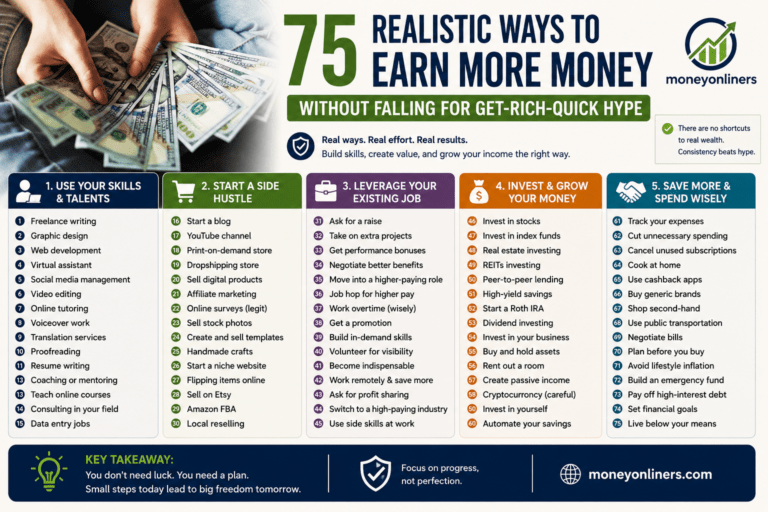
75 Realistic Ways to Earn More Money Without Falling for Get-Rich-Quick Hype
https://moneyonliners.com/ways-to-earn-more-money/
High-Priority Incoming Links
Earn More Money
https://moneyonliners.com/earn-more-money/
Grow Your Income
https://moneyonliners.com/grow-your-income/
Jobs & Careers
https://moneyonliners.com/jobs/
Freelancing
https://moneyonliners.com/freelancing/
Topic Cluster Incoming Links
Side Hustles
https://moneyonliners.com/side-hustles/
Remote Work
https://moneyonliners.com/remote-work/
Make Money Online
https://moneyonliners.com/make-money-online/
Business Academy
https://moneyonliners.com/business-academy/
Recommended External Resources
U.S. Bureau of Labor Statistics — Occupational Outlook Handbook
Occupational Outlook Handbook — U.S. Bureau of Labor Statistics
Useful for researching occupational requirements, pay information and career outlook data.
CareerOneStop
Provides career exploration, training and job-search resources.
O*NET OnLine
Useful for researching occupational skills, knowledge, tasks and abilities.
Internal Revenue Service — Gig Economy Tax Center
Provides general U.S. information relevant to freelance, gig and side-income taxes.
U.S. Small Business Administration
Business Guide — U.S. Small Business Administration
Federal Trade Commission — Job Scams
Job Scams — Federal Trade Commission
Employment, compensation, tax and business rules vary by country, employer and personal situation. This article provides general educational information rather than individualized career, legal, tax, financial or business advice.
Frequently Asked Questions
What are income mistakes?
Income mistakes are decisions or habits that can limit earning potential.
They may involve skills, salaries or pricing.
Others involve poor side-hustle strategy.
Some mistakes create immediate losses.
Others reduce long-term opportunities.
What is the biggest income mistake?
There is no single biggest mistake for everyone.
For one person, chronic underpayment may be the main problem.
Another person may lack marketable skills.
A freelancer may be underpricing services.
Start by identifying the biggest bottleneck in your own situation.
How do I know if I am underpaid?
Research comparable positions.
Look at responsibilities, experience and location.
Consider total compensation rather than salary alone.
Professional contacts can also provide useful context.
Market information is never perfect, so compare several sources.
Should I always negotiate salary?
Not necessarily.
Some employers have fixed compensation structures.
Others may allow negotiation.
Research the situation and communicate professionally.
Consider salary, benefits and flexibility together.
Can changing jobs increase income?
Sometimes.
A new employer may value your skills differently.
However, changing jobs also introduces risk.
Benefits, stability and advancement opportunities should be compared.
Do not change jobs solely because one number is higher.
How often should I check my market value?
There is no fixed rule.
An annual review can provide useful context.
Research may also be appropriate before promotions or major negotiations.
Keep track of changes in responsibilities.
Pay markets can change over time.
Can learning new skills really increase income?
Potentially.
Skills can improve access to higher-value work.
However, demand matters.
Evidence of ability also matters.
No skill guarantees higher compensation.
Why is proof important for income growth?
Employers and customers need reasons to trust your claims.
Projects can demonstrate ability.
Documented achievements can show professional results.
Credentials may help in some fields.
Proof reduces uncertainty for the person deciding whether to pay you.
Is working more hours a good way to earn more?
Additional hours may increase short-term income.
However, time is limited.
Building higher-value skills can sometimes improve income per hour.
Better pricing can also help freelancers.
A sustainable strategy should consider both time and value.
Should I start multiple side hustles?
Usually not all at once.
Each new method requires attention.
Starting too many can reduce progress.
A stronger approach may be building one reliable stream first.
Then add a related second stream if appropriate.
How do I know if my side hustle is worth it?
Calculate revenue.
Subtract expenses.
Then track total working time.
Consider whether the activity also builds useful skills or assets.
Compare the result with other opportunities for your time.
Why is relying on one income source risky?
Dependence on one payer creates concentration risk.
Employees may lose jobs.
Freelancers may lose major clients.
Business owners may lose important customers.
Diversification can help, although it should be built carefully.
Is earning more more important than saving?
Both matter.
Saving improves how efficiently income is used.
Income growth increases the amount available to allocate.
Cost cutting eventually reaches a limit.
A balanced financial strategy considers both sides.
What is skill stacking?
Skill stacking means combining complementary capabilities.
For example, someone may combine data analysis with communication.
Another person may combine SEO with writing.
The combination can make a professional more useful.
The strongest stacks solve clearer problems.
How can I stop underpricing freelance work?
Track the time required for projects.
Include business expenses.
Research comparable services.
Improve proof and specialization.
Adjust pricing carefully as your market value strengthens.
What should I do first if my income is not growing?
Diagnose the bottleneck.
Review skills and market value.
Document your results.
Research better opportunities.
Then choose one specific area to improve over the next 90 days.
Research Methodology
Mistake Selection
MoneyOnliners selected common income-growth barriers involving career positioning, skill development, pricing, freelancing, side-income strategy, professional relationships and long-term income diversification.
Income Standard
The article avoids claiming that correcting any one mistake will produce a specific salary, freelance rate or business outcome.
Career Analysis
Career-related recommendations focus on market awareness, skills, documented results, opportunity seeking, negotiation and total compensation.
Side-Income Analysis
Side-hustle and freelance sections distinguish gross revenue from net economic value and recognize the importance of unpaid time and expenses.
Original MoneyOnliners Analysis
The Income Growth Audit, Income Growth Score, Income Leak Framework and 90-Day Income Recovery Plan are original MoneyOnliners educational frameworks.
First-Hand Evidence Standard
MoneyOnliners only presents personal salaries, promotions, freelance rates, side-hustle results or business income when genuine first-hand evidence exists and can be represented accurately.
Accordingly, examples and formulas in this guide are educational and should not be interpreted as claims about personal MoneyOnliners earnings.
Limitations
Income opportunities vary substantially by country, industry, qualifications, experience, employer, customer demand and broader economic conditions.
Some career changes may also involve financial, family or professional risks that cannot be captured fully in a general guide.
Google Search Console Checklist
- Confirm final URL: /income-mistakes/
- Confirm canonical matches the published URL.
- Confirm the article is indexable.
- Confirm the URL appears in the XML sitemap.
- Use income mistakes naturally in the introduction, headings, FAQ and conclusion.
- Use related phrase: mistakes that keep you from earning more.
- Use related phrase: reasons your income is not growing.
- Use related phrase: how to increase your income.
- Use related phrase: earning more money mistakes.
- Use related phrase: income growth mistakes.
- Add an internal link from Earn More Money.
- Add an internal link from Grow Your Income.
- Add an internal link from High-Income Skills.
- Add an internal link from Income Streams From One Skill.
- Add an internal link from Jobs & Careers.
- Add an internal link from Freelancing.
- Add an internal link from Side Hustles.
- Add links from Career Academy lessons.
- Add links from Freelancing Academy lessons.
- Add links from Digital Skills Academy lessons.
- Check all 25 numbered mistakes on mobile.
- Compress article images before upload.
- Use descriptive image alt text.
- Verify all external resource links.
- Check every internal MoneyOnliners URL before publishing.
- Inspect the final URL in Google Search Console.
- Request indexing after publication if appropriate.
- Monitor “income mistakes.”
- Monitor “income growth mistakes.”
- Monitor “mistakes that keep you from earning more.”
- Monitor “reasons income is not growing.”
Conclusion: Stop Trying to Earn More With the Same Broken Income System
Earning more is not always about adding more hours.
Sometimes the bigger opportunity is fixing the parts of your income system that are already leaking value.
Build Stronger Skills
Develop abilities connected to genuine employer or customer demand.
Build Proof
Document what you can do and what you have accomplished.
Understand the Market
Know how comparable work is valued and where better opportunities may exist.
Price and Negotiate More Effectively
Strong skills can still remain underpaid when compensation is never examined.
Build Options
Career progression, freelancing, related income streams and professional relationships can create alternatives over time.
You do not need to correct all 25 income mistakes today.
Identify the one mistake costing you the most opportunity right now, fix it, and then move to the next.