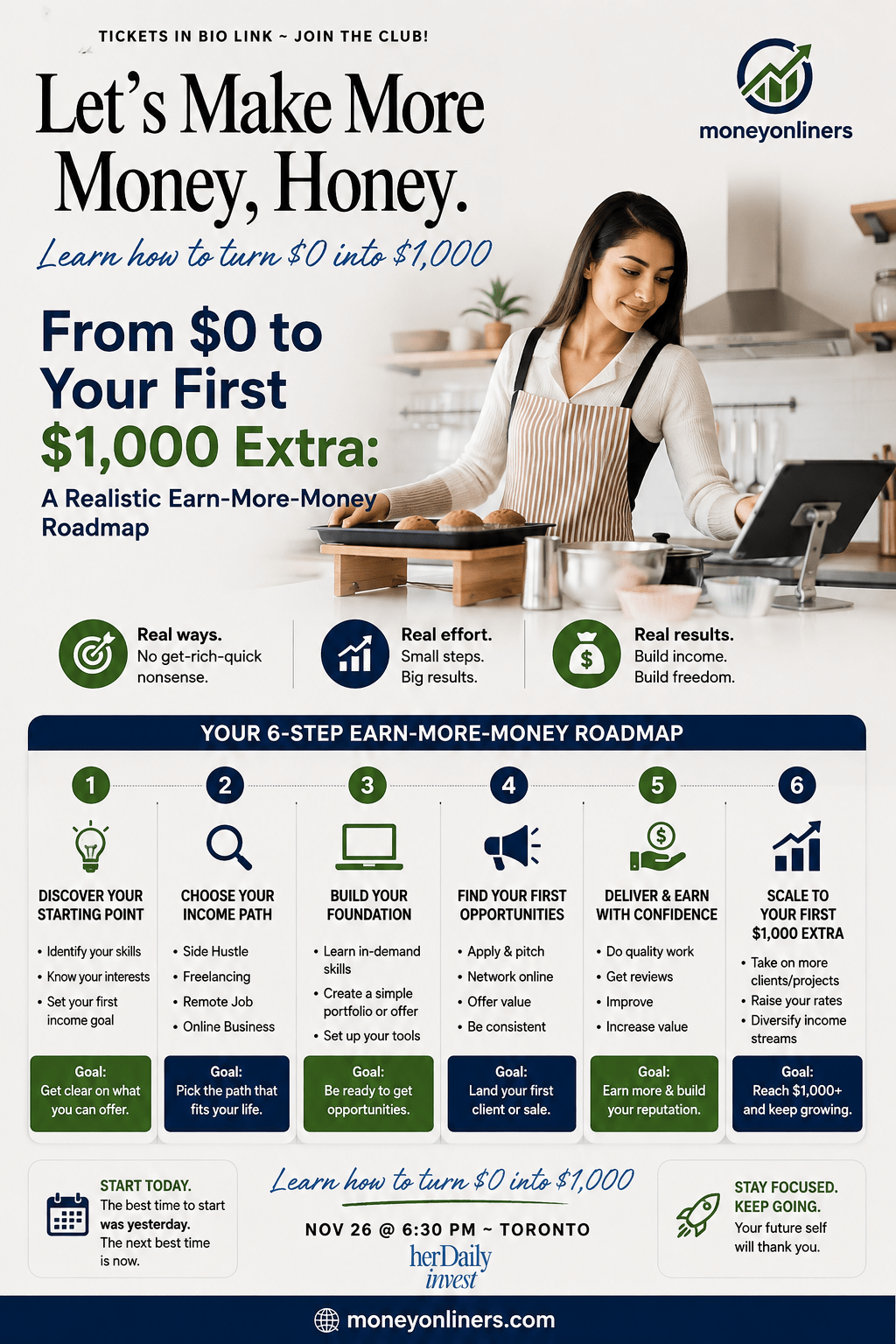
From $0 to Your First $1,000 Extra: A Realistic Earn-More-Money Roadmap
From $0 to Your First $1,000 Extra: A Realistic Earn-More-Money Roadmap
Your first extra $1,000 does not have to come from one lucky break, one viral post or one perfect side hustle. A more realistic approach is to build it in stages: first prove you can earn $100, then strengthen the method enough to reach $250, $500 and eventually $1,000. This roadmap shows how to move from no extra income toward a repeatable earning system without relying on get-rich-quick promises.
How Can You Realistically Earn Your First $1,000 Extra?
Start by choosing one useful skill, service or legitimate income method with a clear customer or employer.
Then break the $1,000 target into smaller milestones.
| Milestone | Main Goal | What You Need to Prove |
|---|---|---|
| First $100 | Validate that someone will pay you. | Your skill or offer has real economic value. |
| First $250 | Repeat the result. | The first payment was not purely luck. |
| First $500 | Improve pricing, volume or repeat business. | Your method can become a meaningful income stream. |
| First $1,000 | Build a repeatable system. | You understand your customers, economics and workflow. |
The first $1,000 may take weeks or months depending on your skills, market, available time, location and method. The objective is not speed at any cost. It is building a legitimate earning process that can be repeated.
Table of Contents
What Does “Your First $1,000 Extra” Mean?
In this guide, your first $1,000 extra means income earned in addition to your normal primary income or baseline financial situation.
It may come from freelancing, a side hustle, additional work, consulting, selling a service, remote part-time work, tutoring, digital products or another legitimate method.
It does not have to arrive in one payment.
For example, four $250 projects equal $1,000. So do ten $100 payments.
Gross Income vs Money You Actually Keep
If the income source has costs, gross revenue is not the same as net income.
For example, if you generate $1,200 in freelance revenue but spend $200 on software, platform fees and other legitimate business expenses, your net amount before applicable taxes would be $1,000.
Taxes and reporting requirements vary by country and situation. Keep records of income and legitimate expenses and follow applicable local rules.

The Math Behind an Extra $1,000
A $1,000 target becomes easier to understand when converted into units of work, customers or sales.
| Model | Illustrative Math | Total |
|---|---|---|
| Hourly Service | 40 hours × $25 | $1,000 |
| Freelance Projects | 5 projects × $200 | $1,000 |
| Larger Projects | 4 projects × $250 | $1,000 |
| Specialized Clients | 2 clients × $500 | $1,000 |
| Small Service Sales | 20 sales × $50 | $1,000 |
| Digital Product | 50 sales × $20 net | $1,000 |
These are illustrations, not income promises.
Your actual pricing, demand and expenses may be completely different.
Weekly Equivalent
If you wanted to build $1,000 over approximately one month, the target is roughly $250 per week.
If you spread the goal across ten weeks, it averages about $100 per week.
Step 1: Choose One Realistic Income Method
The biggest early mistake is trying to pursue ten different ways to make money simultaneously.
Instead, select one method that has a clear payer and a realistic connection to skills you already have or can learn.
Four Strong Starting Categories
Services
Writing, design, admin support, tutoring, bookkeeping, editing or technical support.
Employment
Part-time work, remote work, additional shifts or better-paying roles.
Small Business
Local services, consulting or a simple validated offer.
Products
Templates, guides or other useful products where genuine demand exists.
The MoneyOnliners Real Opportunity Test
Step 2: Build One Useful Skill or Offer
If you already have a marketable skill, start there.
If you do not, choose something with clear beginner-level demand and practice until you can perform the work responsibly.
| Skill | Possible Beginner Offer |
|---|---|
| Writing | Blog posts, editing or simple website content |
| Spreadsheets | Data organization or spreadsheet cleanup |
| Administrative Skills | Virtual assistance or scheduling support |
| Design | Presentation design or simple graphics |
| Teaching | Tutoring or small-group lessons |
| WordPress | Content uploading or simple website maintenance |
| Video | Basic editing or short-form production support |
Build a Small Sample
You do not need a massive portfolio to begin.
Create two or three focused examples that demonstrate what you can do.
Make the Offer Specific
“I do online work” is vague.
“I help small businesses organize and upload WordPress blog content” is clearer.
Stage 1: Earn Your First $100
The Goal
The first $100 is primarily about validation.
Can you get a real person or organization to pay for a legitimate result?
Possible Paths
| Example | Illustrative Path to $100 |
|---|---|
| Writing | 2 small assignments × $50 |
| Tutoring | 5 sessions × $20 |
| Virtual Assistance | 5 hours × $20 |
| Design | 2 small projects × $50 |
| Local Service | 4 jobs × $25 net |
What You Should Learn
- Who was willing to pay?
- Why did they choose you?
- What problem mattered most?
- How long did delivery take?
- Would the customer buy again?
Your first $100 is less about the amount and more about proving that your effort can connect to a real payer.
Stage 2: Grow From $100 to $250
At this point, stop asking only whether someone will pay.
Ask whether you can repeat the result.
Improve What Already Worked
If your first customer came from tutoring, do not immediately abandon tutoring to start affiliate marketing, dropshipping and three other unrelated methods.
First investigate whether tutoring can produce a second and third customer.
Ask for Referrals Carefully
Satisfied customers may know others who need similar help.
A professional referral can reduce the difficulty of constantly finding completely cold prospects.
Improve Delivery
Track how long tasks take and build simple checklists.
Stage 3: Grow From $250 to $500
Reaching $500 often requires improving one or more of three variables:
Option 1: Increase Volume
Serve more customers without reducing quality.
Option 2: Increase Value
Improve your skill enough to solve a more valuable problem.
Option 3: Improve Pricing
If your current rates are unsustainably low relative to your market and evidence, consider adjusting them carefully.
Option 4: Reduce Waste
Better tools and systems can reduce unpaid administrative time.
Example
| Stage | Projects | Illustrative Average Net Value | Total |
|---|---|---|---|
| Early | 5 | $50 | $250 |
| Improved | 5 | $100 | $500 |
The example is purely illustrative. The important lesson is that stronger value can sometimes matter more than endlessly increasing hours.
Stage 4: Reach Your First $1,000 Extra
At $1,000, your focus should increasingly shift from random effort to a repeatable process.
Know Your Customer
Which type of customer produces the strongest fit?
Know Your Offer
Which service or product creates the clearest value?
Know Your Numbers
How many customers, projects or sales are required?
Know Your Costs
What do you actually keep after legitimate business expenses?
Know Your Time
How many hours did the income require?
Make It Repeatable
If you earned $1,000 once but cannot explain where the customers came from or how to repeat the result, you have achieved a milestone but not yet built a reliable income system.
Five Realistic Paths to Your First $1,000 Extra
Path 1: Freelance Service
Possible services include writing, design, editing, virtual assistance, WordPress support or other skills with real demand.
Path 2: Specialized Service
Higher-value services usually require stronger skills, evidence and trust.
Path 3: Tutoring
Actual tutoring rates vary significantly by subject, experience and location.
Path 4: Part-Time Work
A legitimate part-time role can generate additional income without requiring you to acquire customers yourself.
This may be attractive for people who value predictable compensation over entrepreneurship.
Path 5: Income Stack
The $1,000 does not need to come from one source.
| Source | Illustrative Extra Income |
|---|---|
| Freelance Client | $400 |
| Tutoring | $250 |
| Extra Work Shift | $200 |
| Template Sales | $150 net |
| Total | $1,000 |
Do not interpret this as a recommendation to start four income methods simultaneously. An income stack works best when the streams already fit your skills, schedule and existing financial system.
MoneyOnliners First-$1,000 Opportunity Score
Score a potential income method from zero to two across seven factors.
| Factor | 0 Points | 1 Point | 2 Points |
|---|---|---|---|
| Existing Skill | No fit | Some fit | Strong fit |
| Real Demand | Unclear | Some evidence | Clear evidence |
| Startup Cost | High | Moderate | Low |
| Payment Clarity | Confusing | Somewhat clear | Very clear |
| First-Payment Path | Unclear | Possible | Direct |
| Repeatability | Weak | Moderate | Strong |
| Scam/Downside Risk | High | Moderate | Low |
0–5 Points
Investigate carefully before investing substantial time or money.
6–10 Points
The method may deserve a small test, but several weaknesses remain.
11–14 Points
The opportunity may provide a relatively strong starting fit if real demand exists in your market.
The MoneyOnliners First-$1,000 Milestone Ladder, Real Opportunity Test, First-$1,000 Opportunity Score and 90-Day Earn-More-Money Roadmap are original educational frameworks designed to help readers move from vague income goals toward measurable, testable earning systems.
A 90-Day Roadmap From $0 Toward Your First $1,000 Extra
Ninety days is not a guarantee that you will reach $1,000.
Instead, use the period as a structured testing window.
Days 1–15: Choose and Prepare
- Choose one main income method.
- Identify the payer.
- Identify the problem you can solve.
- Research what comparable services or jobs require.
- Choose one core skill to improve.
- Create one to three useful samples.
- Define a simple offer.
Days 16–30: Find the First Opportunity
- Apply for appropriate jobs or projects.
- Contact legitimate potential customers where appropriate.
- Improve your profile or portfolio.
- Track responses.
- Reject suspicious opportunities.
- Refine your offer based on market feedback.
- Aim for the first legitimate payment.
Days 31–60: Repeat What Works
- Deliver good work.
- Ask satisfied customers for appropriate referrals or testimonials.
- Document results.
- Track expenses and working hours.
- Improve your weakest skill.
- Test whether customers will buy again.
- Move toward the $250–$500 milestone.
Days 61–90: Improve the System
- Identify your most profitable offer.
- Stop weak or distracting methods.
- Improve pricing if justified.
- Reduce unnecessary administrative time.
- Focus on higher-quality customers.
- Look for recurring work.
- Create a realistic plan toward $1,000 and repeatability.
What If You Get Stuck Before $1,000?
Getting stuck is information.
Instead of assuming you need more motivation, diagnose where the system is failing.
Avoid Scams and Unrealistic “First $1,000” Promises
Income goals attract scammers because people searching for extra money may be under financial pressure.
Be Careful If Someone Claims:
- You will definitely earn large amounts quickly.
- No skills or work are required.
- You must pay money before you can be paid.
- You must deposit money to “unlock” earnings.
- You must recruit other people to recover your investment.
- You need to send cryptocurrency to receive a job.
- You will be paid simply for repetitive rating or clicking tasks after first depositing money.
- You must act immediately or lose the opportunity.
Research unfamiliar companies independently before giving them money or sensitive information.
10 Mistakes That Can Delay Your First $1,000 Extra
1. Trying Too Many Methods
Constant switching prevents skills and customer relationships from compounding.
2. Choosing Methods With No Clear Payer
If you cannot explain who pays and why, the opportunity may be weak.
3. Spending Too Much Before Earning Anything
Validate demand before buying expensive tools, courses or equipment.
4. Learning Forever Without Selling
Education should eventually lead to responsible market testing.
5. Copying Income Claims From Social Media
Screenshots rarely show costs, failed attempts or working hours.
6. Ignoring Expenses
Gross revenue can make weak opportunities look stronger than they really are.
7. Underpricing Forever
Low prices may help some beginners test demand, but permanent underpricing can create burnout.
8. Quitting Stable Income Too Early
A few successful payments do not automatically create a reliable replacement income.
9. Failing to Track Results
Without numbers, it becomes difficult to know which activity is actually working.
10. Treating $1,000 as the Finish Line
One successful month matters, but repeatability is more important for long-term financial progress.
Why Earning Your First $1,000 Extra Matters
1. First, earning your first $1,000 extra can prove that another income source is possible.
2. The first payment can validate a skill or offer.
3. Meanwhile, reaching $250 can provide evidence that the result may be repeatable.
4. The $500 milestone can reveal whether pricing and workload make sense.
5. Reaching $1,000 can provide a clearer picture of your income model.
6. However, the milestone should not encourage reckless risk-taking.
7. Stable primary income may remain important while a new stream develops.
8. Likewise, extra income should be evaluated after costs.
9. Learning how customers make decisions can strengthen future earning ability.
10. Building professional skills can also create opportunities beyond the initial $1,000.
11. A first client can become useful evidence for future customers.
12. Repeated work can reveal opportunities for specialization.
13. Specialization may improve future pricing power.
14. Extra income can also reduce dependence on a single payer.
15. Nevertheless, diversification should remain manageable.
16. Too many simultaneous projects can create burnout.
17. A milestone-based approach can keep the process measurable.
18. Tracking working hours helps reveal whether the method is economically worthwhile.
19. Over time, the strongest income strategies create skills, proof and repeatable systems rather than isolated wins.
20. Ultimately, learning how to earn your first $1,000 extra matters because the process can teach you how to convert useful skills and real market demand into a measurable income system you may be able to improve over time.
Continue Learning on MoneyOnliners
Recommended External Resources
Federal Trade Commission — Job Scams
Job Scams — Federal Trade Commission
Useful for recognizing suspicious employment and work-from-home opportunities.
Federal Trade Commission — Money-Making Opportunity Scams
Money-Making Opportunity Scams — Federal Trade Commission
Internal Revenue Service — Gig Economy Tax Center
Provides U.S. information about tax responsibilities connected to gig and freelance income.
U.S. Small Business Administration
Business Guide — U.S. Small Business Administration
Useful for readers who begin turning a service or side hustle into a structured business.
CareerOneStop
Provides career exploration, training and job-search resources.
This guide does not guarantee that you will earn $1,000 or reach any milestone within a specific period. Income results vary according to skill, location, demand, competition, working time, pricing, expenses and many other factors.
Frequently Asked Questions
How can I earn my first $1,000 extra?
Begin with one legitimate income method.
Identify a real payer.
Build or use a useful skill.
Aim first for $100 rather than immediately focusing on $1,000.
Then repeat and improve what works.
How fast can I make an extra $1,000?
There is no reliable universal timeline.
Someone with an established skill and customers may reach the target quickly.
A complete beginner may need substantially longer.
Market conditions also matter.
Avoid anyone guaranteeing a specific timeline.
Can I earn $1,000 extra with no experience?
Potentially, but you will still need to provide useful value.
Some beginner services have relatively accessible learning curves.
Examples may include administrative support or simple digital tasks.
However, competence still matters.
Build small samples before charging for work you cannot perform responsibly.
Can I make $1,000 online?
Yes, legitimate online work can produce income.
Examples include freelancing, remote work, tutoring and certain digital services.
However, the internet also contains many scams.
Research opportunities independently.
Never assume that “online” means easy or fast.
What is the easiest way to make $1,000 extra?
There is no universally easiest method.
The easiest path is often the one closest to skills you already possess.
A teacher may find tutoring easier than coding.
A designer may find freelance design more realistic than selling physical products.
Start with personal fit and market demand.
Should I start a side hustle to make $1,000?
A side hustle can be one approach.
However, extra employment or freelancing may also work.
The correct method depends on your available time and skills.
Avoid starting something merely because it is popular.
Choose a path with a clear payment mechanism.
Can freelancing help me earn my first $1,000?
Yes, if you have a skill clients need.
Freelancing can offer a direct connection between useful work and payment.
However, finding clients can take time.
You must also manage unpaid administrative work.
Track net income rather than project fees alone.
Can I make $1,000 with digital products?
Potentially.
However, creating a product does not automatically create buyers.
You need genuine customer demand.
Marketing and distribution matter.
Calculate net sales after fees and other costs.
Should I quit my job after making my first $1,000?
Usually, one $1,000 milestone alone does not prove replacement-income stability.
Consider how repeatable the income is.
Review emergency savings and household expenses.
Compare benefits and job security.
Avoid major financial decisions based on one successful month.
What should I do with my first $1,000 extra?
That depends on your financial priorities.
Some people may need to cover essential bills.
Others may strengthen emergency savings or pay down high-cost debt.
You may also need to reserve money for taxes or business expenses.
Use the money according to your broader financial plan.
Is $1,000 a month a realistic side-income goal?
It can be realistic for some people.
For others, $100 or $250 may be a more appropriate first milestone.
Skill, market demand and available time matter.
Do not compare your timeline with social-media income claims.
Focus on measurable progress.
What if I cannot get my first customer?
Review the offer.
Check whether the customer actually needs the service.
Improve your samples.
Study how successful providers position similar services.
Then test one change rather than constantly switching methods.
Should I charge low prices as a beginner?
Some beginners use introductory pricing to build experience.
However, pricing should still account for time and costs.
Extremely low prices can attract poor-fit customers.
Improve rates as competence and evidence grow.
Avoid competing only on price.
How do I know whether an income opportunity is a scam?
Start by identifying the real company and payer.
Be suspicious of guaranteed income.
Avoid opportunities requiring deposits to unlock earnings.
Never pay simply to receive a legitimate job payment.
Research unfamiliar organizations independently.
Should I use several income methods to reach $1,000?
You can, but beginners should be careful.
Too many methods can divide attention.
One strong method may be easier to improve.
A second complementary stream can be added later.
Build diversification gradually.
What happens after I reach my first $1,000?
Review how the money was earned.
Calculate net income and working hours.
Identify which activities were repeatable.
Improve the strongest method.
The next goal should be building consistency rather than simply chasing a larger number.
Research Methodology
Roadmap Design
MoneyOnliners structured this guide around progressive milestones of $100, $250, $500 and $1,000 because smaller stages allow readers to test demand, repeatability and economics before attempting to scale.
Income Examples
All dollar examples are illustrative calculations rather than expected earnings or personal MoneyOnliners results.
Opportunity Standard
A legitimate income opportunity should have an identifiable payer, useful value exchange and understandable payment mechanism.
Net-Income Standard
Where expenses are involved, the guide distinguishes revenue from net income and encourages readers to track business costs and working time.
Scam-Safety Standard
The guide emphasizes avoiding guaranteed-return claims, upfront-payment schemes and opportunities where the payment mechanism cannot be explained clearly.
Original MoneyOnliners Analysis
The First-$1,000 Milestone Ladder, Real Opportunity Test, First-$1,000 Opportunity Score and 90-Day Earn-More-Money Roadmap are original MoneyOnliners educational frameworks.
First-Hand Evidence Standard
MoneyOnliners only presents personal freelance revenue, side-hustle earnings, salaries, client payments or business results when genuine first-hand evidence exists and can be represented accurately.
Accordingly, this guide does not claim that MoneyOnliners or its founder personally achieved the example income amounts through every method discussed.
Limitations
Income results differ significantly by skill, country, location, market demand, economic conditions, experience, working time, pricing and customer acquisition ability.
A general roadmap cannot predict the timeline or results of an individual reader.
Conclusion: Your First $1,000 Starts With Your First Real Payment
The distance between $0 and $1,000 can look intimidating when treated as one giant target.
It becomes more manageable when divided into smaller tests.
First, Reach $100
Prove that someone will pay for your skill, work or offer.
Then Reach $250
Show that the first payment can be repeated.
Build Toward $500
Improve pricing, customer volume, skills or efficiency.
Reach $1,000 Through a System
Understand the customer, offer, economics and workflow well enough to explain how the income was created.
Then Focus on Repeatability
A reliable income stream is more valuable than one impressive month you cannot reproduce.
Do not compare your timeline with viral income claims.
Instead, focus on the next measurable milestone and build from genuine skills, real demand and a transparent value exchange.
Similar Posts
How to Make an Extra $1,000 a Month: 20 Realistic Income Ideas
How to Make an Extra $1,000 a Month: 20 Realistic Ways | MoneyOnliners MoneyOnliners • Earn More Money → $1,000 Goal How to Make an Extra $1,000 a Month: 20 Realistic Income Ideas An additional $1,000 a month could meaningfully change a household budget, but reaching that target usually requires more than downloading an app…
25 Income Mistakes That Keep People From Earning More Money
25 Income Mistakes That Keep You From Earning More Money | MoneyOnliners MoneyOnliners • Grow Your Income → Income Mistakes 25 Income Mistakes That Keep People From Earning More Money Sometimes the biggest obstacle to earning more is not a lack of effort. It is repeating income decisions that keep the value of your work…
15 Income Streams You Can Build From One Skill or Job
15 Income Streams You Can Build From One Skill or Job | MoneyOnliners MoneyOnliners • Grow Your Income → Multiple Income Streams 15 Income Streams You Can Build From One Skill or Job Building multiple income streams does not always require learning five unrelated side hustles. In many cases, one useful skill, profession or job…
30 Ways to Make Money Online for Beginners With Little or No Experience
30 Realistic Ways to Make Money Online for Beginners | MoneyOnliners MoneyOnliners • Make Money Online → Beginner Methods 30 Ways to Make Money Online for Beginners With Little or No Experience You do not need years of professional experience, an expensive course or a complicated online business to begin exploring online income. However, beginners…
50 Ways to Make Money From Home Without Starting a Full-Time Business
50 Realistic Ways to Make Money From Home in 2026 | MoneyOnliners MoneyOnliners • Earn More Money → Work From Home 50 Ways to Make Money From Home Without Starting a Full-Time Business Making money from home does not have to mean quitting your job, investing thousands of dollars or turning your spare bedroom into…
25 Ways to Make an Extra $500 a Month From Home or Online
25 Realistic Ways to Make an Extra $500 a Month | MoneyOnliners MoneyOnliners • Earn More Money → Extra $500 25 Ways to Make an Extra $500 a Month From Home or Online An extra $500 a month may not make someone rich, but it can create meaningful financial breathing room. It could strengthen an…